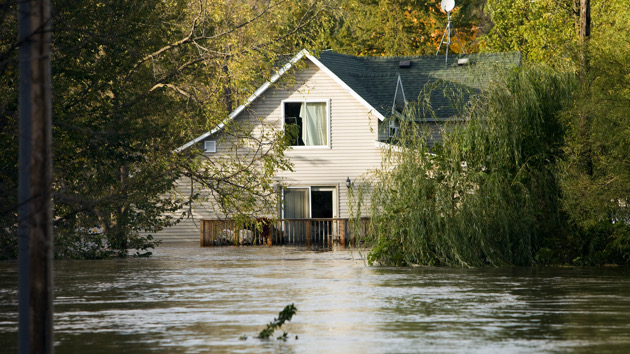
(NEW YORK) — “A lot of people” remain unaccounted for amid devastating flooding in Kentucky, Gov. Andy Beshear said Friday.
“We’re going to do our best to find them all,” Beshear said, without providing a number of the missing.
Beshear toured the devastation by helicopter on Friday and called it the worst flooding he’s seen since being in office.
The official death toll stands at 16, including two children.
Beshear said Friday afternoon that he’s learned of the recovery of four children’s bodies, adding, “We do not have an official update at this time as they have to be verified” by the Department for Public Health.
The governor anticipated that authorities may be updating the number of deceased for “several weeks.”
On Thursday, Beshear called it “one of the worst, most devastating” floods in the state’s history and said he anticipates this will be one of the deadliest floods in Kentucky in “a very long time.”
The flooding hit Kentucky late Wednesday, pounding the state with 2 to 5 inches of rain.
Kentucky is combating washed out roads, destroyed homes and flooded schools, according to the governor.
Thousands of residents are expected to lose their homes, he said.
More than 294 people have been rescued from floodwaters in eastern Kentucky so far and that number will likely rise, Beshear said.
The rain may return to Kentucky late Sunday through early next week, but significant rainfall isn’t expected.
“While rain totals are not expected to be as high, flooding still remains a concern due to saturated grounds,” the governor tweeted.
President Joe Biden approved a disaster declaration and is receiving updates “very regularly,” White House press secretary Karine Jean-Pierre said Friday.
“Our hearts break for the families of those who have lost their lives or are missing, and to all those who have been impacted,” she said.
ABC News’ Alexandra Faul, Kenton Gewecke, Josh Hoyos, Justin Ryan Gomez and Morgan Winsor contributed to this report.
(WASHINGTON) — Amid the latest COVID-19 resurgence sweeping the nation, some top health officials are asking Americans to wear face masks again in an effort to curb the spread of the virus.
Officials such as White House COVID-19 response coordinator Dr. Ashish Jha and Centers for Disease Control and Prevention Director Dr. Rochelle Walensky have repeatedly encouraged jurisdictions to use the CDC’s community level COVID-19 map, which seeks to identify the risk level of COVID-19 in communities across the country, to help them decide if they should reimplement mitigation measures.
“Local jurisdictions — cities, counties, states — should make decisions about mask mandates because communities are different and their patterns of transmission are different,” Jha told ABC News’ Martha Raddatz last week. “The CDC recommendation is that when you’re in a high zone … wearing masks indoors is really important and it really will make a difference.”
According to the CDC, a high community level suggests there is a “high potential for healthcare system strain” and a “high level of severe disease.”
More than 60% of Americans are now living in a county considered a “high” community level for COVID-19, where masking in indoor settings is therefore recommended by the CDC for all people, no matter their vaccination status.
But calls from the Biden administration’s COVID-19 team have been largely met with silence from local officials, with most cities and jurisdictions choosing to forgo federal guidance.
Although some cities, like Boston and New York City, have released strong recommendations, urging residents to mask again while indoors, no formal mandates have been announced.
In recent weeks, one major U.S. county — Los Angeles — was vocal about a possible return of masking requirements following a steady increase in COVID-19 infections.
However, on Thursday, county health officials announced that with case and hospital admission rates beginning to drop, the return of masking had been scratched.
“Any indication that the committee would soon be moving to the medium community level would be a good reason to not move forward with universal indoor masking, which is what we are doing today,” Barbara Ferrer, the director of Public Health for Los Angeles County, said at a press conference this week. “We will be pausing and not moving forward at this time … the clock is stopped at the moment.”
Some local officials lauded the decision, including L.A. County Supervisor Kathryn Barger.
“Unenforceable mandates don’t work,” Barger wrote in a statement following the health department’s announcement. “I’m hopeful that we will now be able to move on from this heightened focus on masking mandates to what really matters — focusing on promoting the efficacy of vaccines and boosters, improving access to COVID-19 treatments, and continuing to educate our county’s residents on the benefits of masking.”
Ferrer stressed that residents are still strongly encouraged to wear masks in many indoor settings and should the numbers begin to rise again, the county will revisit a possible mandate.
“[BA.5] remains highly infectious, so I would strongly advise that everyone keep their masks on when there’s risk for that spread,” Ferrer said. “We should be very careful.”
Despite public messaging that “COVID-19 is still with us,” no major states or cities have reintroduced formal mandates. Many Americans have returned to their normal lives without a second thought of pandemic restrictions — a reality that has troubled some health experts.
“I’m concerned about what the lack of restrictions looks like right now. The caseload, which is vastly undercounted, is already creeping up from an unacceptably high plateau of daily cases that has remained in place since the end of the original omicron wave,” Maureen Miller, professor of epidemiology at Columbia University’s Mailman School of Public Health, told ABC News.
Experts noted that although the U.S. is certainly in a different place now versus the start of the pandemic, periodic use of mitigation measures could still be a way to control the spread of the virus.
“Interventions shouldn’t be all or nothing. They need to be applied in real-time ahead of any surge to help limit transmission in the community and ultimately reduce severe consequences of the virus and limit hospital capacity,” explained John Brownstein, Ph.D., an epidemiologist at Boston Children’s Hospital and an ABC News contributor.
Policymakers and public health officials should “apply nuance” and “allow for the introduction of targeted intervention” as they consider possible ways to confront the “very likely” fall and winter surge, Brownstein said.
“Surveillance data, when interpreted correctly, should ultimately be the barometer for decisions on bringing back restrictions. Without proactive public health response, we will ultimately just repeat the mistakes of the past,” he added.
In recent weeks, virus-related hospitalizations and deaths have also started to tick up again, though not with the same intensity as previous surges.
“Clearly the lack of current interventions are contributing to a BA.5 surge,” Brownstein said. “While we are not seeing the level of severe disease of the past, it is still driving increases in severe disease.”
The reality that hundreds of Americans are still dying of COVID-19 every day is not something the public should take lightly, stressed Miller.
“COVID-19 infection is not just like a cold. No cold I know kills 400 people a day,” she said. “With the lack of COVID-19 information from health departments around the country and the blaring message that COVID-19 is over, it will be impossible to convince a fatigued and uninformed public of the need for additional mitigation measures.”
Although there are now many more treatments and tools available to treat Americans should they contract COVID, Miller noted that the simplest and effective tools that were available at the onset of the pandemic remain at the public’s disposal: masking and social distancing.
“We experienced the success of this approach in the past. I am doubtful that we will do so in the future,” she said.
The decision not to enforce mitigation measures will only prolong the pandemic, Miller said.
“Our actions are ensuring that the pandemic phase of COVID-19 will last much longer than it has to,” Miller added.
(WASHINGTON) — The Biden administration is preparing to roll out 171 million newly formulated vaccines this September as part of a $5B effort aimed at trying to blunt the impact of the highly contagious omicron variant.
The effort follows an internal debate among President Joe Biden’s top officials on whether to allow younger Americans to get a fourth shot now or wait until a more effective vaccine is released this fall.
The current vaccine was designed to work against the original strain of COVID. And while it continues to dramatically reduce the risk of hospitalizations and death, its effectiveness has slowly waned as the virus mutated.
As a result, Americans over 50 have already been told to get second booster doses, while younger Americans have been directed to get one additional booster.
Moderna and Pfizer say they now have new formulas of the COVID vaccine that will hopefully hold up better against the omicron variant.
Federal regulators would still need to sign off on the new vaccines. But industry and government officials say they are hopeful Food and Drug Administration will authorize the shots and that the Centers for Disease Control and Prevention will recommend them.
According to two administration officials, who spoke on condition of anonymity because they were not authorized to speak publicly, industry officials assured the government that it could deliver the newly formulated shots by September.
At that point, the officials said, the decision was made to hold off on a nationwide rollout of additional boosters for people under age 50.
Overall, the government now has the option to buy 600 million new vaccines that are targeted toward the omicron variant, with plans to deliver 171 million this fall.
Moderna and the government announced Friday a $1.74 billion contract for the manufacture and delivery of 66 million doses and the option to buy another 234 million doses later on.
The government had already agreed to pay $3.2 billion to Pfizer for 105 million doses this fall with the option to buy another 195 million doses later on.
The Biden administration says it’s moved $10 billion around in its current budget to cover the cost of these vaccines and other treatments.
But officials warn that there is a trade-off being made to buy these vaccines so Americans can get them cost-free even without insurance.
According to a statement provided by the Department of Health and Human Services, money has been moved away from testing and ensuring stockpiles of protective gear are ready to go ahead of another pandemic or surge in cases.
(WASHINGTON) — House Democrats will vote Friday on a bill to ban assault weapons in the U.S.
Speaker Nancy Pelosi, D-Calif., announced the vote in a letter to colleagues on Friday morning, calling the legislation “a crucial step in our ongoing fight against the deadly epidemic of gun violence in our nation.”
Pelosi urged colleagues to vote for same-day authority — a procedural hurdle that requires a separate vote — in order to fast-track the bill Friday afternoon.
The bill comes roughly two decades after Congress allowed such restrictions to lapse.
“I’m excited today because for a long time now I had wanted to reinstate the assault weapons ban,” Pelosi said in her weekly press conference ahead of the vote. “You weren’t here, maybe weren’t even born when we did this in the 90s. It was hard but it happened, and it saved lives. And I’m looking forward to having a good passage of it this afternoon.”
President Joe Biden and gun control advocates renewed calls to outlaw weapons like AR-15 rifles in the wake of recent mass shootings in Buffalo, New York; Uvalde, Texas and Highland Park, Illinois.
Highland Park Mayor Nancy Rotering pleaded with lawmakers just last week to ban such weapons, stating she will be “haunted forever” after a shooter opened fire during the city’s Fourth of July parade, killing seven people.
Congress passed its first major piece of gun reform in 30 years in June, which enhanced background checks for potential gun buyers under the age of 21 and included money for red flag laws and mental health services. But the measure fell short of what Biden and Democrats hoped to enact.
Leading gun manufacturing executives who testified before lawmakers on Wednesday maintained that people, not firearms, cause mass shootings.
“I hope the American people are paying attention today. It is clear that gun-makers are not going to change unless Congress forces them to finally put people over profits,” Rep. Carolyn Maloney, the chair of the House Oversight Committee, said during the hearing.
House Democrats originally planned on including a ban on assault weapons in a broader public safety package, but division within the caucus has delayed leadership’s efforts to bring the package to the floor before the August recess.
Pelosi said Friday that work continues on the other policing measures, including legislation to create new federal grant programs for local police departments.
“House Democrats are committed to building safer communities, in every corner of the country,” she wrote. “To that end, our Members have been working on a robust package of public safety bills and have made immense progress in our discussions.”
While the assault weapons ban may clear the House, such legislation is not likely to advance in the Senate, where Democrats would need at least 10 Republican votes to overcome the filibuster.
(LAS VEGAS) — The city of Las Vegas has declared an emergency over its water supply after the Calf Canyon-Hermits Peak Fire, the largest wildfire in New Mexico history, contaminated the Gallinas River. The city relies solely on water from the river, which has been tainted with large amounts of fire-related debris and ash, according to city officials.
The city is currently relying on reservoirs which, at the current consumption rate, contain less than 50 days worth of stored water, according to Las Vegas Mayor Louie Trujillo.
The large amounts of ash and turbidity in the river have prevented the city from being able to pull water from it, as the city’s municipal water treatment facility is not able to treat water, according to the mayor.
The Hermit’s Peak Fire and Calf Canyon Fire merged on April 27. By May 2, the blaze had grown in size and caused evacuations in multiple villages and communities in San Miguel County and Mora County.
President Joe Biden issued a major disaster declarations for the New Mexico counties of Colfax, Mora and San Miguel on May 4.
The fire resulted in the loss of federal, state, local, tribal and private property including thousands of acres of the watershed for the Gallinas River, the primary source of municipal water for the city and surrounding areas, according to the emergency declaration.
The Gallinas River has resulted in thousands of acres of scorched forest, flooding, ash and fire debris.
(NEW YORK) — Russian President Vladimir Putin’s “special military operation” into neighboring Ukraine began on Feb. 24, with Russian forces invading from Belarus, to the north, and Russia, to the east. Ukrainian troops have offered “stiff resistance,” according to U.S. officials.
The Russian military has since launched a full-scale ground offensive in eastern Ukraine’s disputed Donbas region, capturing the strategic port city of Mariupol and securing a coastal corridor to the Moscow-annexed Crimean Peninsula.
Here’s how the news is developing. All times Eastern:
Jul 29, 1:17 PM EDT
Blinken speaks with Lavrov, pushes him to accept ‘substantial proposal’ from US
Secretary of State Antony Blinken said he spoke with Russian Foreign Minister Sergey Lavrov on Friday. Blinken said he pushed Lavrov to accept the “substantial proposal” the U.S. put forth to free detained Americans Brittney Griner and Paul Whelan.
This marked the first time the two leaders spoke since the war began.
White House spokesperson John Kirby said Friday, “We very much tried to keep details of the negotiations of this nature as private as possible so that we can allow as much space for negotiators to come to a successful conclusion. We felt that in the context of what was happening in both Brittney Griner and Paul Whelan’s cases, as well as what was not happening, that it was important to lay out publicly that there was, in fact, a serious offer made by the American side that has not been acted on.”
Jul 29, 8:28 AM EDT
US ambassador to Ukraine speaks to ABC News as grain ships prepare to leave
U.S. Ambassador to Ukraine Bridget Brink told ABC News on Friday morning that she is “optimistic” ships carrying grain will begin leaving Ukraine this weekend, but that it’s up to Russia to keep its side of the deal.
During an interview in the Ukrainian port city of Odesa, Brink told ABC News there is currently “no obstacle” to the ships’ departure.
“Ukraine is ready to ship this grain, but it’s also up to Russia to agree on the grain corridor and the ships will be ready to go,” Brink said. “It can be done, it should be done and, in fact, it must be done.”
She declined to say whether the United States would impose consequences on Russia if it disrupted the United Nations-brokered deal or attacked the ships. But she underlined her country’s support for Ukraine and the deal, saying it was important that Ukrainian grain starts reaching countries that need it.
“Twenty-four hours after the deal was agreed a week ago today, Russia bombed this very port where we’re standing,” Brink noted. “So I think it’s imperative on Russia to live up to its commitments and to implement the agreement it signed onto, and imperative on all of us to ensure that Russia lives up to those commitments.”
When asked if there was a “Plan B” if the deal failed, Brink said the focus was on doing everything to ensure “Plan A” works.
Earlier Friday, Brink and ambassadors of other G-7 countries held a press conference in Odesa while overseeing the preparations. She told reporters that she hopes an agreement confirming the safe corridors of the grain ships to sail through this weekend would be reached. Under the deal, Ukraine and Russia have been negotiating the precise routes the vessels will take across the Black Sea.
Since Russian forces invaded neighboring Ukraine on Feb. 24, the cost of grain has skyrocketed worldwide. Russia and Ukraine — often referred to collectively as Europe’s breadbasket — produce a third of the global supply of wheat and barley, but Kyiv has been unable to ship exports due to Moscow’s offensive. Last month, the Ukrainian Grain Association warned that Ukraine’s wheat harvest is expected to plummet by 40%.
In recent weeks, there has been an all-out push from the U.S. and the U.N. to facilitate exports from war-torn Ukraine, desperate to offset what they foretell is a looming global food crisis with the potential to devastate the developing world. A Russian blockade in the Black Sea, along with Ukrainian naval mines, have made exporting siloed grain and other foodstuffs virtually impossible and, as a result, millions of people around the world — particularly in Africa and the Middle East — are now on the brink of famine.
Jul 29, 7:11 AM EDT
Ukraine says 1st grain ships should leave this weekend
Ukraine announced Friday that it hopes the first ships carrying grain will finally be leaving two ports this weekend under a United Nations-brokered deal to end Russia’s blockade.
The departure of the first ships will be a major test of whether the deal with Moscow will hold and Ukrainian food can begin to ease the global hunger crisis worsened by the blockade amid Russia’s war.
Ukrainian Minister of Infrastructure Oleksander Kubrakov, who is overseeing the operation, told reporters in Odesa on Friday morning that the port as well as the nearby Chernomorsk port are prepared to begin, with 17 ships already loaded with grain.
A final agreement mediated by the U.N. and Turkey needs to be signed off on the routes the vessels will take out of the heavily mined ports. Kubrakov said Ukraine had provided a number of options and that, from its side, the country is ready. Ukraine is waiting for the U.N. to confirm the routes are accepted by both sides.
Kubrakov said the first ships should leave by the end of the weekend.
Ukrainian President Volodymyr Zelenskyy was also in Odesa on Friday morning to see the preparations and meet with Kubrakov as well as other officials, including U.S. Ambassador to Ukraine Bridget Brink.
-ABC News’ Patrick Reevell
Jul 27, 2:51 PM EDT
Blinken and Lavrov to discuss US proposal to free Griner and Whelan
Secretary of State Antony Blinken said he plans to speak with Russian Foreign Minister Sergey Lavrov in the coming days, marking the first time the two leaders will speak since the war began.
Blinken said a critical topic of discussion would be securing the freedom of detained Americans Paul Whelan and Brittney Griner, revealing that the U.S. has already put forward a plan to accomplish that.
“We put a substantial proposal on the table weeks ago to facilitate their release. Our governments have communicated repeatedly and directly on that proposal, and I’ll use the conversation to follow up personally and I hope move us toward a resolution,” Blinken said.
“I can’t and won’t get into any of the details of what we’ve proposed to the Russians over the course of some many weeks now,” Blinken said.
Blinken said President Joe Biden played an active role in crafting the proposal for Griner and Whelan.
Blinken also stressed, “My call with Foreign Minister Lavrov will not be a negotiation about Ukraine,” adding, “Any negotiation regarding Ukraine is for its government and people to determine.”
-ABC News’ Shannon Crawford
Jul 27, 9:32 AM EDT
Ukraine uses US rocket system to strike key bridge in Russia-held Kherson
Ukrainian forces struck a strategic bridge in the Russian-occupied city of Kherson early Wednesday, according to local officials.
High-precision missile strikes by the Ukrainian military damaged the Antonivskiy bridge, forcing the occupied authorities to close the structure to civilian traffic. The mile-long bridge across the Dnieper River is an essential artery used by Moscow to supply its troops occupying southern Ukraine.
“Strikes were delivered on the bridge, on its road. The bridge is currently closed to the civilian population,” Kirill Stremousov, the deputy head of the Moscow-appointed administration for the Kherson region, told local media on Wednesday.
The bridge’s pillars and spans were still intact as of Wednesday morning, according to Stremousov.
“It is simply that the number of holes on the road has increased. The strike on the bridge has affected only the civilian population,” he added.
According to Stremousov, Ukrainian forces hit the bridge with High Mobility Artillery Rocket Systems (HIMARS) supplied by the United States. He said ferry crossings across the Dnieper River will be organized during the bridge’s restoration, and that traffic will resume in the near future.
“We have prepared a pontoon bridge. We have a ferry link,” he told local media.
Earlier on Wednesday, Ukrainian military officials said the number of Russian soldiers killed in the war has surpassed 40,000, just more than five months after Russia launched its invasion of neighboring Ukraine in late February.
-ABC News’ Edward Szekeres, Yulia Drozd, Max Uzol and Yuriy Zaliznyak
(NEW YORK) — Russian President Vladimir Putin’s “special military operation” into neighboring Ukraine began on Feb. 24, with Russian forces invading from Belarus, to the north, and Russia, to the east. Ukrainian troops have offered “stiff resistance,” according to U.S. officials.
The Russian military has since launched a full-scale ground offensive in eastern Ukraine’s disputed Donbas region, capturing the strategic port city of Mariupol and securing a coastal corridor to the Moscow-annexed Crimean Peninsula.
Here’s how the news is developing. All times Eastern:
Jul 29, 8:28 AM EDT
US ambassador to Ukraine speaks to ABC News as grain ships prepare to leave
U.S. Ambassador to Ukraine Bridget Brink told ABC News on Friday morning that she is “optimistic” ships carrying grain will begin leaving Ukraine this weekend, but that it’s up to Russia to keep its side of the deal.
During an interview in the Ukrainian port city of Odesa, Brink told ABC News there is currently “no obstacle” to the ships’ departure.
“Ukraine is ready to ship this grain, but it’s also up to Russia to agree on the grain corridor and the ships will be ready to go,” Brink said. “It can be done, it should be done and, in fact, it must be done.”
She declined to say whether the United States would impose consequences on Russia if it disrupted the United Nations-brokered deal or attacked the ships. But she underlined her country’s support for Ukraine and the deal, saying it was important that Ukrainian grain starts reaching countries that need it.
“Twenty-four hours after the deal was agreed a week ago today, Russia bombed this very port where we’re standing,” Brink noted. “So I think it’s imperative on Russia to live up to its commitments and to implement the agreement it signed onto, and imperative on all of us to ensure that Russia lives up to those commitments.”
When asked if there was a “Plan B” if the deal failed, Brink said the focus was on doing everything to ensure “Plan A” works.
Earlier Friday, Brink and ambassadors of other G-7 countries held a press conference in Odesa while overseeing the preparations. She told reporters that she hopes an agreement confirming the safe corridors of the grain ships to sail through this weekend would be reached. Under the deal, Ukraine and Russia have been negotiating the precise routes the vessels will take across the Black Sea.
Since Russian forces invaded neighboring Ukraine on Feb. 24, the cost of grain has skyrocketed worldwide. Russia and Ukraine — often referred to collectively as Europe’s breadbasket — produce a third of the global supply of wheat and barley, but Kyiv has been unable to ship exports due to Moscow’s offensive. Last month, the Ukrainian Grain Association warned that Ukraine’s wheat harvest is expected to plummet by 40%.
In recent weeks, there has been an all-out push from the U.S. and the U.N. to facilitate exports from war-torn Ukraine, desperate to offset what they foretell is a looming global food crisis with the potential to devastate the developing world. A Russian blockade in the Black Sea, along with Ukrainian naval mines, have made exporting siloed grain and other foodstuffs virtually impossible and, as a result, millions of people around the world — particularly in Africa and the Middle East — are now on the brink of famine.
Jul 29, 7:11 AM EDT
Ukraine says 1st grain ships should leave this weekend
Ukraine announced Friday that it hopes the first ships carrying grain will finally be leaving two ports this weekend under a United Nations-brokered deal to end Russia’s blockade.
The departure of the first ships will be a major test of whether the deal with Moscow will hold and Ukrainian food can begin to ease the global hunger crisis worsened by the blockade amid Russia’s war.
Ukrainian Minister of Infrastructure Oleksander Kubrakov, who is overseeing the operation, told reporters in Odesa on Friday morning that the port as well as the nearby Chernomorsk port are prepared to begin, with 17 ships already loaded with grain.
A final agreement mediated by the U.N. and Turkey needs to be signed off on the routes the vessels will take out of the heavily mined ports. Kubrakov said Ukraine had provided a number of options and that, from its side, the country is ready. Ukraine is waiting for the U.N. to confirm the routes are accepted by both sides.
Kubrakov said the first ships should leave by the end of the weekend.
Ukrainian President Volodymyr Zelenskyy was also in Odesa on Friday morning to see the preparations and meet with Kubrakov as well as other officials, including U.S. Ambassador to Ukraine Bridget Brink.
-ABC News’ Patrick Reevell
Jul 27, 2:51 PM EDT
Blinken and Lavrov to discuss US proposal to free Griner and Whelan
Secretary of State Antony Blinken said he plans to speak with Russian Foreign Minister Sergey Lavrov in the coming days, marking the first time the two leaders will speak since the war began.
Blinken said a critical topic of discussion would be securing the freedom of detained Americans Paul Whelan and Brittney Griner, revealing that the U.S. has already put forward a plan to accomplish that.
“We put a substantial proposal on the table weeks ago to facilitate their release. Our governments have communicated repeatedly and directly on that proposal, and I’ll use the conversation to follow up personally and I hope move us toward a resolution,” Blinken said.
“I can’t and won’t get into any of the details of what we’ve proposed to the Russians over the course of some many weeks now,” Blinken said.
Blinken said President Joe Biden played an active role in crafting the proposal for Griner and Whelan.
Blinken also stressed, “My call with Foreign Minister Lavrov will not be a negotiation about Ukraine,” adding, “Any negotiation regarding Ukraine is for its government and people to determine.”
-ABC News’ Shannon Crawford
Jul 27, 9:32 AM EDT
Ukraine uses US rocket system to strike key bridge in Russia-held Kherson
Ukrainian forces struck a strategic bridge in the Russian-occupied city of Kherson early Wednesday, according to local officials.
High-precision missile strikes by the Ukrainian military damaged the Antonivskiy bridge, forcing the occupied authorities to close the structure to civilian traffic. The mile-long bridge across the Dnieper River is an essential artery used by Moscow to supply its troops occupying southern Ukraine.
“Strikes were delivered on the bridge, on its road. The bridge is currently closed to the civilian population,” Kirill Stremousov, the deputy head of the Moscow-appointed administration for the Kherson region, told local media on Wednesday.
The bridge’s pillars and spans were still intact as of Wednesday morning, according to Stremousov.
“It is simply that the number of holes on the road has increased. The strike on the bridge has affected only the civilian population,” he added.
According to Stremousov, Ukrainian forces hit the bridge with High Mobility Artillery Rocket Systems (HIMARS) supplied by the United States. He said ferry crossings across the Dnieper River will be organized during the bridge’s restoration, and that traffic will resume in the near future.
“We have prepared a pontoon bridge. We have a ferry link,” he told local media.
Earlier on Wednesday, Ukrainian military officials said the number of Russian soldiers killed in the war has surpassed 40,000, just more than five months after Russia launched its invasion of neighboring Ukraine in late February.
-ABC News’ Edward Szekeres, Yulia Drozd, Max Uzol and Yuriy Zaliznyak
(NEW YORK) — Global conservation efforts to save tigers have far exceeded expectations, according to experts. There have, however, also been unintended consequences.
Nepalese Prime Minister Sher Bahadur Deuba announced Friday, on International Tiger Day, that the number of tigers in the country has increased 290% since 2009. The revelation surpasses the joint target set by the government and conservationists, Narendra Pradhan, the Nepal program coordinator for the International Union for Conservation of Nature, told ABC News.
Nepal, a landlocked Asian country nestled in the Himalayan Mountains, is one of 13 countries that committed to doubling its tiger population during a 2010 international tiger summit in Saint Petersburg, Russia.
But as the number of tigers in Nepal continues to grow, so does the conflict between tigers and their human neighbors.
In the last year, tigers have killed three people every month on average, according to Nepalese officials.
Very few of these attacks involve “problem tigers” that venture from the forests and national parks to attack humans and livestock, Mayukh Chatterjee, field program manager for the Chester Zoo in the U.K. and a member of the IUCN’s Human-Wildlife Conflict & Coexistence Specialist Group, told ABC News. Many Nepalese live in subsistence farming communities and the majority of the attacks occur when they are foraging, Smriti Dahal, program coordinator for the World Wildlife Fund’s Tigers Alive Initiative and a native of Nepal, told ABC News.
Sometimes the attacks occur when the farmers bring their livestock, such as goats and cows, to the forest because they are unable to collect enough fodder, Dahal said.
Tigers are elusive and shy, Pradhan said, adding that the attacks likely occur when they feel startled or threatened.
Part of the reason why tigers have flourished in countries like Nepal, India, Bhutan, Bangladesh and Sri Lanka is because these cultures revere big cats, experts said. Other Southeast Asian countries, such as Cambodia, Laos and Vietnam, have continued to see a decline or even total extinction of tigers.
India is also seeing an increase of human-tiger conflict as a result of the soaring numbers, Chatterjee said.
In his address on Friday, Deuba stressed the necessity for more strategic methods of tiger habitat management due to the conflict, which he said is taking place in the absence of adequate food and water.
Communities in tiger countries are rapidly changing as development continues and people move around geographically, Dahal said. As humans produce more food to fulfill growing populations, tigers and humans will begin to share more space.
While conservationists are pleased with their efforts, the focus is now on educating locals on safety and getting them involved in conservation efforts, Chatterjee said.
In addition, partners in the tiger initiative will need to monitor and perhaps slow the growth in some populations. Tigers are “very prolific breeders” and not much thought was given a decade ago to how tigers would peacefully coexist with an ever-growing human population, Chatterjee said.
Further growth in tiger populations will only lead to more human-tiger conflicts as the number of individual tigers move out of the secure conservation lands, Chatterjee said.
Communities are aware and support the tiger conservation work, Pradhan said. But partners in the tiger initiative will need to be mindful of the conflict, because as humans continue to lose their livestock and even their lives, resentment toward the big cats could begin, Chatterjee said.
“We don’t want that social tolerance to go down one day and people start killing because they’ve reached a limit where they cannot live with tigers,” Dahal said.
(NEW YORK) — At least 16 people have been killed amid devastating flooding in Kentucky, Gov. Andy Beshear said Friday, and he expects that number to “get a lot higher.”
Among those killed was an 81-year-old woman, according to the governor.
On Thursday, Beshear called it “one of the worst, most devastating” floods in the state’s history, and said he anticipates this will be one of the deadliest floods in Kentucky in “a very long time.”
A flash flood emergency was issued in Kentucky late Wednesday as 2 to 5 inches of rain pounded the Bluegrass State.
As of Friday morning, central and eastern Kentucky remain under a flood watch, according to Beshear. An additional 2 to 4 inches of rain is expected in eastern Kentucky through Monday.
For some areas, the water will not crest until Saturday, the governor said.
“While rain totals are not expected to be as high, flooding still remains a concern due to saturated grounds,” the governor tweeted.
The state is combating washed out roads, destroyed homes and flooded schools, according to Beshear.
“Hundreds” have been rescued by boat and many people remain stranded, Beshear said Friday.
Hundreds of residents are expected to lose their homes and it’ll likely take families years to recover and rebuild, he said.
Three of Kentucky’s state parks are being opened to people who have lost their homes, according to the governor.
President Joe Biden on Friday approved a disaster declaration for Kentucky.
Craig Hudson for The Washington Post via Getty Images
(WASHINGTON) — Despite Wednesday’s news of a potential billion-dollar Senate climate deal, environmental activists still appeared at Thursday night’s annual Congressional Baseball Game in the hope that President Joe Biden and congressional Democrats will follow through on their climate promises, though at a much smaller scale than anticipated.
U.S. Capitol Police and Washington’s Metropolitan Police Department said earlier this week that they were aware of potentially hundreds of protesters and would have an increased presence in the area of Nationals Park, where the century-old charity event is taking place.
The climate activists want Democrats to immediately pass the newly announced energy investments — brokered, per a late Wednesday announcement, between West Virginia Sen. Joe Manchin and Majority Leader Chuck Schumer as part of another spending bill via reconciliation — and for Biden to declare a climate emergency.
The protest was planned as anger mounted against Manchin, one of the most conservative Democrats in the 50-50 Senate who earlier this month seemingly closed the door on climate negotiations in the next spending package, saying he could not support the environmental provisions of Democrats’ bill because of historic inflation.
“Hopeful that both actions can be taken swiftly, activists will continue pushing until Democrats’ climate promises are signed, sealed, and delivered,” Now Or Never, the group of climate organizations organizing Thursday’s protest, said in a statement.
A spokesperson for the Chesapeake Climate Action Network, a Now Or Never member, said the group was “very surprised” at the successful climate negotiations.
“We didn’t anticipate that announcement to happen at that hour,” Quentin Scott told ABC News. “We’re very encouraged by what the Senate and President Biden announced last night, and we support those negotiations. And so far, the text looks pretty solid, but not perfect.”
Scott and Chesapeake Climate Action Network decided a few hours before the baseball game that they would not be protesting. Another Now Or Never spokesperson said the demonstration would be “significantly different” after the announcement of climate provisions advancing in the spending bill.
On Wednesday, more than 300 people had registered to attend the protest. Upwards of 75 were seen gathered after the start of the game.
“We have decided not to protest tonight’s Congressional Baseball Game. Congressional leaders have declared they intend to meet many of our climate and justice demands, so we’ll be attending the game tonight just to urge Congress to seal the deal and to ask Joe Biden to still declare a climate emergency,” Chesapeake Climate Action Network Director Mike Tidwell said in a statement.
If passed, the Manchin and Schumer agreement, known as the Inflation Reduction Act, would be perhaps the largest clean energy package in U.S. history. Senate Democrats hope to approve it before the August recess begins next week — a daunting time-crunch, given other pressures.
The climate bill, which also includes major health care and corporate tax provisions, would spend about $370 billion for climate and energy programs over the next 10 years, such as using tax credits to incentivize consumers to buy electric cars, fund the domestic manufacturing of batteries and solar panels and allocate spending for other environmental initiatives.
“We’re really happy with this $60 billion in environmental justice priorities. We’re really happy with the $9 billion … rebates for homes. And we’re also very happy with the tax credits for used and new electric vehicles,” said Scott, the Chesapeake Climate Action Network spokesperson. “But,” he added, “we also recognize the things that are not perfect about the deal, we’re going to continue to fight.”
Thursday’s event organizers had warned that if Congress did not act on climate legislation by Sept. 30, they were planning a separate, “highly disruptive, mass direct action that fundamentally disrupts business-as-usual in D.C.”
“If Congress passes the deal that they announced yesterday, then it’s very unlikely that we will go ahead with a future action. But we also reserve the right to come back if somehow this deal falls apart and actually carry through those escalated actions,” Scott told ABC news.
District police said in a statement they were aware of potential protests and would have an increased presence in the area “to ensure the safety and security of the event.”
U.S. Capitol Police Chief Tom Manger wrote on Twitter on Wednesday that his officers had a “robust security plan in place” for the game.
“We are aware that demonstrators are planning to protest political issues at the Congressional Baseball Game for Charity. Our mission is to protect the Members of Congress during this family event, so we have a robust security plan in place,” Manger wrote.
“We urge anyone who is thinking about causing trouble at the charity game to stay home,” he wrote. “We will not tolerate violence or any unlawful behavior during this family event.”
Thursday’s demonstration also comes after the arrest of six congressional staff members for sitting in the office of Senate Majority Leader Schumer, urging him to keep negotiating on the climate provisions that were later revived with Manchin.
“Our first demand was to reopen climate negotiations which were considered dead for July — and they did!” he said. “So it is a big big win, now we need to fight to improve the policy and fight to pass it.”
The Congressional Baseball Game is a bipartisan tradition dating back to 1909, with proceeds supporting D.C.-area charities. The annual game has been under threat before. In 2017, at a practice for Republican lawmakers, then-House Majority Whip Steve Scalise, R-La., and Capitol Police officer Crystal Griner were shot.