
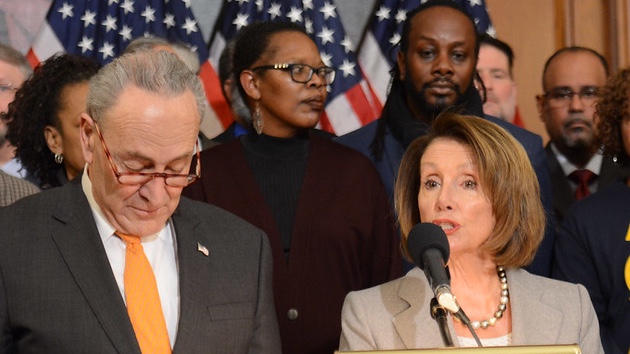
Schumer, Pelosi announce ‘framework’ to pay for $3.5T infrastructure bill

Schumer, Pelosi announce ‘framework’ to pay for .5T infrastructure bill
Flickr

(WASHINGTON) — Democratic House and Senate leaders on Thursday announced they and the White House have reached agreement on a “framework” that will pay for most, if not all, of the massive $3.5 trillion human infrastructure bill — a move meant to mitigate concerns from moderate and centrist Democrats opposed to the hefty price tag.

But the leaders provided very little details on the framework a day after President Joe Biden met with Democratic leaders, moderates and progressives at the White House in an effort to save his agenda from Democratic infighting.House Speaker Nancy Pelosi also did not provide a clear outline about when the reconciliation bill will be ready for a vote.

She also did not commit to putting the bipartisan infrastructure bill on the floor for a vote next Monday, which she had promised moderates would happen.

Pelosi was joined by Senate Majority Leader Chuck Schumer and Treasury Secretary Janet Yellen at her weekly press conference, as Democrats also face a looming possible government shutdown on Oct. 1 and still need to deal with the debt ceiling, which Republicans will not support.

“The White House, the House and the Senate have reached agreement on a framework that will pay for any final negotiated agreement. So, the revenue side of this, we have an agreement on,” Schumer told reporters.

“We know that we can cover the provisions the president has put forward,” Pelosi added. “It’s all good.”

This announcement is meant to provide some relief to those moderate, centrist Democrats like Sens. Joe Manchin and Kyrsten Sinema, who do not support that $3.5 trillion number.

But Pelosi and Schumer provided very little on actual details. As of right now, leaders are no closer to having a reconciliation bill — which means the fate of the bipartisan infrastructure bill hangs in the balance.

“We came to terms as to a framework of an array of agreements that we have, depending on what the need is. Now at the same time, we’re finalizing on the outlay side, so if we need more, we need less — that will impact the choices we make there,” Pelosi said.

Pelosi also did not commit to putting the bipartisan infrastructure bill that has already passed in the Senate on the floor next week.

“We take it one day at time,” Pelosi told reporters. “I am confident that we will pass both bills.”

Pelosi also did not make clear if $3.5 trillion will remain the topline, or if that figure could change and drop lower.

“This is not about price tag. This is about what is in the bill,” Pelosi said.

Following the press conference, reporters caught up with Pelosi and pressed for more details on the framework.

When reporters suggested they had too few details, Pelosi responded, “well that’s your problem, not mine.”

Following the press conference, many senators close to the negotiation table say they are in the dark about the new framework agreement.

Senate Budget Committee Chairman Bernie Sanders said he has “no idea” what the agreement is. He told reporters he hopes to be briefed on it soon “if there is a framework.”

“We’ve been through this a million times. There are many many approaches as to how you can raise money in a fair and progressive way and raise at least 3.5 trillion dollars,” Sanders said. “If that’s what the menu is there is nothing then nothing particularly new I think.”

Sen. Mark Warner, a moderate Democrat on the Budget committee who has been intimately involved in negotiations with the president on the reconciliation plan told reporters he has not the “foggiest idea” what is in the framework.

Warner told reporters he was “as interested in getting those details as you are.”

Senate Finance Committee Chair Ron Wyden, D-Ore., said he was in meetings over the framework, but declined to give many details about what was discussed or decided upon.

“It went right to the heart of what we need in terms of tax fairness in America and that’s where we are this morning,” Wyden said while dodging questions about a topline or any agreed to “payfors.”

Senators said they expected to receive more information from leadership Thursday on what the framework is.

Democratic leaders also have to contend with a potential shutdown on Oct. 1, but Pelosi insisted a shutdown would be avoided.

Pelosi told reporters Republicans could cave on raising the debt ceiling because “public sentiment is everything.”

But she indicated that both chambers will do everything they can to keep the government open via a so-called “continuing resolution” that maintains current funding levels, which may mean they will have to deal with the debt ceiling at a later time.

“We will keep the government open by September 30 … and continue the conversation about the debt ceiling. Whatever it is, we will have a CR that passes both houses by September 30,” Pelosi said.

Copyright © 2021, ABC Audio. All rights reserved.

Shawn Mendes’ Wonder: The World Tour to hit North America June of 2022

Shawn Mendes’ Wonder: The World Tour to hit North America June of 2022
Island Records

After promising to announce his tour, Shawn Mendes has done just that.

Shawn’s Wonder: The World Tour will get underway in the U.K. and Europe in March of 2022, with opening act King Princess.  The tour arrives in North America on June 27, 2022 with opening act Dermot Kennedy through an August date in Brooklyn, NY, and then Tate McRae takes over on the second leg, which starts September 7 in Arizona.

The tour is currently set to conclude October 26, 2022 in Newark, NJ.  It’s Shawn’s first trek since the release of his most recent album, Wonder.

The public onsale date for the North American tour starts October 7 at 10 a.m. local time, though there are American Express and Fan presales prior to that.  All the details and tour dates are available at WondertheTour.com.

American Express card members will be able to access tickets in a special front-of-stage pit, and also purchase tickets that include limited edition merchandise, while supplies last.

More tour dates for other regions will be announced soon.


A post shared by Shawn Mendes (@shawnmendes)

Copyright © 2021, ABC Audio. All rights reserved.

Fugees reunite for first concert in 15 years

Fugees reunite for first concert in 15 years
Live Nation

Fugees kicked off their reunion tour Wednesday night with a free concert in New York City for fans who earned tickets for their humanitarian work.

The show at Pier 17 in Manhattan was part of the Global Citizen Live global series of concerts, which will continue with numerous stars performing around the world on Saturday, September 25. Fans received tickets through the Global Citizen website by taking action to end the hunger crisis and protect the planet

Ms. Lauryn Hill, Wyclef Jean and Pras Michel are celebrating the 25th anniversary of their landmark 1996  album, The Score. Accompanied by a live band, the trio kicked off Wednesday’s concert with the title song of the album, according to Billboard. The performance also featured “Ready or Not,” “Zealots,” “Killing Me Softly With His Song,” and “Fu-Gee-La.”

Hill discussed the group’s breakup following the release of The Score and explained that money and success caused the dissension. Then she asked the crowd to “respect the miracle” of them finally coming back together.

Wyclef, who was born in Haiti, addressed the migrant crisis in his country. He criticized President Biden for the way Haitian migrants are being treated.

The Fugees reunion tour will continue November 2 in Chicago and will make stops in Oakland, Los Angeles, Atlanta, Miami, Newark, and Washington, D.C. The group will then travel abroad to Paris, London, Nigeria and Ghana.

The Score has sold over 12 million copies and earned two Grammy Awards: Best Rap Album, and Best R&B Performance by a Duo or Group with Vocals, for “Killing Me Softly.”

Tickets for the Fugees tour go on sale Friday, September 24 at 10 a.m. local time on LiveNation.com.


A post shared by Wyclef Jean (@wyclefjean)

Copyright © 2021, ABC Audio. All rights reserved.

The Pretty Reckless earns seventh number-one Billboard single with Kim Thayil & Matt Cameron collaboration

The Pretty Reckless earns seventh number-one Billboard single with Kim Thayil & Matt Cameron collaboration
Courtesy Fearless Records

The Pretty Reckless‘ latest number-one Billboard hit features some hard-rocking friends.

“Only Love Can Save Me Now,” the current single from Taylor Momsen and company, has hit the top of Billboard‘s Mainstream Rock Airplay chart. The song features Soundgarden guitarist Kim Thayil and Matt Cameron, who now have their first number-one singles as “individually billed solo artists.”

Thayil and Cameron previously notched six number-one Mainstream Rock Airplay hits as members of Soundgarden. Fittingly, “Only Love Can Save Me Now” is The Pretty Reckless’ seventh leader on that particular chart, breaking a tie with one of Momsen’s musical heroes.

“Only Love Can Save Me Now” is featured on the new Pretty Reckless album Death by Rock and Roll, which dropped in February. Both of the record’s previous two singles, the title track and the Tom Morello-featuring “And So It Went,” also hit number one on Mainstream Rock Airplay.

Copyright © 2021, ABC Audio. All rights reserved.

The Rolling Stones share details about new US tour, which kicks off this Sunday

The Rolling Stones share details about new US tour, which kicks off this Sunday
Credit: J.Bouquet

As The Rolling Stones prepare to launch the 2021 leg of their No Filter Tour this Sunday in St. Louis, the band’s main members have shared a new official interview in which they chat about plan for the trek — their first without longtime drummer Charlie Watts, who died on August 24 at age 80.

In the conversation, which was conducted by acclaimed rock journalist David Fricke, frontman Mick Jagger talks about how rehearsals have been going with Watts’ handpicked replacement, Steve Jordan.

“It’s gone well. We all knew [Steve], and I’d played with him before. He’s very respectful of Charlie,” Jagger says. “He played with Keith [Richards] before we started the rehearsals, and then he did homework, listening to the tunes. When we talk about what Charlie did on this one, we listen to the original record, and then we listen to the live versions. There’s certain licks that we want to do, that Charlie did.”

Jagger reveals that The Stones have rehearsed “80 to 90 songs” for the trek, adding, “We’ve got tons of numbers from most eras. So we have a big set list. We can certainly change up the set list.”

Richards reveals that among the songs the band will be playing are two of the bonus tracks from the group’s upcoming Tattoo You reissue — “Living in the Heart of Love” and a cover of The Chi-Lites‘ “Troubles A’ Comin'” — as well as the 2020 Stones single “Living in a Ghost Town” and the 1976 gem “Hand of Fate.”

Regarding how Jordan has been fitting in with the band, Keith notes, “Steve brings with him a lot of knowledge about the Stones. He’ll say, ‘No, Charlie plays like this.’ Steve is so meticulous, so aware of the seat he’s sitting in.”

Copyright © 2021, ABC Audio. All rights reserved.

‘Tiger King 2’ and more: Netflix introduces itself as “The Home of True Crime”

‘Tiger King 2’ and more: Netflix introduces itself as “The Home of True Crime”
Netflix

In a stylish new trailer, Netflix is revealing a series of upcoming documentaries, welcoming viewers to “The Home of True Crime.”

The trailer from the streaming service that launched the Emmy-winning Making a Murderer, and other true crime docs like Cocaine Cowboys, shows glimpses of sure-to-be bingeable titles, including a sequel to that pandemic smash Tiger King: Murder, Mayhem and Madness.

Here’s the lineup, and descriptions from Netflix: 

Tiger King 2 (debuting this year)

The Puppet Master: Hunting the Ultimate Conman — (January 2022)
“From the acclaimed filmmakers behind The Imposter, this three-part series tells the jaw-dropping story of one of the world’s most audacious conmen who was convicted in 2005 for stealing fortunes and destroying multiple lives. But now, in an incredible twist, the story reaches into the present day, with a desperate family who fear for their mother’s safety.”

The Tinder Swindler — (February 2022)
Centering on “a prolific conman who posed as a billionaire playboy on Tinder, and the women who set out to bring him down.”

Trust No One: The Hunt for the Crypto King — (2022)
“Follow a group of investors turned sleuths as they try to unlock the suspicious death of cryptocurrency multimillionaire Gerry Cotten and the missing $250 million they believe he stole from them.”

Bad Vegan — (2022)
“Celebrity restaurateur Sarma Melngailis becomes the ‘Vegan Fugitive’ when she’s conned out of millions by a man who convinces her that he can expand her food empire and make her beloved pit bull immortal — as long as she never questions his increasingly bizarre requests.”

Copyright © 2021, ABC Audio. All rights reserved.

Patina Miller explains why she loves the “challenge” of playing Raquel in ‘Raising Kanan’

Patina Miller explains why she loves the “challenge” of playing Raquel in ‘Raising Kanan’
Courtesy of Starz

Ahead of Sunday’s season finale of Raising Kanan, Tony Award winner Patina Miller is explaining why taking on the challenging role of Kanan’s mother Raquel has been a godsend for her as an actor.

“Raquel is so many different things,” Miller tells ABC Audio of the fierce and gritty character. “The opportunity to really dig deep, go dark, explore many different things was… exciting to me. And it wasn’t a hard thing.”

Miller, who came off of a six-year run on Madame Secretary as press secretary Daisy Grant, says jumping from a political drama to a crime drama wasn’t seamless, but thankfully she “loves a challenge.”

“I love being able to show different sides of my craft of what I can do,” Miller shares. “And I love being able to bring my experiences, the things that I know, to each character. And so this just really fit for me because I was able to call on a lot of my past experience to help inform who my character was.”

Miller, along with star Mekai Curtis, return Sunday, September 26 at 8 p.m. ET for the season finale of Starz’s Power Book III: Raising Kanan.

Copyright © 2021, ABC Audio. All rights reserved.

The Case For Believing In Michigan Football

The Case For Believing In Michigan Football
stevecoleimages/iStock

(MICHIGAN) —  Michigan football fans are not conditioned in their modern state to feel anything good. The sport so many of them live and die with has burned them too often over the past 20 years for many Wolverines fans to feel truly excited as the calendar flips from month to month in the fall.

This September has put these fans in a tough spot. Michigan football is off to a 3-0 start, and if you’ve watched the games or looked at the numbers, you know it’s been a crisp 3-0. The Wolverines have beaten Western Michigan, Washington and Northern Illinois by a combined 107 points, the largest cumulative margin of victory among Football Bowl Subdivision teams. Michigan was supposed to win all of these games, but there is winning and then there is covering the spread by nearly 19 points per game. Save for losing star receiver Ronnie Bell to a right knee injury for the year, it would be tough to imagine Jim Harbaugh having a smoother first three weeks of a season. 

Yet Michigan fans understand how this goes. Harbaugh was 18-3 in August and September since his takeover of the program in 2015 through last season (though there were no such games for the team in 2020). That was the seventh-best winning percentage in FBS in the season’s opening stretch during those years. The problem was October and November, months in which Harbaugh has gone 30-15 — a nice enough record for most teams but not nearly enough to get Michigan over the Big Ten East hump. Many are understandably circumspect about what lies in store for 2021.

Before we go further, it’s worth doing the necessary Michigan-related hedging. The Wolverines might fall apart and lose three to five games, as they’ve done several times in recent years. They might be great but fall short in their regular-season finale against Ohio State, which is now an annual bit of misery (save for 2020) no matter what’s happened up to that point. In short, Michigan could do what Michigan has done too many times before. These potential outcomes all point to fans shielding their hearts from vulnerability. Why get too serious with a team that has hurt you? But if Michigan fans can stomach it, they should let themselves live a little bit. Three games into 2021, there is no reason Michigan won’t have Harbaugh’s big breakthrough this year. 

In Harbaugh’s first six years, his offenses were good, but not great, and “good” does not win the Wolverines’ division, much less anything beyond that. From 2015 to 2020, Michigan was 19th in FBS in expected points added per game on offense, adjusted for opponent quality. The results varied a bit by year, but its most productive offense by far was in 2016, when Michigan came a J.T. Barrett fourth-down spot away from making the Big Ten Championship. That team produced an adjusted offensive EPA of 15.16 per game. That was the best college offense Harbaugh has ever fielded, save for the 2010 Stanford outfit that had Andrew Luck and various NFL pass-catchers and produced a figure of 20.19. 

The Wolverines have been unable to approach their 2016 level over the last four years. But this year, Michigan leads all of FBS in adjusted offensive EPA and is tracking, at this early date, to produce the most efficient offense by EPA of Harbaugh’s career. Adjusted EPA flattens out the results some, since it accounts for the competition level faced, which means the computers aren’t calling fraud on Michigan’s excellent start.

Along the same line, Michigan’s September success looks like a shift upward even when compared only with its previous nonconference schedules. In strictly regular-season, nonconference games in Harbaugh’s first six years, Michigan’s offense was a combined 44th in adjusted EPA per game. This year, Michigan is second. And again, that’s an opponent-adjusted stat, which suggests that Michigan’s leap can’t be chalked up totally to a schedule that lacks a team like Florida or Notre Dame, two recent season-opener foes for Harbaugh’s teams.

Harbaugh’s new starting quarterback, Cade McNamara, is outdoing his predecessors in a similar way. The junior, a former four-star recruit, threw for 10 yards per attempt in nonconference games and posted a 60.5 Total QBR. Both figures put him ahead of Harbaugh’s previous starting QBs in the same situations: Jake Rudock, Wilton Speight and Shea Patterson. And Michigan’s lead tailback, Blake Corum, has blown away Harbaugh’s previous primary running backs in both yards per attempt (8.5) and missed tackles generated per touch (0.3) against teams outside the Big Ten. In various offensive areas, Michigan is lapping its old self. 

On defense, the Wolverines are under new management this fall. First-year coordinator Mike Macdonald arrived in the offseason from the Baltimore Ravens, where he had worked since 2014 for Harbaugh’s brother, John. (Macdonald was going to be co-defensive coordinator with fellow new hire Maurice Linguist, but Linguist left to take the top job at Buffalo before the season.) Macdonald replaced Don Brown, who’d been Michigan’s defensive coordinator since 2016 and had a reputation for his infatuation with two things: blitzes and man coverage. During Brown’s time in charge, the Michigan defense played man-to-man coverages on 48 percent of opposing dropbacks, the ninth-highest rate in the country. (The average was 33 percent.) In front of all coverages, Michigan blitzed 12.6 times a game, 10th-most in FBS. So far in 2021, the Wolverines have kept playing a lot of man coverage, though less than before — 40.7 percent of the time, which still ranks ninth. Their blitzing has also eased up a bit, to 10.33 times per game (tied for 46th-most).

It’s a little early to know what shape Macdonald’s defense will take the rest of the way, but it looks like his plan is working. In nonconference, regular-season games under Brown, Michigan was fifth in adjusted defensive EPA per game. Under Macdonald, Michigan is 19th in the same situations — a step back overall, but not compared to Brown’s most recent work. There’s no way to make an apples-to-apples comparison from last year to this year because there were no nonconference Big Ten games last fall. But the early returns say Michigan’s defense has cleaned up a 2020 mess where the Wolverines finished the season an ugly 109th in adjusted defensive EPA per game overall. This year, Michigan is 16th, and its straightforward yards allowed per play are down at this point from 5.6 to 4.5. Even if the defense regresses significantly in Big Ten play, it looks like the bleeding from 2020 has slowed.

Michigan has played what looks like a light schedule, but it’s not that hard to look at it in the right light and see something decent. WMU beat Pitt, NIU beat a Georgia Tech team that is probably bad but almost beat Clemson, and Washington looked dysfunctional but has one of the more talented rosters in college football.1

Whatever you think of this schedule, Michigan has pulverized it to an unusual extent. Forward-looking projection systems tend to believe, even if lots of humans aren’t there yet. Bill Connelly’s SP+ and ESPN’s FPI, two opponent-adjusted systems, each have Michigan No. 6 overall. In SP+, the Wolverines rank 12th on offense, eighth on defense and second on special teams. In the AP Top 25, Michigan is 19th, which is fair for now and may turn out to look low. 

The Big Ten might be ripe for the picking, too, or at least more so than usual. The conference has a lot of interesting teams that weren’t at all interesting last year. Penn State looks like a serious contender. Iowa has a punishing defense, Michigan State seems to be getting back to some of its mid-2010s ways, and even Maryland and Rutgers are presently undefeated. But the league’s biggest hoss looks more vulnerable than usual. Ohio State is 37th in Defensive SP+ and has already taken play-calling responsibilities away from its defensive coordinator. 

The Game is in Ann Arbor this year, and that combined with a slightly reduced OSU gives Michigan one of its best chances in a while. Predicting a Michigan win would be foolish, but for a rare change, so would be dismissing the possibility out of hand that the Wolverines give their much more successful rival a lot to handle. 

Copyright © 2021, ABC Audio. All rights reserved.

Billie Eilish calls trolling over her appearance “dehumanizing”: “I lost 100,000 followers just because of the boobs”

Billie Eilish calls trolling over her appearance “dehumanizing”: “I lost 100,000 followers just because of the boobs”
Photographed by Alique for ELLE

While everyone seems to agree that Billie Eilish‘s music is impeccable, her personal appearance is something that she’s regularly criticized for — especially since she dyed her hair platinum blonde and started dressing in more revealing clothing.

Billie gets why fans wish she was still wearing her signature oversized outfits, but she doesn’t like it. “People hold on to these memories and have an attachment. But it’s very dehumanizing,” she tells ELLE magazine for its new cover story.

“I lost 100,000 followers, just because of the boobs,” she laughs. “People are scared of big boobs.”

Her decision to switch her naturally brown-blonde hair color from acid green to platinum blonde brought another wave of criticism. “I’ve had different-colored hair and vibes for everything I’ve ever done. I wanted this album to have its own thing,” she tells ELLE. “I’m still the same person. I’m not just different Barbies with different heads.”

That’s why Billie tries to avoid the online hate. “All my friends know I don’t wanna see any of [the negative chatter],” she says. “When people send me something mean, it hurts my soul.”

“I really wish that there was a way to avoid [social media]…Literally delete my account but still have contact with the fans,” she muses. “I want to be able to have both, but you can’t.”

Well at least Billie has the support of one music legend who practically invented reinvention: Madonna. The Queen of Pop tells ELLE, “If Billie were a man, no one would be writing about this. A man can show up dressed in a suit and tie for the first three years of his career, and then the next month he could be dressed like Prince or Mick Jagger, shirt off, wearing eyeliner, and no one would say a word.” 

Copyright © 2021, ABC Audio. All rights reserved.

How threats at the United Nations General Assembly are handled: ANALYSIS

How threats at the United Nations General Assembly are handled: ANALYSIS
lucagavagna/iStock

(NEW YORK) — As the 76th General Assembly of the United Nations went underway in New York City beginning Sept. 14, authorities arrested Enrique Figueroa on Sunday for allegedly posting threats on social media against Luis Abinader, the president of the Dominican Republic, according to a court document.

The charges state that Figueroa “intentionally transmitted in interstate and foreign commerce a communication containing a threat to kidnap and injure” Abinader, according to the criminal complaint filed in federal court.

When questioned, Figueroa denied intent to harm Abinader, according to the complaint.

His arrest resulted from a joint effort by the U.S. Secret Service, the FBI and the New York Police Department, according to the document. That collaboration between the agencies is part of the protocol for maintaining security at the United Nations General Assembly where this year, up to 190 world leaders gathered in Manhattan for the 13-day event.

Threats at the UNGA can be politically-motivated, personnel-related, terroristic or cyber.

Since the UNGA is a designated National Special Security Event, or, an NSSE, and one of the largest annual security events in the world, the U.S. Secret Service is in charge of overall security management. The agency collaborates with other federal, state and local agencies to identify, mitigate or eliminate any threats at the UN’s event.

As the lead agency, the Secret Service has to plan, coordinate and ultimately implement security operations for NSSEs.

For the UNGA, the Secret Service forms an executive steering committee that consists of senior representatives from other federal, state and local entities including the NYPD and the local office of homeland security and emergency management.

The executive steering committee gives final approval over a list of security and operational plans. Although the UNGA happens annually, that planning process is re-examined, revamped and updated every year.

The highest levels of government, including the directors of the Secret Service, FBI and secretary of homeland security are briefed on every facet involved in the UNGA’s security planning. Some security measures include increasing police presence; having SWAT teams on standby; as well as deploying dogs and other bomb-related resources. Even the water is covered — there is marine security staged near the UN.

Once world leaders and UN members are in New York City, there is close coordination among all security agencies. Part of that coordination is setting up operations and coordination centers throughout the city. These operations and coordination centers tackle everything from hotel lodging and logistics, to intelligence deconfliction, communication, medical response and air traffic. There are also redundant coordination centers and plans in place in the unlikely event of a major or catastrophic incident.

Each agency, in turn, conducts its own threat analysis of existing threats and how to manage them.

The Department of Homeland Security also provides a threat assessment of the event and the potential impact on the surrounding area. This assessment, conducted by the DHS Cybersecurity and Infrastructure Security Agency (CISA), is provided to the other agencies to help them develop a full-threat assessment picture of the event.

The FBI typically co-leads security, intelligence and threat management. Through the FBI’s New York Joint Terrorism Task Force (JTTF) and Joint Intelligence Operations Center (JIOC), threats are vetted and responses are coordinated. The JTTF is made up of over 50 federal, state and local partners. Those partners include: the Secret Service, which protects the president and visiting foreign heads of state; the Diplomatic Security Service which protects visiting minister-level officials including the U.S. secretary of state; the U.S. Marshals; domestic and foreign intelligence agencies; and the NYPD.

Any threat can potentially impact the security of the United Nations building such as the 2016 bombings in New York City’s Chelsea neighborhood during that year’s UNGA. That incident was an example of an existing threat that put all agencies involved with the UNGA on high alert.

Planning for an NSSE like the UNGA often takes over a year. During that time the nation’s front-line defenders work diligently to ensure that all risks are minimized and plans coordinated. This framework allows the planners to ensure that if something does happen, the response will be swift and strong.

Copyright © 2021, ABC Audio. All rights reserved.