(WASHINGTON) — Officials at the Federal Reserve on Wednesday signaled that they could “soon” raise interest rates for the first time in three years, as inflation concerns cast a shadow over the pandemic-battered economy.
The central bankers said in a statement Wednesday that they were leaving rates unchanged for now, at near-zero levels, but with a recovering labor market and the threat of inflation, this will likely change in the near future.
“With inflation well above 2 percent and a strong labor market, the Committee expects it will soon be appropriate to raise the target range for the federal funds rate,” the Fed said in a statement Wednesday.
Federal Reserve Chair Jerome Powell said during his closely watched news conference Wednesday that the Fed’s “policy has been adapting to the evolving economic environment and will continue to do so,” alluding to the backdrop of elevated inflation and labor market gains.
“Economic activity expanded at a robust pace last year, reflecting progress on vaccinations and the reopening of the economy,” Powell said. “Indeed, the economy has shown great strength and resilience in the face of the ongoing pandemic.”
Powell said the sharp rise in COVID-19 cases associated with the omicron variant likely will weigh on economic growth in the short term, but he expressed hope, as health experts have suggested, that the omicron variant hasn’t been as virulent as previous strains, and that it’s expected for cases to drop off more rapidly.
Powell added that “inflation remains well above our longer run goal of 2%,” which it notably has for some time now. He attributed this largely to supply and demand imbalances related to the pandemic and the reopening of the economy.
“These problems have been larger and longer lasting than anticipated, exacerbated by waves of the virus,” Powell said Wednesday. “While the drivers of higher inflation have been predominantly connected to the dislocations caused by the pandemic, price increases have now spread to a broader range of goods and services. Wages have also risen briskly, and we are attentive to the risks that persistent real wage growth in excess of productivity could put upward pressure on inflation.”
The Fed chair said that they expect inflation to decline over the course of the year, but signaled that the central bankers are taking this issue seriously — they’re very aware of the pain it causes for consumers and will be “watching carefully” to see how the economy evolves.
“We understand that high inflation imposes significant hardship, especially on those least able to meet the higher costs of essentials like food, housing and transportation,” Powell added. “In addition, we believe that the best thing we can do to support continued labor market gains is to promote a long expansion and that will require price stability. We’re committed to our price stability goal.”
Powell continued: “We will use our tools both to support the economy and a strong labor market, and to prevent higher inflation from becoming entrenched.”
The Fed officials noted in their latest policy statement that indicators of economic activity and employment have continued to strengthen.
“The sectors most adversely affected by the pandemic have improved in recent months but are being affected by the recent sharp rise in COVID-19 cases,” the statement said. “Job gains have been solid in recent months, and the unemployment rate has declined substantially.”
Still, they noted that supply and demand imbalances related to the pandemic and reopening of the economy “have continued to contribute to elevated levels of inflation,” and that much of the economic recovery still remains at the mercy of the virus.
The unemployment rate as of last month fell to 3.9%, only slightly above the pre-pandemic rate of 3.5% in February 2020.
Soaring inflation, however, has thrown a new wrench into the economic recovery. Government data released earlier this month indicated that consumer prices have jumped 7% over the last 12 months, the largest one-year increase since 1982.
The Fed officials also reiterated Wednesday that they expect to continue to taper their pandemic-era asset purchasing program meant to buoy the economy during the health crisis and end it completely by early March.
In previous projections released last month, Fed officials indicated that they anticipated as many as three interest rate hikes starting in 2022.
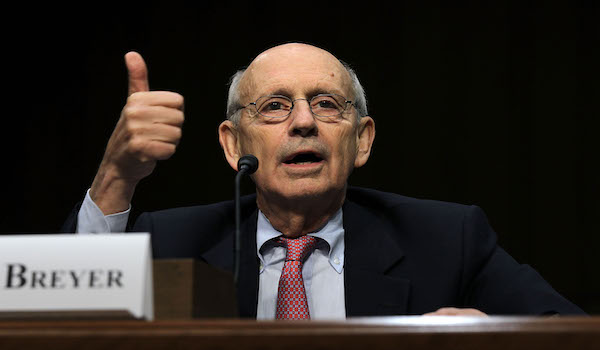
(WASHINGTON) — Justice Stephen G. Breyer, the most senior member of the U.S. Supreme Court’s liberal wing and staunch defender of a nonpartisan judiciary, is retiring from the bench, fulfilling the wish of Democrats who lobbied for his exit and clearing the way for President Joe Biden’s first high court appointment.
Breyer, the court’s oldest member at 83, will step down despite apparent good health, deep passion for the job and active involvement in cases. This term he authored major opinions upholding the Affordable Care Act, affirming free speech rights of students off-campus and resolving a multi-billion dollar copyright dispute between two titans of American technology, Google and Oracle.
“He has been operating at the peak of his powers,” said Jeffrey Rosen, law professor and president of the National Constitution Center. “It was so inspiring that this term his pragmatic vision of compromise and moderation were ascendant and all of the unanimous decisions were a moving tribute to his inspiring legacy.”
While Breyer has disavowed political considerations, many will see them in his decision to leave now. Stepping down early in the Biden presidency and while Democrats retain a razor-thin majority in the U.S. Senate will help ensure his seat is filled with someone who shares his judicial philosophy.
“It’s a highly personal decision,” Breyer told ABC News of retirement in a 2015 interview.
Progressive activists had imposed unprecedented public pressure on Breyer, who was nominated in 1994 by President Bill Clinton, to retire quickly. Senate Republican Leader Mitch McConnell said in June that the GOP may block a Democratic appointment to the court if the party retakes control of the Senate next year and a vacancy occurs in 2023 or 2024.
Many Democrats remain haunted by Republican obstruction of President Barack Obama’s nominee to the court in 2016 and the rushed confirmation of Justice Amy Coney Barrett last year, just weeks before the 2020 election and after the sudden death of Justice Ruth Bader Ginsburg.
In the lead up to his retirement, Breyer distanced himself from partisan politics.
“It is wrong to think of the court as another political institution,” he said in an April speech at Harvard Law School. “And it is doubly wrong to think of its members as junior league politicians.”
He added, justices “are loyal to the rule of law, not to the political party that helped to secure their appointment.”
“He’s very savvy,” said Rosen. “He understands that democracy is fragile and people in the past have not obeyed the court and the court doesn’t have any ability to enforce its decisions. That’s why being attentive to its legitimacy is so important to him.”
The vacancy now clears the way for Biden to nominate an African American woman to the court, a historic first and something he promised during the 2020 campaign.
There have been five female justices in Supreme Court history; three are currently serving — Justices Barrett, Elena Kagan and Sonia Sotomayor, the first and only woman of color confirmed to the high court.
U.S. Appeals Court Judge Ketanji Brown Jackson, a former Breyer clerk, public defender and Biden appointee who won three Senate Republican votes in confirmation, is considered a top contender for nomination along with Judge Leondra Kruger of the California Supreme Court, a former deputy solicitor general in the Obama administration who has argued a dozen cases before the high court.
“We are putting together a list of a group of African American women who are qualified and have the experience to be on the court,” Biden said in June 2020. “I am not going to release that until we go further down the line in vetting them.”
While Breyer never enjoyed the rock-star status held by Ginsburg, he has long been revered and celebrated as a consensus-seeker and happy warrior throughout his 27 years on the court.
“He is not a dogmatist, generating rules from some high-level theory. He is in search of workable results,” former federal appeals court Judge Richard Posner said of Breyer in the Yale Law Journal.
As a devout institutionalist, Breyer has passionately defended the Supreme Court’s reputation as an impartial and apolitical branch of American government. Later this year, he will publish a book on the subject, “The Authority of the Court and the Peril of Politics.”
“A judge has to do his best not to have an opinion on a political matter,” he told ABC News in 2015. “And if I have an opinion, I might talk to my wife about it but I’m not going to talk to you.”
He has described differences among the justices as contrasts in “philosophical outlook” rather than differences of politics and chaffed at the labeling of justices as “liberal” or “conservative.”
“Politics to me is who’s got the votes. Are you Republican or Democrat? I don’t find any of that here,” he told ABC News Chief Washington Correspondent Jonathan Karl.
Breyer has been one of the few justices to be a regular attendee at State of the Union addresses before a joint session of Congress.
“I think it is very, very, very, important — very important — for us to show up at that State of the Union,” the justice told Fox News in 2010. “Because people today, as you know, are more and more visual … and I would like them to see the judges too, because federal judges are also part of that government.”
In recent years, as the court was repeatedly thrust into an uncomfortable spotlight during the Donald Trump presidency, Breyer joined with Chief Justice John Roberts to help steer the institution away from the headlines.
“The more the political fray is hot and intense, the more we stay out of it,” Breyer explained during a 2020 interview with the Kennedy Institute.
The nine justices have handed down more unanimous opinions in 2021 than any time in at least the last seven years. Court analysts credit a narrow focus on common ground rather than sweeping, more divisive pronouncements. Some see a vindication of Breyer’s longtime approach in the results.
During oral arguments, Breyer is frequently one to lean in, animatedly challenging lawyers on both sides of a debate to address the real life consequences of a case. He has earned the moniker “king of hypotheticals” for his creative use of the technique.
“You have to have the imagination to understand how those words will affect those lives,” Breyer said in a 2017 interview with NYU School of Law. “That means you understand something about the lives of other people.”
Breyer has cultivated a reputation for pragmatism and compromise in his opinions, which have been praised for their colloquial language and avoidance of jargon.
“My job … is to write opinions,” Breyer told Fox News Sunday in 2010. “The job of 307 million Americans is to criticize those opinions. And what they say is up to them. And the words I write are carrying out my job under the law as best I see it.”
In 2014, Breyer wrote for an unanimous court to limit the scope of a president’s power to make recess appointments.
“Pro forma sessions (of Congress) count as sessions, not as periods of recess,” he said, dealing a rebuke to Obama who had tried to force appointments to the National Labor Relations Board. “The Senate is in session when it says it is.”
He has twice authored significant majority opinions on the issue of abortion.
In 2000, Breyer wrote a 5-4 decision striking down a Nebraska law criminalizing “partial-birth abortions” as “an undue burden upon a woman’s right to make an abortion decision.” Two decades later, his opinion in June Medical Services v. Russo cast a Louisiana law requiring hospital admitting privileges for abortion doctors as a “substantial obstacle” to women that violates the Constitution.
On the First Amendment, Breyer was the pivotal vote in a pair of 5-4 decisions in 2005 involving public displays of the Ten Commandments. He voted to uphold a longstanding monument at the Texas state capitol, while opposing placement of framed copies of the commandments inside Kentucky courthouses. He was the only justice to agree with both decisions.
“The government must avoid excessive interference with, or promotion of, religion. But the Establishment Clause does not compel the government to purge from the public sphere all that in any way partakes of the religious,” Breyer wrote in a concurring opinion in the Texas case. “Such absolutism is not only inconsistent with our national traditions, but would also tend to promote the kind of social conflict the Establishment Clause seeks to avoid.”
Breyer frequently championed “six basic tools” that judges should use when deciding a case — text, history, tradition, purpose, precedent and consequences. He has also urged consideration of international law.
“When you’re talking about the Constitution, different judges emphasize different ones of those,” he said in a 2017 interview, “but nobody leaves any of those out completely.”
When Breyer’s analysis put him at odds with his colleagues, he frequently wrote in dissent, defending the use of race as a factor in school admissions; pushing for deference to legislatures on gun control laws; and, opposing partisan gerrymandering.
“The use of purely political considerations in drawing district boundaries is not a necessary evil that, for lack of judicially manageable standards, the Constitution inevitably must tolerate,” Breyer wrote in a 2004 case.
In the hotly contested 2000 election, Breyer lamented the court’s decision to get involved in the dispute between George W. Bush and Al Gore.
“The Court was wrong to take this case. It was wrong to grant a stay,” he wrote at the time. “We do risk a self-inflicted wound — a wound that may harm not just the Court, but the Nation.”
Breyer has been a staunch critic of the death penalty and what he sees as unacceptably lengthy delays between sentences and executions.
In a famous 40-page dissent in 2015, Breyer urged the court to reconsider whether capital punishment violates the Eighth Amendment.
“Lack of reliability, the arbitrary application of a serious and irreversible punishment, individual suffering caused by long delays, and lack of penological purpose are quintessentially judicial matters,” he wrote.
“They concern the infliction — indeed the unfair, cruel, and unusual infliction — of a serious punishment upon an individual,” he continued. “The Eighth Amendment sets forth the relevant law, and we must interpret that law.”
Breyer’s career on the high court caps a lifetime of public service.
He grew up in San Francisco, where he attended public schools and earned the rank of Eagle Scout. In 1957, Breyer joined the U.S. Army Reserves and served a tour of active duty in the Army Strategic Intelligence during his six-year career.
He studied philosophy at Stanford University and became a Marshall Scholar at Oxford University. In 1964, he earned his law degree from Harvard University and went on to clerk for justice Arthur Goldberg on the U.S. Supreme Court.
“I’m sure they wanted me to be a lawyer,” Breyer said of his parents in a 2017 oral history. “I thought, well I’d like to be a lawyer. I sort of always knew I would be.”
After a short stint in the Justice Department antitrust division, Breyer joined the faculty at Harvard Law School in 1967, specializing in administrative law. That same year he married Joanna Hare, a member of the British aristocracy and a pediatric psychologist at the Dana-Farber Cancer Institute.
In the mid-1970s, he cut his teeth in politics, serving as an assistant special prosecutor in the Watergate investigation and later as special counsel to the Senate Judiciary Committee working alongside Sen. Ted Kennedy.
“A few lessons I learned from Kennedy. One of them: the best is the enemy of the good,” Breyer said in 2017. “If you could get an inch, it’s much better to get that inch then to complain about not getting a mile.”
He was first appointed to the federal bench in 1980 by President Jimmy Carter, going on to serve 13 years as an appellate judge until Clinton elevated him to replace Justice Harry Blackmun on the Supreme Court in 1994. The Senate confirmed Breyer 87-9.
Asked in 2017 how he would like to be remembered, Breyer told an interviewer: “You play the hand you’re dealt. You’re dealt one. And you do the best with what you have. If people say yes, he did, he tried, he did his best and was a decent person, good.”
(TALLAHASSEE, Fla.) — A Florida bill that would limit classroom discussions on sexual orientation and gender identity and encourage parents to sue schools or teachers that engage in these topics is speeding through the state House and Senate.
It’s being called a “Don’t Say Gay” bill by LGBTQ advocates, who fear that if this bill is signed into law, it could act as a complete ban on the lessons on LGBTQ oppression, history and discussions about LGBTQ identities.
“This would erase LGBTQ+ history and culture from lesson plans and it sends a chilling message to LGBTQ+ young people and communities,” said Melanie Willingham-Jaggers, the executive director of the national LGBTQ youth advocacy group GLSEN.
Activists say that erasing LGBTQ presence from schools may imply to students that their gender identity or sexual orientation is something to be ashamed of or hidden.
“We have to create a learning environment where they feel safe and healthy, or it’s not an effective learning environment,” said Heather Wilkie of the Zebra Coalition, a Central Florida LGBTQ advocacy group.
“When you have laws like this, that directly attack our kids for who they are, it prevents them from learning,” she said. “It prevents them from being able to be healthy.”
The two bills in the state legislature, HB 1557 and SB 1834, state that a school district “may not encourage classroom discussion about sexual orientation or gender identity in primary grade levels or in a manner that is not age-appropriate or developmentally appropriate for students.”
The House Education & Employment Committee has moved the bill forward, handing it off to the Judiciary Committee.
It adds that parents who violate this rule can sue, seeking damages and reimbursement for attorney fees and court costs.
Rep. Joe Harding, who is the sponsor of the legislation, hopes it will “reinforce the fundamental right of parents to make decisions regarding upbringing & control of their children,” according to the bill’s text.
Harding did not respond to ABC News’ request for comment.
Chasten Buttigieg, activist and husband of U.S. Secretary of Transportation Pete Buttigieg, denounced Florida Gov. Ron DeSantis and the state legislature for the efforts.
LGBTQ advocacy organizations say these bills are reminiscent of the “no promo homo” laws of the 1990s that barred educators from discussing queer topics in schools, but with an added mandate on parent and family involvement.
“These mandates are harmful and risk carelessly outing LGBTQ+ young people to families who do not affirm their children’s identities,” Willingham-Jaggers said.
2021 was a record-breaking year for anti-LGBTQ legislation, according to the Human Rights Campaign. More than 250 of these bills were introduced and at least 17 were enacted into law.
Several states, including Arizona, Alabama, Florida, Indiana, Kentucky, Oklahoma, New Hampshire and South Dakota, have already introduced anti-LGBTQ legislation in 2022.
This Florida legislation follows similar bills that restrict educators from teaching about oppression in the U.S.
Wilkie said that queer issues and access to supportive resources have been the priority against anti-LGBTQ attacks in recent years, and this has been a heightened effort since the Pulse nightclub shooting in 2016.
LGBTQ youth in the state, who have a higher risk for suicidal ideation, depression and anxiety, have been struggling, but Wilkie says advocacy groups will continue to fight these bills.
“We will fight,” she said. “It’s so disheartening to think that they would not be able to freely talk about themselves, or learn anything about their history.”
Ellen Weintraub, Commissioner at US Federal Election Commission, addresses the audience during the Web Summit 2021. – Bruno de Carvalho/SOPA Images/LightRocket via Getty Images)
(NEW YORK) — With everyone from giant companies to celebrities embracing the cryptocurrency phenomenon known as NFTs, political candidates are now getting into the act — but some experts say that transparency concerns could affect their use as a political fundraising tool.
Non-fungible tokens — digital assets that cannot be replicated and can be used to represent real-world items — are slowly creeping into the political world, with a few candidates already using them to raise thousands of dollars.
“NFTs are bringing more people into our fold, into our movement,” said Max Rymer, a digital consultant for Minnesota Republican gubernatorial candidate Dr. Scott Jensen.
Jensen’s campaign saw an opportunity for NFTs to be a low-dollar way for people to become engaged with their candidate and receive something of value in return for their donations, Rymer told ABC News.
Through the sale of NFTs, “we’ve added 2,500 new people that are going to support our campaign going forward,” Rymer said.
Blake Masters, a Republican U.S. Senate candidate in Arizona, is also embracing NFTs.
“I was thinking of creative ways to raise money and I thought of NFTs because [they] can give people a sense of ownership,” said Masters, who is also the co-author of “Zero to One,” a bestselling business book published in 2014.
So Masters sold his supporters limited edition NFTs depicting the cover of his book — and raised nearly $575,000.
Like collectible artwork and rare baseball cards, the value of an NFT derives from it being unique — in this case, a unique digital token in a distributed database known as a blockchain. The digital tokens are stored in the blockchain through a digital wallet and can be held as an asset — as digital memorabilia — or sold and traded for investment purposes.
Many NFTs also come with real-life perks and exclusive access to events, which makes them attractive as campaign offerings.
For example, for those who purchased Masters’ digital tokens, the perks included receiving a signed copy of his book and the opportunity to meet him and his co-author, tech billionaire Peter Thiel, who helped develop the NFT collection.
“We’ll have at least one token-holders party,” Masters told ABC News. “It’s like the Willy Wonka golden ticket.”
That kind of involvement makes NFTs a good way to help candidates build a community of supporters, said Joseph Argiro, CEO of Iron Key Capital, a digital asset hedge fund.
“[NFTs] are probably a better way than just to accept donations, because they are more of a symbolic representation of your beliefs,” said Argiro.
For those who purchased from her initial NFT collection, former first lady Melania Trump offered an audio recording with a “message of hope.” A portion of the proceeds from her collection, which was released last month, supported her Be Best initiative, a campaign focused on children’s issues and advocating against cyberbullying.
“What you’re trying to tap into with NFTs is a sense of supporters around a common cause,” said Joshua White, an assistant professor of finance at Vanderbilt University. “And so NFTs can build a community where there’s this positive feedback loop.”
In the case of Masters’ Senate campaign, said White, NFTs could attract young voters that have never voted Republican but want a younger and more tech savvy candidate to represent them.
NFTs have also been a breath of fresh air for political campaigns and fundraisers that are seeking a new way to appeal to grassroots supporters, said Brian Forde, co-founder of the online fundraising platform Numero, which is working to launch a new NFT fundraising platform for Democratic campaigns called electables.com.
“We’ve put out surveys to more than 14,000 grassroots donors and a couple things stand out: One, they’re tired of hyperbolic emails, two, they want to be recognized and connect with other grassroots supporters of that campaign,” Forde said. “So with NFTs, electables allow them to connect with other grassroots supporters and be recognized for their contribution.”
Forde said that supporting an NFT is similar to supporting a sports team — which is why NFTs have been embraced by numerous leagues.
“What surprised me the most about NFTs is how quickly and powerfully one connects and builds a community of strong supporters,” Forde said. “Pro sports leagues were some of the first to figure this out, and in many ways, campaigns are a lot like sports teams. If you own [an NFT], you feel a belonging to that community in a stronger way than you ever did before. Sports teams have been the pioneers, and campaigns are going to follow in their footsteps.
And while the number of political campaigns that have launched NFTs remains low, interest has been growing. Forde said electables.com, which will make money by providing an NFT fundraising platform for campaign clients, currently has more than 300 campaigns on its waitlist ahead of its planned launch in March.
As of now, there’s little to no official guidance on NFT fundraising from the Federal Election Commission, FEC Commissioner Ellen Weintraub said. Nor has there been any campaign or committee seeking an official advisory opinion from the agency.
“It’s not something that the agency has gotten a lot of questions on, and certainly there have been no formal request of the Commission as a whole to weigh in on this,” Weintraub told ABC News. “My sense is that it’s just not that common yet.”
As a result, the Masters campaign and the Jensen campaign both sought legal advice before they launched their NFT collections.
“We ran it through all the legal analyses,” Masters said. “I was heavily legally diligent, and we were careful with our language … we made sure that all the benefits were allowed.”
“It’s brand new territory for a lot of these regulatory bodies too,” said Rymer. “So we partnered, in essence, with the Campaign Finance Board and we treated this the same way that supporters would get a hat for a donation.”
NFTs can typically be purchased using either regular currency — like through a credit card — or with cryptocurrency, virtual tokens that allow purchasers to remain anonymous. But most political campaigns that report to the Federal Election Commission or state-level election agencies are required to report the identity of their donors — and officials say that could raise transparency concerns.
“I think we probably have to look into the transparency aspect, whether one could determine where the NFT, the ‘thing of value,’ is coming from,” Weintraub told ABC News.
White said that if a cryptocurrency user has linked their virtual wallet to their personal information, then transparency isn’t an issue. But he said that the use of cryptocurrency for political fundraising in general makes it easier to “not know where that money is coming from.”
To comply with fundraising regulations that govern contribution limits and other restrictions, some campaigns offering NFTs have turned to platforms like electables.com and the recently launched Front Row, which launched over the fall as another NFT marketplace for Democrats.
“We built this platform because we saw that that’s what needed to happen for progressive organizations, campaigns and movements that have some of these compliance regulations to participate in this ecosystem,” Front Row co-founder Parker Butterworth told ABC News. Butterworth said the platform allows political organizations to collect all the necessary information from NFT buyers, including their name, addresses, age, and U.S citizenship status.
The platform offered its first NFT collection from the Texas Democratic Party, and it’s now talking with several new clients, said Butterworth. He said the world of NFT fundraising is a “very fast moving space” that’s expected to expand the world of digital campaigning.
“NFTs are not going anywhere,” said Argiro. “I think we’re just seeing the beginning of how communities use these NFTs to drive community formation and capital formation.”
(WASHINGTON) — House Speaker Nancy Pelosi announced Tuesday she is running for reelection.
“While we have made progress much more needs to be done to improve people’s lives. This election is crucial: nothing less is at stake than our Democracy. But we don’t agonize-we organize. I am running for re-election to Congress to deliver For The People and defend Democracy. -NP,” Pelosi said in a tweet.
As rumors continued to swirl over Pelosi’s possible retirement, she is putting them to bed — for now.
She could always announce a resignation in the coming months, depending on which party keeps the House after the midterm elections — or she could choose to stay if she wins her seat.
The reelection announcement does not mean she will necessarily be running for the speaker’s gavel should Democrats keep the House.
And if they do retain the majority through the midterms and she stays in office, Democrats will likely be looking for fresh leadership.
Last January, the House narrowly reelected Pelosi as speaker with 216 votes, giving the California Democrat a fourth term as its leader.
Pelosi, who is the only woman to ever serve in the leadership role, has previously said she will not run for speaker after 2022.
(KYIV, Ukriane) — The acting U.S. ambassador to Ukraine told ABC News Tuesday that an order for diplomats’ families at the embassy to leave the country was issued because Russia could attack “any day now” if it chose.
Kristina Kvien, the embassy’s charge d’affairs, made the remarks after standing in the bitter cold with a Ukrainian deputy defense minister to receive a 79-ton delivery of American military aid at Kyiv’s Boryspil Airport, intended to help Ukraine defend itself against Russia.
The U.S. State Department on Sunday ordered diplomats’ families to leave and authorized non-emergency staff to depart if they choose, in light of the threat of a possible Russian invasion, as Moscow masses over 100,000 troops near Ukraine’s borders. Ukraine’s government has criticized the decision, calling it “premature” and “excessively cautious.” The United Kingdom, Canada, Australia and Germany have since followed suit in various forms, but the majority of European countries have said so far they do not believe such a step is warranted.
Kvien told ABC News the decision on the partial evacuation was taken out of an “abundance of caution” given the scale of the Russian build up.
“The decision was made because right now Vladimir Putin and Russia have built up such military might on the border that they could take an action any day now,” she said. “And with that in mind, we felt that out of an abundance of caution, we had to make sure that our embassy families were safe. So that was the basis for a decision.”
Kvien said Russia had built up so many troops it “means that Russia could do anything at any moment.”
“It’s like a gun to the head of Ukraine,” she said. “And we don’t think that Ukraine should have to live with a loaded gun to its head.”
Ukrainian officials have publicly disagreed with the U.S. assessment that a Russian attack could take place at any moment. A deputy defense minister, Hanna Malyar, on Tuesday said the number of Russian troops at the border currently is “not enough for a full-scale invasion.”
In general, Ukrainian officials are more skeptical that Russia will really go through with a major attack and in recent days they have become increasingly vocal in contesting the picture coming from the U.S. that an attack is imminent. The head of Ukraine’s national security council, Alexey Danilov, on Monday told the BBC that “the number of Russian troops is not increasing in the way many people are presenting it”.
Ukrainian officials instead have suggested they believe Russia’s build up is currently intended to destabilize Ukraine with the threat of attack, including by undermining its economy. Ukraine President Volodymyr Zelenskyy in video addresses has urged Ukrainians not to panic and that the threat of invasion is not worse now than when Russia began the conflict in 2014.
Kvien said she believed Ukraine’s government views the threat seriously.
“I do think that President Zelenskyy is taking the threat very seriously, and he is being careful to make preparations as needed,” she said.
“They’ve been living with Russian threats for a long time. So I would say that they are just a bit more, ‘sang froid’ as they say, in French. But that doesn’t mean that they don’t take them seriously,” she said.
The U.S. military aid shipment landing on Tuesday was the third to arrive in a week, part of a $200 million security aid package approved to help Ukraine defend itself and deter Russia.
The delivery included 276 Javelin anti-tank missiles, over 800 SMAW-D shoulder-fired “bunker buster” missiles, 170 pounds of 50-caliber ammunition and bomb disposal suits.
Kvien said the weapons demonstrated the U.S.’ “absolute, rock-solid support” for Ukraine’s sovereignty and territorial integrity.
The U.S. is still seeking to avert a Russian attack through diplomacy. Russia has demanded guarantees from the U.S. that Ukraine will never join NATO and that the alliance will pull back forces from eastern European countries that joined after the Cold War.
The U.S. has already ruled that out but has proposed discussing other security issues, such as limits on missiles deployments and military exercises.
Kvien repeated there are “some areas” that the U.S. is able to talk about with Russia to try to address its concerns, such as “arms control, better transparency in terms of military exercises,” but she reiterated that Ukraine’s choice to try to join NATO was not on the table. She said she hoped Putin would choose to take the path of diplomacy.
“I think that it’s the only reasonable path. I think it’s the only path that ultimately will lead to a more secure Europe, which Mr. Putin says he would like to have,” she said.
(WASHINGTON) — Right-wing radio host and conspiracy theorist Alex Jones appeared before the House select committee investigating the Jan. 6 Capitol attack, he disclosed on his show, telling his audience he invoked the Fifth Amendment to protect himself against self-incrimination “almost 100 times.”
Jones, who was subpoenaed by the committee to provide testimony and records, spoke at a Jan. 5 rally in Washington, D.C., and was also in contact with organizers of the rallies scheduled for Jan. 6, when pro-Trump rioters attacked Capitol Police and disrupted the electoral vote count.
“I went there to have a peaceful political rally, to put peaceful political pressure on Congress,” Jones said. “It’s a horrible historic fiasco and I wish it never happened.”
Jones said the virtual interview with the committee was “extremely interesting to say the least,” and that investigators were “polite” and “dogged.”
He told investigators — who gave him the impression that they regularly monitor his shows — that he had no knowledge of any plans for violence on Jan. 6.
Jones said the committee had “overall pretty reasonable” questions, even though he declined to answer nearly 100 of them.
“I wanted to answer the questions, but at the same time, it’s a good thing I didn’t,” he said. “I’m the type that tries to answer things correctly, even if I don’t know all the answers, and they can then kind of claim that’s perjury” he said.
Jones said the committee showed emails and text messages to him during their session — some of the thousands of records investigators have obtained from dozens of witnesses during their monthslong investigation.
He also said he “had not seen” a clip from his show on Dec. 31, 2020, when a guest host, Matthew Bracken, floated the notion of storming the Capitol to disrupt the electoral vote count.
Jones said investigators also questioned him about his participation in a “Stop the Steal” rally at the Georgia Capitol, and about who he was in touch with in the Trump White House.
“They asked me if we were with Proud Boys and if we were with Oath Keepers,” he said, recalling eating at a Hooters restaurant at his Georgia hotel with members of the far-right group.
“All I know is what I saw and what I witnessed,” he said.
On his show after the Captiol attack, Jones said the White House had asked him to “lead the march” to the Capitol. But on his show Monday, he said he never supported efforts to enter the Capitol and that his main point of contact was Trump campaign fundraiser Caroline Wren, who helped organize the rally outside the White House on Jan. 6.
Jabin Botsford/The Washington Post/Bloomberg via Getty Images
(WASHINGTON) — U.S. Capitol Police Officer Eugene Goodman, the man who led rioters up the stairs and away from the Senate chamber on Jan. 6, 2021, broke his yearlong silence Monday when he appeared on the podcast “3 Brothers No Sense.”
“It could have easily been a blood bath,” Goodman says on the show. “So kudos to everyone there that showed a measure of restraint in regards to deadly force, because it could have been bad.”
Goodman’s heroics were caught on camera in what became a viral video that came to light during President Donald Trump’s impeachment trial in the Senate, which revealed Goodman also guided Sen. Mitt Romney back to the Senate chamber, helping him narrowly avoid contact with the rioters.
The officer’s description of the day is one in which he kicked into “go mode” and relied heavily on previous military training to guide him. He said his decision to move up the stairs with the protestors wasn’t entirely by choice because he thought “they would have followed me anyway.”
“Any situation like that you want to de-escalate, but at the same time you wanna survive first,” Goodman says.
He also discusses his newfound fame and explains that he has chosen to stay out of the spotlight to protect his family’s privacy.
“I keep asking myself that question every day like who the hell am I?” Goodman says. “I’m the guy everybody keeps saying saved the Senate… I don’t need no statue, though, that’s one more thing for a bird to prop up and take a dump on.”
Up until Monday, Goodman has avoided media appearances. The podcast interview was conducted by the three hosts, one of whom, Officer Byron Evans, serves as a member of the U.S. Capitol Police.
Earlier this month, “World News Tonight” anchor David Muir sat down with three Capitol Police officers who were at the Capitol on Jan. 6 last year.
ABC News’ Rachel Scott and Allison Pecorin contributed to this report.
(WASHINGTON) — President Joe Biden said Tuesday there could be some U.S. troop movements in the “nearer term” in Eastern Europe — and that he would consider personally sanctioning Russian President Vladimir Putin if Russia invades Ukraine — a day after 8,500 American forces were put on “heightened alert” in the region.
“If he were to move in with all those forces, it would be the largest invasion since World War II. It would change the world,” Biden told reporters at an unannounced stop at a local business in Washington.
Asked about what would lead him to deploy the troops staging nearby, Biden said that depends on “what Putin does or doesn’t do” but he repeated that American forces would not move into Ukraine.
“I may be moving some of those troops in the nearer term, just because it takes time,” Biden said, adding it’s not to be “provocative” but to reassure NATO allies whom have reasons for concern.
“We have no intention of putting American forces, or NATO forces, in Ukraine. But we — as I said — they’re gonna be serious economic consequences if he [Putin] moves,” Biden added.
Asked whether the risk of an invasion is increasing, decreasing or steady, Biden compared assessing Putin’s intentions to “reading tea leaves.”
“The fact that he continues to build forces along Ukraine’s border from Belarus, all the way around, you’d say, ‘Well that means that he is looking like he’s trying to do something.’ But then you look at what his past behavior is and what everyone is saying on his team, as well as everyone else, as to what is likely to happen. It all comes down to his — his decision-making,” Biden said.
Amid the escalating tensions, Biden had a one hour and 20-minute conference call from the White House on Monday with the leaders of the European Commission, European Council, NATO, France, Germany, Italy, Poland and the United Kingdom, according to the White House, which said they planned to “discuss diplomacy, deterrence and defense efforts” as well as what would constitute potential sanctions against Russia.
The White House said after the call that Biden and European leaders “reiterated their continued concern about the Russian military build-up on Ukraine’s borders” and also discussed “preparations to impose massive consequences and severe economic costs on Russia for such actions as well as to reinforce security on NATO’s eastern flank.”
“We’re all on the same page,” Biden said Tuesday. “You’ve got to make it clear that that there’s no reason for anyone, any member of NATO, to worry whether or not we would, we NATO, would come to their defense.”
(WASHINGTON) — The U.S. Supreme Court on Monday said it would take up a pair of cases that could decide the future of affirmative action in college admissions.
The justices will hear appeals from a conservative student group that has been challenging the use of race as a factor in undergraduate admissions at Harvard University, the nation’s oldest private college, and the University of North Carolina, the nation’s oldest public state university.
It will be the first test on the issue for the court’s 6-3 conservative majority, following the retirement of Justice Anthony Kennedy and death of Justice Ruth Bader Ginsburg, both of whom defended race-conscious admissions.
The group which brought the case — Students for Fair Admissions — alleges that Asian American applicants have been illegally targeted by Harvard and rejected at a disproportionately higher rate in violation of Supreme Court precedent and the students’ constitutional rights.
Two lower federal courts have rejected these claims.
In the second case, the group alleges UNC refused to use workable race-neutral alternatives to achieve the stated goal of a diverse study body.
“Public schools have no legitimate interest in maintaining a precise racial balance,” the group wrote in its brief to the court. “The same Fourteenth Amendment that required public schools to dismantle segregation after [Brown v. Board of Education] cannot be cowed by the diktats of university administrators.”
That the Supreme Court has agreed to hear the cases is widely seen as an indication that the court could be willing to revisit its precedents on affirmative action and end the use of racial classifications in admissions altogether.
Chief Justice John Roberts has been among the most outspoken critics of affirmative action, famously declaring in a 2006 opinion, “It is a sordid business, this divvying us up by race.”
He and many of the court’s other conservatives have long argued that the best way to root out discrimination on the basis of race is to not permit discrimination on the basis of race.
“Harvard’s mistreatment of Asian-American applicants is appalling,” the plaintiffs wrote in their brief in the Harvard case. “That Harvard engages in racial balancing and ignores race-neutral alternatives also proves that Harvard does not use race as a last resort.”
In a series of decisions, beginning in 1978, the court said that race could be used as one factor among many when considering college admissions applications but that a school could not use quotas or mathematical formulas to diversify a class.
Harvard has defended the educational value and social benefits of admitting a diverse student body and rejected claims that it has given outsized importance to race.
“Harvard does not automatically award race-based tips but rather considers race only in a flexible and non-mechanical way; consideration of race benefits only highly qualified candidates; and Harvard does not discriminate against Asian-American applicants,” the school wrote the court in its brief.
The school is asking the court to affirm its precedent.
“The American public has looked to this precedent for assurance that the nation recognizes and values the benefits of diversity and that the path to leadership is open to all,” it wrote.
The cases join a blockbuster series of issues on the Supreme Court’s docket, including gun rights and abortion. It will likely be scheduled for oral argument this spring and decided by the end of June.