(WASHINGTON) — The Supreme Court on Wednesday rejected a bid by California Republicans to block a newly redrawn congressional map backed by Democrats and endorsed by voters ahead of the 2026 midterm elections.
The move allows the state to move forward with a map enacted by Proposition 50, approved in November, that could potentially allow Democrats to flip five seats currently held by Republicans.
California’s mid-decade map change was backed by Gov. Gavin Newsom and the Democratic Party in response to efforts by Texas and other Republican-led states to redraw their maps — at President Donald Trump’s urging — in order to give Republicans a better chance at retaining majority control of Congress.
“Donald Trump said he was ‘entitled’ to five more Congressional seats in Texas. He started this redistricting war. He lost, and he’ll lose again in November,” Newsom posted on X on Wednesday after the Supreme Court’s order.
The California Republican Party in January filed an emergency application with the nation’s high court to try to prohibit California from using the map while their appeal moved forward, arguing it was drawn predominantly based on race.
The Supreme Court on Wednesday did not explain its decision in a single-sentence order. There were no noted dissents.
Late last year, the Supreme Court declined to block the Texas map, citing a desire to refrain from interference in the political process too close to an election and broad deference to state legislators who insisted they acted in good faith and no racial animus.
(WASHINGTON) — The Supreme Court on Wednesday rejected a bid by California Republicans to block a newly redrawn congressional map backed by Democrats and endorsed by voters ahead of the 2026 midterm elections.
The move allows the state to move forward with a map enacted by Proposition 50, approved in November, that could potentially allow Democrats to flip five seats currently held by Republicans.
This is a developing story. Please check back for updates.
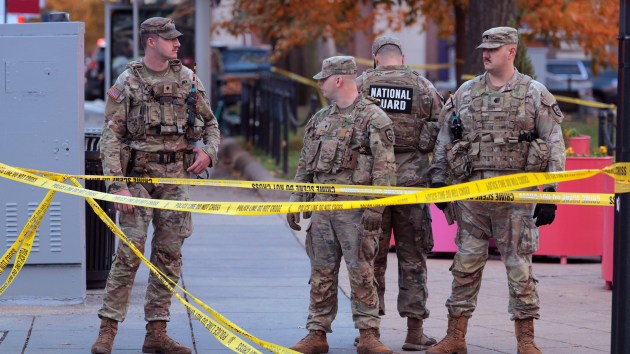
National Guard soldiers respond to a shooting near the White House on November 26, 2025 in Washington, DC. At least two National Guardsmen have been shot blocks from the White House. (Chip Somodevilla/Getty Images)
(WASHINGTON) — The man accused of ambushing West Virginia National Guard members near the White House in November, where one was killed and another severely wounded, pleaded not guilty in federal court on Wednesday.
Rahmanullah Lakanwal, a 29-year-old Afghan national who previously worked with the CIA in Afghanistan, was arraigned on nine charges, including first-degree murder, assault with intent to kill and illegal possession of a firearm.
Lakanwal appeared in court on Wednesday in a wheelchair, seemingly still recovering from the injuries prosecutors say he sustained in the incident.
The Justice Department’s push for the death penalty remains incomplete, with prosecutors telling Judge Amit Mehta that none of the current charges allow them to seek capital punishment. Prosecutors said in court they are reviewing potential additional charges that could make the case death penalty-eligible. Lakanwal is due back in court in early March.
“We will do everything in our power to seek the death penalty against that monster who should not have been in our country,” Attorney General Pam Bondi told Fox News in November.
While the District of Columbia abolished the death penalty decades ago, prosecutors can still seek capital punishment in federal court, where Lakanwal’s case is being handled, under limited circumstances. It remains unclear what additional charges the Justice Department is pursuing — officials with the department did not return a request for comment.
Lakanwal was one of thousands of Afghans evacuated to the United States after the Taliban seized control of Afghanistan in 2021 and his application for asylum was approved in 2025 under the Trump administration.
Army Spc. Sarah Beckstrom, 20, died of her injuries on Nov. 26, the day before Thanksgiving. Air Force Staff Sgt. Andrew Wolfe suffered a gunshot wound to the head and remains in recovery.
Court documents say Lakanwal shot Beckstrom and Wolfe in the back of the head with a .357 Smith & Wesson revolver. A National Guard major returned fire, and another Guard officer subdued Lakanwal. Wolfe is still recovering and will have cranioplasty, or skull reconstruction surgery, in March, according to Melody Wolfe, his mother.
In Afghanistan, Lakanwal was affiliated with a so-called Zero Unit, working closely with the CIA and special operations, ABC News reported in December. He was considered a trusted member of the unit, which carried out U.S. counterterrorism missions, officials with direct knowledge explained.
Investigators believe Lakanwal was under financial strain after his work permit expired and may have been experiencing a mental health crisis, sources told ABC News. Investigators are also examining whether the recent death of an Afghan commander Lakanwal had worked with and might have admired may have worsened his mental and emotional state, according to sources.
The two guard members were a part of President Donald Trump’s surge of troops into Washington, D.C., for law enforcement. After the shooting, the president deployed an additional 500 guard members into D.C., where some 2,600 are currently deployed performing civic duties like cleaning garbage off the street and patrolling the city’s tourist spots and Metro rail stations.
The guard deployment will last through 2026, two officials told ABC News in January.
National Guard soldiers respond to a shooting near the White House on November 26, 2025 in Washington, DC. At least two National Guardsmen have been shot blocks from the White House. (Chip Somodevilla/Getty Images)
(WASHINGTON) — The man accused of ambushing West Virginia National Guard members near the White House in November, killing one and severely wounding another, is set to be arraigned in court on Wednesday.
Army Spc. Sarah Beckstrom, 20, died of her injuries on Nov. 26, the day before Thanksgiving. Air Force Staff Sgt. Andrew Wolfe suffered a gunshot wound to the head and remains in recovery.
Rahmanullah Lakanwal, a 29-year-old Afghan national who previously worked with the CIA in Afghanistan, faces nine charges, including first-degree murder, assault with intent to kill and illegal possession of a firearm, and has pleaded not guilty.
Lakanwal was one of thousands of Afghans evacuated to the United States after the Taliban seized control of Afghanistan in 2021, his application for asylum was approved in 2025 under the Trump administration.
Court documents say Lakanwal shot Beckstrom and Wolfe in the back of the head with a .357 Smith & Wesson revolver. A National Guard major returned fire, and another Guard officer subdued Lakanwal. Wolfe is still recovering and will have cranioplasty, or skull reconstruction surgery, in March, according to Melody Wolfe, his mother.
U.S. Attorney General Pam Bondi said she is seeking the death penalty. Lakanwal’s attorney declined to comment.
In Afghanistan, Lakanwal was affiliated with a so-called Zero Unit, working closely with the CIA and special operations, ABC News reported in December. He was considered a trusted member of the unit, which carried out U.S. counterterrorism missions, officials with direct knowledge explained.
Investigators believe Lakanwal was under financial strain after his work permit expired and may have been experiencing a mental health crisis, sources told ABC News.
Investigators are also examining whether the recent death of an Afghan commander Lakanwal had worked with and might have admired may have worsened his mental and emotional state, according to sources.
The two guard members were a part of President Donald Trump’s surge of troops into Washington, D.C., for law enforcement. After the shooting, the president deployed an additional 500 guard members into D.C. where some 2,600 are currently deployed performing civic duties like cleaning garbage off the street and patrolling the city’s tourist spots and parks and Metro rail stations.
The guard deployment will last through 2026, two officials told ABC News in January.
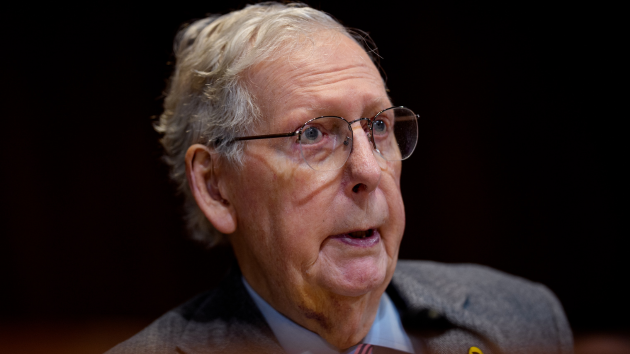
Sen. Mitch McConnell (R-KY) speaks during a Senate Appropriations Subcommittee hearing on “The Abduction of Ukrainian Children by the Russian Federation” on Capitol Hill on December 3, 2025 in Washington, DC. (Andrew Harnik/Getty Images))
(WASHINGTON) — Sen. Mitch McConnell has been hospitalized for evaluation after experiencing flu-like symptoms, his spokesperson said.
“In an abundance of caution, after experiencing flu-like symptoms over the weekend, Senator McConnell checked himself into a local hospital for evaluation last night,” McConnell spokesman David Popp said in a statement. “His prognosis is positive and he is grateful for the excellent care he is receiving. He is in regular contact with his staff and looks forward to returning to Senate business.”
McConnell, 84, who announced last February he would end his long tenure in the Senate at the end of the current term, was hospitalized in March 2023 for five days after suffering a concussion and a broken rib after a fall at a Washington, D.C., hotel.
He suffered a “minor cut” to the face and a “sprained wrist” after another fall during a Senate Republican lunch in December 2024.
McConnell served as the Senate Republican leader for a record-shattering 18 years — the longest- serving party leader of either party. He stepped down from the role in 2024 and was succeeded in by current Majority Leader John Thune.
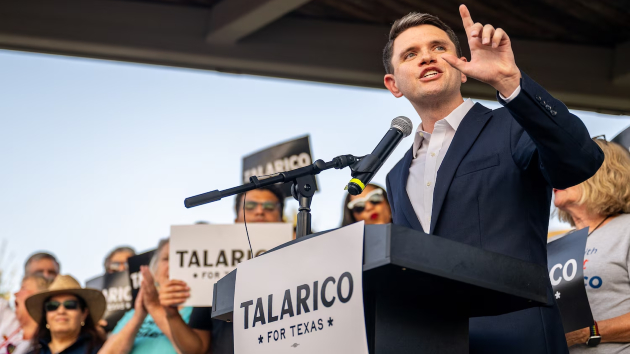
Democratic Texas State Rep. James Talarico speaks during a campaign launch rally, September 9, 2025 in Round Rock, Texas. (Brandon Bell/Getty Images)
(WASHINGTON) — With just one month until the high-stakes primary election in the Texas U.S. Senate race, Democrats are butting heads, with Democratic State Rep. James Talarico pushing back on allegations that he made controversial remarks about the race of his former opponent.
Talarico on Monday responded to a video from former Rep. Colin Allred, who is running for Texas’ 33rd Congressional District, that Talarico made comments critical of Allred on the basis of race.
On Sunday, a TikTok creator alleged that Talarico, in a private conversation, said that Allred was a “mediocre Black man” and that he would would rather run against Allred than Rep. Jasmine Crockett, whom he allegedly called a “formidable and intelligent Black woman.” The TikTok creator, who had previously supported Talarico, posted that the conversation happened after a town hall in Plano, Texas, in January.
Talarico’s campaign told ABC News that the individual was never a member of the campaign team. Talarico has not denied the conversation took place, but has said it was taken out of context.
Talarico, who is white, is running against Crockett in the Democratic primary for U.S. Senate. Allred had previously announced a Senate bid, but dropped out of the race to run for the House again, saying Crockett’s entering of the race contributed to his decision.
In a video posted on X Monday afternoon, Allred endorsed Crockett and criticized Talarico for his alleged comments.
Allred claimed that Talarico “had the temerity and the audacity to say to a Black woman that he had signed up to run against a ‘mediocre Black man,’ meaning me, and not a ‘formidable, intelligent Black woman,’ meaning Jasmine Crockett.”
Talarico pushed back on the claims, arguing that the allegations are “a mischaracterization of a private conversation.”
“In my praise of Congresswoman Crockett, I described Congressman Allred’s method of campaigning as mediocre — but his life and service are not. I would never attack him on the basis of race,” Talarico said in a statement posted to X by his spokesperson.
Talarico added that he “understand[s]” how his criticism could be perceived incorrectly “given this country’s painful legacy of racism,” but emphasized his deep “respect” for Allred.
Crockett reacted to the news, thanking Allred for his endorsement and praising him for being “an even-tempered and measured person who doesn’t engage in pettiness” — though she notably did not criticize her opponent or mention him by name.
“It’s unfortunate that at the start of Black History Month, this is what we’re facing. In former Congressman Colin Allred’s video, he drew a line in the sand. He made it clear that he did not take allegations of an attack on him as simply another day in the neighborhood,” Crockett’s spokesperson said in a statement to ABC News.
Earlier Monday, Talarico appeared on ABC’s “The View” and emphasized his “deep love and respect” for Crockett, saying that he will “1,000 percent” support and assist her if she were to become the Democratic nominee over him. The Democratic nominee would face off in November with incumbent Republican John Cornyn or one of his primary challengers, including Texas Attorney General Ken Paxton and Rep. Wesley Hunt.
While the allegations against Talarico were not discussed during his appearance on “The View,” he elaborated on his Senate campaign, calling for the overhaul of Immigration and Customs Enforcement and celebrating recent Democratic wins in Texas.
Reacting to the news of Liam Ramos, the 5-year-old asylum seeker who was released from a Texas detention center on Sunday, Talarico slammed the current tactics being deployed by ICE before demanding an overhaul and reorganization of the agency.
“It’s time to tear down this secret police force and replace it with an agency that is actually going to focus on public safety,” he said on “The View.”
Though Talarico has stopped short of explicitly calling for the abolition of ICE, he has repeatedly expressed a desire to reallocate funding while also maintaining border security.
Over the weekend, Democrats delivered an upset victory in the Texas Senate District 9, where Democrat Taylor Rehmet defeated President Donald Trump-endorsed GOP candidate, Leigh Wambsganss, and flipped the reliably red seat.
When asked about what he would do to win over the voters that Rehmet had flipped, Talarico emphasized that he is “not writing off any voter” or “any community.”
“I’m extending an open hand instead of a closed fist, and in my experience, if you extend that open hand, you’ll be surprised by who takes it,” Talarico said.
U.S. Capitol Building (Photo by Mike Kline (notkalvin)/Getty Images)
(WASHINGTON) — The Republican-led House on Tuesday voted to pass the government funding package to end the partial shutdown.
The measure, which received some bipartisan support, passed with a vote 217-214. It now heads to President Donald Trump’s desk for signature.
The measure provides funding for the Pentagon, Education, Treasury, Labor and State departments through the end of the fiscal year. The bill also includes a two-week short-term measure to keep Department of Homeland Security funded through the end of next week.
Earlier — after some drama and delay — the House passed a key procedural hurdle that set up the later vote, with Republican Rep. Thomas Massie of Kentucky as the only no vote along with all Democrats. The vote was held open for about 45 minutes as several Republicans held out on casting their votes.
Republican leaders ultimately worked the holdouts to secure enough votes to advance the package.
House Speaker Mike Johnson, who faces an incredibly tight margin, could only afford to lose one Republican vote with all members present and voting.
Johnson earlier Tuesday told reporters that he was confident the package, passed in the Senate after an 11th-hour deal between Senate Democrats and the White House, will pass.
“This may be hard for some of y’all to believe, but I never doubted this,” Johnson said at his weekly news conference Tuesday morning.
The agreement separated a Department of Homeland Security funding bill from five others funding other agencies for the rest of the fiscal year, and grants two weeks of extended DHS funding to negotiate Democratic demands for restrictions on Immigration and Customs Enforcement amid its immigration enforcement operation, including requiring agents to wear body cameras turned on and to not wear masks.
The funding fight over DHS erupted in the aftermath of the death of Alex Pretti, an ICU nurse, who was killed in a shooting involving federal law enforcement in Minneapolis on Jan. 24.
House Minority Leader Hakeem Jeffries told Johnson over the weekend that Democrats would not help Republicans expedite the funding package.
Meanwhile, hard-line Republicans also threatened to hold the package up in hopes of attaching an unrelated bill that would require a proof of citizenship in federal elections known as the SAVE Act. Though some hard-liners, including Reps. Anna Paulina Luna and Tim Burchett, had backed down on their demands.
Trump said Monday that he has spoken to congressional leaders on both sides of the aisle and expressed confidence in a resolution coming soon.
Sailors and marines man the rail as the U.S. Navy Nimitz-class aircraft carrier USS Abraham Lincoln (CVN 72) is guided by tugboats in San Diego Bay as it returns to its homeport of Naval Air Station North Island after a 5-month deployment to the Middle East on December 20, 2024 in San Diego, California. (Kevin Carter/Getty Images)
(WASHINGTON) — A U.S. fighter jet shot down an Iranian drone as it approached the aircraft carrier USS Abraham Lincoln in the North Arabian Sea on Tuesday, according to a statement from U.S. Central Command. Earlier in the day, a Navy destroyer came to the assistance of a U.S.-flagged tanker that was harassed by multiple Iranian small boats as it transited the Strait of Hormuz.
This is a developing story. Please check back for updates.
U.S. Capitol Building (Photo by Mike Kline (notkalvin)/Getty Images)
(WASHINGTON) — After drama and delay, the Republican-led House advanced a government funding package to end the partial shutdown, setting up debate ahead of a final vote on passage.
The tally on the procedural vote was 217-215. Republican Rep. Thomas Massie of Kentucky was the only no vote along with all Democrats. The vote was held open for about 45 minutes.
House Speaker Mike Johnson, who faces an incredibly tight margin, could only afford to lose one Republican vote with all members present and voting.
Initially, several Republicans held out on casting their votes, including Reps. Byron Donalds, Troy Nehls, Andy Ogles and Victoria Spartz. Republican leaders ultimately worked the holdouts to secure enough votes to advance the package.
Republican Rep. John Rose of Tennessee first voted against the rule but then flipped his vote.
Lawmakers are now moving to floor debate on the funding package. A final passage vote to end the partial shutdown is scheduled for later Tuesday afternoon.
Johnson earlier Tuesday told reporters that he was confident the package, passed in the Senate after an 11th-hour deal between Senate Democrats and the White House, will pass.
“This may be hard for some of y’all to believe, but I never doubted this,” Johnson said at his weekly news conference Tuesday morning.
The agreement separates a Department of Homeland Security funding bill from five others funding other agencies for the rest of the fiscal year, and grants two weeks of extended DHS funding to negotiate Democratic demands for restrictions on Immigration and Customs Enforcement amid its immigration enforcement operation, including requiring agents to wear body cameras turned on and to not wear masks.
The funding fight over DHS erupted in the aftermath of the death of Alex Pretti, an ICU nurse, who was killed in a shooting involving federal law enforcement in Minneapolis on Jan. 24.
House Minority Leader Hakeem Jeffries told Johnson over the weekend that Democrats would not help Republicans expedite the funding package.
Meanwhile, hard-line Republicans also threatened to hold the package up in hopes of attaching an unrelated bill that would require a proof of citizenship in federal elections known as the SAVE Act. Though some hard-liners, including Reps. Anna Paulina Luna and Tim Burchett, had backed down on their demands.
President Donald Trump said Monday that he has spoken to congressional leaders on both sides of the aisle and expressed confidence in a resolution coming soon.
The Minnesota National Guard sits at the Whipple Federal Building in Minneapolis, United States, on January 26, 2025. (Arthur Maiorella/Anadolu via Getty Images)
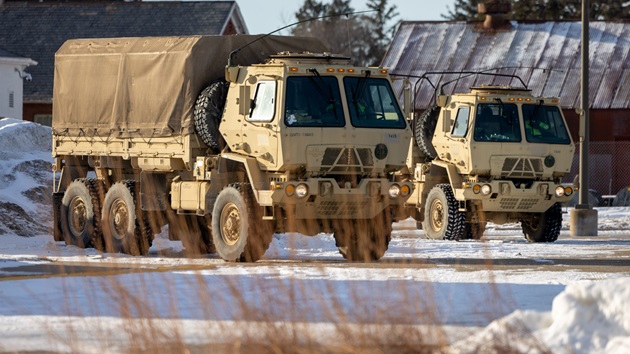
(WASHINGTON) — The Pentagon’s Northern Command over the weekend stood down more than 1,500 federal troops placed on alert for potential deployment to Minneapolis, according to two U.S. officials with direct knowledge of the situation.
ABC News first reported that roughly 1,500 active duty soldiers from the 11th Airborne Division at Joint Base Elmendorf-Richardson in Alaska had been ordered to prepare for a possible mission to the Twin Cities in Minnesota.
Additional units across the country, including some 200 Texas National Guard troops, also had been directed to make preparations.
No specific mission was ever outlined, and placing units on alert is a relatively routine step when commanders anticipate a potential presidential order, according to officials familiar with the planning. The New York Times was the first to report that units were being taken off high alert.
The prepare-to-deploy orders came as President Donald Trump, threatened to use the Insurrection Act of 1807, a rarely used statute that grants a president authority to deploy federal troops for domestic law enforcement missions under limited circumstances.
The law has been invoked most frequently during the Civil Rights era, particularly to enforce court-ordered desegregation and quell large-scale unrest.
The order to stand down comes as the Trump administration has signaled a potential de-escalation in Minneapolis following the fatal shootings of two people involving federal officers.
On Monday, Department of Homeland Security Secretary Kristi Noem said that every officer in Minneapolis will start to wear body cameras.
“As funding is available, the body camera program will be expanded nationwide,” Noem said in a statement. “We will rapidly acquire and deploy body cameras to DHS law enforcement across the country.”
The 11th Airborne Division is the Pentagon’s primary ground combat force tailored for warfare in extreme cold, a niche capability the Army views as increasingly central to modern conflict.
The unit is not built with civilian law enforcement in mind, and such a deployment would’ve likely been seen as a major escalation of the federal government’s role in the Minneapolis protests.
The 11th Airborne Division plays a significant role in the U.S. military’s posture in the Pacific, regularly training alongside allied forces as part of efforts to deter China. Built for speed and flexibility, the division focuses on airborne operations that enable units to parachute into contested terrain, giving commanders an early foothold in a conflict.
Meanwhile, Minnesota Democratic Gov. Tim Walz has ordered the state’s National Guard into Minneapolis to secure the Whipple Federal Building, a massive federal complex that houses a courtroom, a detention center, and offices for multiple agencies, including Homeland Security.
Guard troops have been outfitted in bright reflective vests to distinguish them from federal agents who often dress similar to the military.