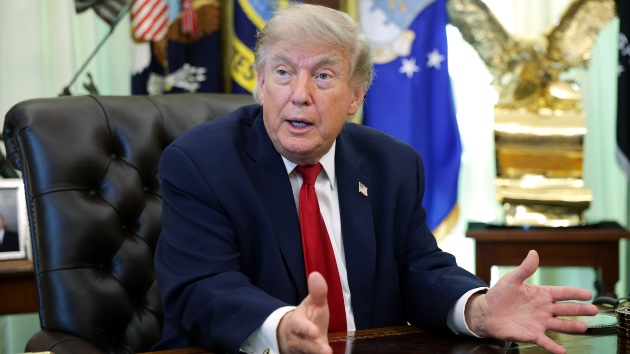
U.S. President Donald Trump talks to reporters in the Oval Office at the White House on June 29, 2026 in Washington, DC. (Photo by Alex Wong/Getty Images)
(WASHINGTON) — The United States and Iran are sharing conflicting messages about the prospects of a meeting between key negotiators in Qatar this week, injecting even more uncertainty into a peace process that is supposed to be focused on addressing Iran’s nuclear program but has so far been dominated by the Strait of Hormuz.
Talks between the countries were originally scheduled to take place in Switzerland this week and center on nuclear issues, but the venue and agenda for the planned high-level and technical meetings changed following a fresh round of tit-for-tat strikes between the U.S. and Iran over the strategic waterway, a U.S. official and another source said.
While the Trump administration is pushing for direct talks, it is still unclear whether Iranian and American officials will meet face-to-face or communicate solely through Qatari mediators, they added.
President Trump announced on Monday that a meeting would take place in Qatar’s capital on Tuesday at Tehran’s request.
“IRAN HAS REQUESTED A MEETING. IT WILL TAKE PLACE TOMORROW IN DOHA!” Trump said in a social media post on Monday morning.
White House Press Secretary Karoline Leavitt later said the U.S. would be represented by Special Envoy Steve Witkoff and the president’s son-in-law, Jared Kushner, adding that both high-level and technical talks with Iran were expected to take place.
Esmail Baghaei, a spokesman for Iran’s foreign ministry, painted a different picture of the upcoming meetings. He said that while an Iranian delegation would travel to Doha to discuss the implementation of the interim deal between the U.S. and Iran, their trip bore no connection to Kushner and Witkoff’s visit.
“There are no negotiation meetings with the U.S. side at any level scheduled in the coming days,” Baghaei asserted.
The Iranian regime’s apparent hesitancy to resume in-person talks is a significant step back from the high-level talks that took place in Switzerland earlier this month following the signing of a memorandum of understanding between the countries. After that meeting, Vice President JD Vance reported that lengthy conversations with senior Iranian officials had resulted in a “good foundation for a successful final deal,” and said they made progress towards the creation of a “mechanism” to ensure the Strait of Hormuz would remain open.
The interim deal stipulates that Iran should “make arrangements using its best efforts for the safe passage of commercial vessels with no charge for 60 days only from the Persian Gulf to the Sea of Oman and vice versa.”
But Iran has repeatedly threatened to close the strait, and on Thursday, it attacked a container ship transiting the waterway–setting off a four-day exchange of strikes with the U.S. that stymied ship traffic.
Trump administration officials are eager to restore conditions in the Strait of Hormuz to their pre-war norm, but sources told ABC News that recent intelligence reports predict Tehran will continue threatening to resume its chokehold on the waterway — a reality that gives Iran significant leverage over the global economy.
The memorandum of understanding also calls for Iran and the U.S. to hammer out a sweeping agreement within 60 days. Almost a quarter of that time has now expired.
While the interim deal says that period can be extended by mutual agreement, Trump has repeatedly declared he wouldn’t let Iran draw out the negotiations.
“We’re negotiating from a position of pure strength, pure strength. They know that,” Trump said on Thursday.
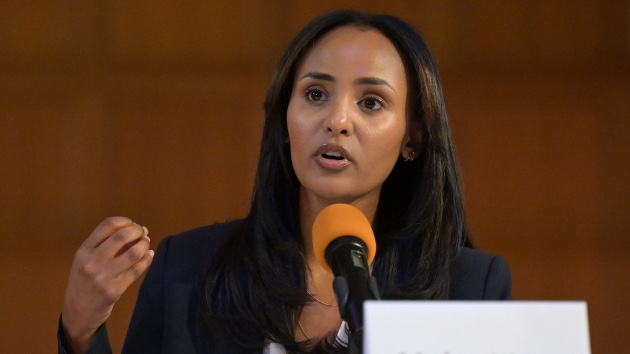
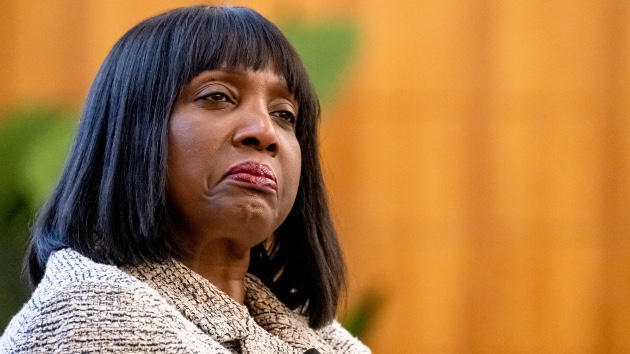
Melat Kiros participated in a League of Women Voters Congressional District 1 candidate forum at Montview Presbyterian Church on May 28, 2026, in Denver, Colorado. (Photo by RJ Sangosti/MediaNews Group/The Denver Post via Getty Images)
(NEW YORK) — After victories in New York City, democratic socialists are taking their fight against the Democratic establishment to Colorado.
On Tuesday, Rep. Diana DeGette will face her toughest reelection fight yet, against 29-year-old attorney and democratic socialist Melat Kiros, who was born months after she won her seat in Congress, 30 years ago.
Kiros, who was fired from her law firm in 2023 after writing an open letter criticizing her employers’ response to pro-Palestinian protests, told ABC News she hopes to build on the movement’s momentum from last Tuesday in New York and channel voters’ anger with the political system.
“Ultimately, folks are really tired of the party failing to meaningfully represent the values and policies that are extremely popular with our base,” she said. “And we’re looking for leaders that are unbought and unafraid to stand up to a lot of these corporations and special interests that have gotten us into this mess in the first place.”
While Kiros has netted the endorsement of progressive stalwart Sen. Bernie Sanders (I-Vermont) and some left-leaning groups, the race does not break down evenly along ideological fault lines. DeGette is a leading member of the Congressional Progressive Caucus who has led Democratic messaging on abortion rights and served as a House impeachment manager during President Trump’s second impeachment trial.
Unlike some incumbent Democrats facing primaries, she has criticized Israel’s handling of the war in Gaza and voted against additional U.S. military aid to Israel.
“Denver knows I don’t back down. That’s why I’m taking on Donald Trump to protect our reproductive freedom, abolish ICE, and pass Medicare for All. Together we’ll win and deliver on our progressive values,” DeGette said in a statement to ABC News.
In a recent interview with ABC affiliate KMGH-TV, DeGette argued that her time in Congress is an asset to her constituents.
But that long record has also made her a target for frustrated progressives, who sense momentum after democratic socialists Darializa Avila Chevalier and Claire Valdez defeated establishment-backed Democrats in two New York City primaries – including the chairman of the Congressional Hispanic Caucus – last week, with the help of democratic socialist Mayor Zohran Mamdani.
“They see Melat as someone who has put up a fight – not just against Republican fascism, but also against the Democratic establishment that has failed voters,” Usamah Andrabi, communications director for Justice Democrats, told ABC News.
The group has helped Kiros and her allies knock on tens of thousands of doors and make more than 200,000 calls to potential voters since last week.
DeGette’s record “is very progressive, and she’s not a moderate,” Doug Friednash, an attorney who was chief of staff to former Gov. John Hickenlooper, told ABC News. “A lot of young voters are demanding change … they look at rising health care costs, gas prices, and there’s a view that the establishment hasn’t done enough.”
Outside of Denver, the Democratic establishment faces tests in primaries for governor and Senate.
Hickenlooper, now serving as Colorado’s junior senator, faces progressive state senator Julie Gonzales in the primary.
And Sen. Michael Bennet is locked in a competitive race against Attorney General Phil Weiser to replace outgoing Democratic Gov. Jared Polis.
Weiser, who served in the Obama administration and as Colorado’s attorney general since 2019, has positioned himself as the insurgent in the race against Bennet, linking the longtime senator to Washington.
And in Colorado’s 8th district, a battleground seat currently held by a Republican, Democrat Manny Rutinel, a 31-year-old state representative, is vying for the Democratic nomination against former state lawmaker Shannon Bird.
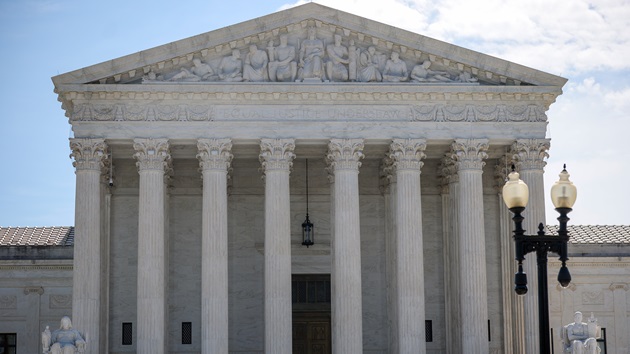
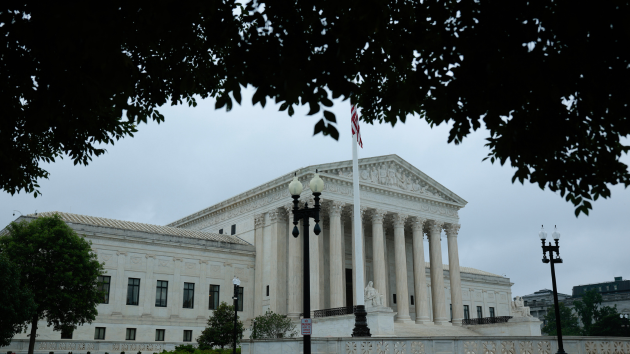
The U.S Supreme Court is seen on June 25, 2026 in Washington, DC. (Kevin Dietsch/Getty Images)
(WASHINGTON) — The Supreme Court on Monday limited law enforcement’s use of sprawling “geofence warrants” that track a suspect using cellphone location data from a broad swath of users, including people with no connection to a crime.
In a 6-3 decision, Justice Elena Kagan wrote that collection of location data through a geofence warrant implicates the Fourth Amendment’s protections against unreasonable searches and seizures — a setback for the federal government, which argued the warrants were a critical law enforcement tool that did not amount to a search at all.
“An individual has a reasonable expectation of privacy in records about his cell phone’s location, and police intrude on that constitutionally protected interest when they demand the information — even though for only a limited time, and from a third-party tech company,” Kagan wrote for the majority.
Kagan concluded that location data — which she described as “a personal journal of a user’s movements” — resembles other kinds of private materials such as emails, photographs or documents and should be “shielded from the ‘inquisitive eyes’ of the government.”
“Today’s decision follows from the same judicial obligation, to guard against the same risk of undue encroachment. The Fourth Amendment applies, too, when officials tap into Google’s ‘database of physical location information.’ That database is new, but the principle covering it is not: That principle is instead the one our history has given. The Fourth Amendment must, as ever, protect against unjustified governmental intrusion on the privacy of the individual,” Kagan wrote.
In effect, the ruling requires authorities to obtain a narrowly tailored warrant before examining cellphone data of a broad swath of users in an area.
While the Supreme Court ruled that location data is protected by the Fourth Amendment, the justices did not weigh in on the legality of the search that prompted the legal challenge — instead leaving that issue for the lower courts to reexamine.
The landmark decision stemmed from a case involving a 2019 bank robbery in Virginia. Law enforcement was able to track down the robber using a geofence warrant that included the location data for every cellphone within a 150-meter radius of the robbery.
While Okello Chatrie, the suspect and Supreme Court plaintiff, eventually pleaded guilty to the armed robbery and was sentenced to serve 12 years in prison, his lawyers have argued that the warrant violated his Fourth Amendment rights because it allowed law enforcement to “to search first and develop suspicions later.”
Justices Samuel Alito, Clarence Thomas and Amy Coney Barrett dissented. In his dissenting opinion, Justice Alito argued the ruling was an “irresponsible escapade” and “destabilizes longstanding Fourth Amendment jurisprudence.”
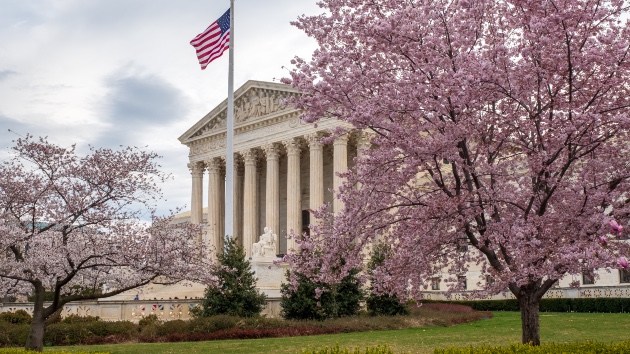
Cherry blossoms at the Supreme Court on a windy morning in Washington, D.C. (John Baggaley/Getty Images)
(WASHINGTON) — In a ruling with direct bearing on the midterm elections, the Supreme Court on Monday narrowly upheld a Mississippi law allowing tabulation of late-arriving mail-in ballots so long as they were postmarked by Election Day.
Justice Amy Coney Barrett, writing for the 5-4 majority, wrote that federal election statutes — which say nothing about ballot receipt — do not override states’ ability to set their own policies for handling tardy votes by mail.
“The Framers recognized the difficulty of crafting election laws applicable to every probable change in the situation of the country. So instead of constitutionalizing election law, they decided that a discretionary power over elections needed to be lodged somewhere. Suffice it to say, that power was not lodged in this Court,” Barrett wrote.
The decision is a loss for the Republican Party, which brought the case, and the Trump administration, which has pushed to override state election rules nationwide by imposing strict federal limits on voting by mail.
The president on Monday called the Supreme Court’s decision a “tremendous loss” and again called on Congress to pass the SAVE America Act, his signature election and voting reforms legislation.
Senate Majority Leader John Thune has repeatedly said there aren’t enough Republican votes for it to pass.
The 29 states that currently accept some timely cast but late-arriving mail-in ballots — sometimes up to several days after polls have closed — will be able to continue providing a grace period.
In dissent, Justice Samuel Alito, joined by Justices Clarence Thomas, Neil Gorsuch and Brett Kavanaugh, wrote that the decision flouts the meaning of “election day” as set forth in federal law.
“Not only is today’s decision inconsistent with statutory text, legal context, historical practice, and precedent; it also threatens to produce lamentable consequences,” Alito wrote. “The majority’s holding spawns a slurry of troubling election-law questions and risks further undermining Americans’ confidence in election integrity.”
The outcome is a win for Mississippi, which had defended its policy of accepting ballots up to five days after voting had ended, and voting rights advocates who had argued that decades of legal precedent supported the primary authority of states to run their own elections.
Voters heavily reliant on the U.S. Postal Service, such as rural, overseas and disabled voters, had feared a higher risk of having ballots rejected if delivery is delayed, election watchdog groups said.
Lateness is the primary reason mail ballots are rejected nationwide, according to the U.S. Election Assistance Commission (EAC).
During the 2024 election, 28 million mail ballots were cast in the 14 states with postmark deadlines and grace periods, according to EAC. Roughly 725,000 were not counted because they were late.
The Supreme Court ruling comes as Trump has pushed aggressively to increase federal oversight of mail-in voting.
A Trump executive order signed in March 2026 would require states to submit approved voter lists to the U.S. Postal Service, which in turn would be tasked with ensuring ballots are only delivered to eligible residents.
Last week, Federal District Court Judge Indira Talwani of Massachusetts put the order on hold, writing in her decision, “The Constitution reserves the power to determine voter eligibility to the States alone. Neither the Executive Branch nor Congress may interfere with this power.”
The Postal Service has not yet implemented a proposed policy change to comply with Trump’s order, but a top USPS official confirmed to Congress that his agency would refuse to deliver ballots unless states turn over lists of voters.
“No law enacted by Congress delegates authority to control mail-in voting to USPS. The voting-related guidance currently issued by USPS is not binding on the States, merely recommended,” Talwani’s ruling said.
Lisa Cook, governor of the US Federal Reserve, during the Stanford Institute for Economic Policy Research (SIEPR) Policy Forum at Stanford University in Stanford, California, US, on Wednesday, May 27, 2026. : David Paul Morris/Bloomberg via Getty Images
(WASHINGTON) — The Supreme Court has blocked for now President Donald Trump’s unprecedented attempt to fire a member of the Federal Reserve Board of Governors, Lisa Cook, over allegation of gross negligence and without any formal opportunity for her to answer the claims.
The decision means Cook, a Democratic appointee who has 10 years left on her 14-year term, will retain her position. She is the first Black woman to serve on the central bank’s advisory committee.
While the Court has recognized expansive power of a president over executive branch agencies, it has appeared to draw a line at the Fed, which has a long history of independence from direct White House interference.
Federal law allows presidents to remove a Fed governor, but only for cause. The heart of Trump’s appeal before the high court involved what constitutes “cause;” who gets to decide that; and, what due process may be owed.
The president had asserted unchecked power, insisting allegations of mortgage fraud against Cook – raised by a member of Trump’s administration, Federal Housing Finance Agency Director Bill Pulte – were sufficient basis alone for her removal.
Trump has claimed Cook illegally filed a mortgage application for a second home as a “primary” residence in an effort to secure more favorable loan terms, at the very least creating an impression of impropriety. The Justice Department has opened a criminal investigation.
Cook, who refused to resign and has not been charge with a crime, insists through her attorneys that relying on “one stray reference” in a 2021 mortgage document amounts to pretext for a politically-motivated effort to manipulate the Fed’s policy board.
The case was being examined by the court in a very preliminary posture, focusing primarily on Trump’s request to stay a lower court order that Cook be allowed to remain on the job as litigation continues. No lower court has thoroughly considered the legal or constitutional issues connected to the dispute.
The court’s decision is widely seen as a victory for the independence of the Federal Reserve – at least in the near term – in the face of Trump’s extraordinary effort to influence the central bank.
This is a developing story. Please check back for updates.
The U.S. Supreme Court building stands in Washington, D.C., U.S. Photographer: Al Drago/Bloomberg
(WASHINGTON) — In a landmark decision that could transform the federal government, the Supreme Court has voted to allow President Donald Trump to remove a Democratic member of the Federal Trade Commission, Rebecca Slaughter, for policy reasons, rolling back 90 years of legal precedent that had prevented at-will removal of independent agency officials and significantly expanding presidential power.
The 6-3 decision came from Chief Justice John Roberts.
This is a developing story. Please check back for updates.
Cherry blossoms at the Supreme Court on a windy morning in Washington, D.C. (John Baggaley/Getty Images)
(WASHINGTON) — The Supreme Court on Monday, in a 5-4 decision, upheld state laws that allow the counting of late-arriving mail-in ballots even if they were postmarked by Election Day.
This is a developing story. Please check back for updates.
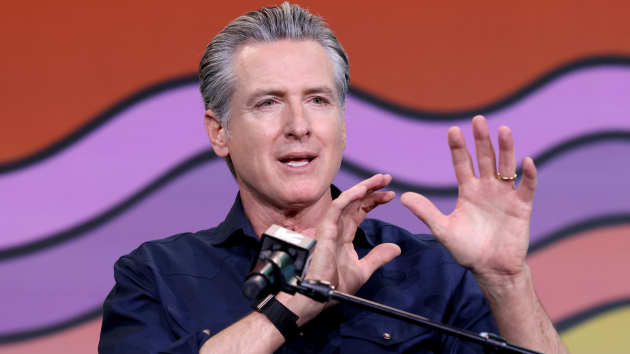
Governor Gavin Newsom speaks at Networth and Chill podcast at the Vox Media Podcast Stage at SXSW on March 15, 2026, in Austin, Texas. (Photo by Rick Kern/Getty Images for Vox Media)
(CALIFORNIA) — As he gears up for a possible presidential bid, California Gov. Gavin Newsom on Friday proposed a national “billionaires’ tax,” — a day after the state wealth tax measure he opposes qualified for the November ballot.
Newsom’s counter proposal calls for a federal minimum tax rate on Americans worth more than $100 million, rather than a state level one-time 5% wealth tax that the governor argues could be dodged by billionaires who could leave the state for another.
Newsom, who said earlier this month that he is “considering running for president,” said the country should return to pre-2017 corporate tax rates and close offshore loopholes that allow multinationals to shift profits and pay less in taxes. He also said inheritance rules need to be rewritten.
“Over the next twenty years, this country will live through the largest intergenerational wealth transfer in human history, with roughly $124 trillion changing hands. If we do not act, that transfer of wealth among the ultra-wealthy will lock in a permanent American aristocracy of inherited wealth,” Newsom wrote in a Substack post announcing the proposal on Friday morning.
The announcement comes a day after California’s own billionaire tax qualified for the November ballot, having collected more than double the signatures needed. The measure, a one-time 5% tax on billionaire wealth introduced by healthcare workers union SEIU-UHW, in response to steep healthcare funding cuts resulting from President Donald Trump’s “Big Beautiful Bill,” has faced opposition from Newsom, California Democratic gubernatorial nominee Xavier Becerra and major lobbying organizations.
“We can’t let a single advocacy organization, however well-intentioned, write the state’s tax code on its own terms,” Newsom wrote, calling out the SEIU-UHW.
The measure has also led to heavy spending from billionaires, who oppose the tax. The nonprofit, Building a Better California, which supports committees promoting two competing ballot initiatives that would nullify the billionaire tax initiative, if passed, has raised more $118 million — and $80 million of that comes from Google co-founder Sergey Brin.
Newsom says that he understands the “anxiety driving the wealth tax proposal in California,” but that he’s voting no on the California proposal, because he argues the measure dedicates almost all of the revenue to just state-funded healthcare services.
SEIU-UHW Vice President Debru Carthan said Thursday that the coalition supporting the tax would not back down.
“The billionaire tax will be on the November ballot,” said Carthan. “And we intend to win.”
About 250 billionaires would be taxed under the California measure, and the state’s nonpartisan Legislative Analyst’s Office says it’s likely that some billionaires would leave the state.
“You may not be able to pick up and move to Texas or Florida to shelter your income from taxation, but I promise you that billionaires can, and do,” Newsom writes. “Wealth is movable, and it shops for the state with the lowest taxes. The fight belongs at the federal level, where this broken system was created in the first place.”
Dan Schnur, a political science professor at UC Berkeley, called Newsom’s tax proposal “savvy political positioning” as it helps him enter the 2028 field without being seen as an opponent to taxing the rich.
“He’s not against taxing billionaires, he just has a different way of doing it,” Schnur said. “He now has an answer for progressive Democrats, whether in California or in early primary states, as to why he didn’t support the ballot measure.”
In Washington, another 2028 contender, California Democratic Rep. Ro Khanna, joined Vermont independent Sen. Bernie Sanders — both of whom supported the California’s initiative — in introducing legislation that would establish an annual 5% wealth tax on billionaires nationwide.
Newsom is also proposing a national public equity fund, giving Americans a stake in economic gains generated by artificial intelligence companies. The fund — aimed at workers left behind by automation — would support universal child care, free higher education, career training and healthcare.
“Part of this fund could provide a real transition for the laid-off factory worker in Ohio or the 25-year-old coder in San Francisco who sent out a thousand resumes and got zero callbacks,” Newsom wrote. “This could include significant severance and portable benefits while we support them through the transition and into new jobs with programs like enhanced employment insurance.”
“As artificial intelligence reshapes the country, every American should own a piece of the future it builds,” Newsom wrote.
Other potential 2028 contenders are also beginning to stake out their positions on AI. Democratic Rep. Alexandria Ocasio-Cortez has introduced legislation proposing a nationwide moratorium on AI data center construction, which would create a temporary prohibition on the construction and expansion of data centers until Congress passes legislation to address the economic, environmental and safety impacts of artificial intelligence.
A light rain falls outside of the U.S. Supreme Court ahead of the release of new opinions on June 23, 2026 in Washington, DC. (Chip Somodevilla/Getty Images)
(WASHINGTON) — Next week, the U.S. Supreme Court is expected to weigh in on President Donald Trump’s attempt to end birthright citizenship by executive order, a move which would upend more than a century of legal precedent and a national tradition that have said babies born on American soil are automatically American citizens.
The ruling, one of the most highly anticipated of the year, is a major test of Trump’s unprecedented assertion of presidential power in his second term with major stakes for millions of children and their families.
What is birthright citizenship?
Birthright citizenship is the idea that a child automatically becomes a citizen of the country in which they are born, regardless of the immigration status of their parents.
It reflects the principle of jus soli, or right of the soil, extending citizenship purely on the basis of geographic location.
By contrast, many countries extend citizenship under the principle of jus sanguinis, or right of blood, which is determined by the nationality of a child’s parents regardless of the location of birth.
How does birthright citizenship work in the U.S.?
With few exceptions, all babies born on U.S. soil become U.S. citizens.
For the approximately 3.6 million children born in American hospitals every year, the birth certificate alone has been the key to obtaining Social Security numbers, passports and early life benefits.
Into adulthood, the birth certificate has been universally recognized as proof of citizenship for such things as voter registration, employment, home loans and military service.
What does the Constitution say about birthright citizenship?
The 14th Amendment, which was ratified in 1868 to address the legal status of former slaves and their descendants, says plainly that all “persons born or naturalized in the U.S. and subject to the jurisdiction thereof” are citizens.
Congress later codified the same language in federal citizenship law enacted in 1940.
Courts and the government have repeatedly interpreted the 14th Amendment to unambiguously confer citizenship on all children born in the U.S., including babies of unauthorized noncitizens and temporary residents, such as asylum seekers, international students, tourists and seasonal workers.
Do other countries allow birthright citizenship?
Yes. Thirty-two other countries have citizenship laws nearly identical to the U.S., according to data compiled by the Pew Research Center. Roughly 50 more have limited versions of birthright citizenship.
The most inclusive citizenship policies are in countries in the Western Hemisphere. Brazil, Canada, Argentina and Mexico, for example, closely mirror American law.
Pakistan, Chad and Mozambique are other notable comparators to the U.S.
European countries have historically been more restrictive when it comes to citizenship. France, Greece and Spain extend citizenship at birth only to children whose parents were also born in those countries.
Australia, Germany and the United Kingdom grant automatic citizenship to any child born to a legal resident.
Why does President Trump want to end birthright citizenship?
On the first day of his second term, President Trump signed an executive order purporting to end birthright citizenship by redefining the meaning of the 14th Amendment.
He claims that children born to noncitizen parents who are either unlawfully in the country or who possess temporary legal status, such as tourists or foreign students, are not “subject to the jurisdiction” of the U.S. and therefore ineligible.
The order would restrict citizenship to babies of current American citizens or other lawful permanent residents that have established “domicile” in the U.S.
The president argues the current citizenship policy is a “scam” that has allowed wealthy adversaries to take advantage of American benefits and “ripped off” taxpayers by providing financial assistance to children of undocumented people.
What is the argument in favor of birthright citizenship?
Birthright citizenship has been part of American tradition repeatedly affirmed by courts and legislators for more than a century.
The Supreme Court previously rejected constitutional arguments similar to the ones Trump is making.
“The [14th] Amendment, in clear words and in manifest intent, includes the children born, within the territory of the United States, of all other persons, of whatever race or color, domiciled within the United States,” wrote Justice Horace Gray in 1898 in the landmark Wong Kim Ark v. U.S. decision, addressing the status of children born to noncitizens.
Immigrant advocates and civil liberties groups have warned that ending birthright citizenship would harm hundreds of thousands of children born every year to noncitizen parents and create a bureaucratic nightmare for older Americans who would no longer be able to prove citizenship simply with a birth certificate.
An estimated 255,000 children born every year to noncitizen parents would have lost legal status under the order, according to the Migration Policy Institute. Some may have faced difficulty establishing citizenship in any country, effectively being born as “stateless.”
What happens if the Supreme Court allows Trump to end birthright citizenship?
The Trump administration says federal agencies have prepared guidelines for implementing a new process of conferring citizenship to children born after the order takes effect.
Federal agencies — by electronic databases or otherwise — would evaluate the legal status of a child’s parents first before making a determination of eligibility for citizenship and, in turn, for a Social Security number, passport and other benefits.
A U.S. birth certificate alone would no longer be sufficient proof of citizenship for any child going forward, including those born to American parents.
Immigrant advocates have warned of a “bureaucratic nightmare” for all parents of newborns, with vulnerable low-income children being particularly at risk of not getting necessary health care or nutrition assistance.
Some children who would not qualify for U.S. citizenship may be rendered “stateless” since several countries, particularly in southeast Asia, do not confer citizenship automatically to children born to their nationals abroad. That lack of legal status might make some newborns immediately eligible for deportation.
Can birthright citizenship be stripped if the court upholds Trump’s order?
The Trump administration says the executive order is not retroactive and would only apply to babies born after it takes effect.
However, some legal experts fear that any legal reasoning upholding Trump’s reinterpretation of the 14th Amendment could potentially be used by a future administration to pursue efforts to strip citizenship from some people if it wanted to.
“The government could move to unnaturalize people who were born here of illegal residents,” Justice Sonia Sotomayor said during oral arguments in April.
When will the Supreme Court issue a ruling?
The justices are expected to rule in the case — Trump v. Barbara — before adjourning for their summer recess in early July.
A light rain falls outside of the U.S. Supreme Court ahead of the release of new opinions on June 23, 2026, in Washington, DC. As it nears the end of the 2025-2026 term, the court handed down rulings in five cases, leaving about 10 more to be announced in the next week. (Photo by Chip Somodevilla/Getty Images)
(WASHINGTON) — The Supreme Court ruled Thursday that the Trump administration can turn away asylum seekers who approach ports of entry along the U.S.-Mexico border, reversing a lower court decision that the policy likely violates federal law and international treaties.
“We hold that an alien who is standing in Mexico does not ‘arrive in the United States’ by attempting, and failing, to set foot in the country,” Justice Samuel Alito wrote for the court’s conservative majority. “An alien ‘arrives in the United States’ only when he crosses the border.”
The 6-3 decision effectively allows border agents to shut the door to migrants fleeing violence and persecution, and deny them even the chance to seek refuge in the U.S.
Federal law says the opportunity to apply for asylum must be afforded to those who “arrive in” the country.
While the policy was voluntarily rescinded in 2021 after a surge of migrants had overwhelmed border crossings, the government now has the ability to reinstate it if necessary. Trump has so far invoked alternate legal authorities to support his current border crackdown.
“A running back does not arrive in the end zone when he reaches the 1-yard line,” Alito wrote. “A guest does not arrive in a house when he knocks on the front door. An army does not arrive in a city by encamping outside its walls. And a letter does not arrive in a mailbox while it remains in the mail carrier’s hand just inches away.”
In a dissent, Justice Sonia Sotomayor, joined by Justices Elena Kagan and Ketanji Brown Jackson, said her colleagues were distorting the procedures set out by Congress to protect vulnerable people.
“The Court today holds that the Executive Branch may circumvent all these mandatory procedures by having U.S. immigration officers stand at the border and physically block noncitizens from setting a foot onto U.S. soil. They may do so even if the asylum seeker is at the threshold of a port of entry designated to receive all noncitizens who seek entrance into the country,” she wrote. “Even if the asylum seeker is certain to be persecuted, or killed, if she is turned away.”
Sotomayor invoked the history of the MS St. Louis from World War II, when European Jews sailed across the Atlantic seeking safety in the U.S., only to be turned away and sent back, where most were killed in the Holocaust. Congress enacted the 1980 Refugee Act, in part, to address that “mistake” of the past.
“The consequences of today’s decision are predictable. More people will die. More people will attempt to cross the border illegally, and some will make it while others will not,” she wrote. “More people will turn back and be subjected to violence because of something they cannot or should not have to change about themselves, such as their race, religious, nationality, or political opinion.”