(WASHINGTON) — On Thursday evening, the Senate passed a bill that will start the process of raising the debt limit with only Democrats’ votes.
Having gained the necessary support to clear the filibuster earlier Thursday afternoon, the Senate-passes legislation will permit a one-time change to Senate rules and allow Democrats to raise the federal borrowing limit by a simple majority.
Despite only requiring 51 votes, 10 Republicans voted with all Democrats to pass the rule, resulting in a 59-35 margin.
On Tuesday, congressional leaders announced a deal that would avert a default of the nation’s credit by allowing Democrats to raise the debt ceiling in the Senate without any Republican support, and the House approved the measure along party lines in a late-night 222-212 vote.
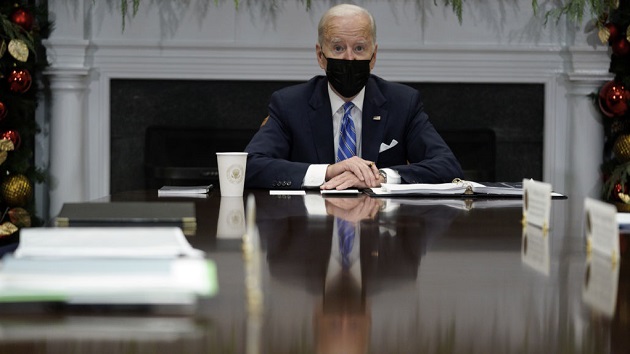
The bill will now head to President Joe Biden’s desk. Once Biden signs the rule change, Democrats in both chambers of Congress will need to pass a second piece of legislation that actually raises the debt limit. Biden must sign that second bill before Dec. 15 to avert catastrophic default, according to the Treasury Department.
ABC News’ Mariam Khan and Trish Turner contributed to this report.
(NEW YORK) — New York Attorney General Letitia James announced Thursday that she’s suspending her campaign for governor and will instead run for reelection for attorney general.
James took to Twitter saying that there are “many investigations and cases underway” and that she “intends to finish the job.”
She opted to relinquish her pursuit of the governor’s office for the good of the state Democratic party, the chairman told ABC News.
“I think that she understands that we need to be united now and divisive primary is going to go against our interests. Not going to help us. This was a selfless act on her part,” state Democratic chairman Jay Jacobs told WABC.
James’ campaign did not gain significant traction despite her high profile as the state’s attorney general. Gov. Kathy Hochul locked up significant endorsements across the state in her bid to win a term outright after she assumed office upon the resignation of former Gov. Andrew Cuomo.
A source familiar with the matter told ABC News Thursday James wants to depose former President Donald Trump as part of her office’s civil investigation into the Trump Organization.
She sought testimony from the former president Jan. 7, the source said, confirming a detail first reported by the Washington Post.
The attorney general’s office is investigating whether the Trump Organization committed financial fraud in the way it valued its real estate holdings. Property valuations are also under investigation by the Manhattan District Attorney’s office, which is deciding whether the former president should face criminal charges.
At a press conference about COVID-19 on Thursday, Hochul told reporters that James called her in the morning to inform her about the decision. Hochul said she supports James’ reelection as attorney general.
“I want to thank her for her leadership; even last week we were together in a Brooklyn church; [we were] always very cordial, always respectful to each other. And that’s the hallmark of the two of us and how we plan to continue working together to support the important policies that she’s undertaking and her support for what we’re doing here in the state of New York,” Hochul said.
Hochul also addressed the investigations James is undertaking: “This is a very bad day for Donald Trump and the NRA when we have when we have Tish James, one of the finest attorney generals in the country, very focused on making sure that justice is done.”
James’ announcement had an immediate impact on the attorney general race, as one candidate dropped out of the Democratic primary and endorsed James.
“Her decision to run for re-election demonstrates her determination to continue her unparalleled actions on major cases and important investigations that are currently pending,” state Sen. Shelley Mayer, who launched her run for attorney general in November, wrote in a statement on Twitter.
Mayer said she will instead run for reelection in the state Senate.
James launched her campaign for governor in late October. Her public profile grew this year following investigations into the office of former New York Gov. Andrew Cuomo for concealing the number of nursing home deaths due to COVID-19 and into sexual harassment allegations against him.
James is the first woman of color to hold statewide office in New York and the first woman to be elected attorney general of the state.
In 2013, she was elected public advocate of New York City, and she was reelected for a second term in 2017. She had previously served as a New York City councilmember for ten years. Before being elected to office, James led the Brooklyn Regional Office of the New York State Attorney General’s Office.
(WASHINGTON) — Former Sen. Bob Dole — a decorated World War II veteran and presidential candidate who served in Congress for 36 years — will lie in state at the U.S. Capitol on Thursday as the nation honors the late American statesman.
Dole died Sunday in his sleep at the age of 98.
A formal arrival ceremony will begin at 9:45 a.m. on Thursday followed by a congressional tribute ceremony at 10 a.m. including remarks from President Joe Biden, who worked alongside Dole in the Senate for more than 20 years and called him “a man of extraordinary courage, both physical and moral courage.”
“Our nation owes Bob Dole a debt of gratitude for the remarkable service and a life well-lived,” Biden said on Wednesday in his first public comments about Dole since the senator’s death.
“Like all true friendships, regardless of how much time has passed, we picked up right where we left off, as though it were only yesterday that we were sharing a laugh in the Senate dining room or debating the great issues of the day, often against each other, on the Senate floor,” Biden, who last saw Dole at the White House in February, wrote on Sunday in a statement.
The president will also deliver a eulogy at Dole’s memorial service on Friday at Washington National Cathedral, which will air on ABC News and ABC News Live.
Thursday’s ceremony at the Capitol will be open only to invited guests, lawmakers said, due to the COVID-19 pandemic, but the public can watch online as he lies in state in the Capitol Rotunda until 8 p.m. — an honor reserved for the most revered American officials.
Dole was severely wounded in action while serving as an Army officer in World War II and left with limited mobility in his right arm — but he persevered. From humble beginnings, Dole went on to graduate law school, serve in the Kansas state legislature and then four terms in the House of Representatives and five terms in the Senate. He also led the Senate Republican Conference for more than a decade and was the longest-serving Republican leader until recently surpassed by Sen. Mitch McConnell of Kentucky.
In Congress, Dole helped shape tax, social security and foreign policy, as well as government farm and nutrition programs. He was an advocate for the rights of veterans and Americans with disabilities, instrumental in the passage of the Americans with Disabilities Act in 1990.
He was known was known as one of the “last lions of the Senate.”
Dole ran for president three times, losing primaries in 1980 to Ronald Reagan and in 1988 to George H.W. Bush. After winning the Republican party nomination in 1996, he lost the general election to Bill Clinton, who later presented him with the Presidential Medal of Freedom.
In a USA Today op-ed Dole finished on pen and paper less than two weeks before his death, he said Congress needs teamwork now more than ever, and wrote, “Those who suggest compromise is a sign of weakness the fundamental strength of our American democracy.”
A formal departure ceremony from the Capitol will be held at 9:30 a.m. on Friday ahead of a funeral at Washington National Cathedral and ceremony at the World War II Memorial with remarks from Chairman of the Joint Chiefs of Staff Gen. Mark Milley.
Dole’s body will then be flown to Kansas for services in his home state.
(WASHINGTON) — Former Sen. Bob Dole — a decorated World War II veteran and presidential candidate who served in Congress for 36 years — lay in state at the U.S. Capitol on Thursday as the nation honored the late American statesman.
Dole died Sunday in his sleep at the age of 98.
Dole’s longtime wife, Elizabeth, and daughter, Robin, were escorted by service members and alongside lawmakers for the formal arrival of Dole’s casket ahead of a congressional tribute ceremony with remarks from President Joe Biden, who worked alongside Dole in the Senate for more than 20 years and called him “a man of extraordinary courage, both physical and moral courage.”
The Capitol ceremony began with an invocation by the House Chaplain who said Dole has “revealed to us what moral and faithful service should be.”
“In extolling Sen. Dole’s unequal integrity, disarming humor, and deep compassion, may we be inspired to reach into the depths of our own small-town virtues or our big city bravado to immolate this plain spokesman statesman, this decorated war hero, this, your, humble servant,” she said in an opening prayer.
Biden, in his remarks, first thanked Dole’s daughter and wife of 46 years, Elizabeth, who also served in the Senate, representing North Carolina, for allowing the ceremony to take place. He then said, “America has lost one of our finest patriots.”
“We meet here in the very heart of American democracy, the capital of the United States of America, to receive a hero of that democracy for a final time,” Biden began. “Robert Joseph Dole belongs here in this place, in this temple of liberty to liberty and temple to possibilities.”
“He, too, was a giant of our history, and that’s not hyperbole,” Biden said, after listing great leaders in American history, including George Washington, Abraham Lincoln, Dwight Eisenhower and Martin Luther King Jr. “It’s real. Of wit and grace, of principle and persistence, of courage and conviction.”
The president shared a light-hearted, personal story before reading a portion of Dole’s final message to the nation.
“They once asked him, why in God’s name did he vote to continue to fund Amtrak. He said because if he didn’t, Biden would stay overnight and cause more trouble,” Biden said to laughter. “Bob and I, like many of us here, we disagreed on a number of things, but not on any of the fundamental things. We still found a way to work together.”
“As divided as we are, the only way forward for democracy is unity, consensus,” Biden said. “We can find that unity again.”
He will also deliver a eulogy at Dole’s memorial service on Friday at Washington National Cathedral, which will air on ABC News and ABC News Live.
Senate Minority Leader Mitch McConnell offered words on Dole’s management in the Senate, having served twice as majority leader for Republicans, and got laughs when describing Dole’s “trademark wit.”
“‘If I’d known, he said, we were going to win control of the Senate, we’d run better candidates,'” McConnell recalled. “I swear, Bob could have made it as a stand-up comic. But in that maiden speech, Bob was earnest. He was already championing a signature cause, helping Americans with disabilities,” McConnell said, garnering a nod from Vice President Kamala Harris, who sat in the socially-distanced audience.
Thursday’s ceremony at the Capitol was open only to invited guests, lawmakers said, due to the COVID-19 pandemic, but the public can watch online as he lies in state in the Capitol Rotunda until 8 p.m. — an honor reserved for the most revered American officials.
Honor guards greeted the body of the late senator shortly after 9:45 a.m. on Thursday and carried his casket up the steps of the building Dole served in for nearly four decades. The last senator to lie in state at the Capitol Rotunda was the late Sen. John McCain in 2018. Twelve U.S. presidents have also had the honor.
Dole was severely wounded in action while serving as an Army officer in World War II and left with limited mobility in his right arm — but he persevered. From humble beginnings, Dole went on to graduate law school, serve in the Kansas state legislature and then four terms in the House of Representatives and five terms in the Senate. He also led the Senate Republican Conference for more than a decade and was the longest-serving Republican leader until recently surpassed by Sen. Mitch McConnell of Kentucky.
In Congress, Dole helped shape tax, social security and foreign policy, as well as government farm and nutrition programs. He was an advocate for the rights of veterans and Americans with disabilities, instrumental in the passage of the Americans with Disabilities Act in 1990.
He was known as one of the “last lions of the Senate.”
Dole ran for president three times, losing primaries in 1980 to Ronald Reagan and in 1988 to George H.W. Bush. After winning the Republican party nomination in 1996, he lost the general election to Bill Clinton, who later presented him with the Presidential Medal of Freedom.
In a USA Today op-ed Dole finished on pen and paper less than two weeks before his death, he said Congress needs teamwork now more than ever, and wrote, “Those who suggest compromise is a sign of weakness the fundamental strength of our American democracy.”
A formal departure ceremony from the Capitol will be held at 9:30 a.m. on Friday ahead of a funeral at Washington National Cathedral and ceremony at the World War II Memorial with remarks from Chairman of the Joint Chiefs of Staff Gen. Mark Milley.
Dole’s body will then be flown to Kansas for services in his home state.
(WASHINGTON) — Ali Alexander, a prominent conservative activist who organized “Stop the Steal” rallies after the 2020 election, is cooperating with the House Jan. 6 select committee and is scheduled to appear behind closed doors on Thursday morning.
Alexander, who was banned from Twitter over his posts about the presidential election, is expected to tell investigators that he had “nothing to do” with any violence that occurred on Jan. 6 at the Capitol, according to a prepared opening statement obtained by ABC News.
“I had nothing to do with the planning. I had nothing to do with the preparation. And I had nothing to do with the execution,” he said in the prepared statement.
Alexander’s cooperation with the committee was first reported by The New York Times.
“As a Black and Arab man, an American, it is common for people who look like me to be blamed for things we did not do,” he said.
Alexander said he attended President Donald Trump’s address to supporters on the National Mall as a guest. Hinting at disagreements with activists in his circle, he is expected to tell the committee that other organizers removed information from the program that would have instructed rallygoers where to go after the event — which could have prevented Trump supporters from marching to the Capitol.
Lawmakers issued subpoenas to Alexander and other conservative activists and organizers who were involved in setting up the post-election rallies in support of Trump’s challenges to the election results.
Investigators are interested in any communications between organizers, Trump White House officials and congressional Republicans — and whether the potential for violence was raised before the assault on the Capitol.
In a statement announcing its subpoena to Alexander in November, the committee said Alexander repeatedly referenced the potental for violence at “Stop the Steal” events following the election.
Ahead of the attack on the Capitol, Alexander was in communication with some Republican lawmakers and aides as he organized rallies around the country on Trump’s behalf. He spoke at a Jan. 5 rally in Washington with far-right and pro-Trump extremist groups, leading chants of “Victory or death!”
In his opening remarks, Alexander said he had spent more than 100 hours working to gather records to comply with the committee’s requests, and called the ordeal “extremely difficult and burdensome.”
“But I am voluntarily here to do the patriotic thing,” he is expected to tell the panel in his opening remarks.
Ahead of Alexander’s appearance, former Trump White House chief of staff Mark Meadows sued the committee and House Speaker Nancy Pelosi over the subpoenas issued for his documents and phone records, after he declined to appear for a deposition and Democrats vowed to hold him in contempt of Congress.
The committee has interviewed more than 275 witnesses, issued dozens of subpoenas and collected thousands of pages of records, along with social media, cell phone and communications data. The panel is expected to start a new round of public hearings as soon as next month.
Chairman Bennie Thompson, D-Mississippi, said the committee has also questioned state election officials in key battleground states about efforts to challenge their work and any potential contacts from the Trump administration.
(WASHINGTON) — By gathering leaders Thursday from 112 of the world’s democracies — some healthy, some challenged — President Joe Biden has done the easy part of a campaign promise: He’s held a summit for democracy within his first year in office.
But to actually make meaningful progress pushing back on the global “democratic recession,” as his administration has warned of, will require far more than speeches, video meetings, and even a joint statement, which it’s unclear his summit will yield.
“Here in the United States, we know as well as anyone that renewing our democracy and strengthening our democratic institutions requires constant effort,” Biden said in opening remarks at the first “Summit for Democracy” Thursday morning.
In front of two video panels with 80 world leaders participating virtually, Biden declared democracy as “the defining challenge of our time,” citing “outside pressure” from autocrats.
“They seek to advance their own power, explore and expand their influence around the world and justify their repressive policies and practices as a more efficient way to address today’s challenges. That’s how it’s sold. By voices that seek to fanned the flames of social division and political polarization,” he said.
The president has cast the fight between democracies and authoritarian governments like China and Russia’s as pivotal to the 21st century — and said his administration will prove that democratic governments can still deliver for their publics.
Activists around the world are pressing the administration, along with their own governments, to demonstrate that this week — taking or announcing concrete steps like strengthening free and fair elections, countering corruption, bolstering a free press and combating disinformation, among other things.
While the guest list has drawn lots of attention, especially for some illiberal heads of government, it’s what the attendees agree on that will really matter, according to many experts — with some skeptical that there will be impactful commitments.
“The Biden administration is conceptually approaching it from the right lens in terms of looking inward and outward and being humble about the challenges that we’re facing” in the U.S., according to Marti Flacks, director of the Human Rights Initiative at the think tank CSIS. But “in practice, translating that into concrete commitments and actions that resonate domestically is very challenging.”
Those commitments will be tested over the next “year of action,” according to the administration, with a second summit the White House plans to hold in-person next year to take stock.
“The interval period between these two events — the virtual and hopefully the in-person — really gives us, I think, a rare opportunity to translate into action commitments that are going to be put on the table,” said Uzra Zeya, the top U.S. diplomat for democracy and human rights. “This is not a one-off event, but it’s really an ongoing engagement process that we hope will culminate in an in-person summit with new platforms and coalitions working together meaningfully.”
Democracy has been deteriorating consistently for the last 15 years, according to Freedom House, a Washington think tank that analyzes and rates governments. Its annual survey found this year that less than 20% of the global population lives in a country considered “free” in their analysis — the lowest percentage since 1995.
That includes the U.S., but there are worrying signs that American democracy is slipping, including partisan attacks on elections, dark money in politics and racial disparities, according to Freedom House — which ranks Belize, Mongolia and Romania’s democracies as stronger.
The International Institute for Democracy and Electoral Assistance, a Swedish think tank, has gone even further, issuing a report last month that said the U.S. has fallen “victim to authoritarian tendencies itself, and was knocked down a significant number of steps on the democratic scale.”
Biden has leaned into that reality, urging the passage of voting rights legislation or historic investments in social programs. But more politically, he’s also gone after supporters of former President Donald Trump, who continued to spread unfounded conspiracies about election fraud, with a senior administration official blaming “Republican legislators” in particular for a “systematic assault.”
“The president has been forthright and clear about the challenges facing democracy here at home throughout his presidency, and I think you can expect him to do so as well at the summit,” the official said Tuesday.
The administration has also announced a series of steps in advance of the meetings — an indication of what kind of action it wants other countries to take. For example, the administration is collecting a group of countries that will commit to stop exporting and sharing technology that could be used to violate human rights, like artificial intelligence.
The Treasury Department is also moving to implement a policy that requires the disclosure of who controls shell companies and has proposed increased oversight of all-cash real estate deals — both of which corrupt foreign officials and other bad actors often use to hide money in the U.S. made illicitly overseas.
The White House also unveiled the first-ever strategy to counter corruption, laying out steps to do so that if “matched with appropriate resources… has the power to fundamentally change the calculus for kleptocrats,” according to Gary Kalman, director of the U.S. office of Transparency International, a German-based nonprofit advocacy group.
“In a world where corruption fuels authoritarianism, today’s strategy provides a forward-looking blueprint for bolstering government integrity and advancing democracy,” he added in a statement Monday.
But the strength of these public commitments will be heavily scrutinized. Already, there’s been criticism that some countries crafted theirs without any input from civil society.
“Having worked with parties and NGOs around the world, I was inundated with emails and calls pleading for advice as to how they could influence their own country’s democracy plan,” Laura Thornton, director of the Alliance for Securing Democracy, a bipartisan U.S. advocacy group, wrote.
Biden will address the summit twice, with opening remarks Thursday and closing remarks Friday. The heads of the other 111 invited governments will make their own speeches, which are expected to include some announcements of how they’re strengthening democracy in their country.
But some of those leaders have checkered records when it comes to doing so.
Filipino President Rodrigo Duterte, for example, has weaponized a war on drugs and terrorism to crack down on dissent and journalists and to rule with violent impunity.
Brazilian President Jair Bolsonaro has sowed doubts about the country’s presidential election next year and threatened to not accept the results, along with attacking the judiciary, political opponents and the free press.
Pakistani Prime Minister Imran Khan will speak, but it’s the military that rules as “political arbiter — more powerful than either the judiciary or the elected government — and sets the constraints within which civilian politics play out,” according to Freedom House.
The Biden administration has defended its invitation list by saying it included a “regionally diverse set” of “established and emerging” democracies, according to Zeya, who added, “The invitation to join us at the summit — it’s not a mark of approval, nor is non-invitation from the summit a sign of disapproval from the United States.”
But if the administration invited them anyway because new “progress and commitments” from these countries “would advance a more just and peaceful world,” as Zeya said, it’s notable then that allies like Turkey and Hungary or neighbors in Central America’s “Northern Triangle” were left off the list.
Certain countries with authoritarian leaders will instead have their opposition leaders participate, including Belarus’s Svetlana Tikhanovskaya and Venezuela’s Juan Guaido, who the U.S. still recognizes as the country’s interim leader.
The administration also invited civic leaders, lawmakers and parliamentarians, journalists, and activists outside of government to address the summit outside of the leader speeches with dozens of side events. So while Duterte will get to pontificate, Filipino journalist Maria Ressa, who shared this year’s Nobel Peace Prize and has been jailed and harassed by Duterte’s government, also spoke Wednesday.
ABC News’ Justin Gomez contributed to this report.
(WASHINGTON) — Former President Donald Trump’s chief of staff Mark Meadows is suing House Speaker Nancy Pelosi and members of the House committee investigating the Jan. 6 Capitol attack, after the panel moved to hold him in contempt for not cooperating with the probe.
Meadows is seeking relief “to invalidate and prohibit the enforcement of two overly broad and unduly burdensome subpoenas from a select committee of the U.S. House of Representatives … issued in whole or part without legal authority in violation of the Constitution and laws of the United States,” according to the lawsuit filed Wednesday in D.C. District Court.
“Mr. Meadows, a witness, has been put in the untenable position of choosing between conflicting privilege claims that are of constitutional origin and dimension and having to either risk enforcement of the subpoena issued to him, not merely by the House of Representatives, but through actions by the Executive and Judicial Branches, or, alternatively, unilaterally abandoning the former president’s claims of privileges and immunities,” the lawsuit says. “Thus, Mr. Meadows turns to the courts to say what the law is.”
Jan. 6. committee chairman Bennie Thompson, D-Miss., had said the panel would move to hold Meadows in contempt after Meadows failed to appear before the committee for his scheduled appearance Wednesday morning.
Following the filing of the lawsuit Wednesday, Thompson told reporters that the panel would move forward with holding Meadows in contempt next week.
On Tuesday, two sources familiar with the matter told ABC News that Meadows had informed the committee that he was no longer cooperating with the probe, after Meadows had earlier agreed to appear before the panel.
Meadows’ attorney, George J. Terwilliger II, told committee members in a letter that they had made an appearance for a deposition untenable because they have “no intention of respecting boundaries concerning Executive Privilege.”
In response, Thompson told Terwilliger in a letter Tuesday night that the committee has “no choice” but to recommend the former chief of staff be held in contempt of Congress for refusing to cooperate.
Thompson’s three-page letter says the committee believes Meadows has “no legitimate legal basis” to refuse to cooperate, given the content in Meadows’ memoir, which was published this week.
The letter also details some of the information and records Meadows has already provided to the committee, including emails from his personal account prior to Jan 6. regarding the election challenges, and data and text messages from his personal cell phone.
According to the letter, Meadows was messaging with one member of Congress about appointing alternate electors from key states to reverse the election results. “I love it,” Meadows replied, according to the letter.
The letter says Meadows also turned over messages he exchanged with a Jan. 6 rally organizer in early January, and another round of messages he exchanged about “a need” for then-President Trump to “issue a public statement that could have stopped the Jan. 6 attack.”
The letter also suggests Meadows may not have complied with federal record keeping laws, given the amount of records he produced from personal devices.
Rep. Adam Schiff, D-Calif., a member of the committee, told ABC News that Meadows may have undercut his own argument against cooperating because of the reams of records he already turned over to the panel.
“He produced a number of documents to our committee, and we have a number of questions about those,” Schiff said. “Those are documents he clearly recognizes he has no viable claim of privilege about, and it’s hard to … reconcile how he can talk about Jan. 6 and his conversations about it and others for a book, but not to Congress.”
(NEW YORK) — Two families from Maine asked the U.S. Supreme Court on Wednesday to expand taxpayer support for religious schools by requiring a state tuition assistance program to include sectarian as well as nonsectarian institutions.
The case, which has been closely watched by school choice advocates, could significantly expand religious liberties and clear the way for broader public support for religious education. Opponents say it risks unconstitutional entanglement of church and state.
During nearly two hours of oral arguments, the court’s conservative majority of justices appeared highly receptive to the families’ claims that Maine has discriminated on the basis of religion, in violation of the First Amendment, by disqualifying schools that “promote” a specific faith and teach subjects “through the lens of their faith.”
“Religious discrimination is religious discrimination,” said attorney Michael Bindas, representing the families. “Religious schools, after all, teach religion just as a soccer team plays soccer and a book club reads books. It’s only because of religion that they are excluded.”
Maine argues that its tuition-aid program is meant to subsidize a “rough equivalent of a public education” and its criteria are religiously neutral — discriminating not on the status or affiliation of the school but what it teaches.
“Maine has determined as a matter of public policy that public education be neutral,” said Maine deputy attorney general Christopher Taub. “[The families] are not being discriminated against.”
Since nearly half of Maine public school districts do not have their own schools, many either contract with other districts to provide education to residents or they provide tuition payments — roughly $11,000 a year — for “the approved private school of the parent’s choice at which a student is accepted.”
Of the roughly 180,000 school children in Maine, only about 5,000 attend private schools using state tuition aid. The plaintiff families want to send their children to Christian schools that overtly advocate religious beliefs and were excluded from the program.
The Supreme Court has said that states cannot use tax dollars to explicitly promote religion, nor can they target a religion or discriminate based solely on religious status. The gray area in between the two rules is where this case will be decided.
Chief Justice John Roberts suggested any state assessment of religious teaching in order to determine qualification for tuition aid would be inherently unconstitutional discrimination.
“We have said that that is the most basic violation of the — the First Amendment religion clauses, for the government to draw distinctions between religions based on their doctrine,” Roberts said.
Justice Brett Kavanaugh said the “neutral position” would be for the state to not consider religion at all in determining a school’s eligibility.
“Why isn’t it treating people neutrally to tell them you’re all equal citizens without respect to your religion, and so, too, all the schools that are accredited are equal without respect to their religion, whether you are secular, Catholic, Jewish, what have you, you’re all going to be treated equally?” he asked.
The court’s three liberal justices took a more critical approach, highlighting potential “strife” among citizens who oppose their tax dollars underwriting religious indoctrination and social values with which they may strongly disagree.
“The very point is they teach all subjects through the lens of religion,” noted Justice Sonia Sotomayor.
Justice Elena Kagan insisted states should be allowed to make their own judgments on funding for religious schools based on local views.
“Why does the state have to exercise — have to subsidize the exercise of a right?” Kagan asked. “Essentially what Maine is saying here is like, all well and good if a locality or if a state wants to do this, but we weigh the interests differently, and shouldn’t we be allowed to weigh the interests differently.”
Bindas, arguing for the parents, insisted Maine’s approach is discrimination that cannot stand.
“This absolutely discriminates against parents. It says you can get an otherwise available public benefit you are statutorily entitled to so long as you don’t exercise a right that this Court recognized,” he said. “And this Court should not allow that to stand.”
The court is expected to hand down a decision next spring.
(NEW YORK) — In the speech she says she would have given had she won the 2016 presidential election, former Secretary of State Hillary Clinton would have challenged the country and spoken to her mother about becoming the first woman elected to the White House, according to excerpts of a video made public Wednesday.
“Fundamentally, this election challenged us to decide what it means to be an American in the 21st century and by reaching for a unity, decency, and what President Lincoln called the better angels of our nature,” Clinton said as she read from a draft of her speech, quoting a line from Abraham Lincoln’s first inaugural address.
“We met that challenge. Today with your children on your shoulders, neighbors at your side, friends, old and new standing as one, you renewed our democracy. And because of the honor you have given me, you changed its face forever.”
Clinton is sharing the speech she never gave in a new online class being released through MasterClass, a subscription service where experts, celebrities, and politicians share video classes teaching skills. Her class, which releases on Thursday, is part of the platform’s “The White House” series where other politicians, including former Presidents Bill Clinton and George W. Bush, are giving political insights and lessons, according to MasterClass.
Excerpts of Hillary Clinton’s class and the speech were aired on NBC’s “Today” broadcast, in an interview with “Sunday Today” host Willie Geist, and online on Wednesday. Clinton told Geist that she chose to revisit the speech because “I wanted to be as helpful as I could to the viewers and to the process of being in a MasterClass.”
In the video released by MasterClass, Clinton became emotional reading a section of her speech about her mother, Dorothy Rodham, who passed away in 2011.
Dorothy Rodham overcame a challenging childhood. Her parents sent her away by train at age 8 to live with her grandparents, and Rodham was forced to find work as a maid at age 14.
Clinton, chocking up, said, “I think about my mother every day. Sometimes I think about her on that train… I wish I could walk down the aisle and find the little wooden seats where she sat holding tight to her even younger sister. Alone; terrified. She doesn’t yet know how much she will suffer. She doesn’t yet know she will find the strength to escape that suffering.”
“I dream of going up to her and sitting down next to her, taking her in my arms, and saying look at me. Listen to me. You will survive. You will have a good family of your own and three children. And as hard as it might be to imagine, your daughter will grow up and become the president of the United States,” Clinton read.
The excerpts of the drafted speech also included the vision Clinton said Americans had of “a hopeful, inclusive, big hearted America. An America where women are respected and immigrants are welcomed; where veterans are honored, parents are supported, and workers are paid fairly.
“An America where we believe in science, where we look beyond people’s disabilities and see their possibilities, where marriage is a right and discrimination is wrong… we all have a role to play in our great American story. And yes, that absolutely includes everyone who voted for other candidates or who didn’t vote at all.”
(WASHINGTON, D.C.) — House Progressives, led by Rep. Ayanna Pressley, said Wednesday they will introduce a resolution later in the day seeking to strip GOP Rep. Lauren Boebert of her two committee assignments in the wake of anti-Muslim remarks she made last month about Rep. Ilhan Omar.
The resolution, obtained by ABC News and first reported by The Washington Post, is co-sponsored by several House progressive members, including Reps. Alexandria Ocasio-Cortez, Pramila Jayapal, Rashida Tlaib, Cori Bush, and Jamaal Bowman.
Their goal: to force Democratic leadership’s hand in punishing Boebert for repeatedly making Islamophobic and racist comments about Omar, likening her to a suicide bomber.
“I haven’t heard anything binding from leadership, which in and of itself is an embarrassment,” Ocasio-Cortez told the news outlet The Hill on Tuesday night. “This shouldn’t take this long; this should not drag on. It’s pretty simple. It doesn’t have to be a big huge thing. It’s pretty open and closed.”
In a video posted to Twitter last month, Boebert referred to Omar as a member of the “Jihad Squad” and claimed that a Capitol Police officer thought she was a suicide bomber in an encounter in an elevator on Capitol Hill.
Boebert later apologized on Twitter “to anyone in the Muslim community I offended,” adding that she had reached out to Omar’s office to speak with her directly, but the phone call did not go well.
Omar is one of only three Muslim members in Congress. She said she has received “hundreds” of death threats often triggered by Republican attacks.
House Speaker Nancy Pelosi has said Boebert’s comments about Omar are “dangerous” and “indecent” and there have been discussions among the caucus about taking decisive action against Boebert. Pelosi has said that there are “different views” among the caucus regarding the appropriate response.
Leaders had discussed a resolution that would condemn Islamophobia, but House liberals, including Omar herself, are not keen to the idea, saying a resolution doesn’t go far enough.
Democrats have also called on Republican Leader Kevin McCarthy to condemn Boebert himself, but he has not done so.
“It’s the responsibility of Republicans to discipline their members,” Pelosi told reporters Wednesday when asked if she supported the new resolution from progressive members.
Pressley’s resolution would boot Boebert from her two spots on the House Committee on the Budget and the House Committee on Natural Resources. The resolution is not privileged, which means Democratic leadership does not have to put the measure on the floor for a vote.
“It is my expectation that Lauren Boebert is going to be held accountable,” House Democratic Caucus chairman Hakeem Jeffries told reporters Wednesday during a news conference.
“It would be a constructive thing if my friends on the other side of the aisle would handle their own business in terms of the out of control members. But we haven’t seen that level of accountability so far,” Jeffries said.
“At some point, I think the House as a whole is going to have to act,” he said, adding that “there is no hesitancy on our side” to take action against Boebert.
Late last month, the House voted to censure GOP Rep. Paul Gosar of Arizona over a video he tweeted depicting violence against Democratic Rep. Alexandria Ocasio-Cortez and President Joe Biden. He was also removed from his committee assignments.
Earlier this year, House Democrats also voted to remove GOP Rep. Marjorie Taylor Greene from her committee assignments over what they said were her violent social media posts aimed at Democrats.
But there are concerns among members and staff about creating a messy precedent that would force Democrats to punish any member for making racist or false statements.
It’s unclear if Pelosi will be moved to act given the public outcry and pressure campaign from members. ABC News has reached out to her office for comment.
“For a Member of Congress to repeatedly use hateful, anti-Muslim rhetoric and Islamophobic tropes towards a Muslim colleague is dangerous. It has no place in our society and it diminishes the honor of the institution we serve in,” Pressley said in a statement.
“Without meaningful accountability for that Member’s actions, we risk normalizing this behavior and endangering the lives of our Muslim colleagues, Muslim staffers and every Muslim who calls America home. The House must unequivocally condemn this incendiary rhetoric and immediately pass this resolution. How we respond in moments like these will have lasting impacts, and history will remember us for it,” she said.
Muslim congressional staffers sent a letter this week urging Pelosi to take action against Boebert. The staffers said in a signed letter that they do not feel welcome or safe working on Capitol Hill knowing there are Islamophobic members in Congress who will go unpunished when they make harmful statements.
The letter, obtained by ABC News, was signed by the “Muslim staff of the U.S. House of Representatives and the U.S. Senate” who said that they decided not to include their last names to “avoid potential additional harm.”
It’s unclear how many staffers signed on to the letter.
“Witnessing unchecked harassment of one of only three Muslim Members of Congress – and the only visibly Muslim Member – we feel that our workplace is not safe nor welcome. We must now come to work every day knowing that the same Members and staff who perpetuate Islamophobic tropes and insinuate that we are terrorists, also walk by us in the halls of Congress,” the letter stated.
“Congress must categorically reject this incendiary rhetoric that endangers the physical, mental, and emotional wellbeing of Muslim staff across both sides of the aisle,” the staffers wrote.