Here’s how immigration enforcement is affecting school enrollment in some districts

Here’s how immigration enforcement is affecting school enrollment in some districts
Demonstrators protest immigration policies in Chicago, Sept. 6, 2025. (Jacek Boczarski/Anadolu via Getty Images)

(WASHINGTON) — The Trump administration’s surge in law enforcement has created a chilling effect on student attendance in school districts nationwide, but it appears that preliminary data and attendance trackers from some districts do not show a large-scale enrollment plunge due to Immigration and Customs Enforcement (ICE) operations near school grounds.

In September, President Donald Trump sent additional federal troops to aid immigration enforcement in Chicago. Despite this, the Chicago Public Schools system said its attendance remains “largely consistent” with last year as some student groups are seeing dips in attendance at “discrete points” — referring to individual, separate events — this fall.

In Washington, D.C., the city’s local law enforcement has always worked alongside federal agencies. After it saw a surge in troops in August and September during a 30-day federal takeover, preliminary data shows the city’s attendance rate was within one percentage point of the same time period in the previous school year for “all students,” according to the Office of the State Superintendent of Education. That office said the preliminary data from Sept. 30 included each student group and racial ethnicity group.

Los Angeles Unified School District (LAUSD), the nation’s second largest school system after New York City’s, has a 94% attendance rate for the 2025-2026 school year, according to the district’s website.

Falling birth rates, self-deportation, migration and other factors have caused a drop in K-12 enrollment and attendance in certain parts of the country so far this year, according to data from school districts around the country, including the Los Angeles and Miami-Dade County public school systems, which both saw 4% decreases in 2025-2026 enrollment.

Fear from immigrant communities

Despite preliminary estimates of student enrollment, the Trump administration’s immigration curb has left immigrant families and communities fearful of returning to school each day — from the nation’s capital to Los Angeles, California — according to education leaders and experts who spoke to ABC News. The immigration operations near LAUSD, home to over 400,000 students, coincided with a drop in more than 16,000 students to start the current school year, according to an LAUSD spokesperson.

Coupled with existing factors like affordability and family migration, Superintendent Alberto M. Carvalho said the widespread disruptions from immigration arrests in town have put a strain on students in the school district. He also suggested that the district is experiencing enrollment patterns that are “deeply connected” to the realities immigrant families are facing.

“When families are afraid to be seen, or when they cannot afford to remain in their communities, they are less likely to enroll, reenroll, or stay in public schools,” Carvalho said in a statement to ABC News.

“Our responsibility is to ensure every child — regardless of where they were born — feels safe in our schools. We will continue to stand firmly with our immigrant communities and protect every student’s right to a welcoming, stable, and supportive education,” Carvalho added.

The Trump administration has lifted longstanding restrictions that kept ICE from conducting immigration enforcement raids on K-12 schools and other sensitive areas, including churches and hospitals, but this decision was made to ensure students and school communities are safe from criminal activity, according to Department of Homeland Security Assistant Secretary Tricia McLaughlin.

McLaughlin stressed that the agency is not invading or raiding classrooms, and shared a DHS memo outlining the department’s approach with ABC News.

“ICE agents use discretion,” it read. “Officers would need secondary supervisor approval before any action can be taken in locations such as a school. We expect these to be extremely rare.”

‘[She] probably won’t go to classes’

In Charlotte, North Carolina, on the first day back to school after federal agents implemented an operation dubbed Charlotte’s Web, an immigration enforcement action around Mecklenburg County last month, 30,000 students were absent from Charlotte-Mecklenburg Schools, the school district said.

The dip in attendance to start that week accounted for roughly one in every five students missing school, which was about a 14% drop from regular attendance rates, according to the school district. However, the district did not indicate that the federal law enforcement presence accelerated those absences.

Republican Rep. Virginia Foxx, who previously chaired the House’s Education and Workforce Committee, told ABC News that other North Carolina districts are experiencing absenteeism as well and there’s been little K-12 growth overall due to recent declines in birth rates. 

Pablo de la Canal, a career and technical education middle school teacher in Charlotte-Mecklenburg, told ABC News that he saw a noticeable absence in his immigrant students during the Charlotte’s Web operation.

According to de la Canal, he received an email on Sunday, Nov. 16, from an immigrant student’s parent, warning him that the student wouldn’t be attending school during the surge. In the email, which was reviewed by ABC News, the parent asked de la Canal if the child could do schoolwork at home to keep up, he said.

“[She] probably won’t go to classes, until we see how this [immigration operation] situation continues,” the email reads in part.

The teacher told ABC News that he wasn’t the only one to get such a message.

“I know that there were a couple other teachers that got, you know, similar emails from parents, basically letting us know that the kids were not going to show up for school,” de la Canal said.

Meanwhile, many school districts like Charlotte, Los Angeles and Chicago have been offering remote learning, including for the immigrant families who are wary of the federal law enforcement agents in their communities. School district leaders and experts have warned that both mixed-status and documented families are choosing between leaving home for school — as they risk being stopped by immigration agents — and migrating to districts in other cities.

In a statement this fall, Vanessa Cárdenas, the executive director of immigration reform advocacy group America’s Voice, argued that children are now paying the price.

“We do not need violence, chaos and fear in order to fix our broken immigration system,” Cardenas said. “We need a plan that works for America — and protects — not harms — all of our children.”

Copyright © 2025, ABC Audio. All rights reserved.
DOJ won’t say what it advised Noem amid contempt inquiry over El Salvador deportations

DOJ won’t say what it advised Noem amid contempt inquiry over El Salvador deportations
Jacek Boczarski/Anadolu via Getty Images

(WASHINGTON) — Department of Justice officials, citing privilege, did not disclose details on the legal advice given to Department of Homeland Security Secretary Kristi Noem about the decision to continue the deportation of more than 100 Venezuelans to El Salvador in March.

The declarations filed in court Friday are a response to a contempt inquiry initiated by U.S. District Court Judge James Boasberg, who is determining whether Noem or anyone else should be referred for potential contempt prosecution.

The court filings Friday were submitted after DOJ lawyers said in a filing last week that Noem directed the deportation flights to continue despite Boasberg’s order to return the planes to the U.S. as he heard a legal challenge to the administration’s use of the Alien Enemies Act (AEA) to deport the Venezuelans, whom the Trump administration accused of being gang members. 

In her declaration, Noem confirmed she made the decision to continue the transfer of the detainees after receiving legal advice from DOJ leadership and from Joseph Mazarra, the acting general counsel of DHS.

In the filings Friday, Deputy Attorney General Todd Blanche and Emil Bove, a DOJ official in March who is now a U.S. circuit judge, declined to provide details on the “privileged” legal advice they gave to Noem.

“DOJ has not authorized me to disclose privileged information in this declaration,” Bove said.

Mazarra, in his declaration, said that he analyzed Judge Boasberg’s order that sought to block the deportations and then provided Noem with legal advice.

“DHS had removed these terrorists from the U.S. before this Court issued any order (or oral statement regarding their removal),” Mazarra wrote in the filing Friday.

In a separate filing, DOJ attorneys said it would be “prejudicial and constitutionally improper” to compel testimony from the officials who submitted declarations in advance of a referral for prosecution.

“[The] Court has all the information it needs to make a referral if it believes one to be justified, and further factual inquiry by the Court would raise constitutional and privilege concerns,” the DOJ attorneys stated.

In response to the declarations, Lee Gelernt, the lead attorney for the American Civil Liberties Union, which has challenged the AEA deportations in court, told ABC News “the Trump administration is again refusing to cooperate with a federal court.”

In March, the Trump administration invoked the AEA — an 18th-century wartime authority used to remove noncitizens with little-to-no due process — to deport two planeloads of alleged migrant gang members to the CECOT mega-prison in El Salvador by arguing that the Venezuelan gang Tren de Aragua is a “hybrid criminal state” that is invading the United States.

In a March 15 court hearing, Boasberg issued a temporary restraining order and ordered that the planes carrying the detainees be turned around, but Justice Department attorneys have said his oral instructions directing the flight to be returned were defective, and the deportations proceeded as planned.

Boasberg’s earlier finding that the Trump administration likely acted in contempt was halted for months after an appeals court issued an emergency stay. A federal appeals court last month declined to reinstate Boasberg’s original order, but the ruling allowed him to move forward with his fact-finding inquiry.

Copyright © 2025, ABC Audio. All rights reserved.

What to know about Adm. ‘Mitch’ Bradley, commander at the center of boat strike controversy

What to know about Adm. ‘Mitch’ Bradley, commander at the center of boat strike controversy
U.S. Secretary of War Pete Hegseth (C) speaks during a Cabinet meeting alongside (L-R) U.S. President Donald Trump, U.S. Secretary of Commerce Howard Lutnick and U.S. Secretary of Transportation Sean Duffy in the Cabinet Room of the White House on December 02, 2025 in Washington, DC. (Chip Somodevilla/Getty Images)

(WASHINGTON) — Adm. Frank “Mitch” Bradley, the commander at the center of the controversial Sept. 2 strikes on an alleged drug-running boat in the Caribbean Sea, has served for decades as a Navy SEAL officer while rising through the ranks to lead all U.S. special operators globally.

Bradley will brief lawmakers on Capitol Hill on Thursday in a bipartisan inquiry into the incident, in which two survivors from a first strike were later seen climbing back into the boat, a source familiar with the incident told ABC News.

The source said the pair of survivors were later killed in a second strike because they were deemed to “still be in the fight” because they were in communications with other vessels nearby and were gathering some of the cargo of drugs the boat had been carrying.

The White House and Defense Secretary Pete Hegseth have said it was Bradley’s call to order the second strike.

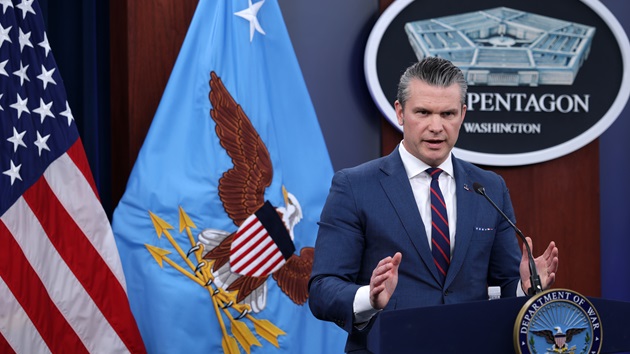
The initial attack was overseen by Hegseth himself, who told reporters at the White House on Tuesday that he watched the first strike unfold before leaving for meetings. He said he did not see any survivors or any further strikes that followed.

“Admiral Bradley made the correct decision to ultimately sink the boat and eliminate the threat,” Hegseth said.

“He sunk the boat, sunk the boat, and eliminated the threat. And it was the right call. We have his back,” he said.

At the time of the attack, Bradley was the three-star admiral in command of the Joint Special Operations Command that oversees the most sensitive special operations missions carried out by units like SEAL Team Six and Delta Force.

Bradley graduated in 1991 from the U.S. Naval Academy, where he studied physics and was a varsity gymnast, according to his Navy biography, and has commanded at all levels of U.S. special operations.

He was among the first to deploy into Afghanistan after the 9/11 terror attacks, his bio says.

Originally from Eldorado, Texas, Bradley earned a Master’s Degree in physics from Naval Postgraduate School in Monterey, California, where he received a provisional patent for his research in 2006, according to his bio.

Those who served with him characterized him as among the military’s best.

Retired Navy Cdr. Eric Oelerich, a former SEAL and current ABC News contributor, said Bradley, who’s been a mentor to him for decades, is an adaptive leader and “one of the most intelligent officers” in the U.S. military.

“Bradley is an example of the very best of what is in the U.S. military,” said Oelerich, who commanded special operators as a Navy officer. “And he is a man extremely grounded in morality.”

Retired Brig. Gen. Shawn Harris, who worked with Bradley and is now a Democratic candidate for Congress in Georgia, told ABC News the admiral is “an outstanding leader.”

Used to operating in the shadows as a senior special operations leader, Bradley made a rare public appearance in July at a Senate confirmation hearing.  Nominated to serve as the four-star commander of U.S. Special Operations Command, he was confirmed and assumed the rank and command role in October.

At the time of the September strike, Bradley headed Joint Special Operations Command (JSOC), which has operational authority over the military’s elite special warfare units.

In his confirmation hearing to lead Special Operations Command, the parent organization of JSOC, Bradley said officers under his command would be focused on preventing civilian harm and the laws of war.

“Just to resonate, it is not only an obligation to adhere to the law of armed conflict to protect civilians, it is critical to our success and competition to represent our values,” Bradley told Sen. Elizabeth Warren, D-Mass. “I believe that every uniformed, every civilian, and every contractor that is employed or in oversight of the use of lethal force has a critical obligation to be able to do that, and I do commit to keeping that as a focus for our command, if confirmed.”

Warren replied, “That is a strong answer, and I appreciate it.”   

The administration has maintained that the 11 people killed in the Sept. 2 incident — as well as the more than 80 killed by strikes in the Caribbean and the eastern Pacific Ocean — were not civilians but rather terrorist combatants that the U.S. was empowered to kill on self-defense grounds.

Some legal experts, including a group of former military lawyers, have said they believe the people killed in the follow-up strikes were no longer in the fight and therefore not legal military targets.

Copyright © 2025, ABC Audio. All rights reserved.

Pentagon IG finds Hegseth could have endangered troops with Signal chat, sources say

Pentagon IG finds Hegseth could have endangered troops with Signal chat, sources say
U.S. Secretary of War Pete Hegseth looks on during a meeting in the Oval Office of the White House on Nov. 18, 2025, in Washington, D.C. (Photo by Win McNamee/Getty Images)

(WASHINGTON) — A Pentagon watchdog concluded that Defense Secretary Pete Hegseth risked exposing classified information that could have endangered U.S. troops when he relayed details about a planned military strike in Yemen using the Signal commercial messaging app, according to a person who read the classified investigative report and another source with knowledge of the findings.

This is a developing story. Please check back for updates.

Copyright © 2025, ABC Audio. All rights reserved.

US sends 1-way attack drones to the Middle East

US sends 1-way attack drones to the Middle East
Low-cost Unmanned Combat Attack System (LUCAS) drones are positioned on the tarmac at a base in the U.S. Central Command (CENTCOM) operating area, Nov. 23, 2025. U.S. Central Command Public Affairs

(WASHINGTON) — The U.S. military has deployed its first squadron of one-way attack drones to the Middle East, employing a U.S.-built drone that was reverse-engineered from Iran’s Shahed drones that have been used by Iran against Israel and by Russia against Ukraine.

U.S. Central Command (CENTCOM) announced on Wednesday the establishment of Task Force Scorpion Strike (TFSS) that will oversee the first of its kind operational deployment by the U.S. military.

The employment of the new one-way drones is an indication of how low-cost drone technology has changed the battlefield in the wake of the war in Ukraine and the war between Israel and Iran.

A common thread in both those conflicts is Iran’s one-way Shahed drones, capable of carrying explosives over long distances. Used by Iran to target Israel, Russia has purchased large quantities of them to launch large swarm attacks against Ukraine.

The Low-cost Unmanned Combat Attack System (LUCAS) drones, built by SpektreWorks, that CENTCOM has deployed to the Middle East are based off the reverse engineering of a delta-winged Shahed-136 drone obtained by the U.S. several years ago, according to a Department of Defense official.

At a cost of $35,000 each, the drones are an improvement on the Iranian drone and a more effective military option at a much lower price point than the deployment of manned fighter aircraft, the official said.

Able to travel long distances, the LUCAS drone is also designed to operate autonomously and can be launched from catapults, rocket-assisted takeoff, and mobile ground and vehicle systems.

The new drones will be sent to various locations in the Middle East, said the official, who declined to provide information as to how many of the drones were being deployed to the region.

Interestingly, the drone squadron does not belong to one of the military services but will be operated by a joint special operation unit operating under CENTCOM.

“This new task force sets the conditions for using innovation as a deterrent,” said Adm. Brad Cooper, CENTCOM commander. “Equipping our skilled warfighters faster with cutting-edge drone capabilities showcases U.S. military innovation and strength, which deters bad actors.”

Israel’s attack on Iran in November severely disabled Iran’s sophisticated missile air defense systems, making it much less able to counter against any air threats, including one-way drone attack, the official said.

“We are essentially flipping the script” on Iran said the official, who noted that the new drone system is a more effective deterrent because there is less risk about its potential use as an offensive capability than if manned aircraft were to be used.

The system’s deployment was spurred in part by Defense Secretary Pete Hegseth’s “drone dominance” initiative that accelerates the delivery of low-cost and effective drones to U.S. forces.

Copyright © 2025, ABC Audio. All rights reserved.

Trump says he’s pardoning Democratic Rep. Henry Cuellar after bribery indictment

Trump says he’s pardoning Democratic Rep. Henry Cuellar after bribery indictment
Rep. Henry Cuellar talks with reporters in the Capitol after a meeting of House Democrats on Thursday, June 27, 2019. Tom Williams/CQ Roll Call

(WASHINGTON) — President Donald Trump announced Wednesday that he is granting a pardon to Democratic Rep. Henry Cuellar and his wife, who were indicted on charges including bribery in 2024.

This is a developing story. Please check back for updates.

Copyright © 2025, ABC Audio. All rights reserved.

What Trump and Hegseth said after the Sept. 2 strike on an alleged drug-smuggling boat

What Trump and Hegseth said after the Sept. 2 strike on an alleged drug-smuggling boat
Al Drago/Bloomberg via Getty Images

(WASHINGTON) — When President Donald Trump and Defense officials revealed on Sept. 2 that the U.S. military killed 11 alleged drug smugglers on a boat in the Caribbean Sea, they touted it as a success in their war against South American cartels.

Their initial comments were met with scrutiny due to the lack of details they provided. More questions arose months later after it was reported that survivors from the attack were killed in a subsequent strike. The White House later confirmed on Monday that there was more than one strike on the boat.

Trump first announced the strike on his social media site as a “kinetic strike against positively identified Tren de Aragua Narcoterrorists in the SOUTHCOM area of responsibility.”

The post included a video of the strike that showed only one hit.

Trump alleged that the boat was under the control of Venezuelan President Nicolas Maduro. Maduro denied the allegations and criticized the U.S. for the attack.

Trump said a day later that a “massive” amount of drugs was on the boat, but provided little detail.

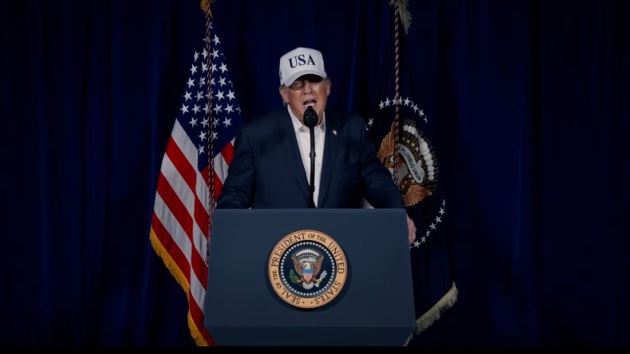
“It was massive amounts of drugs coming into our country to kill a lot of people. And, everybody fully understands that fact. You see it, you see the bags of drugs all over the boat, and they were hit,” Trump told reporters at the White House on Sept. 3. “When they watch that tape, they’re going to say, ‘Let’s not do this.'”

That same day, Defense Secretary Pete Hegseth also touted the strike during a “Fox & Friends” interview and refuted a Maduro spokesperson’s suggestion that the video was AI-generated.

“That was definitely not artificial intelligence. I watched it live,” he said. “We knew exactly who was in that boat. We knew exactly what they were doing, and we knew exactly who they represented.”

The administration would go on to report 20 more strikes against boats in the Caribbean and eastern Pacific Ocean, killing 83 people.

Hegseth spoke about the U.S. operation on Oct. 23 at a White House event on fighting drug cartels, arguing that suspects on the boats would be treated “like foreign terrorist organizations on the offense.”

“So the Department of War is not going to degrade, or just simply arrest. We’re going to defeat and destroy these terrorist organizations to defend the homeland on behalf of the American people,” he said.

His remarks came a week after survivors were reported following a strike on a boat in the Caribbean. The survivors eventually were released to their home countries of Colombia and Ecuador, which prevented them from protesting their detention in a U.S. court.

When asked by ABC News’ Mary Bruce about how survivors would be treated in the future, Hegseth responded, “We’ve got protocol of how we’ll handle it,” but did not go into detail.

At the same event, Trump told reporters that he didn’t plan to ask Congress for authority or declare war against the cartels, and instead he declared bluntly, “We’re just going to kill people that are bringing drugs into our country.”

However, new questions arose about the legality of the attacks after a Nov. 28 Washington Post report that said the first strike on Sept. 2 initially left two survivors clinging to the wreckage and that before the strike Hegseth had given spoken orders to kill everyone on board.

The Post report, which cited two “two people with direct knowledge of the operation,” alleged that Adm. Mitch Bradley, then-head of the Joint Special Operations Command, ordered a second strike in order to comply with Hegseth’s initial orders and to ensure the survivors couldn’t call on other suspected traffickers to retrieve them and their cargo.

Members of Congress from both parties had expressed concerns with the drug cartel operation, but in the days following the Washington Post report, Republican and Democratic leaders on both the House and Senate armed services committees put out joint statements saying they were looking into the incident.

Hegseth pushed back against the Post’s report saying in an X post that the strikes were legal.

ABC News has confirmed that survivors from the initial strike were killed as a result.

Trump told reporters Sunday that he did not know about the details about the Washington Post’s report and defended Hegeseth.

“He said he did not say that, and I believe him,” Trump said when asked about the report and Hegseth’s alleged order.

Trump added that he wouldn’t have wanted a second strike.

“I wouldn’t have wanted that. Not a second strike. The first strike was very lethal. It was fine, and if there were two people around, but Pete said that didn’t happen. I have great confidence,” he said.

On Monday, White House press secretary Karoline Leavitt clarified that Adm. Frank “Mitch” Bradley gave the order for the second strike, but did not give any more details.

The next day, Hegseth doubled down on the administration’s efforts to attack alleged drug boats.

“We’ve only just begun striking narco-boats and putting narcoterrorists at the bottom of the ocean because they’ve been poisoning the American people,” he said at a Cabinet meeting on Tuesday.

Hegseth also clarified his earlier comments about watching the attack live.

“As you can imagine, the Department of War, we got a lot of things to do. So I didn’t stick around for the hour and two hours, whatever, where all the sensitive site exploitation digitally occurs,” he said. “So I moved on to my next meeting. A couple of hours later, I learned that the commander had made the — which he had the complete authority to do.”

“Admiral Bradley made the correct decision to ultimately sink the boat and eliminate the threat. He sunk the boat, sunk the boat, and eliminated the threat. And it was the right call. We have his back,” Hegseth added.

Hegseth said that he did not see any survivors while he watched the video.

“I did not personally see survivors, but I stand — because that thing was on fire. It was exploded and fire and smoke, you can’t see anything. You got digital, there’s — this is called the ‘fog of war.'”

Copyright © 2025, ABC Audio. All rights reserved.

Former Honduran President Juan Orlando Hernandez freed from prison after Trump pardons drug trafficking conviction

Former Honduran President Juan Orlando Hernandez freed from prison after Trump pardons drug trafficking conviction
Former President of Honduras Juan Orlando Hernandez is escorted, April 21, 2022, by members of the Police Special Forces in Tegucigalpa, Honduras, to be extradited to United States after being indicted on drug traffickers charges. (Photo by Jorge Cabrera/Getty Images)

(WASHINGTON) — Former Honduran President Juan Orlando Hernandez, who was convicted in 2024 of trafficking drugs into the United States, has been freed from prison after he was granted a pardon by President Donald Trump, officials said.

The 57-year-old Hernandez was released from a federal prison in West Virginia, where he had been serving a 45-year sentence, according to a spokesperson for the Federal Bureau of Prisons and Hernandez’s attorney.

“After nearly four years of pain, waiting, and difficult trials, my husband Juan Orlando Hernandez RETURNED to being a free man, thanks to the presidential pardon granted by President Donald Trump,” Hernandez’s wife, Ana Garcia de Hernandez, said in a social media post.

Hernandez’s wife added, “Today we give thanks to God, because he is just and His timing is perfect. Thank you, Mr. President, for restoring our hope and for recognizing a truth that we always knew.”

Trump formally granted Hernandez a full pardon on Monday evening, Hernandez’s attorney, Renato Stabile, told ABC News.

“True to his word, I can confirm that President Trump has issued a full and unconditional pardon to former Honduran President Juan Orlando Hernandez,” Stabile said.

Stabile said Hernandez, a two-term president of Honduras, was released early Tuesday morning from the U.S. Penitentiary, Hazelton, a high-security prison in West Virginia.

“On behalf of President Hernandez and his family, I would like to thank President Trump for correcting this injustice,” Stabile said. “President Hernandez is glad this ordeal is over and is looking forward to regaining his life after almost four years in prison.”

Trump’s pardon of Hernandez came as a surprise to lawmakers on both sides of the aisle, who said the decision appears to contradict the Trump administration’s crackdown on drug trafficking from the Caribbean.

“Why would we pardon this guy then go after [Venezuelan president Nicolas] Maduro for running drugs into the United States? Lock up every drug runner! Don’t understand why he is being pardoned,” Sen. Bill Cassidy, R-La., said in a social media post over the weekend.

Sen. Tim Kaine, D-Va., called Trump’s decision to pardon Hernandez “shocking.”

“He was the leader of one of the largest criminal enterprises that has ever been subject to a conviction in U.S. courts, and less than one year into his sentence, President Trump is pardoning him, suggesting that President Trump cares nothing about narco-trafficking,” Kaine said on CBS’ “Face the Nation” on Sunday.

Hernandez was extradited to the United States in April 2022 under the Biden administration after he was indicted on charges of conspiring to import cocaine, using and carrying machine guns in furtherance of cocaine importation, and conspiring to use and carry machine guns in furtherance of cocaine importation.

Following Hernandez’s conviction in March 2024 in federal court in New York City, federal prosecutors said Hernandez helped drug cartels “move mountains of cocaine” into the United States and was “at the center of one of the largest and most violent drug-trafficking conspiracies in the world.”

One of the prosecutors on the case was Emil Bove, who later defended Trump on 34 counts of falsifying business records in connection with a hush money payment to adult film actress Stormy Daniels for which Trump was convicted of in 2024. Bove now sits on the bench as a judge for the 3rd U.S. Circuit Court of Appeals.

In a social media post on Friday, Trump announced, “I will be granting a Full and Complete Pardon to Former President Juan Orlando Hernandez who has been, according to many people that I greatly respect, treated harshly and unfairly.”

In a follow-up social media post on Saturday, Trump said, “The people of Honduras really thought he was set up.”

A one-time ally in the U.S. war on drugs, Hernandez was accused by U.S. federal prosecutors of taking bribes from drug cartels and helping them smuggle an estimated 400 tons of cocaine from Honduras to the United States.

Hernandez, prosecutors alleged, used his power to tip off his brother and other drug traffickers by alerting them to possible interdictions. Hernandez knew where the checkpoints were set up and advised the cartels how to avoid them, according to testimony at his trial.

Federal prosecutors from the Southern District of New York also alleged that Hernandez accepted $1 million in bribes to protect Joaquin “El Chapo” Guzman, the notorious boss of the Sinaloa Cartel in Mexico who is serving a life sentence in the United States.

During his trial, a federal prosecutor alleged Hernandez once boasted at a meeting with narco-traffickers that “together they were going to shove the drugs right up the noses of the gringos.”

Copyright © 2025, ABC Audio. All rights reserved.

3 key questions about the US boat strikes that killed survivors

3 key questions about the US boat strikes that killed survivors
Pete Hegseth, US secretary of defense, during a meeting in the Cabinet Room of White House in Washington, DC, US, on Friday, Nov. 7, 2025.

(WASHINGTON) — Defense Secretary Pete Hegseth and a top military commander are facing serious questions about why the U.S. on Sept. 2 killed survivors of a military strike against a suspected drug boat, when the laws of war say survivors on the battlefield should be rescued.

The White House acknowledges that a second strike was ordered on a boat already hit by the military in the Caribbean Sea, and ABC News has confirmed that survivors from the initial strike were killed as a result.

Democrats say that alone could be enough to suggest a war crime occurred. The laws of war require either side in a conflict to provide care for wounded and shipwrecked troops.

Hegseth told Fox News the day after that he watched the operation unfold in real time and defended it as legal. He appears to be leaning on the same legal playbook carved out during the war on terror, in which the U.S. justified the killing of people transporting weapons that it said posed a threat to U.S. forces.

“We’re going to conduct oversight, and we’re going to try to get to the facts,” Sen. Roger Wicker, the Republican chairman of the Senate Armed Services Committee, told reporters on Monday. “And to the extent that we’re able to see videos and see what the orders were, we’ll have a lot more information other than just news reports.”

Here are three key questions about the orders to kill drug smugglers:

What did Hegseth order exactly?

A key question for lawmakers is what Hegseth’s initial “execute order” included and what intelligence was used to justify it.

According to The Washington Post, sources say Hegseth told the military to ensure that none of the 11 passengers aboard the boat should be allowed to survive. After the initial strike left two people clinging to the wreckage, the Post says, Adm. Mitch Bradley made the decision as head of the Joint Special Operations Command to launch a second strike to fulfill Hegseth’s initial order to kill everyone.

Hegseth called the report a “fabrication,” while his chief spokesman, Sean Parnell, said the allegations were a “fake news narrative that Secretary Hegseth gave some sort of ‘kill all survivors’ order.”

The Pentagon declined to answer questions though about what was included in Hegseth’s initial order.

On Monday, White House press secretary Karoline Leavitt would confirm only that a second strike occurred and didn’t address a question about survivors. When asked if Adm. Bradley had made the decision on his own, Leavitt suggested that was accurate, replying “And he was well within his authority to do so.” 

Why did Adm. Bradley order subsequent strikes after seeing survivors?

Several sources described Bradley, a former Navy SEAL, as a deeply experienced and widely respected commander. At the time of the Sept. 2 strike, Bradley had already spent time overseeing special operations missions in the Middle East under U.S. Central Command and had taken over Joint Special Operations Command, a global command devoted to preparing and executing special operations missions in some of the most challenging and complex operating environments.

When President Donald Trump nominated Bradley to take over U.S. Special Operations Command this fall, the Senate overwhelmingly approved his nomination by voice vote.

Eric Oehlerich, an ABC News contributor and former Navy SEAL who worked under Bradley’s command during the war on terror, said he has never seen Bradley push the bounds of the law.

Oehlerich said that if Bradley ordered subsequent strikes on Sept. 2, as the White House suggested, the decision would have relied on Hegseth’s initial order as well as findings by the intelligence community about why the alleged smugglers on the boats were a threat to the U.S.

Bradley also would have sought counsel from a military lawyer in the room, he said.

“There isn’t a single commander that’s sitting in a position of authority that does not have a lawyer as the closest person to him sitting there watching the entire time,” Oehlerich said.

The attack also would have been directly overseen by Hegseth himself, as he told Fox News on Sept. 3, saying he had watched it “live.” In a post on X on Monday, Hegseth suggested only that the operation was Bradley’s call.

“I stand by him and the combat decisions he has made — on the September 2 mission and all others since,” Hegseth wrote.

Bradley declined to comment but was expected to brief lawmakers later this week.

Who was killed? And were they a threat to the US?

Hegseth’s rationale for killing drug smugglers appears to be the same one used after 9/11 when Congress authorized the military to use force against targets linked to al-Qaida. That authority enabled commanders in places like Iraq and Syria to kill people transporting improvised explosive devices, which it said were an immediate threat to U.S. forces stationed in the region.

Earlier this year, President Donald Trump argued that people smuggling illegal narcotics were just as dangerous to Americans as al-Qaida terrorists. He declared several drug cartels would be deemed “foreign terrorist organizations.”

Legal experts have pushed back on the comparison of drug smugglers and al-Qaida or ISIS fighters. They also note that Congress hasn’t provided any kind of authorization for using force.

A key question remains as to who exactly is onboard the boats and what threat they posed exactly — an assessment that would have been done by the intelligence community and signed off on by Hegseth.

Rep. Jim Himes, the top Democrat on the House Intelligence Committee, said he is still waiting for information on the role U.S. intelligence played in the strikes and whether the attacks are having a strategic impact. Bradley was expected to brief House lawmakers on Thursday.

“If it is substantiated, whoever made that order needs to get the hell out of Washington,” said Sen. Thom Tillis, R-N.C. “And if it is not substantiated, whoever the hell created the rage bate should be fired.”

Copyright © 2025, ABC Audio. All rights reserved.

Supreme Court hears subpoena dispute over anti-abortion pregnancy centers

Supreme Court hears subpoena dispute over anti-abortion pregnancy centers
New Jersey Attorney General Matthew Platkin speaks at the National Safer Communities Summit in 2023. (Bing Guan/Bloomberg via Getty Images)

(NEW YORK) — A group of anti-abortion pregnancy centers in New Jersey is asking the Supreme Court on Tuesday to let it challenge an investigative subpoena from the state’s Democratic attorney general in federal court on grounds it violates the First Amendment.

First Choice Women’s Resource Centers, a faith-based organization that operates five locations across the state, claims the subpoena is part of a “hostile” campaign by Attorney General Matthew Platkin to harass the group and discourage people from supporting it.

The subpoena seeks thousands of pages of documents to determine whether the group “engaged in deceptive or otherwise unlawful conduct,” including the names and contact information of donors who may have wished to remain private.

“His demand for donor disclosure objectively chills First Choice’s associational and speech rights, causing its donors to think twice before supporting the faith-based non-profit,” the group’s attorneys argue in court filings.

Platikin insists he is pursuing a legitimate law enforcement inquiry and that First Choice has not yet been ordered by a state court to comply with the subpoena. (It is not self-executing, meaning there are no penalties for failure to comply in the meantime.)

“Non-profits, including crisis pregnancy centers, may not deceive or defraud residents in our State, and we may exercise our traditional investigative authority to ensure that they are not doing so — as we do to protect New Jerseyans from a range of harms,” Platkin said in a statement.

“The question before the U.S. Supreme Court focuses on whether First Choice sued prematurely, not whether our subpoena was valid,” he added. “I am optimistic that we will prevail.”

The case has potentially sweeping stakes for nonprofits and advocacy groups nationwide. If First Choice wins the ability to preemptively challenge the subpoena in federal court, it could make it easier for organizations to resist state investigations and strengthen the privacy of donors.

The dispute arose in the wake of the Supreme Court decision overruling Roe v. Wade and as states started drawing new battle lines over abortion.

Platkin pledged in 2022 to pursue enforcement actions aimed at promoting abortion access, which remains legal in New Jersey, and launched an investigation into First Choice on the belief that it may have engaged in false advertising and misled donors.

The attorney general issued a consumer alert in 2023 warning people with unplanned pregnancies that crisis pregnancy centers like First Choice don’t offer abortion as an option and may try to prevent a client from seeking medical information about ways to terminate a pregnancy.

“New Jersey’s attorney general is targeting First Choice — a ministry that provides parenting classes, free ultrasounds, baby clothes, and more to its community — simply because of its pro-life views,” said Erin Hawley, the attorney representing the group before the Supreme Court, in a statement.

“The Constitution protects First Choice and its donors from demands by a hostile state official to disclose their identities,” Hawley argued, “and First Choice is entitled to vindicate those rights in federal court.”

In a 2021 decision, the Supreme Court divided 6-3 along ideological lines to strike down a California law that required charities to privately disclose the identities of major donors to the state attorney general.

State officials had argued that the identities, which not-for-profit charities are allowed to keep secret from the public, would help enforce rules around tax-exempt status and catch potential fraud.

The New Jersey case, while similar, focuses primarily on where and when a targeted group can challenge an attorney general’s request in court.

After oral arguments Tuesday, the justices will draft an opinion in the case and release it sometime before the end of June 2026.

Copyright © 2025, ABC Audio. All rights reserved.