(WASHINGTON) — The Biden administration on Wednesday asked the Supreme Court to hear arguments on ending the Trump-era “Remain in Mexico” policy.
The program — formally called the Migrant Protection Protocol — bars asylum seekers from entering the U.S. while immigration courts review their claims. Biden campaigned against the policy, but his administration has hit several legal roadblocks trying to do away with it. Humanitarian organizations have documented high rates of murder, kidnapping and extortion on top of squalid conditions facing those subjected to “Remain in Mexico.”
The program was suspended at the start of the Biden administration, but in August, a federal judge in Texas ordered the administration to resume the protocols after finding the policy change “arbitrary and capricious.”
The Biden administration appealed the ruling, but the 5th Circuit Court of Appeals this month upheld the ruling.
“DHS failed to reasonably consider its own factual findings regarding the benefits of MPP,” the court wrote.
“DHS lacks the resources to detain every alien seeking admission to the United States. That means DHS can’t detain everyone [it] says it “shall” detain. So it’s left with a class of people: aliens it apprehended at the border but whom it lacks the capacity to detain,” they continued.
The Biden administration has acknowledged “Remain in Mexico” likely deterred migrants from coming to the U.S., a concession to Republicans who have cited the temporary repeal of the policy as the driving force behind the record number of arrests at the border. But officials argue the humanitarian consequences outweigh any potential benefits.
In its filing Wednesday, the Biden administration asked for an expedited briefing to allow for arguments in the case in the court’s April sitting.
ABC News’ Quinn Owen and Luke Barr contributed to this report.
(NEW YORK) — Jeep evangelists listen up: Your rugged adventure mobile is going silent.
The gas-guzzling SUVs that have rolled off Jeep’s assembly lines for 80 years will be recast as “green” vehicles that live up to the brand’s off-roading reputation, according to Christian Meunier, the global CEO of Jeep.
Meunier’s ultimate goal? For Jeep to become a “zero-emission freedom brand.”
First up: The Wrangler 4xe, a plug-in hybrid that went on sale this year and already accounts for nearly 25% of Jeep’s volume. The 4xe makes 375 horsepower and has an EPA fuel economy of 49 MPGe (miles per gasoline-gallon equivalent, including electricity). Drivers get 21 miles of electric-only driving range when the 14.0-kWh lithium-ion battery is charged. Under the hood is a 2.0-liter turbocharged inline four-cylinder engine.
The Wrangler 4xe outsold the Prius in the first-quarter of 2021 and is now the No. 1 PHEV in the country. The Grand Cherokee 4xe arrives next year.
“The 4xe could make Jeep die-hards change their mind about leaving [internal combustion engines],” Meunier told ABC News. “When you drive electric Jeeps you fall in love with them.”
He added, “A lot of torque is awesome for off-road driving. It’s cool to be green.”
Electrification may be Jeep’s future — with a few exceptions. EPA fuel economy estimates of the newly launched Rubicon 392, the most powerful Wrangler with a mighty 6.4-liter Hemi V8 engine that produces 470 hp and 470 lb.-ft. of torque, clock in at 13 mpg (city) and 17 mpg (highway).
“The 392 is more of a niche market — 3% of total Wrangler sales. So very limited in volume and very exclusive,” Meunier said.
Jeep also reintroduced its iconic Wagoneer and Grand Wagoneer to compete in the increasingly cutthroat luxury three-row SUV category. Moreover, Meunier and his team are aggressively targeting drivers in key markets — Europe, China and Latin America — to expand Jeep’s customer base. North America makes up two-thirds of Jeep’s global sales.
“There is a very big product offensive across the globe … [our] reliance on North America is getting less and less every day,” Meunier said.
Meunier spoke to ABC News about where the brand is headed and how to get more Americans to accept EVs. The interview below has been edited and condensed for clarity.
Christian, you want to make Jeep the greenest SUV brand in the world.
A: Our vision is really to be the zero-emission freedom brand and we have a plan to get there. It’s clearly a commitment to say we’re the greenest SUV brand in the world. Twenty-five percent of our sales in the U.S. are 4xe. I think next year it will be more. The 4xe is the most capable Wrangler. We’re pretty confident that we’re going to be the greenest, the most electrified SUV brand at a global level, which is a big departure from where Jeep was a few years ago.
When are we going to see an all-electric Jeep in the U.S.?
A: That’s a good question. The only thing I can tell you is that by 2025 we’ll have a BEV [battery electric vehicle] in every single segment and pretty much across the globe. And the first [all electric] Jeep will be launched at the end of next year.
We brought the Magneto [Jeep’s BEV concept] and 4xe to the Easter Jeep Safari in Moab. A lot of the hardcore off-roaders told us that the torque … of the Magneto and 4xe could make them change their mind about leaving ICE [vehicles].
Does Jeep feel extra pressure to produce an all-electric Wrangler to compete in the off-roading space? There is the Rivian R1T, GMC Hummer EV and upcoming Ford F-150 Lightning.
A: We will do it. The question is when and how. We’re full speed ahead on electrification. It’s an obvious thing for Jeep to accelerate the electrification for Wrangler and the other models.
Magneto was really a concept test … we wanted to have an impression from our community. We value enormously the community input and feedback. We have a lot of interaction with them.
How do you get Americans to buy EVs?
A: I think it will take a little bit of time. It takes product to prove that it’s equivalent or better and it doesn’t create annoyance. I think Americans enjoy their freedom and want to be able to use their cars whenever they want. And they want to drive as many miles as they want. When the technology is good they’ll jump on it. Americans are very open to [EVs] as long as it makes their lifestyle equal or better.
Which model in your opinion is the most important for the brand?
A: The two most iconic products that exist today when you talk about Jeep are Wrangler and Grand Cherokee. The Grand Cherokee is a wildly civilized machine. The best-selling Jeep in the U.S. is the Grand Cherokee with 250,000 units. Wrangler is No. 2, with 213,000 units. We’re off to a strong start with Wagoneer and Grand Wagoneer — a premium extension of what Jeep is about.
Ford and Land Rover are determined to steal market share from the Wrangler with the Bronco and Defender. Have Jeep owners defected from the company? How can the Wrangler keep ahead of the competition?
A: The Wrangler has never sold as quickly as right now. We have zero stock on the ground and dealer inventory. Competition is healthy — it creates more visibility to a segment and it puts Wrangler more on the radar as well. It forces us to become better, come up with new ideas, new technologies. We’re not afraid of competition, it’s good. Is there a little cross shopping? Maybe. We don’t see a lot of defection from the Jeepers to Ford or another brand.
What is the biggest challenge facing every automaker right now?
A: The biggest challenge is — I would say there are many of them. We have raw materials going through the roof. Steel prices. Precious metal. Inflation in the materials we use to build cars so that puts pressure on the cost side. We have the microchips shortage which is a challenge for everyone. It forces us to be innovative and engineer cars with alternative solutions. The cost of electrification is quite high. We cannot pass everything to the customer so that puts pressure on us. We’re working with a lot of economies of scale to mitigate these issues. A lot of headwinds on the cost side.
So does that mean Jeep will have to raise prices on all vehicles next year?
A: It’s not only about pricing. It’s also about making sure we’re more efficient in the way we build cars.
(NEW YORK) – New Year’s Eve celebrations for 2021 were significantly scaled back due to COVID, with hopes of larger celebrations to mark 2022. But with case numbers surging, are this year’s festivities safe?
It depends what your plans are, according to Dr. Anthony Fauci.
“What I would suggest people do not do is to go to very large, 50 to 60 person parties where people are blowing whistles and all that sort of thing and celebrating and you don’t know the vaccination status of the people in that environment. That would be a risky situation that I would recommend against,” he said in an ABC News Live interview.
With COVID cases surging, many cities are heading Fauci’s advice.
New York City’s celebration will be larger than last year’s but still extremely scaled back. Only 15,000 masked and fully vaccinated attendees will be allowed to watch the ball drop in Times Square — a quarter of the number normally in attendance.
Other cities have gone even further. Atlanta canceled its annual Peach Drop, Annapolis canceled the in-person portion of its celebration and Seattle’s New Year’s firework show is only available for viewing online or on television.
Paris, London, Berlin and many other cities have also canceled large-scale in-person events.
Sydney Australia, known for being the first place to ring in the new year, will have a celebration only accessible to a limited number of vaccinated ticketed guests.
So how can you celebrate?
“If you’re vaccinated and you’re boosted and you want a family gathering in your home with other vaccinated and boosted people, although the risk is not zero, the risk is very low,” Fauci said.
It might not be the party some had expected, but according to World Health Organization Director General Tedros Adhanom Ghebreyesus, changing your plans could save a life.
“An event canceled is better than a life canceled,” Ghebreyesus said. “It’s better to cancel now and celebrate later, than to celebrate now and grieve later.”
Helen H. Richardson/MediaNews Group/The Denver Post via Getty Images
(SUPERIOR, Colo.) — The mayor of a Colorado town decimated by sudden and fast-moving wildfires called the situation “very grave” in an interview with Good Morning America.
Hundreds of homes were destroyed and thousands were forced to evacuate in Boulder County on Thursday when wind-fueled grass fires exploded into infernos.
“I spent a couple of hours yesterday driving around in the afternoon with the sheriff’s office and town manager just making an assessment of the situation there on the ground and it’s grave,” Clint Folsom, the mayor of Superior, told GMA. “It’s nothing like I would have ever imagined would have happened.”
Folsom said he was fearful of what emergency responders might find in the coming days after hundreds of homes burned “in a matter of minutes.”
“I hope we don’t have fatalities,” Folsom told GMA.
The mayor said that strong winds were not uncommon in the area, but “this was a wind like I’ve never seen.” Combined with an extraordinarily dry summer and fall, the conditions were ripe for a devastating blaze.
Of the two fires burning, one, the Marshall fire, had “ballooned” into a 1,600-acre behemoth as of Thursday night. Boulder County Sheriff Joe Pelle, said the blazes were “consuming football-field lengths of land in seconds.”
Superior, a town of 13,000 and Louisville, a town of 20,000 were both asked to evacuate as the fires tore through the area.
Pelle said he believes the fires were likely sparked by downed power lines.
(NEW YORK) — As the COVID-19 pandemic has swept the globe, more than 5.4 million people have died from the disease worldwide, including over 824,000 Americans, according to real-time data compiled by Johns Hopkins University’s Center for Systems Science and Engineering.
About 62% of the population in the United States is fully vaccinated against COVID-19, according to data from the Centers for Disease Control and Prevention.
Here’s how the news is developing. All times Eastern:
Dec 30, 11:04 pm
FDA to authorize boosters for 12- to 15-year-olds
The Food and Drug Administration is likely to authorize Pfizer COVID-19 booster shots for 12- to 15-year-olds next week, a source with direct knowledge of the plan told ABC News.
An authorization may come as early as Monday.
-ABC News’ Eric Strauss
Dec 30, 10:08 pm
US pediatric COVID-19 hospital admissions hit all-time high
More COVID-19-positive children in the United States are being hospitalized each day than at any other point in the pandemic, according to newly updated federal data.
On average, just under 380 children with COVID-19 were admitted into the hospital daily between Dec. 22 and Dec. 28, according to data from the Centers for Disease Control and Prevention.
The country’s pediatric COVID-19 hospital admission rate has nearly tripled in the past month, CDC data shows.
Nationwide, nearly 2,900 children are currently hospitalized with confirmed or suspected cases of COVID-19 — approximately 1,300 more patients than a month ago — according to data from the Department of Health and Human Services.
Less than a third of eligible children — ages 5 to 17 — in the U.S. are currently fully vaccinated against COVID-19.
Three new studies released Thursday by the CDC found COVID-19 vaccines to be safe and effective for children.
-ABC News’ Arielle Mitropoulos
Dec 30, 6:23 pm
US marks 3rd day of record new COVID-19 cases
The U.S. recorded more than 486,000 new COVID-19 cases in a day, marking the third straight day of record numbers, according to data released by the U.S. Centers for Disease Control and Prevention.
The new data comes as states are going through their huge backlogs of tests taken during the Christmas weekend.
In the last week, the U.S. has reported more than 2.2 million new cases, which averages out to about 220 Americans testing positive for COVID-19 every minute.
The CDC will not be providing new data updates until Jan. 3, due to the New Year’s holiday.
-ABC News’ Arielle Mitropoulos
Dec 30, 4:28 pm
Michigan health officials urge schools to delay sports
Officials from Michigan’s Department of Health and Human Services sent a letter to schools across the state urging them to either postpone large gatherings or make them virtual.
“Large gatherings (involving 100 or more people) should be held using remote technology or postponed, if not essential. Large gatherings would include events with large numbers of people from multiple households such as conferences or meetings, sporting events, and concerts,” the letter read.
The state also urged schools to require masks for everyone who enters school buildings and to test students regularly.
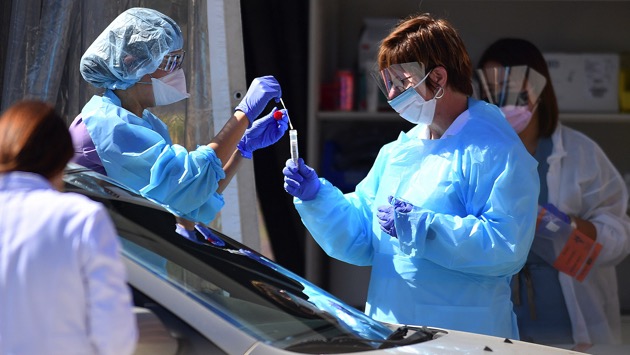
(NEW YORK) — With questions swirling about how well rapid COVID-19 tests work when it comes to detecting the omicron variant, leading scientists are now reassuring the public that they do work, and have a valuable role to play in the ongoing pandemic.
Among them is Dr. Bruce Tromberg, director of the National Institute of Biomedical Imaging and Bioengineering at the NIH, and the top scientist in charge of Rapid Acceleration of Diagnostics. RADx, a new government-funded NIH program, was tasked with rapidly increasing the nation’s testing capacity and studying how tests perform when faced with new variants.
“The tests are an essential component of what we need, especially in the time of very rapidly expanding omicron,” Tromberg said.
While PCR tests are very effective at detecting the presence of even small amounts of virus, rapid tests have become a quick and easy way to determine if a person is contagious. In a Tuesday announcement, the Food and Drug Administration said rapid tests do detect the omicron variant, but in a laboratory setting they did not perform as well as they have with earlier variants.
The FDA announcement, described by one expert as a kind of curveball, lacked specific numbers and sparked confusion and dismay among some experts and Americans who have been using rapid tests to reduce the risk of spreading COVID-19 to loved ones over the holidays.
Dr. Michael Mina, a vocal advocate for increased rapid testing use and the chief science officer for eMed, told ABC News, “There is no reason and no data to support that the tests are less able to detect omicron virus.”
News from the FDA about rapid tests’ ability to detect omicron comes on the heels of the Biden Administration’s announcement that the U.S. will have 500 million at-home rapid tests available starting January.
But Tromberg said Americans should “absolutely not” be discouraged from using rapid tests based on this FDA announcement, which was based on preliminary laboratory studies on live virus samples combined from multiple patients and run on a relatively small number of rapid test brands.
Those tests showed a potential dip in effectiveness, but, “It’s not like they fell off the map,” he said. The FDA also said more clinical studies are needed.
Preliminary studies conducted in a lab can offer clues, but are not as reliable as real-world studies done on real people. Those real-world clinical studies are currently being conducted, and results should be available shortly, Tromberg said.
He expects clinical studies to show the tests are working at an acceptable level.
“We already know that the clinical performance is better than this laboratory benchtop performance, just in our early studies that we’re getting.”
“I have confidence that the tests that we have on our shelves can pick up omicron,” Tromberg said. “There will be different levels of performance, we need to really work through all of those and understand them for every test.”
One reason rapid tests might perform differently is because of the increased infectiousness of the new variant, said Mina.
“Is it that the test is less sensitive, or is the virus more infectious?” he said.
“Omicron is more infectious, and therefore, it is possible that people can start spreading the virus hours or a day before they are testing positive, but after that, the test will still work when people are most infectious just as they have been working throughout the entirety of the pandemic,” Mina said.
Even if some rapid test performance is diminished, Tromberg said, “They still can be extremely powerful and effective at interrupting the chain of transmission of the virus.”
The FDA has authorized 43 rapid antigen tests including at least a dozen at home versions.
Several testing companies have said their tests still work to detect omicron, with Abbott saying Tuesday that the company has tested the popular BinaxNOW rapid test using the omicron variant from live virus and found the test “performed at equivalent sensitivity” compared to prior variants.
But the FDA said tests could be updated if further testing shows updates are needed.
“Studies are underway to confirm the reason for the apparent decreased sensitivity,” FDA spokespersons Stephanie Caccomo said. “Once that is known, adjustments to existing tests can be undertaken by each developer with support from the FDA, if appropriate.”
(ATLANTA) — COVID-19 vaccines are safe and effective for children, according to three new studies released Thursday by the U.S. Centers for Disease Control and Prevention.
One study, which evaluated the safety reports of more than 42,000 children ages 5 to 11 who received a Pfizer shot, found the side effects from the Pfizer vaccine were mostly mild and temporary. It also found that myocarditis, a heart inflammation side effect that has been associated with the mRNA vaccines in very rare cases, does not appear to be a risk.
A second study, which looked at data from 243 children ages 12 to 17 in Arizona, found the Pfizer vaccine was 92% effective at preventing infection. The study, conducted between July and December when delta was the dominant variant in the U.S., also found that adolescents who developed COVID-19 reported a lower percentage of time masked in school and time masked in the community.
The third study, also conducted when delta was dominant, found that among children ages 5 to 17 hospitalized due to COVID-19, less than 1% were fully vaccinated against the virus.
“I think these studies taken as a whole confirm what we’ve been saying all along, which is that these vaccines are incredibly safe and effective,” ABC News medical contributor Dr. John Brownstein, an epidemiologist and chief innovation officer at Boston Children’s Hospital, said. “The side effects that were highlighted originally do not appear to be a risk, including myocarditis, and the efficacy is incredibly impressive.”
“Essentially, they provide additional support for the incredible benefit of these vaccines and the incredibly low risk of any adverse events from taking them,” he said. “Hopefully, this provides support to increase uptake of the vaccine, which unfortunately has been slow in our pediatric population.”
Currently in the U.S., less than a third of eligible children — ages 5 to 17 — have been fully vaccinated.
The Pfizer vaccine has been available for children ages 5 to 11 since November, while it was authorized for emergency use in children ages 12 to 15 in May.
The U.S. Food and Drug Administration approved the Pfizer vaccine for people ages 16 and older in August.
The studies showing the vaccines’ efficacy in children comes as the highly transmissible omicron variant of COVID-19 spreads across the country, impacting children, too.
Experts say it’s unlikely that omicron is affecting children differently than prior variants, but rather this new surge is impacting people who are unvaccinated, including children
Last week, nearly 200,000 children in the U.S. tested positive for COVID-19, up by about 50% since the beginning of December, according to new data from the American Academy of Pediatrics and the Children’s Hospital Association.
And federal data shows more than 2,100 children are currently hospitalized with confirmed or suspected cases of COVID-19 — up by approximately 800 pediatric patients compared to just a month ago.
The increasing numbers are colliding with the holidays as well as cold and flu season and the upcoming return to school from the holiday break.
Brownstein said the data showed it is more important than ever that people eligible to get vaccinated against COVID-19 do so, especially children.
“We know that COVID does not spare kids. Maybe it’s less severe than their adult counterparts but we also know that the virus has had real significant impacts on morbidity and mortality in kids,” he said. “We also know that kids play an important role as vectors of spread and, especially in light of increases we’re seeing right now with increases of cases in kids in record numbers, infections among kids further perpetuate community transmission and further create risks for those who would be the most vulnerable of the virus.”
Brownstein and other experts also said families should go back to mask-wearing when in public, especially in indoor spaces like grocery stores, and limit social gatherings during this omicron surge.
“What’s clear is that the protection against COVID has always been about layers of intervention and, so while the vaccines are affording incredible protection, the idea is that vaccines plus additional interventions, especially in the middle of the surge, is still incredibly key,” Brownstein said. “This is why masking continues to be an important tool in reducing community transmission.”
ABC News’ Arielle Mitropoulos contributed to this report.
(BOULDER COUNTY, Colo.) — Thousands of people are being asked to evacuate immediately and hundreds of buildings have already been lost as winds fuel fast-spreading wildfires in Boulder County, Colorado.
Several small grass fires, sparked by downed power lines amid gusty winds in central Colorado, according to the Boulder County sheriff, have grown into raging blazes Thursday afternoon.
Of two wildfires burning, the most significant — the Marshall Fire — was first reported after 11 a.m. Thursday and has since “ballooned” to approximately 1,600 acres, Boulder County Sheriff Joe Pelle told reporters during a press briefing.
“We’ve been really concerned about the speed of the fire,” Pelle said. “This was consuming football-field lengths of land in seconds.”
Louisville, Colorado, with a population of about 20,000, is being asked to evacuate due to the Marshall Fire, according to the Boulder Office of Emergency Management. The entire city of Superior, Colorado, with a population of about 13,000 people, is also being asked to evacuate due to that fire.
The National Weather Service of Denver/Boulder described the situation in Louisville as life-threatening in an alert on Twitter Thursday afternoon, while urging people to leave immediately.
Centura Health’s Avista Adventist Hospital in Louisville started evacuating its patients, starting with its most critical, a Centura Health spokesperson told ABC News Thursday afternoon.
Hundreds of structures, including over 580 homes, are estimated to have been lost so far due to the fire, Pelle said.
Superior Mayor Clint Folsom told Denver ABC affiliate KMGH at least 200 structures, including residences, in the town have likely been lost.
“This is still a very active, fluid situation,” he told the station.
The town evacuated quickly and Folsom said he was not aware of any injuries or deaths.
Six patients were taken to UCHealth Broomfield, which serves the Boulder area, due to injuries from the fires, a hospital spokesperson confirmed to ABC News.
One officer had a minor injury to his eye due to windblown debris, according to Pelle, who said he was not aware of any other injures or fatalities at this time.
“However, I’d like to emphasize that due to the magnitude of this fire, the intensity of this fire and its presence in such a heavily populated area, we would not be surprised if there are injuries or fatalities,” he said.
Both fires were likely caused by downed power lines, Pelle said.
“We had deputies in the area who confirmed there were downed power lines. So we believe that’s what caused the fire,” he said, adding that authorities will likely determine the exact cause in the next couple days.
Colorado fire officials told ABC News that the high winds are making it difficult to get aerial resources into the area to fight the fires.
Wind gusts topping 100 mph were reported in northern Jefferson County earlier Thursday, while parts of Boulder County saw gusts over 80 mph. The city of Boulder also reported wind gusts over 70 mph Thursday afternoon.
The Boulder area is currently suffering from extreme drought, according to the National Oceanic and Atmospheric Administration and the Department of Agriculture.
Colorado Gov. Jared Polis has declared a state of emergency due to the fires in Boulder County, his office said.
“Prayers for thousands of families evacuating from the fires in Superior and Boulder County,” Polis tweeted. “Fast winds are spreading flames quickly and all aircraft are grounded.”
ABC News’ Jeff Cook, Dan Manzo, Jenna Harrison and Dan Peck contributed to this report.
(DENVER) — A truck driver who was sentenced to 110 years in prison for a fatal accident in Colorado has been resentenced to 10 years after an outcry from family and advocates.
Gov. Jared Polis announced the commutation of Rogel Aguilera-Mederos’ sentence Thursday.
“I am writing to inform you that I am granting your application for a commutation,” Polis wrote. “After learning about the highly atypical and unjust sentence in your case, I am commuting your sentence to 10 years and granting you parole eligibility on December 30, 2026.”
Mederos was sentenced on Dec. 13 to 110 years in prison for a 2019 fatal crash on Interstate 70, outside Denver, that killed four people and injured several others — a sentence the judge said he wouldn’t have chosen if he had the discretion. Mederos testified that his brakes failed, but he was driving 85 mph when the speed limit was 45 mph and he drove past a runaway truck ramp before plowing into stopped traffic, police said.
He was found guilty by a Jefferson County jury of 27 counts — the most serious was first-degree assault, a class-three felony.
The number of the charges, mandatory minimum laws and a classification that mandates some sentences be served consecutively resulted in the lengthy sentence.
“The length of your 110-year sentence is simply not commensurate with your actions, nor with penalties handed down to others for similar crimes,” Polis said in his letter. “There is an urgency to remedy this unjust sentence and restore confidence in the uniformity and fairness of our criminal justice system, and consequently I have chosen to commute your sentence now.”
Jefferson County District Attorney Alexis King has filed a motion earlier this month asking for a sentence of 20 to 30 years instead. A hearing to reconsider the sentence had been scheduled for Jan. 13, 2022.
Among those advocating for a lesser sentence were the family members of some of those killed in the accident.
“I think we all can agree that [110 years] is excessive,” Duane Bailey, the brother of William Bailey who died in the crash, told “GMA,” but added that the jury “came to the correct decision to convict [Mederos].”
(BOULDER COUNTY, Colo.) — Thousands of people are being asked to evacuate immediately as winds fuel fast-spreading wildfires in Boulder County, Colorado.
Several small grass fires, sparked by downed power lines amid gusty winds in central Colorado, according to the Boulder County sheriff, have grown into raging blazes Thursday afternoon.
Louisville, Colorado, with a population of about 20,000, is being asked to evacuate, according to the Boulder Office of Emergency Management. The entire city of Superior, Colorado, with a population of about 13,000 people, is also being asked to evacuate.
The National Weather Service of Denver/Boulder described the situation in Louisville as life-threatening in an alert on Twitter Thursday afternoon, while urging people to leave immediately.
Centura Health’s Avista Adventist Hospital in Louisville started evacuating its patients, starting with its most critical, a Centura Health spokesperson told ABC News Thursday afternoon.
Six patients were taken to UCHealth Broomfield, which serves the Boulder area, due to injuries from the fires, a hospital spokesperson confirmed to ABC News.
Colorado fire officials told ABC News that the high winds are making it difficult to get aerial resources into the area to fight the fires.
Wind gusts topping 100 mph were reported in northern Jefferson County earlier Thursday, while parts of Boulder County saw gusts over 80 mph. The city of Boulder also reported wind gusts over 70 mph Thursday afternoon.
The Boulder area is currently suffering from extreme drought, according to the National Oceanic and Atmospheric Administration and the Department of Agriculture.
Colorado Gov. Jared Polis has declared a state of emergency due to the fires in Boulder County, his office said.
“Prayers for thousands of families evacuating from the fires in Superior and Boulder County,” Polis tweeted. “Fast winds are spreading flames quickly and all aircraft are grounded.”
ABC News’ Jeff Cook, Dan Manzo, Jenna Harrison and Dan Peck contributed to this report.