(SAVANNAH, Ga.) — Over 40 FBI agents are on the ground in Savannah, Georgia, to help search for a toddler who mysteriously vanished nearly one week ago, police said.
Quinton Simon, 20 months old, has been missing since Oct. 5, the Chatham County Police Department said.
Chatham County police requested FBI assistance the day Quinton was reported missing and authorities are continuing “aggressive efforts to find him,” Chatham County police chief Jeff Hadley said at a news conference Monday.
Quinton was last seen at his Savannah home around 6 a.m. Wednesday by his mother’s boyfriend, the chief said. After Quinton’s mother woke up, she reported him missing around 9:40 a.m., he said.
Police said last week that the case didn’t appear to involve a custody dispute.
Hadley added Monday that police have had contact with Quinton’s biological father and said he’s not a suspect.
Authorities have “conducted multiple interviews, executed multiple search warrants and we’ve canvassed numerous specific geographic areas,” Hadley said Monday.
Hadley stressed that he’s committed to finding answers and finding Quinton.
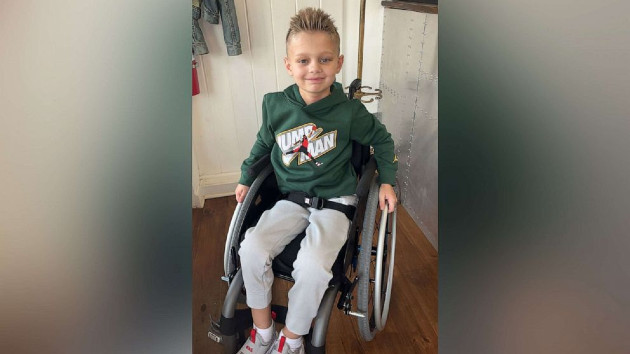
(HIGHLAND PARK, Ill.) — Eight-year-old Cooper Roberts, who was shot and partially paralyzed in the Highland Park, Illinois, mass shooting, is “overjoyed” to return to school with his classmates for the first time since the attack, his family said in a new statement Monday.
Cooper was enjoying the 4th of July parade with his family when gunfire broke out and he was shot in the back. Seven people were killed and Cooper was among dozens who were injured. The suspected gunman was arrested.
Cooper, now in a wheelchair, got to join his twin brother, Luke, at school this week, in what his parents call “an incredible milestone.”
Jason and Keely Roberts said they cried in the parking lot as their 8-year-old son wheeled himself into school.
They were so impressed to find that Cooper “loved every minute” of his return, the family said. Cooper told them: “If I had not been shot and paralyzed and had to be in a wheelchair, it would have been a perfect school day, but it was a really great day! I loved it!'”
But, his parents added, Cooper “is terribly sad about not getting to run around with his friends in the field at recess. He is heartbroken about not getting to play on the jungle gym, hang on the monkey bars, slide down the slide, swing on the swings, kick the ball. He can’t be there all day or even every day.”
“Yet, Cooper continues to affirm for us that his spirit, his soul, his ‘Cooperness’ remains,” they continued. “The hideous, evil act did not take that from him because he won’t let it. He is always going to be more concerned about others than he is for himself, find the positive in any situation, still be ‘the sporty kid,’ and will always love his family and friends fiercely.”
The family added that Cooper’s recovery is ongoing and his “transition back to school will be slow.”
“The anxiety about all of the countless unknowns he will encounter … the endless ‘what if’ questions he thinks about … these run across his mind and ours literally all day long, like an endless reel of worry,” the family said. “We all are learning how to cope with these components of our new reality.”
(CLEVELAND) — After weeks of back and forth negotiating on the time, the hosts and the venue, Ohio Senate nominees Rep. Tim Ryan and J.D. Vance faced off on Monday for their first debate. A second showdown is scheduled a week later.
Ryan and Vance, the Democratic and Republican candidates vying for retiring Republican Sen. Rob Portman’s seat, argued their case on stage hosted by Fox 8 News in Cleveland.
FiveThirtyEight’s polling average shows Ryan and Vance in a close race. The winner could determine the balance of power in the Senate, which is currently split 50-50.
The candidates clashed over the issue of abortion, with Ryan claiming that Vance called those getting pregnant from rape an “inconvenience,” which Vance pushed back on, saying he has never uttered those words.
“I am pro-life. I’ve always been pro-life, and I grew up in a poor family and a poor community. I saw a lot of young women have abortions when I was growing up,” Vance said, adding that, in regard to Sen. Lindsey Graham’s proposed national abortion ban, “some minimum national standard is totally fine with me.”
Ryan added that he would support codifying Roe v. Wade.
Regarding the issue of the 10-year-old Ohio girl who got pregnant and traveled to Indiana for an abortion, Vance said he has always believed in “reasonable exceptions” and that anybody saying otherwise is “misrepresenting” his view.
“I’ve said repeatedly on the record that the [10-year-old Ohio] girl should be able to get an abortion, if she and her family so choose to do,” he said.
Ryan brought up multiple times throughout the debate how he has supported former President Donald Trump’s stances and initiatives, including the former president’s Space Force service branch. Ryan rattled off a list of Democratic lawmakers he has “taken on,” including House Speaker Nancy Pelosi, Sen. Bernie Sanders and President Joe Biden, again stressing that he agreed with Trump on a number of issues including “trade, renegotiating NAFTA [the North American Free Trade Agreement], being firmer on China.”
When asked by a moderator whether Ryan wanted Biden to run in 2024, Ryan said “no” and that he has been “very clear.”
“I like to see a generational change. With Mitch McConnell. Donald Trump. The president. Everybody,” he said.
On the issue of fixing the opioid crisis in the state, Vance slammed Ryan for doing “nothing to stop the flow of fentanyl,” adding that his family members have been impacted by the “terrible addiction crisis.”
When asked by the moderator about his take on Vice President Kamala Harris’ comments that the “southern border is secure,” Ryan said, “Kamala Harris is absolutely wrong on that. It’s not secure. We have a lot of work to do. I’m not here to just get in a fight or just tiptoe the Democratic Party in line.” He also took the opportunity to bring up Vance’s now-shuttered nonprofit, which has been criticized for not helping fix the opioid crisis but rather jump-starting the Trump-backed nominee’s political career.
Vance denounced claims that his nonprofit is a sham, saying, “None of this is true.”
“I put $80,000 of my own money into that nonprofit, and it absolutely did help people,” Vance said, adding that it is “shameful” for Ryan to attack him given that his family has been impacted by the opioid crisis.
Heading into Election Day, Vance has campaigned heavily on the issue of crime in Ohio. ABC News spoke with the “Hillbilly Elegy” author and former investor at a recent event in Perrysburg, Ohio, where he was joined by former President Donald Trump’s eldest son, Donald Trump Jr.
“Let’s declare war on the violent crime on our streets. Let’s let the police go and do their jobs and let’s support them as we do it,” Vance said to supporters at a banquet hall.
He told ABC News afterward, while speaking with reporters, that if elected he would prioritize increasing funding for police.
“We need to probably hire 100,000 additional cops in this country,” he said.
Referring to special legal protections for law enforcement that some Democrats argue are too broad, Vance disagreed and said: “We really have to protect local police officers with qualified immunity.”
ABC News also spoke with Rep. Ryan, most recently at a kick-off event for his statewide bus tour in Warren, Ohio. When asked how he’s prepping before Monday’s debate, Ryan said that he wished the face-off was held sooner.
“We want to get this thing kicked off. But, you know, we’re doing good work,” he said.
He also told ABC News that he can’t “overstate” how important the two debates between him and Vance are going to be because it will show voters what he said is a “contrast” between the two.
“JD has given up on Ohio and I’ve been here fighting like hell for this state, and we’re starting to see some real results. And so that contrast of his extremism versus my pragmatism is going to be very apparent in the next two debates,” Ryan said.
While the party in power often suffers setbacks in midterm races, swing-state Democrats like Ryan have campaigned by seeking to separate themselves from Washington.
He told ABC News that he’s an “independent-minded person,” while Vance has labeled him a “fake moderate.”
In an emailed statement to ABC News, Vance campaign spokesperson Luke Schroeder wrote that “JD is well prepared for the upcoming debates and has found time to prepare between rallies and events. He will have no problem wiping the floor with Tim Ryan.”
Paulina Tam is one of seven ABC News campaign reporters embedded in battleground states across the country. Watch all the twists and turns of covering the midterm elections every Sunday on Hulu’s “Power Trip” with ABC’s George Stephanopoulos.
(LOS ANGELES) — Los Angeles City Council President Nury Martinez has stepped down after a recording emerged of her making racist and offensive comments about fellow council members.
Martinez will remain as a member of the city council, but will relinquish her leadership role.
(NEW YORK) — Influenza cases are rising in the United States as the country prepares for a potentially severe season.
During the week ending Oct. 1 — the latest date for which data is available — there were 969 cases of influenza A and 52 cases of influenza B reported to the Centers for Disease Control and Prevention.
This is a 303.75% increase from the 240 influenza A cases and a 79.3% increase from the 29 influenza B cases reported the week ending Aug. 6, the data shows.
What’s more, over the same period, the percent positivity rate has risen from 0.49% to 2.5%.
Outpatient visits for influenza-like illnesses have particularly risen for children ages 4 and younger to more than 120,000 during the week ending Oct. 1, a 25.5% spike from the roughly 95,600 visits for this age group that were seen the week ending Aug. 6.
The CDC has previously warned the U.S. may see a harsh flu season after few to no cases were reported over the last two years.
Similar trends are being seen on statewide level.
In New York, 596 cases of influenza were confirmed the week ending Oct. 1, according to the state’s Department of Health. This is nearly four times higher than the 150 that were confirmed the same time last year.
Additionally, in Texas, the Department of Health and Human Services confirmed 422 cases of influenza A and B during the week ending Oct. 1. During the same week last year, no cases were confirmed.
Another sign of the potentially severe season comes after Australia experienced its worst flu season in five years.
According to the country’s National Notifiable Diseases Surveillance System, more than 30,000 cases were being per week during the season’s height in June.
Comparatively, at the height of Australia’s flu season in 2017, there were 25,000 cases being reported every week.
Researchers and modelers often look to the southern hemisphere, which experiences its flu season first — typically from May to October — to predict how the season will look in the U.S.
Last week, CDC Director Dr. Rochelle Walensky urged Americans ages 6 months and up to get a flu shot by the end of October.
“Over the past two years, we’ve seen some worrisome drops in flu vaccination coverage, especially in some groups of people who are at the highest risk of developing serious flu illness,” she said during a press conference.
Earlier this year, the CDC published a report about the drop in flu vaccination uptake. Some reasons given include confusions that COVID-19 vaccines also protect against the flu, people making fewer visits to vaccine providers during the pandemic and fewer flu vaccination clinics open compared to years prior.
(WASHINGTON) — The trial of a Russian national accused of lying to federal investigators about information he contributed to the so-called Steele dossier is set to begin this week, marking a major test for the special counsel investigating the origins of the FBI probe of former President Donald Trump’s relationship with Russia.
Igor Danchenko, a Washington-based think tank analyst, was hired by former British intelligence officer Christopher Steele in 2016 to collect information compiled in his now-infamous “dossier,” which included explosive and unproven claims about the former president. In a November 2021 indictment, prosecutors accused Danchenko of misleading FBI agents about his sources of information. Danchenko has pleaded not guilty.
Danchenko’s trial, which begins Tuesday in Alexandria, Virginia, is expected to offer special counsel John Durham an opportunity to justify his years-long probe, which Trump and his allies once hoped would uncover a widespread “deep-state” conspiracy within the bureau.
Assigned in 2019 by then-Attorney General William Barr to pursue allegations of misconduct by the FBI and intelligence community in their Russia investigation, dubbed “Crossfire Hurricane,” Durham has secured indictments against only three individuals, one of whom, Michael Sussmann, was acquitted at trial earlier this year.
In another case, former FBI attorney Kevin Clinesmith admitted to altering a document used in the application process authorizing continued surveillance against a former Trump campaign aide.
Danchenko is the third defendant and the most politically fraught. As Steele’s primary collector, Danchenko was responsible for sharing the salacious claim that Russian officials may have had a videotape of Trump watching prostitutes in a hotel room during a 2013 trip to Moscow. Trump has vehemently denied the claim and no evidence has surfaced to support the allegation.
Prosecutors accused Danchenko of falsely telling the FBI that he never communicated with an unidentified U.S.-based individual “who was a long-time participant in Democratic Party Politics” about any allegations included in the dossier — whereas the indictment says Danchenko had actually sourced one or more of the allegations to that individual.
The indictment also accused Danchenko of lying to the FBI when he suggested that he had spoken with a Belarusian-born businessman named Sergei Millian, who at the time served as president of the Russian-American Chamber of Commerce and had obtained information from Millian that then made its way into the dossier.
“Danchenko stated falsely [to the FBI] that, in or about late July 2016, he received an anonymous phone call from an individual who Danchenko believed to be … then president of the Russian-American Chamber of Commerce” and obtained information about Trump from that man, the indictment says, referring to Millian but not naming him.
In fact, according to the indictment, “Danchenko never received such a phone call or such information from any person he believed to be [Millian] … rather, Danchenko fabricated these facts regarding [Millian].”
The indictment goes on to claim that Danchenko “never spoke to” Millian at all, which would support Millian’s longstanding contention that he was not the source — knowing or unwitting — of any material in the dossier. Millian has called any suggestions that he was a source “a blatant lie.”
Ahead of his trial, Danchenko and his legal team sought to have their case dismissed and nearly succeeded. Danchenko’s lawyers have insisted that Danchenko presented information to the FBI in accordance with what he believed was true and questioned the framing and interpretation of agents’ questions during interviews with Danchenko.
U.S. Judge Anthony Trenga of the Eastern District of Virginia ultimately ruled that the trial should move forward but characterized his decision as “an extremely close call.” Last week, Trenga ruled that prosecutors should avoid reference to the most salacious allegations in Steele’s dossier in presenting their case to jurors.
Steele, who has largely remained silent since his dossier became public in January 2017, told ABC News’ George Stephanopoulos in an exclusive interview last year that he was “interested to see what [Durham] publishes and what he says about us and others,” but did not fear any personal legal exposure.
“Do you think he’s coming for you?” Stephanopoulos asked.
“I don’t think so, no,” Steele replied.
“Are you worried you’ll be indicted?” Stephanopoulos added.
“No,” Steele said.
Durham’s failure to expose allegations of widespread politicization within the FBI has drawn the ire of Trump and his supporters, who at various stages of the probe expressed hope that the special counsel would validate their claims of a “deep state” conspiracy.
“The public is waiting ‘with bated breath’ for the Durham Report, which should reveal corruption at a level never seen before in our country,” Trump wrote in August on Truth Social, his social media platform.
To Trump and his supporters’ apparent chagrin, however, Danchenko’s trial may be one of the final acts of Durham’s tenure as special counsel. The New York Times reported last month that a grand jury empaneled by Durham had expired and that his office hoped to complete a final report by the end of the year.
(NEW YORK) — Some of the nation’s largest airports have been targeted for cyberattacks Monday by an attacker within the Russian Federation, a senior official briefed confirmed to ABC News.
Importantly, the systems targeted do not handle air traffic control, internal airline communications and coordination, or transportation security.
“It’s an inconvenience,” the source said.
The attacks have resulted in targeted “denial of public access” to public-facing web domains that report airport wait times and congestion.
The attacks were first reported around 3 a.m. ET when the Port Authority notified the Cybersecurity and Infrastructure Security Agency that the LaGuardia Airport system had been hit. LaGuardia has been restored, but other airports around the country have subsequently been targeted.
The websites for Des Moines International Airport, Los Angeles International Airport (LAX) and Chicago O’Hare International Airport appeared impacted Monday morning.
Hartsfield-Jackson Atlanta International Airport reported around 10:30 a.m. ET that its site is back up and running and that “at no time were operations at the airport impacted.”
“Early this morning, the FlyLAX.com website was partially disrupted,” LAX said in a statement to ABC News. “The service interruption was limited to portions of the public facing FlyLAX.com website only. No internal airport systems were compromised and there were no operational disruptions.”
Engineers and programmers are actively working to close backdoors that allowed the attacks and shoring up more critical computer infrastructure.
ABC’s Pierre Thomas traveled to Chicago for an exclusive conversation with police Superintendent David Brown as part of ABC’s continuing coverage of guns in America. – John Parkinson/ABC News
(CHICAGO) — Over one recent weekend in Chicago, two children under the age of 10 became victims of the city’s rampant gun violence.
Mateo Zastro, 3, was shot and killed while in the car with his mother and siblings in an apparent road rage incident on Sept. 30. Then 7-year-old Legend Barr was shot and wounded as his family arrived at church on Oct. 2.
ABC News Chief Justice Correspondent Pierre Thomas spent a day with Chicago Police Superintendent David Brown for an inside look at the department’s efforts to curb gun violence — incidents affecting many Chicagoans — throughout the city.
“It’s the most complex policing landscape ever in this country’s history. We are making progress, but the complexities make it such that it is so fragile,” Brown told Thomas. “The ebbs and flows of violence are persistent.”
While shootings like those that killed Zastro and wounded Barr continue, the violence does seem to be ebbing: An ABC News/Gun Violence Archives analysis of the nation’s 50 largest cities shows homicides are down nearly 5% from last year after two years of pandemic-era increases.
In Chicago, shootings are down 20% through the end of summer and homicides have fallen 16%. That means 101 fewer people were shot this year than last.
What’s behind the small but encouraging decline? The Chicago police credit both community engagement as well as a new, more surgical deployment of officers to crime scenes after an analysis by the department showed half of all shootings and homicides occurred on 55 “beats,” or areas that are roughly the size of a block.
According to Brown, police have also been taking an average of 12,000 guns off Chicago’s streets every year — including “ghost guns,” which are unregistered firearms that can be assembled from at-home kits.
But Brown told Thomas that’s likely only 10% of the illegal firearms out there. “I don’t think we’re even chipping away,” Brown said.
Police say they have another powerful tool in their investigations, however: The department uses a system called “ShotSpotter,” where sound sensors are placed throughout Chicago to detect and locate gunfire.
“It’s like the intelligence network for how we respond to crime, how we solve crime,” Brown said. “I think more importantly, this is one of our major linchpins for how we prevent crime.”
Thomas had rare access inside the department’s technology center, where officers comb through surveillance camera footage from businesses and homes near crime scenes to identify and track down suspects. Brown said using such footage also protects witnesses who are “fearful to come forward,” while still helping solve cases.
In 2021, the department said it had cleared about half of its homicide cases, a nearly 20-year high, though a quarter of those did not result in prosecutors bringing charges, according to The Chicago Sun-Times.
Brown stressed to Thomas that gun violence was a multi-pronged issue.
“We’re talking about policing, but this is about economic development,” he said. “This is about poverty. This is about, in many instances, race.”
Community investment and engagement
Brown touted Chicago’s $1.4 billion investment to revitalize South and West side communities, which are disproportionately affected by crime.
“Our impoverished communities in Chicago here, we just did not have the commitment,” he said.
Brown explained his belief in economic development as a crime-fighting tactic by comparing his city to New York City’s Harlem neighborhood.
“You look at Harlem in New York today versus Harlem in New York 30 years ago, where you see actually some gentrification, but you see, really, a commitment to economic development. And you see Harlem much safer than it was 30 years ago,” Brown said.
“You did not have that here in Chicago,” he continued. “We’re starting to see that commitment now. So that we can have that sustained decline, because we are investing in affordable housing. We’re investing in jobs, we’re investing in mental health services and other drug treatments, social services.”
Brown showed Thomas what he says is an example of how that support has made an impact, visiting an area once known for being a crime hotspot that’s now been turned into a basketball court and green space for the community.
“Instead of it being an attraction to hand-to-hand drug transactions, it’s an attraction to community engagement with each other and with police,” Brown said.
With decreased crime and increased investment, the area can foster something more important, the superintendent said.
“Hope, hope, people have hope. People who have hope can have dreams of a better life. People who have dreams of a better life are not attracted to violence,” Brown said. “That’s what economic development does — different than what policing does.”
Working to build trust
Community engagement is another strategy Chicago police have been employing, one Brown told Thomas is key to gaining trust in communities of color, especially in light of high-profile police killings like George Floyd’s murder by an officer in Minneapolis.
“How difficult has it been?” Thomas asked of forging bonds between police and those they are assigned to protect.
“[It] made it more difficult to even be heard,” Brown said.
He also acknowledged the role race plays in perspectives on crime and policing.
“The demographics are what they are, in terms of people who look like you and me, who are shooters and are victims,” Thomas said. “How, as a Black man and as a law enforcement executive, do you balance how you feel about that?”
Brown said: “I think the first step for me personally is to never forget where I’ve come from.”
ABC News’ Jack Date, Quinn Owen and John Parkinson contributed to this report.
(UVALDE, Texas) — The Uvalde, Texas, school district — still facing withering criticism over its police department’s failings both during the May 24 elementary school massacre and since — announced the suspension of the entire district police force on Friday.
Hours later, Uvalde school district Superintendent Hal Harrell announced he would be retiring. In a Facebook statement, he said retirement was “completely my choice” and that he’ll stay on through the year until a new superintendent is named. The transition will be discussed in a closed session of the school board on Monday.
Amid the police department suspension, the district said it’s requested more Texas Department of Public Safety troopers to be stationed on campuses and at extracurricular activities, adding, “We are confident that staff and student safety will not be compromised during this transition.”
The length of the school district police suspension is not clear.
Lt. Miguel Hernandez, who was tasked with leading the department in the fallout from the shooting that killed 19 students and two teachers, and Ken Mueller, the UCISD’s director of student services, were placed on administrative leave.
Hernandez acknowledged in a law enforcement communication in August that he’d received formal notification from DPS that an officer applying to Uvalde’s school police force was under investigation for her response at Robb Elementary.
Mueller has elected to retire, according to the school district.
“Officers currently employed will fill other roles in the district,” the school district said. According to the district’s website, that includes four officers and one security guard.
Victims’ families, led by Brett Cross, guardian of 10-year-old victim Uziyah Garcia, had been holding a round-the-clock vigil outside the school district headquarters calling for change. The families are now commending Friday’s police department announcement.
“We’ve gotten a little bit of accountability,” an emotional Cross told ABC News. “So, it’s a win, and we don’t get very many of those.”
Kimberly Rubio, whose daughter, Lexi, was killed at Robb, said the department suspension was “what we’ve been asking for — it’s more than we’ve been asking for.”
“They don’t know how to hire people, they don’t know how to vet officers,” she told ABC News. “They haven’t provided proper training.”
Gloria Cazares, whose 9-year-old daughter, Jackie, was killed, called the department suspension “bittersweet.”
“It’s a win — a small win,” she told ABC News. “We’re not done.”
Berlinda Arreola, the grandmother of victim Amerie Jo Garza, added, “This is the perfect example of why we didn’t stop.”
“We are going to continue because there are other children that still go to school here. We have a lot of siblings of the deceased that go here,” she said. “We want to make sure our kids are secure and protected. And we want to make sure that the people protecting them are willing to protect them.”
The department suspension comes one day after the firing of Crimson Elizondo, the officer who was hired by Uvalde’s school district despite being under investigation for her conduct as a DPS trooper during the massacre.
Elizondo was the first DPS member to enter the hallway at Robb after the shooter gained entry. The trooper did not bring her rifle or vest into the school, according to the results of an internal review by DPS that was detailed to ABC News.
As a result of potential failure to follow standard procedures, the trooper was among seven DPS personnel whose conduct is now being investigated by the agency’s inspector general. The seven were suspended, however, by Elizondo resigning from DPS to work for the Uvalde schools she was no longer subject to any internal discipline or penalties. Her conduct — if found to be in violation of law or policy — would still be included in the final report from the DPS inspector general.
The school district said in Friday’s statement that “decisions concerning” the school district police department have been pending results of investigations from the Texas Police Chiefs Association and the private investigative firm JPPI Investigations, but “recent developments have uncovered additional concerns with department operations.”
Results of the JPPI investigation “will inform future personnel decisions” and the Texas Police Chiefs Association’s review “will guide the rebuilding of the department and the hiring of a new Chief of Police,” the statement said.
The school district’s police chief, Pete Arredondo, was fired in August.
ABC News’ Patrick Linehan and Olivia Osteen contributed to this report.
(SAN ANTONIO) — The San Antonio Police Department fired a police officer after bodycam footage showed him shooting a teenager eating a hamburger in a McDonald’s parking lot in Texas.
The 17-year-old, identified by police as Erik Cantu, was shot multiple times and remains hospitalized.
The department terminated Officer James Brennand on Wednesday over the incident due to his actions, which violated department tactics, training and procedures, according to San Antonio Police Chief William McManus.
According to police, Officer Brennand was responding to a disturbance call on Oct. 2 when he noticed a vehicle he thought had fled from him the night before during an attempted stop.
The footage shows the officer approaching the car and opening the door, when he sees Cantu eating a hamburger alongside a female passenger and orders him out.
Police said the officer reported the car door hit him as the teen started to reverse the car.
Bodycam video shows the officer firing 10 times at the moving vehicle before chasing after it on foot.
Police said that the passenger in the vehicle was not injured during the incident.
In a statement to ABC News on Sunday, Cantu’s family, through his attorney, said the teenager is on life support and fighting to stay alive.
“We thank you for the heartfelt thoughts on the status of Erik’s recovery. We will inform you that he’s still in critical condition and literally fighting for his life every minute of the day as his body has endured a tremendous amount of trauma,” Cantu’s attorney, Brian Powers, said. “He is still on life support. We need all the blessing we can receive at this time. We kindly ask for privacy beyond this update as this is a delicate moment in our lives and we are focusing on one thing and that’s getting him home.”
The San Antonio Police Officer’s Association had no comment immediately following Brennand’s dismissal from the force, but in a new statement to ABC News, the president of the union, Danny Diaz, said that the organization will not represent Brennand because he had not completed his 1-year probationary period for new officers at the time of the shooting.
“New police recruits must complete a 1-year probationary period before becoming eligible for benefits provided by the union,” Diaz said. “We understand the San Antonio Police Department’s decision to terminate Officer James Brennand but will refrain from further comment until a full investigation is completed.”
ABC News’ Nick Kerr and Jennifer Watts contributed to this report.