Scotty McCreery admits that ever since he and his wife Gabi got married in 2018, they’ve been faced with constant questions about starting a family. Now, the couple is considering the idea more than ever before.
“All my uncles, it didn’t take them two minutes once we tied the knot to be asking those questions. I’m the last McCreery boy with the bloodline, so they’re all like ‘you got to carry on the name’ kind of thing,” the country singer shares.
And while the couple wanted to give themselves time between the wedding and having children to travel, Scotty reveals that the conversation of starting a family is becoming more frequent in their household.
“Those first few years, we were very much like, ‘we’re going to live our life, we’re going to travel, we’re going to do our thing.’ I think we’ve we’ve done a good amount of that now,” he describes. “So I think it’s a little less scary. It’s definitely a conversation that’s being had, I’ll say that.”
While Scotty and Gabi plan their future family, the American Idol‘s future in country music looks bright as his current single, “Damn Strait,” is climbing the top 30 on country radio. He continues on his Same Truck Tour through February 19.
Glass Animals‘ “Heat Waves” has racked up more than a billion streams on Spotify, which means the group will soon be receiving their Spotify billion-play award. The plaque kind of looks like a bowl and in fact, many recipients have eaten food out of their awards. Glass Animals’ Dave Bayley says he’s got plans to do the same.
“I haven’t gotten it yet, but I will definitely eat cereal out of it,” Dave tells ABC Audio. “And…I’m actually doing this thing where I’m trying to design my own cereal at the moment, so I’m going to eat that out of it!”
In addition to notching a billion streams, “Heat Waves” also topped Spotify’s Global Top 50 Chart, as well as Billboard‘s Pop Airplay chart. On that chart, “Heat Waves” is the first #1 in eight years to be written, produced and performed by a single artist. Most hits these days have multiple writers —Justin Bieber‘s “Peaches” has 11, for example — so why did Dave go it alone for “Heat Waves?”
“With this record, I did want to do something very personal — way more personal than anything I’ve ever done before,” Dave says of Dreamland, the album that includes “Heat Waves.” “I think I’m quite a shy person and I’m not very good at being very open. And it seemed like the…only way to do it was to do a lot of it on my own.”
Dave notes that he’s always preferred working solo.
“I remember doing the first album, I sang under a blanket because I didn’t want anyone to see me!” he tells ABC Audio. “I was really scared, even though it was just me and my friend in the room. It’s easier for me to kind of dig deeper if I’m on my own.”
The Lumineers have announced a North American headlining tour in support of the band’s new album, Brightside.
The massive outing launches May 14 in Jacksonville, Florida, and will run all the way through the summer before wrapping up September 6 in Grand Rapids, Michigan.
Tickets go on sale next Friday, February 18, at 10 a.m. local time. Members of The Lumineers’ fan club will have access to a pre-sale beginning Monday, February 14, at 10 a.m. local time.
The itinerary also includes a number of shows rescheduled from The Lumineers’ planned 2020 tour. Previously purchased tickets will be valid for the new dates. Additional tickets to those stops are on sale now.
For the full list of dates and all ticket info, visit TheLumineers.com.
Brightside, the fourth Lumineers album, was released in January. Its title track hit number one on Billboard‘s Alternative Airplay chart.
Kevin Mazur/Getty Images for The Rock and Roll Hall of Fame
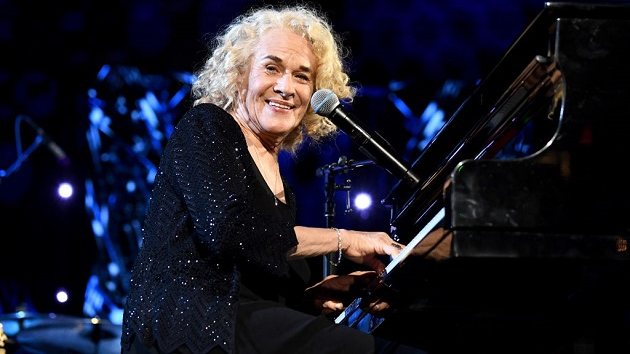
Carole King, the acclaimed singer/songwriter who first found fame in the 1960s as a composer of hits for others before becoming a top-selling solo artist in the early ’70s, celebrates her 80th birthday today.
The Brooklyn, New York, native has enjoyed two distinct chapters to her career. The first began when, as a teenager, Carole started writing songs with her first husband, lyricist Gerry Goffin.
The couple became part of the famed Brill Building songwriting collective that churned out hits for artists in the 1960s. Their breakthrough song was “Will You Love Me Tomorrow,” a #1 hit for The Shirelles in 1960.
Many more hits followed, including Bobby Vee‘s “Take Good Care of My Baby,” Little Eva‘s “The Loco-Motion,” The Drifters‘ “Up on the Roof,” The Chiffons‘ “One Fine Day,” The Animals‘ “Don’t Bring Me Down,” The Monkees‘ “Pleasant Valley Sunday,” and Aretha Franklin‘s “(You Make Me Feel Like) A Natural Woman.”
King and Goffin divorced in 1968 and Carole moved to Los Angeles, where she began the next chapter of her career, writing and recording her own songs. Things exploded for her in 1971, when she released her second solo album, Tapestry.
Tapestry spent 15 straight weeks at #1 on the Billboard 200. The album included the chart-topping hits “It’s Too Late” and “I Feel the Earth Move,” the top-20 single “So Far Away,” and her own versions of “Will You Love Me Tomorrow” and “A Natural Woman.” It also featured “You’ve Got a Friend,” with which James Taylor scored a #1 hit with in ’71.
Tapestry won four Grammy Awards and has gone on to sell over 13 million copies in the U.S.
Carole’s other solo hits include “Sweet Seasons,” “Jazzman” and “Nightingale.”
King is one of only three women to be inducted into the Rock & Roll Hall of Fame twice — in 1990 with Goffin for their songwriting achievements, and as a solo artist in 2021. Her many other accolades include induction into the Songwriters Hall of Fame, a Grammy Lifetime Achievement Award, a Library of Congress Gershwin Prize for Popular Song, and recognition at the Kennedy Center Honors.
Stephane Cardinale – Corbis/Corbis via Getty Images
Liam Neeson didn’t get the girl of his dreams on the set of his latest film, but he just may have found the premise for his next Taken movie.
During an appearance on the Australian TV show Sunrise to promote his new movie, Blacklight, the 69-year-old actor revealed that he “fell in love” with a crew member, “but she was taken.”
Neeson didn’t elaborate, but added, “I look forward to going back, I really do.”
Trainwreck star Amy Schumer couldn’t resist teasing Neesaon, sharing a screenshot of a Daily Mail headline with the caption, “Taken 4?”
One user commented, “Not taken 4, Amy.”
Another added, “Well if we know anything about Liam neeson, it’s that he won’t rest until he gets her back.”
Neeson was married to actress Natasha Richardson from 1994-2009 when she died after suffering a severe head injury in a skiing accident in Canada. They share two sons, Micheál, 26, and Daniel, 25.
He previously dated Helen Mirren in the 1980s after the two met on the set of the film Excalibur.
(NEW YORK) — After months of relatively cooler weather throughout Southern California, temperatures are beginning to spike heading into Super Bowl weekend.
An excessive heat watch has been issued for Southern California including Los Angeles, with temperatures close to 90 degrees starting Wednesday and into this weekend.
The Los Angeles Rams will host the Cincinnati Bengals for Super Bowl LVI on Sunday. The game will take place at SoFi stadium in Inglewood, in the heart of Los Angeles County.
The temperature could be in the mid to upper 80s on game day.
This would not be the first time a Super Bowl took place during extreme heat. The hottest game was played on Jan. 14, 1973, at the Los Angeles Memorial Coliseum, the second time the Super Bowl was played in LA. At kickoff, the temperature was 84 degrees, making it the warmest Super Bowl.
The National Weather Service is warning that the unseasonable heat will increase the potential for heat-related illnesses for visitors from other parts of the country.
For those visiting Los Angeles for the game, wearing light clothing, drinking plenty of water and avoiding strenuous activity during the hottest parts of the day is advised.
SoFi stadium has a capacity of 70,000 and Los Angeles County has agreed to not limit the number of attendees for the game. This will be a huge jump from last year’s attendance of 25,000.
The weather is not the only thing bringing heat to Super Bowl weekend; the halftime show stars Dr. Dre, Snoop Dogg, Enimem, Kendrick Lamar and Mary J. Blige.
The game will air on CBS on Feb. 13 at 6:30 p.m. ET.
(NEW YORK) — As the COVID-19 pandemic has swept the globe, more than 5.7 million people have died from the disease worldwide, including over 908,000 Americans, according to real-time data compiled by Johns Hopkins University’s Center for Systems Science and Engineering.
About 64.2% of the population in the United States is fully vaccinated against COVID-19, according to data from the Centers for Disease Control and Prevention.
Latest headlines:
-Daily cases below 300,000 for 1st time this year
-Omicron estimated to account for 96.4% of new cases
-Michigan closes bridge to Canada amid trucker-led protests
-Oregon to lift mask mandates for indoor public spaces, schools by March 31
Here’s how the news is developing. All times Eastern.
Feb 08, 7:32 pm
Boston mayor lays out guidelines to drop vaccine proof requirement
Boston Mayor Michelle Wu outlined her plan to drop the city’s proof of vaccine requirement at indoor businesses including bars, movie theaters and restaurants.
The city must have fewer than 200 COVID-19 hospitalizations a day, 95% of ICU beds need to be free and the community positivity rate must be below 5%, before the requirement is removed, she said.
“The fastest way to help ensure we are relieving pressure on hospital capacity and driving down community positivity is to keep closing gaps with vaccination and boosters,” Wu said in a statement.
There are no immediate plans to end the city’s mask mandate in schools, she added.
ABC News’ Arielle Mitropoulos
Feb 08, 7:20 pm
LA County maintains mask mandate for schools
While California Gov. Gavin Newsom announced Monday that he will end the statewide mask mandate next week, Los Angeles County health officials said Tuesday they have no immediate plans to drop their mask mandate.
LA County Department of Health Director Dr. Barbara Ferrer told reporters the county’s decision will be made based on dropping hospitalization numbers or vaccination approval for young children.
The mandate will be dropped when daily hospitalizations drop below 2,500 for seven consecutive days, according to Ferrer. Once this threshold is met, “masking will no longer be required while outdoors at outdoor mega events or an indoor outdoor spaces at childcare and K to 12 schools,” Ferrer said.
Even if that threshold is not met, the mandate could be dropped eight weeks after vaccines are approved for children under 5. Pfizer submitted a request to the Food and Drug Administration to have its vaccine approved for children 6 months to 5 years old. A hearing is scheduled for Feb. 15.
Los Angeles County is the second-largest school district in the country, with over 600,000 students.
Feb 08, 1:53 pm
Daily cases below 300,000 for 1st time this year
The U.S. case rate is dropping, down by 63.4% since the peak three weeks ago, according to federal data.
For the first time since December, U.S. daily cases are below 300,000.
However, experts continue to caution that the U.S. isn’t out of the woods. Case levels remain much higher than the nation’s previous surges and the U.S. is still reporting millions of new cases every week. Experts also point out that many Americans taking at-home tests are not submitting their results, and thus, case totals may be higher than reported.
On average, about 13,000 Americans with COVID-19 are being admitted to the hospital each day — a 26.4% drop in the last week, according to federal data.
Emergency department visits with diagnosed COVID-19 cases are also on the decline, down by nearly 60% in the last month, federal data show.
The U.S. death average is at a plateau, with the nation reporting around 2,300 new COVID-19-related deaths each day, according to federal data. That average is significantly lower than last winter when the nation peaked around 3,400 deaths per day.
ABC News’ Arielle Mitropoulos
Feb 08, 11:28 am
Omicron estimated to account for 96.4% of new cases
The presence of the omicron sub-variant, BA.2, is increasing in the U.S., according to new data published by the CDC.
BA.2 was estimated to account for 3.6% of new COVID-19 cases in the U.S. as of Feb. 5. BA.2 was projected to account for 1.2% of new cases the week prior.
The original omicron strain, B.1.1.529, still makes up the vast majority of new cases, accounting for an estimated 96.4% of cases in the U.S.
There is still much unknown about the BA.2 variant, but currently it doesn’t appear to demonstrate a more severe illness. There’s also no indication to suggest that BA.2 will further impact the efficacy of vaccines.
The delta variant, which accounted for 99.2% of all new cases just two months ago, is now estimated to account for 0% of new cases.
(NEW YORK) — In North Lawndale, a neighborhood on the West Side of Chicago laden with crime and poverty, Derek Brown, founder of Boxing Out Negativity, has taken the fight against gun violence off the street and into the ring.
His program provides mentorship and a safe space for at-risk youth who are more likely to be swept up into street life.
“I’m a counselor, I’m a teacher, I’m a motivator, I’m whatever our children need,” Brown told ABC News. “Boxing took troubled kids and started programming them. In order to be ‘bad’ here, you have to run at least five miles a day, exercise all day, repeat the same techniques over and over and over until you get it mastered.”
“We’re not just fighting our way inside the ring, we’re fighting our way through life,” Brown continued. “Our everyday objective is to fight for ourselves, our families and friends and communities.”
As a former gang member who transitioned out of street life at 28, Brown, now 45, said he is acutely aware of environmental factors that lead young people down the wrong path.
Trumale Coleman, Brown’s 18-year-old mentee who has been in the boxing program since he was 8, said the lessons on discipline and dedication provided him with the tools to see his higher potential and navigate through an environment where violence is the norm.
“I never even thought I would do boxing. I never even thought I had as much knowledge as he gave me. He [Brown] is not my biological father; he is my spiritual father. I learn more every day, and what he teaches me, I teach everyone else,” Coleman said.
Experts say examining the environment that perpetuates gun violence is key to understanding the latest uptick in communities of color.
Dr. David Ansell, the senior vice president for community health equity at Rush University Medical Center in Chicago and author of “The Death Gap: How Inequality Kills,” told ABC News that public health and poverty are directly correlated to high rates of gun violence.
MORE: Lessons from a ‘violence interrupter’ as shootings continue to ravage Chicago
“[West Chicago] has one of the highest COVID death rates in the city; it also has high rates of gun violence. These things are co-prevalent,” Ansell said. “What ties it all together is trauma over time and how people react to various traumas. Some of that trauma gets acted out in behavioral ways, with either mental illness, addiction or violence.”
Chicago Police department data showed that 48 people were killed in shooting homicides in January, ABC station WLS in Chicago reported. That’s a 13% decline compared to January 2021, police said.
There were 219 people shot last month, compared to 241 around the same time last year, the data showed.
“We’re seeing reductions in involvement in gun violence. We’re seeing reductions in victimization rates among the [community-led outreach organizations], all heading in the right direction,” Andrew Papachristos, professor of sociology at Northwestern University and director at the Northwestern Neighborhood & Network Initiative.
“It’s hard to prove,” he said. “It’s especially hard to prove because of the national surge in gun violence we just saw happen in Chicago. But even during COVID, even during this national surge in gun violence, we’re seeing positive direction in street outreach.”
Northwestern Neighborhood & Network Initiative (N3) is a research collective that works with Northwestern University’s Institute for Policy Research to engage with community organizations and policymakers to address social problems in Chicago. Researchers have been studying the impact of community street outreach programs, and evidence shows that credible messengers — people who grow up in the same neighborhoods they serve — have a promising impact on lowering gun violence.
A 2021 N3 report evaluated the outreach program of Chicago CRED, anti-violence organization that provides mentorship and resources to at-risk youth, to identify how the use of credible messengers impacts gun violence in neighborhoods with high crime rates. The report identified young adults in the program to see how they perceive violence around them and examined how CRED engaged with them.
Early results from the study showed that there was evidence of a reduction in gunshot victimization and violent crime arrests among CRED participants.
“Overall, the number of fatal and non-fatal gunshot injuries across all CRED participants decreased by nearly 50%, and the number of arrests for violent crimes fell 48% in the 18 months following the start of participation in the program,” according to the report.
The average outreach worker in Chicago is a 44-year old Black man who’s been incarcerated, who got involved with gangs and the criminal justice system around the age 13, according to Papachristos. Twenty-five percent of outreach workers are Latino, and about 20% are women, he said, explaining that credible messengers can have a unique impact on the ability to reach disenfranchised members of low-income communities who are often out of reach by law enforcement and city officials.
“When we look at their lived experience, they have long histories of involvement and victimization. They’ve been victimized when they were young. They have a long history of involvement with gangs. They’ve been incarcerated and they largely have lived in the same community their entire life. So they’re quite familiar with what gun violence looks like in their neighborhood. They know the families, they know the people, they know the neighborhoods, they know the parks, they know the stories, and they’re part of those stories,” Papachristos said.
“This is the workforce that is charged with tackling gun violence,” he said, “and in some ways, they are the only workforce that can reach people that are at risk and bring them into these sorts of services.”
He added, “The question is not about, ‘Did they reduce violence by 50 or 60%,’ but rather, ‘How many lives were saved today?'”
Tio Hardiman, executive director of Violence Interrupters Inc, an anti-violence program focused on combating the culture of violence, uses peace circle and conflict resolution trainings to help at-risk youth de-escalate disagreements and avoid deadly retaliation.
“The violence interrupter trainings that I facilitate is very important because we have an opportunity to actually help young men and educate them on how to think on a higher level. That’s why the training is so important. We focus on the do’s and don’ts of conflict resolution and gang mediation,” Hardiman said. “The work of credible messengers is very impactful because it’s about saving lives. Last year, in 2021, Violence Interrupters Inc mediated around 60 conflicts that could have turned deadly.”
For Patricia Hillard, a West Garfield Park outreach worker, violence interruption work is about meeting people where they are.
That means doing outreach work on “Heroin Highway,” a stretch of West Garfield Park battered by the opioid crisis. It’s the same area Hillard said she dwelled when she was addicted to drugs. After years of sobriety, she said she found a new purpose in helping others.
Now a salaried employee with the Institute for Nonviolence Chicago, Hillard said that the residents she mentors trusts her, because she was once them.
“I was with them. I was with the drug dealer. I was the person out here running to get drugs. I did it all, and I survived,” Hillard said. “A lot of the guys around here, who are doing the shooting and the sliding, they know me. So I’ve actually been able to intervene with guns drawn.”
Investment in gun violence interruption programs are taking shape in major cities and states around the country.
President Joe Biden showed his support for community-led anti-violence programs during his visit to New York City last Thursday, where he discussed his and Mayor Eric Adams’ plans to tackle gun crimes. Biden’s Build Back Better plan proposes a $5 billion dollar investment in community-led programs, but that legislation remains stalled in Congress.
Papachristos said financial investment in street outreach as a profession could have major implications for the reduction of violence over.
“You can look at any map of any city, and the areas that have the highest levels of homicide also have the highest levels of poverty, dropout rates, low birth weight, exposure to toxins like lead. … It’s not that most poor people are criminals. It’s just that crime tends to concentrate by design in communities that lack resources and opportunities,” Papachristos said. “It’s vital right now more than ever, especially as you’re getting the attention from the White House and the State House, to find out how do we develop this workforce? What tools do they need?”
(NEW YORK) — As New York City gets closer to its goal of returning to a pre-pandemic way of life, elected officials are considering making one emergency order a permanent fixture.
A New York City Council committee held its first hearing Tuesday on a bill requested by Mayor Eric Adams that would change the rules for restaurant outdoor seating permits that would allow for more businesses to provide a sidewalk seating option.
City councilmember Marjorie Velazquez, the bill’s co-sponsor, said during Tuesday’s hearing that thousands of restaurants around the city were able to survive the pandemic because of outdoor dining and argued that the city needed to adapt to help owners stay afloat.
“It’s important we save our small businesses, our restaurants,” she said during the zoning and franchises committee hearing.
However, some residents who have grown concerned over the noise, loss of street space and other trade-offs of sidewalk seating say this is one rule that shouldn’t outlast the emergency order.
Prior to the pandemic, restaurant owners would need to obtain approval from several agencies, pay a fee and go through numerous applications before they received an outdoor dining permit. The outdoor dining area would only be limited to a few feet on the sidewalk.
Roughly 1,400 restaurants, over 1,000 of which were in Manhattan, had outdoor seating permits before the pandemic, according to city records.
In June 2020, former Mayor Bill de Blasio issued an executive order that amended the city’s regulations and allowed struggling restaurants to apply for a permit for outdoor dining options in front of their restaurant, on parking spaces and, in some cases, on a closed off street. The seating area needed to meet several requirements, including a minimum of eight feet of sidewalk space for pedestrians and the removal of chairs and other items when the eatery is closed.
Fees were waived as part of the order, and the city’s Department of Transportation oversaw the temporary program.
Since the Open Restaurants program’s inception, the city has approved over 12,000 permits, 6,000 of which are for restaurants outside of Manhattan, according to data from the city. The program has been renewed several times during the pandemic and is set to expire when the city’s pandemic state of emergency ends.
The new proposed legislation would keep the outdoor dining rules in place permanently but would charge owners a $1,050 initial fee and a $525 annual fee for subsequent years. Once approved, the Department of Transportation would continue to issue guidelines for outdoor dining areas and regulate the businesses.
Several restaurant owners and advocacy groups said the rule change was a long time coming and would be a boon to their economic recoveries.
Loycent “Loy” Gordon, the owner of Neir’s Tavern, a 200-year-old bar in Queens, testified that without outdoor dining, his business would be permanently closed. He encouraged lawmakers to continue offering outdoor dining options to more restaurants.
“We have an opportunity to reimagine a bold and better new way forward. Outdoor dining is the start,” he said.
Not every New Yorker is keen to the idea.
Some opponents who testified at the hearing said the city has failed to enforce some regulations on outdoor dining areas regarding litter and noise, and they claimed that some restaurants are failing to provide ample space for pedestrians and cars.
Jeannine Kiely, the chair of a Manhattan community board, testified that the neighborhoods in her community board’s boundary have 1,000 restaurants with outdoor dining and despite thousands of city warnings for violations, the city has only issued 22 fines on owners and removed four permits.
“In baseball, it’s three strikes and you’re out. Not in New York City with open restaurants,” she said. “The city has a terrible track record.”
City Transportation Commissioner Ydanis Rodriguez acknowledged during the hearing that the city has had to deal with instances where an outdoor dining area stepped out of its bounds and inconvenienced neighbors, but he reassured attendees that they will take residents into consideration before they fine tune the regulations for a permanent basis.
“We are ready to take your feedback,” he testified.
The bill will have to pass in the zoning and franchises committee before going through a full council vote. Neither vote has been scheduled.
(WINONA, Minn.) — A 17-year-old has been arrested in connection to the search warrant that led to the death of Amir Locke, a 22-year-old who was shot and killed by Minneapolis police officers executing a “no-knock” search warrant.
Locke, who was fatally shot last Wednesday, was not named in the no-knock warrant, according to civil rights attorney Ben Crump. The warrant was executed on behalf of St. Paul police, who were searching for a homicide suspect.
Body camera video showed officers executing the no-knock search warrant and finding Locke, who had been sleeping under a blanket on the couch and holding a gun.
Locke is seen holding a gun as he sits up and was shot less than 10 seconds after officers entered the room, still covered in the blanket.
The suspect, Locke’s 17-year-old cousin, was arrested Monday afternoon in Winona, Minnesota, the St. Paul Police Department said Tuesday.
Officers from the Minneapolis Police Department had been to the apartment where Locke was killed 10 times in the last seven months for 911 calls related to threats, disturbances, narcotic activity, suspicious activity and domestic abuse, according to 911 calls obtained by ABC News.
The most recent 911 calls had been placed for “unknown trouble” on Feb. 1 and a “suspicious person” on Jan. 19, according to police records.
Police had obtained a search warrant for the apartment, which belongs to a family friend of the suspect’s brother, because staff at the apartment building told investigators that the suspect had a key to the unit and because he was present during numerous occasions when officers responded to 911 calls.
In a statement, Crump said the family and their legal team is aware of the arrest, adding that Locke’s cousin was not in the apartment at the time of the shooting.
“All available information confirms that Amir was never a target of that investigation, of those search warrants,” Crump said. “We must remain focused on the fact that Amir was an innocent young man of a raid gone terribly wrong, who is now the latest statistic and victim of the dangerous and intrusive no-knock warrant techniques that must be banned.”
Over the weekend, a caravan of about 50 vehicles drove through Minneapolis demanding justice for Locke, some in front of the home of interim Police Chief Amelia Huffman, demanding that she resign from her post.
The officer who shot Locke, identified by police as Mark Hanneman, was placed on administrative leave pending the outcome of the investigation, in accordance with department policy.
ABC News’ Whitney Lloyd contributed to this report.