(NEW YORK) — Multiple people have been shot in separate incidents involving a northbound N train in Brooklyn, New York, just before 8:30 a.m. local time Tuesday, according to police sources.
At least 13 people are injured, according to a city source. Many, if not most, appear to have been shot. The victims were taken to local hospitals.
It wasn’t immediately clear whether the shootings took place on the train or at the 36th Street subway station in Sunset Park or the 25th Street station in Greenwood Heights.
Police are also investigating whether a smoke device was detonated.
Authorities are searching for the suspect.
New York Gov. Kathy Hochul tweeted that she’s been briefed on the incident.
“First responders are on the scene and we will work with @MTA & @NYPDnews to provide updates as the investigation continues,” the governor said.
I have been briefed on this developing situation in Brooklyn. First responders are on the scene and we will work with @MTA & @NYPDnews to provide updates as the investigation continues. https://t.co/dM2hKnhoql
— Governor Kathy Hochul (@GovKathyHochul) April 12, 2022
Rihanna‘s been proud of her pregnancy from the jump, and she’s not hiding anything on the cover of the May issue of Vogue, posing in a skin-tight, orange lace bodysuit, plus gloves and sky-high heels. It’s just one of the cutting-edge looks the star has sported since she and her partner A$AP Rocky announced they were expecting.
“I’m hoping that we were able to redefine what’s considered ‘decent’ for pregnant women,” Rihanna tells Vogue. “My body is doing incredible things right now, and I’m not going to be ashamed of that. This time should feel celebratory. Because why should you be hiding your pregnancy?”
As Rihanna notes, her one rule of maternity fashion is no maternity fashion. “When I found out I was pregnant, I thought to myself, ‘There’s no way I’m going to go shopping in no maternity aisle. I’m sorry — it’s too much fun to get dressed up,'” she says.
Rih and Rocky, whom she says became “my family” during lockdown, weren’t exactly “planning” to have a baby, but “certainly not planning against it.” She reveals, “We just had fun. And then it was just there on the test.”
And while the mogul is a bit worried about the prospect of postpartum depression, she’s unbothered by the idea of fitting motherhood into her busy life.
“My mom handled the three of us with not even close to the amount of resources that I have, so I can absolutely do it,” she insists.
As for her music, Rihanna teases, “I’m looking at my next project completely differently from the way I had wanted to put it out before. I think this way suits me better, a lot better. It’s authentic, it’ll be fun for me, and it takes a lot of the pressure off.”
Though Viola Davis hasn’t shared much about the private conversation she had with Michelle Obama ahead of her portrayal as the former first lady in the Showtime series The First Lady, the Emmy, Oscar and Tony Award-winning actress did speak to Deadline about her desire to “honor” her.
Davis joined a panel for Deadline’s Contender TV — a series of events featuring highly popular shows on TV today — where she revealed details of a small portion of her talk with Mrs. Obama.
“What’s dramatic about Michelle Obama?” she asked, re-stating the question posed upon her. “I’ll tell you what’s dramatic. She is a Black woman and the first Black woman in the White House built by slaves, someone who literally was perceived to be overly masculine, not feminine, angry, hostile, and I will share one thing that she said to me.”
Davis continued: “She said, ‘I’m not even an angry person.’ Isn’t that something? Listen, I am sort of an angry person, but she’s not. And so what I wanted to do was honor her and not the perception of what Black women are supposed to be.”
The First Lady will tell the story of White House leadership through the lens of former first ladies Mrs. Obama; Eleanor Roosevelt, who will be played by Gillian Anderson; and Betty Ford, who will be portrayed by Michelle Pfeiffer.
The 10-episode series premieres April 17 on Showtime.
(NEW YORK) — As seven-time WNBA All-Star Brittney Griner enters her 54th day in Russian custody, the WNBA Players Association has a new message amid concerns over her safety and mental health.
Nneka Ogwumike, president of the WNBA Players Association, joined ABC News’ Good Morning America Tuesday to shine a new light on Griner’s detainment and explain the overall mood among her fellow WNBA players.
“We move intentionally and given the nature of Brittney’s situation — it was very important for us to be intentional about doing the best thing to ensure that we don’t compromise her coming home,” Ogwumike told Robin Roberts in an exclusive interview. “A lot of that had to do with educating ourselves about the details of what was going on. As much as we could know. But then understanding how important it was for us to be strategic about when and how we speak about her.”
The 31-year-old Phoenix Mercury star and two-time Olympic gold medalist was arrested in February, one week before Russia invaded Ukraine. Russian customs released video that appeared to show Griner going through security at an airport near Moscow and an airport employee removing a package from her bag. Griner had vape cartridges containing hashish oil — an offense punishable in Russia by up to 10 years in prison — according to Russian state media.
“It’s tough — that could have been us,” Ogwumike said, who has also played overseas during the off-season. “We’re really most concerned about her health and safety. Especially her mental health. We’re hearing that … she’s OK. But we want her home.”
In a statement, the U.S. State Department told ABC News: “We are closely engaged on this case and in frequent contact with Ms. Griner’s legal team,” adding that Griner has not received a consular visit since March 23 but she was in “good condition.”
“The consular officer who visited with Brittney Griner was able to verify that she is doing as well as can be expected under these very difficult circumstances,” Ned Price, a spokesperson for the State Department, said.
Ogwumike said she believes there is a gender issue at play in Griner’s case.
“When is it not? It’s disappointing that the question of it being a gender issue is top of mind now when it comes to this type of circumstance and the reality is she’s over there because of a gender issue, pay inequity,” she said. “I played in Russia for four years and played in Poland for one year and China for two years. We go over there to supplement our incomes and quite frankly to maintain our game. Our teams encourage us to keep up with our game by going over there and being more competitive. There’s so much that’s at play that, you know, we live politically intrinsically.”
The top WNBA salary is $228K, whereas star NBA players can make upwards of $1 million a year.
While Ogwumike said “we’re treated well,” she explained that “we don’t want to play 12 months out of the year — we don’t want to feel as though we have to go over there to get what we want to get at home.”
On Monday night, WNBA Commissioner Cathy Engelbert immediately addressed Griner’s situation overseas at the WNBA Draft and called her freedom a top priority.
“Before we get into tonight’s events, I want to take a moment to reiterate the WNBA’s support for Phoenix Mercury star Brittney Griner. Please know that getting her home safely continues to be our top priority,” she said.
Will Ferrell has joined the cast of the upcoming Greta Gerwig-directed live-action Barbie movie, alongside Ryan Gosling as Ken and Margot Robbie as the titular doll, according to The Hollywood Reporter. Ferrell will reportedly play the CEO of a toy company that may or not be Mattel. Simu Liu, Kate McKinnon, Alexandra Shipp, Emma Mackey and America Ferrera also star. Plot details are being kept under wraps. Barbie will mark Ferrell’s first feature film since Netflix’s 2020 musical rom-com Eurovision Song Contest: The Story of Fire Saga…
Back to the Future’s Christopher Lloyd and She’s All That star Rachael Leigh Cook have been tapped to star in Spirit Halloween, based on the titular North American costume and prop store chain, according to Variety. The plot revolves around three middle school friends who brush off trick-or-treating to spend Halloween night locked in the store and discover it’s full of creepy animatronic characters haunted by an evil spirit who wants to possess them, as well. Spirit Halloween is set to open in October…
Peacock has given a straight-to-series order to the comedy-thriller Based on a True Story, from The Boys executive producer Craig Rosenberg and Ozark‘s Jason Bateman, according to Deadline. The series, inspired by real events, follows “a realtor, a plumber and a former tennis star whose lives unexpectedly collide, exposing America’s obsession with true crime, murder and the slow-close toilet seat,” according to the streamer…
Peacock is also developing a new live-action series based on Casper the Friendly Ghost. Per Variety, the “horror/adventure show” is a “coming-of-age story that explores what it means to be alive. When a new family arrives in the small town of Eternal Falls, Casper finds himself entangled in a mystery uncovering dark secrets that have been buried for over 100 years.” The first live-action film, based on the the 1940s cartoon and Harvey Comics character, was released in 1995 with Malachi Pearson voicing Casper and Devon Sawa playing him in human form, alongside Christina Ricci, Bill Pullman, Cathy Moriarty and Eric Idle. It grossed over $287 million worldwide and was followed by the live-action films Casper: A Spirited Beginning and Casper Meets Wendy, and the animated films Casper’s Haunted Christmas and Casper’s Scare School in 2000 and 2006, respectively…
(NEW YORK) — Russian President Vladimir Putin’s “special military operation” into neighboring Ukraine began on Feb. 24, with Russian troops invading from Belarus, to the north, and Russia, to the east. Russian forces have since been met with “stiff resistance” from Ukrainians, according to U.S. officials.
In recent days, Russian forces have retreated from northern Ukraine, leaving behind a trail of death and destruction. After graphic images emerged of civilians lying dead in the streets of Bucha, a town northwest of Kyiv, the United States and European countries accused Russia of committing war crimes.
Here’s how the news is developing. All times Eastern:
Apr 12, 8:07 am
Nine humanitarian corridors to open in eastern Ukraine on Tuesday
Nine humanitarian corridors are expected to open in eastern Ukraine again on Tuesday to allow civilians escape heavy fighting, according to Ukrainian Deputy Prime Minister Iryna Vereshchuk.
She said in a statement via social media Tuesday that evacuation routes were agreed upon for those traveling by private cars from besieged Mariupol in the Donetsk Oblast, as well as from Berdyansk, Tokmak and Enerhodar in the Zaporizhzhia Oblast — all of which lead to the southeastern city of Zaporizhzhia.
In the Luhansk Oblast, Vereshchuk said routes were established from the cities of Severodonetsk, Lysychansk, Popasna, Hirske and Rubizhne, leading to the city of Bakhmut in the Donetsk Oblast.
The same routes were opened Monday, allowing a total of 4,354 people to evacuate via buses and private cars, according to Vereshchuk. However, Vereshchuk said buses carrying people from Berdyansk, Tokmak and Enerhodar to Zaporizhzhia city were being held up by Russian forces at a checkpoint in Vasylivka for a third day in a row.
Apr 12, 7:26 am
Ukraine investigating alleged chemical attack in Mariupol
Ukraine announced Tuesday it is investigating claims that chemical weapons were used in an attack against Ukrainian soldiers in besieged Mariupol.
The Azov Regiment, a far-right group now part of the Ukrainian National Guard, alleged in a statement via Telegram on Monday that a Russian drone had dropped “a poisonous substance of unknown origin” on its fighters defending a giant metals plant in Mariupol, a southeastern port city in Ukraine’s Donetsk Oblast that has been subjected to heavy bombardment since the Russian invasion began on Feb. 24. The Azov, which did not provide evidence of the alleged attack, said its fighters had suffered minor injuries.
The claims could not be independently verified by ABC News.
Eduard Basurin, a spokesperson for Russia-backed separatist forces in Donetsk Oblast, denied the allegations, telling Russian news agency Interfax that separatist forces “haven’t used any chemical weapons in Mariupol.” However, on the eve of the alleged attack, Basurin appeared to urge their use, telling Russian state media that Russia-backed forces should seize the Mariupol metals plant from Ukrainian soldiers by blocking all the exits and using “chemical troops to smoke them out.”
Ukrainian Deputy Defense Minister Hanna Maliar said Tuesday the government is investigating the claims, adding that preliminary information suggested phosphorous munition had been used.
When deployed as a weapon, phosphorus can inflict excruciating burns and lead to infection, shock and organ failure. Although phosphorus is not classified as a chemical weapon under the Chemical Weapons Convention, its use as an incendiary weapon in civilian areas is forbidden under the Geneva Conventions.
The United Kingdom is “working urgently” to investigate the reports, according to U.K. Foreign Secretary Liz Truss, who noted that any confirmed use of chemical weapons in Mariupol would be a “callous escalation” of the war.
U.K. Armed Forces Minister James Heappey told Sky News on Tuesday that “all options are on the table in terms of how the West might respond.”
Meanwhile, the United States said it was “aware” of the reports.
“We cannot confirm at this time and will continue to monitor the situation closely,” Pentagon press secretary John Kirby said in a statement Monday. “These reports, if true, are deeply concerning and reflective of concerns that we have had about Russia’s potential to use a variety of riot control agents, including tear gas mixed with chemical agents, in Ukraine.”
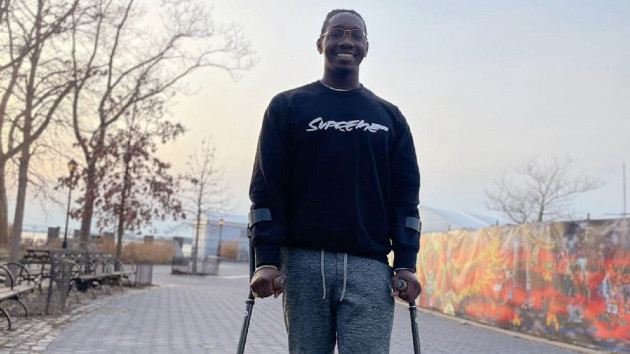
(NEW YORK) — A 27-year-old New York man can walk less than two years after being paralyzed when he was hit by a car while on a bicycle.
Cory Moses, of Brooklyn, was on his way to meet his then-partner on Oct. 25, 2020, when he said someone in a parked car opened a car door into him, sending him flying into the street, where he was hit by another car.
As a result of the accident, Moses, who had just celebrated his 25th birthday, suffered six fractured ribs, two broken arms and a fractured spine, which caused paralysis.
“I remember not wanting to look down. I thought my lower half had been severed,” Moses, who said he eventually looked down at his legs after a bystander told him he was not bleeding, told ABC News’ Good Morning America. “The lower half of my body was at a weird angle and I definitely knew something was wrong.”
“I felt the feeling drain from my legs,” he said.
Moses said he underwent three surgeries and spent two weeks in the intensive care unit. Before his first surgery, Moses said he was told he may never walk again.
“My first surgeon said she’d stabilize my spine as much as she could but from the damage I probably wouldn’t be able to walk or move my legs again,” he said. “They added two rods and eight screws to my back to stabilize it, which took about 12 to 13 hours in total because of how severe the damage was.”
After the surgery, Moses said he was not able to move his left leg at all but could very slightly move his right leg, which gave him and his medical team hope.
“[The surgeon] said that with that, there was still some connection,” Moses said. “They couldn’t tell me how much of a recovery I’d make, but I’d get something back.”
After his first three surgeries, Moses was transferred to The Mount Sinai Hospital, where he underwent two more surgeries and spent nearly three months recovering.
Moses said he realized how severe and life-changing his injuries would be, but he remained determined to overcome them.
“Within my first week or so at Mount Sinai is when I got myself into a place of peace and an understanding that if I’m going to get out of the hospital and into rehab that my mind and my focus has to be there. I can’t lose that to my feelings or depression,” he said.
Moses, who was working as a contractor for a construction business at the time of his injury, took on his rehabilitation work as a full-time job. He learned how to navigate life in a wheelchair, while also practicing on an exoskeleton program, which is a machine that helps patients with spinal cord injuries relearn how to walk.
“I put a lot of work into making my recovery fun,” he said. “I never wanted it to feel like a chore.”
Even after Moses was discharged in January 2021, three months after his accident, he went back to the hospital several days a week for physical therapy, according to Dr. Liz Pike, physical therapist with the Department of Rehabilitation and Human Performance at The Mount Sinai Hospital.
“It takes a lot of time for the body to heal just from a neurological injury and he put in the work and really listened to his body and did all the steps and kind of built the foundation blocks to get to the bigger movements, like walking and balancing,” said Pike. “He took his off time to work on strengthening and stretching and just being healthy in general, like eating well.”
Moses set a goal for himself to be able to walk before the one-year anniversary of his accident. He reached that goal last October, taking his first steps on his own in his apartment.
“I remember feeling really proud of myself,” he said. “It just reassured me that really having a strong mentality makes a difference.”
Dr. Angela Riccobono, rehab psychologist with the Department of Rehabilitation and Human Performance at The Mount Sinai Hospital, who worked with Moses, said in her 20-plus years of experience, she’s never seen someone overcome adversity with “such grace and a positive mindset.”
“He understood early on that with the right mindset and the right people around you, there was little that could stop him,” Riccobono said of Moses.
Defying the odds, Moses has progressed to being able to walk as far as 10 city blocks on his own, according to Pike.
“I think they were hopeful he would be able to use some assisted device to do some standing and some activities like that but were unable to say how far he’d be able to walk, like he is now,” Pike said.
Moses still utilizes crutches and leg braces to walk if he is going a longer distance, and relies on his wheelchair at times, too, as he continues to build his strength.
He lives on his own and works at a local school while also working to fulfill his next dream, competing in the Paralympic Games in fencing, a sport Moses said he had always wanted to play as a kid but was never able to because it was not accessible.
After the accident, Moses got a chance to try fencing thanks to his friend, Curtis McDowald, a member of the U.S. Fencing team for the 2020 Tokyo Olympics, who invited him to a training facility in New York City.
Moses committed himself to the sport and took home two medals in his first competition in January in California.
“The goal is Paralympics,” said Moses. “I’m the type that whenever I do something, I want to do it to the maximum.”
(NEW YORK) — For tens of thousands of civilians trapped in active combat zones in Ukraine, the establishment of humanitarian corridors could mean the difference between living and dying, experts said.
At least nine humanitarian corridors are expected to open in war-torn areas of eastern Ukraine this week to allow civilians to escape heavy fighting, Ukrainian Deputy Prime Minister Iryna Vereshchuk said.
But the designated passages out of besieged towns such as Mariupol in southeast Ukraine and the separatist-controlled areas of the Donbas in eastern Ukraine can be riskier than sheltering in basements if not done with precision and complete transparency, Crystal Wells, a spokesperson for the International Committee of the Red Cross, told ABC News.
“We see humanitarian corridors, that we refer to as safe passages, as really a desperate measure in dire times,” Wells said.
What is a humanitarian corridor?
Humanitarian corridors are routes for civilians to escape from the most dangerous war zones. The safe passages require Russian and Ukrainian leaders to agree on specific routes and a ceasefire span of time along those thoroughfares to allow civilians a window of opportunity to get out of the crossfire.
Safe passageways during wars date back to World War II, when routes were established to transport 10,000 children from Nazi-controlled countries in humanitarian rescues dubbed “kindertransports.” The Geneva Conventions in 1949 also established rules to ensure civilians had access to humanitarian supplies, including food and medicine, during war.
“It’s important, first of all, to remember that civilians are actually protected under international humanitarian law. Those are the laws that govern armed conflict,” Wells said. “And civilians should be protected from hostilities whether they’re in their homes, in a hospital, in a school or in a so-called humanitarian corridor.”
But Wells said that some humanitarian routes opened in Ukraine had to quickly be closed or not used at all because Russian forces allegedly continued to bomb the passages despite both sides agreeing to a ceasefire.
“It’s not like all of a sudden a humanitarian corridors comes in and it’s a magic wand to ending civilian suffering,” Wells said. “It’s so important that these are agreed on not just in principle but in concrete terms so that it’s not only the people sitting in capital cities who agree. It needs to come down to actionable, concrete, logistical details, and it has to be communicated down the chain of command to the militaries on the ground for these to work safely.”
She said if details of a humanitarian corridor, including the precise routes and ceasefire times, are not conveyed to frontline troops, it could create a dangerous — and deadly — situation.
“It’s not just about the safety of our teams, but it’s to not also lead people or accompany people into something where they could be in harm’s way,” Wells said.
In the absence of humanitarian corridors, Ukrainian civilians have risked their lives trying to flee battle zones on their own. Many have been killed.
“What’s been happening in cities like Mariupol is that in the absence of these concrete agreements, you have civilians leaving, but they’re doing so in a very ad hoc way. They’re making a life-and-death decision to go, and there’s not a ceasefire agreement in place and there’s not specifics about routes and the times and all of that. So, it’s very risky for people,” Wells said.
100,000 people trapped in Mariupol
Much of the focus for humanitarian agencies in recent days has been on Mariupol, a port city of nearly 400,000 people that has been under siege since the start of the Russian invasion on Feb. 24.
Despite reports that thousands have been killed in Mariupol, Russia has denied committing atrocities in Ukraine and claims it is not targeting civilians.
Vereshchuk said in a statement posted on social media Monday that humanitarian evacuation routes were agreed upon for those traveling by private cars from Mariupol.
Wells estimated that more than 100,000 civilians remain in Mariupol.
“For us, Mariupol really remains very much a focus and a priority,” Wells said. “That’s a city that’s been for weeks now without any humanitarian aid. They’ve been for weeks now without really any proper safe passage for civilians out of the city.”
She said ICRC teams have been trying for weeks to deliver humanitarian aid to Mariupol without success.
“We tried again a couple of Fridays ago to access Mariupol, and our teams spent five days and five nights on the road trying to get into the city, and security conditions didn’t allow it,” Wells said.
Successful humanitarian corridors
Wells said the ICRC has successfully used designated safe passages to get civilians out of the hard-hit town of Sumy in northeast Ukraine and between the Russian-controlled city Berdyansk to safety in Zaporizhzhia, a roughly 120-mile journey.
She said an unarmed ICRC convoy from Berdyansk to Zaporizhzhia last week included buses and Red Cross land cruisers clearly marked with the agency’s emblem at the front and rear of the caravan. Wells said many of the civilians who joined the convoy were fleeing Mariupol.
“We had seven buses with seven volunteer bus drivers, and that would allow about 350 people to board,” Wells said. “But then we had private cars starting to join the convoy from Berdyansk all the way to Zaporizhzhia. By the end of that convoy to Zaporizhzhia, they estimated there were about 100 civilian cars, which got us up to about 1,000 people.”
Wells said the evacuation from Berdyansk to Zaporizhzhia took two days. She said a similar mission in Mariupol would likely take longer.
“To think of doing it for 100,000 people, we would really need agreements to hold for not just hours, but days,” Wells said.
No matter how much time is granted to the humanitarian corridors, Wells said some civilians are bound to get left behind.
“What about the elderly? What about people with disabilities? Not everyone is able-bodied to get into their own car or board a bus and leave,” Wells said. “So, that’s where it’s also important that aid needs to be brought into these places as well and that civilians still have to be protected and respected from hostilities.”
(WASHINGTON) — A former police officer who stormed the Capitol during the Jan. 6 insurrection was found guilty Monday by a jury on all six counts.
Thomas Robertson was found guilty on charges ranging from obstruction of an official proceeding to entering or remaining in a restricted building or grounds with a dangerous weapon. This is the second jury case for a Capitol rioter.
Monday marked day five of a trial that spanned hours of Jan. 6 video footage, first-hand accounts from Capitol and Metro police officers and an inside look at how FBI agents handled the arrest of both Robertson and former colleague and close friend Jacob Fracker, who testified against Robertson as part of his own plea agreement for storming the Capitol.
The jury deliberated for about 15 hours in a trial that focused on very specific details of Robertson’s actions — from where he stood to what he was holding.
Robertson entered the restricted area of the Capitol with the goal of obstructing the electoral vote, the jury found. He used a wooden stick to push past an officer, which was ruled it could be used as a dangerous weapon.
“Many people in this country disagreed with the outcome of the presidential election,” a U.S. attorney said during opening arguments last Tuesday. “Many people use, and continue to use, strong language to express their political views. But the defendant, he is not on trial for beliefs — he is on trial for his actions.”
Shortly after he found out about the warrant for his arrest, Robertson destroyed his phone along with Fracker’s, saying in a message, “anything that may have been problematic has been destroyed, including my phone,” prosecutors said during the trial.
That also means he could have corrupted two official proceedings, the jury found — either the Electoral College voting process or his own federal trial, or both.
Robertson’s lawyers said he was invited into the Capitol by an officer, stayed for only 10 minutes and didn’t assault anyone or cause any damage. The defense brought in two witnesses who each took the stand for less than 8 minutes.
“He entered, he retrieved, he departed,” one of Robertson’s lawyers said on day one of the trial. “That’s what this case is about.”
The U.S. attorney’s office brought in nine witnesses, who oftentimes took the stand for over an hour.
One of those witnesses was Fracker, who stormed the Capitol with Robertson. He agreed to testify as part of his plea agreement. He said during the trial he did this in part to lower his sentence.
The jury deliberated for five hours last Friday after closing arguments. Judge Christopher R. Cooper read the decision Monday.
Robertson was found guilty of obstruction of an official proceeding; obstructing officers during a civil disorder; entering or remaining in a restricted building or grounds with a dangerous weapon; disorderly and disruptive conduct in a restricted building or grounds with a dangerous weapon; disorderly conduct in a capitol building and obstruction of an official proceeding.
Andy Cross/MediaNews Group/The Denver Post via Getty Images
(WASHINGTON) — Just as he was emerging as a top target of the House committee investigating the Capitol attack, former Trump lawyer John Eastman took a trip to Wisconsin.
Eastman, a right-wing lawyer who drafted a plan for former President Donald Trump to cling to power by falsely claiming then-Vice President Mike Pence could reject legitimate electors during the 2020 presidential election, was part of a small group of Trump allies who secured a private meeting last month to try and convince the Republican leader of the Wisconsin state Assembly to decertify President Joe Biden’s win, multiple sources familiar with the meeting told ABC.
On March 16, Eastman and others spent nearly two hours behind closed doors pressuring Republican Wisconsin Assembly Speaker Robin Vos to nullify the 2020 election and reclaim the electors awarded to Biden, the sources said, which legal experts say is impossible.
Eastman was subpoenaed by the congressional committee looking into the Jan. 6 attack on the Capitol in November. He had been bucking the panel’s request for documents, claiming attorney client privilege, until a federal judge recently ordered most of them turned over.
Eastman in the meeting urged Vos to decertify the election, sources familiar with the meeting said. According to Jefferson Davis, a Wisconsin activist pushing to reverse Biden’s victory who was also in the meeting, Trump’s former lawyer pushed Vos to start “reclaiming the electors” and move forward with “either a do over or having a new slate of electors seated that would declare someone else the winner.”
When reached for comment, Eastman said in a statement to ABC News, “By explicit request from Speaker Vos, that meeting was confidential, so I am not able to make any comment.”
Following the meeting, Vos reiterated his position that the 2020 election can’t be decertified. Vos, however, has pushed claims of widespread election fraud and was held in contempt by a judge last month for failing to turn over documents related to a Republican-led investigation he had launched himself in May 2021 into the 2020 election.
His office did not respond to multiple requests for comment from ABC News.
The Wisconsin meeting is just one instance among many in an ongoing effort by Eastman and other Trump allies who, even 15 months into President Joe Biden’s tenure, have continued to push for the results of the 2020 election to be overturned despite no evidence of widespread voter fraud.
In February, Eastman also joined leaders of Colorado’s election denial campaign, holding an “emergency town hall meeting” in Castle Rock. The meeting, organized by FEC United founder Joe Oltman, rallied the crowd against Secretary of State Jenna Griswold, falsely accusing her of participating in an election fraud conspiracy.
During the meeting, Eastman boasted about his involvement in election lawsuits in Texas, Pennsylvania, Georgia and Wisconsin and decried the “attacks” that he and others who push election conspiracies have experienced, calling it “pure evil,” according to a video of the meeting posted by FEC United.
Eastman has said he attended a gathering of Trump supporters at the Willard Hotel on Jan. 5, 2021 and spoke before Trump at the “Save America” rally the next day. Eastman also has said publicly that he, along with other Trump allies, had a so-called “war room” set up at the hotel for several days preceding and on Jan. 6.
Trump has been watching the decertification push closely, saying in a statement last month following the Wisconsin meeting that “Speaker Vos should do the right thing and correct the Crime of the Century—immediately! It is my opinion that other states will be doing this, Wisconsin should lead the way!”
The former president has been in contact with multiple people in Wisconsin working on the effort and has received regular updates from MyPillow CEO Mike Lindell, sources said, who has spread wild and baseless conspiracy theories about the 2020 vote count.
Lindell, who remains a close confidant of the former president, has participated in the Wisconsin pressure campaign with his own team of people including Douglas Frank, who was prominently featured at the My Pillow CEO’s conspiracy-filled “Cyber Symposium” last August, Army Reserve Lt. Colonel Ivan Raiklin, who has also worked closely with former Lt. Gen. Michael Flynn to overturn the 2020 election and Shawn Smith, a Colorado-based activist who has called Lindell an “angel investor” in her organization devoted to “election integrity.”
While Lindell was absent from the March 16 meeting, Frank, Raiklin and Smith attended with Eastman, according to sources familiar with the meeting.
Lindell is currently facing a $1.3 billion lawsuit from Dominion Voting Systems for promoting false claims about their voting machines. He traveled to Mar-a-Lago last Thursday to attend a fundraiser for Arizona gubernatorial candidate Kari Lake that featured the former president.
As Eastman continues his campaign to overturn the election, he has become of greater interest to investigators on the Jan. 6 committee, the panel has publicly indicated.
Last month, a federal judge ruled that Eastman must turn over most of the documents he has been withholding from the committee. The panel has begun receiving and reviewing the documents, according to sources.
The judge, who reviewed the documents privately, said that Trump “more likely than not” committed felony obstruction in the effort to overturn the election.
Eastman and others continue to push to decertify President Joe Biden’s 2020 victory in Wisconsin despite multiple recounts, court filings and audits failing to identify any widespread fraud in the battleground state.
Reviews and audits in other states including Georgia and Arizona, have also failed to substantiate claims about widespread election fraud.