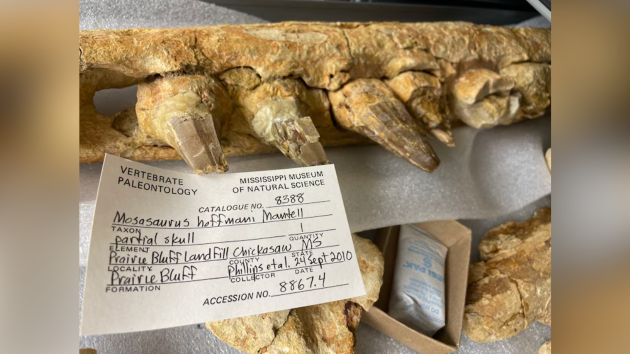
(STARKVILLE, MS) — Geologists working in Mississippi recently stumbled upon an incredible find: the fossil of an ancient marine apex predator.
They uncovered a piece of vertebra they said likely belonged to a mosasaur, a lizard ancestor that lived in the Late Cretaceous period, according to James Starnes, research director for the surface geology and surface mapping divisions for the Mississippi Department of Environmental Quality.
On April 15, researchers were collecting rock, sediment and fossil samples just south of Starkville, Mississippi, Starnes said. Poking out from the sediment of a creek bed was the end an “unusually large” lumbar vertebra.
After Starnes pointed it out, Jonathan Leard, the lead author of the MDEQ’s geological map, pulled the vertebra out of the clay.
“Both of us are standing there looking at each other with our jaws wide open because of the size,” Starnes said.
Starnes “immediately” knew they had found a mosasaur based on the shape of the vertebra, he said. The researchers estimated the specimen, determined to be Mosasaurus hoffmannii, was between 30 and 40 feet long when it died, but mosasaurs typically grew to be about 50 feet and weighed 20,000 pounds.
“These animals, like other lizards, are indeterminate,” Starnes said. “That means they just keep growing, with age, until they die.”
Due to its geological formations, the Mississippi region is known for its fossils, but this was especially rare, Starnes said.
Shell fossils are common, as are much younger Ice Age fossils from land animals, such as mastodons and sloths. But mosasaurs have a “very different” vertebra shape than other animals.
“This was distinctly not a mammal,” Starnes said. “This was definitely a sea lizard.”
Mosasaurs, a diverse group of marine lizards, conquered the seas in the Late Cretaceous period, a time when dinosaurs inhabited various ocean environments.
The Mississippi River occupies an ancient geologic structure called the Mississippi Embayment, which was inundated by the Western Interior Sea Way during the Cretaceous period.
Mosasaur fossils have been found in the area before, but only in much smaller fragments, Starnes noted. This was the largest mosasaur fossil the researchers had ever encountered.
Mosasaurs were fast and agile swimmers with jaws that contained 60 dagger-like teeth that helped them capture large prey, researchers said.
Scientists believe mosasaurs became extinct at the end of the Cretaceous period, according to Mississippi Department of Environmental Quality researchers.
Israeli Defense Forces / IDF / Handout/Anadolu via Getty Images
(LONDON) — Edan Alexander — the American-Israeli hostage freed from Gaza last week — was “weak and exhausted” upon his dramatic release, his mother Yael told ABC News, recalling her son’s first moments of freedom after 584 days as a Hamas captive.
“I was screaming and running until I bumped into him,” Yael said of her reunion with Edan at Israel’s Re’im military base near the Gaza border.
Edan “was so weak that he almost fell because he was also so excited, but he was so exhausted,” Yael continued. “I start crying like crazy. Because, that was the moment, you know? That’s it. I got it. My son is here. He’s in my arms.”
Edan, from New Jersey, moved to Israel at the age of 18. He was serving in the Israel Defense Forces when captured from his base close to the Gaza border during Hamas’ Oct. 7 attack. He was 19 when abducted and spent two birthdays in captivity.
Edan was the last living American citizen still believed to be held hostage by Hamas. The terror group is believed to also be holding the bodies of four dead American hostages, according to U.S. officials.
His father Adi told ABC News that Edan was “held in a facility” consisting of “a very dark and narrow room” with steel construction rebar. “You can call it the cage if you think about it,” he said.
News of a possible release broke on May 11, Mothers Day, but Adi nearly missed it. When he finally glanced at his phone he said he noticed eight missed phone calls from Steve Witkoff — President Donald Trump’s Middle East envoy — who was involved in direct negotiations with Hamas.
“My phone was on silent and I was working with the blower outside and it was too noisy,” he recalled. “I saw those eight missed calls and called them back immediately,” Adi continued, saying Witkoff then told him and Yael that within 10 minutes they would be hearing good news.
Fifty-seven hostages remain in Gaza, including over 20 who are believed to be alive, according to Israeli officials.
The IDF has now launched a new expanded operation in Gaza which Israeli Prime Minister Benjamin Netanyahu said is intended to both free the remaining hostages and conclusively defeat Hamas in the strip. The families of remaining hostages, though, have criticized the new operation, saying it puts surviving captives in danger.
While the IDF pressed its new offensive, Netanyahu said Israel would simultaneously allow the resumption of a “basic” level of humanitarian aid to Gaza after a 10-week freeze, citing pressure from the U.S. as a key driver in the decision.
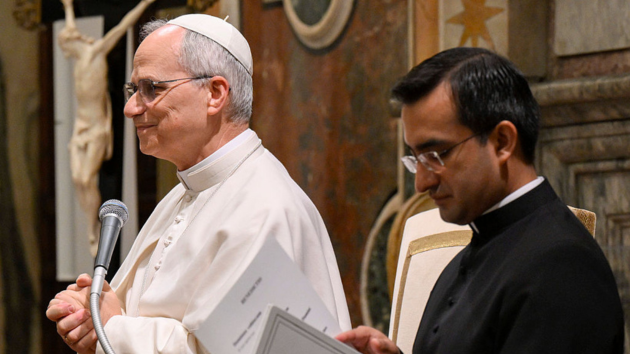
(VATICAN CITY) — Pope Leo XIV, the first American pontiff for the Roman Catholic Church, will lead his inaugural mass on Sunday, according to the Vatican.
The mass, called the Holy Mass for the Beginning of the Pontificate, will begin in Vatican City on Sunday at 10 a.m. local time (4 a.m. ET), the Vatican Press Office said.
Before the start of the mass, Leo will wave to the tens of thousands of people expected to be in the crowds, according to officials.
The mass, which will be held in St. Peter’s Basilica, will begin by the tomb of St. Peter, according to Vatican officials.
During the mass, the Petrine Pallium and Fisherman’s Ring will also be presented to Leo, the press office said.
The Pallium — a narrow Y-shaped band woven in white and decorated with two black pendants, six black crosses and three pins representing Christ’s crucifixion — signifies the pontiff carrying on his shoulders the responsibility of shepherding the church.
The Fisherman’s Ring, a gold signet ring, symbolizes the new pope’s role as the successor of St. Peter, a fisherman who is considered to be the first leader of the church, according to the Vatican Press Office. The ring signifies the beginning and the end of a pope’s authority, with Francis’ ring ceremonially broken after his death. Catholics who meet the pope traditionally kiss the ring to demonstrate both their respect for the pontiff and their devotion to the church.
Leo will then deliver a homily, followed by a prayer, called the Regina Caeli, according to the Vatican. The event is expected to be approximately over two hours, officials said.
After the Regina Caeli, Leo is expected to greet delegations and guests, the Vatican said.
Among the guests expected in attendance are Vice President JD Vance, wife Usha Vance and Secretary of State Marco Rubio.
Leo, formally Cardinal Robert Prevost, was elected the 267th pontiff on May 8. The Chicago native is the successor of Pope Francis, who died on April 21.
Leo started to emerge as a front-runner for the papacy in the days before the start of the conclave, according to the Rev. James Martin, a papal contributor to ABC News.
The new pontiff was the only U.S. cardinal on a short list of potential candidates for pope, also known as “papabiles,” compiled in the aftermath of Francis’ death by The Associated Press.
ABC News’ Phoebe Natanson and Christopher Watson contributed to this report.
Eugene Abrasimov/Suspilne Ukraine/JSC “UA:PBC”/Global Images Ukraine via Getty Images
(LONDON) — A Russian drone hit a civilian minibus in Bilopillia, northeastern Ukraine early Saturday morning local time, killing nine people and injuring four others, according to the Sumy regional military administration.
The bus was en route to Sumy, not far from the Russian border and was struck at approximately 6:17 a.m.
Ukrainian national police condemned the attack as a “cynical war crime”, stating that Russia once again deliberately targeted a civilian object, violating international humanitarian law as regional governor Oleh Hryhorov called the strike “inhumane.”
The attack occurred just hours after Russia and Ukraine held their first direct peace talks since March 2022 in Istanbul. While the negotiations did not produce a ceasefire, both sides agreed to a mutual exchange of 1000 prisoners of war in the coming days.
Russia has not directly commented on the civilian bus strike, but the Russian Ministry of Defense claimed to have hit a “military staging area” in the Sumy region.
Meanwhile, Russian official Kirill Dmitriev praised yesterday’s peace talks in Istanbul — calling the outcome a “good result” –while highlighting the largest prisoner-of-war exchange, possible ceasefire options and a better understanding of each side’s position.
He credited the progress to Donald Trump’s team and the U.S. delegation sent to help negotiations, saying the talks wouldn’t have happened without their help.
However, many key issues remain unresolved.
Russia is demanding that Ukraine give up control of parts of its territory — something Ukrainian officials say is unacceptable. and have accused Russia of using the talks to buy time and avoid more international sanctions.
Ukrainian President Zelenskyy, meanwhile, expressed disappointment and urged Ukraine’s allies to keep up pressure on Moscow to reach a meaningful peace deal.
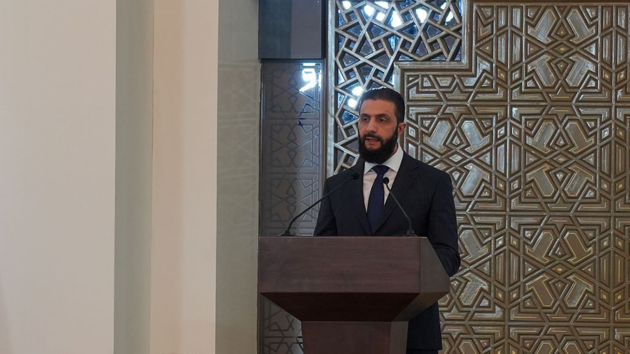
(DAMASCUS, SYRIA) — He’s a former al-Qaeda insurgent who fought against U.S. forces in Iraq and served time in the infamous Abu Ghraib prison. Still, on Wednesday, new Syrian President Ahmad al-Sharaa stood on the world stage shaking hands with President Donald Trump and achieving a major feat for his fledgling administration.
Trump announced he would lift the crippling U.S. sanctions against Syria and urged al-Sharaa to meet specified conditions in hopes that it will stabilize the country. These conditions include normalizing relations with Syria’s neighbors, including Israel, as well as the United States.
Syria’s civil war ended in December when al-Sharaa and a band of rebel fighters overthrew the government of strongman Bashar al-Assad. Since then, al-Sharaa has been working to form a new government, band together rival rebel groups inside Syria, quell infighting among former Assad-regime loyalists and establish a diplomatic presence on the world stage, ABC News has reported.
“There was always the potential that once a power vacuum was created, it would be filled by someone who was associated with one of the more extremist or terrorist related groups,” said John Cohen, a former Department of Homeland Security undersecretary of intelligence.
But Cohen, an ABC News contributor, said the United States has no choice but to engage with al-Sharaa, explaining that a stable Syria is vital to the entire Middle East region.
“We have to engage,” Cohen said. “There are other powers, like China and Russia, who would be more than happy to assert geopolitical control over the region. So, it’s in our interest not to have that occur.”
In a speech to his country after assuming the presidency, al-Sharaa spoke about uniting his country, saying that “together we can open a new chapter in the history of our beloved land.”
“From here, I address you today in my capacity as president of Syria in this fateful period, asking God to grant us all success so we can revive our homeland, and overcome the challenges that we are facing, and that will only be through all standing together in people and leadership,” al-Sharaa said in the January speech.
Al-Sharaa said he planned to form an inclusive government, “reflecting Syria’s diversity in its men, women and youth.” He also said he intends to build new Syrian institutions “so that we can reach a stage of free and impartial elections.”
“I address you today not as a ruler but as a servant for our wounded homeland, striving with all power and will I have been given to realize Syria’s unity and renaissance, as we should all understand that this is a transitional stage, and it is part of a political process that requires true participation by all Syrian men and women, inside and outside the country, so that we can build their future with freedom and dignity, without marginalization or sidelining,” he said.
Who is Ahmad al-Sharaa?
The 42-year-old al-Sharaa was born in Saudi Arabia to a family that was originally from the Israeli-occupied Golan Heights. He grew up in Damascus, the capital of Syria, according to Thomas Warrick, an international lawyer and a former Department of Homeland Security assistant secretary for counterterrorism.
“He was a quiet boy, studious and very intelligent, according to all the reports we received about him when he was a terrorist leader,” said Warrick, now a nonresident senior fellow in Middle East programs for the Atlantic Council, a nonpartisan think tank in Washington, D.C.
Unlike some terrorist leaders — including Abu Bakr al-Baghdadi, the late leader of the Islamic State jihadist group, and Ayman al-Zawahiri, the late al-Qaeda chief and accused plotter of the 9/11 terrorist attacks — al-Sharaa has not been known as a charismatic leader, said Warrick.
“He doesn’t attract fanatical followers in quite the same way that those terrorist leaders did, and he’s certainly not known as a religious scholar like Anwar al Awlaki of al-Qaeda in the Arabian Peninsula was,” said Warrick, who has worked under the administrations of Presidents George W. Bush, Barack Obama and under Donald Trump during his first term in the White House.
As a young man, al-Sharaa joined al-Qaeda following the 2003 U.S. invasion of Iraq, said Warrick.
“Right after the invasion of Iraq, he fought for them. He said he was a foot soldier,” Warrick said.
After joining al-Qaeda, al-Sharaa adopted the name Abu Mohammad al-Jolani, Warrick said, adding that the al-Jolani part of his pseudonym in Arabic means “of the Golan,” a reference to where his family originated.
While fighting for al-Qaeda in Iraq, al-Sharaa was captured by U.S. military forces and imprisoned at Abu Ghraib and other detention sites, according to Warrick.
Sometime after U.S. forces began to pull out of Iraq in 2007, al-Sharaa was released from prison and returned to Syria, Warrick said.
In Syria, al-Sharaa founded and led the al-Qaeda affiliate organization al-Nusrah Front, Warrick said.
Al-Sharaa later had a falling out with al-Baghdadi over the al-Qaeda leader’s decision to form an Islamic territorial caliphate, according to Warrick.
Al-Sharaa then rebranded the al-Nusrah Front as the Hay’at Tahrir al-Sham (HTS) during Syria’s civil war, setting up shop in Idlib in northwestern Syria near the Turkish border, Warrick said. HTS remains on the U.S. State Department’s list of foreign terrorist organizations.
“But there’s a very interesting history from then, partly because of ego, partly because he was ambitious, and he understood economics and how groups like his need to have economic support in order to have power,” Warrick said.
To generate revenue for his group, Warrick said al-Sharaa began “what would be considered either taxation or extortion” of trucks crossing from Turkey into Syria.
“He used taxation to raise money from businesses and anybody who wanted to either transit or stay,” Warrick said. “This is what enabled him to become one of the more effective warlords for that part of northwest Syria.”
Rise to the presidency
During the civil war in Syria, more than 1 million Syrians fled to Turkey, prompting that country’s president, Recep Erdogan, to ask al-Assad in mid-2024 for concessions to ease the refugee burden Turkey was experiencing, Warrick said. But a dispute between the two leaders developed when al-Assad refused Erdogan’s request, according to Warrick.
At the same time, al-Sharaa and other rebel groups opposed to the al-Assad regime came up with a plan to carry out a limited military offensive against the government’s forces. With support from Erdogan, according to Warrick, al-Sharaa’s organization and other rebel groups were able to overthrow the regime and oust al-Assad from power.
In 2018, Trump, during his first term in office, ordered U.S. missile strikes on al-Assad’s chemical weapons facilities and ISIS fighters in Syria. The United States also set up a military presence in Syria in early 2016 to train and advise Kurdish and Arab rebel forces fighting ISIS in northern and eastern parts of the country.
The U.S. intervention in Syria’s civil war, combined with missile strikes on the country by Israel, severely weakened al-Assad’s forces by the time al-Sharaa and his rebel group launched their attack in 2024 that would eventually topple the Assad regime.
“What nobody really appreciated was how brittle Assad’s forces were, and so this ‘limited effort’ began to become like an avalanche rolling downhill,” Warrick said. “It picked up momentum and led al-Sharaa eventually to taking over Damascus within a matter of weeks.”
Facing big challenges
The new Syrian leader will attempt to convince Western and European leaders that his days as a terrorist are behind him.
With Edogon and the Saudi Crown Prince helping pave his way, al-Sharaa, in just a matter of months, has garnered support and legitimacy from other leaders in the region, including the Emir of Qatar, whom he visited. Getting Trump to lift the sanctions is seen as a major achievement by the Syrian people.
But al-Sharaa has major challenges to face, the two biggest being asserting control over all of the Syrian territory, as well as the armed groups that helped him ascend to power.
In December, the Syrian Arab News Agency reported that a meeting of the heads of the rebel groups and al-Sharaa “ended in an agreement on the dissolution of all the groups and their integration under the supervision of the Ministry of Defense.”
However, reports of human rights abuses allegedly carried out by some of the rebel forces during fighting with Assad loyalists have raised questions about the Syrian president’s control of these forces. He announced an investigation and vowed to hold accountable anyone responsible for violence against civilians.
After meeting with President Trump on Wednesday, al-Sharaa delivered a televised speech to his nation, saying Syria would no longer serve as an arena for foreign struggles, nor would it allow the resurgence of the old regime narrative that divided his country. He signaled that his country is interested in pivoting toward building international partnerships rooted in sovereignty and mutual interest.
During the speech, he invited Syrian investors abroad to return to the country and help it rebuild, saying, “Hope in modern Syria has become a tangible reality,” and he praised Trump’s decision to lift sanctions, calling it “historic and courageous.”
During Wednesday’s meeting in Riyadh, Saudi Arabia, with al-Sharaa, Saudi Arabia’s Crown Prince Mohammed bin Salman and Erdogan, who phoned into the meeting, Trump urged al-Sharaa to take five specific actions, according to a readout of the meeting provided by the White House.
The conditions Trump laid out, according to the readout, include deporting Palestinian terrorists, ordering all foreign terrorists to leave Syria, helping the United States prevent a resurgence of ISIS, and signing the Abraham Accords — a series of agreements formed in 2020 to normalize relations between Israel and several Arab states.
Israel occupies a demilitarized buffer zone along the southern Syrian border, and Israeli officials have publicly accused al-Sharaa’s Islamist government of targeting the Druze, a minority religious group, south of Damascus.
On May 2, Israel bombed an area near the presidential palace in Damascus. In a joint statement, Israeli Prime Minister Benjamin Netanyahu and the country’s Defense Minister, Israel Katz, said the strike was “a clear message to the Syrian regime: We will not allow [Syrian] forces to deploy south of Damascus or any threat to the Druze community.” Al-Sharaa’s government said the bombing marked “a dangerous escalation.”
Israel has been hitting Syria in multiple locations since al-Assad’s fall in December. Israeli forces have also moved past the demilitarized buffer zone and have publicly said they won’t leave the positions they’re in currently.
Al-Sharaa told Reuters he’s been having indirect talks with Israel to ease the violence. He says an investigation is underway in the Druze attack.
Rep. Marlin Stutzman, R-Indiana, who recently traveled to Syria and met with al-Sharaa, told ABC News this week, before Trump decided to lift sanctions, that it was the right move to help Syria recover.
“This is an important time to support a government that will not only respect human rights in the country, but respect women’s rights, religious rights,” Stutzman said.
Asked if he believed al-Sharaa is truly interested in uniting the Syrian people, Stutzman said, “I hope so, and we pray so, because of what the Syrian people have been through.”
“We traveled into the community of Jobar, where there was just billions and billions of dollars of destruction, homes and lives ruined by [Assad],” Stutzman said. “This was a political genocide. It wasn’t religious, it wasn’t racial, it was strictly political genocide.”
Stutzman added, “So, I think there’s a great opportunity. He’s talking to the right people and he’s saying the right thing. But obviously his actions are going to speak louder than words at the end of the day.”
‘Potentially transformative moment’
Mathieu Rouquette, country director for Syria for Mercy Corps, a U.S.-based humanitarian organization, said in a statement to ABC News that lifting the sanctions on Syria “marks a potentially transformative moment for millions of Syrians.”
“This decision, if successfully implemented, could enable broader recovery efforts, help revive markets, mobilize resources for the rehabilitation of heavily damaged or destroyed infrastructure and housing, and give Syrians a long-awaited opportunity to rebuild their lives with dignity,” Rouquette said.
But Rouquette said what matters most to the Syrian people is whether lifting the sanctions will bring meaningful improvements to their daily life, from access to critical infrastructure, jobs, food and clean water to functioning markets and services.
“For organizations like ours, the lifting of sanctions could remove long-standing operational barriers that have hampered recovery programming, aid delivery and local engagement,” Rouquette said. “With fewer restrictions on financial transactions and imports, we can more effectively support Syrians to restore livelihoods, revive small businesses, and strengthen local markets. This moment offers a real opportunity to shift from a heavy reliance on aid toward long-term resilience.”
Following Wednesday’s meeting, Trump complimented al-Sharaa while speaking with reporters on Air Force One on his way to Qatar, describing the Syrian leader as a “young, attractive, tough guy. Strong past, very strong past — fighter.” The president added that al-Sharaa has “got a real shot at pulling it together.”
In a speech he gave at an investment forum in Riyadh before leaving Saudi Arabia, Trump said he would call off the sanctions on Syria to “give them a chance at greatness.”
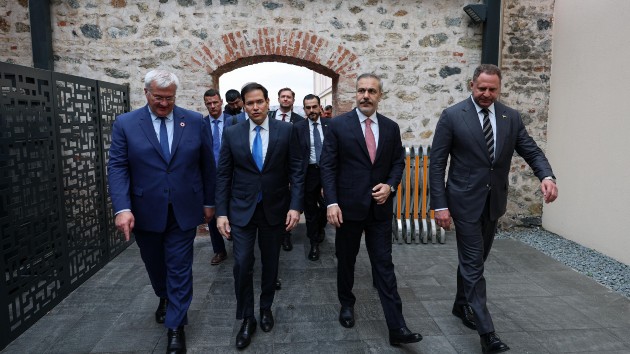
On Thursday, Secretary of State Marco Rubio met with Syrian Foreign Minister Asaad Hassan al-Shaibani in Turkey and affirmed the United States’ support for sanctions relief to stabilize Syria, according to the White House. Rubio, the White House said, welcomed the Syrian government’s calls for peace with Israel, efforts to end Iran’s influence in Syria and commitment to ascertaining the fate of U.S. citizens missing or killed in Syria.
Rubio underscored to al-Shaibani the critical importance of protecting the human rights of all Syrians regardless of ethnicity or religion, the White House said.
Handout photo by Arda Kucukkaya/Turkish Foreign Ministry via Getty Images
(LONDON) — Russia and Ukraine agreed to a prisoner exchange during peace talks in Turkey on Friday, which were led by a U.S. delegation headed by Secretary of State Marco Rubio.
The two sides will conduct a 1,000 for 1,000 person prisoner exchange at a yet-to-be determined time, officials said.
Both sides also agreed to present their vision for a ceasefire, officials said.
Notably absent from Friday’s talks were Ukrainian President Volodymyr Zelenskyy, who is in Albania, and Russian President Vladimir Putin, who is in Moscow.
Ukrainian officials on Friday asked for a meeting between Zelenskyy and Putin; Russia officials said they would take the proposed meeting under advisement.
The Turkish foreign minister said Russia and Ukraine have agreed in principle to come together again after Friday’s talks in Istanbul, which lasted for 1 hour and 50 minutes.
President Donald Trump said Friday morning in Abu Dhabi that he wants to meet with Putin “as soon as we can set it up” to negotiate an end to the war in Ukraine.
“We’re going to do it,” Trump said. “I actually think it’s time for us to do it.”
Trump suggested that “in two or three weeks” the world could be “a much, much safer place.”
“I will tell you that the world is a much safer place right now, and I think in two or three weeks we could have it be a much, much safer place,” Trump said. “We’re going to handle a couple of situations that you have here with some very serious situations. and we’re looking at Gaza, and we’ve got to get that taken care of. A lot of people are starving. A lot of people. There’s a lot of bad things going on.”
A Ukrainian diplomatic source in Istanbul has told ABC News that “we value President Trump’s genuine effort to end the war and stop the killing. Ukraine itself is the country that wants peace more than anyone else.”
“We’re going to get it done,” Trump said of Ukraine negotiations. “Five thousand young people are being killed every single week on average, and we’re going to get it done.”
ABC News’ Joe Simonetti contributed to this report.
Handout photo by Arda Kucukkaya/Turkish Foreign Ministry via Getty Images
(LONDON) — The meeting between the U.S. delegation headed by Secretary of State Marco Rubio, Ukraine and Russia are set to take place in Turkey on Friday following a day of confusion on Thursday.
Notably absent from the talks, however, are Ukrainian President Volodymyr Zelenskyy, who is in Albania, and Russian President Putin, who is in Moscow, as delegates from the United States, Ukraine and Turkey meet.
President Trump said this Friday morning in Abu Dhabi that he wants to meet with Russian President Vladimir Putin “as soon as we can set it up” to negotiate an end to the war in Ukraine
“We’re going to do it,” Trump said. “I actually think it’s time for us to do it,” he said.
Trump suggested that “in two or three weeks” the world could be “a much, much safer place.”
“I will tell you that the world is a much safer place right now, and I think in two or three weeks we could have it be a much, much safer place,” Trump said. “We’re going to handle a couple of situations that you have here with some very serious situations. and we’re looking at Gaza, and we’ve got to get that taken care of. A lot of people are starving. A lot of people. There’s a lot of bad things going on.”
A Ukrainian diplomatic source in Istanbul has told ABC News that “we value President Trump’s genuine effort to end the war and stop the killing. Ukraine itself is the country that wants peace more than anyone else.”
“We’re going to get it done,” Trump said of Ukraine negotiations. “Five thousand young people are being killed every single week on average, and we’re going to get it done.”
ABC News’ Joe Simonetti contributed to this report.
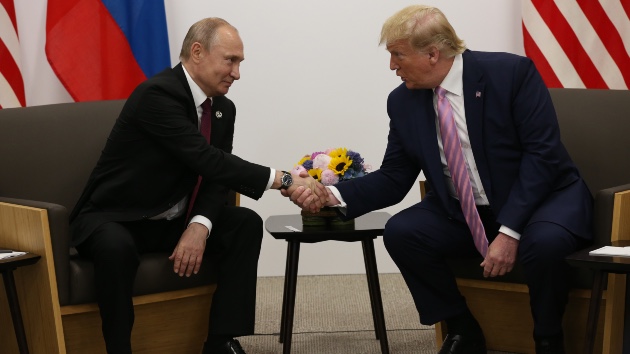
Vladimir Putin & Donald Trump at G20 Osaka Summit 2019/ Mikhail Svetlov/Getty Images
(LONDON )– Ukrainian and Russian representatives will meet in Istanbul, Turkey, on Thursday, for their first meeting since the opening weeks of Moscow’s 3-year-old invasion of its neighbor.
Russian President Vladimir Putin will not attend Thursday’s talks, despite an invitation from Ukrainian President Volodymyr Zelenskyy for a face-to-face meeting between the two leaders. Kremlin spokesperson Dmitry Peskov confirmed to journalists on Thursday that the Russian leader would not be taking part.
President Donald Trump cast doubt on the potential for success in comments aboard Air Force One on Thursday, despite having this week repeatedly suggested a breakthrough was possible.
“Nothing’s going to happen until Putin and I get together, okay?” Trump said, after it became clear the Russian leader would not attend the talks in Istanbul.
“And obviously he wasn’t going to go,” Trump added. “He was going to go, but he thought I was going to go. He wasn’t going if I wasn’t there. And I don’t believe anything’s going to happen, whether you like it or not, until he and I get together, but we’re going to have to get it solved, because too many people are dying.”
The return to Istanbul is symbolic, the historic Turkish city having played host to arguably the most successful bursts of diplomacy in three years of devastating warfare.
It was there in March 2022 that Ukrainian and Russian negotiators produced the Istanbul Communiqué — the framework of a possible peace agreement to end Russia’s nascent full-scale invasion.
Its tradeoff was essentially one of Ukraine accepting permanent neutrality — meaning forever abandoning any hope of becoming a member of NATO — in exchange for ironclad security guarantees.
The subsequent intensification of the war and emerging evidence of alleged Russian war crimes — as well as suspicions of sabotage operations against peace talks participants — fatally undermined those early peace efforts.
Later, Istanbul was also the hub of the Black Sea Grain Initiative that ran from 2022 to 2023, which with the support of Turkey and the United Nations temporarily allowed for the safe export of grain and other agricultural goods from Ukrainian and Russian ports through the Black Sea — which had by then become a key theater of the fighting — to the rest of the world.
Kremlin aide Vladimir Medinsky — who led talks in 2022 — will lead the Russian delegation.
Medinsky will be joined by Deputy Foreign Minister Mikhail Galuzin, Deputy Defense Minister Alexander Fomin and Igor Kostyukov, the head of Russia’s military intelligence agency.
Zelenskyy and Putin last met in person in France in 2019 for a session of the Normandy Format, a peace forum convened with France and Germany in a bid to end the conflict in eastern Ukraine.
The fighting there was touched off by Russia’s annexation of Crimea and subsequent fomentation of a separatist revolt against Kyiv in the Donbas region. Moscow’s 2022 full-scale invasion was a continuation of that initial cross-border aggression, with Russian columns surging out of occupied Crimea, Donetsk and Luhansk to seize more territory.
Zelenskyy said at a news conference this week he would not meet any other Russian representative, because “everything in Russia depends” on its president.
Zelenskyy arrived in the Turkish capital Ankara on Thursday to meet with President Recep Tayyip Erdogan. Once there, he posted to social media confirming Ukraine’s “top-level delegation,” adding its representatives were “ready to make any decisions that could lead to a long-awaited just peace.”
“I have not yet received official confirmation regarding the Russian level of representation,” he added. “But from what we can observe, it appears theatrical. We will decide on our next steps after the conversation with President Erdogan.”
“We will have several hours for an important discussion and very important decisions,” Zelenskyy wrote. “It is essential to understand the level of the Russian delegation, what mandate they hold, and whether they are authorized to make any decisions at all — because we all know who actually makes decisions in Russia.”
President Donald Trump — who since returning to office has been seeking a ceasefire and eventual peace deal — suggested this week that he hoped for progress at Thursday’s talks.
“I think we’re having some pretty good news coming out of there today and maybe tomorrow and maybe Friday,” Trump said upon arrival in Qatar on Wednesday.
The president even hinted he might even travel to Istanbul, though did not say whether he expected Putin to do the same.
“Well I don’t know if he’s showing up,” Trump said of his Russian counterpart. “He would like me to be there, and that’s a possibility. If we could end the war, I’d be thinking about that,” Trump added.
At a Thursday roundtable in Qatar during the second leg of his ongoing Middle East visit, Trump again floated the idea of traveling to Istanbul.
“If something happened, I’d go on Friday if it was appropriate,” the president said. “But we have people right now negotiating, and I think that I just hope that Russia and Ukraine are able to do something, because it has to stop, not only the money.”
Trump said he did not expect Putin to attend. “I actually said, why would he go if I’m not going? Because I wasn’t going to go. I wasn’t planning to. I would go, but I wasn’t planning to go. And I said, I don’t think he’s going to go if I don’t go. And that turned out to be right.”
The U.S. delegation to Turkey includes Secretary of State Marco Rubio and senior envoys Steve Witkoff and Keith Kellogg. Speaking at a gathering of NATO foreign ministers in Ankara on Thursday, Rubio said of his hopes for the upcoming Ukraine-Russia talks, “We’ll see what happens over the next couple of days.”
“I will say this, and I’ll repeat it, that there is no military solution to the Russia-Ukraine conflict, Rubio continued. “This war is going to end not through a military solution, but through a diplomatic one, and the sooner an agreement can be reached on ending this war, the less people, less people will die and the less destruction there will be.”
Trump, Rubio said, “is interested in building things, not destroying. He wants economies and countries focused on building things, making things, providing opportunity and prosperity for its people, and he’s against all the things that keep that from happening, like wars, like terrorism and all the instability that comes with that.”
Putin proposed the talks last weekend, in response to Ukraine’s demand — backed by the leaders of France, Germany, the U.K. and Poland during a joint visit to Kyiv — for a full 30-day ceasefire during which time peace talks could proceed. Trump agreed to the plan by phone, the European leaders said.
But Trump then also backed Putin’s offer to restart the talks that collapsed in 2022. Trump even publicly pressed Zelenskyy to “immediately” agree to the meeting.
Despite the significance of renewed direct Ukraine-Russia talks, Oleg Ignatov — the International Crisis Group’s senior Russia analyst — told ABC News he had low expectations of an immediate breakthrough.
“The Russians clearly say that they’re interested in keeping military and diplomatic pressure on Ukraine,” he said. “They clearly say that there will be long negotiations and Ukraine should be prepared for this.”
While Trump agitates for a deal he can sell as a political win, Kyiv and Moscow are maneuvering to avoid blame for the failure of peace talks — and dodge Trump’s subsequent wrath.
Ukrainian Foreign Minister Andrii Sybiha met with Rubio on Wednesday in Istanbul. “I reaffirmed Ukraine’s strong and consistent commitment to President Trump’s peace efforts and thanked the United States for its involvement,” the former wrote om X.
“We are ready to advance our cooperation in a constructive and mutually beneficial manner,” he added. “It is critical that Russia reciprocate Ukraine’s constructive steps. So far, it has not. Moscow must understand that rejecting peace comes at a cost.”
Russian Foreign Ministry spokesperson Maria Zakharova, meanwhile, said during a Thursday morning press briefing that Moscow “is ready for serious negotiations.”
(WASHINGTON) — The Venezuelan 2-year-old who was kept in U.S. government custody after her parents were deported has been returned to Venezuela.
In a video posted to Venezuelan President Nicolas Maduro’s YouTube page, Maduro is seen greeting the toddler upon the toddler’s return.
The toddler, Maikelys Antonella Espinoza, is seen in the video being carried by Venezuelan first lady Cilia Flores before being handed over to the toddler’s mother, Yorley Inciarte, who had been deported two weeks ago from the United States.
Espinoza’s return comes after Maduro and other Venezuelan government officials accused the Trump administration of kidnapping the 2-year old.
Last month, the Department of Homeland Security labeled Inciarte and her partner Maiker Espinoza Escalona as “Tren de Aragua parents,” alleging the two are members of the Venezuelan criminal gang.
Escalona was sent to the CECOT mega-prison in El Salvador on March 30 under Title 8 authorities. Inciarte was deported two weeks ago to Venezuela without her daughter.
“The child’s father, Maiker Espinoza-Escalona is a lieutenant of Tren De Aragua who oversees homicides, drug sales, kidnappings, extortion, sex trafficking and operates a torture house,” DHS said in a statement. “The child’s mother, Yorely Escarleth Bernal Inciarte oversees recruitment of young women for drug smuggling and prostitution.”
“Everything is false,” Inciarte told ABC News in an interview last week. “Here I am waiting for the evidence they have because if they are accusing me, it’s because they have proof of what they are saying — but here I am waiting.”
“When my partner and my daughter arrive here, the only thing I think about is staying here in my country, because the only one who supported me and fought alongside me was my country, no one else,” Inciarte said. “And I will never, ever abandon my homeland. I won’t even mention the United States, it will never come up. Because what I experienced in that country was so horrible, I don’t even want to talk about how bad it is.”
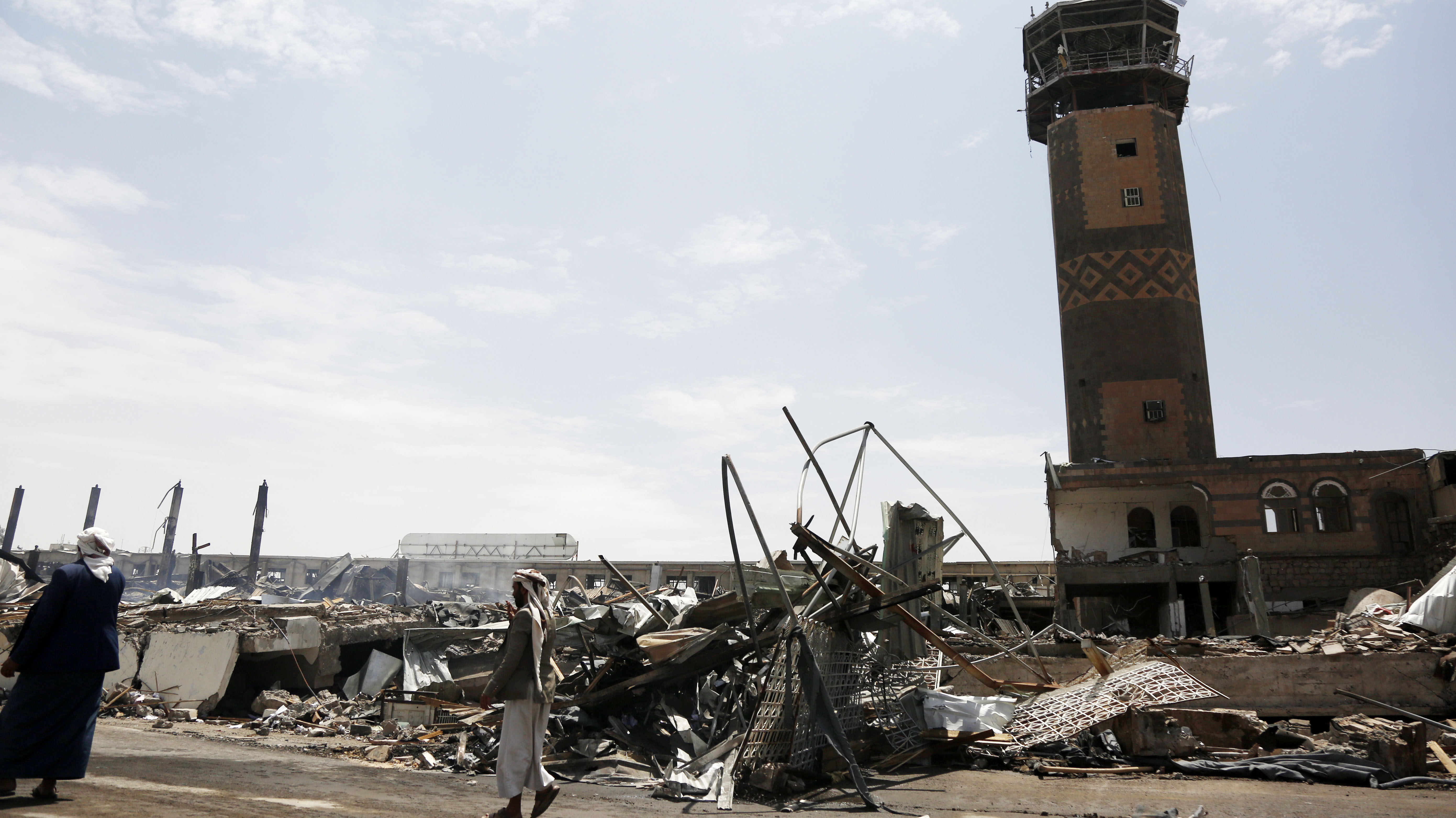
(LONDON) — The Israel Defense Forces issued evacuation warnings for three ports in Houthi-controlled Yemen after intercepting two of three ballistic missiles fired by the Iran-backed group in the past 24 hours. The IDF said one Houthi missile misfired on Tuesday.
The IDF said in a post to X that the third missile launched toward Israel on Wednesday was intercepted just before 8 a.m. local time. Air raid sirens rang out from Jerusalem to Tel Aviv, sending several million Israelis rushing for cover. About two hours later, IDF spokesperson Avichay Adraee ordered those present at the Red Sea ports of Ras Isa, al-Hudaydah and al-Salif to evacuate the area.
“Due to the terrorist Houthi regime’s use of seaports for its terrorist activities, we urge all those present at these ports to evacuate and stay away from them for your own safety until further notice,” Adraee wrote in a post to X.
The IDF routinely issues such evacuation orders ahead of planned airstrikes. The IDF’s first such warning for Yemen was issued on May 6, before Israeli strikes on the Sanaa International Airport in the Yemeni capital.
The spate of Houthi missile attacks came as Israeli Prime Minister Benjamin Netanyahu said Israeli forces would enter Gaza with “full force” in the coming days. Last week, Netanyahu’s security cabinet approved plans to expand the IDF’s war against Hamas in Gaza.
Netanyahu said Wednesday that intensified military action is required “to accomplish all of Israel’s war goals, including the release of all our hostages, destroy Hamas’s military and governance capabilities and ensure that Gaza will never again pose a threat to Israel.”
The Houthis have been attacking U.S. military and global commercial shipping and launching drones and missiles toward Israel since Hamas’ deadly surprise attack on Israel in October 2023. The Houthis say their attacks are a protest of Israel’s war against Hamas in Gaza.
Last week, the Houthis agreed to end attacks on American commercial shipping in the region in exchange for an end to the intense U.S. airstrikes against them, a campaign President Donald Trump began in March. The Houthis have clarified that this agreement struck with the U.S. does not include stopping its attacks on Israel.
Trump announced the agreement on May 6. Over the next two days, the Houthis launched an attack drone and a ballistic missile toward Israel, both of which the IDF said were intercepted.
While traveling to Saudi Arabia to begin a tour of Gulf nations on Monday, Trump told Fox News host Sean Hannity of the Houthis, “You know, they’re tough fighters. They can take a lot of punishment.” Asked if the ceasefire would hold, he responded, “With respect to America, they say it’s true. We’ll see.”
The Houthis have vowed to continue attacks on Israel until it ends its operation in Gaza and the blockade of humanitarian aid into the strip. The Israeli war on Hamas began after the terror group’s Oct. 7, 2023, attack on southern Israel.
The attack killed nearly 1,200 people in Israel with 253 others abducted as hostages, the Israeli government said. Fifty-seven hostages remain in Gaza, including 20 who are believed to be alive.
IDF soldier Edan Alexander — the last living U.S. citizen being held hostage in Gaza — was freed on Monday after direct talks between Hamas and the Trump administration. U.S. officials told ABC News that Alexander’s release was viewed as a goodwill gesture toward the Trump administration and a potential opening to jumpstart talks on a Gaza ceasefire.
After Netanyahu met top U.S. officials in Israel Monday ahead of Alexander’s release, the Israeli leader announced he would send an Israeli negotiating team to Doha, Qatar, for ceasefire talks. Indirect talks with Hamas entered their second day on Wednesday.
But Netanyahu said Tuesday that any new ceasefire deal reached — for example to facilitate the release of more living hostages — would be temporary. “There will be no way we will stop the war,” Netanyahu said. “We can make a ceasefire for a certain period of time, but we’re going to the end.” Netanyahu has repeatedly said that Hamas cannot remain in power in the Mediterranean exclave.
Also on Tuesday, a series of airstrikes targeted the European Hospital near Khan Younis in the southern Gaza Strip. Mohammad Sinwar — the leader of Hamas in Gaza and the brother of former leader Yahya Sinwar, who was killed by the IDF in October — was the target, an Israeli source familiar with the matter told ABC News.
The IDF has not confirmed Mohammed Sinwar was the target and it is not yet clear whether he was killed in the attack. Gaza’s Hamas-run Ministry of Health said that at least six people were killed and 40 others were wounded in the strike.
The IDF claimed its “precise strike” targeted “Hamas terrorists in a command and control center located in an underground terrorist infrastructure site beneath the European hospital.”
The IDF routinely alleges that Hamas uses civilian infrastructure, including hospitals, for military activities — allegations Hamas denies.
The Hamas-run Ministry of Health in Gaza said Wednesday that at least 70 people were killed and dozens injured in overnight Israelis strikes on various targets across the strip.
At least 50 people — including 22 children — were killed by Israeli attacks on houses in the Jabalia refugee camp in the northern part of the strip, the ministry said, citing local hospital officials.
The total death toll in Gaza since Oct. 7, 2023, now stands at 52,928 people, according to the Ministry of Health, with another 119,846 people injured. The ministry does not differentiate between civilian and combatant dead.