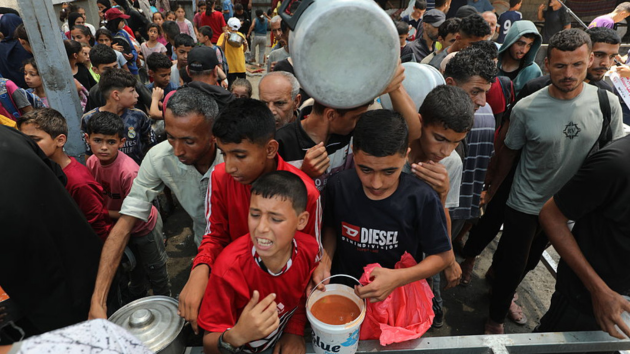
(LONDON) — Israeli troops shot and killed at least eight Palestinians near a humanitarian aid distribution center in the Rafah, Gaza, early Saturday, according to hospital officials and Gaza’s Hamas-run Ministry of Health.
The deadly shooting occurred at the Al-Alam roundabout near an aid center west of Rafah city at around 6 a.m. local time, according to the health ministry. The area is approximately 1 kilometer from an aid distribution center, which the Israel Defense Forces considers an active combat zone during the night when the site is closed.
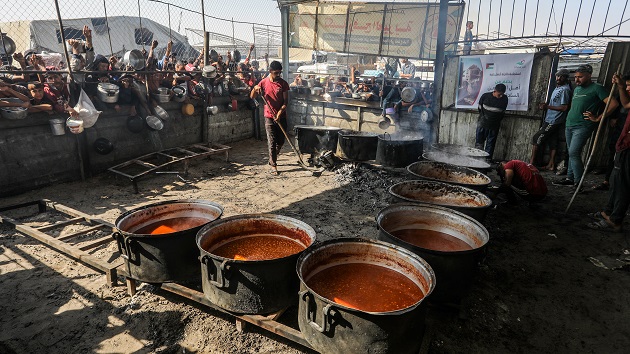
The Israeli- and U.S.-backed Gaza Humanitarian Foundation — which is running aid distribution in Gaza — closed its aid distribution sites on Friday, without giving a date on when they would reopen. Palestinians in Gaza remain at risk of extreme starvation and famine, the United Nations and other aid groups have warned.
Since May 27, when the aid distribution centers were established, more than 100 Palestinians have been killed and hundreds more have been wounded while trying to collect food from the sites, Gaza’s Hamas-run Government Media Office said.
The Nasser Medical Complex received four out of the eight deceased victims from the incident so far, a source at the hospital told ABC News.
The Gaza Humanitarian Foundation has not responded to ABC News’ request for comment.
The Israel Defense Forces said it “is aware of the reports of casualties.”
“Despite prior warnings that the area is an active combat zone during nighttime hours, several suspects attempted to approach IDF troops operating in the Tel al-Sultan area overnight (Saturday), in a manner that posed a threat to the troops,” the IDF told ABC News when asked for comment. “The troops called out to the suspects to drive them away, but as they continued advancing in a way that endangered the troops, the soldiers responded with warning shots.”
Reverend Dr. Johnnie Moore, the new chairman of GHF, told ABC News this week the organization “can’t control what happens outside” the distribution points and added that there have been incidents, “as one would expect, in a war, outside of our distribution sites.”
According to Moore, GHF — since it was set up 10 days ago — had distributed “10 million meals to Gazans, to thousands and thousands and thousands of people.” The GHF has not specified what it defines as a single “meal.”
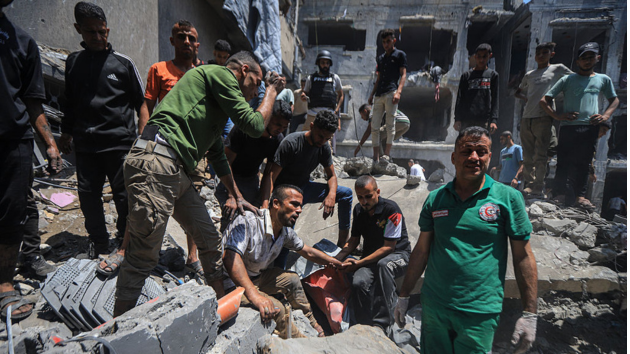
Palestinians conduct search and rescue operations in the rubble of destroyed buildings following an Israeli attack on the Sabra neighborhood of Gaza City on the second day of Eid al-Adha in Gaza on June 07, 2025. (Photo by Khames Alrefi/Anadolu via Getty Images)
(LONDON) — Talking with ABC News for his first-ever interview, the new executive chairman of the controversial United States-backed Gaza Humanitarian Foundation (GHF) discussed dozens of people being killed near the aid distribution centers and one of the sites being shut down within 10 days of opening.
Reverend Dr. Johnnie Moore — who has twice been appointed by President Donald Trump as a commissioner on the United States Commission for International Religious Freedom — said the organization “can’t control what happens outside” the distribution points and added that there have been incidents, “as one would expect, in a war, outside of our distribution sites.”
Israel Defense Forces said that its troops opened fire on both Sunday and Tuesday of this week in areas near GHF aid distribution sites in Gaza, stating it has fired shots “towards” people but not at them. The IDF said “suspects” had deviated from specific routes towards the aid hub.
According to Moore, “some” deaths in one of the incidents did “come from the IDF” although he also blamed “some” of the deaths on Hamas.
At least 57 people were killed and nearly 300 injured, health officials said, between Sunday and Tuesday’s shootings, leading GHF to pause its distribution for 24 hours.
When asked if GHF’s aid plan was part of the problem, given that desperate, hungry people had been killed on their way to pick up food, Moore answered, “No, I think that’s a quite cynical point of view.”
“I fundamentally disagree with the premise that our operation is somehow disproportionately imperiling people,” he said.
According to Moore, GHF — since it was set up 10 days ago — had distributed “10 million meals to Gazans, to thousands and thousands and thousands of people.”
The population of Gaza is around 2.2 million.
Addressing the two incidents, Moore said, “Somehow people veered off the secure corridor,” and referred to the deaths as “a tragedy.”
In the wake of such deadly incidents, GHF has since closed its distribution centers. Moore said his organization was “working with others” to make such incidents “less likely to happen” in the future.
“I’m not doing this for anybody to die,” GHF’s executive chairman said.
Moore pushed back on the implication that the new aid plan, which was set up at the behest of Israel to counter the alleged looting of aid by Hamas, had been mismanaged.
Moore confirmed that Gazans arriving at the aid distribution points didn’t need to show any form of ID to get access to aid. When asked by ABC News how he could be sure that Hamas would not profit from aid distributed under his plan, he said there was “no evidence” any of their aid had been seized.
The GHF executive said his organization was “very much solving the problem” and, over time, GHF would “put more energy on verification.”
International aid agencies have refused to participate in GHF’s aid distribution operation, stating that it breaches fundamental humanitarian principles, such as the notion that aid should always be distributed at the point of need.
The GHF operation has been accused by multiple U.N. organizations of forcing people to have to travel long distances through a perilous war zone to reach the distribution points, which are located in tightly restricted areas. The most vulnerable people in Gaza would appear to be the least likely to be able to access the aid.
Moore rejected that premise and said, “over time” he believed they would be able to get aid to the most vulnerable people.
International aid agencies have also accused GHF’s aid distribution operation of being part of Israel’s military strategy, which Moore said was “simply not true.”
“Palestinians have been presented the grimmest of choices: die from starvation or risk being killed while trying to access the meagre food that is being made available through Israel’s militarized humanitarian assistance mechanism,” United Nations High Commissioner for Human Rights Volker Turk said in a statement on Tuesday.
“This militarized system endangers lives and violates international standards on aid distribution, as the United Nations has repeatedly warned,” Turk’s statement continued.
Moore said GHF was communicating with the IDF to “manage” the “secure corridors,” but he described GHF as an “American organization” with “American contractors.”
When asked if Israel was funding the organization, at least to some extent, he refused to comment.
“There’s certain things that we’re not gonna talk about or focus on now,” Moore told ABC News.
GHF has been mired in controversy from the beginning, and it lost Executive Director Jake Wood, a U.S. military veteran, who resigned just before the aid plan launched nearly two weeks ago. Wood cited concerns over the group’s impartiality.
In an interview days before his resignation, Wood had suggested on CNN that GHF would only be able to scale up its operation to the necessary level to cater for Gaza’s population if major aid agencies were to join the operation, something they have all refused to do.
As a new executive, Moore said he believed they could scale up the operation to the necessary degree, but said it was not their goal to do it without the cooperation of major aid agencies.
“I mean, they’re the ones who have said that they won’t work with us,” he added. “My message to them [international aid agencies] is like, stop criticizing us, just join us, and we can learn from them if people have better idea.”
As of Thursday, the aid sites were shut down and then briefly re-opened and then closed again at two sites in Rafah, Gaza, GHF said. The GHF says that some sites have been reopened on Saturday but it is currently unclear how much aid is being distributed.
Moore said the ultimate aim was to have significantly more than eight distribution centers and said he thought that “big organizations” would eventually cooperate with GHF.
(PARIS, FRANCE) — Kim Kardashian made a defiant walk into Paris’ Palace of Justice in May, to face the criminals who held the reality star at gunpoint and robbed in 2016. The trial’s shocking outcome would only prompt more questions.
Ten suspects, dubbed the “Grandpa Robbers” by French media because most of them were in their 60s and 70s, stood trial in Paris for the notorious 2016 jewel heist that terrorized the reality star.
Despite finding eight of the 10 suspects guilty of crimes related to the 2016 heist, the French court allowed all defendants to walk free, with some receiving suspended sentences or credit for time already served. The judge cited the defendants’ ages and health concerns as reasons for leniency. Two were acquitted.
The crime occurred during Paris Fashion Week in October 2016, when Kardashian was staying at the exclusive “No Name Hotel,” reportedly known for hosting celebrities like Leonardo DiCaprio and Madonna. That night, while Kardashian’s security detail accompanied her sister Kourtney to a nightclub, the robbers struck.
In an interview with ABC News, Yunice Abbas, one of the convicted robbers, said he didn’t even know who Kardashian was at the time.
“I was always told ‘wife of an American rapper,'” Abbas said.
The robbers, wearing fake police jackets, first confronted the hotel’s night concierge, Abderrahmane Ouatiki. They forced him at gunpoint to lead them to Kardashian’s suite.
“When you feel the cold steel of a gun on the back of your neck, you have to be calm,” Ouatiki told ABC News. “You have to be wise in such situations.”
The thieves escaped with more than $6 million worth of jewelry, including Kardashian’s upgraded 18.8-carat wedding ring from then-husband Kanye West. In their hasty bicycle getaway, Abbas admitted to falling and spilling some of the stolen jewels on the street.
Following the verdict, Kardashian, who has become an advocate for criminal justice reform, released a statement.
“While I’ll never forget what happened, I believe in the power of growth and accountability and pray for healing for all. I remain committed to advocating for justice, and promoting a fair legal system.”
The outcome of the trial surprised even the defendants. When asked if he expected the lenient sentence, Abbas responded with a simple “No” as he left the courthouse a free man.
The unexpected verdict left some questioning the French justice system.
“I respect Kim Kardashian, but I call foul. Justice was not served,” legal commentator Nancy Grace told ABC News. “They should be in jail for what they did.”
(LONDON) — Editor’s note: This story contains descriptions of graphic violence.
Aid distribution through the controversial Gaza Humanitarian Foundation sites (GHF) resumed at two sites in Rafah, Gaza, on Thursday, the group said.
One of the sites, which has been used by GHF previously, is now closed after distribution was finished for the day, the U.S.-backed group said. The second site is a new one that is located 1 kilometer away and will open at 2:15 p.m. local time, according to the GHF.
Aid in Gaza was paused after several people died and were injured trying to reach the sites to obtain food, according to the Hamas-run Gaza Ministry of Health, eyewitness reports on the ground and international aid organizations working in Gaza.
Palestinians described harrowing scenes of bullets flying and people dying around them as they tried to get aid with a famine looming in Gaza.
The U.S.- and Israel-backed GHF suspended distribution of aid in Gaza on Wednesday after a deadly shooting left at least 27 people dead and more than 90 others injured on Tuesday while people were trying to reach one of the distribution sites in southern Gaza, according to Gaza health officials, eyewitnesses on the ground in Gaza and the International Committee of the Red Cross working on the ground in Gaza.
The GHF asked the Israel Defense Forces (IDF) to “enhance its security measures beyond the perimeter,” “develop clearer guidance” and “enhance IDF force training to support safety,” a GHF source told ABC News on Wednesday.
The newly established food distribution centers, constructed last month according to satellite imagery obtained and reviewed by ABC News, in southern Gaza have been overrun since they opened last week, with thousands of Palestinians in search of food and medicine following Israel’s partial lifting of the 11-week blockade of aid, according to aid groups.
The Israeli government imposed an 11-week blockade on all humanitarian aid entering Gaza on March 2, after the temporary ceasefire between Israel and Hamas ended. The Israeli government said the blockade was put in place to pressure Hamas to release the remaining hostages being held in Gaza.
One Palestinian who was injured trying to get flour at one of the sites said he was “surprised to find bullets hitting us,” when he went in search of food.
“I went to get some flour — only flour. Just a kilo or two of flour for our home. We were surprised to find bullets hitting us. Even lying on the ground bullets were still hitting us,” Kamel Muhanna, a Palestinian who was injured while attempting to receive aid in Rafah, told ABC News.
Muhanna described people dying around him while he was near the aid distribution site trying to get food. Those whose family members were with them collected their bodies, but those who did not remained on the ground, he said.
“The bullet passed through the head of the young man in front of me and then hit me. There were like 100 in front of me and I still got hit,” Muhanna said. “If the bullet hadn’t killed the young man in front of me, it would have taken off my arm.”
Dozens of Palestinians were killed and hundreds more were injured in two events in the last week, according to the Hamas-run Gaza Ministry of Health and the International Committee of the Red Cross working on the ground in Gaza.
Nasser NaserAllah, a Palestinian who was being treated inside Nasser Hospital, told ABC News the aid “is like a trap.”
“If there wasn’t aid, fewer people would have died,” he said. “They killed women, children [there was] blood on the ground everywhere — huge tragedies.”
The IDF acknowledged they “carried out warning fire approximately half a kilometer from the aid distribution center, targeting a few individuals who were approaching in a way that posed a security threat,” in a video statement given in English by IDF spokesperson Effie Defrin.
In a statement released on Tuesday, the International Committee of the Red Cross (ICRC) said they have responded to five incidents, four of which had occurred in the previous 96 hours.
The majority of victims suffered gunshot wounds, and “all responsive patients said they were trying to reach an assistance distribution site,” the ICRC said.
The GHF said it closed the distribution sites Wednesday for “preparations and staging” to prepare for the large number of people it expects to arrive.
“We did not expect 15,000 per hour,” the GHF said in the statement.
At the same time, the GHF said in a statement to media Tuesday they have distributed approximately 7 million meals in Gaza since they began operating last week.
The GHF also said they distributed 21 truckloads of food, totaling 20,160 boxes providing approximately 1,159,200 meals to Palestinians on Tuesday morning.
Established international aid groups operating inside Gaza — including Amnesty International and the ICRC — and the United Nations have criticized the U.S.-backed aid distribution plan, saying it is militarized and negates the neutrality of international humanitarian work.
NaserAllah claimed that the situation goes beyond hunger.
“People are living in famine,” he said.
Gaza’s entire population is experiencing critical levels of hunger, according to a report released last month. Gaza’s 2.1 million residents will face a “crisis” level of food insecurity — or worse — through the end of September, according to an Integrated Food Security Phase Classification partnership report.
He also noted that people are forced to go to the aid distribution areas despite the risks.
“A week ago, my cousin Ibn Hassoonah, went to the aid station. They shot him dead [but we still go] because of the severity of the hunger,” he said. “If they don’t die from bullets, they die from hunger.”
(LONDON) — An analysis by multiple experts of new video and satellite images suggests that at least 11 Russian bomber aircraft and one large transport plane were badly damaged or destroyed in Ukraine’s drone attack on Sunday.
Video released on Wednesday by the Security Service of Ukraine (SBU) gives more details on the attack, the full extent of which has been unclear.
Ukraine’s government said over 40 aircraft were destroyed in an attack on at least four air bases on Monday.
On Wednesday, two United States officials said around 10 planes had been destroyed and a total of around 20 were targeted in the attack.
The video from the SBU released Wednesday opens with a view of the Olenya air base with multiple drones landing on Tu-95 and Tu-22 bombers and an An-12 transport plane. Explosions from other drones and burning planes can be seen in some of the clips.
At Olenya, according to the defense intelligence firm Janes, a company using open-source information to provide intelligence, four Tu-95 bombers and one An-12 were destroyed. Janes said they based their analysis on video and multiple satellite images.
Analysts with the private intelligence firm MAIAR wrote in a report, provided to ABC News, that no significant damage was visible at the base and that imagery suggested eight A-50s remained in the same position as seen in earlier images.
Two A-50 aircraft are seen at Russia’s Ivanovo air base in a video posted by SBU on June 4.
After the appearance of the A-50s in the video from Ukraine’s SBU released Wednesday, a series of clips shows drones landing on and around large airplanes at Russia’s Dyagilevo air base.
Scorch marks on the ground suggested Russia’s Dyagilevo air base was likely targeted in the attack, according to Janes, but there was no visible evidence of damage to aircraft there.
MAIAR’s analysts also pointed to ground scarring near areas where aircraft had been stored.
After reviewing the SBU’s video, the open-source intelligence analyst Brady Africk told ABC News the video pointed to evidence of damage to at least one Tu-22.
According to Africk, a damaged Tu-22 bomber is seen at Russia’s Dyagilevo air base.
The video from Ukraine’s SBU closes with a series of clips from the Belaya air base, where several smoke plumes and fires are seen as drones target multiple planes.
There, the wreckage of three Tu-95 and four Tu-22 bombers could be seen in a June 4 image from Planet Labs, according to an analysis by Janes.
MAIAR’s analysts reached the same conclusion, highlighting evidence in the satellite imagery of ground scarring and burned grass in two areas of the base.
Africk, the open-source intelligence analyst, told ABC News that destroyed Tu-95 and Tu-22 bombers could be seen at the base.
Both types of bombers have been used in long-range strikes on Ukraine, Africk told ABC News.
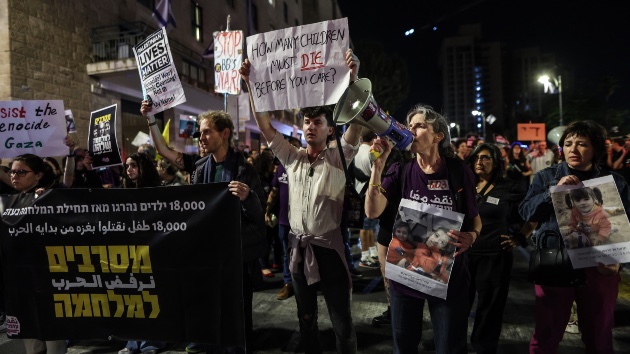
Demonstrators protest calling for action to secure the release of Israeli hostages held in the Gaza Strip/ Saeed Qaq/Anadolu via Getty Images
(JERUSALEM AND LONDON) — Israeli Prime Minister Benjamin Netanyahu announced Thursday morning that Israeli forces recovered the bodies of two Israeli-American hostages held by Hamas and returned them to Israel.
Judy Weinstein-Hagi, 70, and Gadi Hagi, 72, were a couple from kibbutz Nir Oz close to the Gaza frontier. Both were dual U.S.-Israeli citizens, with Judy also holding Canadian citizenship.
Their bodies were recovered from the Khan Younis area of the southern Gaza Strip in a special operation by the Israel Defense Forces and the Israel Security Agency, also known as the Shin Bet, according to the statement released by Netanyahu.
Netanyahu said the couple were killed during Hamas’ Oct. 7, 2023, attack and their bodies abducted. The IDF had previously determined they were killed on the day of Hamas’ surprise attack by the same terror group, Kitab al-Mujahidin, that abducted and killed Israeli hostage Shiri Bibas and her two young children.
“We will not rest or be silent until we return all of our abductees home — the living and the dead alike,” Netanyahu said.
Fifty-six hostages remain in Gaza, of whom 20 are believed to still be alive, according to figures provided by the prime minister’s office. Two Americans — Itay Chen and Omer Neutra — are among the 36 hostages believed to be dead.
ABC News’ Morgan Winsor contributed to this report.
(GAZA and LONDON) — This is not the first time Dr. Victoria Rose has visited the war-ravaged Gaza Strip, but she said the current situation on the ground is the worst she’s ever seen it.
Rose, a London-based consultant plastic surgeon, has been volunteering in weekslong stints at Gaza hospitals since the ongoing Israel-Hamas war erupted in October 2023. Most recently, she spent the month of May operating on the wounded at Nasser Medical Complex in Khan Younis, the largest referral hospital — and now the only one still functioning — in southern Gaza.
“I think it’s mainly the volume of patients that are coming in now. When we were here in August, we were seeing a lot of bomb victims, but not as many as we’re seeing now,” Rose told ABC News during an interview at the hospital on Saturday.
“We are seeing patients, we’re getting them on the operating table, we are cleaning the wounds and we are making a plan for their reconstruction,” she added. “And then we’re sending them back to the ward and then we’re not getting a chance to get them back and do the reconstruction because so many more new bomb injuries come in and then we start again. So it’s very difficult to keep up with this ongoing workload that’s coming through the door.”
Rose said Israeli forces have been relentlessly bombing the area in recent weeks and, as a result, Nasser Medical Complex has seen a surge in patients. ABC News was allowed into the hospital’s operating room as Rose performed extensive surgery on an 18-year-old patient, who she said “had quite a significant injury to his right arm” from a blast.
“If they just stop bombing us for a couple of days, it would mean that we could catch up with the backload,” Rose said. “I woke up this morning at 2 a.m. to nonstop bombing and all I could think about is the number of patients that that’s going to bring through the door that we can’t cope with here.”
The Israel Defense Forces launched an extensive new ground operation in Gaza last month targeting Hamas militants and what it called “terrorist infrastructure sites above and below ground.”
At least 54,381 people in Gaza have been killed and 124,054 have been wounded, according to the Hamas-run Gaza Ministry of Health, since the war began after Hamas attacked Israel on Oct. 7, 2023, killing 1,200 people and taking hundreds hostage. At least 20 hostages remain in Hamas captivity.
Bed occupancy at Nasser Medical Complex is currently over 100%, while 47% of essential drugs are out of stock at the hospital along with 65% of all consumable items, according to Rose.
“So we really are on our knees at the moment. We don’t have anything,” she told ABC News. “And on top of that, we have a really, really depleted health care staff.”
“We’ve lost a lot of them because they’ve been displaced and they’ve had to move, so they can’t get to the hospital,” she continued. “We’ve a lost a lot them because they have been detained or they’ve left Gaza. The staff that we have are tired. They’ve been working nonstop since the war started. So it’s a really difficult situation all around.”
The hospital is located about a mile from where active fighting is currently taking place between Israeli forces and Hamas militants, according to Rose, who fears that Israeli troops will “encircle us” and “cut us off completely” rather than evacuate the complex.
“So it’s a really dire situation because if Nasser goes out of function, all of the patients that you see here on the ICU department will die — and this is one of three ICUs that we have at Nasser,” Rose said, referring to the critically ill patients lying in beds behind her. “Plus, the fact that none of the other hospitals around us — even combined — could take the number of patients that we have here.”
Rose said she’s also seen the effects of malnutrition on the civilian population, particularly children, after Israel’s 11-week blockade on all food and other essential supplies entering Gaza. Since May 19, Israel has allowed a limited amount of humanitarian aid into the Hamas-governed Palestinian territory, but the United Nations and other organizations have repeatedly warned it’s far from enough and that famine is imminent.
“We have had a patient in our operating theater where we’ve had to cancel the procedure because he was so malnourished and we didn’t feel that he would survive the surgery,” Rose told ABC News. “The other thing that we are noticing is that people are not able to heal their wounds as effectively as they should do. So because of the malnutrition, they’re not getting the essential nutrients and vitamins they need.”
Cell turnover — the process of producing new skin cells — “is poor, so they’re not healing,” Rose said.
She added, “Coupled with that, there’s a massive spike in infection this time compared to when we were here in August. Everybody’s wounds get infected and that’s a real sign of malnutrition.”
ABC News’ Helena Skinner contributed to this report.
Security Service of Ukraine / Handout /Anadolu via Getty Images
(LONDON) — President Donald Trump said he spoke to Russian President Putin on Wednesday, describing their call as “good” but “not a conversation that will lead to immediate Peace.”
In a post on Truth Social, Trump said the leaders discussed Ukraine’s large-scale drone operation that targeted Russian military airfields on Sunday and “various other attacks” during their approximately 65-minute call.
“President Putin did say, and very strongly, that he will have to respond to the recent attack on the airfields,” Trump said.
With U.S.-brokered Ukraine-Russia peace talks still floundering despite another round of negotiations in Istanbul on Monday, Ukrainian President Volodymyr Zelenskyy and his top officials are applying more pressure on Trump to increase the cost of what they see as Russian obfuscation.
Trump returned to office in January having vowed to end the war in 24 hours. But months of failed talks — with Kyiv and Moscow clearly still far apart on their peace demands — have left the president and his administration publicly frustrated.
Trump has threatened both — Ukraine with the withdrawal of all aid and Russia with more sanctions — with punishment if his peace-making efforts fail. Both Ukraine and Russia have sought to frame the other as the main impediment to a peace deal.
Ukraine aligned itself with Trump’s May appeal for a full 30-day ceasefire, a proposal Putin has refused. In the weeks since, Zelenskyy has pushed Trump to meet Russia’s obstinance with sanctions.
Following Monday’s talks — which lasted just over an hour — Kyiv embarked on a renewed push.
“I want to thank all Americans, all Europeans who support this approach of pressuring Russia into peace — it is extremely important,” Zelenskyy wrote on Telegram on Tuesday night, following the latest round of deadly Russian drone and missile attacks on his country — and after two headline-grabbing attacks by the Security Service of Ukraine (SBU) on Russia’s strategic bomber fleet and the Kerch Strait Bridge.
“Putin does not change his behavior when he does not fear the consequences of his actions,” Zelenskyy added. “Russia must feel what war truly means. Russia must bear the losses from the war. They must really feel that continuing the war will have devastating consequences for them.”
The two sides did agree to further prisoner exchanges during the latest Istanbul talks. But both Ukrainian Foreign Minister Andrii Sybiha and Andriy Yermak — the influential head of Zelenskyy’s presidential office — pushed back on the notion that the negotiations moved the needle toward a lasting ceasefire agreement.
Yermak said in a post to social media that he spoke with Trump’s Special Envoy Steve Witkoff about the talks, telling him, “Russia’s position remains unconstructive.”
“I emphasized that Russia is stalling and manipulating the negotiation process in an attempt to avoid American sanctions and has no genuine intention of ceasing hostilities,” Yermak said. “Only strong sanctions can compel Russia to engage in serious negotiations.
Sybiha said Russia “has not responded to our document outlining Ukraine’s vision for ending the war,” in a post on X summarizing Ukraine’s official conclusions from the second round of talks.
“Instead of responding to our constructive proposals in Istanbul, the Russian side passed a set of old ultimatums that do not move the situation any closer to true peace,” he said.
“This contradicts Russia’s previous promises, including to the United States, that it would put forward something realistic and doable this week in Istanbul,” Sybiha added, also calling for new U.S. sanctions on Moscow.
Trump is also facing pressure at home. Republican Sen. Lindsey Graham — long influential in advising the president’s foreign policy — is among those pushing a sanctions bill through the Senate that would slap 500% tariffs on any country that buys Moscow’s energy products.
On Sunday, following a visit to Kyiv with Democratic Sen. Richard Blumenthal, Graham wrote on X, “Russia indiscriminately kills men, women and children. It’s time for the world to act decisively against Russia’s aggression by holding China and others accountable for buying cheap Russian oil that props up Putin’s war machine.”
The Kremlin urged patience. “It would be wrong to expect any immediate decisions or breakthroughs here,” spokesperson Dmitry Peskov told reporters on Tuesday of the latest talks. “But work is ongoing. Certain agreements were reached in Istanbul, and they are important. Indeed, first and foremost, it is about people. These agreements will be implemented.”
But Dmitry Medvedev — the former Russian president and prime minister now serving as the deputy chairman of the country’s Security Council — gave a darker read on the negotiations. The talks, he wrote on Telegram, “are not meant to achieve a compromise peace based on some imaginary and unrealistic conditions invented by others, but rather to secure our swift victory and the complete destruction” of Zelenskyy’s government.
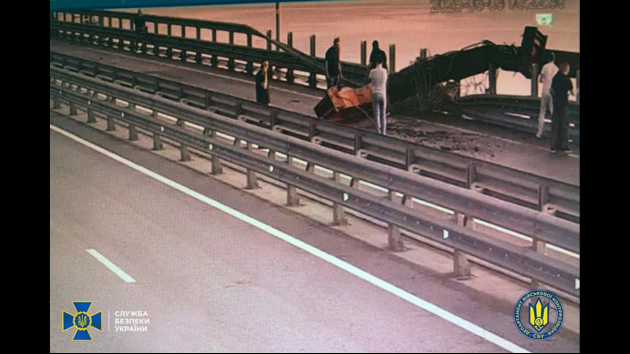
Meanwhile, Kremlin spokesperson Dmitry Peskov told journalists on Wednesday that Tuesday’s explosion at the Kerch Strait Bridge caused no damage, after the Security Service of Ukraine (SBU) claimed responsibility for the latest attack on the structure.
“Well, there was an explosion, nothing was damaged, the bridge is working, the Kyiv regime continues its attempts to attack the objects of peaceful infrastructure,” Peskov said at a briefing. “The Russian side takes appropriate precautions.”
The SBU said it attacked the bridge — which links occupied Crimea to Russia’s Krasnodar Krai region and is a prominent symbol of Moscow’s control over the occupied peninsula — with underwater explosives early on Tuesday, in an operation that “lasted several months.”
The SBU claimed that the explosion “severely damaged” the “underwater supports of the piers.” The official account for the bridge said the structure was “temporarily closed” after the explosion.
The long-range strikes that have unsettled Trump continued. Ukraine’s air force reported 95 Russian drones launched into the country overnight, of which 61 were shot down or neutralized. Impacts were recorded in seven locations, the air force said.
Russia’s Defense Ministry, meanwhile, said its forces downed seven Ukrainian drones overnight.
The U.S. Embassy in Ukraine issued a security alert Wednesday warning Americans about the increasing intensity of Russian attacks. The embassy urged U.S. citizens to “exercise appropriate caution” and be prepared to “shelter immediately” if an air alert is announced.
ABC News’ Ellie Kaufman, Oleksiy Pshemyskiy, Nataliia Popova and Will Gretsky contributed to this report.
(LONDON) — Zimbabwe has announced that dozens of its elephants will be killed to control the population size and the meat from the carcasses will be distributed to people.
The Zimbabwe Parks and Wildlife Management Authority, also known as ZimParks, said it has issued permits to Save Valley Conservancy, a large private game reserve in the southeast, “for an elephant management exercise.”
“The management quota is meant to address the growing elephant population in the region and will initially target 50 elephants,” the agency said in a statement Tuesday. “According to the 2024 aerial survey, there are 2,550 elephants against an ecological carrying capacity of 800 elephants in Save Valley Conservancy.”
The reserve has translocated 200 elephants to other areas in the southern African nation over the past five years “to manage the elephant population and protect the wildlife habitat,” according to ZimParks.
“Elephant meat from the management exercise will be distributed to local communities while ivory will be State property that will be handed over to the ZimParks for safekeeping,” the agency added.
A global ban on ivory trade bars Zimbabwe from selling its stockpile of elephant tusks.
ZimParks spokesperson Tinashe Farawo told ABC News on Wednesday that the “management exercise” is “not culling,” as the latter “involves wiping [out] the whole herd in huge numbers.” He did not respond to a question about how many elephants in total will be killed in this instance and over what period of time.
ABC News has reached out to Save Valley Conservancy for comment.
Zimbabwe is home to the second-largest population of elephants in the world, after neighboring Botswana.
Security Service of Ukraine / Handout /Anadolu via Getty Images
(LONDON) — Kremlin spokesperson Dmitry Peskov told journalists on Wednesday that Tuesday’s explosion at the Kerch Strait Bridge caused no damage, after the Security Service of Ukraine (SBU) claimed responsibility for the latest attack on the structure.
“Well, there was an explosion, nothing was damaged, the bridge is working, the Kyiv regime continues its attempts to attack the objects of peaceful infrastructure,” Peskov said at a briefing. “The Russian side takes appropriate precautions.”
The SBU said it attacked the bridge — which links occupied Crimea to Russia’s Krasnodar Krai region and is a prominent symbol of Moscow’s control over the occupied peninsula — with underwater explosives early on Tuesday, in an operation that “lasted several months.”
The SBU claimed that the explosion “severely damaged” the “underwater supports of the piers.” The official account for the bridge said the structure was “temporarily closed” after the explosion.
Meanwhile, with U.S.-brokered Ukraine-Russia peace talks still floundering despite another round of negotiations in Istanbul, Turkey, on Monday, Ukrainian President Volodymyr Zelenskyy and his top officials are applying more pressure on President Donald Trump to increase the cost of what they see as Russian obfuscation.
Trump returned to office in January having vowed to end the war in 24 hours. But months of failed talks — with Kyiv and Moscow clearly still far apart on their peace demands — has left the president and his administration publicly frustrated.
Trump has threatened both — Ukraine with the withdrawal of all aid and Russia with more sanctions — with punishment if his peace-making efforts fail. Both Ukraine and Russia have sought to frame the other as the main impediment to a peace deal.
Ukraine aligned itself with Trump’s May appeal for a full 30-day ceasefire, a proposal President Vladimir Putin has refused. In the weeks since, Zelenskyy has pushed Trump to meet Russia’s obstinance with sanctions.
Following Monday’s talks — which lasted just over an hour — Kyiv embarked on a renewed push.
“I want to thank all Americans, all Europeans who support this approach of pressuring Russia into peace — it is extremely important,” Zelenskyy wrote on Telegram on Tuesday night, following the latest round of deadly Russian drone and missile attacks on his country — and after two headline-grabbing attacks by the Security Service of Ukraine (SBU) on Russia’s strategic bomber fleet and the Kerch Strait Bridge.
“Putin does not change his behavior when he does not fear the consequences of his actions,” Zelenskyy added. “Russia must feel what war truly means. Russia must bear the losses from the war. They must really feel that continuing the war will have devastating consequences for them.”
The two sides did agree to further prisoner exchanges during the latest Istanbul talks. But both Ukrainian Foreign Minister Andrii Sybiha and Andriy Yermak — the influential head of Zelenskyy’s presidential office — pushed back on the notion that the negotiations moved the needle toward a lasting ceasefire agreement.
Yermak said in a post to social media that he spoke with Trump’s Special Envoy Steve Witkoff about the talks, telling him, “Russia’s position remains unconstructive.”
“I emphasized that Russia is stalling and manipulating the negotiation process in an attempt to avoid American sanctions and has no genuine intention of ceasing hostilities,” Yermak said. “Only strong sanctions can compel Russia to engage in serious negotiations.
Sybiha said Russia “has not responded to our document outlining Ukraine’s vision for ending the war,” in a post on X summarizing Ukraine’s official conclusions from the second round of talks.
“Instead of responding to our constructive proposals in Istanbul, the Russian side passed a set of old ultimatums that do not move the situation any closer to true peace,” he said.
“This contradicts Russia’s previous promises, including to the United States, that it would put forward something realistic and doable this week in Istanbul,” Sybiha added, also calling for new U.S. sanctions on Moscow.
Trump is also facing pressure at home. Republican Sen. Lindsey Graham — long influential in advising the president’s foreign policy — is among those pushing a sanctions bill through the Senate that would slap 500% tariffs on any country that buys Moscow’s energy products.
On Sunday, following a visit to Kyiv with Democratic Sen. Richard Blumenthal, Graham wrote on X, “Russia indiscriminately kills men, women and children. It’s time for the world to act decisively against Russia’s aggression by holding China and others accountable for buying cheap Russian oil that props up Putin’s war machine.”
The Kremlin urged patience. “It would be wrong to expect any immediate decisions or breakthroughs here,” spokesperson Dmitry Peskov told reporters on Tuesday of the latest talks. “But work is ongoing. Certain agreements were reached in Istanbul, and they are important. Indeed, first and foremost, it is about people. These agreements will be implemented.”
But Dmitry Medvedev — the former Russian president and prime minister now serving as the deputy chairman of the country’s Security Council — gave a darker read on the negotiations. The talks, he wrote on Telegram, “are not meant to achieve a compromise peace based on some imaginary and unrealistic conditions invented by others, but rather to secure our swift victory and the complete destruction” of Zelenskyy’s government.
Meanwhile, the long-range strikes that have unsettled Trump continued. Ukraine’s air force reported 95 Russian drones launched into the country overnight, of which 61 were shot down or neutralized. Impacts were recorded in seven locations, the air force said.
Russia’s Defense Ministry, meanwhile, said its forces downed seven Ukrainian drones overnight.
ABC News’ Ellie Kaufman, Oleksiy Pshemyskiy, Nataliia Popova and Will Gretsky contributed to this report.