
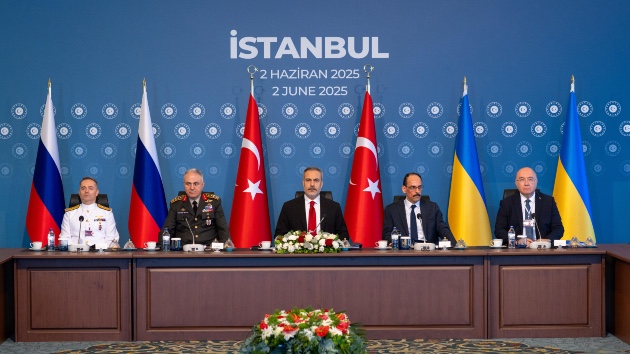
6.2 magnitude earthquake near Istanbul rattles Turkey

6.2 magnitude earthquake near Istanbul rattles Turkey

(LONDON) — A 6.2 magnitude earthquake has rattled much of Turkey Wednesday morning, according to the United States Geological Survey.

The quake occurred at a depth of just 6.2 miles with the epicenter of the quake located approximately 14 miles southeast of Marmara Ereğlisi and 70 miles west of Istanbul.

No casualties have been reported so far, but hospitals reported that many patients were admitted due to anxiety and panic as citizens could be seen rushing into the streets and parks.

ABC News’ Engin Bas and Somayeh Malekian contributed to this report.

Copyright © 2025, ABC Audio. All rights reserved.
Could the next pope be from Africa or Asia? Experts weigh in

Could the next pope be from Africa or Asia? Experts weigh in
Marco Di Lauro/Getty Images

(VATICAN CITY) — Pope Francis marked multiple firsts for the papacy, becoming the first Latin American pope and the first from the Southern Hemisphere when elected in 2013.

He was also the first head of the Roman Catholic Church born outside of Europe in over a millennium.

Following his death on Monday at the age of 88, the selection process to elect the 267th pontiff will soon begin.

Ahead of the secretive gathering of eligible cardinals for the vote, questions swirl over whether the next pope will similarly come from outside Europe, such as Asia or Africa, and potentially be another history-making leader.

“I do think it’s fair to say that election of an archbishop from Asia or Africa is certainly a real probability now. That is not unthinkable at all,” Bruce Morrill, the Edward A. Malloy chair in Roman Catholic studies and distinguished professor of theology at Vanderbilt University, told ABC News. “That’s very different from when, let’s say, someone like John Paul II was elected. It was a big deal back in 1978 because he wasn’t Italian.”

“To move a couple papacies later to a man from Argentina — clearly, it’s reflecting more than ever a global church,” he added.

The election of someone from the Global South would be a “move in that direction of how to be a global church,” Jaisy A. Joseph, an assistant professor of theology and religious studies at Villanova University, told ABC News.

“That move from a Eurocentric church to a truly global church — I think that’s what Francis really inaugurated,” she said.

Pope Francis’ successor could be someone who continues his progressive legacy and mirrors his pastoral approach, or someone who counters it with a more conservative approach, experts say.

“Is he going to be someone who really strongly continues the primary emphases of the Francis papacy, or do they want to go with someone that they would see as bringing a balance or a certain pendulum swing, to use that language, in counter or contrast of priorities from the Francis papacy?” Morrill said.

Such a swing occurred when Pope Francis was elected, succeeding Pope Benedict XVI, Morrill noted.

“Is he going to be someone who really strongly continues the primary emphases of the Francis papacy, or do they want to go with someone that they would see as bringing a balance or a certain pendulum swing, to use that language, in counter or contrast of priorities from the Francis papacy?” Morrill said.

Such a swing occurred when Pope Francis was elected, succeeding Pope Benedict XVI, Morrill noted.

“If the electors are going to turn to someone and discern the way to go is to continue, strongly, the priorities of the late Pope Francis, Tagle fits the bill,” Morrill said.

“He’s likewise someone who smiles readily and has this warm pastoral way,” he added. “That’s what makes him the figure that we would think of as providing the most continuity.”

If elected, Tagle would be the first Asian pope.

Should the voting cardinals move in a more conservative direction, a potential pope could be found in Sub-Saharan Africa, Morrill said. Such a move would make for the first Black pope in modern history.

“There would be archbishops, cardinal archbishops in Sub-Saharan Africa that are much more focused on preservation or guarding of the strict traditional practices and teachings of the church,” Morrill said.

One name that comes to mind for Morrill is Cardinal Fridolin Ambongo Besungu, 65, of the Democratic Republic of the Congo.

Other conservative candidates from Africa that could gain recognition include Ghanaian Cardinal Peter Turkson, 76, and Guinean Cardinal Robert Sarah, 79, according to Miles Pattenden, historian of the Catholic Church at Oxford University.

Cardinals under the age of 80 are eligible to participate in the secret conclave inside the Sistine Chapel to choose the next pontiff, a gathering that typically commences between 15 to 20 days after the pope’s death.

A two-thirds majority is required to elect a pontiff.

Francis appointed roughly 80% of the cardinals who are eligible to vote for his successor, which could impact the selection of the next pope, Morrill said.

“He was advancing and choosing more and more people from Asia and Africa, and so that does all feed these distinct probabilities or possibilities,” Morrill said. “But there really is no way to make any solid prediction.”

The Pew Research Center found that under Francis, voting-age cardinals from the Asia-Pacific region increased 10%, and those from Sub-Saharan Africa went up 8%, while those from Europe decreased 51%.

In all, there are 53 cardinal electors from Europe, 23 from Asia, 18 from Africa, 17 from South America, 16 from North America, four from Central America and four from Oceania, according to the Vatican.

For Phyllis Zagano, the senior research associate-in-residence in Hofstra University’s Department of Religion, it’s unclear at the moment how that shift in makeup will impact the election of the next pope.

“The College of Cardinals has expanded significantly under Pope Francis, who has included cardinals from the farthest reaches of the world,” Zagano told ABC News. “Whether that will make any difference in the election of his successor remains to be seen.”

Copyright © 2025, ABC Audio. All rights reserved.
Thermoresistant ‘super corals’ offer hope amid climate change: Scientists

Thermoresistant ‘super corals’ offer hope amid climate change: Scientists
Alexis Rosenfeld/Getty Images

(TATAKOTO, FRENCH POLYNESIA) — A possible “biological treasure chest” of corals located in an underwater lagoon off a remote island in the South Pacific appear to be surviving extreme heat stress caused by climate change, scientists say.

In the pristine waters off a French Polynesian island in the South Pacific, a team of marine biologists believes it has made a “miracle-like” discovery — a type of coral which can survive in abnormally warm water.

The coral lives in a semi-enclosed underwater lagoon, within which the water temperature is significantly higher than the swirling South Pacific Ocean beyond.

The lagoon is situated off the remote island of Tatakoto, and in the warmest month of March, water temperatures can reach a sizzling 95 F (35 C) which is about 7 F to 9 F (4 C or 5 C) higher than the wider ocean, according to France’s National Scientific Research Center (CRNS), which is behind the study.

In extreme heat events, which scientists say have become more frequent around the world because of our planet’s changing climate, abnormally warm water temperatures can “bleach” corals, which are a vital food source and habitat for a vast array of marine organisms.

Bleaching means the coral loses the algae living in its tissues, turning it white. Coral struggles to survive in this state.

The warming of seas and oceans, which scientists say is primarily driven by human-amplified climate change, has contributed to the death of large areas of coral reef right across the globe, putting fragile underwater ecosystems at risk.

For four years, the team of marine biologists led by Dr Laetitia Hédouin — in a joint partnership with the marine research non-profit 1ocean.org — has been studying what they say are thermoresistant “super corals” living and “thriving” inside the abnormally warm lagoon off Tatakoto.

Hédouin told ABC News that she and her colleagues are carrying out further studies on the corals, but she is already confident the corals seem to have developed some type of “biological mechanism” that helps them survive.

Last year, French Polynesia experienced a “super long and super strong” marine heat wave that bleached other coral reefs elsewhere in French Polynesia in less extreme water temperatures, according to Hédouin.

It was “almost like a miracle” that the corals survived in the lagoon, because the sea water there is “way warmer” than the ocean outside, Hédouin said.

The aim of the mission is to study whether the so-called super-resistant corals can live and reproduce in new environments outside of the warm lagoon, and potentially survive extreme heat events that have bleached other corals.

The mission has the backing of UNESCO, the lead U.N. agency on ocean research. UNESCO described the corals found in the lagoon as “remarkable specimens” and said the study in French Polynesia could pave the way for the development of “new strategies to repopulate coral reefs worldwide.”

Hédouin and her team have planted cuttings of the heat-resistant coral from the lagoon in another area of the archipelago to see if they can adapt and thrive in a more typical environment where the sea temperature is lower.

If the corals from Tatakoto can survive being moved — a process known as “assisted migration” — then scientists behind the project hope the island could become “a biological treasure chest” of heat-resistant corals that would help restore damaged reefs elsewhere in the world.

The project is being documented by French underwater photographer and 1ocean.org founder Alexis Rosenfeld, who described the lagoon off Tatakoto as a symbol of hope because it represented what he said is humankind’s ability to “live better” with nature.

Rosenfeld said he and his team were documenting this project and others like it through photos and film to “build awareness” of the need to protect fragile ecosystems in our oceans and seas.

Copyright © 2025, ABC Audio. All rights reserved.
Faithful recall Pope Francis’ historic US virtual town hall with David Muir in 2015

Faithful recall Pope Francis’ historic US virtual town hall with David Muir in 2015
ABC News

(VATICAN CITY) — Pope Francis’ death is bringing renewed attention to his historic virtual town hall in 2015, during which he connected with followers via satellite, demonstrating how modern technology can bridge distances and bring the Catholic Church closer to its people.

Francis, the first Latin American pontiff, died Monday at the age of 88. The Vatican announced that the pope died from a stroke followed by heart failure, as mourners worldwide gathered to honor his legacy of compassion and inclusivity.

Francis’ death followed a series of worsening health problems, including a respiratory crisis that left him in critical condition back in February.

During his decade-long papacy, Francis broke new ground in many ways, including a 2015 virtual town hall with Americans that showcased his dedication to connecting directly with the faithful.

ABC News and “World News Tonight” revisited the pope’s historic town hall, where he participated in a virtual audience with Americans from across the country, moderated by ABC News anchor David Muir.

The groundbreaking event, held Aug. 31, 2015, marked the first time a pope had ever engaged in such direct dialogue with Americans through virtual technology. The conversation revealed Francis’ characteristic warmth and accessibility, moving many participants to tears.

The pope spoke for nearly an hour via satellite to groups including Cristo Rey Jesuit High School in Chicago; Sacred Heart Church in McAllen, Texas; and homeless individuals and outreach workers in Los Angeles.

Throughout the conversation, the pontiff responded directly to participants’ questions and provided encouraging words of wisdom.

“It really touched my heart. It really made me feel that he is really connecting with us,” Ricardo Ortiz, 19, told ABC News at the time, after speaking to Francis from the church in McAllen.

Valerie Herrera was 17 when she shared her story with Pope Francis about struggling with a rare skin disorder and turning to music to cope with bullying. In a touching moment during the virtual town hall, the pope asked her to sing for him.

As cheers filled the room at Cristo Rey Jesuit High School in Chicago, Herrera sang a song of her choice, moving many in the audience. The pope thanked her with his characteristic warm smile.

Now 26 and working as a nurse outside Chicago, Herrera reflects on that transformative moment.

“When I think about Pope Francis, I remember his warming and welcoming smile when he asked me to sing for him,” Herrera told ABC News. “That’s the face I will always remember.”

Herrera detailed how the moment with the pontiff inspired her in her carrer and personal life, saying it “taught me to just to be more of a woman of faith that is here to serve others, that is here to provide care as a nurse.”

“I have the responsibility to care for those that are under my care. I have the responsibility to provide and give everything that I have in order to ensure that people are healing, people are getting better, and to provide the love and compassion that family members and patients really need in their time of weakness when they’re sick,” Herrera said.

Members of the audience who did not get a chance to ask the pope a question were still equally touched by the event, including Adam Nichol, a formerly homeless man who lives and works at the Midnight Mission.

“This experience touched me, and it will be something that I will carry with me for the rest of my life,” Nichol told ABC News at the time.

The virtual town hall remains a testament to Francis’ pioneering efforts to modernize the Church’s outreach while maintaining its focus on compassion, social justice, and connecting with those on society’s margins.

Copyright © 2025, ABC Audio. All rights reserved.
El Salvador government rejects lawmakers’ request to visit Abrego Garcia

El Salvador government rejects lawmakers’ request to visit Abrego Garcia
Tasos Katopodis/Getty Images

(SAN SALVADOR, EL SALVADOR) — The government of El Salvador on Monday rejected a request from four Democratic lawmakers to visit wrongly deported Kilmar Abrego Garcia.

The lawmakers were trying to arrange a meeting four days after a visit from Sen. Chris Van Hollen of Maryland, where Abrego Garcia and his family live.

In an interview with MSNBC from El Salvador, Florida Rep. Maxwell Frost said Monday that he and the others were told that their visit was rejected because they are not in El Salvador “in an official capacity.”

“We’re not giving up,” Frost said. “We have more meetings scheduled.”

Abrego Garcia, a Salvadoran native who has been living with his wife and children in Maryland, was deported in March to El Salvador’s CECOT mega-prison — despite a 2019 court order barring his deportation to that country due to fear of persecution — after the Trump administration claimed he was a member of the criminal gang MS-13.

The Trump administration, while acknowledging that Abrego Garcia was deported to El Salvador in error, has said that his alleged MS-13 affiliation makes him ineligible to return to the United States. His wife and attorney have denied that he is an MS-13 member.

An official with the U.S. Department of State said Monday in a status report that Abrego Garcia is in “good conditions and in an excellent state of health.”

“The Salvadoran government responded on April 21 that Mr. Abrego Garcia is being held at the Centro Industrial penitentiary facility in Santa Ana,” Michael Kozak, a senior bureau official for the State Department, reported.

Sen. Van Hollen said that Abrego Garcia told him at their meeting that he had been transferred out of CECOT “about eight days” prior.

Copyright © 2025, ABC Audio. All rights reserved.
Who are the top contenders to be the next pope? Experts weigh in

Who are the top contenders to be the next pope? Experts weigh in
Christoph Reichwein/picture alliance via Getty Images

(VATICAN CITY) — The question looming on many minds around the world following the death of Pope Francis on Monday is who will become the next leader of the Roman Catholic Church.

The selection process will begin when all cardinals under the age of 80 who are eligible to participate are summoned to Rome to prepare for the secret conclave inside the Sistine Chapel to choose the next pontiff. This gathering typically begins between 15 to 20 days after the pope’s death.

While the inner workings of the conclave and how the group ultimately decides on a new pontiff remain a secret, experts are still weighing in on who could be the likely front-runners for the papacy.

Francis, who was a progressive leader of the church, had appointed roughly 80% of the cardinals who are eligible to vote for the new pope, according to Miles Pattenden, historian of the Catholic Church at Oxford University. But, Pattenden told ABC News that does not mean the next pontiff will directly mirror the same values as Francis.

“It’s a mistake to think of [Francis’ cardinals] as one homogenous block. Not all of them will have shared Francis’ views,” Pattenden told ABC News. “Some of them will have been open about that. He appointed them because they represented important areas or factions in the church that he thought should be represented. Other ones possibly weren’t in harmony with all of Francis’ views, but kept quiet about it. Now he’s no more, we will see where their actual positions are.”

Any baptized Catholic male is eligible to take Francis’ place, but Pattenden said Pietro Parolin, the cardinal secretary of state, and Luis Tagle, the archbishop of Manila in the Philippines, are the main front-runners.

Pietro Parolin

Parolin, who “looks very much on paper like he should be the obvious continuity candidate,” has been the secretary of state since August 2013 and is a “vastly experienced Vatican diplomat,” Petterden said.

“He’s got all the right credentials. The question is whether most of the cardinals want that or not,” Pattenden said.

Cristina Traina, religious studies professor at New York’s Fordham University, said Parolin is someone who is “extraordinarily versed in the internal workings of the Vatican, but that could count against him if they are interested in continuing Vatican reforms.”

Luis Tagle

A candidate similar in “charisma and emphasis on pastoral mission” to Francis is Tagle, who was appointed by Pope Benedict as the archbishop of Manila in 2011, Pattenden said.

“His downside is that he may be a little bit young, he’s only 67,” Pattenden said. “It’s not clear that he has the right kind of administrative experience. If the cardinals are looking for someone to steady the ship and to make sure that the Vatican stays in order, maybe they want someone else.”

Even though Francis “elevated a lot of cardinals with generally progressive views” and “it would be fairly automatic they’d choose one of their own, someone in Francis’ image,” Pattenden said there are still conservative candidates that could gain recognition, including Hungarian Cardinal Peter Erdo, Ghanaian Cardinal Peter Turkson and Guinean Cardinal Robert Sarah.

European moderates: Matteo Zuppi, Jean-Marc Aveline, Mario Grech

If the “more obvious front-runners don’t command majority appeal” during the selection process, Pattenden said European moderates, including Archbishop of Bologna Matteo Zuppi, Archbishop of Marseille Jean-Marc Aveline and Archbishop of Malta Mario Grech, could also potentially gain consensus among the conclave.

Regardless of who the successor will be, Traina told ABC News the new papacy will vary from Francis’, since not many candidates hold his stance of being pastorally progressive yet theologically conservative.

Pope Francis progressives: Marc Ouelett, Willem Eijk

The only two that Traina said resemble Francis’ approach would be Canadian Cardinal Marc Ouelett or Dutch Cardinal Willem Eijk.

“Successors have different skills than their predecessors, and that’s not because people are rejecting the predecessor skills,” Traina said. “It wouldn’t be surprising for there to be a change, the question is, which direction?”

ABC News’ Phoebe Natanson contributed to this report.

Copyright © 2025, ABC Audio. All rights reserved.
What Pope Francis said about controversial issues from gay rights to immigration

What Pope Francis said about controversial issues from gay rights to immigration
Buda Mendes/Getty Images

(VATICAN CITY) — Pope Francis, one of the more progressive pontiff’s in the history of the Roman Catholic Church, died on Monday morning at the age of 88, the Vatican confirmed.

Francis’ willingness to take a more progressive stance on issues from LGBTQ rights to same-sex marriage to immigration make him one of the most progressive and influential popes of the modern era.

Here are memorable moments from Francis’ time where he voiced his opinions on those topics.

Francis’ stance on members of the LGBTQ community

In December 2023, Francis formally signed off on allowing Catholic priests to bless same-sex couples, he said in a declaration released by the Vatican’s office.

The declaration stated, “When people ask for a blessing, an exhaustive moral analysis should not be placed as a precondition for conferring it. For those seeking a blessing should not be required to have prior moral perfection.”

“A blessing offers people a means to increase their trust in God. The request for a blessing, thus, expresses and nurtures openness to the transcendence, mercy and the closeness to God in a thousand concrete circumstances of life, which is no small thing in the world in which we live,” the declaration stated.

Before this declaration, Francis had previously reaffirmed the church’s stance on marriage — “an exclusive, stable, and indissoluble union between a man and a woman, naturally open to procreation” — but also said he advocated for “pastoral charity.”

“The defense of objective truth is not the only expression of this charity; it also includes kindness, patience, understanding, tenderness and encouragement. Therefore, we cannot be judges who only deny, reject and exclude,” he said in a letter written in July 2023.

He added that “pastoral prudence must adequately discern whether there are forms of blessing, requested by one or more persons, that do not convey a mistaken concept of marriage.”

In an exclusive interview with The Associated Press earlier that year, Francis said “being homosexual isn’t a crime.”

In 2013, during his first foreign trip as pope, a journalist asked Francis a question about gay priests, to which he replied: “If a person is gay and seeks God and has good will, who am I to judge?”

Francis on migrants: ‘The Son of God, in becoming man, also chose to live the drama of immigration’

In a letter shared in February, Francis rebuked the Trump administration over the migrant deportations occurring in the United States in the wake of the president’s second inauguration, calling it a “major crisis.”

“The family of Nazareth in exile, Jesus, Mary and Joseph, emigrants in Egypt and refugees there to escape the wrath of an ungodly king, are the model, the example and the consolation of emigrants and pilgrims of every age and country, of all refugees of every condition who, beset by persecution or necessity, are forced to leave their homeland, beloved family and dear friends to foreign lands,” the letter read.

He said that he “act of deporting people who in many cases have left their own land for reasons of extreme poverty, insecurity, exploitation, persecution or serious deterioration of the environment, damages the dignity of many men and woman, and of entire families, and places them in a state of particular vulnerability and defenselessness.”

Francis, who was the first pope from Latin America, also donated $500,000 to migrants at the U.S. border back in 2019 to assist in providing food, lodging and basic necessities for those fleeing their home countries through Mexico.

Francis previously stated he was against surrogacy, abortion

In an interview with CBS News’ Norah O’Donnell in May 2024, Francis stated surrogacy is “not authorized” and advocated for adoption.

“Sometimes surrogacy has become a business, and that is very bad,” Francis told CBS News. “The other hope is adoption. In each case, the situation should be carefully and clearly considered, consulted medically and then morally as well.”

In 2014, the pontiff also shared his views on abortion, calling it part of the world’s “throwaway culture.”

“Unfortunately, what is thrown away is not only food and dispensable objects, but often human beings themselves, who are discarded as ‘unnecessary,'” Francis said in 2014 during his “State of the World” address.

Copyright © 2025, ABC Audio. All rights reserved.
What we know about Cardinal Kevin Farrell, leader of the Catholic Church until a new pope is elected

What we know about Cardinal Kevin Farrell, leader of the Catholic Church until a new pope is elected
Vatican Media via Vatican Pool/Getty Images

(VATICAN CITY) — Cardinal Kevin Farrell, the senior Vatican official who announced Pope Francis’ death on Monday morning, will serve as head of the Catholic Church until a new pope is elected, according to the Vatican.

Born in Ireland, the 77-year-old Farrell has long ties in the United States, having served as the bishop of the Diocese of Dallas and auxiliary bishop of the Archdiocese of Washington, D.C., according to the Vatican.

Pope Francis nominated Farrell in 2019 to be the Camerlengo of the Holy Roman Church with the responsibility of administering the property and revenues of the Holy See. In 2020, Francis also appointed Farrell as president of the Church’s Commission on Confidential Matters and in 2023, the late pontiff elevated Farrell to president of the Vatican City State Supreme Court, according to the Vatican.

On Monday morning, Farrell broke the news to the world of Pope Francis’ death, reading a statement at the chapel of the Domus Santa Marta at the Vatican, the pope’s residence and where he died. In the announcement, Farrell said, “At 7:35 this morning, the Bishop of Rome, Francis, returned to the house of the Father.”

“Dearest brothers and sisters, with deep sorrow I must announce the death of our Holy Father Francis,” Farrell said.

Standing next to Farrell for the somber announcement were Cardinal Pietro Parolin, the Vatican secretary of state, Archbishop Edgar Peña Parra, substitute chief of staff, and Archbishop Diego Ravelli, master of liturgical ceremonies.

“His entire life was dedicated to the service of the Lord and his Church,” Farrell said of Francis. “He taught us to live the values of the gospel with fidelity, courage, and universal love, especially in favor of the poorest and marginalized. With immense gratitude for his example of a true disciple of the Lord Jesus, we commend the soul of Pope Francis to the infinite merciful love of the triune God.”

The Holy See Press Office said Farrell will preside over the rite of ascertainment of death, or the certification of death, and placement of the late Pope Francis’ body in the coffin, which is scheduled to occur Monday night.

Farrell will be joined at the ritual by Cardinal Giovanni Battista Re, the dean of the College of Cardinals, relatives of the pope and other church officials, according to the Vatican press office.

Farrell is now in charge of the Holy See’s day-to-day operations during what is known as the “Apostolica Sede Vacans,” the period between the pope’s death and the election of the next pontiff during a secret gathering of cardinals in the Sistine Chapel.

Farrell is also expected to lead a procession transporting the pope’s body from the chapel of the Domus Santa Marta to St. Peter’s Basilica.

Born in 1947 in Dublin, Ireland, Farrell attended the University of Salamanca in Spain and the Pontifical Gregorian University in Rome, according to his biography on the Vatican’s website. He holds degrees in philosophy and theology from the University of St. Thomas in Rome. Farrell began studying for the priesthood in 1966 and was ordained a priest on Dec. 24, 1978, according to his biography.

After his ordination, he served as chaplain of the Regnum Christi Movement at the University of Monterrey in Mexico.

In 1984, Farrell was incardinated in the archdiocese of Washington, D.C., where he served as assistant pastor at St. Thomas the Apostle Church for a year before becoming the director of the Spanish Catholic Center in 1986, according to his biography. He also served as the executive director of the Catholic Charitable Organizations from 1987 to 1988. He was appointed pastor of the Annunciation parish in Washington, D.C., in 2000 and served until 2002.

In 2002, Farrell was appointed auxiliary bishop for the Archdiocese of Washington, D.C., and served in that role until 2007, when he became bishop of the Diocese of Dallas.

In 2016, Pope Francis called Farrell to the Vatican to serve as the vicar general of administration and moderator of the Roman Curia, the administrative arm of the Holy See and the central governing body of the Catholic Church, according to his biography.

Copyright © 2025, ABC Audio. All rights reserved.
Electing a new pope: What happens next?

Electing a new pope: What happens next?
Arturo Mari – Vatican Pool/ Getty Images

(VATICAN CITY) — The process by which a new pope is elected has undergone numerous changes in the nearly two millennia that the Catholic Church has existed, with the current procedure a combination of ancient traditions and modern updates as recent as 2013, reflecting changes instituted by Pope Benedict XVI. Even so, the essential ritual has remained largely unchanged for centuries.

Pope Francis’ death sets into motion a series of formalized rites and observances that occur during what is called the interregnum, which begins upon the pontiff’s passing and ends with the election of his successor. The period of time during which the papacy is vacant is known as the sede vacante, Latin for “vacant seat.”

The pope’s death is first ritually verified by the cardinal camerlengo, or chamberlain, who who runs the ordinary affairs of the Vatican city-state during the sede vacante. A traditional nine days of mourning then commences. This includes the pope’s funeral, which per tradition is held within four to six days of his death, after his body lies in state for several days in St. Peter’s Basilica. This also allows global dignitaries and heads of state to pay their respects and attend the funeral.

It’s also during the interregnum that all cardinals under the age of 80 who are eligible to participate are summoned to Rome to prepare for the secret conclave inside the Sistine Chapel to choose the next pontiff, a gathering that typically commences between 15 to 20 days after the pope’s death. The cardinals spend the interregnum housed in private rooms in the Domus Marthae Sanctae — essentially a residence hotel in the Vatican with dining facilities that usually houses visiting clergy and laity. Per tradition, the cardinals are cut off from the outside world, including televisions, phones, computers and newspapers.

The College of Cardinals will cast as many as four ballots in a single day for the next pope, with a two-thirds majority required to elect a pontiff. After each vote, the ballots are burned and smoke is released from the Sistine Chapel’s chimney as a signal to the throngs holding vigil in St. Peter’s Square. Black smoke — fumata nera in Italian — indicates an inconclusive vote, while white smoke — fumata bianca — will signify that a new pope has been elected. If three days pass with no pope elected, voting can be suspended for a day to allow the cardinals time for reflection before the next round of ballots are cast.

Once the College of Cardinals elects a new pope, the candidate is formally asked in the Sistine Chapel if he accepts the election and, if so, to choose his papal name. While popes have the option of keeping their baptismal name, every pope for the last 470 years has chosen to change his name, usually to honor a predecessor and to signal their intention to emulate his example.

The interregnum ends when the newly elected pope makes his first public appearance in his new role, stepping onto the central balcony at St. Peter’s Basilica, overlooking St. Peter’s Square, to bless the gathered crowd there after being introduced by the senior cardinal deacon with the traditional declaration “Habemus papum” – Latin for “We have a pope.”

Copyright © 2025, ABC Audio. All rights reserved.

Popes through the ages: some facts you might not know

Popes through the ages: some facts you might not know
Christopher Furlong/Getty Images

(VATICAN CITY) — Who was the very first pope? How many popes have there been? Has anyone ever refused the office?

For an institution that has existed for nearly 2,000 years, most people know very little about the papacy and its history. Here are some of the most commonly asked questions – and a few answers you may find surprising.

Who can be pope?

Canon law says any unmarried, baptized male Catholic, clergy or not, is eligible to be pope. That said, only cardinals have been elected for the last 600-plus years, so being considered for the position in this case is very much the result of whom you know.

Who was the very first pope?

The first pope was St. Peter, after whom St. Peter’s Basilica in Vatican City is named. St. Peter wasn’t elected, however, being said by the church to have been appointed by Christ. In fact, all popes were essentially appointed for about the first thousand years; even if the church selected a successor, that selection had to be approved by a secular party or parties – think monarchs, heads of state and other power brokers – a process that made choosing the next pope both fractious and extremely political.

It’s generally accepted that the papal election process as we currently recognize it began with Pope Nicholas II, the 155th pope, who in 1059 issued a landmark bull, or edict, that contained major church reforms, among them giving the sole power of papal election to the College of Cardinals – a responsibility they retain to this day.

How many popes have there been?

Pope Francis, elected in 2013, who died on Monday, was the 266th pope in the Catholic Church’s roughly 2,000-year history, which spans three millennia. However, that count comes with qualifications.

There were nearly 40 popes who were considered to be illegitimate for various reasons, mostly because they were appointed by secular rulers or warring factions within the church itself, and so aren’t officially counted by the Vatican. The last of these so-called antipopes was Felix V, whose roughly nine-and-a-half-year reign ended in 1449.

There also were five interregnums – that is, periods without a pope and no active papal selection process – the first in the late 13th century and the most recent ending in March 1800, totaling 10 years and 50 days.

Has anyone ever rejected being elected pope?

Has anyone ever rejected being elected pope?It’s rare, but it has happened. The first person known to have done so was St. Philip Benizi, in 1271, who reportedly was so opposed to being elected that he ran away and hid until another candidate was chosen. The late 16th century St. Charles Borromeo, one of the few cardinals to be canonized, also refused the papacy, though in less dramatic fashion.

Most recently, when Cardinal Giovanni Colombo, the 76-year-old archbishop of Milan, began receiving votes during the conclave in October 1978, he reportedly made it clear that he would refuse the papacy if elected. Cardinal Karol Józef Wojtyla, Archbishop of Kraków, was ultimately elected pope and took the name John Paul II.

Why do popes change their names, and do they have to?

Short answer? Tradition. In fact, immediately after affirming that he accepts his election, the ceremonial second question a new pope is asked is, “By what name shall you be known?”

That said, no pope is required to change their name upon election, and for more than a thousand years, few did. The first pope to change his name was the Roman-born 56th pope, John II, elected in the year 533, who felt that using his birth name – Mercurius – was inappropriate because of its association with the Roman god Mercury. He chose John II in honor of his predecessor, Pope John I, the 53rd pontiff.

Even so, the practice of choosing a papal name remained inconsistent for the next 1,000 years, with most popes using their baptismal names. Taking a papal name became more common as the centuries passed, with some non-Italian popes doing so for no more complex a reason than to make it something easier for Romans to pronounce.

Pope Marcellus II, elected in 1555, was the last to use his baptismal name. His successor, Giovanni Pietro, chose the papal name Paul IV, and the practice has continued uninterrupted since. The tradition is now seen as a way for the new pope to signal which of his predecessors he will emulate.

However, although most popes select a predecessor’s name, they are not obliged to do so. Pope Francis bucked that tradition when he was elected, instead choosing his name to honor St. Francis of Assisi, the 13th century cleric now celebrated in the church as the patron saint of animals and the environment. Pope Francis said St. Francis inspired him as “the man of poverty, the man of peace, the man who loves and protects creation.”

Interestingly, there have only been two popes to take a double papal name, both of them in the 20th century and both back-to-back. John Paul I was the first to do it, in August 1978, and was also the first to intentionally include the designation ‘the first’ in his papal name. Upon his unexpected death less than two months later, John Paul I’s successor, Karol Wojtyla, chose the name John Paul II to honor him.

What are the most-used papal names?

With 266 popes and 2,000 years of history, there are plenty of papal names from which new popes can choose. There are, however, some clear favorites.

The most popular papal name, by far, is John: 23 popes have taken it. The first was John I, the 53rd pontiff, in 523; the most recent was John XXIII, the 261st pope, elected in October 1958.

In second place is Gregory, with 16 uses, the first in 590 and the most recent in 1831. Benedict is tied for second, also with 16 uses, with the most recent being Pope Francis’ predecessor, Benedict XVI. Some purists, however, insist there were only 15 Benedicts, purposely omitting Benedict X, who was elected in 1058 but later determined to be an antipope and replaced in less than a year by Nicholas II.

Following Gregory and Benedict, there have been 14 Clements, 13 Innocents, 13 Leos, and 12 popes to use Pius. It’s single-digits from there on, with 44 out of 266 papal names used only once. Chief among the single-use names is Peter, being St. Peter, the first pope – a name that, per tradition, is unlikely ever again to be used.

Who was pope for the longest/shortest time?

The church officially recognizes St. Peter, the first pope, as the longest-serving, with at least 34 years. However, many historians dispute that as impossible to verify, and instead say the longest-serving pope was Pius IX, who held the office just shy of 32 years, until his death in February 1878.

The record for shortest time as pope goes to Urban VII, who died of malaria in September 1590 after just 13 days in office.

Who was the youngest/oldest pope?

At 81 years old, Pope Gregory XII was the oldest pope at time of election, in November 1406. The youngest was John XII, who is believed to have been just 18 years old when he was elected in 955 as the 130th pope.

The longest-lived pope, active or former, was Benedict XVI, who resigned the papacy in February 2013 at age 85 and was 95 years old when he died Dec. 31, 2022. Having turned 78 just three days before he was elected pope in April 2005, he also was the fifth-oldest pope in history when he accepted the office.

Of the nine popes who reigned in the 20th century – beginning with Leo XIII, whose papacy ended in 1903 – their average age at the time of election was 65. Of those, John XXIII was the oldest, at 76, and John Paul II the youngest, at 58. The average age of the 62 popes elected since 1400 is 62.4 years. Any age data prior to 1400 is considered largely unreliable.

Bonus fact: Who makes the pope’s clothes?

The liturgical garments – such as robes, stoles and hats – worn by the pope and other Christian church officials are known as vestments. Since 1798, the pope’s vestments have been manufactured by the Gammarelli family tailors in Rome, who first made the garments for Pope Pius VI. They also make off-the-rack liturgical garments for clergy other than the pope, but the election of a new pope requires special attention.

While a new pope is being chosen, the Gammarellis prepare three sets of vestments in small, medium and large sizes so they will be ready to be worn immediately by the new pope, who makes his first public appearance within hours of election. Once he’s elected, the Gammarellis make bespoke vestments for him, though the pontiff has the option of obtaining his vestments elsewhere if he so chooses.

Despite the care taken, those ready-to-wear initial papal vestments didn’t always do the trick. Pope John XXIII, who was five feet, six inches tall and weighed close to 200 pounds when elected in 1958, donned the small-size vestments by mistake for his first public appearance, requiring attendants to slit them up the back so that they appeared to fit from the front. Conversely, the athletic Pope John Paul II – five feet, ten inches tall and broad-shouldered – is said to have barely been able to fit into the large-sized vestments for his first public appearance.

ABC News’ Phoebe Natanson contributed to this report.

Copyright © 2025, ABC Audio. All rights reserved.