
Qatar’s luxury jet donation poses significant security risks, experts say

Qatar’s luxury jet donation poses significant security risks, experts say
Win McNamee/Getty Images

(WASHINGTON) — The Trump administration’s plan to accept a luxury jet donated by the Qatari government to use as Air Force One raises significant security concerns, intelligence experts and government officials say, as President Donald Trump said it would be “stupid” not to accept a free plane.

Trump on Monday defended the administration’s plans to receive a luxury jet donated by the Qatari government during remarks at the White House, calling the donation a “very nice gesture.”

“I would never be one to turn down that kind of an offer. I mean, I could be a stupid person and say, ‘No, we don’t want a free, very expensive airplane.’ But it was, I thought it was a great gesture,” he said.

Rhode Island Sen. Jack Reed, the top Democrat on the Senate Armed Services Committee, slammed the move, arguing that using the plane as Air Force One would “pose immense counterintelligence risks by granting a foreign nation potential access to sensitive systems and communications.”

“This reckless disregard for national security and diplomatic propriety signals a dangerous willingness to barter American interests for personal gain,” Reed said in a statement Monday. “It is an affront to the office of the presidency and a betrayal of the trust placed in any U.S. leader to safeguard the nation’s sovereignty.”

Air Force One a ‘high-value target’

The primary aircraft used in the current Air Force One fleet includes two aging Boeing 747-200 jumbo jets that have been operational since 1990. Despite flying for more than 35 years, the current pair of Air Force One jets are considered some of the safest and secure aircraft in the world.

Many of the security features on the plane remain classified. It has anti-missile defenses or countermeasure systems to protect against surface-to-air and air-to-air missiles, and the communication devices can also withstand the pulse of a nuclear blast. It is also outfitted with sophisticated communications capability to allow the president to securely run the country from the plane and protect him from cyberattacks.

“It’s designed to transport the president in a safe way and be able to withstand physical attacks, but to also ensure that the president maintains communication with military, his cabinet, other government leaders in a safe and secure manner,” said John Cohen, an ABC News contributor and former acting Homeland Security official. “Any building or vehicle or airplane that the president is located is a high-value target for foreign intelligence services who want to gather as much information about the president.”

Air Force One can also remain in the air for several days due to its ability to refuel in midair. The plane also houses a small medical facility where doctors could perform surgery if needed.

All of these systems would likely need to be installed on the Boeing 747-8 that Trump would receive as a gift from Qatar.

A jet donated by Qatar would also be a “counterintelligence nightmare,” ABC News contributor Darrell Blocker, a former CIA field operative, said.

“If you go back to almost anything that is given by a foreign government, there are regulations and restrictions and guidelines for ensuring that they’re not being bugged, and a plane would be an absolute nightmare to be able to confirm that it’s not,” Blocker told ABC News Live on Monday. “From an intelligence perspective, it’s not the brightest move.”

Blocker cited that when the U.S. embassy was being built in Moscow in the 1980s, the U.S. had to “take it down to its bare bones” because the Russians “put bugs through every room, every facility.”

“I think the people of Troy, when they accepted that horse, regretted it after the fact also,” he said.

The complexity and time needed to retrofit and inspect the plane raise questions on cost and a timeline.

“Even under the best of circumstances, it’s going to take a significant effort for the military to be satisfied that the aircraft is constructed safely, that it’s not compromised from the standpoint of intelligence collection capabilities being planted on it, and that it is built in a way that it will be able to assimilate the sensitive communications and countermeasure capabilities that are that are present on any plane that’s Air Force One,” Cohen said. “To be done right, it’s not going to happen quickly.”

“In order to adequately ensure that this airplane — which was operated by a foreign government that happens to have a relationship with Iran and China and Russia — in order to ensure that that plane has not had collection capabilities introduced into it when it was constructed, they’re gonna have to basically tear it down to the airframe,” he added.

White House working on ‘legal details’

ABC News has reached out to the White House for comment on the security concerns and has not yet received a response.

Both the U.S. Air Force and the Department of Defense referred questions to the White House when asked about the possible transfer of the Qatari-owned Boeing 747 to the Department of Defense.

House Speaker Mike Johnson said Monday he would not comment on Trump preparing to receive the jet from Qatar because he hasn’t seen the “details.”

The White House is working on the “legal details” of the Qatari government’s donation to the Defense Department, press secretary Karoline Leavitt said Monday in an appearance on Fox News.

“But, of course, any donation to this government is always done in full compliance with the law. And we commit ourselves to the utmost transparency and we will continue to do that,” Leavitt added.

Trump said during remarks at the White House on Monday that he doesn’t plan to use the plane after he leaves office. Pressed by ABC News Senior Political Correspondent Rachel Scott on what he would say to people who view the luxury plane as a personal gift to him, Trump said it was not a gift to him but “a gift to the Department of Defense.”

Sources familiar with the proposed arrangement told ABC News that the plane would be a gift that is to be available for use by Trump as the new Air Force One until shortly before he leaves office, at which time ownership of the plane will be transferred to the Trump presidential library foundation.

If a private contractor were able to complete the modifications needed to the donated plane before the end of Trump’s presidency, many of the systems installed would then need to be removed should the Trump presidential library foundation take possession of the plane upon Trump leaving office due to the sensitive nature of the technology.

Ultimately, Cohen said he suspects that members of the intelligence community and the military will assess the risk to national security and “the level of effort to minimize the risk to national security.”

“If they’re doing their job, the president’s national security team will explain to him the level of risk that exists if a foreign intelligence service were able to introduce collection capabilities that could intercept face-to-face communications on the plane, electronic communications coming from the plane,” Cohen said. “They should also be explaining to him the level of effort that it will involve in order for that risk to be mitigated. And with that information, he can then make an informed decision on whether and under what conditions to accept the airplane.”

Copyright © 2025, ABC Audio. All rights reserved.
Kim Kardashian to testify Tuesday in Paris trial over 2016 jewelry heist

Kim Kardashian to testify Tuesday in Paris trial over 2016 jewelry heist
Matt Crossick/PA Images via Getty Images

(LONDON) — Reality TV star and entrepreneur Kim Kardashian is expected on Tuesday to take the stand in a Paris courtroom, where a trial is underway for 10 people accused in connection with the violent robbery of millions of dollars’ worth of her jewelry.

Kardashian is expected to testify midafternoon to give her version of the events, which allegedly saw her tied up and held at gunpoint in a luxury hotel suite during Paris fashion week in 2016.

Nine men and one woman are accused in connection with the robbery, during which five masked men posing as police officers allegedly stormed into Kardashian’s hotel suite.

The suspects allegedly made off with valuables worth at least $6 million, including a diamond engagement ring given to Kardashian by her then-husband Kanye West. That ring alone was said to be worth about $4 million.

The trial, which began last month, has been a spectacle in the French media, where the defendants are collectively referred to as the “grandpa robbers” — or “papys braqueurs” — because many of them are over 60.

The defendants are charged with several counts, the main one for most of them being armed robbery in an organized gang. Some are also charged with kidnapping.

There were initially 12 defendants in this case, one of whom has since died. Another person cannot be tried due to their medical condition, according to French authorities.

Kardashian “has tremendous appreciation and admiration for the French judicial system and has been treated with great respect by the French authorities,” Michael Rhodes, an American lawyer representing the influencer, said in a statement prior to the trial.

Rhodes added, “She wishes for the trial to proceed in an orderly fashion in accordance with French law and with respect for all parties to the case.”

ABC News’ Joe Simonetti, Will Gretsky, Hugo Leenhardt and Aicha El-Hammar Castano contributed to this report.

Copyright © 2025, ABC Audio. All rights reserved.
American-Israeli hostage Edan Alexander freed from Hamas captivity

American-Israeli hostage Edan Alexander freed from Hamas captivity
Lev Radin/Pacific Press/LightRocket via Getty Images

(LONDON) — American-Israeli hostage Edan Alexander, who had been held captive by Hamas in Gaza since Oct. 7, 2023, was released on Monday after successful negotiations between the U.S. and the Palestinian group.

Alexander’s mother, Yael, has arrived at Re’im military base in Israel near the Gaza border to see her son before he’s taken to a hospital in Tel Aviv. Retired Brig. Gen. Gal Hirsch, the Israeli coordinator for prisoners of war and missing persons, and U.S. Middle East envoy Steve Witkoff are also heading to the military base, an Israeli official told ABC News.

Israeli security officials told ABC News there would be a temporary pause in combat, airstrikes and aerial reconnaissance in the area of Gaza where Alexander was to be released. The pause will last until Alexander crosses into Israeli territory, officials said, which is expected to take less than 30 minutes.

Alexander, a New Jersey native, traveled to Israel at the age of 18. He was serving in the Israel Defense Forces when captured from his base close to the Gaza frontier during Hamas’ Oct. 7 attack. He was 19 when abducted and has had two birthdays while in captivity.

Alexander is the last living American citizen still believed to be held hostage by Hamas. The terror group is believed to also be holding the bodies of four dead American hostages, according to U.S. officials.

Israeli Prime Minister Benjamin Netanyahu on Monday met with Witkoff and U.S. Ambassador to Israel Mike Huckabee, per a readout from his office. Netanyahu also spoke with President Donald Trump, the statement said, with the Israeli leader thanking Trump for his assistance in securing Alexander’s release.

“The prime minister discussed the last-ditch effort to implement the outline for the release of the hostages presented by Witkoff, before the escalation of the fighting,” the statement said. “To this end, the prime minister instructed that a negotiating delegation be sent to Doha tomorrow.”

“The prime minister clarified that the negotiations will only take place under fire,” it added.

Hamas announced its intention to free Alexander on Sunday, describing the decision as a “part of the steps being taken to achieve a ceasefire.”

The statement said Hamas has been in contact with American officials “over the past few days” as part of ceasefire negotiations.

Trump posted to Truth Social saying Alexander’s release “is the first of those final steps necessary to end this brutal conflict.”

A U.S. official familiar with the deal to release Alexander told ABC News that the agreement came together in recent days via direct talks between the U.S. and Hamas.

Alexander’s release is being viewed as a goodwill gesture toward the Trump administration and a potential opening to jumpstart talks surrounding the broader conflict, U.S. officials told ABC News.

Still, officials said the U.S. did not secure all the concessions it was seeking. Negotiators had also been pushing Hamas for the release of the remains of the four dead American hostages still held in Gaza, officials said.

Alexander’s family said in a statement released through the Hostage Families Forum that it was informed of Hamas’ announcement and “is in continuous contact with the U.S. government regarding the possibility of Edan’s expected release in the coming days.”

They added that “it is forbidden to leave any hostage behind” and said that “Israel is committed to ensure the return of all 58 remaining hostages without delay.”

Alexander was one of the 253 hostages taken during Hamas’ Oct. 7 attack, in which some 1,200 people were also killed, according to Israel.

Israel’s subsequent offensive in Gaza had killed 52,829 people and wounded 119,554 more as of Sunday, according to figures released by the Hamas-run Ministry of Health in the strip.

This is a developing story. Please check back for updates.

ABC News’ Shannon K. Kingston contributed to this report.

Copyright © 2025, ABC Audio. All rights reserved.
American-Israeli hostage Edan Alexander freed from Hamas captivity, in IDF custody

American-Israeli hostage Edan Alexander freed from Hamas captivity
Lev Radin/Pacific Press/LightRocket via Getty Images

(LONDON) — American-Israeli hostage Edan Alexander, who had been held captive by Hamas in Gaza since Oct. 7, 2023, was released on Monday after successful negotiations between the U.S. and the terrorist organization and is now in the custody of the Israel Defense Forces, the IDF said.

The International Committee of the Red Cross said in a statement that its workers “successfully facilitated the safe transfer of a hostage from Gaza to Israeli authorities.”

Alexander’s mother, Yael, has arrived at Re’im military base in Israel near the Gaza border to see her son before he’s taken to a hospital in Tel Aviv. Retired Brig. Gen. Gal Hirsch, the Israeli coordinator for prisoners of war and missing persons, and U.S. Middle East envoy Steve Witkoff are also heading to the military base, an Israeli official told ABC News.

Israeli security officials told ABC News there would be a temporary pause in combat, airstrikes and aerial reconnaissance in the area of Gaza where Alexander was to be released. The pause will last until Alexander crosses into Israeli territory, officials said, which is expected to take less than 30 minutes.

Alexander, a New Jersey native, traveled to Israel at the age of 18. He was serving in the Israel Defense Forces when captured from his base close to the Gaza frontier during Hamas’ Oct. 7 attack. He was 19 when abducted and has had two birthdays while in captivity.

Alexander is the last living American citizen still believed to be held hostage by Hamas. The terror group is believed to also be holding the bodies of four dead American hostages, according to U.S. officials.

Israeli Prime Minister Benjamin Netanyahu on Monday met with Witkoff and U.S. Ambassador to Israel Mike Huckabee, per a readout from his office. Netanyahu also spoke with President Donald Trump, the statement said, with the Israeli leader thanking Trump for his assistance in securing Alexander’s release.

“The prime minister discussed the last-ditch effort to implement the outline for the release of the hostages presented by Witkoff, before the escalation of the fighting,” the statement said. “To this end, the prime minister instructed that a negotiating delegation be sent to Doha tomorrow.”

“The prime minister clarified that the negotiations will only take place under fire,” it added.

Hamas announced its intention to free Alexander on Sunday, describing the decision as a “part of the steps being taken to achieve a ceasefire.”

The statement said Hamas has been in contact with American officials “over the past few days” as part of ceasefire negotiations.

Trump posted to Truth Social saying Alexander’s release “is the first of those final steps necessary to end this brutal conflict.”

A U.S. official familiar with the deal to release Alexander told ABC News that the agreement came together in recent days via direct talks between the U.S. and Hamas.

Alexander’s release is being viewed as a goodwill gesture toward the Trump administration and a potential opening to jumpstart talks surrounding the broader conflict, U.S. officials told ABC News.

Still, officials said the U.S. did not secure all the concessions it was seeking. Negotiators had also been pushing Hamas for the release of the remains of the four dead American hostages still held in Gaza, officials said.

Alexander’s family said in a statement released through the Hostage Families Forum that it was informed of Hamas’ announcement and “is in continuous contact with the U.S. government regarding the possibility of Edan’s expected release in the coming days.”

They added that “it is forbidden to leave any hostage behind” and said that “Israel is committed to ensure the return of all 58 remaining hostages without delay.”

Alexander was one of the 253 hostages taken during Hamas’ Oct. 7 attack, in which some 1,200 people were also killed, according to Israel.

Israel’s subsequent offensive in Gaza had killed 52,829 people and wounded 119,554 more as of Sunday, according to figures released by the Hamas-run Ministry of Health in the strip.

This is a developing story. Please check back for updates.

ABC News’ Shannon K. Kingston contributed to this report.

Copyright © 2025, ABC Audio. All rights reserved.

Malnourished children, hospital supplies running low: Impact of 2 months of no aid in Gaza

Malnourished children, hospital supplies running low: Impact of 2 months of no aid in Gaza
(pawel.gaul/Getty Images)

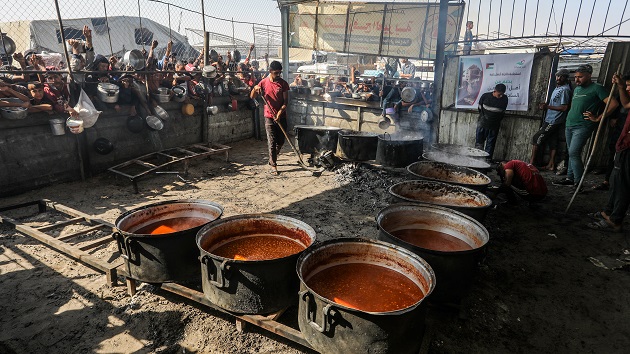
(LONDON) — Israel’s decision to halt all humanitarian aid from crossing into Gaza is entering its third month.

The Israeli government said the blockade is to pressure Hamas to release the remaining 59 hostages, including the remains of those who have died, and to accept a new proposal to extend phase one of the ceasefire deal, which ended on March 18.

Israel’s Coordination of Government Activities in the Territories (COGAT) wrote in a post on X in late April that humanitarian personnel have been allowed to enter and exit Gaza to support humanitarian efforts in the strip.

But multiple doctors and international aid workers told ABC News that water, food, medicine and medical supplies are running low, and in some cases running out completely.

Children are becoming malnourished, diseases are at risk of spreading and those who are injured cannot be treated properly, the workers said.

“If nothing is done, if food is not brought in, if water is not brought in, if vaccines are not brought in at scale — we’re already in a catastrophe, and we’re going to have way more children dying [from] preventable causes,” Jonathan Crickx, chief of communication for UNICEF Palestine, told ABC News.

A Trump administration official told ABC News there is a no-yet-finalized plan to administer the delivery of humanitarian aid in Gaza, starting with fewer than half a dozen distribution sites set up throughout the enclave.

The Israel Defense Forces did not immediately return ABC News’ request for comment.

Children becoming malnourished

The lack of food entering Gaza is one of the most severe problems the strip is facing, according to aid workers.

Osama As, the lead for quality, evidence and learning with the Mercy Corps Gaza Emergency Response Program, said the situation “is getting worse day after day, especially in relation to food” because most people in Gaza depend on humanitarian aid and community kitchens for food.

He said most families survive on one meal a day, and that most food available is canned food and bread.

“I never imagined that we would reach this point. Most people cannot afford the remaining items, which are either like canned foods and few quantities of vegetables which are produced locally here in Gaza,” As, who is based in Gaza, said. “The prices are very high, so I think most people cannot afford these kinds of items to buy from the local market.”

Dr. Ahmed Alfar, head of the pediatrics department at Nasser Hospital in Khan Younis, in southern Gaza, said he has seen many examples of malnourished children over the past two months.

One example he gave is a baby girl named Siwar, who was born four months ago. At birth, she weighed 2.5 kilograms, or 5.5 pounds.

Four months later, she should be weighing about 5 kilograms, or 11 pounds. Instead, she is only about 6 pounds, according to Alfar.

Alfar said the mother is unable to lactate and the family does not have much money, so they have been unable to feed Siwar milk, just sweetened water.

“That means in four months she gained just 200 grams, and this is unbelievable,” he told ABC News in Arabic. “She was a full-term baby. She was delivered vaginally. Her health was completely normal. … We called it one of the most severe [cases of] malnutrition. Now Siwar is facing a severe, critical situation.”

Similarly, Crickx, from UNICEF Palestine, who is currently in Al Mawasi, in southern Gaza, said he visited Nasser Hospital this week and met a 4-year-old boy named Osama.

Crickx said Osama should weigh 15 to 16 kilograms, about 33 to 35 pounds. Instead, he weighs 8 kilograms, or 17.5 pounds, Crickx said.

He said UNICEF and its partners have a small number of ready-to-use therapeutic foods to treat malnutrition, but they are running out. UNICEF has already run out of food meant to address the first signs of malnutrition.

“[Osama] has, really, the skin on the bones, and he was healthy before the beginning of this terrible war,” Crickx said. “So, we are now in a situation where children are hungry, they are little by little being affected more and more by acute malnutrition, acute severe malnutrition. And if nothing is done, we fear that the worst will happen to them.”

Community kitchen workers told ABC News if the border crossings remain closed, markets will close, and ingredients will run out. Some food relief organizations have already closed.

In late April, the United Nations’ World Food Programme said it had delivered its last remaining food stocks to hot meal kitchens in Gaza, and it expected to fully run out of food in the coming days. Additionally, the nonprofit group World Central Kitchen (WCK) announced on Wednesday that it had run out of supplies and ingredients needed to cook meals or bake bread in Gaza.

WCK said it has trucks loaded with food and cooking fuel that have been ready to enter Gaza since early March as well as additional food and equipment ready to be shipped from Jordan and Egypt.

“In recent weeks, our teams stretched every remaining ingredient and fuel source using creativity and determination. We turned to alternative fuels like wood pallets and olive husk pellets and pivoted away from rice recipes that require more fuel in favor of stews with bread,” WCK said. “But we have now reached the limits of what is possible.”

Risk of spreading disease

The blockade has also had an impact on the spread of disease in Gaza, aid workers said.

Overcrowding in tent camps — along with a lack of clean water, hygiene products and poor sanitation — puts Gazans at risk of contracting infectious diseases, they said.

Limited supplies of soap and hygienic products “will continue to lead to escalation in skin manifestations of diseases like scabies,” Dr. Aqsa Durrani, a pediatrician who was recently on assignment in Gaza with Médecins Sans Frontières (MSF), or Doctors Without Borders, told ABC News.

It’s unclear how many infections have been diagnosed over the past two months but a study from April 2024 estimated 55,400 cases of scabies and lice outbreaks among children under age five who were displaced.

Limited clean drinking water and overcrowded camps has also led to a rise in diarrheal diseases. A report from the Institute for Palestine Studies estimates at least half of cases recorded as of Jan. 2024 have been among children under 5 years old.

Crickx said a majority of children are affected by chronic watery diarrhea, which can lead to serious complications for babies and toddlers.

There has also been a rise in vaccine-preventable diseases in Gaza including hepatitis A, chickenpox, measles and polio.

Aid workers say the blockade imposed by Israel has halted the delivery of vaccines, such as the oral polio vaccine to Gaza, leaving residents vulnerable to diseases.

“Even in these terrible conditions, we have pregnant women and babies still being born in this community and population of 2 million people,” Durrani said. “And so, we need more vaccinations as well vaccines.”

Hospitals running out of supplies to treat injured

Since Hamas launched its surprise terrorist attack in Israel on Oct. 7, 2023, and Israel responded by declaring war, thousands have reportedly been killed or injured. Israel has said its goal is to destroy Hamas and that it attempts to minimize civilian casualties as often as possible.

More than 15 months into the conflict, Hamas and Israel reached a ceasefire deal. The ceasefire saw the withdrawal of some Israeli forces to allow more aid to get in and the release of some of the hostages.

However, resumption of hostilities in mid-March led to an increase in injuries, Crickx said. UNICEF estimates that more than 500 children have been killed since March 18 and more than 1.250 children have been injured.

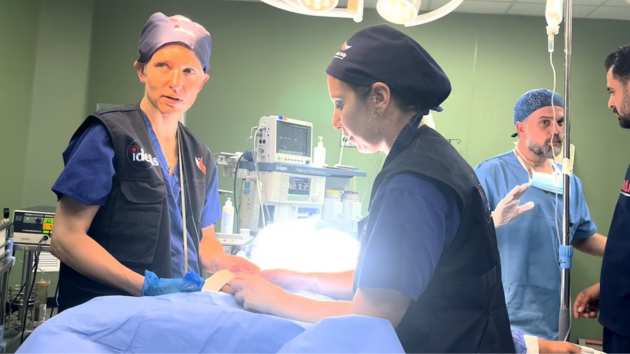
Durrani — who worked as medical activity manager for MSF at a field hospital in Deir al Balah in central Gaza from the end of February until the end of April — said she saw injuries caused by air strikes, fires after air strikes and from large cooking fires.

“Because there’s no cooking gas, people are burning household items and trying to cook over large open flames,’ she said. “So, we also saw children with burns due to those flames, as well as scald burns from children who had been waiting in food distribution lines, and the jostling of the food items would then lead to them being injured from hot food.”

What’s more, burn victims or those who are injured can take longer to heal due to malnourishment. They can also be at risk of infections or skin graft failure.

Durrani explained that poor wound healing can be associated with poor nutrition, which resulted in some pediatric burn patients developing infections.

“Not only was our staff hungry, but we also had no food for our patients, including our pediatric patients,” Durrani said. “Other than just being harrowing from a human perspective, it’s also, from a medical perspective, really impacts the way that people can heal from these injuries, and these types of burns.”

“Not even being clear that we will have enough antibiotics to treat the infection if the patients develop infections,” she continued. “In the face of also not having enough surgical materials or concern that we may run critically low on anesthesia supplies if they need to go back to the [operating room].”

In conversations with doctors this week, Crickx said hospitals are experiencing shortages of anesthetics and anticoagulants. There is also a lack of medical supplies to fix bones when they suffer fractures, he said.

Durrani said her team was forced to ration medications, including painkillers, antibiotics and critical surgery supplies. They often had to perform painful procedures and wound dressing changes without any pain control.

She said she didn’t want to cause pain by removing dressings without proper pain control, but if the dressings aren’t removed, then it could lead to infections for patients.

“We’re being forced to make impossible decisions like that, which is unconscionable, given that just miles away there are trucks and trucks full of food and supplies and medications and nutritional sources,” she said. “For me personally, this is the first time that I had to look patients in the eye and say I didn’t have something that I know is just miles away.”

ABC News’ Shannon Kingston and Diaa Ostaz contributed to this report.

Copyright © 2025, ABC Audio. All rights reserved.

Ukraine and allies ready for ‘full unconditional’ 30-day ceasefire starting Monday, foreign minister says

Ukraine and allies ready for ‘full unconditional’ 30-day ceasefire starting Monday, foreign minister says
(Valentyn Semenov / EyeEm/Getty Images)

(LONDON) — Ukraine and its allies “are ready for a full unconditional ceasefire” with Russia “for at least 30 days” beginning on Monday, the Ukrainian foreign minister said Saturday.

“Ukraine and all allies are ready for a full unconditional ceasefire on land, air, and at sea for at least 30 days starting already on Monday. If Russia agrees and effective monitoring is ensured, a durable ceasefire and confidence-building measures can pave the way to peace negotiations,” Ukrainian Foreign Minister Andrii Sybiha said in a post on X.

The European Union supports “the proposal for a full and unconditional 30-day ceasefire” between Russia and Ukraine, the head of the EU’s main executive body said Saturday, adding that the “ball is now in Russia’s court.”

“It must be implemented without preconditions to pave the way for meaningful peace negotiations,” European Commission President Ursula von der Leyen said in a post on X. “We stand ready to maintain strong pressure on Russia and impose further biting sanctions in the event of a breach of a ceasefire.”

The United Kingdom, France and Germany are saying they — with U.S-backing — are demanding Russia’s Vladimir Putin accept a 30-day ceasefire or they will all together increase sanctions on Moscow and increase military support to Ukraine.

UK Prime Minister Keir Starmer said “all of us here, together with US, are calling Putin out.” If he is “serious” about peace then “he has a chance to show it now by extending the VE Day pause into a full, unconditional 30-day ceasefire,” Starmer said.

Copyright © 2025, ABC Audio. All rights reserved.
India, Pakistan agree to full and immediate ceasefire

India, Pakistan agree to full and immediate ceasefire
Soldiers take security measures near the damaged mosque situated at health and education complex which was hit by Indian strike in Muridke, near Lahore, Pakistan, on May 07, 2025 (Photo by Muhammed Ali/Anadolu via Getty Images).

(LONDON) — India and Pakistan have agreed to a full and immediate ceasefire, ending tensions that had been rising since an April attack on Indian-controlled Kashmir, according to Pakistan’s Foreign Minister Ishaq Dar.

Officials from India also confirmed that the country agreed to a full and immediate ceasefire.

President Donald Trump first announced the ceasefire in a post on social media.

“After a long night of talks mediated by the United States, I am pleased to announce that India and Pakistan have agreed to a FULL AND IMMEDIATE CEASEFIRE. Congratulations to both Countries on using Common Sense and Great Intelligence. Thank you for your attention to this matter!” Trump said in a post on his platform Truth Social.

Secretary of State Marco Rubio confirmed in a statement that over the past two days, Vice President JD Vance and he conversed with Indian and Pakistani officials to broker an immediate ceasefire.

“We commend Prime Ministers Modi and Sharif on their wisdom, prudence, and statesmanship in choosing the path of peace,” Rubio said in a statement.

Earlier Saturday, Indian officials said during a press briefing that Pakistan had attacked 26 locations across India and the Pakistani military had begun moving its troops “into forward areas.”

“I have said on numerous earlier occasions, it is Pakistani actions that have constituted provocations and escalations,” Indian Foreign Secretary Vikram Misri said. “In response, India has defended and reacted in a responsible and measured fashion to these provocations and escalations by the Pakistani side. Earlier this morning, we saw a repeat of this escalatory and provocative pattern.”

Indian Army Col. Sofiya Qureshi said the forward movements of Pakistani troops indicate “offensive intent to further escalate the situation.”

“Indian armed forces remain in a high state of operational readiness,” Qureshi said. “All hostile actions have been effectively countered and responded appropriately. Indian armed forces reiterate their commitment to non-escalation, provided it is reciprocated by the Pakistan military.”

Indian Air Force Wing Commander Vyomika Singh denied that Pakistani strikes have caused any damage to India’s military infrastructure.

“Pakistan has also attempted to execute a continued malicious misinformation campaign, with claims of destruction of the Indian S-400 system at Adampur, destruction of airfields at Surat and Sirsa, Brahmos space at Nagrota, artillery gun positions in Derangyari and Chandigarh ammunitions depot, with heavy damage to other military stations being propagated on social media,” Singh said. “India unequivocally rejects these false claims being spread by Pakistan.”

India and Pakistan have exchanged cross-border fire and strikes for the past several days, with civilian casualties reported on both sides.

Tensions have been rising between the nuclear-armed neighbors since the April 22 attack on Hindu tourists in Indian-controlled Kashmir, which India blamed on Pakistani-backed militants. In response, India on Wednesday launched strikes on both Pakistan and Pakistan-administered Kashmir targeting what it called “terrorist infrastructure.”

Pakistan has denied any involvement in last month’s attack and said it is conducting retaliatory strikes on India and Indian-controlled Kashmir.


Copyright © 2025, ABC Audio. All rights reserved.
Cardinal suggests Pope Leo XIV wasn’t elected as ‘counterweight’ to Trump

Cardinal suggests Pope Leo XIV wasn’t elected as ‘counterweight’ to Trump
(Photo by Tiziana FABI / AFP) (Photo by TIZIANA FABI/AFP via Getty Images

(VATICAN CITY) — One day after the election of Pope Leo XIV, the first pontiff from the U.S., seven American cardinals sat down with reporters on Friday to discuss the Chicago native who now leads the Roman Catholic Church and how he will follow the footsteps of Pope Francis, but not as a “photocopy.”

The cardinals that gathered — Daniel DiNardo, Timothy Dolan, Joseph Tobin, Blase Cupich, Wilton Gregory, Robert McElroy and Christophe Pierre — agreed that all members of the clergy worked effectively together to elect a pontiff that would follow Pope Francis, who died on April 21.

“It was an amazing opportunity to see such a diverse assembly of humanity coming from many different perspectives, facing many different challenges, but coming together for a common purpose to find Peter’s successor, and I think we did well,” Gregory, the archbishop emeritus of Washington, said during the press conference at the Pontifical North American College in Rome.

Several of the cardinals admitted they were surprised an American was selected, including Robert McElroy — archbishop of Washington — who “always thought it would be impossible.”

But Dolan, the archbishop of New York, said he did not think the fact that Leo was from the U.S. “carried much weight” in the decision to elect him as the 267th leader of the church.

He also suggested that Leo’s election wasn’t a reaction to President Donald Trump.

“I don’t think at all my brother cardinals would have thought of him as a counterweight to any one person,” he said.

Regarding remarks made earlier by Cardinal Maung Bo — who said Leo will “build a bridge” with Trump — Dolan said the new pontiff will instead “build bridges with leaders of every nation.”

Dolan said Leo’s potential meeting with Trump would “not be of more heft” than conversations with other world leaders.

Overall, Gregory — who agreed with Dolan’s suggestion that American politics had nothing to do with the decision to elect Leo — told reporters the cardinals were attempting to elect someone who could lead the Catholic Church and could answer these questions: “Who among us can bring us together? Who among us can strengthen the faith and bring the faith to places it has grown weak?”

During the conclave itself, Gregory said Leo engaged in conversations with members of the clergy in “smaller groups,” specifically during meal times and coffee breaks.

“It wasn’t like he got up and made an overwhelmingly convincing speech that wowed the body,” Gregory said.

Cardinal Robert McElroy, archbishop of Washington, said it was not the substance of what Leo said during the conclave, but the “manner in which he said it” that resonated with the cardinals.

Tobin, archbishop of Newark, described a moment during the conclave, when he saw Leo, formerly Cardinal Robert Prevost, with “his head in his hands” after realizing he could possibly become pope.

“I was praying for him, because I couldn’t imagine what happens to a human being when you’re facing something like that, and then when he accepted it, it was like he was made for it,” Tobin said. “All of whatever anguish was resolved by the feeling that, I think, that this wasn’t simply his saying yes to a proposal, but God would make something clear.”

The clergy also noticed that Leo had the mind of Pope Benedict and the “missionary zeal” of Francis, Dolan said. Similarly, McElroy said Leo has the “same type of freedom that is in his heart and soul that was in Francis,” but the new pontiff may not express that freedom in the same manner.

“We are looking for someone following the pathway, but we are not looking for a photocopy,” McElroy said.

Gregory, who said he spoke to Leo during the conclave about how they are both from Chicago, advised the world to give the new pope patience as he grows into this role, joking that he has only been in this position for a day.

“He’s never been pope before,” Gregory said. “Pope Leo will surprise us as he brings his gifts, confronts the challenges and responds in grace to the needs of the church.”

Copyright © 2025, ABC Audio. All rights reserved.

Pope Leo shared content critical of Trump, Vance’s immigration policies in social media posts

Pope Leo shared content critical of Trump, Vance’s immigration policies in social media posts
Christopher Furlong/Getty Images

(VATICAN CITY) — Prior to being elected pontiff, Pope Leo XIV had a presence on Twitter, and later X, where he sometimes shared messages that appeared to be critical of some of President Donald Trump’s policies.

Cardinal Robert Prevost appears to have an X account with the handle @drprevost and posted, replied and reposted content since 2011, according to his page.

A picture of Prevost and Pope Francis holding each others arms in their robes inside a church is the profile image for the account.

While most of the new pope’s 439 posts involved posting articles about the latest developments from the Vatican and dioceses from around the world, he did share other posts from time to time dealing with political matters.

He last posted on April 14, when he shared a post from prominent American Catholic commentator Rocco Palmo that criticized Trump and El Salvadoran President Nayib Bukele’s controversial immigration policies.

“As Trump & Bukele use Oval to 🤣 Feds’ illicit deportation of a US resident …, once an undoc-ed Salvadorean himself, now-DC Aux +Evelio asks, “Do you not see the suffering? Is your conscience not disturbed? How can you stay quiet?” Palmo’s post read.

Palmo linked to a Catholic Standard editorial written by Bishop Evelio Menjivar, an auxiliary bishop of The Roman Catholic Archdiocese of Washington.

In an interview with ABC News on Thursday, Pope Leo’s brother John Prevost in Chicago said immigration is an important issue for his brother.

“I think because the way our country is going, I don’t think he necessarily will always agree [with] what’s happening. I think a big thing for him is immigration and is it right — what’s going on? I think that will be a challenge for him, because I think he’ll say something about it, too.”

Asked about his brother’s X account, John Prevost said, “I know that’s his feelings, but I didn’t know he was putting it out on social media.”

The pope’s last original X post was on Feb. 13, when he posted a link to an America magazine editorial that criticized Vice President JD Vance about his interpretation of the Latin phrase “ordo amoris.” Vance contended in a Fox News interview, that the idea meant that one must love their family first before the community.

Pope Francis sent a letter to bishops after Vance’s comment rebuking that interpretation without naming the vice president.

Pope Leo, however, appeared to criticize Vance directly in a Feb. 3 post, where he linked to a National Catholic Reporter editorial that dismissed the vice president’s stance on immigration.

He shared the headline of the article “JD Vance is wrong: Jesus doesn’t ask us to rank our love for others” and linked to the full story in his post.

Leo had not posted on X between July 2023 and Feb. 3.

The Vatican has not immediately commented about the social media account or posts.

Vance and Trump both congratulated the pope on his election on social media posts.

“I’m sure millions of American Catholics and other Christians will pray for his successful work leading the Church. May God bless him!” Vance wrote on X Thursday.

Copyright © 2025, ABC Audio. All rights reserved.

Pope Leo XIV: How his views compare to those of Pope Francis

Pope Leo XIV: How his views compare to those of Pope Francis
(Christopher Furlong/Getty Images)

(ROME) — Cardinal Robert Prevost was chosen as Pope Francis’ successor on Thursday, taking the papal name Leo XIV. The world is wondering how the first American pope compares to his predecessor.

In his first public remarks, Pope Leo XIV called for unity.

“We have to be a church that works together to build bridges and to keep our arms open, like this very piazza, welcoming,” he said.

The 69-year-old Chicago native, known for being reserved and private, brings a different style to the papacy compared to his predecessor, according to Time. While Francis was famous for his outgoing personality and spontaneous interactions with crowds, Leo is described by those who know him as more cautious and measured.

Before becoming pope, Leo played a key role in the church, leading Francis’ team that chose new bishops. He made history by adding three women to the group that recommends bishop appointments to the pope — a major change in church tradition, according to the Associated Press.

Many Catholics are watching closely to see how Leo will handle important issues that Francis championed during his time as pope. Francis took progressive positions on many issues, including allowing Catholic priests to bless same-sex couples in December 2023 and strongly defending immigrants’ rights.

The contrast between the two leaders’ styles is already clear. While Francis was known for blessing babies and engaging with crowds until his death last month, Leo reportedly takes a more reserved approach.

“He does not have excesses,” the Rev. Michele Falcone told the New York Times about Leo. “Blessing babies, yes. Taking them in his arms, no.”

LGBTQ+ issues and role of women in the church

Leo’s past statements suggest he may take different positions on some social issues than his predecessor did.

In 2012, he expressed concern about Western media promoting what he called “beliefs and practices that are at odds with the gospel,” including same-sex relationships, according to the Times. As a bishop in Peru from 2015 through 2023, he opposed teaching gender studies in schools, stating that “gender ideology is confusing, because it seeks to create genders that don’t exist.”

That appears to mark a departure from Francis’s more welcoming approach to LGBTQ+ issues. Francis famously asked “Who am I to judge?” when discussing gay clerics, and made headlines with his decision to allow same-sex couple blessings.

In other areas, like women serving in leadership roles in the Catholic Church, Leo has taken a more progressive stance.

In a 2023 interview with Vatican Media, Leo XIV highlighted his experience with having women in church leadership, particularly discussing the three women appointed to help select bishops — a reform he oversaw under Francis.

“Their opinion introduces another perspective and becomes an important contribution to the process,” he told Vatican Media, emphasizing that their roles represent “real, genuine, and meaningful participation.”

Immigration and treatment of migrants

During his time in Peru, Leo earned praise for supporting Venezuelan immigrants, the Times reported.

Francis had been particularly vocal on this issue, recently condemning the Trump administration’s deportations of migrants in the U.S. after the president’s second inauguration, calling it a “major crisis.”

In an interview with ABC News on Thursday, Pope Leo’s brother John Prevost cited his brother’s missionary work.

“I think because he was trained in missionary work in South America for so many years, I think he will be looking out for the disenfranchised,” John Prevost said. “He will be looking out for the poor. He will be looking out for those who don’t have a voice.”John Prevost also said immigration is an important issue for his brother.

“I think because the way our country is going, I don’t think he necessarily will always agree [with] what’s happening. I think a big thing for him is immigration and is it right — what’s going on? I think that will be a challenge for him, because I think he’ll say something about it, too.”

Church sexual abuse scandals

Questions have emerged about Leo XIV’s handling of abuse cases in both the U.S. and Peru. In Chicago, activists raised concerns about his role in a case involving a monastery placement, the Times reported.

When discussing the ongoing challenge of sexual abuse in the church, Leo acknowledged there is “still much to learn” in handling these cases. He stressed the importance of supporting abuse victims, saying “silence is not the solution” and emphasized the need for transparency.

“We must be transparent and honest, we must accompany and assist the victims, because otherwise their wounds will never heal,” Leo told Vatican Media in 2023, adding that cultural differences often affect how abuse cases are handled in different regions.

The new pope’s more recent comments indicate he plans to continue addressing the abuse crisis that has plagued the church, while maintaining the reforms started under Francis’ leadership, though with his characteristically more measured approach.

Leadership style

Those who know Robert Prevost before he became Pope Leo XIV describe his communication style as more measured than Francis’, the Times reported.

“Where Francis might immediately speak his mind, Cardinal Prevost holds himself back a bit,” the Rev. Moral Antón, who succeeded Leo as leader of the Augustinian order, said.

Despite these differences in style, some expect Leo to maintain certain aspects of Francis’ legacy.

The Rev. Mark R. Francis, who knew Leo XIV as a classmate, told the Times he believes the new pope will continue Francis’s practice of including regular Catholics in church discussions.

“I know that Bob believes that everybody has a right and a duty to express themselves in the church,” he said.

Copyright © 2025, ABC Audio. All rights reserved.