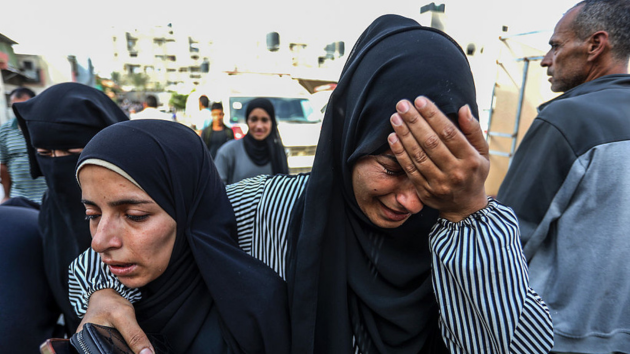
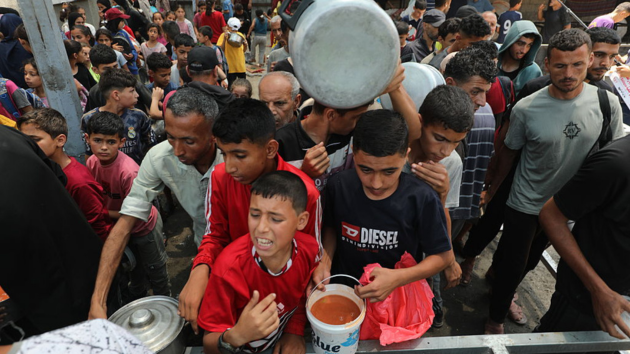
(LONDON) — At least 36 Palestinians were killed while attempting to get aid in southern Gaza on Tuesday, according to the Hamas-run Gaza Ministry of Health.
This is the highest death toll from a shooting near an aid distribution center in Gaza since the opening of the U.S.- and Israeli-backed Gaza Humanitarian Foundation aid distribution sites last month, according to numbers from the health ministry.
The shooting happened when Israeli forces opened fire near an aid distribution site in central Gaza on Tuesday morning, according to two local hospitals in Gaza. Over 100 people were injured in the shooting, according to the two hospitals.
The Israel Defense Forces said in a statement it fired “warning shots to distance suspects,” who were advancing in the area and “posed a threat to troops.”
The IDF said the warning shots were fired “hundreds of meters form the aid distribution site,” before it opened in the statement.
“The IDF is aware of reports regarding several individuals injured in the area,” it said. “An initial inquiry suggests that the number of reported individuals injured does not align with the information held by the IDF.”
“The details are under review,” the IDF said.
The Gaza Humanitarian Foundation — which has been running aid distribution in Gaza since Israel lifted its 11-week blockade last month — resumed aid distribution on Monday after previous shootings near aid sites, saying it gave out 1,386,000 meals at two sites. The GHF has not specified what it considers a meal.
The GHF has closed its aid distribution sites several times since it began distributing meals after several shooting incidents. As of Tuesday, at least 163 people had been killed while trying to get aid from GHF aid distribution sites, according to the Gaza Health Ministry.
The blockade was instituted to pressure Hamas to release the remaining hostages taken during Hamas’ surprise terror attack on southern Israel on Oct. 7, 2023, that killed 1,200 people and led to the capture of hundreds, Israel said.
The GHF was first announced on May 19 — three days after the Israeli government began its increased military operation in Gaza. After the end of an 11-week Israeli blockade on aid entering Gaza, the GHF — a private contractor backed by the U.S. and Israel — took over distributing aid in Gaza.
Humanitarian groups and the United Nations have said the GHF politicizes aid and criticized the role of IDF forces in the operation.
Palestinians in Gaza remain at risk of extreme starvation and famine even after Israel lifted the blockade on all humanitarian aid entering the Strip, according to aid groups like the U.N., the International Committee of the Red Cross and others.
(LONDON, PARIS and BELGRADE) — Ten people are dead and at least a dozen are injured after a shooting on Tuesday at a high school in Graz, Austria, the city’s mayor said, adding that the alleged shooter is also dead.
Austrian state police confirmed the death toll, after earlier saying on social media that there had been several fatalities at the school, the BORG Dreierschützengasse.
Among the dead were three males and seven females, officials said.
At least 12 people were injured, some severely, officials said during a press conference on Tuesday. Of the ten victims who died, nine were students — aged 15 to 17 — and one was a teacher, police said. Those who were injured in the attack were all students, police said.
The shooter died by suicide in a bathroom in the school during the incident, a Styria police spokesperson said. One of the individuals severely injured, a female adult, died Tuesday evening, the University Hospital Graz confirmed to ABC News.
“Today is a day of sorrow and processing the dramatic incident,” Styria Gov. Mario Kunasek said at the press conference.
The suspect, a 21-year-old Austrian citizen and former student of the school who never graduated, acted alone, authorities said. The shooter used a long gun and a handgun, that were found at the scene and are now being investigated, a Styria police spokesperson said. The suspect — who was not employed at the time of the shooting — legally owned the two weapons used in the attack, officials said.
Police had “no prior police records on this individual,” Karner said. “There was no prior warning,” he added.
As of Tuesday evening, the reasoning behind the attack still remains unclear, police said. When officials were searching the premises of where the suspect lived, they found a farewell letter, but police did not mention a motive for the attack.
“The school shooting in Graz is a national tragedy that has deeply shocked our entire country,” Austrian Chancellor Christian Stocker said in a statement posted on social media.
He added, “Young people suddenly ripped from the lives they had ahead of them. There are no words for the pain and grief that all of us — all of Austria — are feeling right now.”
Officers responded after gunshots were heard at the school, the Styria State Police said in a message posted on social media, later adding, “The school was evacuated and all persons were brought to a safe meeting point.” The 300 officers who responded to the scene were able to secure the scene within 17 minutes, a Styria police spokesperson said.
When police originally arrived on the scene, one of the victims was found outside the school building, but still on the school grounds, while the rest were found inside, officials said.
As of Tuesday afternoon, 40 people remain at the scene of the incident and there is support being provided for students and parents, Kunasek said.
Emergency vehicles, including Cobra tactical vehicles, had been deployed to the site, police said. Video shot near the scene showed a street lined with ambulances and other emergency vehicles.
Stocker declared a three-day national period of mourning, with a nationwide moment of silence for the victims at 10 a.m. local time on Wednesday, he said.
The city of Graz sits in southern Austria, in the Styria province. It’s the second-largest Austrian city by population, with about 300,000 residents.
Officials are expected to provide additional updates regarding the incident on Wednesday.
This is a developing story. Please check back for updates.
ABC News’ Ellie Kaufman contributed to this report.
(LONDON, PARIS and BELGRADE) — At least nine people are dead after a shooting on Tuesday at a high school in Graz, Austria, the city’s mayor said, adding that the alleged shooter is also dead.
Austrian state police confirmed the death toll, after earlier saying on social media that there had been several fatalities at the school, the BORG Dreierschützengasse.
Several others were seriously injured, police said in an update. The suspect was a former student at the high school, where he attended about three years ago, the mayor’s office said.
“The school shooting in Graz is a national tragedy that has deeply shocked our entire country,” Austrian Chancellor Christian Stocker said in a statement posted on social media.
He added, “Young people suddenly ripped from the lives they had ahead of them. There are no words for the pain and grief that all of us — all of Austria — are feeling right now.”
Officers responded after gunshots were heard at the school, the Styria State Police said in a message posted on social media, later adding, “The school was evacuated and all persons were brought to a safe meeting point.”
Emergency vehicles, including Cobra tactical vehicles, had been deployed to the site, police said. Video shot near the scene showed a street lined with ambulances and other emergency vehicles.
The city of Graz sits in southern Austria, in the Styria province. It’s the second-largest Austrian city by population, with about 300,000 residents.
This is a developing story. Please check back for updates.
ABC News’ Ellie Kaufman contributed to this report.
(LONDON and PARIS) — Several people are dead and several others are injured after a shooting at a school in Graz, Austria, local police told ABC News by phone Tuesday.
Austrian state police also said on social media that there had been several fatalities at the school, the BORG Dreierschützengasse.
“The reason for the deployment was heard gunshots in the building,” the Styria State Police said in a message posted on social media, later adding, “The school was evacuated and all persons were brought to a safe meeting point.”
Several emergency vehicles, including Cobra tactical vehicles, were traveling to the site, police said.
The city of Graz sits in southern Austria, in the Styria province. It’s the second-largest Austrian city by population, with about 300,000 residents.
This is a developing story. Please check back for updates.
ABC News’ Ellie Kaufman contributed to this report.
(ODESA, UKRAINE) — At least two people were killed in the Ukrainian city of Odesa overnight into Tuesday morning amid another night of intense nationwide Russian drone and missile strikes.
Ukraine’s air force said in a post to Telegram that Russia launched a total of 322 “air attack vehicles” into the country, among them 315 drones and seven missiles. The air force said 277 drones were shot down or otherwise neutralized, as were seven missiles.
Kyiv’s military administration said that at least four people were injured. “The majority of the damage was sustained by civilian infrastructure,” the administration wrote in a post to Telegram.
Two people were also killed in Odesa, local authorities said, with nine others injured. Among the buildings hit in the Black Sea coastal city were a maternity hospital and an emergency medical center, officials said.
Closer to the front, local officials said that three people were killed and eight injured in the eastern Donetsk region by artillery fire and drone attacks. One person was killed and eight injured in the southern city of Kherson, local authorities said.
President Volodymyr Zelenskyy said in a post to social media that Kyiv, Odesa, Dnipro and Chernihiv regions were targeted. Russia’s bombardment included at least two North Korean-made ballistic missiles, he added.
“Residential buildings and urban infrastructure were damaged,” Zelenskyy wrote. “In Odesa, even a maternity hospital became a Russian target. Thirteen people were injured. Tragically, there are fatalities. My condolences to the families.”
“It is vital that the response to this and other similar Russian attacks is not silence from the world, but concrete action,” Zelenskyy said in his statement.
“Action from America, which has the power to force Russia into peace,” he continued. “Action from Europe, which has no alternative but to be strong. Action from others around the world who called for diplomacy and an end to the war — and whom Russia has ignored. There must be strong pressure for the sake of peace.”
Ukraine continued its own drone strike campaign overnight, according to Russia’s Defense Ministry. Russian forces downed 103 Ukrainian drones on Monday night and Tuesday morning, the ministry said in a post to Telegram.
Monday night’s attacks came 24 hours after Russian forces targeted regions throughout Ukraine with more than 470 attack drones — one of the largest aerial strikes of the war, according to Ukraine’s air force.
Earlier Monday, Russia and Ukraine held the first stage of a prisoner swap following an agreement reached during peace talks in Istanbul, Turkey.
ABC News’ Oleskiy Pshemyskiy, Morgan Winsor and Joe Simonetti contributed to this report.
(LONDON) — The Israeli Foreign Ministry said early Monday that Israeli forces had boarded and diverted a privately owned ship carrying Swedish human rights activist Greta Thunberg and several others, who said they were attempting to bring humanitarian aid to the Gaza Strip.
The boat, the Madleen, was “safely making its way to the shores of Israel,” the ministry said in a statement, deriding the efforts by those aboard as a “media provocation.”
“The passengers are expected to return to their home countries,” the ministry said.
The ship had been approaching the coast of the Gaza Strip with the stated aim of breaking an Israeli blockade on aid via the sea and delivering humanitarian supplies to the territory. According to the Freedom Flotilla Coalition, the group that organized the aid trip, the 12 people on board were unarmed.
“The ship was unlawfully boarded, its unarmed civilian crew abducted, and its life-saving cargo — including baby formula, food and medical supplies — confiscated,” the coalition said in a statement on Monday.
The sea blockade of Gaza predates the current conflict that started when Hamas launched a surprise attack on southern Israel on Oct. 7, 2023, and has been in place since Hamas took control of the Gaza Strip in June 2007.
Israeli officials released images of Thunberg and others wearing orange life vests and sitting closely together on the Madleen. People in Israel military uniforms are seen in the video handing bread and water to the activists.
The ministry also released a separate image of Thunberg, in which a soldier is handing her bread and water. The ministry accompanied that image with a statement saying Thunberg was “currently on her way to Israel, safe and in good spirits.”
A video posted by the coalition appeared to rebuke the characterization that Thunberg was in “good spirits.”
“If you see this video we have been intercepted and kidnapped in international waters by the Israeli occupational forces or forces that support Israel,” Thunberg says in a video that was shot prior to the vessel being intercepted.
In the video, which was verified by ABC News after it was posted online, Thunberg urged her “friends, family and comrades” to apply pressure on the Swedish government to push for their release “as soon as possible.” Other activists onboard recorded similar messages.
Israeli Defense Minister Israel Katz said in a statement to social media that he had “instructed the IDF [Israel Defense Forces] to show the flotilla passengers the video of the horrors of the October 7 massacre when they arrive at the port of Ashdod.”
Katz had prior to the ship being diverted announced that he had instructed the IDF to act so that the flotilla “does not reach Gaza.” The statement from Katz said the IDF had been instructed to stop the ship from reaching Gaza “and to take any measures necessary to do so.”
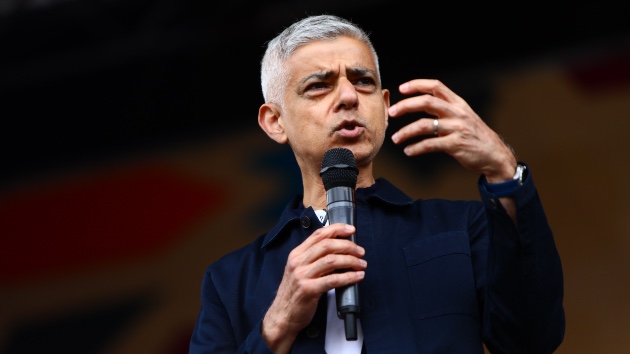
(LONDON) — Students shut out of U.S. universities by President Donald Trump’s administration should instead come to the U.K., London Mayor Sadiq Khan told an event on Monday, as he criticized governments that engage in “narrow” and damaging nationalism.
Lauding London as a “beacon of hope, progress and possibility,” Khan told attendees at the Concordia Europe Summit that the city will push back against movements “towards closed societies and countries that want to cut themselves off from the world, abdicate their responsibilities under the rule-based global order and stoke a narrow form of nationalism that divides their populations into insiders and outsiders.”
“To pick one country entirely at random, I’ve got to say we’re delighted that record numbers of Americans are applying for British citizenship or to live and work here, and that many are choosing to settle in London,” Khan continued.
“Our city will always offer newcomers a warm welcome,” the mayor said. “The same goes for any overseas students considering where to head next. If the U.S. is closed to you, we’ll make sure that London is open, because we value and celebrate the contribution foreign students made to our society, our economy and our culture.”
Those governments seeking to “put the brakes on globalization or unwind it as much as they can to their perceived advantage,” are engaging in “an entirely self-defeating exercise that will do immense damage to your own economy and those of your allies and trade partners,” Khan said.
Khan — a prominent member of the U.K.’s center-left Labour Party — did not explicitly mention the Trump administration in his address. The two men have repeatedly criticized each other in the past.
When Khan was running for mayor of London in 2015, he said Trump’s proposed ban on Muslims entering the U.S. was “outrageous.” Khan, who is from British Pakistani background, later said he hoped Trump would “lose badly” in the 2016 presidential election. During Trump’s first term, Khan lobbied the British government to cancel the president’s 2017 state visit.
Trump has characterized Khan’s criticism as “very nasty,” accused the three-term mayor of doing a “terrible job” and dismissed him as a “stone cold loser.”
European nations are mobilizing to attract students and researchers blocked from their work in the U.S., as the Trump administration seeks to curtail funding for U.S. institutions linked to diversity, equity and inclusion initiatives.
The Trump administration is also targeting universities it accuses of doing too little to suppress pro-Palestinians protests against Israel’s war in Gaza — protests the White House has broadly characterized as antisemitic.
The European Union last month launched a $566 million plan for 2025-2027 “to make Europe a magnet for researchers.” The U.K., meanwhile, is preparing its own $67 million plan to attract foreign researchers.
Khan on Monday addressed those who are “no longer comfortable with their political climate” to “come to London, because we’re ready to roll out the red carpet to business leaders, tech entrepreneurs, high net-worth individuals, creatives, students, whoever it may be.”
“If you value certainty and stability, freedom and democracy, pluralism and mutual respect, then London is the place to be,” the mayor said.
(LONDON) — Israeli troops shot and killed at least eight Palestinians near a humanitarian aid distribution center in the Rafah, Gaza, early Saturday, according to hospital officials and Gaza’s Hamas-run Ministry of Health.
The deadly shooting occurred at the Al-Alam roundabout near an aid center west of Rafah city at around 6 a.m. local time, according to the health ministry. The area is approximately 1 kilometer from an aid distribution center, which the Israel Defense Forces considers an active combat zone during the night when the site is closed.
The Israeli- and U.S.-backed Gaza Humanitarian Foundation — which is running aid distribution in Gaza — closed its aid distribution sites on Friday, without giving a date on when they would reopen. Palestinians in Gaza remain at risk of extreme starvation and famine, the United Nations and other aid groups have warned.
Since May 27, when the aid distribution centers were established, more than 100 Palestinians have been killed and hundreds more have been wounded while trying to collect food from the sites, Gaza’s Hamas-run Government Media Office said.
The Nasser Medical Complex received four out of the eight deceased victims from the incident so far, a source at the hospital told ABC News.
The Gaza Humanitarian Foundation has not responded to ABC News’ request for comment.
The Israel Defense Forces said it “is aware of the reports of casualties.”
“Despite prior warnings that the area is an active combat zone during nighttime hours, several suspects attempted to approach IDF troops operating in the Tel al-Sultan area overnight (Saturday), in a manner that posed a threat to the troops,” the IDF told ABC News when asked for comment. “The troops called out to the suspects to drive them away, but as they continued advancing in a way that endangered the troops, the soldiers responded with warning shots.”
Reverend Dr. Johnnie Moore, the new chairman of GHF, told ABC News this week the organization “can’t control what happens outside” the distribution points and added that there have been incidents, “as one would expect, in a war, outside of our distribution sites.”
According to Moore, GHF — since it was set up 10 days ago — had distributed “10 million meals to Gazans, to thousands and thousands and thousands of people.” The GHF has not specified what it defines as a single “meal.”
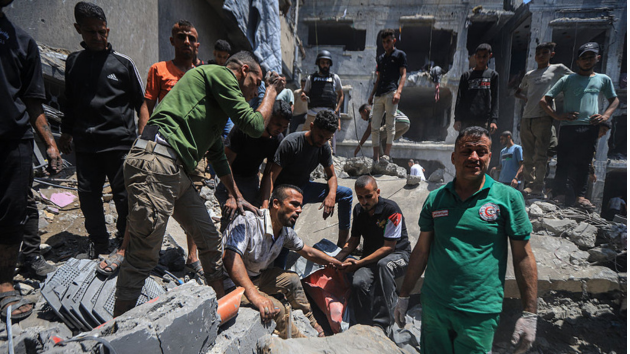
Palestinians conduct search and rescue operations in the rubble of destroyed buildings following an Israeli attack on the Sabra neighborhood of Gaza City on the second day of Eid al-Adha in Gaza on June 07, 2025. (Photo by Khames Alrefi/Anadolu via Getty Images)
(LONDON) — Talking with ABC News for his first-ever interview, the new executive chairman of the controversial United States-backed Gaza Humanitarian Foundation (GHF) discussed dozens of people being killed near the aid distribution centers and one of the sites being shut down within 10 days of opening.
Reverend Dr. Johnnie Moore — who has twice been appointed by President Donald Trump as a commissioner on the United States Commission for International Religious Freedom — said the organization “can’t control what happens outside” the distribution points and added that there have been incidents, “as one would expect, in a war, outside of our distribution sites.”
Israel Defense Forces said that its troops opened fire on both Sunday and Tuesday of this week in areas near GHF aid distribution sites in Gaza, stating it has fired shots “towards” people but not at them. The IDF said “suspects” had deviated from specific routes towards the aid hub.
According to Moore, “some” deaths in one of the incidents did “come from the IDF” although he also blamed “some” of the deaths on Hamas.
At least 57 people were killed and nearly 300 injured, health officials said, between Sunday and Tuesday’s shootings, leading GHF to pause its distribution for 24 hours.
When asked if GHF’s aid plan was part of the problem, given that desperate, hungry people had been killed on their way to pick up food, Moore answered, “No, I think that’s a quite cynical point of view.”
“I fundamentally disagree with the premise that our operation is somehow disproportionately imperiling people,” he said.
According to Moore, GHF — since it was set up 10 days ago — had distributed “10 million meals to Gazans, to thousands and thousands and thousands of people.”
The population of Gaza is around 2.2 million.
Addressing the two incidents, Moore said, “Somehow people veered off the secure corridor,” and referred to the deaths as “a tragedy.”
In the wake of such deadly incidents, GHF has since closed its distribution centers. Moore said his organization was “working with others” to make such incidents “less likely to happen” in the future.
“I’m not doing this for anybody to die,” GHF’s executive chairman said.
Moore pushed back on the implication that the new aid plan, which was set up at the behest of Israel to counter the alleged looting of aid by Hamas, had been mismanaged.
Moore confirmed that Gazans arriving at the aid distribution points didn’t need to show any form of ID to get access to aid. When asked by ABC News how he could be sure that Hamas would not profit from aid distributed under his plan, he said there was “no evidence” any of their aid had been seized.
The GHF executive said his organization was “very much solving the problem” and, over time, GHF would “put more energy on verification.”
International aid agencies have refused to participate in GHF’s aid distribution operation, stating that it breaches fundamental humanitarian principles, such as the notion that aid should always be distributed at the point of need.
The GHF operation has been accused by multiple U.N. organizations of forcing people to have to travel long distances through a perilous war zone to reach the distribution points, which are located in tightly restricted areas. The most vulnerable people in Gaza would appear to be the least likely to be able to access the aid.
Moore rejected that premise and said, “over time” he believed they would be able to get aid to the most vulnerable people.
International aid agencies have also accused GHF’s aid distribution operation of being part of Israel’s military strategy, which Moore said was “simply not true.”
“Palestinians have been presented the grimmest of choices: die from starvation or risk being killed while trying to access the meagre food that is being made available through Israel’s militarized humanitarian assistance mechanism,” United Nations High Commissioner for Human Rights Volker Turk said in a statement on Tuesday.
“This militarized system endangers lives and violates international standards on aid distribution, as the United Nations has repeatedly warned,” Turk’s statement continued.
Moore said GHF was communicating with the IDF to “manage” the “secure corridors,” but he described GHF as an “American organization” with “American contractors.”
When asked if Israel was funding the organization, at least to some extent, he refused to comment.
“There’s certain things that we’re not gonna talk about or focus on now,” Moore told ABC News.
GHF has been mired in controversy from the beginning, and it lost Executive Director Jake Wood, a U.S. military veteran, who resigned just before the aid plan launched nearly two weeks ago. Wood cited concerns over the group’s impartiality.
In an interview days before his resignation, Wood had suggested on CNN that GHF would only be able to scale up its operation to the necessary level to cater for Gaza’s population if major aid agencies were to join the operation, something they have all refused to do.
As a new executive, Moore said he believed they could scale up the operation to the necessary degree, but said it was not their goal to do it without the cooperation of major aid agencies.
“I mean, they’re the ones who have said that they won’t work with us,” he added. “My message to them [international aid agencies] is like, stop criticizing us, just join us, and we can learn from them if people have better idea.”
As of Thursday, the aid sites were shut down and then briefly re-opened and then closed again at two sites in Rafah, Gaza, GHF said. The GHF says that some sites have been reopened on Saturday but it is currently unclear how much aid is being distributed.
Moore said the ultimate aim was to have significantly more than eight distribution centers and said he thought that “big organizations” would eventually cooperate with GHF.
(PARIS, FRANCE) — Kim Kardashian made a defiant walk into Paris’ Palace of Justice in May, to face the criminals who held the reality star at gunpoint and robbed in 2016. The trial’s shocking outcome would only prompt more questions.
Ten suspects, dubbed the “Grandpa Robbers” by French media because most of them were in their 60s and 70s, stood trial in Paris for the notorious 2016 jewel heist that terrorized the reality star.
Despite finding eight of the 10 suspects guilty of crimes related to the 2016 heist, the French court allowed all defendants to walk free, with some receiving suspended sentences or credit for time already served. The judge cited the defendants’ ages and health concerns as reasons for leniency. Two were acquitted.
The crime occurred during Paris Fashion Week in October 2016, when Kardashian was staying at the exclusive “No Name Hotel,” reportedly known for hosting celebrities like Leonardo DiCaprio and Madonna. That night, while Kardashian’s security detail accompanied her sister Kourtney to a nightclub, the robbers struck.
In an interview with ABC News, Yunice Abbas, one of the convicted robbers, said he didn’t even know who Kardashian was at the time.
“I was always told ‘wife of an American rapper,'” Abbas said.
The robbers, wearing fake police jackets, first confronted the hotel’s night concierge, Abderrahmane Ouatiki. They forced him at gunpoint to lead them to Kardashian’s suite.
“When you feel the cold steel of a gun on the back of your neck, you have to be calm,” Ouatiki told ABC News. “You have to be wise in such situations.”
The thieves escaped with more than $6 million worth of jewelry, including Kardashian’s upgraded 18.8-carat wedding ring from then-husband Kanye West. In their hasty bicycle getaway, Abbas admitted to falling and spilling some of the stolen jewels on the street.
Following the verdict, Kardashian, who has become an advocate for criminal justice reform, released a statement.
“While I’ll never forget what happened, I believe in the power of growth and accountability and pray for healing for all. I remain committed to advocating for justice, and promoting a fair legal system.”
The outcome of the trial surprised even the defendants. When asked if he expected the lenient sentence, Abbas responded with a simple “No” as he left the courthouse a free man.
The unexpected verdict left some questioning the French justice system.
“I respect Kim Kardashian, but I call foul. Justice was not served,” legal commentator Nancy Grace told ABC News. “They should be in jail for what they did.”