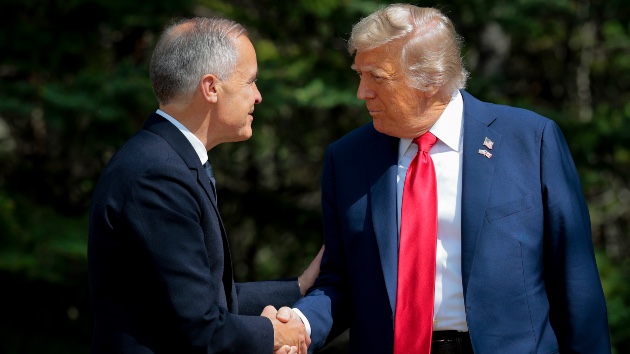
A teacher from Gurukul school of art paints a poster of US President Donald Trump (L) and Supreme Leader of Iran Mojtaba Khamenei (R) with a message welcoming two weeks of ceasefire between US and Iran outside their art school in Mumbai. (Ashish Vaishnav/SOPA Images/LightRocket via Getty Images)
(PARIS and LONDON) — Foreign leaders expressed hope for a full peace deal to end the U.S.-Israeli war against Iran in their reactions to Tuesday’s two-week ceasefire, which was first announced by President Donald Trump and later confirmed by Iranian officials.
British Prime Minister Keir Starmer said in a post to X that the ceasefire agreement “will bring a moment of relief to the region and the world. Together with our partners we must do all we can to support and sustain this ceasefire, turn it into a lasting agreement and re-open the Strait of Hormuz.”
Italian Foreign Minister Antonio Tajani likewise suggested the ceasefire was “a very positive development” which “moves us toward a peace agreement — for the civilian population, for the region, and for Israel — but also for our economy.”
German Friedrich Merz thanked Pakistan for its mediation efforts, adding in a post to X, “The aim now is to negotiate a lasting end to the war. We are in close coordination with our partners on this matter.”
Ursula von der Leyen, the president of the European Commission, said the ceasefire brought “much-needed de-escalation” and said that further negotiations are “crucial.”
Spanish Prime Minister Pedro Sanchez, who has been a prominent European critic of the war, said in a post to X that the ceasefire was “welcome news,” but added, “Momentary relief must not make us forget the chaos, the destruction, and the lives lost.”
“The Spanish government will not applaud those who set the world on fire just because they show up with a bucket,” Sanchez added. “What is needed now: diplomacy, international law, and PEACE.”
French President Emmanuel Macron stressed that the situation in Lebanon — another theater of the conflict in which Israel is fighting against the Iran-backed Hezbollah militia — is “critical.”
Macron said the ceasefire extended to Lebanon, as did Pakistani Prime Minister Shehbaz Sharif, though Israeli Prime Minister Benjamin Netanyahu said overnight that Lebanon was not included in the agreement. Israel continued intense strikes in Lebanon, including on Beirut, on Wednesday.
Macron called the ceasefire “a very good thing” and said the question of Lebanon is “one of the most delicate.” Hezbollah, Macron said, made a “strategic error” by attacking Israel and dragging Lebanon into the regional crisis, but said Israel’s strikes and occupation of southern Lebanon “cannot be a long-term response.”
Persian Gulf and other regional nations also welcomed the ceasefire in Iran, though several reported fresh Iranian drone and missile attacks on Wednesday.
Saudi Arabia’s Foreign Ministry expressed its support for the pause in a statement posted to X, while Qatar’s Foreign Ministry described the ceasefire as “an initial step toward de-escalation.” Doha also stressed “the necessity for the Islamic Republic of Iran to take the initiative to immediately cease all hostile acts and practices.”
Oman — traditionally a mediator of U.S.-Iranian talks — said in a Foreign Ministry statement that it affirmed “the importance of intensifying efforts now to find solutions capable of ending the crisis at its roots and achieving a permanent cessation of the state of war and hostile acts in the region.”
Jordan’s Foreign Ministry in a post to X “emphasized the importance of opening the Strait of Hormuz and ensuring freedom of international navigation without restrictions in accordance with international law.”
Egyptian President Abdel Fattah el-Sisi said in a post to X that the news “undoubtedly brought relief to the hearts of millions of peace-loving people across all corners of the earth,” adding that Cairo valued Trump’s “decision to heed the voice of reason.”
The Turkish Foreign Ministry released a statement expressing its backing for the peace process, adding, “We will continue to extend all necessary support for the successful conclusion of the negotiations to be held in Islamabad,” referring to Friday’s planned talks.
Iranians hold national flags as they gather in Tehran’s Revolution Square after the United States and Iran agreed to a two-week ceasefire, on April 8, 2026 in Tehran, Iran. (Majid Saeedi/Getty Images)
(LONDON) — As President Donald Trump pulled back from threats to annihilate “a whole civilization” when the Iranian regime agreed to a ceasefire and open the critical Strait of Hormuz, some people in the Islamic Republic expressed relief after juggling feelings ranging from despair to doom.
Trump had given the Iranian regime a deadline of 8 p.m. ET Tuesday — which would have been Wednesday, April 8, at 3:30 a.m. in Tehran — for the Iranian government to strike a peace deal or risk the destruction of all bridges and power plants in Iran.
He later extended the deadline to two more weeks as Iran agreed to open the Strait of Hormuz and work to forge a peace deal.
Sohreh, a 33-year-old journalist and resident of Tehran, told ABC News she felt an immediate sense of “relief” when she heard that a ceasefire agreement had been brokered.
“My heart was about to stop,” Sohreh said in a written message to ABC News of the hours she and other Iranian citizens spent on Tuesday bracing for the massive U.S. to strike on its power plants, bridges and infrastructure before the attack was called off. “I cried all day for Iran and prayed to a God I don’t believe in: ‘A miracle, please, send a miracle. I can’t live after the destruction of Iran.'”
Leading up to the ceasefire announcement, Iranians who have been in contact with ABC News throughout the conflict, which began with a Feb. 28 U.S.-Israel joint attack, recalled moments of joy as it appeared the Iranian regime was about to be toppled and disappointment that the Islamic Republican Guard Corps (IRGC) had refused to give up the fight.
An internet blackout imposed by the regime has made it challenging to communicate with people inside Iran, so it’s difficult to gauge how people in the country are feeling. Some have managed to get messages to ABC News.
“I am against the regime and I want them gone with every cell of my body. I have participated in the protests against the regime. But by no means I agree with a foreign power destroying what has been built by my people, for my people, and for the future of our children,” Fatemeh, a 40-year-old engineer who lives in Tehran, told ABC News in a written statement on Monday.
Citing security reasons, Iranians like Fatemeh and Sohreh who have communicated with ABC News, spoke on condition that their real names not be used.
Sohreh recalled a rollercoaster of emotions since the conflict began, from hope that the regime would be toppled to despair that it was hanging on and prolonging the pain of regular Iranians.
“I danced so much to the news of Khamenei’s death, so much that my legs hurt and I fell,” Sohreh said in a message to ABC News on Monday, referring to Ayatollah Ali Khamenei, the country’s supreme leader, who was assassinated in a strike on the first day of the conflict.
But as the war dragged on, Sohreh said she battled doubts that the U.S.-Israel attacks would bring the regime to its knees. “We ask ourselves what if the war continues?” she said.
“When they hit Asaluyeh, everyone was feeling terrible,” Sohreh said of Monday’s strike by Israel Defense Forces on Iran’s southern petrochemical infrastructure in the Persian Gulf port city of Asaluyeh. “We wonder what to do if they hit the infrastructure. They don’t belong to the Islamic Republic. They are built by our own children. They belong to Iran and the future of Iran.”
On Tuesday morning, Trump posted an ominous message on his social media platform, saying, “A whole civilization will die tonight, never to be brought back again.”
“I don’t want that to happen, but it probably will,” Trump wrote. “However, now that we have Complete and Total Regime Change, where different, smarter, and less radicalized minds prevail, maybe something revolutionarily wonderful can happen, WHO KNOWS?”
During a news conference on Wednesday morning, Defense Secretary Pete Hegseth declared “a historic and overwhelming victory on the battlefield.
“A capital V military victory,” said Hegseth, adding that the U.S. military had “achieved every objective.”
Hegseth said that prior to the ceasefire being announced, the U.S. military was prepared to carry out the threat Trump made on Tuesday morning.
“Had Iran refused our terms, the next target would have been their power plants, their bridges and oil and energy infrastructure, targets they could not defend and could not realistically rebuild. It would have taken them decades. And we were locked and loaded,” Hegseth said.
He added, “President Trump had the power to cripple Iran’s economy in minutes, but he chose mercy. He spared those targets because Iran accepted the ceasefire under overwhelming pressure.”
Trump’s ominous statement on Tuesday came after he told reporters on Monday during the annual White House Easter Egg Roll, “The Iranian people, when they don’t hear bombs go off, they’re upset.”
“They want to hear bombs because they want to be free,” Trump said without attributing where he was getting his information from.
He went on to claim that the only reason Iranian civilians have not taken to the streets en masse to demonstrate against the regime is that “they will be shot immediately, and that’s an edict. That’s in writing.”
Leila, a 36-year-old resident of Tehran who works as a manager of a shipping company, said she agreed with Trump, telling ABC News on Monday that when she doesn’t hear bombs, she feels “upset.” Leila, who described herself as anti-regime, said she longs for the day she sees American soldiers in Iran to save them.
In an earlier message Leila sent to ABC News on March 30, she said, “We don’t have fear from the missile attacks, we just get very happy to watch them burning the bases of the IRGC.”
Darius, a 38-year-old anthropologist from Tehran, told ABC News in a message sent on March 25 that he was initially anti-regime, but as the bombing continued, his opinion of the regime had started to change.
“The noise of the bombs and the fact that they are actually killing a lot of civilians pushes us more towards let’s say rallying around the flag,” Darius wrote. “We are fighting this war as a country and even though the Iranian state is not my cup of tea and even though I detest many of the things they do, still, I prefer to stand by their side against a Nazi in the White House.”
At least 3,546 people, including 244 children and 1,616 other civilians, have been killed in Iran due to the U.S.-Israeli strikes since the war began, the U.S.-based Human Rights Activists News agency reported on Sunday.
A soldier of the Unmanned Systems Forces prepares a ‘Salut’ drone on March 31, 2026 in Kharkiv, Ukraine. (Nikoletta Stoyanova/Getty Images)
(LONDON) — Ukraine launched more cross-border attack drones than Russia in a one-month period for the first time since the start of the ongoing war in 2022, according to daily data published by the Ukrainian Air Force and Russian Ministry of Defense, which was analyzed by ABC News.
Russia’s defense ministry reported downing 7,347 Ukrainian drones during March, the highest monthly total ever reported by Moscow and an average of 237 craft each day. The defense ministry only publishes figures of Ukrainian drones it claims were shot down.
Ukraine’s air force, meanwhile, said its forces faced 6,462 Russian drones and 138 missiles of various types across the course of the month, of which 5,833 drones and 102 missiles — around 90% of drones and just under 74% of missiles — were intercepted or suppressed.
Ukraine, therefore, faced a daily average of just over 208 drones and four missiles during March, according to the data published by Kyiv.
ABC News cannot independently verify the data released by either Russia or Ukraine. It is possible that both sides may seek to exaggerate the effectiveness of their air defenses, or to amplify the attacks against them as proof that their enemies are not interested in pursuing a peace deal, experts have suggested.
The combined tally of 6,600 Russian drones and missiles reported by Ukraine’s air force across the month marks a new record high for a single month of Russian long-range attacks.
Ukraine’s air force publishes what it says is a daily tally of Russian drone and missile strikes, including information as to how many munitions were intercepted and how many hit targets.
Russia launched the month’s largest overall attack in a 24-hour period by either side. Ukraine’s air force said Moscow launched 948 drones and 34 missiles into the country on March 24.
Long-range drone and missile strikes have been a key element of the conflict as both Kyiv and Moscow seek to degrade the other’s economy and undermine their ability to prosecute and fund the ongoing war. The strikes have continued despite the resumptions of U.S.-brokered peace talks.
Russia has thus far been able to launch more drones and missiles into Ukraine, with Ukrainian leaders citing Moscow’s nightly barrages as a severe threat to the country’s strategic position. But March’s data suggests the balance may be shifting more in Ukraine’s favor, as Kyiv’s long-term efforts to expand its drone and missile capabilities bear fruit.
Ukrainian President Volodymyr Zelenskyy has been clear on Kyiv’s plans to expand Ukraine’s long-range strike capabilities.
“Our production potential for drones and missiles alone will reach $35 billion next year,” Zelenskyy said in October. “Despite all the difficulties, Ukrainians are creating their national defense product that, in certain parameters, already surpasses many others in the world.”
“Never before in history has Ukrainian defense been so long-range and so felt by Russia,” Zelenskyy added. “We must make the cost of war absolutely unacceptable for the aggressor — and we will.”
To date, the majority of Ukrainian strikes are believed to have been conducted using relatively cheap, Ukrainian-made drones. Increasingly, Ukraine is also using interceptor drones designed and built by Ukrainian companies to intercept incoming Russian strike drones.
Ukraine is now producing its own cruise missiles — most notably the Flamingo, which Kyiv says has a range of more than 1,800 miles — but its drone arsenal still accounts for the vast majority of projectiles reported shot down by the Russian defense ministry, according to daily data published by Moscow.
Over the past year, Ukraine has put a special focus on attacking Russian oil refining and transport facilities, hoping — according to Ukrainian leaders — to cut into a key funding stream for Moscow and its military.
Ukraine’s most high-profile attacks of March came at Russia’s Baltic Sea ports of Ust-Luga and Primorsk — key oil export hubs. Kremlin spokesman Dmitry Peskov denounced the strikes as “terrorist attacks.”
Zelenskyy in February said Russia’s energy sector is “a legitimate target” for attacks by Ukraine, because Russia uses revenue from sales of oil to procure weapons used to attack Ukraine.
“We do not have to choose whether we strike a military target or energy,” Zelenskyy said while addressing students at the National Aviation University in Kyiv. “He sells oil, takes the money, invests it in weapons. And with those weapons, he kills Ukrainians,” Zelenskyy said of Russian President Vladimir Putin.
Russian officials have broadly sought to downplay the Ukrainian attacks, with most reports of damage or casualties attributed to falling debris from intercepted drones, rather than craft that found their mark. When Russian officials do acknowledge damage, they often describe the strikes as “terrorist attacks.”
But plenty of publicly available information — including video footage and photographs of the attacks — indicate that a significant number of Ukrainian drones do penetrate Russian air defenses and impact at sensitive military and industrial sites.
Meanwhile, drone incursions into neighboring countries — among them NATO allies — have raised concerns of the war spilling over into non-combatant nations.
NATO aircraft are regularly scrambled in NATO nations like Poland and Romania in response to Russian drone attacks along Ukraine’s western borders.
Allied officials have reported Russian drone violations in Romania, Poland, Lithuania and Latvia. Russian drones have also overflown Moldova, which is not a NATO member. Russian officials have denied responsibility for such incursions.
Stray Ukrainian drones have been reported falling in Finland, Estonia, Latvia and Lithuania.
ABC News’ Fidel Pavlenko contributed to this report.
A Palestinian mother hugs her child as eight children evacuated from Gaza to Egypt through the Rafah Border Crossing during 2023 land attacks due to health issues return to Gaza after completing treatment, coordinated by the World Health Organization (WHO) at Nasser Medical Complex in Khan Yunis, Palestine, on March 30, 2026. (Photo by Hani Alshaer/Anadolu via Getty Images)
(NEW YORK) — When Sundus al Kurd and her daughter Bissan were separated at the start of the Israel-Hamas war in 2023, she wasn’t sure she’d see her again. Bissan was only a few days old when her mother allowed her to be medically evacuated from the Gaza strip to Egypt.
The premature baby’s life was saved, along with others, by the World Health Organization and Palestinian Red Crescent during the height of the conflict, but now the two have been reunited.
“After all this time, my daughter is finally back in my arms!” al Kurd, a young Palestinian mother, exclaims as she held her child for the first time in over two years.
“Every day, I lived with fear — fear that I might never hold her again, fear that she might forget me. But the moment I held her in my arms again, it felt like she had never been away. That moment was complete joy!” the 27-year-old al Kurd told ABC News.
Bissan, who has spent the last 2 1/2 years in Egypt, had been one of 33 premature babies trapped inside the Al Shifa hospital as the Israeli military laid siege to it in November 2023.
“Being reunited with my daughter is something I cannot fully describe. It is a mix of relief, love, and something deeper — like life returning to me after being paused for years,” al Kurd said.
“The first night we spent together was very emotional. I couldn’t sleep. I kept watching her, holding her, making sure she was really there beside me. I was afraid to close my eyes, as if it was all a dream that might disappear,” she said.
Bissan’s life had been in imminent danger in November 2023, doctors said. The neonatal unit she was in at Al Shifa hospital was running out of fuel and oxygen, cut off by the Israeli army, which had encircled the hospital, saying that Hamas had a hidden command center in its precincts, something both Hamas medical teams there strongly denied.
“They were meant to die without incubators, without oxygen, without water, but they survived every single stage of this terrible reality,” Dr. Ahmed Mokhallalati, the former head of plastic surgery at Al Shifa Hospital, told ABC News.
Mokhallalati was one of the few doctors who remained at Al Shifa throughout the Israeli siege.
“Most of the doctors were surgeons, not even pediatricians, but we felt we had to do our best to keep these kids alive,” he said. “We felt these kids were like our own babies. Every morning, we would go just to make sure they were still alive.”
He said that the extreme danger of the situation forced some parents to abandon their babies.
“There were no parents because the hospital was bombed and people were forced to flee to save their other children,” Mokhallalati said. “In the calculus of survival, mothers fled with the children who could run and left behind those who could not, making an impossible choice.”
The premature babies were left fighting for their lives for days, with one doctor and six nurses caring for them in ever-worsening conditions, he said.
“We did not know their names, we did not know their parents. They had no one to take care of them. They were wearing only small wristbands, usually with their mothers’ names, and that was the only thing we knew about them,” Mokhallalati said.
Not all the babies survived those difficult days. Five died as the team struggled to keep them fed and warm, but Mokhallalati was amazed that so many of the babies made it.
“They were meant to die at many stages but they survived every single challenge,” adding, “They were the only feeling of hope we had in all of this chaos and destruction.”
On Nov. 19, 2023, they were rescued after the WHO and the Palestinian Red Crescent were given access to the hospital. They carried the precious cargo through a war zone to a hospital in Rafah, in southern Gaza, before taking them across the border to Egypt, officials said.
“Twenty-eight were evacuated to Egypt, but seven more died there due to the difficult conditions, leaving 21 survivors. Of those, 11 have now returned on March 30, while four others came back earlier when Rafah crossing opened, and six remain in Egypt with their families,” Dr. Ahmed Al-Farra, the head of pediatrics and neonatal care at Nasser Hospital in Gaza, told ABC News.
Among those returning was 2-year-old Azzhar Kafarna. Her mother, Heba Saleh, described the ordeal of their separation to ABC News.
“For two and a half years, I felt something missing all the time,” she said.
“I missed everything — her first smile, her first steps, even the little things that any mother waits for. I used to imagine her … how she looks now, how her voice sounds, and if she would recognize me when we finally meet,” Saleh said.
She was nervous about their reunion, “When I saw her again, I didn’t know what to feel. I just hugged her tightly. It felt like I was holding all the days we lost in that one moment.”
Al-Farra examined all the toddlers when they returned to Gaza this week.
“All of the children are in generally good condition, with normal weight and growth, but many are facing complications linked to extreme prematurity,” he said.
Al-Farra says many of them, “have vision problems and need glasses because their eye nerves were not fully developed,” like Bissan, who wears a bright red pair of spectacles.
However, not all of them have come back to happy reunions.
“I don’t think all of these children have parents to return to. Some of their families were likely killed during the war,” Al-Farra said.
“In one case, there is real confusion over the child’s identity, with more than one person claiming the baby. We are still trying to identify the family, but without access to DNA testing in Gaza, we cannot confirm who the child belongs to,” he said.
Fear returning to Gaza
Both the mothers ABC News spoke with were nervous about their children returning to Gaza.
“As a mother, I feel everything at once. I’m happy she’s finally with me … but at the same time, I feel guilty, even though I had no choice. I keep thinking about all the moments I wasn’t there for.” Saled said.
“And of course, I’m worried about raising her in Gaza. I want her to feel safe, to live a normal life, but the situation here is not easy,” Saled said.
That sentiment was echoed by al Kurd.
“I am also worried. My daughter has never heard the sound of bombing before. I am afraid of how she might react if she experiences it here in Gaza. This fear is always in my heart.”
“I wish for my daughter to have a better future, a life that is safer and more stable than the one we are living now,” al Kurd said.
(WASHINGTON) — A U.S. fighter jet appears to have been shot down by Iran over Iranian territory, American officials confirmed to ABC News, marking a new and potentially dangerous point in the conflict.
One crew member aboard the downed two-seater F-15E has been rescued, according to a U.S. official. The status of the other crew member is unknown, according to the official.
Combat search and rescue missions have become relatively rare for U.S. forces after more than a generation of near-total air dominance, with American aircraft typically operating with limited threats to aircraft in the wars in Iraq and Afghanistan.
The early indications that the U.S. fighter was brought down by enemy fire would mark the first time Iran has successfully downed a manned American aircraft in the war, which started in February.
There are photos of the fighter that were released by Iranian state media and could not be independently verified by ABC News.
President Donald Trump has been briefed on the matter, according to White House press secretary Karoline Leavitt.
In late March, an American F-18 fighter jet narrowly dodged an Iranian surface-to-air missile, according to a U.S. official. Earlier that month, an American F-35, the Pentagon’s most advanced stealth fighter jet, had to make an emergency landing after being struck by Iranian fire. Three F-15s were also brought down over Kuwait in a friendly fire episode earlier in the war, though all six pilots ejected safely, according to U.S. officials.
The incident comes after Secretary of Defense Pete Hegseth and other U.S. officials have said that Iran’s military capabilities have been severely crippled and that the U.S. has “total air dominance” over Iran.
Trump, in a primetime address to the nation earlier this week, said the U.S. was “nearing completion” of its military objectives and that Tehran’s anti-aircraft abilities had been decimated.
“We’ve done all of it. Their navy is gone. Their air force is gone. Their missiles are just about used up or beaten,” Trump said in his speech on Wednesday night.
“They have no anti-aircraft equipment,” Trump added in his remarks. “Their radar is 100% annihilated. We are unstoppable as a military force.”
The Islamic Revolutionary Guard Corps has made a number of false claims about US aircraft being downed but the US has pushed back on those.
Iran has maintained at least some ability to continue with attacks targeting U.S. facilities in the Middle East and other countries in the region, wounding more than 300 U.S. service members, according to U.S. officials. The number of wounded has increased at a relatively steady rate each week, data reviewed by ABC News shows. Thirteen service members have been killed in action since the war began five weeks ago, according to U.S. Central Command.
This is a developing story. Please check back for updates.
(WASHINGTON) — A U.S. fighter jet appears to have been shot down by Iran over Iranian territory and a U.S. search and rescue effort is underway, three American officials confirmed to ABC News.
The status of the crew aboard the F-15E aircraft was not immediately known.
The early indications that the U.S. fighter was brought down by enemy fire would mark the first time Iran has successfully downed a manned American aircraft in the war, which started in February.
There are photos of the fighter that were released by Iranian state media and could not be independently verified by ABC News.
President Donald Trump has been briefed on the matter, according to White House press secretary Karoline Leavitt.
In late March, an American F-18 fighter jet narrowly dodged an Iranian surface-to-air missile, according to a U.S. official. Earlier that month, an American F-35, the Pentagon’s most advanced stealth fighter jet, had to make an emergency landing after being struck by Iranian fire. Three F-15s were also brought down over Kuwait in a friendly fire episode earlier in the war, though all six pilots ejected safely, according to U.S. officials.
The incident comes after Secretary of Defense Pete Hegseth and other U.S. officials have said that Iran’s military capabilities have been severely crippled and that the U.S. has “total air dominance” over Iran.
Trump, in a primetime address to the nation earlier this week, said the U.S. was “nearing completion” of its military objectives and that Tehran’s anti-aircraft abilities had been decimated.
“We’ve done all of it. Their navy is gone. Their air force is gone. Their missiles are just about used up or beaten,” Trump said in his speech on Wednesday night.
“They have no anti-aircraft equipment,” Trump added in his remarks. “Their radar is 100% annihilated. We are unstoppable as a military force.”
The Islamic Revolutionary Guard Corps has made a number of false claims about US aircraft being downed but the US has pushed back on those.
Iran has maintained at least some ability to continue with attacks targeting U.S. facilities in the Middle East and other countries in the region, wounding more than 300 U.S. service members, according to U.S. officials. The number of wounded has remained at a relatively unbroken steady rate each week, data reviewed by ABC News shows. Thirteen service members have been killed in action since the war began five weeks ago, according to U.S. Central Command.
Combat search and rescue missions have become relatively rare for U.S. forces after more than a generation of near-total air dominance, with American aircraft typically operating with limited threats to aircraft in the wars in Iraq and Afghanistan.
In 2011, Marines rescued two Air Force pilots in Libya who had ejected from their F-15 after a mechanical failure. During the 1993 Battle of Mogadishu, the mission shifted almost instantly after two U.S. Black Hawk helicopters were shot down, forcing American special operations troops to pivot toward securing crash sites and extracting surviving crew members under fire.
This is a developing story. Please check back for updates.
(LONDON) — An American fighter jet appears to have been shot down by Iran, according to three U.S. officials. Search and rescue operations are currently underway, the officials said.
Iraqi Shiite militia groups organize a military parade as part of the ‘World Quds Day’ events in Baghdad, Iraq, March 28, 2025. (Anadolu via Getty Images)
(WASHINGTON) — U.S. officials have issued a new warning to Americans still in Iraq, advising them to leave the country immediately as Iraqi terrorist militia groups aligned with Iran may “intend to conduct attacks” in central Baghdad.
“U.S. citizens should leave Iraq now,” said the alert issued on Thursday by the United States Embassy and Consulate in Iraq, which has previously issued warnings for Americans to leave the country due to security risks.
The new alert comes as the U.S.-Israeli war on Iran has entered its second month.
The security alert also came just days after an American journalist, Shelly Kittleson, was kidnapped in broad daylight on a busy street in Baghdad, allegedly by an Iran-linked militia group.
“Iraqi terrorist militia groups aligned with Iran may intend to conduct attacks in central Baghdad in the next 24-48 hours,” the U.S. Embassy’s alert said.
The embassy’s statement added that Iran and Iran-aligned terrorist militias have already conducted “widespread attacks against U.S. citizens and targets associated with the United States throughout Iraq, including the Iraqi Kurdistan Region.”
The alert cautioned Americans to be aware that militia groups “may claim to be associated with the Iraqi government.”
“Terrorists may carry identification denoting their status as Iraqi government employees,” according to the alert.
In addition to U.S. citizens, terrorist militias might also target businesses, universities, diplomatic facilities, energy infrastructure, hotels, airports and “other locations perceived to be associated with the United States,” according to the alert.
While telling U.S. citizens to leave the country immediately, U.S. officials also said the only escape routes out of Iraq are overland to Jordan, Kuwait, Saudi Arabia and Turkey because the airspace is closed, preventing commercial airlines from flying out of Iraq.
“Local ground transportation options are functioning. Americans should depart now via one of these overland routes,” according to the alert.
For the time being, the U.S. Mission in Iraq remains open. But the alert advised Americans not to go there.
“Do not attempt to come to the Embassy in Baghdad or the Consulate General in Erbil in light of significant security risks,” the alert said.
The search for Kittleson, 49, a freelance journalist originally from Wisconsin, continued on Thursday, according to the Iraqi Ministry of Interior.
“We have no answer or explanation,” the interior ministry said in a statement on Thursday about Kittleson’s abduction.
In a security camera recording verified by ABC News and confirmed by Iraq’s interior ministry to show the moment Kittleson was kidnapped on Tuesday, the journalist is seen standing on a sidewalk as a silver car approaches before she is pushed towards the car, which then quickly speeds away.
One suspect alleged to be involved in the kidnapping was arrested when one of the cars fleeing the scene crashed and overturned, according to Iraq’s interior ministry. Kittleson had been forced into another car that got away.
Dylan Johnson, assistant secretary of state for global public affairs for the State Department, said in a statement on Wednesday that the suspect has ties to the Iranian-aligned militia group Kataib Hezbollah.
A man sweeps up debris near a residential building that was hit in an airstrike in the early hours of March 27, 2026 in Tehran, Iran. (Majid Saeedi/Getty Images)
(LONDON) — President Donald Trump and Israeli Prime Minister Benjamin Netanyahu kicked off their joint military campaign against Iran in late February, urging the fall of the Islamic Republic.
“When we are finished, take over your government. It will be yours to take. This will be probably your only chance for generations,” Trump said, addressing Iranians in announcing the start of “major combat operations.”
A month of unrelenting combined U.S.-Israeli strikes appears to have significantly eroded Iran’s military capabilities and killed many of its most senior leaders, including Supreme Leader Ayatollah Ali Khamenei, who died alongside dozens of top Iranian officials in a series of airstrikes on his official residence in Tehran in the opening salvos of the war.
But despite Trump’s assertion that the “war has been won,” Iranian forces continue to launch attacks on Israel, regional U.S. bases and American partners across the Middle East, while commercial shipping through the strategic Strait of Hormuz remains constrained, with large numbers of cargo vessels in limbo on either side of the narrow waterway at the southern entrance to the Persian Gulf.
Trump has also asserted that there had been “complete regime change,” with the leaders the U.S. is now dealing with in recently announced negotiations “more moderate” and “much more reasonable,” the president told ABC News’ Jonathan Karl.
Trump named Mohammad Bagher Ghalibaf, the powerful speaker of the Iranian parliament, as the direct U.S. negotiating partner, though Ghalibaf has denied the assertion.
But in Tehran, the cadre of officials – Ghalibaf among them – emerging to take the reins of power appear as committed as the slain figures they are replacing, many of them veterans of the powerful Islamic Revolutionary Guard Corps (IRGC), analysts have said.
The regime in Tehran, according to Danny Citrinowicz – the Israel Defense Forces’ former top Iran researcher, now at the Institute for National Security Studies think tank in Israel – “is weaker than it was before the conflict, but it is also more radical. The IRGC has further consolidated its influence over decision-making, eroding what little internal balance once existed within the regime.”
The war appears to have given Tehran long-term leverage over the Strait of Hormuz – a “weapon of mass disruption,” as described by Ali Vaez of the International Crisis Group during an online briefing hosted by the think tank this week.
If the Islamic Republic survives the war, and its immediate aftermath by suppressing simmering anti-regime movements, its new leaders may be emboldened to retain perceived strategic advantages, chief among them control of the Strait of Hormuz, analysts who spoke to ABC News said.
That regime sentiment seems to be crystalizing. Ghalibaf, for example, told the IRNA state news agency that Iran’s strategy now rests on its control of three pillars: “missiles, the streets, and the Strait.”
Inside Iran, some sense that shift. Darius – who did not wish to use his real name for fear of reprisal – told ABC News from Tehran of a growing sentiment that “the source of legitimacy for the Islamic republic is shifting” from the clerical establishment to the IRGC.
“Now, the de facto leaders of the country are the generals in the IRGC. And they are actually running the show at the moment,” Darius said.
IRGC ascendant
The IRGC was formed shortly after the Iranian Revolution by Ayatollah Ruhollah Khomeini in 1979, ultimately emerging as the new Islamic Republic’s primary tool for projecting its ideology and influence beyond its own borders.
The IRGC entrenched and expanded its power during the Iran-Iraq War from 1980 to 1988. With its battlefield exploits and ideological zeal, the IRGC came to embody the wartime concept of “sacred defense,” Johns Hopkins University professor Vali Nasr wrote in his recent book, “Iran’s Grand Strategy.”
Observers have long considered the IRGC to be the most powerful military, political and economic institution in Iran.
Even before the most recent U.S.-Israeli campaign against Iran, many experts warned that decapitation strikes or a push for regime change risked empowering the IRGC to seize the state’s other mechanisms of power – though others suggested the force had no need to openly seize control, given its de facto hold over the country.
The new supreme leader, Mojtaba Khamenei, the son of Ali Khamenei, served in an elite IRGC unit during the Iran-Iraq War, and analysts have suggested his candidacy was strongly supported by the force.
Mojtaba Khamenei’s newly appointed military adviser, Mohsen Rezaei, was drawn from the senior ranks of the IRGC, as was the new secretary of Iran’s Supreme National Security Council, Mohammad Bagher Zolghadr, who was selected to replace Ali Larijani when the latter was killed by Israeli airstrikes in mid-March.
Meanwhile, IRGC veteran Ghalibaf – who has reportedly long been close to Mojtaba Khamenei – remains alive and appears to be in a position of influence, one of the few top prewar officials to have survived the U.S.-Israeli campaign.
Inside Iran, some sense that shift. Darius told ABC News from Tehran of a growing sentiment that “the source of legitimacy for the Islamic republic is shifting” from the clerical establishment to the IRGC.
“Now, the de facto leaders of the country are the generals in the IRGC. And they are actually running the show at the moment,” Darius said.
Reading the ‘mosaic’
Iranian Foreign Minister Abbas Araghchi credited a “mosaic defense” strategy with enabling the Iranian military to launch retaliatory strikes despite the killing of so many senior military officials in the opening hours of the U.S.-Israeli campaign.
That decentralized approach also appeared to cause some tactical confusion. Araghchi and Iranian President Masoud Pezeshkian, for example, both denied Iranian responsibility for several reported Iranian drone and missile attacks in the region in the days after the war erupted.
A decapitated regime in Tehran may pose challenges to American negotiators seeking a peace deal, Citrinowicz said, telling ABC News that the killings have created a “worse” strategic situation by dispersing power.
The centralized decision-making power enjoyed by Ali Khamenei is no more, he said. “Now, how are you going to work with them? It’s going to be very hard to reach an agreement with them,” Citrinowicz said, referring to the newly emergent group of leaders.
Trump himself appeared to acknowledge a diffusion of power in Iran as a result of the American-Israeli assassination campaign. “We have nobody to talk to, and you know what, we like it that way,” the president said earlier this month.
Secretary of State Marco Rubio told “Good Morning America” this week there are “fractures” within the Iranian leadership, though he would not say with whom the administration is in contact.
Yossi Kuperwasser – the former head of the IDF’s military intelligence research division – told ABC News that the emergence of hardliners “was to be expected.”
“Once you eliminate Khamenei, he’s not going to be replaced by some wishy-washy character, but somebody who is committed to the cause and the IRGC is going to be in charge,” Kuperwasser said.
But Kuperwasser also noted that figures currently touted as Iranian negotiators, such as Ghalibaf, might not live to see the end of the war. Indeed, Larijani was often noted as among the prime negotiating candidates before his killing. “I’d guess there are going to be more eliminations,” Kuperwasser said.
As the war progressed, both U.S. and Israeli officials have distanced themselves from earlier suggestions of regime change. Instead, officials refocused the strategic narrative on their ambitions to degrade Iran’s conventional military – especially ballistic missile – and nuclear programs.
These targets, according to Kuperwasser, were always the Israeli priority.
“Simultaneously, we are trying to weaken the regime so as to create the conditions that can be used by the people of Iran in order to promote something that can bring about the removal of the regime from power,” Kuperwasser said. But that will not necessarily occur in the short term, he added.
‘Missiles, the street, the strait’
Citrinowicz said that whatever structure emerges to negotiate with the Trump administration will likely be influenced toward more hardline demands by the killing of its predecessors.
On the nuclear file, too, “it goes without saying” that Tehran’s outlook will have shifted, Citrinowicz said. Before the war, Iranian leaders had already publicly committed not to pursue nuclear weapons, though Tehran was refusing to accept Trump’s demands of zero enrichment. Now, Citrinowicz said, the new Iranian leadership “might find themselves rushing toward a bomb.”
Iran also has more leverage in the Strait of Hormuz than it did before the conflict, even with the significant military degradation that the U.S. and Israel appear to have inflicted. Officials in Tehran have suggested that Iranian control over the strait – and the requirement for those transiting it to coordinate with Tehran and pay tolls – is the new baseline.
Rubio hinted at long-term disruption in the Persian Gulf last week. “Immediately after this thing ends, and we’re done with our objectives, the immediate challenge we’re going to face is an Iran that may decide that they want to set up a tolling system in the Strait of Hormuz,” Rubio said.
Hamidreza Azizi of the German Institute for International and Security Affairs think tank said during the Crisis Group briefing that Tehran will be set on a conclusive settlement, not merely a ceasefire that would allow the U.S. and Israel to rearm and resume the conflict at a later date, as was the case after the 12-day conflict in June.
“Deep inside Iran’s strategic thinking, there is an understanding that ceasefires are only a means for the United States and Israel to buy time,” Azizi said. While before the conflict, Tehran appeared willing to make concessions on the nuclear file and other issues, now Iranian leaders see an opportunity to achieve what they were unable to across years of negotiations.
The endgame, Azizi said, could be one in which Iran preserves “some sort of leverage” over the Strait of Hormuz or secures “substantial sanctions removal.”
For its part, Citrinowicz said the U.S. appears to be scrambling. “There are so many people in the U.S. that understand this regime, but the administration is behaving like it’s Venezuela. It’s crazy,” Citrinowicz said, referring to the American operation in January to seize Venezuelan President Nicolas Maduro and support his vice president, Delcy Rodriguez, as Maduro’s successor.
Last week, the U.S. delivered 15-point plan to end the war, which was widely interpreted as a blueprint for Tehran’s capitulation. Iranian demands are likewise maximalist, calling for reparations and for the U.S. to abandon its regional bases.
“Nobody’s getting their wish list,” Dalia Dassa Kaye of the UCLA Burkle Center for International Relations said during this week’s Crisis Group briefing.
In the meantime, the battlefield costs will rise and geopolitical implications deepen across the Middle East. “Even if this ends tomorrow,” Kaye said, the costs have already been paid. “It’s going to take years to recuperate the damage.”
“This is not something you put back in a box,” he added.
ABC News’ Desiree Adib and Somayeh Malekian contributed to this report.
A view of gigantic poster as daily life continues despite the ongoing conflict in Tehran, Iran on April 1, 2026. (Fatemeh Bahrami/Anadolu via Getty Images)
(LONDON) — President Donald Trump is set to address the nation on Wednesday evening with an “important update” on the ongoing U.S.-Israeli war against Iran, which was launched on Feb. 28.
ABC News has collated a timeline of the key events in the conflict to date.
Feb. 28: Combined U.S.-Israeli airstrikes began, with Iranian Supreme Leader Ayatollah Ali Khamenei killed alongside dozens of senior political and military leaders in strikes on his office in Tehran. Iran immediately began retaliatory attacks targeting Israel, U.S. facilities and allies across the Middle East.
The opening salvo of strikes targeted Iranian government and military sites across the country, but there were allegations of collateral damage. The most significant was an airstrike on a girls’ elementary school in the southern city of Minab, which Iranian state media said killed 168 people.
March 1: Six American troops were killed in an Iranian drone strike on a U.S. base in Port Shuaiba, Kuwait — the first U.S. personnel to be killed in the conflict. Three U.S. F-15 fighter jets are also shot down by friendly fire from Kuwaiti air defenses.
The first commercial tankers were struck by projectiles in the Strait of Hormuz, marking the beginning of Iran’s efforts to choke the flow of shipping through the strategic chokepoint.
March 2: The Iran-aligned Hezbollah militant group in Lebanon launches attacks into northern Israel, framing them as retaliation for several months of Israeli airstrikes across Lebanon. Israel responded by intensifying its campaign — including with fresh strikes in Beirut — and launching new ground operations along the shared border.
March 4: The Iranian IRIS Dena frigate was sunk by a U.S. submarine off the coast of Sri Lanka, killing at least 104 crew members, according to the Iranian military.
The Israeli military issued an “urgent warning” to all residents of southern Lebanon located south of the Litani River ahead of intended strikes, ordering them to immediately evacuate and head north of the river — highlighting a vast area.
March 8: Mojtaba Khamenei was selected by Iran’s Assembly of Experts as the country’s next supreme leader, succeeding his father who was killed on Feb. 28. Mojtaba Khamenei’s candidacy was reportedly backed by the Islamic Revolutionary Guards Corps, in which the new leader once served.
March 12: A U.S. KC-135 refueling aircraft went down over western Iraq, killing six airmen. Another aircraft involved in the incident was damaged but able to land safely.
March 17: Ali Larijani, the influential secretary of Iran’s Supreme National Security Council, was killed in an Israeli strike in Tehran.
March 18: The Israeli military strikes the South Pars gas field in the Persian Gulf, which is shared by Iran and Qatar. The attack signaled a move toward the targeting of energy and critical infrastructure targets, prompting Tehran to warn it would target energy targets across the Gulf.
March 20: Iran is accused of launching a missile attack targeting Diego Garcia, a U.S.-U.K. military base in the Indian Ocean, around 2,500 miles from Iranian territory. The U.S. and Israel said the attacked showed that the range of Iranian missiles was longer than Tehran previously admitted.
March 22: Trump issued a 48-hour ultimatum for Iran to open the Strait of Hormuz or face punishing strikes on critical energy infrastructure. The president later extended his deadline.
March 24: Airstrikes targeted three major Iranian steelworks, reflecting an apparent shift in U.S.-Israeli strategy toward degrading Iran’s economic base.
Iranian drones and missiles targeted the Prince Sultan Air Base in Saudi Arabia, damaging several American aircraft — among them an E-3 Sentry AWACS aircraft — and wounding multiple service members.
Israeli Defense Minister Israel Katz said the Israeli military will destroy homes in southern Lebanon, just as it did in the war-torn Gaza Strip, in a continued effort to eliminate Hezbollah militants from the area. Israel will implement “the Rafah and Beit Hanoun models,” Katz said, referring to two Gaza border towns that Israel destroyed in its offensive in the Palestinian enclave.
March 28: The Iran-aligned Houthis rebels in Yemen fired a ballistic missile toward Israel, marking their first involvement in the conflict.
March 28: U.S. Central Command announces the arrival of some 3,500 U.S. sailors and Marines in the Middle East aboard the USS Tripoli, amid reports of a possible American ground operation against Iran. Around 1,500 soldiers with the 82nd Airborne Division are also expected in the region.
March 30: Trump again demanded the end of Iranian harassment of shipping in the Strait of Hormuz, threatening to broaden U.S. strikes to target Iranian energy facilities and desalination plants.
March 31: Katz says Israeli forces will occupy Lebanese territory up to the Litani River — around 18 miles north of the Israeli border — and block the return of hundreds of thousands of displaced residents.
April 1: Trump prepares for an “important” address to the nation related to the war in Iran.