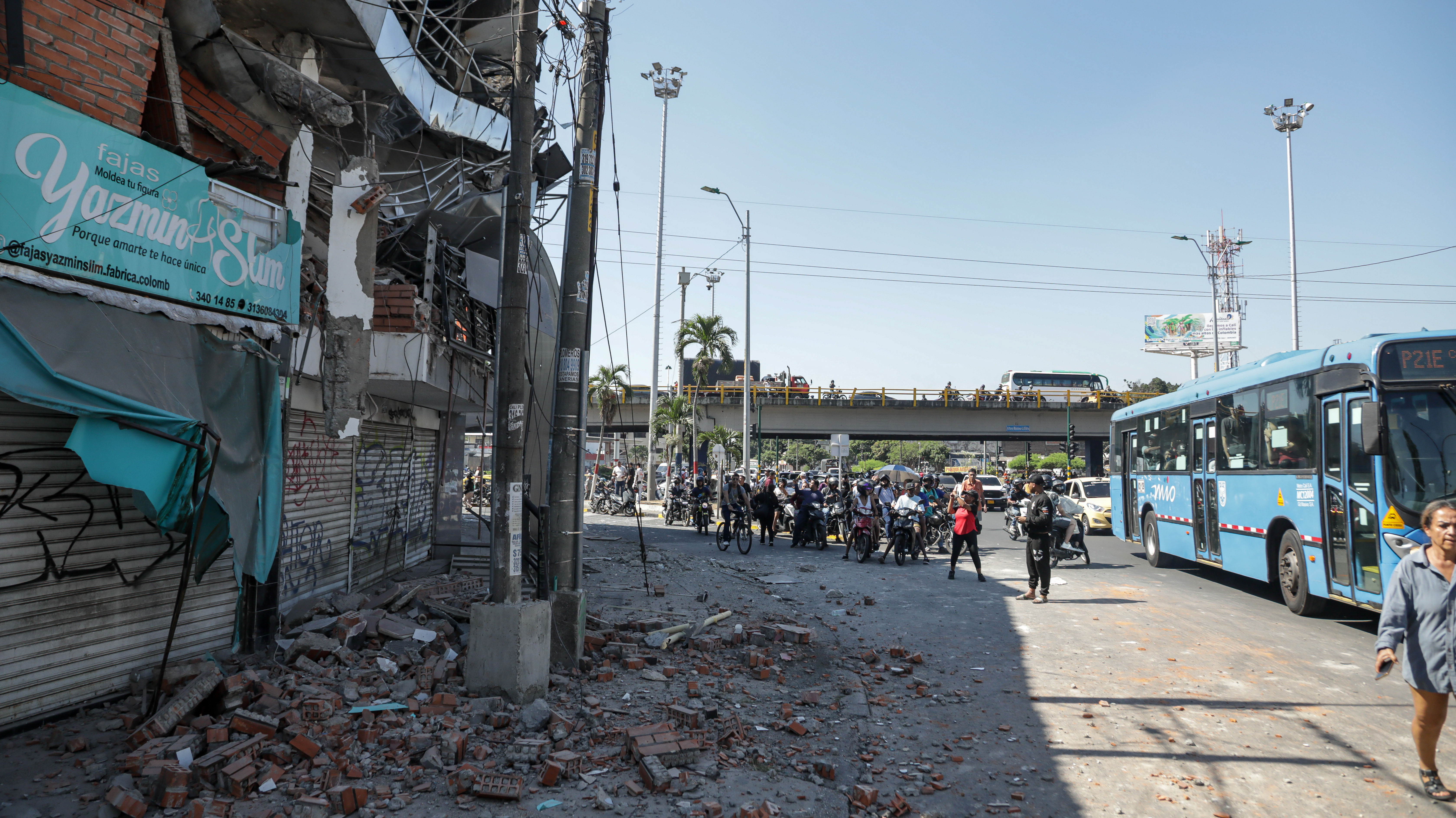
The partially collapsed La Luna hotel after a magnitude 7.4 earthquake struck Colombia on Aug. 10, 2026, in Cali, Colombia. (Samir Rojas/Getty Images)
(LONDON) — Over 100 people are dead after a 7.4-magnitude earthquake rocked western Colombia on Monday, officials said.
The country’s new president, Abelardo de la Espriella, has declared a national disaster, with destruction reported in multiple cities.
The earthquake’s epicenter was 5 kilometers east of San José del Palmar, Colombia, according to the U.S. Geological Survey.
At least 111 people are dead and 87 have been injured, according to Colombia’s president.
Some of the hardest-hit regions include the cities of Pereira and Cali. Dozens of people have been reported dead in their respective departments.
At least 61 buildings have collapsed and over 1,600 homes have been damaged or destroyed, the president said. Dozens of health centers, community centers and roads have also been damaged, he said.
In Cali, at least 20 buildings collapsed and people were trapped, according to the mayor. A rescue effort was ongoing in a building where at least 15 people were trapped, according to officials.
The governor of Chuco said there were injuries and “severe damage” to buildings in the department’s capital city of Quibdo.
Seven airports have suspended their services, in the cities of Armenia, Cali, Manizales, Pereira, Quibdo, Buenaventura and Cartago.
There have not been any reports of collapsed buildings in the capital of Bogota, officials said.
The Colombian president said in a video on social media that he was headed to Bogota to “focus on addressing the emergency facing our country” and has convened a unified command post to respond to the affected areas, including what’s known as the Coffee-Growers’ Axis.
The Trump administration is “closely monitoring” the earthquake and stands “ready” to support the people of Colombia, Secretary of State Marco Rubio said in a statement.
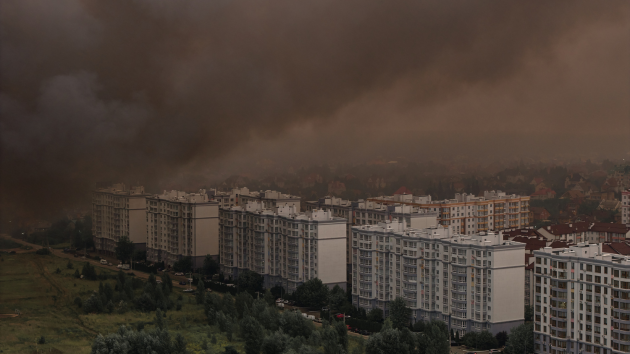
Thick black smoke engulfs buildings on the outskirts of Kyiv following a Russian ballistic missile attack on the capital on August 5, 2026 in Kyiv, Ukraine. (Photo by Kostiantyn Liberov/Libkos/Getty Images)
(LONDON) — Ukrainian President Volodymyr Zelenskyy said on Wednesday that at least 17 people were killed in Kyiv and the surrounding region in a massive overnight Russian missile and drone strike, with Ukraine’s air force failing to intercept any missiles amid a shortage of air defense munitions.
Ukraine’s air force said in a post to Telegram that Russia launched 115 drones and 28 missiles — 24 ballistic missiles and four anti-ship missiles — into the country overnight, of which 98 drones were intercepted.
None of the missiles were shot down, the air force said citing “preliminary data,” reporting missile and drone impacts across 26 locations.
Zelenskyy said in a post to Telegram that the “massive” and “devastating” attack killed at least 17 people. At least another 44 people were injured in the attack, Zelenskyy added.
“The main targets of the attack were storage facilities belonging to civilian enterprises, but there were also strikes on infrastructure and a railway station,” Zelenskyy said. “The targets included entities unrelated to the war: a brewery, warehouses for building materials and civilian logistics facilities.”
“Ballistic missile interceptors — these are what could have saved the lives of those who died today,” Zelenskyy wrote. “It is crucial that our partners understand that delays in their supply or a reluctance to provide anti-ballistic systems leads to precisely these horrific casualties and destruction.”
“A significant portion of Russian ballistic missile production is not currently under sanctions. This needs to change. New steps are needed from the G7, from the EU, from everyone who supports the protection of life,” Zelenskyy wrote.
The Russian Defense Ministry said in a statement posted to Telegram that its “massive strike” targeted what it said were “transport, logistics and distribution centers in the city of Kyiv and the Kyiv region.”
The ministry said that storage and distribution facilities for drone components and electronic warfare systems were among the targets struck, as were three cargo ships.
The ministry also said that Russian forces shot down at least 475 Ukrainian drones overnight into Wednesday morning.
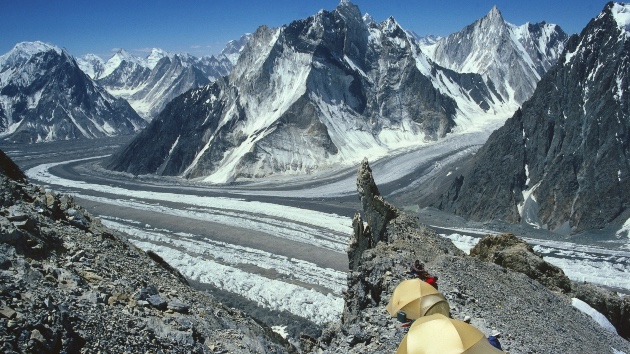
Undated photo of Karakoram Range, Pakistan (Photo by Uwe Steffens/ullstein bild via Getty Images)
(LONDON )– A team of 10 climbers, including one American, is missing after a reported avalanche on Broad Peak in Pakistan’s Karakoram mountain range, according to the Alpine Club of Pakistan.
The club said the avalanche was reported around midday Thursday and that it has lost contact with the expedition.
The team reportedly includes five Nepalese mountaineers led by climber Nims Dai, Pakistani climber Sohail Sakhi of Hunza, an Omani climber, American climber Mallory Geis, a Chinese climber and one other foreign climber, according to the Alpine Club of Pakistan. Renowned climber Nirmal Purja is also thought to be among the missing.
Broad Peak, where the climbers were traversing when the avalanche struck, is a 26,401-foot mountain in the Karakoram range in central Asia.
The Alpine Club of Pakistan said the entire team has been out of communication since the reported avalanche but confirmed that it is working with government authorities and relevant agencies to support an immediate search-and-rescue operation.
Two Pakistan Army aviation helicopters are carrying out rescue operations, while ground rescue teams are already searching the area.”Every possible effort is being made to ensure that helicopter support and all available rescue resources are mobilized at the earliest opportunity, subject to weather and operational conditions,” the club said in a statement.
The Alpine Club of Pakistan said it is continuing to monitor the situation and will provide updates as more information becomes available.
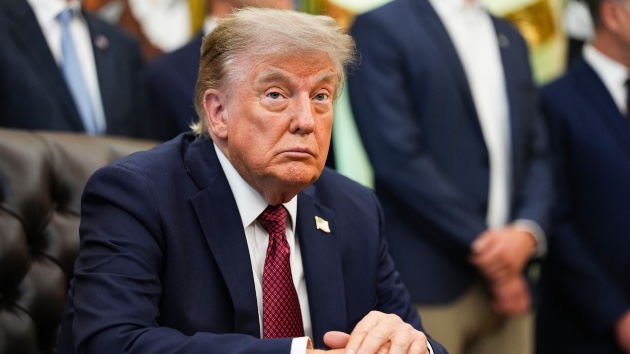
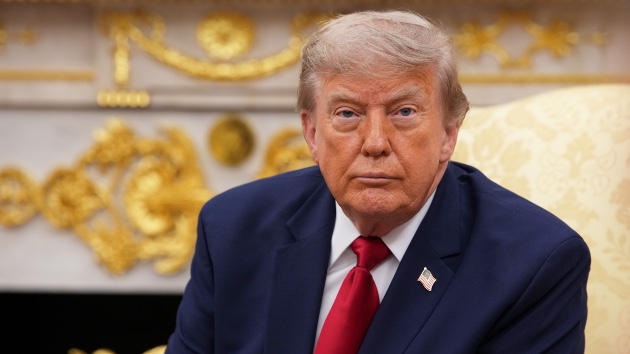
U.S. President Donald Trump makes an announcement on American nuclear innovation in the Oval Office at the White House on July 24, 2026 in Washington, DC. (Photo by Eric Lee/Getty Images)
(WASHINGTON) — President Donald Trump announced Thursday an agreement for Hamas to disarm and Israel to withdraw its troops from the Gaza Strip as part of a U.S.-brokered ceasefire signed last year.
“This agreement is a critical step towards Gaza finally being governed by a new Palestinian government that will work closely with the Board of Peace to help the Palestinian people,” Trump said in a social media post, referencing the newly formed multinational organization established by the U.S. president to oversee the 20-point peace plan in Gaza.
“At the same time, Israel will have the security it deserves, with Gaza no longer used as a base for terror attacks,” Trump added.
Few details about the agreement were initially released and there was no immediate official comment from Israel or Hamas on the president’s announcement.
In a statement following Trump’s announcement, the Board of Peace said Hamas has “agreed to a detailed Roadmap for implementing the next phases of the Gaza ceasefire,” calling it the result of a months of negotiations.
“The Roadmap represents a historic breakthrough,” the board said. “For the first time, Hamas officially has committed to an actionable plan for relinquishing all its weapons, which will be followed by Israeli withdrawal from Gaza.”
In his post, Trump said the agreement marks a “major milestone” in the 20-point plan and noted that it “will be carried out in carefully structured phases.”
“As disarmament is completed, Israeli forces will withdraw, and the International Stabilization Force will work with a new Palestinian police force to take responsibility for Gaza being safe for its residents and its neighbors,” Trump said. “Under this agreement, Gaza will finally be in the hands of a new Palestinian government that serves its PEOPLE.”
Trump also thanked mediators — including Egypt, Qatar and Turkey — for their work on the plan.
Trump’s 20-point plan, unveiled last fall, led to a ceasefire between Israel and Hamas, as well as the exchange of Israeli hostages and Palestinian prisoners. The plan also calls for Hamas — Gaza’s militant rulers — to surrender its weapons and dismantle its military infrastructure — including a vast tunnel network — and relinquish power to a new technocratic Palestinian government in return for an Israeli troop withdrawal, desperately needed humanitarian aid for Gaza’s population and an international effort to rebuild the war-ravaged Palestinian territory.
Earlier this month, Hamas announced it had dissolved its government in the strip to make way for the National Committee for the Administration of Gaza as part of phase two of the plan.
The war between Israel and Hamas began after the Hamas-led terror attack on southern Israel on Oct. 7, 2023, which killed more than 1,200 people and saw 251 taken hostage. The Israeli military subsequently launched a massive retaliatory campaign in Gaza, which has killed more than 73,000 Palestinians, including over 1,200 killed since the ceasefire, according to Gaza’s Hamas-run Ministry of Health. The conflict also led to a humanitarian crisis in Gaza, with the United Nations saying last week the overall situation remains “brutal.”
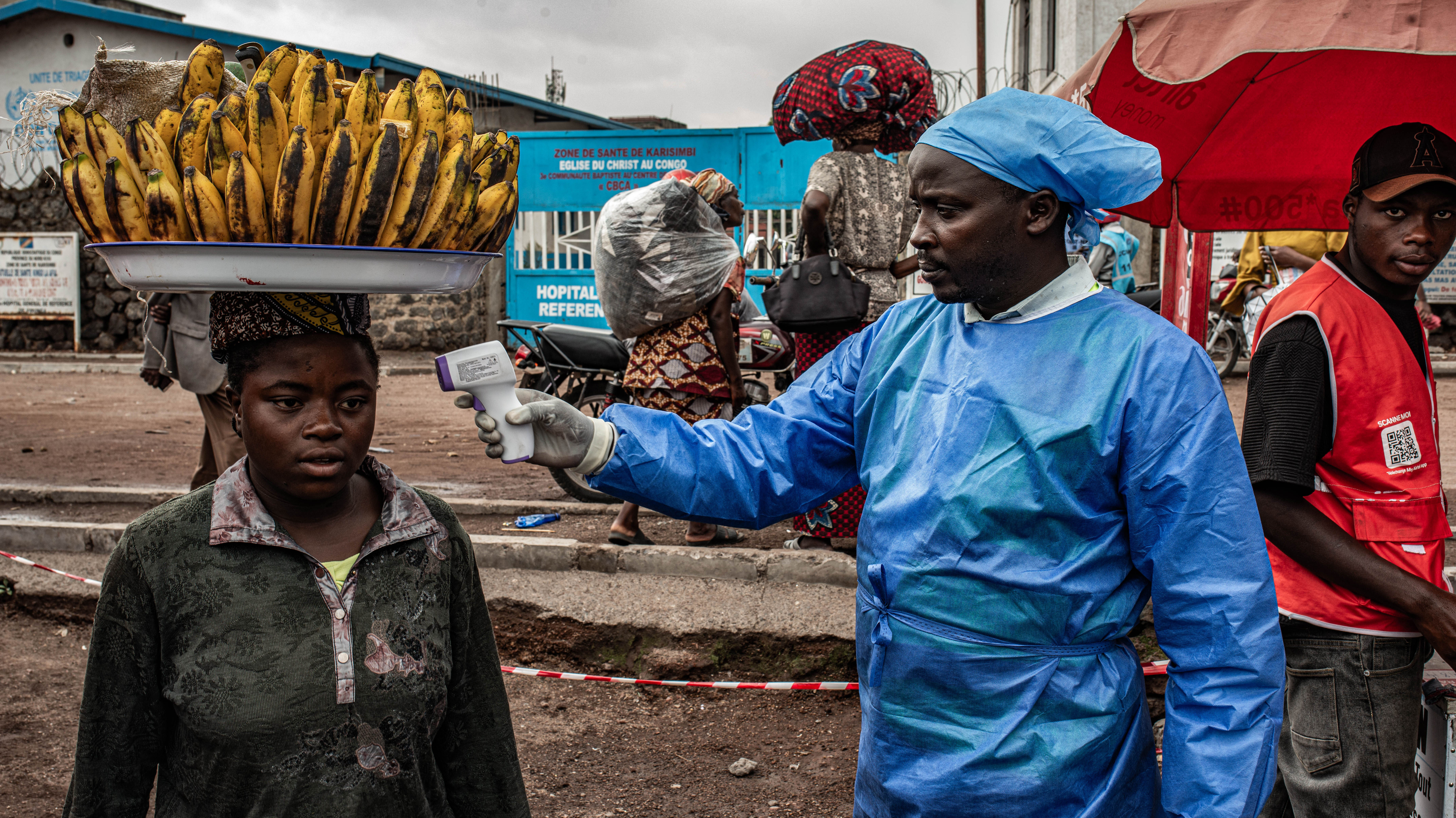
A health worker takes a woman’s temperature as part of Ebola screening efforts on June 24, 2026, in Goma, Democratic Republic of Congo. (Photo by Daniel Buuma/Getty Images)
(NEW YORK) — More than 1,500 people have died from Ebola as an outbreak continues to spread in the eastern Democratic Republic of the Congo, according to government figures released on Thursday.
As of Tuesday, at least 3,442 cases and 1,521 deaths had been recorded, with 797 people hospitalized or in isolation, Congo’s Ministry of Health said.
Health officials said the contact tracing rate stands at 78.3%, which is below the 90-95% that the World Health Organization says needed to contain the outbreak.
The outbreak was first detected in the DRC’s northeastern province of Ituri, with cases officially confirmed by the health ministry on May 15.
It marks the 17th outbreak of Ebola virus disease in the DRC, which is Africa’s second-largest country and its fourth-most populous nation. The country had a population of about 105 million as of 2023, according to the WHO.
The majority of cases have been detected in Bunia, the capital of the Ituri province, with cases also recorded in the provinces of North Kivu, South Kivu, Haut-Uele and Tshopo, health officials noted.
Aid organizations have said that community mistrust, insecurity due to armed conflict, and gaps in healthcare have hindered response and containment efforts.
Mercy Corps, an aid organization responding to the outbreak, said in a press release this week that teams are finding it “increasingly difficult to reach communities safely, consistently, and early enough.”
Onesphore Bangenza, Ebola response team leader in Bunia for Mercy Corps, said that in 10 weeks, there have been about as many cases recorded as there were during the 2018-2020 outbreak, which is “alarming and should stop us in our tracks.”
“There is no doubt that the virus is moving faster than we can contain it,” Bangenza said in a statement. “We have seen a real improvement in people’s understanding of Ebola over the past month, but those gains are fragile. When basic healthcare is unavailable, insecurity interrupts humanitarian assistance, or essential prevention infrastructure.”
A doctor working on the Ebola response in the DRC told ABC News on Thursday that basic supplies for safe and dignified burials are running short in some areas. He asked to remain anonymous.
“People are crying because they don’t even have the materials needed to bury the bodies,” the doctor said.
Additionally, there aren’t enough people to perform the contact tracing needed to get the outbreak under control, according to the doctor.
“You cannot investigate, you cannot do contact tracing with so few epidemiologists. Two epidemiologists per hospital is the minimum, but it is nowhere near enough to respond to an outbreak of this scale,” he said. “The response needs more than money. It needs people, equipment and community engagement. All the partners need to work together.”
Meanwhile, in neighboring Uganda, health officials declared the Ebola outbreak over earlier this week. The majority of the 20 cases reported in Uganda were travel-related, according to the country’s health ministry.
Dr. Jean Kaseya, the head of Africa Centres for Disease Control and Prevention, wrote in a post on X on Thursday that he was joining Uganda’s Minister of Health for a media briefing following the declaration of the end of the Ebola outbreak.
“This milestone reflects the commitment and dedication of health workers, communities, national authorities and partners who worked tirelessly to detect, contain and overcome this outbreak,” he wrote. “I commend the leadership of Uganda and all those who contributed to this response, including the teams from Africa CDC, WHO and partners who supported efforts on the ground.”
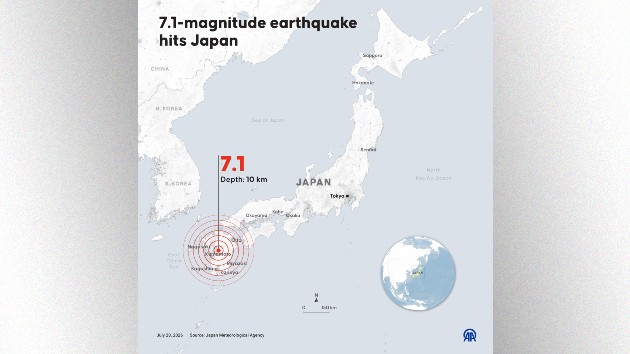
An infographic titled “7.1-magnitude earthquake hits Japan” created in Ankara, Turkiye on July 28, 2026. (Photo by Mehmet Yaren Bozgun/Anadolu via Getty Images)
(TOKYO and LONDON) — A powerful earthquake rocked southern Japan on Tuesday, damaging building, causing injuries and prompting warnings from officials, according to local authorities and broadcasts.
The U.S. Geological Survey said the quake measured at a magnitude of 6.8 after initially releasing a preliminary magnitude of 7.1.
It struck Kyushu Island, in the Kumamoto Prefecture, shortly before 4:30 p.m. local time, according to the U.S. Geological Survey, where a large shopping mall has been damaged.
The shopping mall was evacuated when the quake struck, Japan’s NHK News reported, adding that there appeared to have been an explosion in the aftermath of the earthquake and that injuries were reported in the area.
Aerials taken from above the shopping mall appeared to show that a number of walls, as well as the roof, partially collapsed. NHK reported that the fire department said the second floor of the building collapsed.
The quake struck about 6 miles below the island, which is the southernmost of the main Japanese islands, according to local and U.S. weather officials.
The quake prompted the Japan Meteorological Agency to issue and later lift a tsunami advisory for the coasts of the Ariake Sea and the Yatsushiro Sea.
The agency warned that further quakes may strike the area in the coming days, with an official saying, “As the place where the latest earthquake occurred is shallow, this shows that many earthquakes have occurred.”
The rumbling on Tuesday afternoon lasted for about a minute, according to Japan’s NHK News, which broadcast images of apparent smoke or fire nearby.
The prefecture’s airport, Kumamoto Airport, in Mashiki, suspended flights all flights shortly after the quake, according to a notice posted on its website.
Japan’s Nuclear Regulation Authority said in an emergency update that it had not recorded “abnormalities” at nearby facilities in Ikata, Genkai and Satsumasendai City.
Several thousand homes were without power following the quake, NHK reported.
Officials urged people to stay away from the ocean and the sea shore. They also warned residents to watch for possible landslides.
Japanese Prime Minister Sanae Takaichi said strong shaking could be felt in both city of Uki and the town of Hikawa. She warned of potential tsunamis of about a meter, or just over 3 feet, near the Ariake and Yatsushiro seas.
“I urge residents in areas that experienced strong shaking to remain vigilant against the possibility of further earthquakes of similar magnitude,” she said in a statement posted in Japanese on social media.
ABC News’ Joe Simonetti contributed to this report.
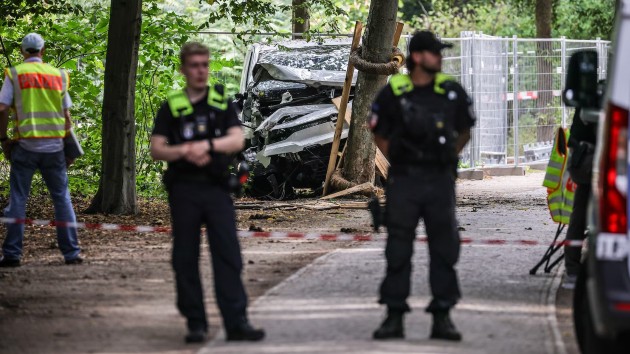
German police stand near a white van that suspect Abdul B. allegedly used in last night’s vehicle crash during the Christopher Street Day Berlin pride parade on July 26, 2026 in Berlin, Germany. (Omer Messinger/Getty Images)
(LONDON) — The man suspected of allegedly driving a vehicle into a crowd during Berlin’s LGBTQ+ celebrations on Saturday, killing one person and injuring several others, has been killed, police said.
“Around 6 p.m., the suspect in yesterday’s attack in the Großer Tiergarten was located in an allotment garden complex in Spandau,” according to a statement from Berlin police.
“According to current information, he reportedly ran toward our officers with a stabbing weapon, prompting our SEK Berlin unit to open fire,” the statement continued. “Despite immediate resuscitation efforts by the Berlin Fire Department, he died at the scene.”
Berlin police earlier Sunday released a photo of the man, whom they identified as Abdul B., using only an initial for his surname, as is common under German privacy law.
“Abdul B. is alleged to have injured several people with a moving vehicle in the Tiergarten area at approximately 10 p.m.,” according to a joint statement released by the Berlin Police and Public Prosecutor’s Office.
“Everything we are seeing here indicates that this was an Islamist terrorist attack,” German Interior Minister Alexander Dobrindt said at a press conference Sunday.
Dobrindt also updated the number of injured from 17 to 29, “including several who sustained serious injuries.”
The suspect rammed into the crowd with a vehicle, Dobrindt said, after which “he then attacked other pedestrians with a bladed weapon, believed to have been a machete, seriously injuring them.”
Dobrindt confirmed earlier police reports that the suspect, whom he described as a “German citizen of Lebanese descent who was born in Germany,” had “an extensive criminal record, showed signs of radicalization, and was associated with the radical Islamist scene.”
“He was previously sentenced in Berlin to one year and ten months in prison. The sentence was commuted to parole, and prosecutors appealed the decision,” Dobrindt said. He did not provide details about why the suspect was sentenced to prison.
“The search for the suspect is currently the top priority,” according to Dobrindt.
Details about potential motives for the attack were not immediately released.
Hundreds of thousands of people had come to Berlin to celebrate Christopher Street Day, one of Europe’s largest LGBTQ+ celebrations, according to the city.
The two-day event was scheduled on Saturday to include a parade, which was to begin in Mitte, in central Berlin, wind its way south into Schöneberg, then turn back northward toward Brandenburg Gate.
The vehicle crashed into the crowd in Tiergarten Park, according to law enforcement, an area along a footpath within the park and near to the parade’s end.
“One or more people are believed to have subsequently fled the vehicle,” police initially said. “Furthermore, several people are reported to have been injured with stabbing weapons.”
Several of those who were injured had life-threatening injuries, the Berlin Police told ABC News.
The suspect was described by police as having a “slim build.” They said he was about 1.9 meters tall, or about 6 feet, 3 inches, with black hair. He was wearing a black hoodie and white pants, police said.
“If you encounter this person, under no circumstances should you approach them or have any direct contact with them,” police said. “They may be armed and dangerous! Immediately contact the police emergency number 110.”
The police on Saturday called off the rest of the celebrations for the night after the incident at the park.
German Chancellor Friedrich Merz on Sunday described the vehicle crash as a “heinous act,” adding that “people from all over the world were peacefully celebrating” during Christopher Street Day.
“They wanted us to treat each other with kindness and tolerance,” he said on social media. “This is an attack on our society.”
ABC News’ Rashid Haddou, Felix Franz, Jamie Dorrington and Ivan Pereira contributed to this report.
U.S. President Donald Trump looks on during a bilateral meeting with the Prime Minister of Iraq Ali al-Zaidi, in the Oval Office of the White House on July 14, 2026 in Washington, DC. . (Photo by Andrew Harnik/Getty Images)
(WASHINGTON) — President Trump has approved an agreement with Saudi Arabia to partner on developing the Kingdom’s civil nuclear energy program, according to two U.S. officials.
The deal leaves open the possibility that Saudi Arabia will enrich uranium domestically in the future, the officials said, a prospect that could raise concerns about nuclear weapons proliferation.
In the deal, the United States and Saudi Arabia have agreed to safeguards to inhibit any weaponization effort, the sources said. But that framework would be governed by the two countries themselves, instead of the International Atomic Energy Agency (IAEA), which conventionally oversees nuclear pacts.
Secretary of State Marco Rubio was asked about the agreement on Wednesday. He declined to comment on the contours of the plan but said that the Trump administration would work with Congress to formalize the deal.
“Suffice it to say, the U.S. is not going to reach any agreement with any country in the world that leads to the risk of proliferation,” Rubio said.
The agreement, under which U.S. industry would help develop Iranian nuclear infrastructure, spans 30 years and is valued at tens of billions of dollars, the officials said.
The U.S. and Saudi Arabia discussed details of the proposal during a visit to Washington, D.C. by Saudi Crown Prince Mohammed bin Salman last fall. The administration is expected to submit the deal to Congress, which is required by federal law.
The Wall Street Journal first reported that the president had approved the deal.
Atop the Acropolis ancient hill with Parthenon temple during a heat wave on July 20, 2023 in Athens, Greece. (Photo by Milos Bicanski/Getty Images)
(ATHENS, Greece) — Two Greek-American tourists were rushed to the hospital Tuesday morning after they were stabbed outside the Acropolis in Athens, Greece.
The incident occurred at approximately 8:05 a.m., just after the Acropolis Museum’s opening, police said.
Prior to the incident, an individual brandishing a knife outside the museum’s entrance was threatening pedestrians, prompting a bystander to place an emergency call to authorities, according to eyewitnesses and authorities.
Before law enforcement arrived, the assailant stabbed a couple, a 53-year-old man and a 48-year-old woman. The male victim suffered severe blood loss, police said.
The male victim’s injuries required urgent care due to blood loss, but both victims are reported to be in stable condition. The female victim suffered minor injuries to her hands and legs.
Police have taken a 60-year-old suspect into custody.
The rapid-response unit within the Hellenic Police and the Athens Police Directorate immobilized and disarmed the suspect, detaining the individual on the scene.
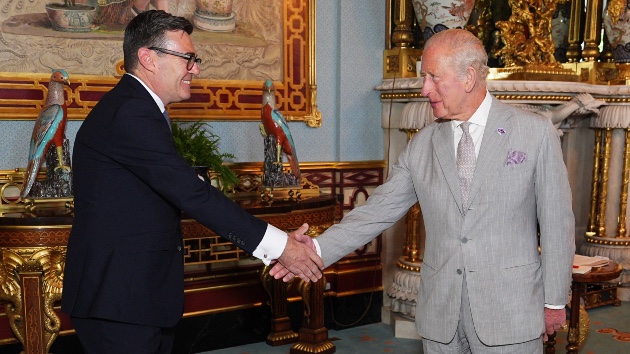
King Charles III welcomes Andy Burnham, during an audience at Buckingham Palace, London, where he invited the leader of the Labour Party to become Prime Minister and form a new government, on July 20, 2026 in London, England. (Photo by Aaron Chown – Pool/Getty Images)
(LONDON) — Andy Burnham officially became British prime minister on Monday — the country’s seventh leader in 10 years — having already been elected as the leader of the country’s Labour Party last week.
Burnham, who until recently was serving as the mayor of Greater Manchester, succeeded outgoing Prime Minister Keir Starmer.
Speaking outside the prime minister’s official residence — 10 Downing Street — on Monday morning, Starmer said, “Today I am here to offer my resignation and close the book on my time as prime minister. My work is done.”
“I thank the British people for the opportunity to serve. I go with good grace, I go with a smile, and I go proud of everything that we have achieved. Thank you very much,” Starmer added.
Of his successor, the outgoing prime minister said, “I now pass the baton to Andy Burnham, I wish him every success. He has my full support.”
After his address, Starmer traveled the short distance to Buckingham Palace to formally inform King Charles III of his resignation. Burnham then also traveled to palace where the king asked him to form a government.
The new prime minister then traveled to Downing Street to give his first address, telling the assembled press that Britain must show “that we can regain our stability.”
Burnham said his appointment will serve as “a circuit-breaker” for the country, pledging to deliver a new political and economic model and a 10-year plan.
Among the new prime’s commitments were to address cost of living concerns, help young people into work, end homelessness, re-industrialize the country, put “life’s essentials back under public control” and push for more local powers.
Through the rest of Monday, Burnham is expected to begin appointing cabinet ministers from Number 10.
Starmer announced that he would step down in June, following months of domestic political turmoil. Despite leading Labour to a historic majority in parliament in the 2024 general election, Starmer faced persistent external and internal criticism over his perceived failure to deliver rapid change after 14 years of Conservative Party rule in Britain.
Many in Starmer’s party had written to the prime minister asking him to step down following local elections in May, which saw the party lose more than 1,000 seats on local councils, results that were widely interpreted as a repudiation by British voters of Labour’s performance under the prime minister’s leadership.
Starmer long said he intended to see out his full five-year. Announcing his resignation in June, Starmer said, “The question my party is asking now is whether I am best placed to lead us into the next general election. I have heard the answer of my parliamentary party to that question, and I accept that answer with good grace.”
Burnham was the only candidate in the subsequent leadership election, ultimately winning nominations from 379 of the 403 Labour members of parliament — of the 650 MPs in total — in the House of Commons.
In accepting the leadership of Labour last week, Burnham said his mission was “to bring back hope” and address decades of economic inequality plus falling living standards.
“We must recognize that this generation of politicians — myself included — have failed to challenge a political culture and an economic model that simply doesn’t work well enough for ordinary people,” he said.
Burnham will become the seventh leader to take the reins of the country in 10 years, a reflection of the political and economic turbulence that has beset the country since the Brexit vote in 2016.
The incoming prime minister said he would also make British politics “less toxic, adding, “I will work to build a new politics. The country is crying out for it.”
Burnham, 56, was born in the Lancashire region of northern England. Burnham started out as a journalist, writing for trade magazines, before transitioning to work as a Labour parliamentary researcher while in his early 20s.
Burnham rose through the party ranks before being elected as the MP for his hometown of Leigh, in Greater Manchester, in 2001. He held that seat for 16 years, during which time he was appointed to several cabinet positions under Prime Ministers Tony Blair and Gordon Brown.
During Labour’s years in opposition, Burnham bid to become Labour leader twice, but was defeated by — and then served in shadow cabinets of — Labour leaders Ed Miliband and Jeremy Corbyn.
In 2017, Burnham left parliament to become the mayor of Greater Manchester. In his victory speech, Burnham heralded what he called “the dawn of a new era, not just for this city region but for politics in our country. It has been too London-centric for too long. The old political and party structures haven’t delivered for all people and for all places.”
Burnham is associated with the center left of the Labour Party, and has described himself as a socialist. Burnham’s time as Manchester mayor saw him emerge as a major proponent of shifting investment and political power out of London, and earned him the nickname “the King of the North.”
ABC News’ Kevin Shalvey contributed to this report.