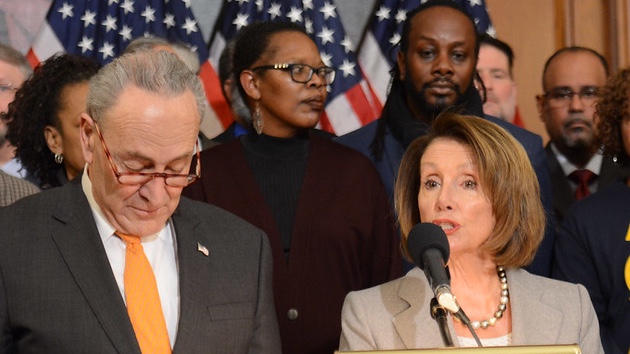
(WASHINGTON) — House Speaker Nancy Pelosi, D-Calif., may not bring the bipartisan infrastructure bill to the House floor Monday as she previously committed to, she said Sunday.
“I’m never bringing to the floor a bill that doesn’t have the votes,” Pelosi told ABC “This Week” anchor George Stephanopoulos.
“You cannot choose the date,” Pelosi said. “You have to go when you have the votes in a reasonable time, and we will.”
Pelosi had previously agreed to put the bipartisan infrastructure bill on the floor to be considered by Sept. 27, after moderates in her caucus demanded a vote.
“It may be tomorrow,” Pelosi added Sunday.
On Saturday, the House Budget Committee approved a $3.5 trillion budget resolution that calls for investments in climate change policy, childcare and other social programs.
Pelosi told her colleagues in a letter on Saturday they “must” pass the bill this week along with a separate bipartisan infrastructure bill.
“The next few days will be a time of intensity,” she wrote.
Pelosi also said on Sunday’s “This Week” that the price tag for the bill could drop in negotiations.
“That seems self-evident,” Pelosi said, acknowledging the $3.5 trillion topline number could be lowered.
This is a developing news story. Please check back for updates.
(DES MOISE, Iowa) — Iowa’s senior Republican senator, Chuck Grassley, announced in an early morning tweet Friday that, at age 88, he will seek reelection in 2022.
Grassley, who will be 89 by Election Day next year, is proud of his physical fitness, and not-so-subtly bragged about in a tweet announcing his run that showed him jogging before sunrise in Iowa.
“It’s 4 a.m. in Iowa so I’m running. I do that 6 days a week. Before I start the day I want you to know what Barbara and I have decided,” Grassley said the tweet. “I’m running for re-election—a lot more to do, for Iowa. We ask and will work for your support. Will you join us?”
The tweet included a clock turning to 4 a.m. and video of him jogging in the dark along a rural road.
It’s 4 a.m. in Iowa so I’m running. I do that 6 days a week. Before I start the day I want you to know what Barbara and I have decided.
Even getting close to 90, Grassley is currently only the second oldest member of the Senate, with California Democrat Dianne Feinstein besting him for the title by a matter of months.
His physique is a matter of legend on Capitol Hill.
He is frequently seen running or walking briskly through the Capitol hallways, and he’s known to challenge other senators to push-up contests. (He can do at least 21, perhaps more.)
But Grassley’s endurance can also be measured by his steady presence on Capitol Hill.
He began his career in Washington when he was elected to the House of Representatives in 1975. He’s been a member of the Senate since 1980, and currently holds the record for the 10th longest Senate tenure.
Grassley currently serves as the top Republican on the Senate Judiciary Committee. He led the committee for a portion of the Trump administration and aided in the confirmation of Supreme Court nominees and many federal judges that cemented conservative sway of the judiciary. He also served as chair of the Senate Finance Committee for the later half of President Donald Trump’s term.
With Republicans hoping to retake the now evenly-divided Senate in 2022, Grassley’s seat, as well as those of other Republican incumbents up for reelection, will be closely watched. Several long-serving Republican senators are retiring in 2022.
Following the announcement of his intent to run, the Iowa Republican Party threw its weight behind the senator.
“The road to a Republican majority runs right through Iowa. Defending this seat should be a top priority for every Iowan looking to stop Joe Biden’s chaotic agenda,” the party said in a statement. “Sen. Grassley’s never-quit attitude has propelled him to be one of the most effective senators in our state’s history. Grassley is a lifelong family farmer who understands the value of hard work, community, education, and family.”
Grassley’s most likely opponent is former Democratic Iowa Representative Abby Finkenauer, who was narrowly defeated in her 2020 reelection bid for the House.
Recent polling be the Des Moines Register/Mediacom Iowa Poll showed Grassley leading Finkenauer by 18 percentage points among likely voters.
Finkenauer slammed Grassley in a statement, alleging that the senator has lost touch with Iowa during his lengthy Senate tenure.
“After 47 years in Washington, D.C., Chuck Grassley has changed from an Iowa farmer to just another coastal elite,” Finkenauer alleged.
Grassley’s Senate colleagues celebrated his announcement in tweets Friday, praising his work ethic and experience.
“Chuck is a ferocious advocate for the people of Iowa and the conservative cause,” GOP Sen. Lindsey Graham of South Carolina said in a tweet. “I have served with Chuck my entire time in the Senate. He is one of the most hardworking, enthusiastic senators I have ever met with a wealth of experience and knowledge.”
ABC News’ Quinn Scanlan contributed to this report.
(PHOENIX) — Nearly eleven months after Joe Biden was elected president, the GOP-led review of Arizona’s Maricopa County ballots has found no substantial deviation from the vote count reported by the county that helped clinch the win for Biden.
The review’s count was within a “few hundred” of the county’s total, according to Republican Senate President Karen Fann.
“That is a true statement. They were close. I find it ironic that our secretary of state, and a few others have called this a sham audit — that you can’t trust, that you can’t believe it. Well the interesting fact is: Truth is truth, numbers are numbers and we said that from day one,” Fann said. “And those numbers were close. Within a few hundred.”
“This has never been about overturning the election. It’s never been about decertifying,” she said.
Despite mandated post-election reviews and two private audits of the county’s results that showed no anomalies or election integrity issues, Republicans still forged ahead with court cases seeking to prove fraud in Maricopa County.
When those failed, the state Senate contracted a private company to conduct a review of its own, which has now ultimately found similar results to the vote counts reported by Maricopa County, officials said during their presentation.
Democrats disavowed the process in a statement Friday afternoon.
“This fake audit, which has cost Arizona taxpayers hundreds of thousands of dollars, was never about increasing voter trust. It was about overturning the will of the voters, waging war against a fair and secure election and encouraging conspiracy theories to destabilize American democracy. The facts are this: Maricopa County performed multiple real audits of the election as required under state law,” Senate Democratic Leader Rebecca Rios said. “At the end of the day, the American people elected Joe Biden in a free and fair election and Cyber Ninjas and Arizona Republicans can’t change that.”
Biden flipped the state blue with a 10,457 vote lead. Sen. Mark Kelly also ousted former Republican Sen. Martha McSally — winning that race by 78,806 votes.
Maricopa County Chairman Jack Sellers, a Republican who was critical of the partisan review process, said after a draft report began circulating Thursday night that the results were not surprising.
“You don’t have to dig deep into the draft copy of the Arizona Senate/Cyber Ninja audit report to confirm what I already knew – the candidates certified by the Maricopa County Board of Supervisors, Governor, Secretary of State and Attorney General – did, in fact, win,” Sellers said in a statement.
Despite the fact that the review reaffirmed Biden’s win, critics say it still contained misrepresentations about election procedures.
The process was also criticized for a lack of transparency. While the review was being conducted, it was difficult to discern who exactly was in charge. Far-right media outlets were typically given increased access to the review and its officials, according to local media.
Fann chose Cyber Ninjas, a Florida-based cybersecurity firm with no experience working in elections, to conduct the review. She agreed to cover $150,000 of the cost with taxpayer money and approximately $6 million was donated by private groups, according to records released in response to a court order.
Only Fann and the chairman of the Judiciary Committee heard the presentation on Friday. There was no public comment or question period expected. Democrats are not allowed to participate in the presentation and were not expected to be able to ask questions, according to a spokesperson for Senate Democrats, who said the party had been “out of the loop.”
Since the beginning of the review, election experts have warned that the process was flawed and results would not be trustworthy given the unscientific manner the review was conducted. Maricopa County Recorder Stephen Richer, a Republican who took office in January, wrote a 38-page report to debunk common conspiracy theories and lies about the election results.
“I spent November and December willing to wait for a meritorious lawsuit, a scientific claim, or convincing data. But it never came because it didn’t exist. What is there, is data showing that Trump’s loss was built on disaffected Republican voters,” Richer wrote in his report. “And the maps of presidential votes in 2020 almost exactly match the Arizona map of 2016, except that it shifted slightly in favor of the Democrat.”
Secretary of State Katie Hobbs, a Democrat running for governor who fought to allow official election observers in to watch the review process, wrote a prebuttal of her own, saying the partisan review does not meet the standard definition of an “audit.”
“Moreover, it failed to satisfy the basic standards for election auditing. Because of these failures, any findings or report issued by Cyber Ninjas, or the state senate, based on the information collected using these faulty and inconsistently applied procedures and processes, should not be considered trustworthy or accurate,” she said.
(NEW YORK) — Vice President Kamala Harris’ interview on “The View” on Friday was delayed after two co-hosts tested positive for COVID-19.
Harris, who was supposed to appear in-studio with the co-hosts of the show, instead appeared remotely from another room after Ana Navarro and Sunny Hostin were said to have tested positive.
Speaking with the two remaining co-hosts, Joy Behar and Sara Haines, the vice president said the treatment of Haitian migrants on the southwest U.S. border was “horrible and deeply troubling.”
“Human beings shouldn’t be treated that way,” Harris said. “And as we all know, it also evoked images of some of the worst moments of our history, where that kind of behavior has been used against the indigenous people of our country, has been used against African Americans during times of slavery.”
The show began with the four co-hosts sitting at the host’s table for the start of the show; Navarro and Hostin were quickly ushered off the set before Harris’ intended appearance. The other co-hosts said Navarro and Hostin had been vaccinated against the virus.
“This is going to be a major news story in a minute now,” Behar said when she first announced the news. “Sunny and Ana apparently just tested positive for COVID.”
Harris’ deputy press secretary, Sabrina Singh, said in a statement that the vice president “did not have contact with the hosts before the show” and that Harris’s Friday schedule would “continue as planned.”
But the interview was delayed for much of the show as producers and the U.S. Secret Service took precautions to make sure the vice president would remain safe.
When Harris did appear for her interview, she noted the effectiveness of the vaccines since the anchors did not appear to have any noticeable, or severe, symptoms.
“Sunny and Ana are strong women and I know they’re fine,” Harris said. “But it really does speak to the fact that they’re vaccinated and vaccines really make all the difference…”
Harris also answered questions about COVID-19, Afghanistan and abortion access — with sharp words about Haitians at the border.
When asked about asylum applications from migrants, she said she and Biden believe the administration has to do more to support Haiti itself.
“Haiti is our neighbor,” Harris said. “The United States has to help and we have to do more and our administration feels strongly about that.”
On Friday morning, President Joe Biden told ABC News Congressional Correspondent Rachel Scott that, as president, he took responsibility for the photos and videos coming from the border of mounted police units confronting Haitian migrants.
“It’s an embarrassment, beyond an embarrassment. It’s dangerous. It’s wrong,” Biden said. “It sends the wrong message around the world, sends the wrong message at home.”
On Thursday, the U.S. Border Patrol announced it would put a pause on agents on horseback.
The president earlier this year tasked Harris with serving as his point person on stemming the flow of migration from Central America to the United States.
Earlier in the week, the vice president had condemned the ways Border Patrol agents were shown to be treating migrants.
(WASHINGTON) — President Joe Biden on Friday harshly criticized the action of some Border Patrol agents, mounted on horseback, who confronted Haitian migrants crossing the border into Texas, calling their actions “horrible.”
“It’s outrageous, I promise you, those people will pay,” Biden said.
Biden’s blunt statements came as the situation and the agents’ conduct are still under investigation and the agents have been placed on administrative leave. The use of horses has been suspended in the meantime.
Biden was responding to a question from ABC News Congressional Correspondent Rachel Scott, who asked, “You said on the campaign trail that you were going to restore the moral standing of the U.S., that you are going to immediately end Trump’s assault on the dignity of immigrant communities. Given what we saw at the border this week, have you failed in that promise? And this is happening under your watch–do you take responsibility for the chaos that’s unfolding?”
“Of course, I take responsibility,” Biden said, but he then quickly shifted to the controversial images of the agents on horseback. “I’m president but it was horrible to see what you saw to see people treat it like they did — horses family nearly running over people being strapped. It’s outrageous, I promise you, those people will pay. They will be — there is investigation underway now, and there will be consequences. There will be consequences. It’s an embarrassment, beyond an embarrassment. It’s dangerous. It’s wrong, it sends the wrong message around the world, sends the wrong message at home. It’s simply not who we are,” he said.
Democrats, including members of the Congressional Black Caucus, have demanded an end to the Haitians being expelled and the ACLU and other migrant advocates have had the administration is illegally removing them through the use of Title 42, claiming they are justified in doing so for public health reasons because of the pandemic.
The U.S. special envoy for Haiti, Daniel Foote, has resigned in protest over the administration policy, calling the treatment of the Haitian migrants “inhumane.”
(WASHINGTON) — The House on Friday passed a bill to uphold abortion rights for women, taking swift action in response to a new Texas law that bans nearly all abortions in the state.
The final tally was 218-211 with House Speaker Nancy Pelosi announcing the vote.
Recent Stories from ABC News
The House bill has little chance of becoming law and is largely symbolic given Republican opposition in the Senate.
The House bill would codify protections provided by the Supreme Court’s landmark Roe v. Wade ruling, which legalized women’s right to an abortion.
The Texas law that passed in September prohibits abortions after about six weeks of pregnancy and allows “any person, other than an officer or employee of state or local government,” to bring a civil suit against someone believed to have “aided or abetted” an unlawful abortion.
People who successfully sue an abortion provider under this law could be awarded at least $10,000.
Texas Gov. Greg Abbott signed the so-called “heartbeat ban” on May 19 and it went into effect on Sept. 1.
The U.S. Supreme Court voted 5-4 on Sept. 1 to allow SB8 to take effect on procedural grounds, despite what the majority acknowledged as “serious questions” about constitutionality. The justices did not address those questions.
Pelosi has said taking congressional action would make a “tremendous difference” in Democrats’ efforts to maintain access to abortion rights. She called the Supreme Court’s decision “shameful.”
Ahead of Friday’s vote, Pelosi said the House legislation should “send a very positive message to the women of our country — but not just the women, to the women and their families, to everyone who values freedom, honors our Constitution and respects women.”
Since Texas’s abortion ban went into effect, lawmakers in 11 states, including Florida, have announced intentions or plans to model legislation after the state’s law, according to NARAL Pro-Choice America.
The Supreme Court is set to hear oral arguments in a Mississippi abortion case in early December. The high court is expected to consider the legality of Mississippi’s ban on most abortions after 15 weeks of pregnancy, a law that is intended to challenge Roe v. Wade.
(WASHINGTON) — The House committee investigating the Jan. 6 Capitol riot issued its first subpoenas Thursday to four former senior Trump administration officials, including former President Donald Trump’s longest-serving aide and last chief of staff.
The committee is seeking documents and depositions from Dan Scavino — Trump’s caddy-turned-social media guru and senior White House aide — former chief of staff Mark Meadows, conservative activist Steve Bannon and Kash Patel, who was the chief of staff for the acting defense secretary on Jan. 6.
In the letters, the panel said it was seeking information about Trump’s actions before, during and after the Capitol riot regarding his campaign to overturn the election results.
The committee is demanding records be delivered by Oct. 7, and for all four witnesses to appear for closed-door depositions on Oct. 14 and 15.
“The Select Committee has reason to believe that you have information relevant to understanding the important activities that led to and informed the events at the Capitol on January 6, 2021,” Chairman Bennie Thompson, D-Miss., wrote in letters to Bannon and Scavino.
The panel’s members have vowed to move aggressively to obtain documents and records from witnesses in Trump’s orbit, many of whom have a history of stonewalling congressional investigators.
“That is a concern, but we have additional tools that we didn’t before, including a Justice Department that may be willing to pursue criminal contempt when people deliberately flout the compulsory process,” Rep. Adam Schiff, D-Calif., told reporters Thursday about the possibility of Trump aides defying congressional investigators.
Trump, in a statement, pledged to fight the subpoenas “on executive privilege and other grounds,” though not every recipient was a White House or administration official.
Meadows, who was Trump’s last chief of staff, was close to Trump before, during and after Jan. 6, and was involved in efforts to challenge the election results — participating in Trump’s call with Georgia Secretary of State Brad Raffensberger when he repeatedly urged him to reverse the presidential election results.
A Meadows aide declined to comment on the subpoena and whether Meadows would cooperate.
Patel, a former GOP congressional aide who worked in the Trump National Security Council before joining the Pentagon, was involved in security preparations for the Jan. 6 counting of the electoral vote on Capitol Hill and mobilizing the response to the riot, according to the committee, citing records obtained from the Defense Department.
Bannon, who remained an outside adviser to the president after helping to lead his first presidential campaign and a short stint in the White House, was at a meeting at the Willard Hotel where lawmakers were encouraged to challenge the election results, the committee claimed in its letter.
He was quoted as saying, “All hell is going to break loose tomorrow,” the panel wrote in its letter, citing a Jan. 5 episode of his podcast, “War Room.”
Scavino, Trump’s longest-serving aide and one of his fiercest defenders on social media, was with Trump before and after rioters stormed the Capitol, the committee claimed in its letter, citing reporting from Peril, the new book by Washington Post reporters Bob Woodward and Robert Costa.
He also used his Twitter feed to promote the Jan. 6 demonstration in Washington in support of Trump. Some attendees of that event outside the White House later marched on the Capitol and stormed Congress as lawmakers attempted to officially affirm the election results.
(WASHINGTON) — Talks of bipartisan police reform legislation in Congress are officially over as Republicans and Democrats can’t agree on key issues.
Democrats, after more than a year of negotiations, made a final offer, but despite “significant strides,” said Sen. Cory Booker, D-N.J., there weren’t any more concessions to be made.
“I just want to make it clear that this is not an end — the efforts to create substantive policing reform will continue,” Booker told reporters at the Capitol.
“It is a disappointment that we are at this moment,” Booker continued, adding that having participation from nation’s largest police union and the International Association of Chiefs of Police shows that “this is a bigger movement than where we were just a year or two ago.”
Lead Republican negotiator Sen. Tim Scott, R-S.C., said he’s concerned about high crime rates in some cities.
“When you’re talking about making progress in the bill, and your definition of progress is to make it punitive — or take more money away from officers if they don’t do what you want them to do — that’s defunding the police,” Scott told ABC News. “I’m not going to be a part of defunding the police.”
More than a year after the start of a racial reckoning in the United States, the movement to address brutality and racism in policing continues to dominate political discourse.
George Floyd’s death prompts reform
The George Floyd Justice in Policing Act was introduced in June 2020, very soon after Floyd, a Black man, was killed by then-Minneapolis police officer Derek Chauvin during an arrest. Floyd was accused of using a fake $20 bill at a local store.
Chauvin pinned Floyd on the ground, with his knee on the back of Floyd’s neck and upper back until he went unconscious. Videos taken by bystanders sparked a national movement against police brutality and racism, and legislators, including Rep. Karen Bass, D-Calif., and Rep. Sheila Jackson Lee, D-Texas, sought to answer calls for justice and end the current system of policing.
The Justice in Policing Act aimed to establish a national standard for policing practices, collect better data on police use of force and misconduct, ban the use of tactics such as no-knock warrants, and limit qualified immunity, which protects officers against private civil lawsuits.
It passed the House in March on a party-line vote, but the Republican-majority Senate didn’t move it forward. The legislation was reintroduced in 2021.
Senate Republicans also proposed a reform bill in June 2020, but Democrats blocked it, saying it didn’t do enough.
The Justice Act proposed using federal dollars to incentivize police departments to ban controversial practices, like the chokehold that killed Floyd, make lynching a federal hate crime, increase training and enforce the use of body cameras. The effectiveness of no-knock warrants also was to be studied.
Democrats and Republicans agree on ‘framework’
In summer 2021, both sides settled on a shared “framework” from which to pursue legislation.
“After months of working in good faith, we have reached an agreement on a framework addressing the major issues for bipartisan police reform,” Scott, Booker and Bass said in a joint statement. “There is still more work to be done on the final bill, and nothing is agreed to until everything is agreed to. Over the next few weeks we look forward to continuing our work toward getting a finalized proposal across the finish line.”
Many Republicans said they believed the proposed legislation put law enforcement under attack, while most Democrats held firm in holding accountable officers accused of abusing suspects.
Qualified immunity
Both sides still agreed to pursue change, but qualified immunity quickly became a sticking point for Republicans, and it ultimately led to the legislation’s demise.
Qualified immunity protects officers in cases where they’ve been individually accused of violating a person’s civil rights.
Some congressional Republicans said they feared a rise in frivolous lawsuits if qualified immunity were to be eradicated, but officers still would’ve had the same constitutional protections, and civil cases still would’ve been reviewed by courts before moving forward.
Sources told ABC News that Scott would get on board with a proposal if police unions could agree on a plan, but they’ve been very reluctant to do so.
Two police unions, the Fraternal Order of Police and the International Association of Chiefs of Police, were involved in negotiations with legislators. Though they came close to an agreement with Booker, other police unions such as the National Association of Police Organization, spoke out against Booker’s proposals because they weren’t included in earlier discussions.
Now, it’s back to square one. Booker said he and Congressional Democrats will find other pathways to achieving extensive police reform , but those pathways likely won’t include Republican colleagues.
Vice President Kamala Harris, who was in the Senate at the start of these negotiations, denounced Republican efforts to quash reform.
“We learned that Senate Republicans chose to reject even the most modest reforms. Their refusal to act is unconscionable,” Harris said in a statement. “Millions of people marched in the streets to see reform and accountability, not further inaction. Moving forward, we are committed to exploring every available action at the executive level to advance the cause of justice in our nation.”
White House press secretary Jen Psaki said President Joe Biden was disappointed.
“In the coming weeks,” she said, “our team will consult with members of Congress, the law enforcement, civil rights communities and victims families to discuss a path forward, including potential executive actions the president can take to ensure we live up to the American ideal of equality and justice under law.”
(FLORIDA) — A state legislator in Florida has introduced an abortion restriction bill similar to a controversial law that took effect in Texas earlier this month.
The new bill, HB 167, introduced Wednesday in the Florida House of Representatives by Rep. Webster Barnaby, would ban most abortions in the state and would allow people to file civil lawsuits against doctors who violate the law.
Specifically, HB 167 would require physicians to test for a “fetal heartbeat” on a pregnant person seeking an abortion.
Under the proposed legislation, a physician may not perform an abortion if there is a “detectable fetal heartbeat.”
The bill also puts the enforcement of the law on private citizens, versus the state, in allowing people to bring lawsuits against physicians. It calls for damages of at least $10,000 per abortion for the physician who performs the procedure and any defendants that “aided or abetted” the procedure.
People would have up to six years after an illegal abortion is performed to file a lawsuit.
The Texas law, Senate Bill 8, bans nearly all abortions after six weeks of pregnancy, specifically once the rhythmic contracting of fetal cardiac tissue can be detected.
Similar to the newly introduced bill in Florida, the Texas law is unusual in that it prohibits the state from enforcing the ban but allows anyone to sue a person they believe is providing an abortion or assisting someone in getting an abortion after six weeks.
People who successfully sue an abortion provider under this law could be awarded at least $10,000.
Texas Gov. Greg Abbott signed the so-called “heartbeat ban” on May 19 and it went into effect on Sept. 1.
The heartbeat bill is now LAW in the Lone Star State.
This bill ensures the life of every unborn child with a heartbeat will be saved from the ravages of abortion.
Like the Texas law, the Florida legislation does not include exceptions for pregnancies that occur from rape or incest, but makes an exception if a physician believes a “medical emergency” exists.
The bill’s language about “fetal heartbeat” is controversial because many medical experts say that early-stage cardiac activity isn’t a heartbeat.
Cardiac activity is typically first detected five to six weeks into pregnancy, or three to four weeks after the embryo starts developing.
Most of the abortions performed nationwide are after six weeks of pregnancy.
When a person is six weeks pregnant, it typically means the embryo started developing about four weeks prior, based on the formula doctors use to figure out when a person will give birth. People don’t often realize they are pregnant until after the six-week mark.
The U.S. Supreme Court voted 5-4 on Sept. 1 to allow SB8 to take effect on procedural grounds, despite what the majority acknowledged as “serious questions” about constitutionality. The justices did not address those questions.
Texas is one of 13 states that have passed laws banning abortion in the first trimester of pregnancy; legal challenges have so far prevented all from taking effect.
Since Texas’s abortion ban went into effect, lawmakers in 11 states, including Florida, have announced intentions or plans to model legislation after the state’s law, according to NARAL Pro-Choice America.
Florida Gov. Ron DeSantis’ office said the new proposed abortion legislation in his state will be reviewed, according to The Associated Press.
“Governor DeSantis is pro-life. The Governor’s office is aware that the bill was filed today and like all legislation, we will be monitoring it as it moves through the legislative process in the coming months,” DeSantis spokesperson Taryn Fenske said in an email to the AP.
Democratic leaders in Florida have vowed to fight the legislation.
“This bill is dangerous, radical, and unconstitutional. The hypocrisy of this attempt by Governor (Ron) DeSantis and Republicans in the state legislature to take away our rights while at the same time preaching ’my body, my choice’ when it comes to wearing masks is absolutely disgusting,” Agriculture Commissioner Nikki Fried, also a Democratic candidate for governor, said in a statement, according to the AP.
(WASHINGTON) — Democratic House and Senate leaders on Thursday announced they and the White House have reached agreement on a “framework” that will pay for most, if not all, of the massive $3.5 trillion human infrastructure bill — a move meant to mitigate concerns from moderate and centrist Democrats opposed to the hefty price tag.
But the leaders provided very little details on the framework a day after President Joe Biden met with Democratic leaders, moderates and progressives at the White House in an effort to save his agenda from Democratic infighting.House Speaker Nancy Pelosi also did not provide a clear outline about when the reconciliation bill will be ready for a vote.
She also did not commit to putting the bipartisan infrastructure bill on the floor for a vote next Monday, which she had promised moderates would happen.
Pelosi was joined by Senate Majority Leader Chuck Schumer and Treasury Secretary Janet Yellen at her weekly press conference, as Democrats also face a looming possible government shutdown on Oct. 1 and still need to deal with the debt ceiling, which Republicans will not support.
“The White House, the House and the Senate have reached agreement on a framework that will pay for any final negotiated agreement. So, the revenue side of this, we have an agreement on,” Schumer told reporters.
“We know that we can cover the provisions the president has put forward,” Pelosi added. “It’s all good.”
This announcement is meant to provide some relief to those moderate, centrist Democrats like Sens. Joe Manchin and Kyrsten Sinema, who do not support that $3.5 trillion number.
But Pelosi and Schumer provided very little on actual details. As of right now, leaders are no closer to having a reconciliation bill — which means the fate of the bipartisan infrastructure bill hangs in the balance.
“We came to terms as to a framework of an array of agreements that we have, depending on what the need is. Now at the same time, we’re finalizing on the outlay side, so if we need more, we need less — that will impact the choices we make there,” Pelosi said.
Pelosi also did not commit to putting the bipartisan infrastructure bill that has already passed in the Senate on the floor next week.
“We take it one day at time,” Pelosi told reporters. “I am confident that we will pass both bills.”
Pelosi also did not make clear if $3.5 trillion will remain the topline, or if that figure could change and drop lower.
“This is not about price tag. This is about what is in the bill,” Pelosi said.
Following the press conference, reporters caught up with Pelosi and pressed for more details on the framework.
When reporters suggested they had too few details, Pelosi responded, “well that’s your problem, not mine.”
Following the press conference, many senators close to the negotiation table say they are in the dark about the new framework agreement.
Senate Budget Committee Chairman Bernie Sanders said he has “no idea” what the agreement is. He told reporters he hopes to be briefed on it soon “if there is a framework.”
“We’ve been through this a million times. There are many many approaches as to how you can raise money in a fair and progressive way and raise at least 3.5 trillion dollars,” Sanders said. “If that’s what the menu is there is nothing then nothing particularly new I think.”
Sen. Mark Warner, a moderate Democrat on the Budget committee who has been intimately involved in negotiations with the president on the reconciliation plan told reporters he has not the “foggiest idea” what is in the framework.
Warner told reporters he was “as interested in getting those details as you are.”
Senate Finance Committee Chair Ron Wyden, D-Ore., said he was in meetings over the framework, but declined to give many details about what was discussed or decided upon.
“It went right to the heart of what we need in terms of tax fairness in America and that’s where we are this morning,” Wyden said while dodging questions about a topline or any agreed to “payfors.”
Senators said they expected to receive more information from leadership Thursday on what the framework is.
Democratic leaders also have to contend with a potential shutdown on Oct. 1, but Pelosi insisted a shutdown would be avoided.
Pelosi told reporters Republicans could cave on raising the debt ceiling because “public sentiment is everything.”
But she indicated that both chambers will do everything they can to keep the government open via a so-called “continuing resolution” that maintains current funding levels, which may mean they will have to deal with the debt ceiling at a later time.
“We will keep the government open by September 30 … and continue the conversation about the debt ceiling. Whatever it is, we will have a CR that passes both houses by September 30,” Pelosi said.