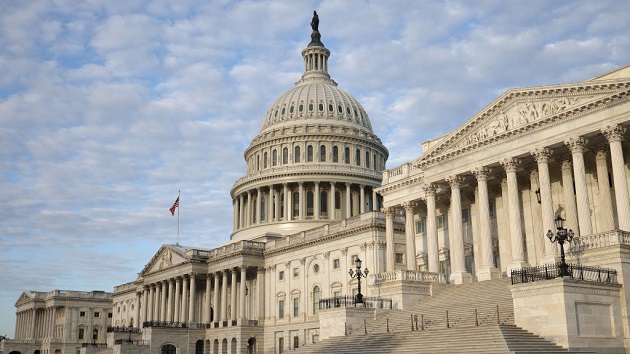
(WASHINGTON) — U.S. Treasury Secretary Janet Yellen said Tuesday that if Congress doesn’t raise the debt ceiling by the deadline it would be a ‘calamity.’
Testifying before the U.S. Senate Committee on Banking, Housing and Urban Affairs alongside Federal Reserve System Chairman Jerome Powell, Yellen said the U.S. would hit its debt limit in less than three weeks, on Oct. 18.
“This would be a manufactured crisis we had imposed on this country, which has been going through a very difficult period and is on the road to recovery,” she said. “This would be a self-inflicted wound of enormous proportions.”
The United States has never defaulted on its debt. Congress has voted 80 times to raise or suspend the debt limit since 1960.
Yellen has previously laid out the consequences to lawmakers of missing the deadline. She has said nearly 50 million seniors could temporarily stop receiving Social Security checks, troops could go unpaid and millions of families who receive the monthly child tax credit could experience delays. A default could also trigger a spike in interest rates and result in a steep drop in stock prices and other financial turmoil, reversing the current economic recovery into a recession, with billions of dollars of growth and millions of jobs lost.
Yellen painted a grim picture again Tuesday.
Even if Congress increases the debt limit but does so too close to the deadline, it could cause economic fallout, Yellen said.
“Furthermore, we know from previous debt limit impasses that waiting until the last minute can cause serious harm to business and consumer confidence, raise borrowing costs for taxpayers and negatively impact the credit rating of the United States for years to come. Failure to act promptly could also result in substantial disruptions to financial markets, as heightened uncertainty can exacerbate volatility and erode investor confidence,” Yellen outlined in a letter to congressional leadership.
Yellen also reiterated that raising the debt limit has nothing to do with future government spending — a point some Republicans have tried to push as reason for not supporting a debt-limit hike as Democrats on the Hill scramble to try to pass both a bipartisan infrastructure bill and a larger social spending package.
“I want to see that the debt ceiling is raised. I believe that it would be catastrophic not to do so. But I equally believe that deficits have been under both Democratic and Republican administrations, it’s important to recognize that, and that means paying the bills for those deficits is a shared responsibility,” Yellen testified.
ABC News’ Congressional Correspondent Rachel Scott contributed to this report.
(NEW YORK) — Caitlyn Jenner, a candidate in California’s recent gubernatorial recall election, said Tuesday on “The View” that she would run for office again, advocating for greater inclusivity among “old school” Republicans who are hurting the party.
This month’s attempted recall of California Gov. Gavin Newsom failed by more than 24%, with some votes left to count. Jenner did not finish among the top 10 replacement candidates.
“Even though it didn’t work out the way we wanted it to in the end, it was one of the most rewarding experiences of my life,” Jenner said.
“Would I run again? Yes. I want to stay involved,” she added. “But there’s other things that I would like to do, and that is — one is — try to get the Republican Party to be more inclusive.”
Jenner, a transgender woman, had defended former President Donald Trump while he was in office, but later she said she could no longer support him after he “relentlessly attacked” the trans community. She said on Tuesday that she thinks the media doesn’t give Republicans a “fair break.”
“Trump certainly had his messaging issues,” Jenner said. “I will agree with you on that.”
“He had an insurrection issue and a couple of impeachment issues as well,” co-host Sunny Hostin added.
“We need better candidates,” Jenner responded, adding that “old school” Republicans are hurting the party.
“Honestly,” Jenner continued, “I feel like [they] are destroying the Republican Party in so many ways, they have to move on. There’s got to be a next generation to come in, and I think they’re out there. And I’m hopeful that they’re out there, but we have to change, we have to do a better job.”
Co-host Joy Behar asked Jenner her thoughts on the Jan. 6 Capitol insurrection in Washington.
“Did that bother you too?” she asked Jenner.
Jenner said that Jan. 6 “obviously wasn’t right. And we can’t have that in our country.”
“We need to bring people together is what we need to do. We have a tendency in this country to put everybody in a box,” she said. “And the Republican party needs to change, and to be honest with you, I am the poster child for change.”
He’s been there before, with many of the same players alongside him, and wants to see his party get there again.
With that in mind, former President Barack Obama is lending rhetorical support to President Joe Biden’s agenda — an agenda he thinks the nation “desperately needs” and that he believes Democrats will get across the finish line.
In an interview with ABC’s Robin Roberts — ahead of the groundbreaking for what he sees as a legacy-defining initiative: the Obama Presidential Center in Chicago — the former president urged his party not to shy away from the argument that wealthier Americans should be asked to pay more in taxes.
“I think that they can afford it. We can afford it. I put myself in this category now,” Obama said. “And I think anybody who pretends that it’s a hardship for billionaires to pay a little bit more in taxes so that a single mom gets child care support, or so that we can make sure that our communities aren’t inundated by wildfires and floods and that we’re doing something about climate change, for the next generation, you know, that’s an argument that is unsustainable.”
It’s a relatively simple message, but one with complicated repercussions at this moment of uncertainty for the agenda of his former vice president.
Memories of the political wipeout that followed the passage of Obamacare — back when Democrats had far more comfortable margins in Congress than they do now — would be fresh even if so many key figures weren’t still in positions of power.
One critique from back then is that Democrats failed to sell what they were seeking to do, in a debate where Obama and others found themselves playing defense around what bills would not do.
Obama’s long-view-of-history take isn’t shared by all Democrats, just like they don’t all agree on the unmitigated political upside of what Biden wants. But the party might be able to use a dose of the fierce urgency they famously had in the Obama days, in the uncertain now.
The RUNDOWN with Averi Harper
Top Pentagon officials are slated to face tough questions during testimony on Afghanistan before the Senate Armed Services Committee Tuesday.
Secretary of Defense Lloyd Austin, U.S. Central Command head Gen. Kenneth McKenzie and chairman of the Joint Chiefs of Staff Gen. Mark Milley will offer their insight into the chaotic troop drawdown in Afghanistan.
All eyes will be on Milley, who has taken heat, including calls to resign, since Washington Post reporters Bob Woodward and Robert Costa revealed in their book “Peril,” that Milley took secret precautions to keep former President Donald Trump from being able to launch a nuclear weapon or taking military action after the attack at the Capitol on Jan. 6.
Milley and the others will likely be grilled on not only the troop withdrawal and the suicide bombing that killed 13 U.S. service members, but also on the later retaliatory drone strike that killed 10 civilians, including children.
Milley had first referred to the drone strike as “righteous,” but changed his stance amid the fallout.
“This is a horrible tragedy of war and it’s heart wrenching and we are committed to being fully transparent about this incident,” Milley said.
The TIP with Alisa Wiersema
The long-awaited debut of Texas’ redistricting proposal revealed that despite Republican influence on the map-making process, the outcome broadly favored incumbents on both sides of the aisle. Additionally, given the state’s rapid population growth, two newly proposed congressional districts — numbered 37 and 38 — were outlined respectively in the Austin and Houston suburbs.
Under the proposed map, incumbent Democrats — like Rep. Colin Allred and Rep. Lizzie Fletcher — whose current district borders would have led to competitive midterm challenges, were “packed” into would-be bluer districts. On the flipside, this means that many of the areas surrounding those districts are also going to become more favorable to Republicans and would lessen future chances of competitive races that could benefit Democrats.
Democrats also argue that the current configuration doesn’t reflect the state’s increased population being attributed to people of color.
The political packing approach is likely to resonate most in the Houston metropolitan area, where existing Democrat-represented districts were redrawn to overlap one another. This allows the newly proposed 38th Congressional District to create a new, reliably red district in the suburbs. Meanwhile, the creation of the 37th Congressional District near Austin would spread out existing Democrat influence, while reinforcing surrounding GOP-controlled districts.
The most visible border change would happen to Texas’ 34th Congressional District, which is currently occupied by retiring Democrat Filemon Vela. The current district would essentially be split in half and the southern, bluer region would become the entire district. The former northern portion would fold into the more GOP-favoring 27th district, which is currently occupied by GOP Rep. Michael Cloud.
THE PLAYLIST
ABC News’ “Start Here” Podcast. Tuesday morning’s episode begins with analysis of the verdict in R. Kelly’s sex trafficking and racketeering trial. Then, ABC’s Anne Flaherty reports on the impact of New York’s vaccine mandate on hospital workers. And, ABC News Chief National Correspondent Matt Gutman is on the site of a major train derailment in Montana, where the NTSB is still trying to determine what happened. http://apple.co/2HPocUL
WHAT YOU NEED TO KNOW TODAY
ABC News’ Robin Roberts’ exclusive interview with former President Barack Obama airs on ABC’s “Good Morning America” at 7 a.m.
Secretary of Defense Lloyd Austin, chairman of the Joint Chiefs of Staff Gen. Mark Milley and Commander of U.S. Central Command Gen. Kenneth “Frank” McKenzie testify in a Senate Armed Services Committee hearing on the conclusion of military operations in Afghanistan and plans for future counterterrorism operations at 9:30 a.m.
Treasury Secretary Janet Yellen and Federal Reserve Chairman Jerome Powell testify in a Senate Banking, Housing and Urban Affairs Committee hearing on supporting an equitable pandemic recovery at 10 a.m.
President Joe Biden receives the President’s Daily Brief at 10:30 a.m.
The White House COVID-19 Response Team and public health officials hold a press briefing at 12:30 p.m.
Obama, former first lady Michelle Obama, Illinois Gov. J.B. Pritzker and Chicago Mayor Lori Lightfoot attend the groundbreaking ceremony for the Obama Presidential Center in Chicago at 1:15 p.m. CT
White House press secretary Jen Psaki holds a briefing at 1:30 p.m.
Democrat Terry McAuliffe and Republican Glenn Youngkin participate in the final Virginia gubernatorial debate of the general election campaign in Alexandria, Virginia, at 7 p.m.
The Note is a daily ABC News feature that highlights the day’s top stories in politics. Please check back tomorrow for the latest.
(CHICAGO) — Former President Barack Obama believes the migrant crisis at the border in Del Rio, Texas, is “heartbreaking” and thinks comprehensive immigration reform is needed to fix “a system that, overall, is dysfunctional.”
“It’s no secret that we don’t have that. It’s the reason I proposed comprehensive immigration reform. It’s the reason Joe Biden proposed it during his administration, and it’s something that is long overdue,” Obama told Good Morning America co-anchor Robin Roberts in an exclusive interview that aired Tuesday morning.
As a candidate, Biden vowed to work with Democrats and Republicans to reach common ground on comprehensive immigration reform — efforts that have stalled in Congress for two decades.
Obama said that the crisis in Del Rio “is a painful reminder that we don’t have this right yet and we’ve got more work to do.”
“As big-hearted as he is, nobody understands that better than Joe Biden,” Obama added. “And the question is now: Are we gonna get serious about dealing with this problem in a systemic way, as opposed to these one-offs where we’re constantly reacting to emergencies? And I think that that’s something that every American should wanna put an end to.”
Biden vowed to implement a more humane approach to immigration than his predecessor, President Donald Trump, but now Biden is under fire from members of his own party over his administration’s handling of the migrant surge at the border in Del Rio.
At the center of the criticism from Democrats is the Biden administration’s use of a Trump-era public health order to rapidly expel thousands of those migrants, mostly Haitian nationals, without giving them a chance to apply for asylum within the United States — a move that violates U.S. asylum law, according to advocates challenging it in court.
“Despite the Administration’s rapid deployment of personnel and resources in response to this crisis, much of the strategy to address the care of these vulnerable individuals is deeply concerning,” Democratic Reps. Bennie Thompson and Gregory W. Meeks said in a joint statement Wednesday. “Specifically, we urge the Administration to halt repatriations to Haiti until the country recovers from these devastating crises.”
The Biden administration is defending its use of a Trump-era public health order to deport migrant families in court, arguing that lifting it would lead to overcrowding at DHS facilities, and that an influx of migrants, amid the delta variant surge, poses a public health risk.
So far, more than a dozen flights have taken about 4,000 people back to Haiti, Department of Homeland Security Secretary Alejandro Mayorkas said on CNN on Sunday.
At one point, there were more than 14,000 migrants in Del Rio, putting a strain on Customs and Border Patrol resources.
The influx of migrants from Haiti came after civil unrest erupted this summer following the assassination of Haitian President Jovenel Moïse and a 7.2 magnitude earthquake that devastated the Caribbean nation.
“Immigration is tough. It always has been because, on the one hand, I think we are naturally a people that wants to help others. And we see tragedy and hardship and families that are desperately trying to get here so that their kids are safe, and they’re in some cases fleeing violence or catastrophe,” Obama said. “At the same time, we’re a nation state. We have borders. The idea that we can just have open borders is something that … as a practical matter, is unsustainable.”
Obama also weighed in on Biden’s attempts to unite Democrats as divisions within the party threaten to imperil the president’s domestic agenda.
Amid ongoing disagreements within the party over a $3.5 trillion so-called “human infrastructure” bill, Biden met last week with House Speaker Nancy Pelosi and Senate Minority Leader Chuck Schumer, as well as moderate and progressive Democrats from both chambers.
“And as far as Democrats are concerned, I think President Biden is handling it exactly right, which is one of the great strengths of the Democratic Party is we’re diverse,” Obama said. “We come from all parts of the country. We look like the country as a whole.”
Obama said the country “desperately needs” the programs Biden has planned and predicted that the infrastructure package will pass.
“Any time Democrats try to pass legislation, there’s gonna be some negotiation and back and forth and sometimes some arguments that spill out into the press,” he said. “At the end of the day though, Democrats believe that we can make an economy that is fair, that we can address critical issues like climate change in a smart way.”
Obama has been outspoken in his support for his former vice president and told the New York Times in June that the Biden administration is “finishing the job” begun by the Obama presidency.
Obama is set to attend the groundbreaking of the Obama Presidential Center in Chicago on Tuesday — a presidential library in the historic Jackson Park neighborhood on Chicago’s South Side that will honor his legacy as the first Black president.
(WASHINGTON) — House Speaker Nancy Pelosi privately rallied Democrats in a caucus meeting Monday evening as the House began debate over the bipartisan infrastructure package.
Pelosi signaled she plans to push forward with a Thursday vote on the Senate’s bipartisan infrastructure bill, regardless of the status of negotiations on the larger Democratic policy package with the Senate.
Members believe it’s an attempt to pressure key senators to reach an agreement on the social spending plan, and some remain skeptical that the package will be ironed out with the backing of enough Democrats to clear the chamber by then.
Pelosi’s announcement to Democrats was a reversal of her earlier pledge to move both pieces of legislation together. It’s also a test of progressives’ vow to block the Senate-passed legislation unless it’s paired with the social spending package.
President Joe Biden and White House press secretary Jen Psaki both indicated earlier Monday afternoon that negotiations could stretch beyond this week.
“What we’re focused on right now is working in lockstep with leadership to move the agenda forward and get it over the finish line,” Psaki said in a briefing, adding, “We’ll see,” when asked if it could go into next week.
On the other side of Capitol Hill, Democratic Sen. Joe Manchin of West Virginia did not share the House’s urgency on the social spending package, eschewing progressive threats to tank the bipartisan infrastructure bill Manchin co-authored without a deal certain on the larger social and economic spending package.
“I don’t do really good on threats,” Manchin told reporters. “I’ll guarantee you this: The infrastructure bill will be passed before November 2022, before the election.”
Biden spoke on the phone with Pelosi and Senate Majority Leader Chuck Schumer on Monday afternoon before they both met with their respective Democratic colleagues to discuss the infrastructure package, the larger economic plan and avoiding a U.S. default, according to the White House.
The White House said the leaders “covered the outreach that each of the three are doing to Democratic House and Senate members” on the two big bills that represent much of Biden’s domestic priorities, though more specific details about that outreach were not provided.
Biden, Pelosi and Schumer “will continue their close coordination over the coming days,” the White House said.
Pelosi also privately told House members that Biden is negotiating directly with senators over the overall price tag of the reconciliation package.
“We just have to make difficult choices,” she said during the Monday evening caucus meeting. “But we’re still waiting for the number because you cannot prove the design on the legislation without the number. And the president is working on that piece. He’s working on that piece.”
The speaker indicated that she and Schumer are “completely in sync” and plan to have the same bill.
“We are not going to pass a bill that cannot pass – that won’t pass the Senate,” Pelosi told caucus members. “And that’s why we have to come up with a number. But we’re not there yet.”
However, Rep. Ilhan Omar, D-Minn., told reporters that figure is less important than making sure their “priorities” are addressed.
“It’s about the priorities that are getting funded and specific policies we put forth,” Omar said.
Democrats will continue working behind the scenes to reach an agreement with Manchin and Sen. Kyrsten Sinema, D-Ariz., on a range of different issues from climate change to the size and scope of the education and medical programs in the package, as well as who will be impacted by the tax law changes.
“We can’t have a situation where the Senate doesn’t agree with us, or we leave some issues off the table,” Rep. Pramila Jayapal, D-Wash., said. “The whole bill needs to be agreed upon, written, etc.”
Some Republicans did signal plans to vote with Democrats on the package — “This is a working piece of legislation that will build, put people to work,” Rep. Don Young, R-Alaska, the dean of the House, said — others spoke out against it, despite it being negotiated by both Republicans and Democrats in the Senate.
“It’s a facade to lure everyone into opening the door for Speaker Pelosi’s real priority: a $3.5 trillion tax and spend plan,” Republican Rep. Sam Graves of Missouri, the top Republican on the House Transportation Committee, said.
(CHICAGO) — President Biden’s far-reaching multitrillion-dollar domestic agenda, in peril because of Democratic infighting, is getting a prominent boost from former President Barack Obama, who told ABC News in an exclusive interview that the country “desperately needs” the programs and that he supports taxing the wealthy to help support the package.
“You’re talking about us stepping up and spending money on providing childcare tax credits — making those permanent to help families, who for a long time, have needed help,” Obama told Good Morning America host Robin Roberts.
“You’re looking at making our infrastructure function more efficiently … you’re talking about rebuilding a lot of buildings, roads, bridges, ports so that they are fortified against climate change. And also, that we start investing in the kinds of energy efficiency that’s going to be required to battle climate change.”
The former president’s comments come as ongoing disagreements between progressive and moderate Democrats in the House delayed a vote on a sweeping $1.2 trillion bipartisan infrastructure bill that passed in the Senate on Aug. 10.
The legislation bolsters funding for the country’s infrastructure — from roads and bridges to transit systems and the electricity grid.
Progressives have indicated that they will not vote on the infrastructure bill until the larger $3.5 trillion so-called “human infrastructure” bill is also ready for a vote, but some of the contents of the larger bill, as well as disagreements over how to pay for it have been a point of contention among Democrats.
The $3.5 trillion bill is a 10-year spending plan that covers a host of Democratic priorities, including investments in health care, child care, eldercare, universal preschool, free community college, as well as efforts to combat climate change.
Republicans and some moderate Democrats have raised concerns over the price tag of the package, while House Democrats have sought to offset the costs by raising taxes on wealthy Americans and corporations — a proposal that Obama said he supports.
“I think that they can afford it. We can afford it. I put myself in this category now,” Obama told Roberts.
“It’s paid for by asking the wealthiest of Americans, who have benefited incredibly over the last several decades — and even in the midst of a pandemic, saw their wealth and assets rise enormously — asking them to pay a few percentage points more in taxes in order to make sure that we have a economy that’s fair for everybody,” Obama said.
“I think anybody who pretends that it’s a hardship for billionaires to pay a little bit more in taxes so that a single mom gets childcare support or so that we can make sure that our communities aren’t inundated by wildfires and floods and that we’re doing something about climate change for the next generation — you know, that’s an argument that is unsustainable,” he added.
Hoping to salvage his agenda, Biden met with members of Congress last week, including House Speaker Nancy Pelosi, D-Calif., Senate Majority Leader Chuck Schumer, D-N.Y., as well as Democratic moderates and progressives from both chambers.
White House press secretary Jen Psaki told reporters Thursday that the administration is considering a “range of options” for financing the plan.
“Our bar has continued — has always been from the beginning, nothing that would raise taxes on anyone making less than $400,000 a year. And certainly we wouldn’t support anything that would,” she added.
Pelosi may delay vote on Senate bipartisan infrastructure bill
Following the meeting with the president Pelosi indicated that a vote on the infrastructure bill in the House was set for Monday Sept. 27 — a timetable that she has since indicated could change.
“I’m never bringing to the floor a bill that doesn’t have the votes,” Pelosi told ABC’s This Week anchor George Stephanopoulos on Sunday.
“You cannot choose the date,” she added. “You have to go when you have the votes in a reasonable time, and we will.”
A White House official told ABC News on Monday that Biden, along with senior White House staff, spoke over the weekend with several members of Congress whose votes are key to getting the legislation passed.
“Engagement is happening through the weekend into Monday and it continues to be clear that there is strong resolve across the caucuses behind passing these bills so that our economy delivers for the middle class and not just those at the top,” the White House official said.
(WASHINGTON) — The Senate is poised to vote on a measure aimed at averting a government shutdown and raising the federal debt limit Monday evening, but Republicans have promised to block it.
If Monday’s vote fails, as it is expected to, Congress will be left with just four days to cobble together a government funding bill.
The measure being considered by senators Monday would extend federal funding at the current levels through early December and provide billions in emergency relief funds for Afghan refugee resettlement and Hurricane Ida relief. It also includes raising the federal debt limit through December 2022.
The debt limit must be dealt with by mid-October if lawmakers hope to avert potential financial calamity. Experts warn that failure to act could lead to the stock market crashing, rising rates for mortgages, loans and credit cards, and businesses finding it more expensive to do basic business, leading to layoffs.
Treasury Secretary Janet Yellen put it in stark terms in a recent Wall Street Journal op-ed, saying, “In a matter of days, millions of Americans could be strapped for cash.”
“Nearly 50 million seniors could stop receiving Social Security checks for a time,” she wrote. “Troops could go unpaid. Millions of families who rely on the monthly child tax credit could see delays.”
But Republicans are nearly united in their resolve to block any hike to the debt limit from moving forward, though Louisiana Sen. John Kennedy may vote to advance it because he feels his state desperately needs the hurricane relief.
On Monday, Republicans are expected to deny Democrats the 60 votes necessary to move forward on a stopgap funding bill because it would raise the debt limit.
Senate Majority Leader Chuck Schumer scolded Republicans for signaling they won’t come together to vote yes on Monday’s continuing resolution, calling their refusal “unhinged” and “radical.”
“There is no scenario on God’s green Earth where it should be worth risking millions of jobs, trillions in household wealth, people’s social security checks, veterans benefits and another recession, just to score short-term meaningless political points,” Schumer said.
“We’re facing a parade of horrible that will hurt every single American in this country,” he added.
Senate Minority Leader Mitch McConnell argued Republicans have been transparent for weeks that they will not support a continuing resolution that raises the debt ceiling.
“We will support a clean continuing resolution that will prevent a government shutdown, get disaster relief to Louisiana, help properly vetted Afghan refugees who put themselves on the line for America and support the Iron Dome assistance for our ally, Israel,” McConnell said. “We will not provide Republican votes for raising the debt limit.”
McConnell has argued that Democrats can and should be responsible for raising the debt limit on their own to offset the cost of a not-yet-passed massive social spending bill that encompasses many of President Joe Biden’s agenda items.
That social spending bill is exempt from the normal 60-vote threshold in the Senate. Democrats can pass it without any GOP support, and a raise in the debt limit should be tied to that bill, Republicans argue.
“My advice to this Democratic government, the president, the House and the Senate: Don’t play Russian roulette with our economy. Step up and raise the debt ceiling to cover all that you’ve been engaged in all year long,” McConnell said last week. “This is a totally Democratic government. They have an obligation to raise the debt ceiling, and they will do it.”
But raising the debt limit is traditionally a bipartisan objective. Senate Democrats have cried foul, alleging that McConnell is being inconsistent in his position.
Democrats worked with Republicans under the Trump administration to raise the debt limit on multiple occasions, and the limit now needs to be raised largely to pay for legislation passed during the Trump presidency. New proposals from the Biden administration haven’t yet been factored in.
“For Republicans to suddenly throw their hands in the air and abscond from their responsibility to pay debt that they proudly supported is nothing short of a dine and dash of historic proportions,” Schumer said last week. “Republicans wracked trillions of dollars in debt under President Trump and are demanding American families foot the bill.”
It’s not clear exactly how the Senate might proceed in the coming days to stop a shutdown.
House Speaker Nancy Pelosi suggested last week that Congress would likely consider a stopgap funding measure that does not impact the debt limit, buying lawmakers more time to strategize on how to proceed. McConnell said Republicans would support this.
But the clock is ticking. Democrats must address both the debt limit and government funding in the coming weeks while simultaneously juggling the fate of many of Biden’s most ambitious domestic policy priorities.
Without the 60 votes necessary to advance a debt limit hike in the Senate, lawmakers will have little choice but to include it in their massive $3.5 trillion social spending bill — but that bill’s fate is anything but certain.
In the House, moderates are threatening to withhold votes unless a separate $1 trillion infrastructure bill that passed the Senate in August clears the lower chamber. The House is expected to vote on the bipartisan bill later this week, but progressives want to see more progression the larger social bill before they lend their support to it.
Biden addressed the big week on Capitol Hill while receiving his booster shot earlier Monday.
“We’ve got three things to do: the debt ceiling, continuing resolution and the two pieces of legislation. We do that, the country is going to be in great shape,” Biden told reporters.
Echoing the president at a briefing Monday afternoon, White House press secretary Jen Psaki indicated congressional negotiations could stretch beyond this week.
“You said it could go into next week? That’s your expectations?” one reporter asked.
There are three mammoth bills, two enormous deadlines and one big collective legacy to be defined – by a pair of veteran Democrats who need each other to make it happen.
House Speaker Nancy Pelosi is framing the high-stakes action coming to the House floor as an opportunity to enact “the vision of Joe Biden,” as he told ABC’s George Stephanopoulos on “This Week” Sunday.
That and more is at stake this week, in what could be the biggest votes in the long careers of both the House speaker and the president. Pelosi and Biden need a nearly unanimous Democratic Party to cast risky votes that carry uncertain payoffs, with failure on all or part bringing potential calamity.
Already, the timeline and price tag of key components are slipping, as was inevitable, and the president said Sunday that action should “take the better part of the week.”
The long-promised Monday vote on the bipartisan infrastructure bill is most likely getting pushed back, and a Senate vote to keep government funding flowing will almost certainly fail on Monday given complete GOP opposition.
Biden’s sliding approval rating and spotty direct involvement continue to be a factor. So does the mistrust between the moderate and progressive wings that Pelosi is struggling to unite.
There’s a lot of truth here: “Overwhelmingly, the entirety of our caucus – except for a few whose judgment I respect – support the vision of Joe Biden,” Pelosi said on “This Week.”
Biden and Pelosi have both been in a position where they need to respect all Democrats’ judgment, because the obvious alternative if failure. Their most potent argument from here is that failure is possible – one of the few things all Democrats definitely agree on at the moment.
The RUNDOWN with Averi Harper
An investigation of border patrol agents on horses appearing to whip migrants is ongoing, but Texas Gov. Greg Abbott is making his support for those agents clear.
“If [Biden] takes any action against them whatsoever, I have worked side-by-side with those border patrol agents, I want them to know something. If they are at risk of losing their job at a president who is abandoning his duty to secure the border, you have a job in the state of Texas,” said Abbott on Fox News Sunday. “I will hire you to help Texas secure our border.”
Abbott’s declaration comes after Biden denounced the actions taken by those border patrol agents.
“It’s outrageous, I promise you, those people will pay,” Biden told ABC News’ congressional correspondent, Rachel Scott.
If an investigation determines that the law enforcement officers in those controversial images acted inappropriately, Abbott’s commitment to employ them despite potential misconduct would undermine Biden’s attempt at holding them accountable.
The idea also highlights an aspect of police reform that Democrats hoped to address in the now-dead George Floyd Justice in Policing Act: handling law enforcement officers who are reprimanded or terminated by one agency only to be employed by another. The legislation aimed to create a national police misconduct registry.
The issue, along with so many other aspects of police reform, remains unaddressed after the breakdown of Senate negotiations.
The TIP with Alisa Wiersema
After Arizona’s so-called “audit” results only added votes to Biden’s 2020 winning margin, former President Donald Trump rallied supporters on Saturday by continuing to cling false allegations that Georgia’s elections also suffered from mass voter fraud.
The validity of the 2020 presidential election in Georgia has been backed by several investigations, a statewide hand recount, a statewide voting machine recount and a voter signature review in one of the state’s most populous counties. Still, former Trump continues to deny the evidence to the extent of endorsing Georgia Secretary of State Brad Raffensperger’s Republican primary opponent, Rep. Jody Hice, who challenged November’s election results in Congress.
Trump’s adamance to oppose history also includes targeting Republican Gov. Brian Kemp, of Georgia, who refused to get involved in overturning the outcome of the election despite being pressured to do so by the former president last year. Trump’s apparent fixation on Kemp even caused him to go off-message at Saturday’s rally, which was meant to support pro-Trump Republican candidates in upcoming elections.
Instead, Trump said voting rights advocate and possible Democratic gubernatorial candidate Stacey Abrams would make a better executive than Kemp. “Having her, I think, might be better than having your existing governor. It might very well be better,” Trump said of his fellow Republican. Abrams is popularly credited with successfully mobilizing voters and turning Georgia blue.
THE PLAYLIST
ABC News’ “Start Here” Podcast. Monday morning’s episode features a breakdown of this week’s key reconciliation and infrastructure votes for Democrats with ABC News White House Correspondent MaryAlice Parks. Then, a Florida school board member talks about spending a weekend knocking on hundreds of doors to find students still missing from school. And, ABC’s Britt Clennett tells us why world leaders are paying close attention to who will replace German Chancellor Angela Merkel. http://apple.co/2HPocUL
WHAT YOU NEED TO KNOW THIS WEEKEND
President Joe Biden and Vice President Kamala Harris will receive the president’s daily brief in the Oval Office.
Former President Barack Obama hosts a discussion with campaign alums ahead of the Obama Presidential Library groundbreaking on Tuesday.
Virtual groundbreaking celebrations begin for the Obama Presidential Center in Chicago.
The House of Representatives, which convenes at noon for morning hour and at 2 p.m. for legislative business, will begin a floor debate on the bipartisan infrastructure framework.
The Senate convenes at 3 p.m. and resumes consideration of the Extending Government Funding and Delivering Emergency Assistance Act.
The Note is a daily ABC News feature that highlights the day’s top stories in politics. Please check back Monday for the latest.
(WASHINGTON) — President Joe Biden vowed to implement a more humane approach to immigration than his predecessor, but now the Biden administration is facing backlash over its use of a Trump-era order to rapidly expel thousands of migrants, mostly Haitian nationals, without giving them a chance to apply for asylum within the United States.
The process is known as Title 42, a reference to part of a U.S. public health code, and according to advocates challenging the administration in court, its use violates U.S. asylum laws.
Despite a chorus of criticism from advocates and Democratic lawmakers over the handling of the crisis at the border in Del Rio, Texas, the administration is defending the use of Title 42 in court.
After more than a week of growing controversy, immigration authorities in Del Rio, Texas, on Friday finished clearing out an encampment of mostly Haitian migrants that at one point expanded to about 15,000 people.
So far, more than a dozen flights have taken about 2,000 people back to Haiti, according to the Department of Homeland Security. About 17,400 have been moved from the camp for processing or to initiate removal proceedings where they will have the chance to claim asylum. About 8,000 at the camp returned to Mexico, according to DHS.
What is Title 42?
Title 42 is a clause of the 1944 Public Health Services Law that “allows the government to prevent the introduction of individuals during certain public health emergencies,” said Olga Byrne, the immigration director at the International Rescue Committee.
Rarely used over the past few decades, the Trump administration used an interpretation of Title 42 to issue a public health order during the COVID-19 pandemic to rapidly expel migrants at the border, citing concerns over the spread of the virus, without giving them a chance to apply for asylum, Byrne said.
“U.S. law says that any person in the United States or at the border with the United States has a right to seek asylum,” said Byrne.
“The legal issue at hand [with the use of Title 42] is that there’s nothing in the law that allows the government to expel [migrants] without any due process,” she added.
Between October 2020 and August 2021, 938,045 migrants were expelled under Title 42, according to U.S. Customs and Border Protection data.
Who is being deported under Title 42?
Nearly two week ago, thousands of migrants, mostly Haitian nationals, began arriving at the Texas-Mexico border in Del Rio. At one point, there were more than 14,000 migrants, with thousands sheltering under an international bridge.
The influx of migrants from Haiti came after civil unrest erupted this summer following the assassination of Haitian President Jovenal Moïse as well as a 7.2 magnitude earthquake that devastated the Caribbean nation.
Many Haitian migrants have also been in South America for about a decade ever since the 2010 earthquake caused massive damage and social and economic instability throughout Haiti considered the poorest country in the Western Hemisphere.
“We are definitely seeing a high number of Black immigrants, Haitian immigrants in particular, immigrants from the African continent who are not even given the tiniest opportunity to explain their experiences and request asylum,” said Breanne Palmer, the policy and community advocacy counsel at the UndocuBlack Network, an advocacy group for undocumented Black individuals.
When asked last Friday what is being done to remediate the situation in Del Rio and what has caused the recent increase of migrants at that port of entry, Department of Homeland Security Secretary Alejandro Mayorkas said DHS would continue to use Title 42 to its fullest extent to help expel individuals arriving at the border.
“…we have the authority to expel individuals under the laws that Centers for Disease control have,” Mayorkas told ABC News. “It is their public health authority under Title 42 and that is what we will bring to bear to address the situation in Del Rio, Texas.”
Byrne said that the Biden administration has chosen to deport Haitian migrants without screening them for coronavirus, despite the fact that COVID-19 testing is widely available as tourists and travelers have continued to flow into the U.S. through the U.S.-Mexico border.
“Title 42 is the most efficient tool at the government’s disposal for quick expulsions to quickly get people out of the U.S. without due process,” Byrne said.
The Biden administration has exempted unaccompanied minors from deportation under Title 42 but is defending in court its use of the public health order to deport families, arguing that lifting the public health order would lead to overcrowding at DHS facilities, and that an influx of migrants along with the delta variant surge, poses a public health risk.
The court battle and what’s next
The American Civil Liberties Union, joined by a group of civil rights organizations, filed a preliminary injunction in court, challenging the expulsion of families under the use of Title 42.
“Anybody who arrives at our border is supposed to be able to seek asylum if they claim a fear of persecution,” said ACLU attorney Lee Gelernt, the lead lawyer in the case.
“The Haitian situation is a dramatic and horrific illustration of the harms caused by the Title 42 policy,” he added. “… families are literally being pushed back into the arms of persecutors and cartels, without any hearing.”
On Sept. 16, a federal judge granted the injunction, blocking the use of Title 42 to expel families.
“The Title 42 Process is likely unlawful,” judge Emmitt Sullivan wrote in the ruling, referencing protections for asylum seekers in place under current U.S. immigration laws.
But the judge’s order, which was appealed by the Biden administration, does not apply to single adults and will not take effect for 14 days or Thursday, Sept. 30.
And according to Byrne, because the Biden administration has already applied for a stay of the injunction pending appeal, it is likely that the order will not go into effect on Thursday.
In the meantime, the expulsion of migrants has continued.
“The government is using those two weeks now, rather than to organize itself at the border … to quickly expel as many Haitians as it can,” Gelernt said.
(WASHINGTON) — A former senior Department of Homeland Security official who once accused the Trump administration of politicizing intelligence said Sunday that a return of President Donald Trump to the White House in 2024 “would be a disaster” for the U.S. intelligence community.
“(Former President Trump) has denigrated the intelligence community, he puts out disinformation — and that’s an existential threat to democracy and he is one of the best at putting it out and hurting this country,” Brian Murphy, who once led the DHS intelligence branch, said Sunday in an exclusive interview on ABC’s “This Week” with George Stephanopoulos.
Murphy, a long-time federal law enforcement official, made headlines last year after filing a whistleblower complaint accusing Trump-appointed leaders of politicizing intelligence by withholding or downplaying threats that ran counter to Trump’s political messages.
The 24-page complaint, filed in September 2020, named former Homeland Security Secretary Kirstjen Nielsen and former acting Secretary Chad Wolf as trying to “censor or manipulate” intelligence bulletins related to Russian meddling in the presidential election and the threat of domestic white supremacist groups.
“I became a whistleblower because when I arrived at DHS in 2018, from the outset, everything that I had stood for — you know, finding objective truth when I was in the FBI and serving in the Marines and serving the American public — was quickly told to me that’s no longer acceptable,” Murphy said Sunday.
In his complaint, Murphy further accused Nielsen, Wolf and other top officials of scrambling to gather and prepare intelligence reports that aligned with Trump’s public remarks in the months leading up to the 2020 election.
“There was intense pressure to try to take intelligence and fit a political narrative,” Murphy said Sunday. “When I got to DHS, it was all about politics.”
In one instance, Murphy wrote in his complaint that he was “instructed” by Wolf “to cease providing intelligence assessments on the threat of Russian interference in the United States, and instead start reporting on interference activities by China and Iran.”
On Sunday, Murphy said “there was a push-on across government at the senior levels — cabinet officials — to do everything possible to stifle anything” about Russia’s interference.
“They did not want the American public to know that the Russians were supporting Trump and denigrating what would soon be President Biden,” Murphy added.
Murphy also claimed Sunday that discussing white supremacy as a national security threat became a “third-rail issue” within the department after the 2017 “Unite the Right” rally in Charlottesville, Virginia.
“I disagreed with that, I made that known to my superiors,” Murphy said Sunday.
A DHS spokesperson said last year that the agency “flatly denies that there is any truth to the merits of Mr. Murphy’s claim.”
Wolf responded last September during a speech that any effort to “paint recent DHS actions as examples of mission drift or politicization … could not be more wrong.” James Wareham, Nielsen’s attorney, told ABC News at the time that Murphy’s allegations “would be laughable if they were not so defamatory.”
Murphy’s explosive claims nonetheless fueled concerns that Trump and his appointees had sought to politicize the intelligence process to more closely support the administration’s legislative and political agenda.
Shortly before filing his whistleblower complaint, Murphy was reassigned within the department after it was revealed that his intelligence unit had included reporters’ tweets in bulletins disseminated to law enforcement networks across the U.S. — a practice that experts said was out of the agency’s purview.
Questioned by Stephanopoulos about that, Murphy said Sunday he “understands why, at the time, the media reacted the way they did” to reports his branch collated public-source information about reporters, citing the alleged credibility gap between the White House and the American people.
Murphy added that “at no time was I aware or direct anybody in my organization to collect information on journalists.”
“People did not trust (the Trump administration). There was a war against the media and I wasn’t going to be a part of that,” Murphy said.