(WASHINGTON) — Supreme Court Justice Sonia Sotomayor did not ask her colleague and seatmate on the bench, Justice Neil Gorsuch, to wear a mask during the omicron surge, according to a rare joint statement issued Wednesday.
The justices, addressing swirling media reports of discord, insist they remain “warm colleagues and friends” despite recent headlines suggesting Gorsuch had defied a request to mask up, forcing Sotomayor, who, because of her diabetes and her age — 67 — is at heightened risk of COVID, to retreat to her chambers.
“Reporting that Justice Sotomayor asked Justice Gorsuch to wear a mask surprised us. It is false. While we may sometimes disagree about the law, we are warm colleagues and friends,” they said in a rare joint statement.
Since early January, Sotomayor has not joined her colleagues for any in person proceedings or private meetings due to health concerns. At the same time, her peers began wearing masks while together — with one notable exception: Gorsuch.
NPR’s Nina Totenberg reported Tuesday, citing an unnamed source, that Chief Justice John Roberts had encouraged his colleagues “in some form” to mask up during omicron. She indicated that Gorsuch defied that request.
Fox News’ Shannon Bream reports, citing a separate unnamed source, that’s not true and that no request went out from Roberts and that Sotomayor never asked Gorsuch herself.
Roberts later out his own statement, saying, “I did not request Justice Gorsuch or any other Justice to wear a mask on the bench.”
He indicated he will have no further comment.
All the justices are boosted and tested daily before meeting together, per the court.
From October through December, all nine justices convened on the bench together — and only Sotomayor wore a mask at that time. She sat next to a maskless Gorsuch and Justice Stephen Breyer, among others.
In January, when they reconvened, most justices started wearing masks — with sole exception being Gorsuch. Sotomayor started dialing in from chambers.
The implication has been the appearance that Sotomayor is not comfortable sitting next to unmasked Gorsuch — with whom she’s been friendly and appeared with jointly in virtual events.
Her chambers has not specified the reason for her remote participation.
Everyone else in the courtroom who’s not a justice must be masked and must be tested, per court rules.
(WASHINGTON) — On the eve of the one-year anniversary of his inauguration, President Joe Biden held a formal news conference at the White House Wednesday, answering reporter questions on his handling of the pandemic, the economy and legislative agenda.
“It’s been a year of challenges, but it’s also many years of enormous progress,” Biden said to begin, ticking through his administration’s successes before fielding questions from reporters.
With Biden facing the limits of what he can accomplish with an evenly-divided Senate, unable to get either his signature social spending package or major voting rights reform through Congress in recent weeks, and with the pandemic still raging well into its second, his approval rating in polls has hit an all-time low. A Jan. 12 Quinnipiac poll found his approval rating to be 33%, a 3-point drop from November.
Still, Biden touted wins over the year to kick off the news conference, including administering more than 200 million COVID-19 vaccine doses and hitting record-low unemployment rates in many states.
“Should we have done more testing earlier? Yes,” Biden said in his opening remarks. “But we’re doing more now. We’ve gone from zero at-home tests a year ago to 375 million tests on the market just this month.”
He said the bottom line on COVID-19 is the country is “in a better place than we’ve been and have been thus far” and reiterated his position not to go back to lockdowns and school closures.
“Some people may call what’s happening now a new normal. I call it a job not yet finished,” Biden said with confidence. “We’re moving toward a time that COVID-19 won’t disrupt our daily lives or COVID-19 won’t be a crisis, but something to protect against and a threat. Look, we’re not there yet. We will get there.”
The first question to Biden was on whether he believes he overpromised to the American public what his administration could achieve in office one year in.
“Look, I didn’t overpromise,” a defensive Biden replied. “I have probably outperformed what anybody thought would happen. The fact of the matter is that we’re in a situation where we have made enormous progress.”
Then, he acknowledged a weakness.
“One thing I haven’t been able to do so far, is get my Republican friends to get in the game of making things better in this country,” Biden said. “I did not anticipate that there’d be such a stalwart effort to make sure that the most important thing was that President Biden didn’t get anything done.”
In an answer to ABC News Senior White House Correspondent Mary Bruce, Biden said there’s no need to scale back his agenda despite the appearance that Democrats aren’t getting their priorities through.
“I’m not trying to — I’m not asking for castles in the sky,” Biden replied. “I’m asking for practical things the American people have been asking for for a long time, a long time. And I think we can get it done.”
White House press secretary Jen Psaki, one day earlier, set up a preemptive defense for the president, telling reporters, “You don’t get everything done in the first year.”
“But what we feel good about … is that coming into an incredibly difficult circumstance, fighting a pandemic, an economic a massive economic downturn, as a result, an administration that was prior to us that did not effectively deal with a lot of these crises, that there’s been a lot of progress made,” she added.
“We need to build on that. The work is not done, the job is not done, and we are certainly not conveying it is, so our objective and I think what you’ll hear the president talk about tomorrow is how to build on the foundation we laid in the first year, Psaki said.
White House Communications Director Kate Bedingfield cited the $1.9 trillion COVID-19 relief law, the American Rescue Plan, and a major, bipartisan infrastructure package as two achievements Biden will highlight in an appearance on MSNBC’s “Morning Joe” Wednesday. But she also acknowledged the president can do more on other issues.
“He has been laser-focused on taming COVID and growing the economy. He would be the first to say we’re not where we need to be on those,” Bedingfield said.
Wednesday’s session marks just the second time Biden has held a solo formal press conference at the White House. The first such news conference was held March 25, 2021.
Since then, he held five news conferences on foreign trips, and three in partnership with other foreign leaders at the White House, for a total of nine news conferences. While Biden often answers questions shouted by the press at other events, his tally of formal news conferences is the lowest for any president since Ronald Reagan, according to data from University of California Santa Barbara’s American Presidency Project.
(WASHINGTON) — On the eve of the one-year anniversary of his inauguration, President Joe Biden is set to hold a formal news conference at the White House Wednesday at 4 p.m. ET, and is bound to face questions on waning public support for his handling of the pandemic, the economy and legislative agenda.
With Biden facing the limits of what he can accomplish with an evenly-divided Senate, unable to get either his signature social spending package or major voting rights reform through Congress in recent weeks, and with the pandemic still raging well into its second, President Biden’s approval rating in polls has hit an all-time low. A Jan. 12 Quinnipiac poll found his approval rating to be 33%, a 3-point drop from November.
Still, Biden is expected at the news conference to tout his successes over the year, including administering more than 200 million COVID-19 vaccine doses, and hitting record-low unemployment rates in many states.
“You don’t get everything done in the first year. But what we feel good about … is that coming in to an incredibly difficult circumstance, fighting a pandemic, an economic a massive economic downturn, as a result, an administration that was prior to us that did not effectively deal with a lot of these crises, that there’s been a lot of progress made,” White House press secretary Jen Psaki said Tuesday.
“We need to build on that. The work is not done, the job is not done, and we are certainly not conveying it is, so our objective and I think what you’ll hear the president talk about tomorrow is how to build on the foundation we laid in the first year,” she added.
White House Communications Director Kate Bedingfield cited the $1.9 trillion COVID-19 relief law, the American Rescue Plan, and a major, bipartisan infrastructure package as two achievements Biden will highlight in an appearance on MSNBC’s “Morning Joe” Wednesday. But she also acknowledged the president can do more on other issues.
“He has been laser-focused on taming COVID and growing the economy. He would be the first to say we’re not where we need to be on those,” Bedingfield said.
Wednesday’s session marks just the second time Biden has held a solo formal press conference at the White House. The first such news conference was held March 25, 2021.
Since then, he held five news conferences on foreign trips, and three in partnership with other foreign leaders at the White House, for a total of nine news conferences. While Biden often answers questions shouted by the press at other events, his tally of formal news conferences is the lowest for any president since Ronald Reagan, according to data from University of California Santa Barbara’s American Presidency Project.
(WASHINGTON) — In a rare event, the Senate will convene on Wednesday morning with all Democrats instructed to be in their seats inside the chamber when the business begins as they try to move forward on voting rights legislation and a challenge a long-standing Senate rule, efforts poised to fail without the support of a single Republican and likely even some Democrats.
Senate Majority Leader Chuck Schumer said Tuesday that Democrats will seek a carveout to the filibuster rule to pass voting rights legislation by replacing the current 60-vote threshold needed to break a filibuster with an old-fashioned “talking filibuster.”
“We feel very simply: on something as important as voting rights, if Senate Republicans are going to oppose it, they should not be allowed to sit in their office,” Schumer said Tuesday following an evening caucus meeting. “They’ve got to come down on the floor and defend their opposition to voting rights, the wellspring of our democracy. There’s broad, strong feeling in our caucus about that.”
“To anyone who says, ‘Oh, well you may not win.’ Don’t do it. Look at history,” Schumer added, preemptively defending the effort as a moral win, if not a legislative one.
Under a talking filibuster, senators are required to “hold the floor” during debate, testing their stamina as they must stand and speak to block bills. Once a party runs out of steam and gives in, the chamber would then pass the bill that was filibustered by a simple majority. So, in theory, Vice President Kamala Harris, as president of the Senate, would serve as a tie-breaking vote for Democrats to pass the once-filibustered bill.
But both Democratic Sens. Joe Manchin and Kyrsten Sinema have repeatedly made clear their opposition to changing the filibuster rule to pass voting rights, although they say they support the underlying legislation.
“I don’t know how you break a rule to make a rule,” Manchin told reporters Tuesday, shooting down the proposed talking filibuster.
And without the support of every single Democrat, it’ll be a non-starter in the chamber.
Senate Republican Leader Mitch McConnell gave a highly critical speech on the floor Tuesday of the effort after weeks of warning of “scorched earth” if Democrats made a filibuster carveout.
“Does the Senate exist to help narrow majorities double down on divisions or to force broad coalitions to build bridges?” McConnell said. “This fake hysteria does not prove the senate is obsolete it proves the Senate is as necessary as ever.”
Both parties have supported filibuster carveouts in the past decade for judicial nominees – first under then-Senate Majority Leader Harry Reid, who lowered the threshold for judicial nominees to 51 votes to make way for then-President Barack Obama’s nominees in 2013. McConnell, as Senate majority leader in 2017, also used the so-called “nuclear option” to confirm then-President Donald Trump’s first Supreme Court nominee, Neil Gorsuch.
The Senate rules change vote is expected in the early evening.
Across Pennsylvania Avenue, President Joe Biden – one day shy of one year in office – will hold a press conference from the White House around the same time, where he’ll likely take questions on his stalled legislative agenda.
The election reform bill at hand in the Senate would make Election Day a federal holiday, expand early voting and mail-in-voting, and give the federal government greater oversight over state elections. And would come at a time when nearly 20 states have restricted access to voting fueled by false claims in the wake of the 2020 election, according to the Brennan Center for Justice.
(WASHINGTON) — With the United States facing many of the same crises that Joe Biden took on when he took office one year ago, the president has been taking stock of his legislative accomplishments — including major infrastructure and coronavirus relief packages — and has stayed upbeat even as his popularity plummets and key priorities remain unmet.
“There’s a lot of talk about disappointments and things we haven’t gotten done,” Biden said last week. “We’re going to get a lot of them done, I might add.”
From fighting the pandemic and rebuilding the economy, to dealing with racial strife and combating climate change, Biden faces a mixed report card of what he’s been able to accomplish, as the limits of his office — and political realities he’s had trouble overcoming — launch him into a challenging second year in the White House.
On COVID, shift to science gives way to ‘reactive’ policies
From his first day in office, Biden set a different tone on COVID-19 from his predecessor, President Donald Trump. He embraced science and his top medical advisers — like Dr. Anthony Fauci — donned face coverings, and expressed sympathy for lives lost to the virus.
Biden pushed a $1.9 trillion relief package through Congress, oversaw a testing program that ramped up exponentially in his first months in office, and encouraged or mandated masks where he could, including on planes and other public transport.
Sixty-three percent of Americans are now fully vaccinated and nearly all schools have in-person instruction. And while the Supreme Court this month blocked his administration from requiring large businesses to mandate their workers get vaccinated or test weekly, many companies have instituted vaccine and testing requirements regardless.
But after Biden predicted that the Fourth of July last year would “begin to mark our independence from this virus,” the delta and omicron variants drove up cases, hospitalizations and deaths — and overwhelmed U.S. hospitals.
Shifting guidance from the Centers for Disease Control and Prevention and a testing shortage amid the omicron surge led public health experts to criticize his administration. A group of Senate Democrats said “far too many measures” his White House had taken “have been reactive, rather than proactive.”
And fewer Americans than ever now approve of the way Biden is handling COVID.
“If you take a look,” Biden said earlier this month, “we’re very different today than we were a year ago, even though we still have problems.”
On Tuesday, a White House official said, the Biden administration would make 400 million non-surgical N95 masks available to Americans for free and a government website went live allowing them to order free at-home tests.
Economy surges, but inflation hampers economic recovery
Biden delivered on two key economic promises: a $1.9 trillion COVID relief package and a $1.2 trillion infrastructure law that passed with bipartisan support.
He presided over the economy’s resurgence last year, with a record 6.4 million jobs created, rising wages and low unemployment — dropping to just 3.9% in December.
But inflation was up a record 6.8% over the course of the year, outpacing wage growth for many Americans.
The White House initially labeled rising prices temporary in nature, and this month said they expected price jumps to moderate this year.
Global supply chain headaches have also led to shipping delays, although most packages reached consumers on time for the holidays.
Legislative priorities stalled
While his infrastructure bill marked a major win, Biden ended his first year in office with two top domestic priorities, his nearly $2 trillion “Build Back Better” social plan and a pair of voting rights bills, stalled in the Senate despite passing the House.
That’s in large part due to the intransigence of two key Democratic senators, Joe Manchin of West Virginia and Kyrsten Sinema of Arizona.
The pair’s opposition to changing Senate rules — over Biden’s pleas — has allowed Republicans to block legislation that would widen access to voting and federal oversight of elections.
Meanwhile, the president’s negotiations with Manchin on the social spending plan — which includes universal preschool, expanding the child tax credit, an historical investment in climate policies and more health coverage, among other policies — hit a roadblock last month.
Biden had pledged to take on climate change and racial equity as key priorities, and while he has signed executive orders aimed at both, legislative pushes — climate action in the “Build Back Better” bill, and police reform measures — have failed to garner bipartisan support despite Biden’s pledge to soften political divisions.
White House press secretary Jen Psaki said Tuesday that Biden would continue to “advocate for both” voting rights and the “Build Back Better” bill.
“You don’t get everything done in the first year,” she said.
‘America is back’
The president traveled twice to Europe last year, declaring to allies that “America is back,” reaffirming traditional relationships and returning the U.S. to international organizations and agreements like the World Health Organization and Paris climate accord.
Seeking to end America’s involvement in Afghanistan, he withdrew troops from the country before the 20th anniversary of the Sept. 11 attacks — but in the chaotic final days, a terror attack killed 13 American service members.
He has found it difficult to bring Iran back to the agreement over its nuclear program, which Trump scrapped, while North Korea has continued to test missiles despite U.S. misgivings.
As he juggles long-term competition with China and bringing about worldwide consensus on fighting climate change, Biden has in recent months found one of his most acute foreign policy challenges to be Russia’s military build-up on its border with Ukraine.
Biden has threatened severe consequences — economic and otherwise — should Russian President Vladimir Putin decide to invade.
Hope of unity hits political reality
Just two weeks after the Jan. 6 attack on the U.S. Capitol, Biden stood on the building’s steps for his inauguration and preached about the need for unity.
Biden predicted Republicans would have an “epiphany” after Trump left office, but that has not materialized. In an ABC News/Ipsos poll conducted in late December, 71% of Republicans said they sided with Trump’s false claims that he was the rightful winner of the 2020 election.
Trump’s lies about the election — and politicization of the pandemic — continue to guide Republicans, both in Washington and across the country.
And Biden this month used his strongest language yet to describe Republicans opposed to passing voting rights bills, comparing those opposed to his measures to notorious racial segregationists.
ABC News’ Karen Travers contributed to this report.
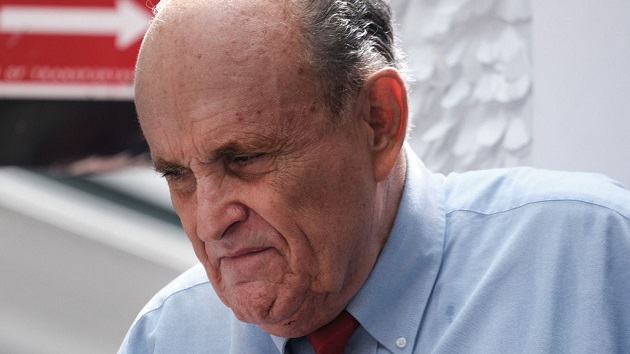
(WASHINGTON) — The House select committee investigating the Jan. 6 Capitol attack on Tuesday subpoenaed former Trump lawyers Rudy Giuliani, Jenna Ellis and Sidney Powell, who pushed unfounded claims of widespread election fraud and pushed to overturn the 2020 election results on former President Donald Trump’s behalf.
“The Select Committee’s investigation has revealed credible evidence that you publicly promoted claims that the 2020 election was stolen and participated in attempts to disrupt or delay the certification of the election results based on your allegations,” the panel wrote in letters to Giuliani, Ellis, Powell and Trump aide and attorney Boris Epshteyn.
Within the last week, the House Select Committee also subpoenaed the phone records of Eric Trump, former president Trump’s second eldest son — a source with direct knowledge has confirmed to ABC News. The subpoena was sent to a cell phone provider of Eric Trump.
The group subpoenaed Tuesday worked with Trump to contest the results of the election in the fall of 2020, traveling to key states and huddling with Trump and other White House aides in the Oval Office as the president weighed how to overturn the results.
“The four individuals we’ve subpoenaed today advanced unsupported theories about election fraud, pushed efforts to overturn the election results, or were in direct contact with the former President about attempts to stop the counting of electoral votes,” Chairman Bennie Thompson, D-Miss., said in a statement. “We expect these individuals to join the nearly 400 witnesses who have spoken with the Select Committee as the committee works to get answers for the American people about the violent attack on our democracy.”
Ellis also circulated two legal memos urging former Vice President Mike Pence to reject or delay the count of electoral votes on Jan. 6, the committee said.
Giuliani urged Trump to seize voting machines after being told the Department of Homeland Security lacked the authority to do so, the committee said, pointing to a report from the news website Axios and documents obtained by investigators.
The former mayor of New York City, a close Trump confidant, spoke at the Jan. 6 rally outside the White House, urging for “trial by combat” over the election results before Trump supporters marched to the Capitol.
Powell, according to the committee, reportedly urged Trump to seize voting machines to find evidence that foreign hackers had altered the election results.
Powell, Giuliani, Ellis and Epshteyn did not immediately respond to requests for comment.
Dominion Voting Systems, a Colorado-based voting machine company, has filed defamation lawsuits against both Giuliani and Powell and is seeking billions of dollars in damages over their unfounded claims of election fraud. A federal judge denied both Powell and Giuliani’s efforts to have the suits dismissed.
Giuliani’s law license was also suspended in New York state last year over his claims of election fraud.
ABC’s John Santucci, Olivia Rubin and Will Steakin contributed to this report.
(WASHINGTON) — The House select committee investigating the Jan. 6 Capitol attack on Tuesday subpoenaed Trump lawyers Rudy Giuliani and Jenna Elllis, who were among those who pushed claims of widespread voter fraud in the 2020 election and for GOP officials to disrupt the certification of President Joe Biden’s victory.
The committee, which is seeking records and testimony from the witnesses in early February, also subpoenaed Trump aide Boris Epshteyn and lawyer Sidney Powell.
To date, the committee has issued nearly 60 public subpoenas for records and testimony.
(WASHINGTON) — For the first time this Congress, the Senate started debating voting rights legislation on Tuesday, a day after Democrats failed to meet their hopeful, symbolic, deadline to pass an election reform bill by Martin Luther King Jr. Day.
Majority Leader Chuck Schumer opened debate on the House-passed voting rights bill, a combination bill wrapping in both the Freedom to Vote Act and John Lewis Voting Rights Advancement Act, on Tuesday afternoon.
But Democrats need 60 votes, or the support of 10 Republican senators — which they don’t have — plus all 50 of their own, to overcome a GOP filibuster on the legislation and end debate, making way for the bill’s final passage. All 50 Senate Republicans are opposed to the bill.
“The American people deserve to see their senators go on record on whether they will support these bills or oppose them. Indeed, that may be the only way to make progress on this issue,” Schumer said on Tuesday. “And if Republicans choose to continue to filibuster voting rights legislation, we must consider and vote on rule changes that are appropriate and necessary to restore the Senate and make voting legislation possible.”
The bill at hand would make Election Day a federal holiday, expand early voting and mail-in-voting, and give the federal government greater oversight over state elections. And would come at a time when nearly 20 states have restricted access to voting fueled by false claims in the wake of the 2020 election, according to the Brennan Center for Justice.
Quoting the late civil rights leader Dr. Martin Luther King Jr., Schumer acknowledged that Democrats have “an uphill struggle” to pass voting rights legislation but said they should “keep moving, keep fighting” in the face of the inevitable defeat this week.
“Win, lose, or draw — members of this chamber were elected to debate and to vote, especially on an issue this vital to the beating heart of our democracy as voting rights. And the public — the public is entitled to know where each senator stands on an issue so sacrosanct as defending our democracy.”
He also seized the spotlight to slam Republicans for continuing to block Democrats from passing the legislation last year, and addressing the American people from the Senate floor, said the GOP has “regressed.”
“The Republican Party used to be one that supported voting rights. Presidents Reagan, George H.W. Bush and George W. Bush worked to renew voting rights bills,” Schumer said. “Now, sadly, unfortunately, this is Donald Trump’s Republican Party.”
McConnell, on Tuesday, speaking first for Republicans, slammed his colleagues across the aisle for characterizing the Senate filibuster as a “Jim Crow relic” while, Democrats argue, the procedural tactic is being weaponized by Republicans to prevent federal voting protections largely to minorities.
“This is about one party wanting the power to unilaterally rewrite the rulebook of American elections,” McConnell said.
“Democrats have been pushing the same policy changes in the same Chicken Little rhetoric since 2019,” he added. “The Democratic leader’s effort to break the Senate long predates the latest pretext.”
“Too many of our colleagues across the aisle still want to respond to a 50-50 Senate with a rule-breaking power grab. Those voting to break this institution will not be a free vote or a harmless action, even if efforts fail,” McConnell continued. “An unprincipled attempt at grabbing power is not harmless just because it fails. Voting to break the Senate is not cost-free, just because of a bipartisan majority of your colleagues have the wisdom to stop you.”
To go it alone, Schumer said he will move to challenge the chamber’s filibuster rule with a simple majority vote, and aides say that rules-change proposal will come as early as Wednesday. Schumer on Tuesday also filed cloture on the bill, setting up the 60-vote threshold filibuster vote for later this week.
It’s still unclear exactly how Democrats intend to change the filibuster rule. Schumer didn’t lay out specifics Tuesday on what his plans are on possible changes to the filibuster when Republicans block the voting rights bill as they’re expected to do.
Senate Democrats are scheduled to meet Tuesday evening ahead of an expected vote Wednesday to try to change the filibuster rule.
Sen Tim Kaine, D-Va., a key negotiator in voting rights talks., told ABC News last week that it will likely amount to a one-time change to the rule, or carveout, by lowering the threshold to end debate on the legislation from 60 votes to 51 votes. In theory, Vice President Kamala Harris, as president of the Senate, could serve as Democrats’ tie-breaking vote — both to quash the filibuster and, eventually, pass the voting rights bill.
Another option Democrats have looked into is reverting back to a talking filibuster, which would require 41 opponents of the bill to keep talking on the floor — called “holding the floor” — to test the opposition’s stamina. If they run out of steam, there would be a 51-vote requirement for passage of the once-filibustered bill.
But Democrats need the support of their entire party to change the rule in the chamber where they hold the slimmest of majorities. And conservative Democratic Sens. Joe Manchin and Kyrsten Sinema have made clear their opposition to changing the filibuster, even though both support the underlying legislation, so the effort is expected to fail — a massive blow to Democrats as President Joe Biden approaches one year in office on Thursday.
Martin Luther King Jr.’s 13-year-old granddaughter, Yolanda Renee King, called out Manchin and Sinema by name in demonstrations near Capitol Hill on Monday as activists took the street to demand action in the name of the late civil rights leader being honored across the nation.
“Sen. Sinema, Sen. Manchin, our future hinges on your decision, and history will remember what choice you make,” she called out. “So join me in demanding action for today, tomorrow and generations to come.”
After Biden took the national spotlight last Tuesday in Georgia to demand the Senate change its rules “whichever way they need to be changed to prevent a minority of senators from blocking actions on voting rights,” he met with Sinema and Manchin privately at the White House. As he headed to the Hill last Thursday to meet with lawmakers, Sinema stunningly took to the Senate floor and reiterated her opposition to what the president had just publicly called for.
Republicans, meanwhile, have argued Biden went too far in his attacks on the GOP, tying their obstruction on the bill to Jim Crow-era racism, with Minority Leader Mitch McConnell slamming Biden’s speech from the Senate chamber as “profoundly, profoundly un-presidential” and as a “rant” that was “incoherent, incorrect and beneath his office.”
As activists continue to push for federal action, Sen. Mitt Romney, R-Utah, said over the weekend he was never contacted by the White House to try and gain support for passing voting rights legislation.
“Sadly, this election reform bill that the president has been pushing, I never got a call on that from the White House. There was no negotiation, bringing the Republicans and Democrats together to try to come up with something that would meet bipartisan interest,” he told NBC’s “Meet The Press” Sunday.
With the Senate finally taking up voting rights Tuesday, the president is scheduled to remain out of sight, according to his schedule, but at the White House for briefings.
Biden is scheduled to hold a news conference on Wednesday, one day before marking his first year in office, where he’ll likely face questions on the issue of voting rights — among other unfinished agenda items.
Paul Hennessy/SOPA Images/LightRocket via Getty Images
(WASHINGTON) — The Biden administration launched COVIDTests.gov on Tuesday, the website Americans can use to request free at-home rapid COVID tests mailed to their doorsteps, one day ahead of its scheduled official launch.
The early launch is to prepare for a smooth debut on the day most Americans are expecting it, White House press secretary Jen Psaki told reporters Tuesday, and catch any issues with the site before its formal rollout.
Psaki called it “beta testing.” But the website is still live for anyone who chooses to try it Tuesday and the orders will be processed.
People are able to order four tests per household through the website. They will be shipped out 7-12 days after they’re ordered via first class mail.
That means the first free tests won’t reach Americans until late January or early February, which will be too late to blunt the peak of omicron cases in many parts of the country. Still, the plan will allow Americans to have free tests on-hand in the coming weeks and months.
All that people need to enter on the site to receive a test is a name and an address. The White House will also launch a call line for people who don’t have computer access.
Another 500 million tests will eventually also be available, bringing the total to 1 billion free at-home tests distributed to Americans, but the White House hasn’t announced a timeline for the second batch of tests.
And more immediately, starting last Saturday, people are also able to get up to eight tests per month reimbursed through insurance if they go out and purchase them on their own, either online or at stores.
“In the first couple of days, we’re encouraging people to just make sure you keep your receipts as the systems are getting up online,” a senior administration official said on Friday.
The White House is also incentivizing insurers to work with retailers and offer the tests for free up-front for people who show their insurance cards, similar to how prescriptions might be covered at the pharmacy. Those partnerships between insurers and retailers are still in the works.
This is on top of 50 million free at-home tests that have been doled out to community health centers around the country and 20,000 free testing sites.
Taken together, it all signifies a clear effort on behalf of the administration to increase the testing supply after omicron caught the government off guard.
The myriad testing options now in full swing will also likely take the pressure off the website as it officially launches on Wednesday, particularly as cases begin to fall in some northeastern areas.
Less demand will give the White House time to finish contracting all 500 million tests.
Currently, the White House only has tens of millions of tests on hand, a senior administration official confirmed Friday.
They’ve secured another 400 million or so that are still being manufactured and delivered.
But senior administration officials last week said they were confident they would be able to get tests sent out to any American who ordered one within their shipping timeline of 7-12 days.
“We’re confident that with our contracting speed, which is very fast, with the ones we have on hand, and the timeline we’re laying out today, that we can meet all of our timelines and get these to Americans that want them,” a senior administration official said.
The tests will be sent via the U.S. Postal Service as first class mail.
The tests will not necessarily be of use to Americans who were exposed and want to take a test within the first 5 days of exposure, or come down with symptoms and want to test immediately, since they’ll take more than 7-12 days to arrive.
But senior administration officials ran through the host of other testing options Americans can use in those scenarios and defended this program as one “designed to ensure that Americans have at-home rapid tests on hand in the weeks and months ahead, as they have a need.”
The officials also said they were “ready” to meet demand and prevent any website crashes, as seen during former President Barack Obama’s launch of Healthcare.gov, which was overseen at the time by the current White House COVID Coordinator Jeff Zients.
“Of course, every website launch poses some risks, we are quite cognizant of that. But we have the best tech teams” across the administration, an official said. “So we’re ready for this and we’re ready for Americans to start ordering their tests on January 19.”
(WASHINGTON) — A dispute over a Boston flagpole, the Christian flag and the First Amendment is testing the limits of free speech on government property.
The U.S. Supreme Court on Tuesday will hear arguments over whether the city of Boston engaged in unlawful discrimination and censorship when it denied the request of a local civic organization to fly the Christian flag on a flagpole outside City Hall.
Designed in the late 1880s, the white banner with red Latin cross has been adopted by many American Protestant communities as a nondenominational symbol of their faith.
The city says its policies forbid promotion of religion on its flagpoles and that doing so would violate separation of church and state.
Hal Shurtleff, founder of the nonprofit group Camp Constitution, which brought the case, argues the flagpole was effectively treated by the city as a public forum open to all viewpoints for more than a decade.
“It’s a public access flagpole,” Shurtleff said in an interview with ABC News Live about his 2017 request to raise the flag at a planned Constitution Day event on City Hall Plaza.
“It’s kind of ludicrous to think flying a flag on a flagpole for maybe an hour or two will somehow get people to think, ‘Oh my goodness, look at the city of Boston now endorsing the Protestant or the Christian faith,'” he said.
City officials had approved 284 private flag-raising events over a dozen years, including flags to mark Veterans Day, Columbus Day, LGBTQ Pride Month and numerous ethnic and cultural communities across Boston.
Shurtleff’s request was the first and only one denied, court records show.
“This is an 83-foot-tall flagpole in front of City Hall that’s associated with the government. That’s why, you know, this religious group wants to use it, because it carries with it some government imprimatur,” said Patrick Elliott, senior counsel with the Freedom From Religion Foundation, which is backing Boston in the case. “So we say the city can control that.”
In court documents, Boston lawyers also argue that approved private flag-raisings were almost always “in connection with publicly recognized days of remembrance” and that the city had “never flown a purely private flag on a random day.”
Lower courts sided with the city, concluding that the flagpole was not public forum and that the city officials could exercise discretion in approving requests to raise flags on its flagpole.
“The city, for its own speech, does not want to get into the issue of religion,” said attorney Doug Hallward-Driemeier, who is arguing the case for Boston. “It’s said that it didn’t want to fly a flag that was offered as ‘the Christian flag,’ because that wasn’t the message that the city itself wanted to communicate.”
Supporters of the policy say it also protects the city from unwanted association with divisive messages and, in this case, a flag that critics allege has been coopted by hate groups.
“The Christian flag is associated with Christian nationalism. This is the same flag that was used during the Jan. 6th insurrection,” said Elliott, referencing publicly available images showing the flag being carried by some rioters as they stormed the U.S. Capitol last year. “So this is really akin to them trying to take over City Hall and saying, ‘Hey, this is a Christian place.'”
Shurtleff dismissed the comparison and insinuation that the flag was a symbol of extremism.
“I don’t know of any white nationalists carrying Christian flags. That may have happened, but I don’t know. But this flag certainly represents Christianity and was designed by a couple of Sunday school teachers. Not exactly white supremacists,” he said.
The Supreme Court has limited the display of religious symbols by governments on government property, but it has also said that public forums are different and that censorship of viewpoints there isn’t allowed.
The ACLU is siding with Camp Constitution in this battle, saying a win for Boston would threaten free speech.
“When the government opens its public property for private speakers, it has to treat everybody equally,” said David Cole, ACLU national legal director. “This case is really about private citizens’ access to government property to express themselves. And that access is critical to our ability to speak to each other, to express our views and the like.”
Boston insists it never intended to make the flagpole open to anyone, for any reason, telling the high court that if a majority sides with Camp Constitution, the city may end its flag-raising program altogether.
“We’re optimistic that they will rule in our favor and that we will be allowed to raise the flag,” said Shurtleff, “although I understand the city will most likely cancel its flag raising events. So we’ll see what happens.”