
Biden announces plan to mail half a billion free rapid tests to Americans next month

Biden announces plan to mail half a billion free rapid tests to Americans next month
INA FASSBENDER/AFP via Getty Images

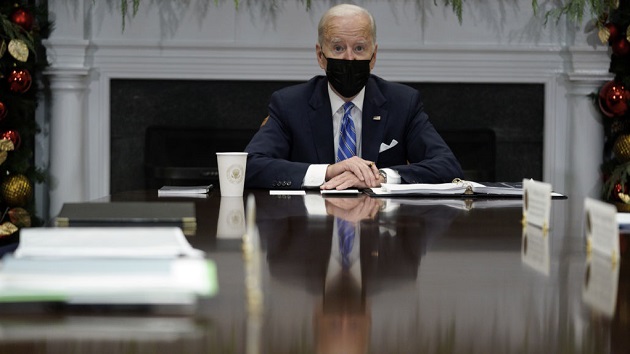
(NEW YORK) — President Joe Biden on Tuesday announced a plan to distribute 500 million free at-home rapid tests to Americans beginning in January, doubling down on an effort to slow the spread of a highly transmissible variant that has hit the U.S. distressingly close to the holidays.

But he denied it was a failure not to have more tests already available as Americans wanted to get checked days before family gatherings.

“I want to start by acknowledging how tired, worried and frustrated I know you are,” Biden began in his address to the nation from the White House. “For many of you, this will be the first or even the second Christmas, we look across the table to see an empty kitchen chair.”

“If you’re not fully vaccinated, you have good reason to be concerned,” Biden went on, talking about the omicron variant, now the dominant strain in the U.S. “Almost everyone who has died from COVID-19 in the past many months has been unvaccinated. Unvaccinated.”

“You’re putting other people at risk — your loved ones, your friends, neighbors, strangers,” he said to unvaccinated Americans. “You may think you’re putting only yourself at risk. But, it’s your choice. Your choice is not just about you, it affects other people. You’re putting other people at risk. Your loved ones, your friends, neighbors, strangers you run into, and your choice can be the difference between life or death. The longer the virus is around, the more likely variants form that may be deadlier than the ones that have come before,” he said.

Still, the president rejected the idea that the U.S. would go back to March 2020 or impose new lockdowns, and said public health officials have the means this winter to keep schools open safely, for example.

“If you are vaccinated and follow the precautions that we all know well, you should feel comfortable celebrating Christmas and the holidays as you planned it,” he said.

“The best thing to do is get fully vaccinated and get your booster shot — and no, this is not March of 2020. Two hundred million people are fully vaccinated. We’re prepared. We know more. We just have to stay focused,” Biden added.

In his ongoing push to get hesitant Americans vaccinated and boosted, Biden also mentioned that former President Donald Trump this week said he had gotten his booster shot, adding, “Maybe one of the few things he and I agree on.”

He also gave the Trump administration a nod on vaccine development.

“Let me be clear, thanks to the prior administration and our scientific community, America is one of the first countries to get the vaccine,” Biden said. “Thanks to my administration and the hard work of Americans, we led a rollout that made America among the world leaders in getting shots and arms.”

Biden’s new efforts come as the omicron variant became the most dominant COVID strain in the country Monday, accounting for nearly three-quarters of all cases, and just as travel kicks off at nearly pre-pandemic levels for the holiday season.

The Biden administration’s free at-home rapid tests will be delivered by mail to Americans who request them, Biden said, marking a slightly different approach from European countries that chose to send tests to all residents.

“Because Omicron spreads so easily, we’ll see some fully vaccinated people get COVID, potentially in large numbers. There will be positive cases in every office, even here in the White House,” he said, one day after the White House reported the president came in contact with a staffer who later tested positive.

“But these cases are highly unlikely to lead to serious illness. Vaccinated people who get COVID may get ill, but they’re protected from severe illness and death. That’s why you should still remain vigilant,” he said.

Pressed by reporters, Biden rejected suggestions it was a failure to not have the tests readily available in advance of the holidays.

“No, it’s not a failure, but the alarm bell went off. I don’t think anybody anticipated that this was going to be as rapidly spreading as it did,” he said.

Americans will have to request the tests through a website that will launch in January, a senior administration official said on Monday, and it’s not yet clear how many tests Americans will be able to request per household.

The move is a significant departure from the White House’s posture just two weeks ago, when White House press secretary Jen Psaki dismissed the idea of mailing tests to every American as costly and wasteful.

“Should we just send one to every American?” Psaki told a reporter on Dec. 6.

“Then what happens if every American has one test? How much does that cost, and then what happens after that?” Psaki said.

But the effort shows the consensus among White House officials on the need to improve the nation’s testing apparatus, which was caught unprepared by the perfect storm of high demand for pre-holiday testing and a surge of omicron cases.

As a result, Americans have faced long lines and empty shelves this week as they attempt to safely gather for the holidays in keeping with CDC guidance, which calls for families to use at-home rapid tests as an extra layer of prevention before gathering.

Fielding questions after his remarks, Biden was also asked what took so long to get tests out to Americans as the spread of omicron coincides with a greater need for testing ahead of the holidays.

“Come on, what took so long?” Biden quipped back at a reporter.

“Well, what took so long, is it didn’t take long at all. What happened was, the omicron virus spread even more rapidly than anybody thought,” Biden said.

Dr. Sam Scarpino, managing director of pathogen surveillance at the Rockefeller Foundation and a member of their Pandemic Prevention Institute, said the government could have seen this coming.

“Scientists have been warning about the potential for new variants to come along for a year now or more. And we’ve known about omicron since the day before Thanksgiving. It’s been weeks at this point,” he said.

There will be other actions to get ahead of omicron outlined in Biden’s speech on Tuesday, too, like new federal testing sites around the country — the first several of which will launch in New York City by Christmas — and mobilizing 1,000 military doctors and nurses to overburdened hospitals, the senior administration official said.

The military aid will be five-fold the current deployment and could be a big boost to hospitals that have been running on fumes for two years.

There are currently 175 troops spread over four states, and since August 2021, when a joint military operation across the Army, Navy and Air Force began, about 530 medical military personnel have been deployed to work alongside civilian health care providers.

Tuesday marked the second time Biden addresses the nation about the omicron variant in less than a month.

In November, Biden announced a winter COVID plan that included beefing up vaccination and booster clinics to encourage more Americans to get protected and increase testing by getting insurance companies to reimburse the cost of at-home tests.

The 500 million free at-home tests that will be announced on Tuesday will be in addition to getting at-home tests reimbursed, which will go into effect on Jan. 15.

Noticeably missing from the new government efforts will be any attempts to enact further restrictions or lockdowns — which some European countries have opted for as omicron has swept through their populations.

“I know you’re tired. I really mean this, and I know you’re frustrated. We all want this to be over. But we’re still in it,” Biden said in closing. “This is a critical moment. But we also have more tools than we’ve ever had before. We’re ready. We’ll get through this. As we head into the holidays, I want us to all keep the faith.”

ABC News’ Anne Flaherty and Justin Gomez contributed to this report.


Copyright © 2021, ABC Audio. All rights reserved.

Biden lays out new efforts against omicron in address to nation

Biden announces plan to mail half a billion free rapid tests to Americans next month
INA FASSBENDER/AFP via Getty Images

(WASHINGTON) — President Joe Biden detailed further steps his administration will take to slow the spread of omicron in an address to the nation on Tuesday, including an effort to distribute 500 million free at-home rapid tests to Americans next month, dispatch military members to overburdened hospitals and continue the push to vaccinate and boost all Americans.

“I want to start by acknowledging how tired, worried and frustrated I know you are,” Biden began in his address to the nation from the White House. “For many of you, this will be the first or even the second Christmas we look across the table to see an empty kitchen chair.”

He acknowledged that the highly transmissible omicron variant, which became the most dominant COVID strain in the country Monday, was raising concerns just as travel kicks off at nearly pre-pandemic levels for the holiday season.

“If you’re not fully vaccinated, you have good reason to be concerned,” Biden said. “Almost everyone who has died from COVID-19 in the past many months has been unvaccinated. Unvaccinated.”

“You’re putting other people at risk — your loved ones, your friends, neighbors, strangers,” he said to unvaccinated Americans. “You may think you’re putting only yourself at risk. But, it’s your choice. Your choice is not just about you, it affects other people. You’re putting other people at risk. Your loved ones, your friends, neighbors, strangers you run into, and your choice can be the difference between life or death. The longer the virus is around, the more likely variants form that may be deadlier than the ones that have come before,” he said.

For vaccinated Americans, the message was starkly different. Biden encouraged spending time with family.

“If you are vaccinated and follow the precautions that we all know well, you should feel comfortable celebrating Christmas and the holidays as you planned it,” he said.

But he also acknowledged the risks of higher breakthrough cases in the weeks and months to come, stemming from omicron’s many mutations able to escape vaccine protections.

“Because omicron spreads so easily, we’ll see some fully vaccinated people get COVID, potentially in large numbers. There will be positive cases in every office, even here in the White House among among the vaccinated,” he said.

“But these cases are highly unlikely to lead to serious illness. Vaccinated people who get COVID may get ill, but they’re protected from severe illness and death. That’s why you should still remain vigilant.”

Still, the president rejected the idea that the U.S. would go back to March 2020 or impose new lockdowns.

“The best thing to do is get fully vaccinated and get your booster shot — and no, this is not March of 2020. Two hundred million people are fully vaccinated. We’re prepared. We know more. We just have to stay focused,” Biden said.

In his ongoing push to get hesitant Americans vaccinated and boosted, Biden also mentioned that former President Donald Trump this week said he had gotten his booster shot.

“Maybe one of the few things he and I agree on,” Biden said.

He also gave the Trump administration a nod on vaccine development.

“Let me be clear, thanks to the prior administration and our scientific community, America was one of the first countries to get the vaccine,” Biden said. “Thanks to my administration and the hard work of Americans, we led a rollout that made America among the world leaders in getting shots and arms.”

Biden’s newest efforts on omicron, from more testing to help for strained hospitals

Part of Biden’s latest efforts will be free at-home rapid tests delivered by mail to Americans who request them, the president said, marking a slightly different approach from European countries that chose to send tests to all residents.

Americans will have to request the tests through a website that will launch in January and it’s not yet clear how many tests Americans will be able to request per household.

The move is a significant departure from the White House’s posture just two weeks ago, when White House press secretary Jen Psaki dismissed the idea of mailing tests to every American as costly and wasteful.

“Should we just send one to every American?” Psaki told a reporter on Dec. 6.

“Then what happens if every American has one test? How much does that cost, and then what happens after that?” Psaki said.

But the effort shows the consensus among White House officials on the need to improve the nation’s testing apparatus, which was caught unprepared by the perfect storm of high demand for pre-holiday testing and a surge of omicron cases.

As a result, Americans have faced long lines and empty shelves this week as they attempt to safely gather for the holidays in keeping with CDC guidance, which calls for families to use at-home rapid tests as an extra layer of prevention before gathering.

Fielding questions after his remarks, Biden rejected suggestions that it was a failure to not have the tests readily available in advance of the holidays.

“No, it’s not a failure, but the alarm bell went off. I don’t think anybody anticipated that this was going to be as rapidly spreading as it did,” he said.

But experts have long been warning that new variants are always on the horizon. Since omicron was detected last month, many have urged the Biden administration to move away from a strategy that solely prioritizes vaccination and to beef up other prevention measures, such as testing or mask mandates.

“Scientists have been warning about the potential for new variants to come along for a year now or more. And we’ve known about omicron since the day before Thanksgiving. It’s been weeks at this point,” said Dr. Sam Scarpino, managing director of pathogen surveillance at the Rockefeller Foundation and a member of their Pandemic Prevention Institute.

Biden outlined other efforts in his speech on Tuesday, too, including new federal testing sites around the country — the first several of which will launch in New York City by Christmas — and mobilizing 1,000 military doctors and nurses to overburdened hospitals.

The military aid will be five times the current deployment and could be a big boost to hospitals that have been running on fumes for two years.

There are currently 175 troops deployed over four states, and since August 2021, when a joint military operation across the Army, Navy and Air Force began, about 530 medical military personnel have been deployed to work alongside civilian health care providers.

Tuesday marked the second time Biden had addressed the nation about the omicron variant in less than a month.

In November, Biden announced a winter COVID plan that included setting up more vaccination and booster clinics to encourage more Americans to get protected and increase testing by getting insurance companies to reimburse the cost of at-home tests.

The 500 million free at-home tests announced on Tuesday will be in addition to getting at-home tests reimbursed, which will go into effect on Jan. 15.

“I know you’re tired. I really mean this, and I know you’re frustrated. We all want this to be over. But we’re still in it,” Biden said Tuesday, closing out his speech. “This is a critical moment. But we also have more tools than we’ve ever had before. We’re ready. We’ll get through this. As we head into the holidays, I want us to all keep the faith.”

ABC News’ Anne Flaherty and Justin Gomez contributed to this report.

Copyright © 2021, ABC Audio. All rights reserved.

Bidens welcome new first pup to White House

Bidens welcome new first pup to White House
Al Drago/Bloomberg via Getty Images

(WASHINGTON) — The president has a new puppy at 1600 Pennsylvania Avenue — just in time for Christmas.

The Biden family has welcomed a new German Shepherd, “Commander,” the president announced in a tweet on Monday.

“Welcome to the White House, Commander,” Biden tweeted.

Commander, a purebred German Shepherd, was gifted to Biden by his brother James and his sister-in-law for his birthday, and will also be joined by the long-awaited Biden family cat in January.

Biden later tweeted a 15-second video showing him meeting the new arrival on the White House lawn.

“Hey, pal. How you doing? How are you?” Biden said to his enthusiastic new friend.

The video also features Biden throwing a ball to Commander on the lawn, walking into the White House holding the new puppy on a leash alongside first lady Jill Biden, and the president giving a treat to their new pet in front of a festive fireplace mantel.

As the Bidens welcomed Commander to the White House on Monday, they also announced that their other German Shepherd, Major, the first shelter dog to live in the White House, would be leaving 1600 Pennsylvania Avenue to live with family friends following a handful of biting incidents involving White House staff this year.

“After consulting with dog trainers, animal behaviorists and veterinarians, the First Family has decided to follow the experts’ collective recommendation that it would be safest for Major to live in a quieter environment with family friends,” the first lady’s press secretary Michael LaRosa said in a statement.

“This is not in reaction to any new or specific incident, but rather a decision reached after several months of deliberation as a family and discussions with experts,” he added.

The family’s other longtime German Shepherd, Champ, whom Biden said considered himself a member of the Secret Service, died in June at 13 years old.

The first lady teased in an April interview with NBC’s Today program that a female cat was “waiting in the wings.”

Copyright © 2021, ABC Audio. All rights reserved.

Biden to announce plan to mail 500 million free rapid tests to Americans next month

Biden announces plan to mail half a billion free rapid tests to Americans next month
INA FASSBENDER/AFP via Getty Images

(WASHINGTON) — President Joe Biden will announce a plan on Tuesday to distribute 500 million free at-home rapid tests to Americans beginning in January as part of an attempt to double down on the spread of a transmissible variant that has hit the U.S. distressingly close to the holidays.

Biden’s new efforts come as the omicron variant became the most dominant COVID strain in the country Monday, accounting for nearly three-quarters of all cases, and just as travel kicks off at nearly pre-pandemic levels for the holiday season.

The free at-home rapid tests will be delivered by mail to Americans who request them, a senior administration official told reporters on Monday night in a preview of the speech, marking a slightly different approach from European countries that chose to send tests to all residents.

Americans will have to request the tests through a website that will launch in January, the official said, and its not yet clear how many tests Americans will be able to request per household.

The move is a significant departure from the White House’s posture just two weeks ago, when White House press secretary Jen Psaki dismissed the idea of mailing tests to every American as costly and wasteful.

“Should we just send one to every American?” Psaki told a reporter on Dec. 6.

“Then what happens if every American has one test? How much does that cost, and then what happens after that?” Psaki said.

But the effort shows the consensus among White House officials on the need to improve the nation’s testing apparatus, which was caught unprepared by the perfect storm of high demand for pre-holiday testing and a surge of omicron cases.

As a result, Americans have faced long lines and empty shelves this week as they attempt to safely gather for the holidays in keeping with CDC guidance, which calls for families to use at-home rapid tests as an extra layer of prevention before gathering.

Dr. Sam Scarpino, managing director of pathogen surveillance at the Rockefeller Foundation and a member of their Pandemic Prevention Institute, said the government could have seen this coming.

“Scientists have been warning about the potential for new variants to come along for a year now or more. And we’ve known about omicron since the day before Thanksgiving. It’s been weeks at this point,” he said.

There will be other actions to get ahead of omicron outlined in Biden’s speech on Tuesday, too, like new federal testing sites around the country — the first several of which will launch in New York City by Christmas — and mobilizing 1,000 military doctors and nurses to overburdened hospitals, the senior administration official said.

The military aid will be five-fold the current deployment and could be a big boost to hospitals that have been running on fumes for two years.

There are currently 175 troops spread over four states, and since August 2021, when a joint military operation across the Army, Navy and Air Force began, about 530 medical military personnel have been deployed to work alongside civilian health care providers.

This will be the second time Biden addresses the nation about the omicron variant in less than a month.

In November, Biden announced a winter COVID plan that included beefing up vaccination and booster clinics to encourage more Americans to get protected and increase testing by getting insurance companies to reimburse the cost of at-home tests.

The 500 million free at-home tests that will be announced on Tuesday will be in addition to getting at-home tests reimbursed, which will go into effect on Jan. 15.

Noticeably missing from the new government efforts will be any attempts to enact further restrictions or lockdowns — which some European countries have opted for as omicron has swept through their populations.

It will not be a speech about “locking the country down,” Psaki said at a press briefing on Monday afternoon.

“This is a speech outlining and being direct and clear with the American people about the benefits of being vaccinated, the steps we’re going to take to increase access and to increase testing and the risks posed to unvaccinated individuals,” Psaki said.

Psaki also said Biden would deliver a “stark warning” for those that choose to remain unvaccinated.

“For those who choose to remain unvaccinated, he’ll issue a stark warning and make clear unvaccinated individuals will continue to drive hospitalizations and deaths,” she said.

Copyright © 2021, ABC Audio. All rights reserved.

Manchin says he’s a ‘no’ on Biden’s Build Back Better social spending plan

Manchin says he’s a ‘no’ on Biden’s Build Back Better social spending plan
Anna Moneymaker/Getty Images

(WASHINGTON) — Sen. Joe Manchin, D-W.Va., seems to have sealed the fate of President Joe Biden’s Build Back Better bill on “Fox News Sunday,” when he announced that he is a “no” on the legislation.

“I’ve always said if I can’t go home and explain it to the people of West Virginia, I can’t vote for it. I cannot vote to continue with this piece of legislation. I just can’t. I’ve tried everything humanly possible. I can’t get there,” Manchin said.

Despite working “every day” for five months with different members of the party to get there on the legislation, Manchin said his concerns about inflation and the cost of the program still stand.

“You’re done? This is a no?” host Bret Baier asked.

“This is a no on this piece of legislation. I have tried everything I know to do,” Manchin replied, adding that Biden worked “diligently” and was “wonderful to work with” but knew he had concerns.

Manchin’s comments effectively end Democrats’ hopes of passing Biden’s $1.75 trillion social spending plan, which passed the House last month, with Democratic votes alone. Manchin is the crucial 50th vote needed to get the bill across the line.

White House Press Secretary Jen Psaki has issued a lengthy statement that Manchin’s bombshell announcement Sunday is “at odds” with what he indicated in private negotiations earlier this week — confirming the White House was caught off guard by Manchin’s news, and unleashing on the senator for the “sudden and inexplicable reversal of his position.”

“On Tuesday of this week, Senator Manchin came to the White House and submitted—to the President, in person, directly—a written outline for a Build Back Better bill that was the same size and scope as the President’s framework, and covered many of the same priorities,” Psaki said Sunday. ” If his comments on FOX and written statement indicate an end to that effort, they represent a sudden and inexplicable reversal in his position, and a breach of his commitments to the President and the Senator’s colleagues in the House and Senate.”

While Manchin recognized that the party had negotiated down from Sen. Bernie Sanders’ initial proposal of $6 trillion, he felt shortening the timelines of the “aspirational goals” included in the bill was not a genuine answer to the issue.

“The thing that never changed Bret, was basically the same amount of things that they’re trying to accomplish by just changing, if you will, the amount of time that we can depend on it,” Manchin said Sunday on Fox. “So if you’re going to do something and do it, pick what we’re apprised priorities are like most people do in their families, or their businesses, and you fund them for 10 years and you make sure they deliver the services for 10 years,” Manchin argued.

Manchin argued COVID-19 and inflation should be where the country is focusing its fire, rather than dragging out the negotiations further.

“I’ve tried. I mean, I really did and the President was trying as hard as he could. He has an awful lot –A lot of irons in the fire right now — more on his plate than he needs for this to continue when I’m having the difficulties I’m having and basically the challenges we have from different parts of our party basically pushing in different ways,” Manchin said.

Manchin also said it was “not right” that he was getting all the attention for his concerns over the bill, but said he wasn’t going to speak for other Senators who also might have concerns with the mammoth legislation.

It was just Thursday that Biden put out a statement that the negotiations with Manchin would continue this week.

Sen. Bernie Sanders, I-Vt., who has been one of the senators leading the charge on the Build Back Better bill in Senate, responded to Manchin’s no vote on CNN’s “State of the Union.”

“Well, I think he’s gonna have a lot of explaining to do to the people of West Virginia,” Sanders said, ticking through the benefits the bill would provide like lowering prescription drug costs, expanding Medicaid and helping to pay for childcare.

“I would have hoped that we could have had at least 50 Democrats on board who have the guts to stand up for working families and take on the lobbyists and the powerful special interests,” Sanders said on CNN. “We have no Republicans, not one Republican in the United States Senate or the House for that matter is prepared to stand up to the drug companies or the insurance companies or wealthy.”

Sanders was not shy about telling Americans who are concerned about losing their monthly Child Tax Credit payments to blame Sen. Manchin.

“If Mr. Manchin Votes no, those $300 tax credits that have gone a long way to reduce childhood poverty in America- they’re gone. That’s over. We cut childhood poverty by over 40%, an extraordinary accomplishment. Manchin doesn’t want to do that, tell that to the struggling families of West Virginia and America,” Sanders said.

Copyright © 2021, ABC Audio. All rights reserved.

Kinzinger: It’s ‘possible’ some GOP colleagues are responsible for Jan. 6 attack

Kinzinger: It’s ‘possible’ some GOP colleagues are responsible for Jan. 6 attack
ABC News

(WASHINGTON) — Rep. Adam Kinzinger said Sunday “it’s possible” some of his GOP colleagues in Congress are responsible for the Jan. 6 attack on the Capitol but added he’s not ready to “go to that point” yet, because he wants to “let the facts dictate it.”

The Illinois Republican also revealed that the committee investigating the insurrection is not ruling out issuing subpoenas for sitting members of Congress.

“Nobody — member of Congress, former president, nobody — in America is above the law,” Kinzinger told ABC “This Week” co-anchor Jonathan Karl.

Kinzinger, who announced in October he will not seek reelection to Congress, was one of 10 Republicans who voted to impeach former President Donald Trump following the events at the Capitol on Jan. 6 and is one of two Republicans serving on the committee. He said the committee would subpoena Trump if they determine it’s necessary.

“Nobody should be above the law, but we also recognize we can get the information without him at this point, and, obviously, when you subpoena the former president, that comes with a whole kind of, you know, circus environment,” Kinzinger said. “But if we need him, we’ll do it.”

Kinzinger and Rep. Liz Cheney, R-Wyo., on Tuesday night joined Democrats in the House in voting to hold Trump’s former chief of staff, Mark Meadows, in contempt of Congress. Meadows defied a subpoena to appear for a deposition before the House select committee investigating the Jan. 6 insurrection.

Prior to the vote, members of the committee unveiled text messages sent to Meadows during the attack on the Capitol, reading aloud texts from Republican lawmakers, Fox News personalities and the former president’s son, Donald Trump Jr., that implored Meadows to get Trump to denounce the rioters. Rep Jim Jordan, R-Ohio, was one of the GOP lawmakers whose texts to Meadows were revealed, his office confirmed.

The new messages were part of the approximately 9,000 documents Meadows turned over to the committee, before he reversed course and decided to not cooperate with the investigation. The House previously voted to hold Trump ally Steve Bannon in contempt of Congress for defying a subpoena by the Jan. 6 committee.

Kinzinger said he’s “not sure” whether Meadows knew how damaging the text messages would be, but emphasized he had no choice given the committee’s legal authority.

“I will tell you, yes, there are more texts out there we haven’t released,” he added.

During debate on the House floor before the vote, Cheney emphasized the importance of Meadows’ testimony. “Mr. Meadows’ testimony will bear on another key question before this committee. Did Donald Trump through action or inaction corruptly seek to obstruct or impede Congress’ official proceedings to count electoral votes?” Cheney said.

Karl pressed Kinzinger on the possibility of the Justice Department filing criminal charges based on what the committee finds, given that it is a crime to obstruct the official proceedings of Congress.

“Are you sending a message that the Justice Department should be prosecuting not just those that broke into the building on Jan. 6, but should be prosecuting Donald Trump himself or at least investigating that possibility?” Karl asked.

“I think investigating that possibility, for sure,” Kinzinger responded. “Our committee is getting more information than law enforcement agencies and DOJ, because we’ve had the power and the ability to get that done.”

“Whatever information we get will be public record, and the DOJ should take a look, particularly if there’s criminal charges to be filed, because again, the big thing is as bad as it was on Jan. 6, there’s really nothing in place to stop another one from happening again,” he added. “If somebody broke the law, it is so essential that we send the message that you are not untouchable as president — you’re not untouchable as a former president.”

Senate Minority Leader Mitch McConnell, R-Ky., said Thursday in an interview with Spectrum News he looks forward to seeing what the Jan. 6 committee finds in its probe, effectively endorsing the work of the commission after he had opposed its creation. “I think that what they’re seeking to find out is something that public needs to know,” McConnell said.

“That’s not exactly what Kevin McCarthy, the leader over there in the House, is saying,” Karl pointed out, alluding to the fact that the two GOP leaders in the House and Senate have juxtaposing views toward the investigation.

“Right,” Kinzinger replied, laughing. “Look, I mean — I got to tell you, so, you know, say what you want about Mitch McConnell. He obviously holds his cards very close. I think that was a very powerful statement and I appreciate it.”

Kinzinger, who along with Cheney has faced harsh backlash for sitting on the committee, criticized McCarthy for not doing something similar.

“Kevin McCarthy, on the other hand, has not said a word about anything, except for that Donald Trump is probably the greatest president to ever exist,” Kinzinger said. “Kevin McCarthy himself I think made Donald Trump relevant again when two weeks after Jan. 6 or so, he went back down to Mar-a-Lago and brought him back to political life by putting his arm around him and taking that picture and basically sending the signal to the rest of the Republicans that were pretty quiet at this moment, that we got to get back on the Trump train.”

“He bears responsibility for that,” he added. “I don’t think history books are going to be kind to him.”

Copyright © 2021, ABC Audio. All rights reserved.

Students go on hunger strike to push for voting rights

Students go on hunger strike to push for voting rights
Courtesy Shana Gallagher

(WASHINGTON) — A hunger strike that started in Phoenix has made its way to the nation’s capital. Students from different parts of the U.S. have gathered outside the White House participating in a hunger strike which they say is to help get the Freedom to Vote Act passed.

The bill addresses voter registration and voting access, election integrity and security, redistricting, and campaign finance.

The students are part of UN-PAC, a nonpartisan, pro-democracy youth organization.

“For many months, we’ve been knocking on doors, we’ve been making phone calls, we’ve been meeting with senators, and it hasn’t been enough,” Shana Gallagher, co-founder and executive director of UN-PAC said. “We really feel an existential urgency around passing the Freedom to Vote Act, the federal democracy reform package that the Senate has landed on before the end of the year.”

The hunger strike began in Phoenix on Dec. 6. On the fourth day of the strike, protesters met with Sen. Kyrsten Sinema, D-Ariz to discuss the legislation.

“She reiterated her support for the Freedom to Vote Act, and we hope desperately that when the time comes, she will do whatever it takes to pass the bill,” Gallagher said. “But the meeting did go well enough that we decided we should move our hunger strike to D.C. because the person who needs to be prioritizing the passage of this bill now is President Biden.”

As the group is about to enter the third week of their hunger strike, they say that many are feeling the impact of not eating.

“Every morning, I feel like I’ve been hit by a bus of exhaustion,” Joseline Garcia, co-founder and the national organizing director of UN-PAC said. “My stomach feels like it’s been twisted and tied up into knots, and there are sharp pains as if knives are poking it.”

Before taking part in the hunger strike, the group discussed the risks, Garcia said.

“We considered the risks soon after we started considering this as a serious tactic,” Garcia said. “We do have a team of medical professionals that check on us twice a day, to see where everyone is at.”

The group has received online support from celebrities including Kerry Washington and Mark Ruffalo.

“When we are able to get access to platforms that are willing to amplify our message, it helps spread the word which will be necessary to move the Senate and President Joe Biden,” Garcia said.

Even though members of Congress have left Washington, D.C., for the holidays and the Senate is not scheduled to return until Jan. 3, some strikers including Callynn Johnson, a student at the University of Central Florida who flew to participate in the strike, say they remain committed to seeing this hunger strike through until they see movement on the Freedom to Vote Act.

“The current plan is that this is an indefinite hunger strike until we do see this bill passed. And as much as I would love to go home for the holidays and see my family, this very much depends on whether the Senate prioritizes this issue,” Johnson said.

Copyright © 2021, ABC Audio. All rights reserved.
‘Stop the Steal’ organizer Ali Alexander told Jan. 6 committee about contacts with Republican lawmakers

‘Stop the Steal’ organizer Ali Alexander told Jan. 6 committee about contacts with Republican lawmakers
Anna Moneymaker/Getty Images

(WASHINGTON) — Ali Alexander, the conservative activist behind the “Stop the Steal” movement, recently told congressional investigators that he had communicated with several House Republican lawmakers ahead of the Jan. 6 rally and Capitol riot, along with at least one member of the Trump family’s inner circle.

Alexander disclosed his communications — and the relevant materials turned over to the Jan. 6 House select committee — in a new lawsuit challenging the panel from obtaining his phone records from Verizon.

“Alexander received a notice from Verizon that the Select Committee had subpoenaed Verizon for nine categories of information associated with Alexander’s personal cell phone number, including IP addresses, devices, billing addresses, account changes, a list of contacts, call session times, and dozens to hundreds of other data points or metadata from November 1, 2020 … to January 31, 2021,” according to a Friday complaint filed against lawmakers on the committee and Verizon.

Alexander had challenged the grounds for obtaining his cellphone communication, saying in the complaint the data is “not pertinent to the investigation and sweeps up privileged communications between Alexander and clergy, Alexander and people he spiritually counsels, and Alexander and his respective attorneys.”

According to the complaint, Alexander testified to the committee on Dec. 9 that he “had a few phone conversations” with Rep. Paul Gosar, R-Ariz., potentially texted Rep. Mo Brooks, R-Ala., and spoke in person to Rep. Andy Biggs, R-Ariz.

All three GOP lawmakers were involved in the efforts to challenge the electoral results on Jan. 6, and participated in meetings at the White House and on Capitol Hill on the subject.

Brooks released Saturday night what he said was the text he received from Alexander, showing the activist introducing himself on Dec. 16, 2020, and calling Jan. 6 “a big moment for our republic.” Brooks said he did not recognize the number at the time and called the contents “benign” anyway.

“The insinuation that this single text to Congressman Brooks from an unknown number by someone claiming to be ‘Ali Alexander’ somehow suggests Congressman Brooks in any way helped plan the Capitol attack is absurd, outrageous and defamatory,” Brooks wrote in a statement.

Alexander had boasted in a social media video in January that he had worked with the GOP lawmakers to challenge the election results. He did not take part in storming the Capitol.

“In January, Mr. Alexander held an organizing call where Members of Congress might have been present, and some were invited. He doesn’t recall who was in attendance because there was no roll call of attendees because the call was so large,” the complaint reads.

Alexander also spoke over the phone with Kimberly Guilfoyle, Donald Trump Jr.’s partner and a Trump campaign fundraiser, and told investigators it was a “short and pleasant” conversation about the Georgia Senate runoffs and GOP primaries in 2022, according to the complaint.

In January, after the Capitol riot, Biggs’s office told ABC News the congressman was “not aware of hearing of or meeting Mr. Alexander at any point — let alone working with him to organize some part of a planned protest on January 6.”

Copyright © 2021, ABC Audio. All rights reserved.

Democrats leave for the holidays with much unfinished business

Democrats leave for the holidays with much unfinished business
Anna Moneymaker/Getty Images

(WASHINGTON) — Democrats are leaving Washington for the holidays having fallen short on a slew of President Joe Biden’s top domestic priorities and staring down the barrel of a politically-contentious 2022 in which the balance of power in Congress is up for grabs and trending red.

After months of intra-party gridlock, the Senate is closing out its first session without voting on the president’s cornerstone social spending package with no clear path forward on how the bill might progress to the floor in the new year.

“The president requested more time to continue his negotiations. So we will keep working with him, hand in hand,” Majority Leader Chuck Schumer said on the Senate floor amid a rare Friday session, acknowledging for the first time that Biden’s Build Back Better bill will not come to the floor before the holidays.

West Virginia moderate Democrat Sen. Joe Manchin has proven to be the most intransigent of obstacles for Democrats who hoped to quickly expedite the social spending bill, which includes funding for in-home care, universal pre-K, an extension of the Child Tax Credit and Medicare expansion.

Manchin has for months opposed the cost of the $1.75 trillion bill, citing concerns that the real cost of the programs over time would plunge the nation trillions further in debt and spike inflation rates at a time when the cost of consumer goods is skyrocketing.

In particular, Manchin has insisted on extending the expanded Child Tax Credit for the full 10 years of the overall plan — a $1 trillion proposal — while also demanding that the price tag remain under $2 trillion, a dilemma that could only result in deeper cuts elsewhere among prized programs.

Despite ongoing negotiations with Schumer and Biden, Manchin hasn’t been persuaded to come off his position. His vote, and that of every Democrat in the Senate, is necessary to both start debate on and pass the final package.

Biden acknowledged as much in a separate statement released Thursday evening.

“My team and I are having ongoing discussions with Senator Manchin; that work will continue next week. It takes time to finalize these agreements, prepare the legislative changes, and finish all the parliamentary and procedural steps needed to enable a Senate vote. We will advance this work together over the days and weeks ahead; Leader Schumer and I are determined to see the bill successfully on the floor as early as possible,” Biden said.

Immigration reform, another key Biden campaign promise, has also hit snag. Democrats had hoped to work a pathway to citizenship into the proposal, but the Senate parliamentarian, who must assess whether certain items are admissible under the rules governing passage of the package, has ruled against multiple efforts.

On Thursday, the parliamentarian dealt Democrats yet another blow, ruling against their latest effort that sought to provide five-year work permits and deportation protection to undocumented immigrants who have lived in the U.S. for at least a decade.

Other December priorities also fell by the wayside as the Senate spent the month grappling with government funding, a must-pass defense authorization bill and a hike to the federal debt limit. All of these issues had to be attended to before the Senate left, and stalls on each priority ate valuable floor time.

Lawmakers will leave Washington this week also failing to address election reform after Republicans mounted a near-unanimous blockade on multiple legislative efforts. Under the current Senate filibuster rules, at least 60 lawmakers must consent to passage of federal voting rights legislation, and GOP opposition has all but doomed the reform efforts.

Democrats made a last-minute push for voting rights earlier this week, convening calls with Biden aimed at pushing moderate holdouts to consider reforming Senate rules to bust the GOP filibuster.

But Manchin and Sen. Kyrsten Sinema, D-Ariz., aren’t prepared to make exceptions to the Senate rules, even for voting rights.

Sinema “continues to support the Senate’s 60-vote threshold, to protect the country from repeated radical reversals in federal policy which would cement uncertainty, deepen divisions, and further erode Americans’ confidence in our government,” her office said in a statement Wednesday.

During Friday’s policy lunch, Democrats drilled down on the Senate rules, hearing from two former Senate rules experts. Sen. Richard Blumenthal, D-Conn., said that there are somewhere “between five and nine different plans or permutations of plans, some extremely complex, some pretty straightforward and simple” on getting voting rights passed through the chamber. But so far, there’s no obvious path forward.

“We’re talking about 50 very strong-minded, extremely independent elected officials, each with a separate constituency who are really looking into their consciences,” Blumenthal told reporters. “I think we’re very close, because I think that voting rights is so absolutely critical. I’m hopeful that the New Year will bring us closer together.”

Many Democratic lawmakers see substantive action before the November midterms as necessary to shore up their razor-thin majorities in both chambers of Congress. But Republicans are using the intraparty squabbling among Democrats as an opportunity.

They’ve painted Biden’s social spending agenda as an all but certain increase in inflation.

“I think the big story of the year is inflation,” Senate Republican Leader Mitch McConnell Thursday. “The single biggest thing we could do for the American people is to kill the reckless tax and spending spree.”

McConnell said he thought 2022 would be “a good environment” for Republicans looking to retake the majority, adding, “The places that will be making this decision are Georgia, North Carolina, Pennsylvania, New Hampshire, Ohio, Missouri, Nevada and Arizona, and we’ll be out there doing battle. And I think we’ll have the wind at our back.”

Asked about the wildest of wild cards for Republicans — former President Donald Trump, who has consistently attacked McConnell’s leadership — the Kentucky Republican dodged. “Good try,” he told ABC News.

Copyright © 2021, ABC Audio. All rights reserved.

Biden demands action on voting rights at South Carolina State University commencement

Biden demands action on voting rights at South Carolina State University commencement
Yuri Gripas/Abaca/Bloomberg/Getty Images

(WASHINGTON) — President Joe Biden on Friday dug into Republican opposition to advancing federal voting rights legislation during a commencement address at South Carolina State University.

His remarks came ahead of a renewed push on voting rights, even as he acknowledged Thursday night that another major legislative priority of his administration, the Build Back Better social spending bill, will need to wait until 2022.

“I’ve never seen anything like the unrelenting assault on the right to vote. Never,” Biden said Friday during his address to the graduates.

Showing some clear frustration, Biden said, “We have to protect that sacred right to vote, for God’s sake.”

The president mentioned his key role in getting an extension of the original Voting Rights Act passed with bipartisan support in 1982, saying that at the time he thought the nation was “finally beginning to move.”

“But this new sinister combination of voter suppression and election subversion, it’s un-American, it’s undemocratic, and sadly, it is unprecedented since Reconstruction,” he said.

He said his administration has supported Democratic efforts to reform voting rights since “day one” and that there is “unanimous support” within the party, but with the filibuster in Congress blocking its efforts, Biden again criticized Republicans for not even wanting to debate voting rights legislation.

“But each and every time it gets to be brought up, that other team blocks the ability even to start to discuss it. That other team — it used to be called the Republican Party. But this battle is not over. We must pass the Freedom to Vote Act and the John Lewis Voting Rights Act. We must!” Biden said.

Earlier this year, Biden expressed support for altering filibuster rules to pass voting rights legislation, but he did not make the same call Friday.

The president also focused on “hate and racism” in his remarks.

There is currently a “reckoning on race not seen since the 50s and 60s,” he said, adding that the graduates are entering a “tumultuous and consequential moment in modern American history.”

He pointed to the Orangeburg, South Carolina, massacre of 1968 and the mass shooting at Mother Emmanuel AME Church in Charleston, South Carolina, in 2015. He said there was a “through-line” of hate and racism that extended to the 2017 white nationalist rally in Charlottesville, Virginia.

Those marchers were “carrying torches and Nazi banners, screeching [the] most antisemitic and anti-Black rhetoric in history,” Biden said.

Referencing former President Donald Trump, he said that “when asked what he thought about it, Trump said, ‘well there’s some very good people there.'”

“Hell very good people! They’re racist, they’re fascist,” Biden said.

Biden also invoked the Jan. 6 insurrection on the U.S. Capitol, saying that he gets asked by world leaders, “Is America going to be alright” after witnessing those scenes play out.

After his speech, Biden was presented with an honorary doctorate from the university.

The university also gave a degree to Rep. Jim Clyburn, a Democrat representing South Carolina. Clyburn graduated from South Carolina State University in December 1961 but only received his diploma by mail and did not walk across the aisle until Friday’s ceremony.

In remarks before Biden spoke, Clyburn told the audience about how his late wife, Emily Clyburn, who he met after they were both jailed for civil rights demonstrations while students at the university, encouraged him to support President Joe Biden in the 2016 Democratic primary.

“Not long before she passed away a little over two years ago, she said to me: If we want to succeed in this upcoming election, we’d better nominate Joe Biden,” Clyburn said.

“She passed away before the South Carolina primary, but what she said to me in that night stayed on my mind… And I followed her directions, just I had for the fifty-eight years that we were married.”

Clyburn’s endorsement of Biden in 2020 is credited as a deciding factor in helping him clinch the presidency.

Copyright © 2021, ABC Audio. All rights reserved.