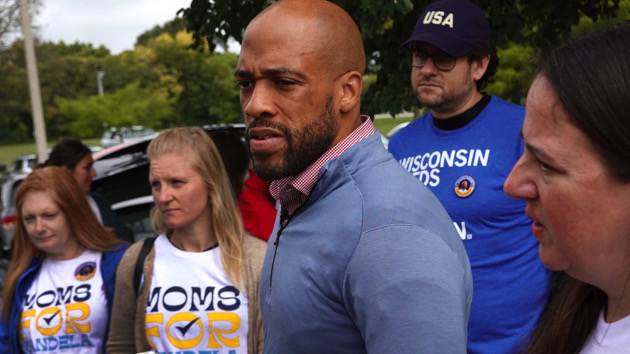
(MILWAUKEE) — The first senatorial debate in the battleground state of Wisconsin is happening Friday evening, with incumbent Republican Ron Johnson facing off against the state’s Lt. Gov. Mandela Barnes, who, if elected, would be the state’s first Black senator.
The debate will be broadcast live from PBS studios in Milwaukee at 8 p.m. ET/7 p.m. local time and is presented by the Wisconsin Broadcasters Association Foundation.
Democrats view the Senate seat in the state as one of the easiest ones to flip, but Republicans’ focus on the issue of crime, along with attack ads on the topic targeting their opponent, have helped tightened the race there, although some Democratic operatives say Republicans’ focus on crime is a distraction from other big issues on voters’ minds, including abortion rights.
A source close to the Barnes campaign said the debates, like the election, will be a referendum on Johnson. Issues that voters can expect to hear Barnes take Johnson to task on will be the Republican senator’s restrictive stance on abortion, past suggestions to end Social Security and Medicare, and Johnson’s ties with his wealthy donors, according to the source.
When asked by ABC News about the first senate debate this Friday, Alec Zimmerman, the communications director for Johnson, wrote in an emailed statement that Barnes is a “dangerous Democrat who has supported radical leftist causes like defunding the police and abolishing ICE.”
Zimmerman adds, “The debate will show what’s at stake in this race: safer communities and an affordable economy — two issues where Mandela Barnes is completely out of touch with Wisconsin families.”
The source close to the Barnes campaign said voters should expect to hear Barnes share his story as the son of a public school teacher and a third-shift auto worker, and how he’ll fight for the middle class.
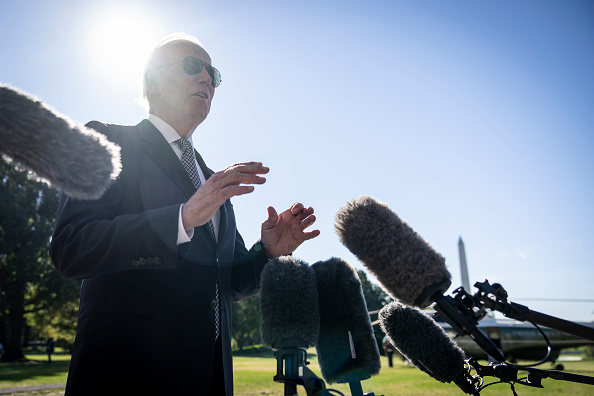
(WASHINGTON) — President Joe Biden on Thursday announced he’s pardoning all Americans who’ve been convicted of simple marijuana possession under federal law, coming closer to keeping a 2020 campaign promise to try to get the drug decriminalized a little more than a month before the midterm election.
The executive action will benefit 6,500 people with federal convictions from 1992 to 2021 and thousands of others charged under the District of Columbia’s criminal code, according to senior administration officials. Elaborating on the number of people affected, officials said “there are no individuals currently in federal prison solely for simple possession of marijuana.”
“As I said when I ran for president, no one should be in jail just for using or possessing marijuana,” Biden tweeted in an unusual video statement. “It’s legal in many states, and criminal records for marijuana possession have led to needless barriers to employment, housing, and educational opportunities. And that’s before you address the racial disparities around who suffers the consequences. While white and Black and brown people use marijuana at similar rates, Black and brown people are arrested, prosecuted, and convicted at disproportionate rates.”
His action before the consequential midterm elections, in which Democrats are vying to maintain control of the House and Senate, could be viewed as a move to energize voters, particularly younger voters.
When asked about the timing of the executive action, administration officials only said that Biden’s been “clear that our marijuana laws are not working.”
Biden said Thursday he’s urging governors to do the same for individuals with state convictions, which administration officials said account for the vast majority of possession-related convictions.
He’s also requesting Health and Human Services Secretary Xavier Becerra and Attorney General Merrick Garland expeditiously review how marijuana is scheduled under federal law. Currently, marijuana is classified as a “Schedule 1” drug — along with LSD, ecstasy and heroin — under the Controlled Substances Act, which Biden said Thursday “makes no sense.”
“Too many lives have been upended because of our failed approach to marijuana. It’s time that we right these wrongs,” Biden added.
Biden’s faced pressure from his own party this year to take more decisive action, as recent elections have shown Americans’ views on legalization have changed.
In the 2020 cycle alone, four states approved ballot measures to legalize the sale and possession of cannabis for adult use. An analysis from FiveThirtyEight found a majority of registered voters in all 50 states favor making marijuana legal.
This past summer, a group of lawmakers including Sens. Elizabeth Warren, D-Mass., and Bernie Sanders, I-Vt., wrote a letter to Biden, Garland and Becerra urging them to deschedule cannabis and issue pardons to all individuals convicted of nonviolent cannabis-related offenses.
Biden, while slower to embrace marijuana reform than many of his Democratic colleagues, pledged on the 2020 campaign trail to decriminalize cannabis use and expunge prior convictions.
Senate Democrats this year also finally released their long-awaited marijuana legalization proposal, which would lift the federal prohibition and allow states to determine how they want to regulate marijuana. But the legislation faces an uphill battle in the 50-50 chamber, where 10 Republicans would need to support it, and Senate leadership has yet to announce when the bill will be brought up for a vote.
“Members of Congress have been working on this issue,” Biden administration officials said Thursday. “But that effort has stalled and we’re almost at the end of the Congress. So the president has been considering his options and he’s now taking executive action to address the country’s failed approach to marijuana.”
Republican Arkansas Gov. Asa Hutchinson claimed Biden’s move was to score political points.
“The President, in his announced policy on marijuana, has waived the flag of surrender in the fight to save lives from drug abuse and has adopted all the talking points of the drug legalizers,” Hutchinson said. “Biden is simply playing election-year politics and sacrificing our national interest to win votes.”
Meanwhile, advocacy groups are welcoming the announcement.
“We commend this important and necessary step to begin the process of repairing the harms of prohibition and look forward to working with Congress and the administration to develop policies that would ultimately solve the underlying problems in our outdated cannabis policies,” Aaron Smith, Co-founder and CEO of the National Cannabis Industry Association said in a statement.
The Drug Policy Alliance said it was “thrilled” by Biden’s decision, which they called “incredibly long overdue.”
– ABC News’ Darren Reynolds and Anne Flaherty contributed to this report.
(WASHINGTON) — President Joe Biden on Thursday announced he is taking executive action to pardon Americans who’ve been convicted of simple marijuana possession under federal law.
The action will benefit 6,500 people with prior federal convictions and thousands of others charged under the District of Columbia’s criminal code, according to senior administration officials.
“No one should be in jail just for using or possessing marijuana,” Biden said in a statement outlining the administration’s new actions. “Sending people to prison for possessing marijuana has upended too many lives and incarcerated people for conduct that many states no longer prohibit.”
“Criminal records for marijuana possession have also imposed needless barriers to employment, housing, and educational opportunities,” Biden continued. “And while white and Black and brown people use marijuana at similar rates, Black and brown people have been arrested, prosecuted, and convicted at disproportionate rates.”
Biden is also urging governors to do the same for individuals with state convictions and is requesting Health and Human Services Secretary Xavier Becerra and Attorney General Merrick Garland to expeditiously review how marijuana is scheduled under federal law.
(PHOENIX) — Kicking off a season of senatorial debates in key battleground states, Arizona Sen. Mark Kelly and his Republican challenger Blake Masters will face off Thursday in Phoenix for their only debate — one week before early ballots go out in the state. Libertarian candidate Marc Victor will also participate.
The one-hour debate, hosted by the Citizens Clean Elections Commission at the Walter Cronkite School of Journalism and Mass Communication at Arizona State University, will air live on Arizona PBS at 9 p.m. ET/6 p.m. local time.
Gina Roberts, the voter education director at the Citizens Clean Elections Commission, the leading debate organizer for the last 20 years in Arizona, told ABC News that her team has been working on the midterm debates for more than year, “So it takes a lot to bring this to life, to bring this to voters — it’s quite a bit in terms of production.”
Her group outsources debate questions from Arizona voters, which they then share with the debate moderators, Ted Simons of Arizona PBS and an alternating reporter from the Arizona Republic, who go over the voter-submitted questions together and come up with the discussion topics.
“Bringing these debates to voters from a nonpartisan entity that only has the goal to educate, not influence, is a really great resource for voters,” Roberts added, “Because it gets all the candidates together on the same stage where Arizonans can hear directly from them on the issues that matter most.”
Masters, a 36-year-old venture capitalist from Tucson in his first run for public office, has gone after the junior senator on southern border security and high inflation, while Kelly is expected to raise Democrats’ concerns that Masters would support a federal abortion ban and spread baseless doubts about American elections since he has alleged, without evidence, that the 2020 presidential race was corrupt.
With former President Donald Trump’s endorsement, Masters beat out five other Republican candidates in the August primary, but after swinging far-right to stand out in the bunch, he’s faced criticism for an apparent post-primary pivot to being the “commonsense” candidate.
His campaign website was scrubbed in August to soften his views on abortion and the 2020 election and removed language about how Democrats “want to import a new electorate,” which appeared to echo the right-wing “replacement theory” that white people are being strategically diminished. (Masters has denied any pivot in his message and likened the website scrub to a run-of-the-mill update.)
Kelly, a former astronaut and Navy combat pilot who often flies himself in a two-seater plane to events across the state, is running on bipartisan wins in the Senate, such as a bipartisan infrastructure package, the CHIPS and Science Act investing in domestic manufacturing and measures in the Inflation Reduction Act to fund drought and Colorado River relief measures and lower prescription drug costs for Arizona’s seniors.
While Kelly won his 2020 race by earning more votes in the battleground than now-President Joe Biden, it’s unclear if Arizona will maintain its purple hue given that southern border encounters are at an all-time high and inflation is the steepest in the country in the Phoenix-metro area, home to most of the state’s voters.
Abortion access has also taken on new significance in the swing state after a judge lifted an injunction on a territorial-era, near-total ban on the procedure, with prison time for doctors, which the Republican attorney general revived in the wake of the Supreme Court overturning Roe v. Wade.
Kelly has said he supports codifying the right to an abortion with “some limits” late in pregnancy, while Masters supports the procedure only to save a mother’s life. Masters told ABC News last month that he would support Sen. Lindsey Graham’s proposal for a federal ban on most abortions after 15 weeks but also said a federal “personhood law” banning all third-trimester abortions could garner more support.
On the campaign trail, Masters has tried to keep the conversation on Democrats’ spending in Washington and on Kelly voting with Biden 94% of the time, according to FiveThirtyEight, with Masters contrasting that record with Arizona’s other Democratic senator, Kyrsten Sinema.
Still, Kelly has consistently polled ahead of Masters since the summer, according to FiveThirtyEight.
The Arizona Senate race has already surpassed $120 million in funding and is expected to reach more than $240 million, according to AdImpact, as the midterm elections are poised to be the second most expensive cycle in history after the 2020 election.
Two years ago, Kelly flipped his Senate seat for Democrats in a special election triggered by the death of the late Sen. John McCain. Kelly defeated Sen. Martha McSally, who was appointed by Republican Gov. Doug Ducey, by more than 78,000 votes to serve out the remainder of McCain’s term through January 2023.
Kelly became a strong advocate for gun restrictions in the aftermath of a failed assassination attempt on his wife, former Rep. Gabby Giffords, and he won his last election by pitching himself as an independent-minded candidate who would work across the aisle — a strategy he’s deployed in 2022 as well.
Masters, betting that Arizona is still a red state, joined former President Trump for a rally in Prescott in July after gaining his endorsement and will do so again on Sunday in Mesa.
Thursday marks Kelly’s second debate but his first as a senator. While Masters participated in a GOP primary forum in June, Thursday is his first senatorial debate as a nominee.
“Senator Kelly looks forward to the upcoming debate where Arizonans will have a chance to see the stark choice in front of them this November,” Kelly’s campaign spokesperson Sarah Guggenheimer told ABC News. “While Masters will have to answer for his dangerous support of a national abortion ban and privatizing Social Security, Senator Kelly will speak directly to Arizonans about his work with Republicans and Democrats to lower costs, create jobs, and get our economy back on track.”
Masters’ campaign declined to comment to ABC News for this story.
(WASHINGTON) — While Iran’s brutal attempts to put down nationwide protests — sparked by the death of a young woman in the custody of its so-called morality police — have done little to stop domestic dissent, the crackdown has dire implications for the regime on the international stage, cementing Iran’s pariah status.
Following Iranian security forces siege of an elite university in Tehran where students were demonstrating, President Joe Biden this week promised his administration would soon impose “further costs on perpetrators of violence against peaceful protestors.” Administration sources say those additional penalties could come as soon as Thursday and are expected to include sanctions targeting human rights violators in the country.
Meanwhile, the top levels of leadership within Iran have sought to blame outside influences for fueling the nearly three straight weeks of unrest. In his first public response to what he characterized as “riots,” Iran’s supreme leader, Ayatollah Ali Khamenei, baselessly claimed the protests had been orchestrated by the U.S. and Israel.
Will Iran’s attempts to blame the West work?
Behnam Ben Taleblu, a senior fellow at the Foundation for Defense of Democracies, said Khamenei’s attempt to point the finger at the West was “reliance on a decades-old authoritarian playbook,” predicting it would have little impact in the current political climate.
“There’s no doubt that Iranians don’t buy Khamenei’s attempts to deflect. That’s why they remain on the streets. Iranians understand who is responsible for their current predicament,” Taleblu said.
“I think the youth who are continuing to come to the streets and have organized protests at their schools and universities know better about who is posing a challenge to their lives,” said Gissou Nia, director of the Strategic Litigation Project at the Atlantic Council and board chair of the Iran Human Rights Documentation Center. “In previous protests, we saw slogans to the effect of ‘our enemy is not America, our enemy is right here.'”
Iranian powers have also attempted to scapegoat entities closer to home. In recent days, the country’s Islamic Revolutionary Guard Corps (IRGC) has repeatedly struck at Kurdish groups across its border in Iraq, accusing them of inflaming protests.
Taleblu called the missile barrage “an attempt to feign strength abroad when weakness has been showcased at home,” and warned similar — and likely, more severe — attacks will follow if the regime doesn’t face broad consequences.
“The greater Iran’s missile capabilities and the greater Iran’s confidence in a survivable or non-response, the lower the threshold for the use of force of these dangerous weapons. As Iran’s ballistic missile capabilities increase, so will such types of operations,” he said.
Talks on nuclear deal continue
Despite longstanding U.S. disdain for Iran’s IRGC, its ballistics program, and its human rights abuses, the Biden administration has been engaged in a winding and indirect negotiation process with Tehran aimed at finding one area of common ground — a deal to limit its nuclear program.
Though talks have all but collapsed, U.S. officials initially expressed some hope that the unrest might encourage Iran to renew an Obama-era pact known as the Joint Comprehensive Plan of Action (JCPOA) to secure the sanctions relief that would come with it. But both Behnam and Nia argue that Iran’s crackdown should only darken the already grim outlook on returning to an agreement.
“I think it would be a very wrong moment for the international community to somehow shore up the Islamic Republic [of Iran] in this moment, when the people of Iran are clearly saying they don’t want this government, or that they want substantial change,” said Nia.
Taleblu argues that the Biden administration should shut down negotiations altogether.
“Tehran continues to have Washington right where it wants it on the JCPOA: constantly seeking a deal,” he said. “As long as Biden keeps the door open for the JCPOA, he will be unable to fully stand with the Iranian people.”
This week, Iran made a separate, surprising move that the regime argues should lead to a windfall: allowing Baquer Namazi, an 85-year-old Iranian American held captive in Iran since 2016 on dubious charges, to leave the country for urgent medical treatment and granting a temporary prison furlough to his son, Siamak Namazi — another American citizen considered to be wrongfully detained.
Tehran claimed the developments should prompt Washington to unfreeze $7 billion in Iranian assets being held in South Korea due to U.S. sanctions.
Although the elder Namazi left Iran on Wednesday, the U.S. is still working permanently to secure the freedom of the younger, as well as a number of other American citizens detained in Iran.
U.S. officials have repeatedly denied agreeing to allow any funds to be transferred back to Iran. Taleblu warns reversing course would be detrimental for both Americans and Iranians.
“If Washington intends to pay ransom for hostages with frozen funds, two things will be guaranteed: the apparatus of repression currently on display in Iran will receive a boon, and second, Iran will continue to take hostages,” he said.
(ATLANTA) — Georgia Democrat Stacey Abrams said she has continuing doubts about voting equity in her upcoming rematch with incumbent Republican Gov. Brian Kemp, telling ABC News in a new interview that she would “not question the outcome of the election” but would continue to “question the process.”
Abrams, a former state lawmaker-turned-prominent voting rights advocate, repeatedly attacked Kemp in 2018 given that he was her rival and the sitting secretary of state who was overseeing their race. Abrams also challenged what she said were Georgia’s excessively strict regulations around voter registration and more, calling them tantamount to suppression. Kemp said he wanted to ensure election integrity.
Abrams waited more than a week to acknowledge Kemp’s victory after the 2018 election. Pressed twice by ABC News congressional correspondent Rachel Scott in an interview on Sunday about whether she would concede the 2022 gubernatorial election if she lost, Abrams repeatedly drew a distinction between conceding the outcome — which she said she would do — and criticizing the process, including regulations restricting voter access to polling places and absentee voting.
“I have always acknowledged the outcome of elections,” she said in a clip from the interview, set to air Oct. 9 on Hulu’s “Power Trip.” “What is deeply concerning to me is the conflation of access to the right to vote and the outcome of elections.”
“Voter access is not the same as election outcomes,” Abrams continued, “and when those become conflated and we buy into the conflation, when we buy into the false equivalency, we erode access to democracy.”
Conservatives have tried to draw comparisons between Abrams’ handling of the 2018 race and former President Donald Trump’s refusal to concede the 2020 presidential election to Joe Biden, who won the popular vote by a margin of more than 7 million. (Abrams lost to Kemp in 2018 by some 54,000 votes.)
When Abrams finally acknowledged on Nov. 16, 2018, that Kemp had won, she pointedly stated that it was “not a concession speech.” But as she later stressed, she doesn’t deny Kemp’s victory — unlike Trump.
She echoed that position to ABC News.
“What I said in that speech is that I would not concede [to] a system that would not permit voters to be heard,” she said. “I will always acknowledge the victor, but I will never say that there is a system in place that denies access that should be validated.”
She added, “For those who do not appreciate nuance, my response is always going to be: Yes, I will acknowledge the victor. I did so in ’18. I will do so in 2022. But in 2022, I intend to be the victor myself.”
On Friday, shortly before her interview with ABC News, a federal judge knocked down a lawsuit challenging Georgia’s election practices, ruling in favor of the state. Fair Fight Action, a group founded by Abrams, filed the suit shortly after the 2018 election and as part of the suit called for an overhaul of Georgia’s voting system.
U.S. District Judge Steve Jones, an Obama-era appointee, wrote in his order that “although Georgia’s election system is not perfect, the challenged practices violate neither the constitution nor the [Voting Rights Act of 1965].”
Kemp and other Republicans seized on the ruling and accused Abrams of using her group’s challenge to advance her own political interests — a claim Abrams dismissed to ABC News.
“This was not a lawsuit about my election,” she said. “This is a lawsuit about voting issues that were exposed by my election but were endemic to the state of Georgia.”
If elected governor, Abrams said she would continue to fight to expand voting access and propose changes to the state’s voting laws.
Hulu’s “Power Trip,” with ABC’s George Stephanopoulos, releases new episodes on Sundays.
(WASHINGTON) — President Joe Biden and Florida Gov. Ron DeSantis appeared side-by-side in hard-hit Fort Myers on Wednesday as the president surveyed damage from Hurricane Ian.
The two leaders, often political opponents, have momentarily put politics aside to respond to the historic storm, which is shaping up to be one of Florida’s deadliest and costliest in decades. Making landfall as a Category 4 hurricane, Ian leveled the coast, knocking out power to millions. At least 100 people died.
DeSantis and his wife, Casey DeSantis, greeted Biden and first lady Jill Biden upon their arrival at Fisherman’s Wharf for an operational briefing. FEMA Administrator Deanne Criswell, Republican Sens. Rick Scott and Marco Rubio, and other local officials were also at the site.
“Mr. President, welcome to Florida,” DeSantis said, making remarks first. “We appreciate working together across various levels of government.”
Biden spoke with local residents affected by the storm, offering handshakes and hugs as he toured damage at the marina’s. The area was filled with debris, fallen trees, downed electric lines and boats and yachts tossed into piles.
Earlier in the day, the Bidens took an aerial tour to get a wider look at the storm’s devastation before meeting with the governor.
“I’m sure it’s much worse from the ground,” Biden said. “But you can see a whole hell of a lot of damage from the air.”
Biden touted his administration’s response so far and emphasized the federal government’s ongoing commitment to the people of Florida as they recover and rebuild, which he said will take years.
“We’re not leaving till this gets done. I promise you that,” Biden said.
Ahead of the visit, the White House said Biden would announce he is doubling the length of time the federal government will cover all the costs associated with search and rescue, debris removal, sheltering and other emergency measures from 30 days to 60 days.
Desantis had requested the aid extension last week. In response to the announcement, he told reporters, “It’s important, but we may need more.”
Biden said 4,000 federal personnel are on the ground in Florida and the Southeast. Search and rescue teams have knocked on over 70,000 doors, he said, with 3,800 people. He also discussed more ways the federal government can help with other actions FEMA, the Small Business Administration and the Department of Housing and Urban Development.
Wednesday’s visit was the first face-to-face meeting between Biden and DeSantis since the governor ordered migrants flown from Texas to Martha’s Vineyard, which the White House this week continued to slam as a “political stunt.”
Biden and DeSantis have put politics aside to respond to Hurricane Ian, as they spoke several times before and after the storm hit as Biden issued emergency declarations.
“I want to thank President Biden and Jill Biden as well as Administrator Deanne Criswell for coming down here looking at a really really significant damage here in Lee County and there’s other places where you have really significant damage as well outside of this general area,” DeSantis said Wednesday.”We were very fortunate to have good coordination with the White House and with FEMA from the very beginning of this.”
The Florida trip came just days after Biden traveled to Puerto Rico, which was hit by Hurricane Fiona last month.
The Category 1 storm hit the island on Sept. 18, knocking out power for most of the U.S. territory’s residents and killing at least 13 people. As of Biden’s visit, more than two weeks after the storm, more than 100,000 people were still without power.
During his visit to Port of Ponce, on the south side of Puerto Rico, Biden announced more than $60 million in federal funding to help the island better prepare for extreme weather events in the wake of Hurricane Fiona.
“Puerto Rico is a strong place, and Puerto Ricans are strong people,” Biden said as he spoke at the Port of Ponce. “But even so, you have had to bear so much and more than need be, and you haven’t gotten the help in a timely way.”
(WASHINGTON) — President Joe Biden will meet with Florida Gov. Ron DeSantis on Wednesday as he visits the state in the aftermath of Hurricane Ian.
White House press secretary Karine Jean-Pierre confirmed Biden will meet with the Republican governor, who has often been a political adversary, as he and first lady Jill Biden assess the storm’s damage in Fort Myers.
There, Jean-Pierre said, Biden will meet with small business owners and local residents impacted by the historic storm. He will also thank officials who are providing life-saving assistance, working to restore power and are removing debris.
“Gov. DeSantis, FEMA Administrator Deanne Criswell and other state and local officials will also provide the president with an operational briefing on the current response and recovery efforts,” Jean-Pierre told reporters.
But Jean-Pierre deflected when asked if DeSantis would join Biden for any public remarks, saying the governor has a “busy schedule” and she couldn’t speak to “where he’s going to be at every step of the way.”
Wednesday’s visit will be the first face-to-face meeting between Biden and DeSantis since the governor ordered migrants flown from Texas to Martha’s Vineyard, which Jean-Pierre continued to slam as a “political stunt.”
“Obviously the president laid out his concerns and outrage by the stunt,” she said, adding: “There will be plenty of time to discuss differences between the president and the governor but now is not the time.”
Biden and DeSantis have momentarily put politics aside to respond to Hurricane Ian, which is shaping up to be one of Florida’s deadliest and costliest storms in decades. Making landfall as a Category 4 storm, Ian leveled the coast, knocking out power to millions. At least 100 people have died due to the storm.
Biden and DeSantis leaders spoke several times before and after the storm hit as Biden issued emergency declarations. On Saturday, Biden signed a major disaster declaration for the state, which makes more funding available to help with Florida’s recovery.
“As I’ve made clear: At times like these, our nation comes together, put aside our political differences and get to work,” Biden said Monday as he spoke about his upcoming trip. “We show up when we’re needed. Because if we lost our home, if we lost a loved one, we’d hope that people would show up for us as well.”
DeSantis has said he appreciated “FEMA’s responsiveness to this disaster” and has thanked the Biden administration for its emergency declarations.
The White House over the weekend released a fact sheet touting the federal response to Hurricane Ian. More than 3,400 federal response personnel are on the ground in Florida, the White House said, and the Army Corps of Engineers has now deployed over 550 personnel to conduct engineering evaluations about the safety of bridges, roads, and other infrastructure needs.
The Florida trip comes just days after Biden traveled to Puerto Rico, which was hit by Hurricane Fiona last month.
The Category 1 storm hit the island on Sept. 18, knocking out power for most of the U.S. territory’s residents and killing at least 13 people. As of Biden’s visit, more than two weeks after the storm, more than 100,000 people were still without power.
During his visit to Port of Ponce, on the south side of Puerto Rico, Biden announced more than $60 million in federal funding to help the island better prepare for extreme weather events in the wake of Hurricane Fiona.
“Puerto Rico is a strong place, and Puerto Ricans are strong people,” Biden said as he spoke at the Port of Ponce. “But even so, you have had to bear so much and more than need be, and you haven’t gotten the help in a timely way.”
(WASHINGTON) — Former President Donald Trump, in a limited request, has asked the U.S. Supreme Court to halt part of an 11th Circuit Court of Appeals ruling and restore a special master’s access to classified documents seized from Mar-a-Lago while the Justice Department review continues.
“The Eleventh Circuit lacked jurisdiction to review, much less stay, an interlocutory order of the District Court providing for the Special Master to review materials seized from President Trump’s home, including approximately 103 documents the Government contends bear classification markings. This application seeks to vacate only that portion of the Eleventh Circuit’s Stay Order limiting the scope of the Special Master’s review of the documents bearing classification markings,” Trump’s lawyers write.
The application was made to Justice Clarence Thomas, circuit justice for the 11th Circuit. He could rule on his own, or refer the matter to the full court. The Justice Department was given a deadline of Oct. 11 at 5 p.m. to respond to Trump’s emergency application.
On Sept. 21, a panel of judges on the appeals court granted a request from the Justice Department to stay portions of a ruling by U.S. District Judge Aileen Cannon that had effectively paused the government’s investigation into Trump’s potential mishandling of classified records after leaving office.
The three-judge panel, comprised of two Trump appointees and a Barack Obama appointee, ruled unanimously that the Justice Department was no longer enjoined from investigating the documents with classification markings that were recovered from Mar-a-Lago and no longer had to submit those materials to special master Ray Dearie for his independent review.
“The unprecedented circumstances presented by this case — an investigation of the Forty-Fifth President of the United States by the administration of his political rival and successor — compelled the District Court to acknowledge the significant need for enhanced vigilance and to order the appointment of a Special Master to ensure fairness, transparency, and maintenance of the public trust,” Trump’s lawyers write in their filing.
“That appointment order is simply not appealable on an interlocutory basis and was never before the Eleventh Circuit. Nonetheless, the Eleventh Circuit granted a stay of the Special Master Order, effectively compromising the integrity of the well-established policy against piecemeal appellate review and ignoring the District Court’s broad discretion without justification,” they continue.
“This unwarranted stay should be vacated as it impairs substantially the ongoing, time-sensitive work of the Special Master. Moreover, any limit on the comprehensive and transparent review of materials seized in the extraordinary raid of a President’s home erodes public confidence in our system of justice,” they say.
(WASHINGTON) — A new Biden administration report on abortion access in the U.S. describes how widely the procedure has been curtailed in the roughly 100 days after Roe v. Wade was overturned, according to a memo obtained by ABC News.
The report, compiled by Jen Klein, the head of the administration’s interagency task force on abortion access, was one focus of a Tuesday meeting that President Joe Biden, Vice President Kamala Harris and Cabinet members convened to discuss the state of abortion care.
The report recapped efforts by Republicans to limit abortions in the wake of the Supreme Court’s reversal of Roe in June, a ruling that allowed states to regulate or ban the procedure as they saw fit.
At least 15 states have since ceased nearly all abortion services. As a result, the report said, close to 30 million women of reproductive age now live in states with bans.
Biden warned of similar efforts in Washington.
“Congressional Republicans are doubling down on the extreme position with the proposal for a national ban,” Biden said.
Tuesday’s meeting came as the White House works to drum up support for Democratic midterms candidates in the political fight to preserve or expand access to abortion and to call attention to the ways Republicans have banned or chipped away at the procedure, which polling repeatedly shows is unpopular with voters.
But the task force gathering also served as a reminder of what the Biden administration has yet to do — or says it cannot do — on abortion access, which has fueled criticism from advocates and some others in his party.
The new White House report describes a bill to codify Roe into federal law as the only way to protect women’s access, but the memo acknowledges this unlikely reality, given Democrats’ current narrow majority in the Senate.
“Republican elected officials at the state and national level have taken extreme steps to block women’s access to health care,” Klein writes in her report for the president and vice president, noting Republican Sen. Lindsey Graham’s proposal to ban most abortions nationwide after 15 weeks of pregnancy.
“The result is that in 100 days, millions of women cannot access critical health care and doctors and nurses are facing criminal penalties for providing health care,” Klein wrote.
Graham has contrasted his call for a ban with “radical” Democrats and said his “legislation is a responsible alternative as we provide exceptions for cases of rape, incest and life and physical health of the mother.”
Biden called Graham’s bill a threat to “every women, in every state and every county.”
“Even if you live in a state where extremist Republican officials aren’t running the show, your right to choose will still be at risk, because the Republicans in Congress want to pass a law to take away the right to choose for every woman in every state and every county,” he said.
He called on Americans to elect more Democrats in November so that Congress could codify Roe vs. Wade into law, something he acknowledged they were “a few votes short on.”
“The only way it’s going to happen is if the American people make it happen,” Biden said.
But particularly after a lag in reaction time after the high court’s initial ruling came down, many advocates have continued to voice frustration that Biden hasn’t done more, they say, to work to protect abortion rights.
At the last task force meeting, for example, the president signed an executive order that the administration said would help low-income women pay for abortion services.
As a result of the order, the administration said, Medicaid would cover abortion-related costs for women who have traveled from states where abortion is banned to states where it is not.
But the implementation has been slow and details on next steps have been sparse. It’s unclear if states will enroll in the program, or how many women it will aid in getting abortion care.