(WASHINGTON) — The White House believes “the stakes are very high right now” with Russia amid Vladimir Putin’s struggles in Ukraine and his references to his nuclear arsenal, but President Joe Biden’s warning of possible “Armageddon” wasn’t about an imminent threat, a top Biden spokesperson said Sunday.
“These comments were not based on new or fresh intelligence or new indications that Mr. Putin has made a decision to use nuclear weapons and, quite frankly, we don’t have any indication that he has made that kind of decision,” John Kirby, a spokesman for the White House National Security Council, told ABC “This Week” co-anchor Martha Raddatz.
“Nor have we seen anything that would give us pause to reconsider our own strategic nuclear posture in our efforts to defend our own national security interests and those of our allies and partners,” Kirby said, citing the president’s promise that “neither we nor our allies are going to be intimidated by this.”
Kirby’s comments come after Biden’s unusually stark remarks at a fundraiser on Thursday.
Biden said then that Putin, the Russian president, was “not joking when he talks about the use of tactical nuclear weapons or biological or chemical weapons” and that “we have not faced the prospect of Armageddon since Kennedy and the Cuban missile crisis” in the 1960s.
The White House was pressed repeatedly last week over whether Biden’s warning marked some shift in the administration’s assessment of Putin’s behavior, which Kirby denied on “This Week.”
“We are monitoring this as best we can, and we have been monitoring his nuclear capabilities, frankly, since he invaded Ukraine back in February,” Kirby said.
Raddatz asked what the U.S. saw as Putin’s “way out” of this war, where his forces have been losing ground in recent weeks in Ukraine’s eastern and southern regions. On Saturday, an explosion also partially collapsed a bridge serving as a crucial supply link from Russia to Crimea, the disputed peninsula Russia annexed from Ukraine in 2014.
“Mr. Putin started this war and Mr. Putin could end it today, simply by moving his troops out of the country,” Kirby said, adding, “We all want to see this war end. … And what needs to happen is for the two sides to be able to sit down and negotiate and find a way out of this peacefully and diplomatically.”
But, so far, “Mr. Putin has shown no indications — zero, none — that he’s willing to do that,” Kirby said. And so, he said, the administration remained committed to indirect involvement in the war by supporting Ukraine via weapons and other military aid.
On the Ukrainian side, President Volodymyr Zelenskyy has ruled out negotiating with Putin specifically — not Russia — and signed a decree formalizing that position on Tuesday.
Raddatz also pressed Kirby on the White House’s approach to North Korean leader Kim Jong Un, who launched a barrage of ballistic missiles in recent days, including over Japan, raising alarms there and in South Korea.
“I’ve seen this for decades and decades, the same thing happens through many presidents: You respond, you do drills, he keeps firing,” Raddatz said.
“What are you doing differently?” she pressed.
Kirby pointed to intelligence gathering and “military readiness” between the U.S., Japan and South Korea: “We’re going to make sure that we have the capabilities in place to defend our national security interests if it comes to that.”
But direct talks with Kim’s regime remained the goal, he said: “We want to see the denuclearization of the Korean peninsula, verifiable and complete … We are willing to sit down with them without preconditions at the negotiating table to work toward that end.”
(NEW YORK) — More than 500 children have been reunited by the Biden administration’s task force to find families separated as a result of the Trump administration’s “zero-tolerance” policy at the border, Homeland Security Secretary Alejandro Mayorkas said Friday.
“This is a significant milestone that reflects the tireless dedication of the many public servants in the Department of Homeland Security and across the federal government, including those in the Departments of Health and Human Services, State, and Justice,” Mayorkas said in a statement. “It is a milestone that we could not have achieved without the partnership and critical work of several incredibly committed non-governmental organizations.”
Nearly 200 other children who have yet to be reunited and are in the process, Mayorkas said.
The administration had previously identified 3,855 total children who would qualify for government-assisted reunification, according to the last formal progress report from the task force in July. Since then, the administration has now reached out to about 150 families who are eligible but have not responded. Prior to the establishment of the task force, some 2,260 known children were reunified.
The work is done in connection with international non-governmental organizations including the International Organization for Migration and the UN Refugee Agency. Human rights workers have fanned out across Central America, traveling over 62,000 miles to find separated parents.
“We will continue to work tirelessly to deliver on President Biden’s commitment to reunite children separated from their families at the United States-Mexico border,” Mayorkas said Friday.
Those admitted for reunification receive humanitarian parole for three years to live and work in the U.S. The status is similar to those who have fled Afghanistan and Ukraine over the past year. The administration continues to operate two websites — Together.gov and Juntos.gov — where families can register to check their eligibility. So far, the government has registered about 1,700. Once found eligible, families then submit documentation to receive parole, allowing them to enter the U.S.
The government is also providing families access to mental health services as part of the reunification effort.
Last month, the Justice Department asked a federal judge to approve a new round of psychological evaluations for those separated and a part of an ongoing lawsuit in Arizona federal court. Five mothers who were separated from their kids are seeking compensation for mental health damages from the U.S. government.
Lee Gelernt, the lead ACLU attorney representing migrant families said in a statement to ABC News that the progress was notable, but much more work needs to be done, noting they continue to look for 150 separated families.
“The task force should be given credit for reunifying 500 families, but unfortunately there is still a long way to go to remedy the historic wrong committed by the Trump administration,” Gelernt said. “Beyond reunification, these families deserve comprehensive relief, including a chance to remain in the United States.”
Armando Garcia and Luke Barr contributed to this report.
(PHOENIX) — In the first and likely only debate for the Arizona Senate race, Democrat Mark Kelly pitched himself to independent voters as someone who can stand up to President Joe Biden and his own party, particularly on border security.
“When Democrats are wrong, like on the border, I call them out on it, because I’m always going to stick up for Arizona,” Kelly said in his opening remarks on stage at Arizona State University’s downtown campus on Thursday. “When the Biden administration refused to increase oil and gas production, I told him he was wrong,” he offered at another point.
The debate between Kelly, his Republican challenger Blake Masters and Libertarian Marc Victor comes just one week before early ballots are sent out in a race that could determine which party has majority control of the Senate next year, as polls show the race is tightening.
“Two years ago, Mark Kelly stood right there, and he promised to be independent,” Masters said in his opening. “But he broke that promise.”
Kelly, who won a special election in 2020 by getting more votes in Arizona than Biden himself, has distanced himself from Democrats’ messaging on immigration amid a record number of arrests or detentions of migrants at the southern border.
That includes the Biden administration’s decision to lift Title 42, a controversial Trump-era public health order which cut down opportunities for migrants to make legal claims to avoid deportation during the coronavirus pandemic.
“When the president decided he was going to do something dumb on this and change the rules that would create a bigger crisis, you know, I’ve told him he was wrong,” Kelly said. “So I’ve pushed back on this administration multiple times, and I’ve got more money on the ground.”
Kelly called the situation at the U.S.-Mexico border a “mess” and said he supports some physical barriers at the border.
Meanwhile, Masters emphasized Kelly’s record of allegiance to Democrats, asking Kelly about a vote against a GOP amendment to the Inflation Reduction Act that would’ve funded additional 18,000 border patrol agents.
“There are votes that happen in DC that have nothing to do with Border Patrol agents that have might have the title on it and nothing happens,” Kelly offered.
Masters called on Kelly to “respectfully resign” if he has truly done everything he can to secure the border.
During the hour-long debate, the candidates also sparred over the 2020 election, inflation, abortion rights and water security.
Asked if Biden is the legitimately elected president, Masters at first sarcastically offered, “Joe Biden is absolutely the president. I mean, my gosh, have you seen the gas prices lately?” before acknowledging Biden as the “the legitimate president.”
But the political newcomer then pivoted into a conspiracy theory about how the FBI pressured Facebook and other big tech companies to censor information about Hunter Biden’s alleged crimes in the weeks before the 2020 election.
Masters, who said in a campaign ad last year, “I think Trump won in 2020,” has softened some stances since beating out four other candidates in the August primary and conceded under questioning from moderator Ted Simons of Arizona PBS that he hasn’t seen evidence of voter fraud in the 2020 race.
“I haven’t seen evidence of that,” Masters said, breaking from former President Donald Trump, who endorsed him over the summer.
Kelly warned that the “wheels” could “come off our democracy” if candidates like Masters, who he says continue to questioning the integrity of American elections, win this November.
On abortion — a hot-button issue in Arizona after a federal judge last month upheld a 1901 law prohibiting all abortions other than those necessary to save the life of the mother and mandating jail time for providers — the two candidates offered vastly different views.
Kelly answered “of course” when asked if he’d vote to codify Roe v. Wade, and attacked Masters for his past statements describing abortion as “demonic” and “religious sacrifice.”
“You think you know better than women and doctors about abortion,” Kelly said. “You can think you know better than seniors about social security. And you think you know better than veterans about how to win a war. Folks, we all know guys like this, and we can’t be letting them make decisions about us because it’s just dangerous.”
Masters said he’s “pro-life as a matter of conscience” with “exceptions” and falsely accused Kelly of supporting abortion “up until the moment of birth.” He said he would support a federal “personhood law” to ban all third-trimester abortions — which Kelly called “code for throwing women into jail” — as well as Sen. Lindsey Graham’s federal abortion ban after 15 weeks.
With inflation highest in the country in the Phoenix-metro area, Masters appeared most comfortable when grouping in Kelly with spending in Washington.
“Joe Biden is spending like a drunken sailor and at every single opportunity Mark Kelly just says yes. He can’t say no to Chuck Schumer. He can’t say no to Joe Biden,” Masters said. “You never have to wonder which way Senator Kelly is gonna vote.”
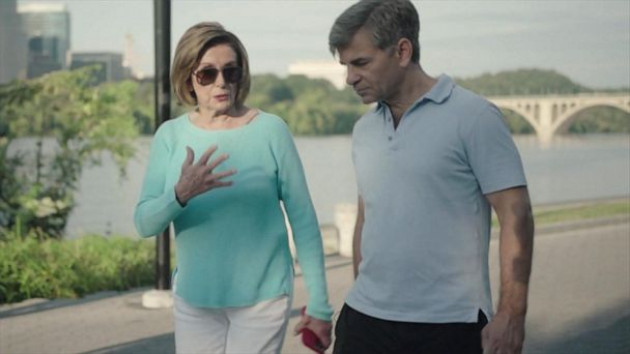
(WASHINGTON) — In a recent ABC News interview, House Speaker Nancy Pelosi said she felt clear-eyed about the contrast between her Democratic Party and the Republicans hoping to oust her from power in the midterm elections.
But Pelosi was also clear, she told ABC News’ George Stephanopoulos on Hulu’s “Power Trip,” about what it would take to win in November — despite major political headwinds like high inflation and a sour mood on the economy.
Pelosi saw it another way, and as evidence she cited the Supreme Court’s divisive ruling striking down nationwide abortion access, Dobbs v. Jackson Women’s Health Organization.
“We know that the public is with us, it’s just a question of turning out the vote,” she argued. “Any doubt that anyone might have in their minds about the enthusiasm of the Democratic voter — should be dispelled by the Dobbs decision.”
The California lawmaker stressed how few Republicans in the House had supported a law ensuring access to contraception and how none had voted to codify abortion access into federal law.
“Our races are discreet,” she acknowledged of the midterms, in which a resurgent GOP hopes to flip at least the handful of seats needed to erase Pelosi’s majority.
“But,” she said, Democrats could press another advantage: “Going into each race with the contrast of what that member of Congress or that candidate said about Social Security, Medicare, a woman’s right to choose, a ban on abortion and undermining our democracy — and that is what they [Republicans] are trying to do.”
“You’ve got a lot of Republicans on the ballot who still don’t accept the last election,” Stephanopoulos told her of those who falsely deny the results of the 2020 presidential race.
“Well, that’s pathetic,” Pelosi told him, adding, in a nod to football coach Al Davis, “Just win, baby.”
ABC News polling shows there are major challenges to such a feat as voters say that the economy and inflation remain key issues — while giving low marks to President Joe Biden on each. Democrats also have to contend with a long history of midterm losses for the party in power.
“Our message is what this means to you in your home at your kitchen table,” Pelosi said.
“Is that what people are feeling right now?” Stephanopoulos asked. “Right now they’re feeling inflation, they’re looking at the border, seeing people cross the border all the time, they feel crime in the cities.”
When pressed further by Stephanopoulos about inflation, crime and the border — three areas Republicans are focusing on this election cycle — Pelosi said she didn’t believe recent migrant flights by GOP governors were working and contended inflation is a “global issue.”
“They can’t do any more about inflation than we are,” she said.
House Minority Leader Kevin McCarthy had a reaction to some of Pelosi’s criticism, telling ABC News’ Brittany Shepherd in “Power Trip” — at an event previewing the House GOP’s campaign-season “Commitment to America” — that Democrats “can’t run on their record.”
“The ‘Commitment to America’ is a plan for a new direction, one that will make our economy strong, will make our nation safe. It’d be a future built on freedom and give us check and balance inside Washington,” McCarthy said.
As to Pelosi’s criticism of Republicans as a threat to democracy, given how many in the party embrace baseless claims about the 2020 race, McCarthy was not fazed. “It’s idiotic,” he said.
(WASHINGTON) — At the end of Donald Trump’s presidency, his team returned a large batch of classified FBI documents and other government records to the Justice Department in such disarray that a year later — in a letter to lawmakers — the department said it still couldn’t tell which of the documents were the classified ones.
The documents came from the FBI’s controversial probe in 2016 looking at alleged links between Russia and Trump’s presidential campaign. Trump tried to make the documents public the night before he left office, issuing a “declassification” memo and secretly meeting with conservative writer John Solomon, who was allowed to review the documents, Solomon told ABC News this past week.
But for reasons that are still not clear — and to the great frustration of Trump and his political allies — none of the documents were ever officially released, and the Justice Department said Thursday it’s still working to determine which documents can be disclosed.
“[T]he Justice Department has … failed to declassify a single page,” Sens. Charles Grassley, R-Iowa, and Ron Johnson, R-Wisc., complained to the attorney general in February.
Much of what happened with the documents in those last days of the Trump administration — and ever since — remains shrouded in mystery because current and former government officials involved have refused to speak about it, especially now that the FBI is pursuing its investigation into Trump’s alleged mishandling of a separate cache of classified documents.
The story that still emerges, though, from pieces of public statements and Solomon’s own accounts is one that sheds further light on how Trump’s White House treated certain government secrets. And it helps explain how — in the midst of the FBI probe — Solomon became one of Trump’s official “representatives” to the National Archives.
‘Thank God’ for Solomon
By the middle of Trump’s presidency, Solomon had become one of Trump’s favorite voices in media.
“John Solomon should get the Pulitzer Prize,” Trump said to cheers at a rally in Louisiana in October 2019.
At the time, Solomon was promoting a series of since-discredited claims about supposed Obama-era corruption in Ukraine, claims which Trump then privately pushed the Ukrainian president to investigate, leading to Trump’s first impeachment.
Solomon’s own employer then, The Hill newspaper, eventually launched an internal review and concluded his Ukraine-related pieces “potentially blurred the distinction between news and opinion” and at times failed to include relevant “context and/or disclosure[s].” Solomon has stood by those pieces, insisting still that they were accurate.
His work at the time was also focused on the FBI’s Russia-related investigation and its offshoots, which he described as “a sin against Donald Trump,” an “offense against the entire American people,” and “arguably the most devious political dirty trick in American history.”
“Thank God we have [Solomon and several Fox News hosts] on our side,” Trump declared at the 2019 rally.
So when Trump and his team were determined to push out the so-called “full story” of “the Russia hoax” before Trump’s presidency ended, Solomon was well-positioned to help, with his online media platforms and regular TV appearances.
“We worked closely together in trying to get to the truth on that,” Solomon recounted to Trump’s former chief of staff, Mark Meadows, in an interview with him last year.
In its final report on the investigation, the Justice Department’s internal watchdog said that while it found “fundamental errors” and significant “failures” in the FBI probe, it found no evidence that “political bias or improper motivation influenced” the investigation, including the decision to eavesdrop on one of Trump’s former campaign advisers.
But Trump and many of his allies contended otherwise.
‘Continuing objection’
With just weeks left as president, Trump “demanded” that “key documents” — still classified by the FBI and Justice Department — “be brought to the White House” so they could be “entered into the public record once and for all,” Meadows wrote in a memoir published last year.
On Dec. 30, 2020, the Justice Department delivered a binder filled with internal notes, memos, emails and other records. The White House was unsure of what should be disclosed, so Trump’s team asked a group of Republican staffers on the House Intelligence Committee to make recommendations, a congressional source informed of the request told ABC News.
“[It’s] a foot-and-a-half of documents, almost everything that the FBI had left out of public sight,” Solomon said in an interview with a right-wing website on Jan. 14, 2021, predicting that the documents could be “made public as early as tomorrow.”
But the FBI objected to “any” release at all, Trump’s “declassification” memo said.
“The FBI has concerns about everything, from the protection of assets and codenames, and prior investigations that may be referenced in the Russia materials, to Privacy Act stuff,” Solomon said in an interview with another right-wing website on Jan. 18, 2021. “There’s been a lot of back and forth.”
The FBI even sent a letter to the White House identifying passages in documents that were particularly “crucial to keep from public disclosure,” the subsequent memo said.
Trump then agreed to some redactions, declaring that everything else in the binder was declassified, according to the memo.
“I personally went through every page, to make sure that the President’s declassification would not inadvertently disclose sources and methods,” Meadows wrote in his book.
It’s unclear if the FBI and Justice Department ever agreed with the review Meadows conducted.
Around that time, White House staffers produced multiple copies of documents from the binder, a former Trump administration official told ABC News.
‘All the documents’
Trump formally issued his “declassification” memo regarding those documents at around 7 p.m. ET on his last full day in office, Jan. 19, 2021, the same day Solomon allegedly met with him.
“I had a brief interview with President Trump in which he told me unequivocally he had signed the order completing the [declassification] and that I would be getting a set of the declassified documents to post online for the public,” Solomon told ABC News in a statement this past week. “Later that same day, I was allowed, on two occasions, to briefly review a stack of documents that I was told were the declassified documents. I wasn’t allowed to keep the documents either time, but was told I would get a full set later in the day.”
Shortly after 9 p.m. ET that day, Solomon appeared on Fox News and said he had “been through all the documents at least one time now.”
He told ABC News the documents he reviewed had redactions, cross-outs and other “markings on them indicating they had been declassified” — though at least some of them were not stamped “declassified,” as formally-declassified documents often are.
Nevertheless, on the same day Solomon met with Trump and reviewed the documents, the Justice Department and U.S. intelligence community “were trying to get the documents back” from the White House, Solomon said in a subsequent interview on Fox Business Network.
Several people at the White House “were fearful that something was going to happen to the larger batch,” so they took steps to get at least “some of the documents” to Solomon, he said in a separate interview on Newsmax TV last September.
That night, a “courier” or staffer he didn’t know delivered a package to his Washington, D.C., office with a “small batch” of the documents in it, he told ABC News.
The envelope carrying the documents had the Justice Department insignia on it, he said.
Meadows did not respond to questions from ABC News, and the Justice Department declined to comment for this article.
‘Bombshell revelations?’
Just before his Fox News appearance the night of Jan. 19, 2021, Solomon published a piece online revealing the “First Trump declassified Russia document,” which he told ABC News came in the package he received.
The document was an FBI report detailing two September 2017 interviews with Christopher Steele, the former British spy whose “dossier” — much of it since debunked — was used to separately convince four federal judges that the FBI should be allowed to eavesdrop on a former Trump campaign adviser.
“There are some bombshell revelations,” Solomon said of the FBI report on Fox News.
Despite such rhetoric, it’s unclear how much new information the documents could actually reveal about any FBI missteps or alleged bias in 2016.
Meadows claimed in his book that “several key papers” could “unravel the full story of how the United States intelligence community had targeted President Trump, spied on his campaign, and attempted to bring him down.”
And on Fox News that night, Solomon called the FBI report “the most important of all the documents.”
As Solomon touted it at the time, the FBI report supposedly revealed that Steele viewed Trump as his “main opponent,” that he was worried Trump would hurt the U.S.-U.K. relationship, and that he leaked information about Trump and the FBI to the media because of Hillary Clinton’s ongoing email scandal during the 2016 campaign.
But records with that same information had been released by Senate Republicans seven weeks earlier and mentioned in the Justice Department inspector general’s report two years earlier, which outlined Steele’s “bias against Trump” and questions about the credibility of Steele’s sources.
Next week, one of Steele’s primary sources, Igor Danchenko, is set to go on trial in Virginia for allegedly lying to the FBI about his own sources of information as the FBI was trying to vet Steele’s “dossier.” Danchenko has pleaded not guilty in the case.
‘Proven challenging’
On the morning of Jan. 20, 2021 — with just two hours left before Joe Biden would become president — Meadows found himself racing to the White House to retrieve at least some of the documents, he recalled in his book. And in a memo to then-acting attorney general Jeffrey Rosen that morning, Meadows said he would be returning “the bulk of the binder” to the Justice Department.
According to the memo, which Solomon later obtained, and more recent statements from Meadows, the department raised last-minute concerns about “privacy” and “personal information.” So “out of an abundance of caution” the White House gave the documents back to the Justice Department “to do final redactions,” he said in an interview with Solomon last December.
The New York Times recently reported that the privacy concerns stemmed from years-old text messages between then-FBI agent Peter Strzok and his romantically-connected colleague Lisa Page, who in 2016 exchanged a series of anti-Trump sentiments as they worked on the Russia-related probe.
Meadows said he expected that when the “final redactions” were completed, the documents would be released.
But that never happened.
“[D]etermining precisely what was declassified by [Trump] has proven challenging given the manner in which the relevant records were returned to the Department on January 20, 2021,” the Justice Department wrote Grassley and Johnson earlier this year, after they repeatedly expressed concern that none of the documents had been released. “The Department has been taking steps to determine what material is appropriately and lawfully disclosable.”
The National Archives also received a batch of related documents, which were similarly delivered in a not “easily discernible manner,” Solomon quoted the National Archives as telling him.
Efforts by ABC News to understand why at least two separate tranches of documents were allegedly both in such disarray were not successful.
Meanwhile, Meadows allegedly kept copies of at least some of those documents himself after leaving government.
In a newly-released book, New York Times reporter Maggie Haberman said Trump told her in an interview last year, months after leaving the White House, that Meadows still had “in his possession” the internal FBI text messages between Strzok and Page that Trump planned to make public on his last night in office.
“[Trump] offered to connect me with him,” Haberman wrote.
As for Solomon, he told ABC News he never received the full set of documents Trump promised him.
The conservative group Judicial Watch recently filed a lawsuit asking a federal judge to force the Justice Department to release all of the document
In a court filing Thursday, the department said it is now “processing” 815 pages relevant to Judicial Watch’s request and expects to start releasing “non-exempt records” in late December.
It’s unclear if the Biden administration may have reclassified any of the documents that Trump previously declared as “declassified.”
‘A records dispute?’
In June, Trump announced he had designated Solomon and a former Trump administration official, Kash Patel, as his official representatives to the National Archives.
By then, a federal grand jury was already weeks into its investigation of Trump’s alleged refusal to return sensitive government documents to the National Archives and his alleged mishandling of national security documents at Mar-a-Lago.
When the FBI then sought approval from a judge to raid Mar-a-Lago, it noted — among many other things — that Patel publicly claimed Trump had already “declassified the materials at issue.” The next two-and-a-half pages of the FBI’s submission to the judge were completely redacted.
In a recent interview on Fox News, Trump made a series of widely-disputed claims about a president’s authority to declassify information.
“If you’re the president of the United States, you can declassify … [just] by thinking about it,” Trump said. “So when you send it, it’s declassified. I declassified everything.”
After the raid at Mar-a-Lago, Solomon issued a statement insisting his role as Trump’s representative to the National Archives “has nothing to do with the [FBI] investigation.”
He was acting “as a reporter in an effort to resolve the question of what happened to the Russia probe documents that former President Trump declassified but which were never released,” he said.
Solomon has denounced the FBI investigation as the “criminalization of a records dispute.”
According to the Justice Department, hundreds of documents marked classified, including many marked “top secret,” were kept in unsecure locations at Mar-a-Lago after Trump left office. And a federal appeals court recently noted that, with respect to documents found during the raid, Trump has offered “no evidence that any of these records were declassified.”
(WASHINGTON) — The nation’s democratic process has been dangerously tested after the 2020 presidential race and the Jan. 6 attack on the U.S. Capitol, polls show and experts warn, leaving many Americans with little faith in the election system.
Heading into the consequential midterm elections, when voters will decide which party will control Congress next year, more than two-thirds of Americans think our democracy is in danger of collapse, according to an August poll from Quinnipiac University.
An ABC News/Washington Post poll conducted in January — more than a year after the insurrection — found only 20% of those surveyed saying they’re very confident about the election system. Even fewer Republicans, just 13%, said they were very confident in the process.
“After every election, especially a presidential election, there is some sense among the people who voted for the losing candidate that the election was not quite fair,” Barry Burden, the director of the Elections Research Center at the University of Wisconsin-Madison, told ABC News.
“But 2020 is different,” Burden continued. “Republican voters have been stuck with very low levels of support.”
That’s in large part due to Donald Trump, Burden and other elections observers said, as well as his GOP allies who continue to emphatically spread falsehoods about the integrity of the 2020 election.
In fact, 60% of Americans will have an election denier on the ballot this November. Out of 541 total Republican nominees running for office, FiveThirtyEight found 199 who’ve fully denied the legitimacy of the 2020 election.
So, what can be done to restore trust in the system? The path forward is unclear, experts ABC News spoke with said.
“It’s a very hard problem,” Burden acknowledged.
The most effective solution?
What would be the most successful fix is also the thing least likely to happen: for Trump and his allies to change their message.
“Donald Trump, as somebody who knows how to bring a crowd, whenever he leans into some of this election conspiracy stuff, he is tapping into a very, very animated part of the Republican base,” explained Eli Yokley, a senior reporter at the data firm Morning Consult, which also tracks confidence in U.S. institutions.
Yokley said it will be “incumbent on policymakers not to lean into voters’ worst instincts” for trust to be restored.
Because Republicans are also generally more skeptical of mainstream media and traditional news sources, it’s going to be most impactful for those lacking faith in the system to hear it straight from the former president and his closest associates.
“Those kinds of authoritative voices for Trump’s followers have to be what’s going to deliver the message because other sources like the current president or the mainstream media or fact checkers just aren’t trusted in the same way,” Burden said.
But Trump, as recently as Oct. 1, at a rally in the battleground state of Michigan, continued to call the 2020 election “stolen” and said Democrats “cheat like dogs” to win.
“I don’t believe we’ll ever have a fair election again,” Trump said, prompting boos and shouts of agreement from his crowd.
“I don’t believe it,” he repeated.
Combatting disinformation
While Trump and his allies continue to spread lies about the 2020 election, state and local elections offices are picking up the slack to combat disinformation.
Arizona’s Maricopa County — the largest county in the battleground state and the site of intense scrutiny both during and after the 2020 election — launched a campaign in 2021 titled “Just the Facts” in response to the increase of misinformation spreading about elections administration.
The website and an accompanying newsletter answers questions about how elections are administered, how officials build the ballot, how they count the ballots and ensure accuracy of the equipment used. This cycle, the campaign will also provide information about the upcoming races and how to participate successfully, according to Maricopa County Elections Department spokesperson Megan Gilbertson.
“It’s imperative for election experts to provide a trusted source of information to voters about the you know, the facts about elections administration,” Gilbertson told ABC News. “And so I think that initiatives like this are attainable for elections offices.”
The city of Atlanta has launched the Atlanta Votes initiative, a similar online tool aimed at educating voters and increasing turnout. The Connecticut legislature has provided $2 million for internet, TV and mail education efforts on the election process, and to hire an election information security officer. Colorado has also hired a team called the “Rapid Response Election Security Cyber Unit” to monitor sites for misinformation.
The U.S. Elections Assistance Commission, a national clearinghouse for information regarding election administration, similarly revamped the information on its site to make it more digestible to everyday Americans, Chairman Thomas Hicks told ABC News.
“I always say that election officials are public servants,” Hicks said. “None of us are doing this to get rich, and so we’re doing this for the love of our country and for our democracy.”
Hicks said the commission has also worked with other organizations and has spoken to Twitter and Facebook about combating misinformation.
The tech platforms took some steps to tackle misinformation in 2020 but some experts said the actions weren’t enough. YouTube, Google and TikTok have announced election plans for 2022 that include bolstering trusted news sources and flagging or removing posts containing falsehoods about the process.
But it’s difficult to stop individuals who are spreading disinformation, Burden said.
“We have the First Amendment in the United States that protects people’s right to say things they believe, even if they’re factually incorrect,” Burden said. “If they think they don’t trust the system, they’re certainly allowed to say that. So it’s a difficult problem to solve.”
(WASHINGTON) — While attending the Georgia State Fair on Friday, Gov. Brian Kemp was asked if he would continue to support fellow Republican Herschel Walker’s Senate candidacy following the allegations that the businessman and college football legend paid for an ex-girlfriend to have an abortion — a claim that Walker has adamantly denied.
Kemp responded by telling ABC News that he would support the Republican candidates on the ballot.
“I’m going to vote like everyone else, but I’m supporting the ticket,” he said. “We’re working hard to help the whole ticket in this state. We’ve got a great team, especially the folks I’ve been serving with in the state.”
During a gaggle with the press, Kemp told reporters that he was looking toward the November elections and working toward getting voters’ support.
When pressed about Walker’s anti-abortion stance in light of the latest allegation, Kemp steered clear of answering the question directly and instead said that he’s focusing on running his reelection campaign against Democrat Stacey Abrams.
Walker, a local icon from his time playing for the University of Georgia, this week repeatedly denied a report in The Daily Beast in which an ex-girlfriend claimed he reimbursed her for an abortion in 2009.
Asked Friday about the woman’s accusations, Kemp said, “I’m not a police officer, I’m not an investigation reporter. I’m running to be governor of Georgia.”
Other GOP state leaders have publicly criticized Walker.
Georgia Lt. Gov. Geoff Duncan said on CNN on Wednesday night that the latest reports about Walker were not easily dismissed: “Even the most staunch Republicans, I think, are rattled at the continued flow of information.”
“If we’re being intellectually honest, Herschel Walker won the primary because he scored a bunch of touchdowns back in the ’80s and he was Donald Trump’s friend. And now you move forward several months on the calendar and that’s no longer a recipe to win,” Duncan said.
The allegations against Walker come at a critical point in the campaign — just a few weeks from Election Day, where Walker will face Democratic Sen. Raphael Warnock.
(NEW YORK) — Foreign actors are “likely” to use “information manipulation” to try to influence the 2022 election, the Cybersecurity and Infrastructure Security Agency and FBI warn in a new bulletin.
“Foreign actors may intensify efforts to influence outcomes of the 2022 midterm elections by circulating or amplifying reports of real or alleged malicious cyber activity on election infrastructure,” the public service announcement dated Oct. 6 states. “Additionally, these foreign actors may create and knowingly disseminate false claims and narratives regarding voter suppression, voter or ballot fraud, and other false information intended to undermine confidence in the election processes and influence public opinion of the elections’ legitimacy.”
CISA is the cyber arm of the Department of Homeland Security.
The law enforcement agencies cite previous elections where foreign governments, without directly naming any, have attempted to influence the election and “incite violence” as a result of spreading misinformation.
In the 2016 and 2020 presidential elections, the U.S. government identified Russia, China and Iran as election disrupters.
“Foreign actors can use a number of methods to knowingly spread and amplify false claims and narratives about malicious cyber activity, voting processes, and results surrounding the midterm election cycle,” the alert says. “These actors use publicly available and dark web media channels, online journals, messaging applications, spoofed websites, emails, text messages, and fake online personas on U.S. and foreign social media platforms to spread and amplify these false claims.”
John Cohen, the former Acting Secretary of Intelligence and Analysis at the Department of Homeland Security said it is “critical” local, state and federal officials come together to “understand the risks posed by these foreign and domestic threat actors and take steps to protect elections officials, workers and infrastructure from physical and cyberattacks.”
“As we approach the midterm elections, state and local officials face a number of highly dangerous election-related threats ranging from cyberattacks and information operations by hostile foreign powers to threats of violence directed at election officials and infrastructure,” Cohen, an ABC News contributor said. “The security of the nation depends on it.”
In one example, federal officials say foreign actors might try and say hackers have compromised voter registration data — that voter registration data is publicly available from state and local governments.
“These efforts by foreign actors aim to undermine voter confidence and to entice unwitting consumers of information and third-party individuals to like, discuss, share, and amplify the spread of false or misleading narratives,” the alert says.
“The FBI and CISA urge the American public to critically evaluate the sources of the information they consume and to seek out reliable and verified information from trusted sources, such as state and local election officials and reputable news media. The FBI and CISA will continue to quickly respond to potential threats, by seeking to engage with state and local officials and the public when possible,” the alert adds.
Earlier this week, officials from the Department laid out what they see as the biggest threats to the 2022 midterm elections.
Among the “big four” areas of concern Jenn Easterly, the director of CISA, says, are insider threats, threats from state-sponsored actors, physical threats and disinformation.
“Cybersecurity threats from sophisticated state sponsored threat actors, but also from cyber criminals, we still worry about potential ransomware attacks, insider threats from people with institutional knowledge and current or prior Authorized Access to equipment or sensitive information,” she told reporters on Monday, adding they’ve seen examples of these activities but declined to provide any. “We’ve seen some of this increasing physical security concerns which very sadly include unprecedented levels of threats and harassment targeting election officials and, increasing myths and disinformation about elections that that undermine confidence in our democratic institutions.”
Easterly told ABC News that the challenges are “interconnected” and cannot be viewed individually, especially when it comes to foreign threat actors.
(WASHINGTON) — The House Jan. 6 committee on Thursday announced it will hold what might be its final hearing next Thursday, Oct. 13.
It will take place at 1 p.m.
The committee postponed its Sept. 29 session due to Hurricane Ian, a Category 4 storm that made landfall in Florida the day before the hearing was set to take place.
It’s been more than two months since the panel investigating the U.S. Capitol attack last held a public hearing after airing eight televised sessions from June to July to reveal the findings of their probe.
In those hearings, lawmakers described what they called a “sophisticated, seven-part plan” by former President Donald Trump and his supporters to try to overturn his 2020 election loss to Joe Biden, including his pressure on the Department of Justice and local election officials. The last session focused exclusively on Trump’s actions while violence unfolded on Jan. 6, 2021, with witnesses telling the panel Trump initially refused pleas from his staff to condemn the mob.
Chairman Bennie Thompson, D-Miss., previously said the committee would air “substantial footage” and “significant witness testimony” in this new hearing, but declined to give any more details on what the focus of the session will be.
Rep. Adam Schiff, D-Calif., previously teased the hearing will be “more sweeping than some of the other hearings” and will “tell the story about a key element of Donald Trump’s plot to overturn the election.”
A major development in recent weeks has been the committee’s interview on Sept. 29 with Ginni Thomas, the wife of Supreme Court Justice Clarence Thomas, about her efforts to push state officials to reject the 2020 results.
Thomas told the panel she still believes the 2020 election was stolen, Chairman Thompson said after the interview. Thompson also said Thomas answered “some” questions, but didn’t elaborate on what questions she responded to.
In her opening statement to the committee, which was obtained by ABC News, Thomas reiterated that she doesn’t believe her husband’s work is within the scope of the investigation.
“I can guarantee that my husband has never spoken with me about pending cases at the Court,” her opening statement read. “It’s an iron clad rule in our home.”
Next Thursday’s hearing could be the last before the committee releases a comprehensive report on their findings and recommendations, and will take place just 25 days before Election Day.
(RALEIGH, N.C.) — On Friday, North Carolina voters will see their candidates for Senate face off for the first and probably only time.
The debate, hosted by Spectrum News 1, will take place in Raleigh and will start at 8 p.m. ET.
Former state chief justice and Democratic candidate Cheri Beasley will meet GOP candidate Rep. Ted Budd on stage in a swing-state race that could help decide the control of Congress.
According to FiveThirtyEight, Budd leads Beasley by less than 1 point.
Beasley has heavily run her campaign on issues such as access to abortion and lowering health care costs. Meanwhile, Budd, endorsed by former President Donald Trump, has emphasized combating crime and supporting law enforcement in North Carolina.
Just a few weeks out from Election Day, Beasley and Budd have ramped up attacks on one another. She hit him on his anti-abortion stance and he emphasized having ample support from the local law enforcement community, arguing he would be better at handling the issue of crime.
The Beasley campaign told ABC News that the former chief justice has been looking forward to the debate.
Budd’s campaign did not respond to our request for comment.
Tim Boyum a reporter for Spectrum News 1 in North Carolina, will be moderating the debate. Prior to the debate, Boyum spent a day on the campaign trail with both candidates, where, he said, it became clear what issues are top of mind for voters as the election nears.
“On the Republican side, the issues of inflation, immigration and the border and crime dominated the discussion,” Boyum said. “On the Democratic side, voters were talking extensively about abortion and prescription drugs. I think that follows the path of recent polling that shows that the economy, abortion, health care and immigration are topping voters’ minds.”
The issue of the economy and inflation is likely to be a powerful force pushing people to the polls this year. According to the latest ABC News/Washington Post poll, 74% of voters said the economy is in bad shape. Equally important, 84% called the economy a top issue in their vote for Congress and 76% said the same about inflation.
And although Republican voters are set with Budd and Democratic voters are set with Beasley, it could be the large number of unaffiliated voters who tip the scale of the race. Currently, there are 2.5 million unaffiliated voters in North Carolina, making it the largest voting bloc — surpassing the amount of registered Democrat and Republican voters.
Friday’s debate will allow unaffiliated voters to learn more about the Senate candidates.
“This race has run under the radar nationally, and a lot of voters may not be as familiar with the candidates as the political class,” Boyum, the moderator, said.
Prior to Friday’s face-off, neither candidate took part in any primary debates. Beasley cleared the Democratic field before a debate could even be put together and Budd declined to take part in any events with his Republican challengers.
As of now, this is the only Senate debate scheduled in North Carolina, a contrast with just two years ago, when then-candidates Cal Cunningham and Sen. Thom Tillis faced off three times prior to Election Day.