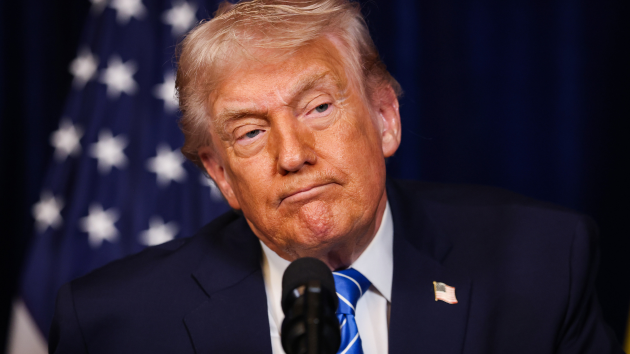
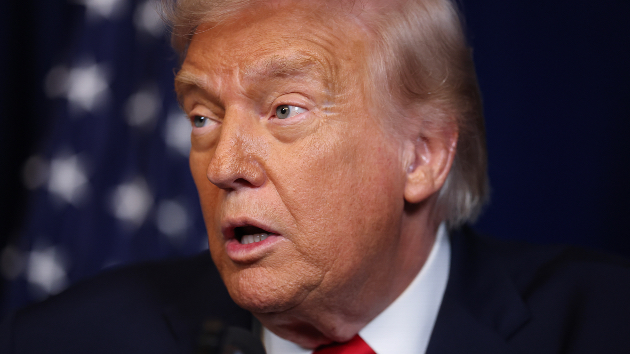
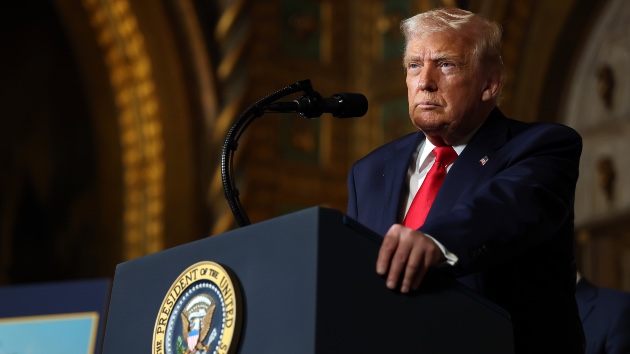
(WASHINGTON) In the latest reversal of his signature economic policy, President Donald Trump is rolling back tariffs on furniture, kitchen cabinets and vanities.
Higher tariff rates on those goods that were set to take effect Jan. 1 will now be delayed for another year, according to a White House fact sheet.
In October, the White House imposed a 25% tariff on upholstered furniture, kitchen cabinets and vanities. Rates for cabinets and vanities were set to go up to 50% in 2026, while upholstered wooden furniture — like sofas or chairs — were set to increase to 30%.
This move means that, for now, the 25% tariff stays in effect on all those goods until at least Jan. 1, 2027.
The White House cited “productive negotiations with trade partners to address trade reciprocity and national security concerns with respect to imports of wood products.”
Furniture prices have already been going up — the latest inflation report shows living room, kitchen and dining room furniture prices increased 4.6% in November compared to one year ago.
When the White House first announced the tariffs, stocks of companies that import furniture from overseas like Restoration Hardware, Wayfair and Williams Sonoma traded lower.
Amid many households’ concerns about affordability and rising prices, President Trump has already rolled back tariffs on more than 200 foods like coffee and bananas.
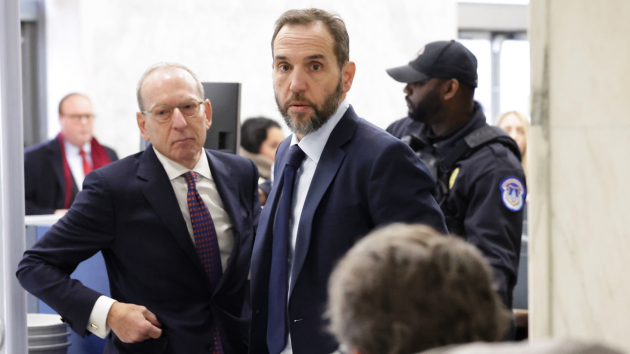
(Washington) Former special counsel Jack Smith defended his decision to bring charges twice against President Donald Trump — telling lawmakers in a closed-door deposition earlier this month that his team “had proof beyond reasonable doubt in both cases” that Trump was guilty of the charges in the 2020 election interference and classified documents cases.
And Smith fervently denied that there was any political influence behind his decision — contrary to what the Republicans on the House Judiciary Committee, who requested the testimony, alleged — such as pressure from then-President Joe Biden or Attorney General Merrick Garland.
“No,” Smith responded continuously.
Just over an hour before the closed testimony on Dec. 17, the Department of Justice sent an email to Smith’s lawyers preventing him from discussing the classified documents case, according to the 255-page transcript of the deposition, released Wednesday by the Judiciary Committee along with a video of the hearing.
This meant Smith was unable to answer most questions on that case and the deposition — intended to ask questions about the alleged weaponization of the DOJ against Trump and his allies — mainly focused on the 2020 election case instead.
Smith’s counsel said the DOJ also refused to send a lawyer to advise Smith on whether his statements were in line with their determination of what he could or could not say regarding the cases, according to the deposition. Smith did say, however, that Trump “obstructed” the classified documents investigation “to conceal his continued retention of those documents.”
Trump repeatedly denied the allegations in both felony cases, which were unprecedented against an American president, and decried them as part of a “witch hunt.” Smith, one of Trump’s frequent targets on social media, ultimately dropped the cases after Trump’s reelection because he said that he was constitutionally prohibited from prosecuting a sitting president.
Smith asserted in his final report that “but for Mr. Trump’s election and imminent return to the Presidency, the Office assessed that the admissible evidence was sufficient to obtain and sustain a conviction at trial.”
During the deposition, Smith argued, as he had in the past, that Trump “President Trump engaged in a criminal scheme to overturn the results of the 2020 election and to prevent the lawful transfer of power.”
When asked if Trump was responsible for the violence at the Capitol on Jan. 6, Smith said “Our view of the evidence was that he caused it and that he exploited it and that it was foreseeable to him.”
Smith argued that Trump’s claims that he won the 2020 election were not protected free speech because they were intended to target a government function.
“There is no historical analog for what President Trump did in this case. As we said in the indictment, he was free to say that he thought he won the election. He was even free to say falsely that he won the election,” Smith said. “But what he was not free to do was violate Federal law and use knowing — knowingly false statements about election fraud to target a lawful government function. That he was not allowed to do. And that differentiates this case from any past history.”
And Smith said Trump wrote a tweet that “without question in my mind endangered the life of his own Vice President” during the Jan. 6 attack on the Capitol.
Smith said several witnesses who said they voted or campaigned for Trump — including the Speaker of the House in Arizona and Speaker of the House in Michigan — were the foundation of the case.
“We had an elector in Pennsylvania who is a former Congressman who was going to be an elector for President Trump who said that what they were trying to do was an attempt to overthrow the government and illegal. Our case was built on, frankly, Republicans who put their allegiance to the country before the party,” Smith said.
Asked why Smith did not charge any of the alleged co-conspirators, Smith said “As we stated in the final report, we analyzed the evidence against different co-conspirators. We — my staff determined that we did have evidence to charge people at a certain point in time. I had not made final determinations about that at the time that President Trump won reelection, meaning that our office was going to be closed down.”
Smith said he had evidence that Trump ordered the alleged co-conspirators to place phone calls to senators the night of Jan. 6 to try and delay the certification vote.
The committee pressed Smith why he did not speak with Trump allies Steve Bannon, Roger Stone or Peter Navarro as part of their investigation.
“We pursued the investigative routes that we thought were the most fruitful,” Smith argued. “I didn’t think it would be fruitful to try to question them.”
And they pressed him on seizing phones of members of Congress. Smith said only Scott Perry had his phone seized and no senators did.
“I don’t recall that,” Smith said when asked if he wanted a search warrant for the content of any text messages from members of Congress.
Smith said he just wanted toll records and confirmed that he approved the subpoenas.
“If Donald Trump had chosen to call a number of Democratic Senators, we would have gotten toll records for Democratic Senators. So responsibility for why these records, why we collected them, that’s — that lies with Donald Trump,” Smith said.
Smith recalled that Jim Jordan, the Judiciary Committee chair, was in direct contact with White House on Jan. 6, according to an interview his team conducted with Mark Meadows.
Meadows stated that Jordan was scared. “I’ve never seen Jim Jordan scared of anything,” Meadows said, according to Smith.
Smith said he is “eyes wide open” that he believes Trump will seek retribution against him.
“I came here. I was asked to come here,” he added.
(WASHINGTON) — The Department of Justice is asking for help reviewing 5.2 million pages of unreviewed documents related to convicted sex offender Jeffrey Epstein, seeking to enlist 400 lawyers total from its criminal and national security divisions along with the U.S. attorneys’ offices in Florida and New York, according to people familiar with the matter.
As Deputy Attorney General Todd Blanche told ABC News Chief Justice Correspondent Pierre Thomas in an interview earlier this month, the DOJ already had nearly 200 lawyers working to review the files.
But in recent days, department leadership has made clear to the workforce that more help is needed.
The New York Times was first to report the development.
The review of the documents is expected to take much of January, the sources said.
The reorienting of resources from both the criminal and national security divisions has already raised concerns among current and former DOJ officials given the department has already diverted many of those resources towards immigration enforcement, according to sources familiar with the matter.
At this point, the next release of documents is not expected until the end of next month, according to the sources.
Congress passed the Epstein Files Transparency Act in November mandating the release of the DOJ’s files on Epstein. The measure required the DOJ to release all of the documents, with certain exceptions like protecting victim privacy and ongoing investigations, by Friday, Dec. 19. Missing the deadline, the DOJ said it has been delayed by the vetting process to protect victims.
It’s not immediately clear why the Department of Justice is only now claiming that it has just discovered upward of 5 million pages of documents from its investigations into Epstein, who died by suicide in 2019 in his jail cell awaiting trial on sex trafficking charges.
In February, Attorney General Pam Bondi admonished the U.S. Attorney’s office for the Southern District of New York after she said they had only just alerted her to the existence of hundreds of thousands of documents that they had not previously provided to her office. It’s not clear why they are only now claiming to be alerted to this vast volume of alleged unreviewed material.
(WASHINGTON) — President Donald Trump issued vetoes for the first bills of his second term, including a bipartisan bill intended to provide funding for a water infrastructure project in Colorado, a measure that passed the House and Senate unanimously.
The Finish the Arkansas Valley Conduit Act was set to provide clean water to rural parts of Colorado.
“Enough is enough. My administration is committed to preventing American taxpayers from funding expensive and unreliable policies,” Trump wrote in a veto letter sent to Congress. “Ending the massive cost of taxpayer handouts and restoring fiscal sanity is vital to economic growth and the fiscal health of the nation.”
Trump also vetoed the Miccosukee Reserved Area Amendment Act, a bipartisan bill that aimed in part to optimize water flow into part of Everglades National Park designated for the Miccosukee Native American tribe and to incorporate the Osceola Camp into the Miccosukee Reserved Area to improve the governing structure of the tribe.
“[D]espite seeking funding and special treatment from the Federal Government, the Miccosukee Tribe has actively sought to obstruct reasonable immigration policies that the American people decisively voted for when I was elected,” Trump wrote in his veto. “My Administration is committed to preventing American taxpayers from funding projects for special interests, especially those that are unaligned with my Administration’s policy of removing violent criminal illegal aliens from the country.”
The Miccosukee tribe was part of the opposition to the construction of the so-called “Alligator Alcatraz” migrant detention facility in the Everglades.
Trump’s veto of the bipartisan bill supporting the Colorado project comes at a time when he has fractious relations with some of the state’s political leaders.
The bill was co-sponsored by House Republican Rep. Lauren Boebert of Colorado, who defied the Trump administration by signing onto the Epstein discharge petition that forced a vote on a measure to compel the DOJ to release the files. The pipeline would provide water to residents of Boebert’s district.
“This isn’t over,” Boebert said on social media on Tuesday, responding to the White House’s veto announcement.
Democrats also are responding to the bill’s veto, with Colorado’s Democratic Sens. Michael Bennet and John Hickenlooper lambasting Trump on social media, with both accusing him of playing partisan politics.
“Trump just vetoed my Arkansas Valley Conduit bill — passed unanimously to deliver clean, affordable water to Southeast Colorado,” Bennet said. “This isn’t governing. It’s a revenge tour.”
“Donald Trump is playing partisan games and punishing Colorado by making rural communities suffer without clean drinking water,” Hickenlooper said, adding that Congress should overturn Trump’s veto.
Since the bill cleared both chambers unanimously, Congress could overturn Trump’s veto. Doing so would require passing the measure by a two-thirds vote in both chambers. Trump vetoed ten bills total during his first administration, only one of which — the National Defense Authorization Act for Fiscal Year 2021 — was overridden by Congress.
Trump’s veto also comes two weeks after he attacked Colorado Gov. Jared Polis for refusing to release former Mesa County, Colorado, clerk Tina Peters from prison following her receiving a presidential pardon.
Peters was convicted on state charges for a scheme to tamper with voting systems driven by false claims about the 2020 election. Trump’s pardon power does not extend to state crimes.
“The poorly run state of Colorado with a governor whose incompetent and frankly, with a governor that won’t allow our wonderful Tina to come out of a jail, in a high intensity jail because she caught people cheating on an election and they said she was cheating,” Trump said on Dec. 15.
He added, “She wasn’t cheating. She went over, she looked at one of the election scams going on. And because she did that, they put her in jail for nine years.”
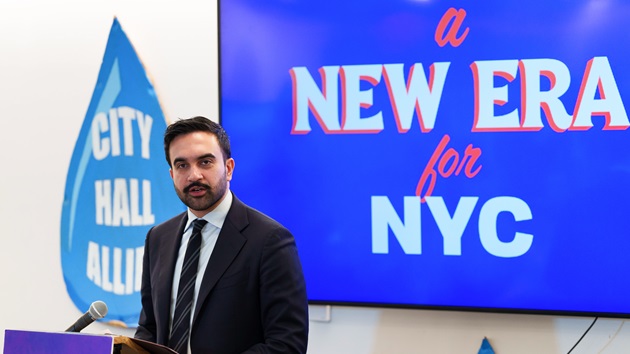
Zohran Mamdani, mayor-elect of New York, during an announcement in New York, US, on Monday, Dec. 22, 2025. Adam Gray/Bloomberg via Getty Images
(NEW YORK) — Zohran Mamdani, the state assemblyman and democratic socialist who catapulted to national attention during the 2025 race for New York City mayor, is set to be inaugurated on New Year’s Day 2026 in a ceremony that will usher in historic leadership for America’s largest city, as Mamdani becomes the city’s first Muslim mayor and first mayor of South Asian descent.
“I think this is an important day for New Yorkers and even for the United States. The Mamdani inaugural on Jan. 1 is going to attract a global audience,” Mitchell Moss, a professor of urban policy at New York University, told ABC News.
Mamdani will be formally sworn in during a private ceremony by New York Attorney General Letitia James at midnight Thursday. That will take place in the now-decommissioned original City Hall subway station, which is known for its ornate arches and tiled ceiling.
Mamdani will be sworn in during the midnight ceremony on a centuries-old Qur’an from the New York Public Library’s collections, the library said Wednesday.
Laura Tamman, a political science professor at Pace University, said she sees both historical and practical significance in that location.
It is “acknowledging the history of the city,” she said. “It also, honestly, is a secure location … It was such a divisive campaign.”
Mamdani faced death and car bomb threats during his campaign, which included threats that targeted his Muslim faith.
“Whenever you have someone who’s making history like this — I’m sure that there are more security concerns than there were for, say, [former Mayor] Bill de Blasio’s swearing-in,” Tamman said.
At his public inauguration ceremony, set for 1 p.m. ET on the steps of New York City Hall on Thursday, Mamdani will be sworn in by Vermont Sen. Bernie Sanders, a Brooklyn-born independent and fellow democratic socialist who has been an ideological ally.
Rep. Alexandria Ocasio-Cortez, a fellow democratic socialist who represents a swath of the Bronx, will also deliver remarks.
Moss said that having Sanders be a part of the inauguration makes a statement “that this is a national event … so I think that [Mamdani is] identifying his ideological roots and his connection to national politics.”
Tamman, meanwhile, said that “Ocasio-Cortez was, similarly to [Mamdani], really underestimated by the Democratic establishment, and has gone on to become a really important leader in the party.”
Mamdani’s transition team has also said that Cornelius Eady, a prolific poet and a National Book Award finalist, will read a new poem at Mamdani’s inauguration, and that the inauguration will include a block party open to the public.
Mamdani triumphed over independent candidate former New York Gov. Andrew Cuomo and Republican candidate Curtis Sliwa after campaigning largely on making the city more affordable, although he often faced questions over his relative lack of political experience and feasibility of his proposals. His campaign promises included a rent freeze for rent-stabilized apartments, free bus fares and free childcare for children aged 6 weeks to 5 years.
During the campaign, he took stances on policing and public safety more moderate than how he had spoken about policing previously, and committed during his campaign to keeping on New York City’s current police commissioner, Jessica Tisch.
Mamdani will also face the challenge of translating his campaign promises into reality, which will include working with the state government, which controls taxes, and the city council on various city proposals.
At an event on Tuesday with reporters, Mamdani focused largely on administration appointments and the road ahead.
“I will demand excellence from my team, from myself, and also, I will ensure that we create the conditions where that excellence is possible to deliver on,” he said while responding to questions about the city’s Law Department.
Moss said that “no one expects a new mayor to do everything they promise, but they have to be making progress on their promises.”
“So Mamdani has to have some wins this year, which lay the ground for bigger wins in the future. And I think the key part is that he has identified what he wants,” Moss said.
The new mayor will also have to navigate the liberal-leaning city’s relationship with the Republican-controlled federal government. In November, Mamdani met with President Donald Trump in what was widely expected to be a contentious meeting, but ended up being very cordial.
During the meeting, Trump and Mamdani said they agreed on many things, after they had criticized each other for months during the campaign.
“I think you’re going to have, hopefully, a really great mayor; and the better he does, the happier I am,” Trump said at the time.
Neera Tanden, president of the liberal-leaning Center for American Progress, said on ABC’s “This Week” on Sunday that Mamdani “has to get the rents down. He has to make sure the city runs well.”
“But I think a lot of people look at the fact that he was able to get Donald Trump to basically compliment him,” she added.
ABC News’ Ivan Pereira contributed to this report.
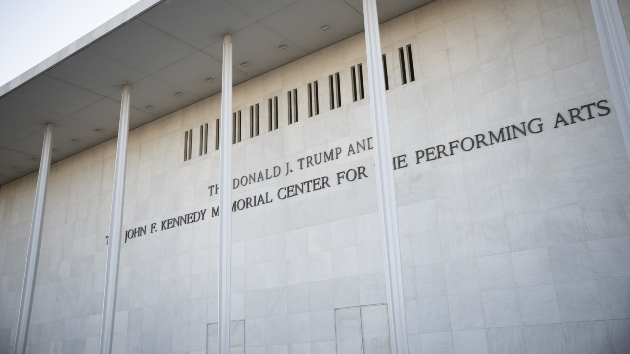
(WASHINGTON) — Several artists have cancelled their upcoming performances at the newly renamed Trump-Kennedy Center in Washington, D.C., publicly voicing their opposition to President Donald Trump’s name being added to the signage of the building last week.
Jazz musician Chuck Redd canceled his Christmas Eve event, while jazz group The Cookers announced on social media that they will be cancelling their New Year’s Eve performance at the cultural center.
On Monday evening, Doug Varone and Dancers, a New York dance company, announced in an Instagram post that it was canceling its scheduled April performances.
Posting an image of the official portrait of late President John F. Kennedy, Doug Varone and Dancers wrote that it was an “honor” to be invited to perform, but the group “totally disagreed with the takeover by the Trump Administration at the Kennedy Center.”
” … With the latest act of Donald J. Trump renaming the Center after himself, we can no longer permit ourselves nor ask our audiences to step inside this once great institution,” the statement said, in part.
“The Kennedy Center was named in honor of our 35th President who fervently believed that the arts were the beating heart of our nation, as well as an integral part of international diplomacy. We hope in three-year’s time, that the Center and its reputation will return to that glory,” the statement continued.
After the renaming last week, folk singer Kristy Lee announced in an Instagram post that she is canceling a free performance scheduled for Jan. 14 at the center.
“I won’t lie to you, canceling shows hurts. This is how I keep the lights on. But losing my integrity would cost me more than any paycheck,” Lee wrote in the post.
Richard Grenell, the Trump-appointed president of the Trump-Kennedy Center, criticized the recent cancellations in a Monday evening X post, where he cast the musicians as “far left political activists.”
“The artists who are now canceling shows were booked by the previous far left leadership,” Grenell wrote.
“Their actions prove that the previous team was more concerned about booking far left political activists rather than artists willing to perform for everyone regardless of their political beliefs. Boycotting the Arts to show you support the Arts is a form of derangement syndrome. The arts are for everyone and the left is mad about it,” he added.
Grenell also indicated in a letter addressed to Redd, who canceled his Christmas Eve show, that the center plans to file a $1 million lawsuit against the jazz musician and called the move a “political stunt.”
It is unclear if Redd has obtained legal representation. ABC News reached out to him for comment.
The cancellations came after the Trump administration announced on Dec. 18 that the board at the Kennedy Center, which Trump now chairs and is newly filled with his appointees, voted “unanimously” to rename the building the “Trump-Kennedy Center.” The signage was updated a day later.
The national cultural center, which is located on the banks of the Potomac River, was originally named the John F. Kennedy Center for the Performing Arts to honor the late president, and it first opened its doors on Sept. 8, 1971.
Trump, who was sworn in for his second term as president on Jan. 20, dismissed most of the Board of Trustees during his first weeks back in office and replaced them with his own appointees. In February 2025, the new board announced that they had elected Trump as chairman.
Several musicians also cancelled performances or engagements at the Center earlier this year after Trump was elected as chair.
The artists who cancelled shows over the past year include musician Rhiannon Giddens, rock band Low Cut Connie and actor Issa Rae. Meanwhile, musician Ben Folds resigned from his role as the adviser to the center’s National Symphony Orchestra and producer Shonda Rhimes resigned as treasurer of the Kennedy Center’s board.
Singer and actress Renée Fleming also resigned from her role as artistic advisor at large after Trump purged the Center’s leadership. Fleming is scheduled to perform at the Trump-Kennedy Center in May 2026.
Writer Lin-Manuel Miranda’s hit musical “Hamilton,” which was scheduled for a run at the Kennedy Center in the spring of 2026, was canceled back in March.
“We have sadly seen decades of Kennedy Center neutrality be destroyed,” the show’s producer Jeffrey Seller wrote in a statement posted to Facebook.
White House press secretary Karoline Leavitt said in a social media post that the board voted to rename the center “because of the unbelievable work President Trump has done over the last year in saving the building.”
The post appears to refer to recent restorations and renovations that were touted by Trump during his speech at the Kennedy Center Honors dinner on Dec. 7.
House Democratic Rep. Joyce Beatty, who serves as an ex officio member of the center’s board, sued Trump on Monday, arguing that the board’s vote to rename the building was illegal because an act of Congress is required for such an action.
Asked for comment on the lawsuit, White House spokesperson Liz Huston instead told ABC News in a statement on Monday that the Kennedy Center’s board voted to rename it after Trump “stepped up and saved the old Kennedy Center.”
ABC News’ Chad Murray, Hannah Demissie, Isabella Murray, Michelle Stoddart, Karen Travers, Lauren Peller and Alex Ederson contributed to this report.
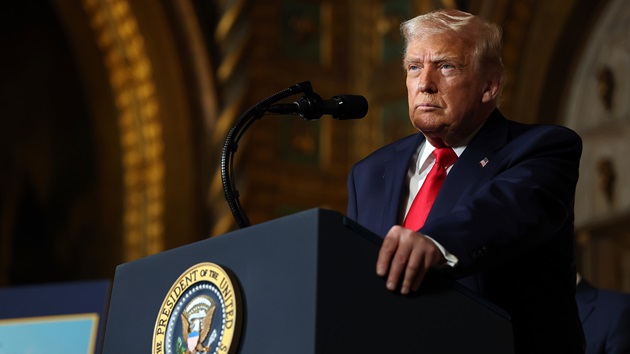
U.S. President Donald Trump takes questions during a statement to the media at Trump’s Mar-a-Lago estate on December 22, 2025 in Palm Beach, Florida. Tasos Katopodis/Getty Images
(WASHINGTON) — President Donald Trump said on Monday that the United States “hit” a dock in Venezuela where drugs were allegedly being loaded onto boats.
The comments came after Trump said in a radio interview last Friday that the U.S. “knocked out” a “big facility” in Venezuela as he touted his administration’s effort to stop drug trafficking from the region, including strikes against alleged drug boats.
“And we just knocked out, I don’t know if you read or you saw, they have a big plant or a big facility where they send the, you know, where the ships come from. Two nights ago we knocked that out, so we hit them very hard,” Trump said on WABC’s “Cats and Cosby,” though he didn’t provide specifics.
If Trump’s comments are accurate, then it would mark the first known attack on land in Venezuela since the Trump administration began its campaign against the country.
On Monday, as he welcomed Israeli Prime Minister Benjamin Netanyahu to his Mar-a-Lago club, Trump was pressed by a reporter for more details on the strike — including whether the action was carried out by the U.S. military after Trump confirmed in October that he authorized the CIA to operate inside the South American nation.
“Well, it doesn’t matter, but there was a major explosion in the dock area where they load the boats up with drugs,” Trump responded. “They load the boats up with drugs. So we hit all the boats and now we hit the area. It’s the implementation area. That’s where they implement. And that is no longer around.”
ABC News has reached out to the Pentagon and the White House for comment; the Pentagon referred ABC News to the White House for comment. The CIA declined to comment on the matter.
Trump has teased land action in Venezuela for weeks.
The U.S. has also built up its military presence in the region, with 15,000 U.S. troops and several warships standing ready in the Caribbean. Earlier this month, Trump ordered what he called a “complete blockade” of all sanctioned oil tankers going into and out of Venezuela, targeting the government’s main source of revenue.
“He can do whatever he wants, it’s alright, whatever he wants to do. If he wants to do something, if he plays tough, it’ll be the last time he’s ever able to play tough,” Trump said.
U.S. President Donald Trump takes questions during a statement to the media at Trump’s Mar-a-Lago estate on December 22, 2025 in Palm Beach, Florida. Tasos Katopodis/Getty Images
(WASHINGTON) — President Donald Trump said that the United States “knocked out” a “big facility” in Venezuela last week, in what appears to be a reference to a strike on a drug trafficking site in the country.
Trump, in a radio interview with on WABC’s “Cats and Cosby” on Friday, was discussing his administration’s effort to stop drug trafficking from the region, including strikes against alleged drug boats, when he made the comment.
“And we just knocked out, I don’t know if you read or you saw, they have a big plant or a big facility where they send the, you know, where the ships come from. Two nights ago we knocked that out, so we hit them very hard,” Trump said in the interview.
The New York Times reported that American officials said that Trump was referring to a drug facility in Venezuela and that it was eliminated, but gave no further details.
If Trump’s comments are accurate, then it would mark the first known attack on land in Venezuela since the Trump administration began its campaign against the country.
ABC News has reached out to the Pentagon and the White House for comment; the Pentagon referred ABC News to the White House for comment. The CIA declined to comment on the matter.
Trump has teased land action in Venezuela for weeks, confirming in October that he authorized the CIA to operate inside the South American nation.
The U.S. has also built up its military presence in the region, with 15,000 U.S. troops and several warships standing ready in the Caribbean. Earlier this month, Trump ordered what he called a “complete blockade” of all sanctioned oil tankers going into and out of Venezuela, targeting the government’s main source of revenue.
“He can do whatever he wants, it’s alright, whatever he wants to do. If he wants to do something, if he plays tough, it’ll be the last time he’s ever able to play tough,” Trump said.
This is a developing story. Please check back for updates.
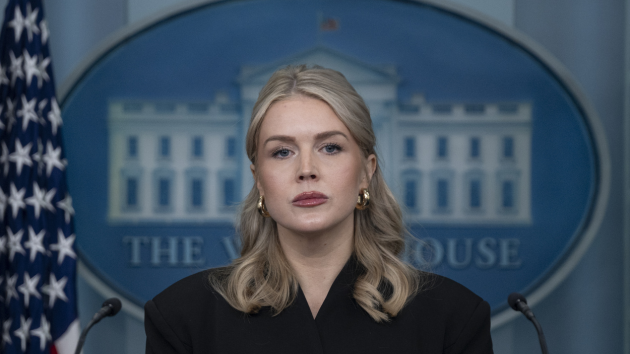
The White House Press Secretary Karoline Leavitt speaks at the White House press briefing room in Washington DC, United States, on December 11, 2025. (Photo by Celal Gunes/Anadolu via Getty Images)
(WASHINGTON) — White House press secretary Karoline Leavitt announced on Friday that she is pregnant with her second child.
“The greatest Christmas gift we could ever ask for – a baby girl coming in May 2026,” Leavitt wrote in a post to Instagram.
“My husband and I are thrilled to grow our family and can’t wait to watch our son become a big brother. My heart is overflowing with gratitude to God for the blessing of motherhood, which I truly believe is the closest thing to Heaven on Earth,” she wrote.
“I am also extremely grateful to President Trump and our Chief of Staff Susie Wiles for their support, and for fostering a pro-family environment in the White House. 2026 is going to be a great year and I am so excited to be a girl mom!” Leavitt added in the social media post.
Leavitt is 28 years old and is the youngest person to serve as White House press secretary. She previously worked in the press office during President Donald Trump’s first term and also served as the press secretary for his 2024 campaign.
Leavitt ran a failed bid for Congress in New Hampshire, her home state, in 2022.
She and her husband, Nicholas Riccio, welcomed their first child, Nicholas “Niko” Robert Riccio, in 2024.
U.S. President Donald Trump at Trump’s Mar-a-Lago estate on December 22, 2025 in Palm Beach, Florida. (Photo by Tasos Katopodis/Getty Images)
(WASHINGTON) — President Donald Trump said in a post on his social media platform Thursday that he launched a “powerful and deadly strike” on ISIS terrorists in Nigeria, whom he claimed have been “targeting and viciously killing, primarily, innocent Christians.”
This comes after the president posted a video in early November threatening to go into Nigeria “guns-a-blazing.” Around that time, Defense Secretary Pete Hegseth echoed Trump’s message and said in a post on X that the Department of Defense was “preparing for action.”
“I have previously warned these Terrorists that if they did not stop the slaughtering of Christians, there would be hell to pay, and tonight, there was. The Department of War executed numerous perfect strikes, as only the United States is capable of doing,” Trump added in the post.
It is not yet clear the outcome of that strike or what the exact target was. ABC News has asked the White House for more information.
In a post on X, Hegseth further said there will be “more to come” and expressed his gratitude to the Nigerian government for its support and cooperation.
“The President was clear last month: the killing of innocent Christians in Nigeria (and elsewhere) must end.
“The @DeptofWar is always ready, so ISIS found out tonight — on Christmas.”
Hegseth ended his post with, “Merry Christmas!”
In a post on X, U.S. Africa Command confirmed the strikes, which it said were conducted “in coordination with Nigerian authorities.”
The Nigerian Ministry of Foreign Affairs in Abuja later released a statement saying that the U.S. strikes were carried out together with Nigerian authorities and are part of the ongoing security work they do with the U.S. and other partners to tackle ISIS and extremist groups.
“In line with established international practice and bilateral understandings, this cooperation includes the exchange of intelligence, strategic coordination, and other forms of support consistent with international law, mutual respect for sovereignty, and shared commitments to regional and global security,” the ministry said.
The Defense Department also reposted President Trump’s statement, along with a brief video clip labeled “unclassified” that shows a missile being launched from a ship, presumably at targets in Nigeria.
The strike against ISIS in Nigeria Thursday comes just days after U.S. strikes were launched against ISIS in Syria, following an attack on U.S. and partner forces in Syria that killed three Americans earlier this month.
Trump in November instructed the Pentagon to prepare for possible action against Nigeria after accusing the Nigerian government of not doing enough to protect Christians from violence.
Asked if there was a possibility of U.S. troops being boots on the ground in the West African country, Trump replied, “Could be.”
“They’re killing the Christians and killing them in very large numbers, we’re not going to allow that to happen,” he said.
Days later, the State Department officially updated its designation for Nigeria as a “Country of Particular Concern” (CPC) for its alleged “severe violations of religious freedom” and persecution of Christians.
Last week, Nigeria was also added to the U.S. travel ban list of countries facing partial restrictions and entry limitations.
Nigerian President Bola Tinubu doesn’t deny the violence against Christians in Nigeria, but says previous claims that Nigeria is religiously intolerant “does not reflect our national reality.”
Independent experts say extremist groups have targeted both Muslims and Christians in Nigeria, killing tens of thousands of civilians in recent years.
On Christmas Eve, Nigerian President Bola Tinubu posted on X, saying that he prayed “for peace in our land, especially between individuals of differing religious beliefs.”
“I stand committed to doing everything within my power to enshrine religious freedom in Nigeria and to protect Christians, Muslims, and all Nigerians from violence,” the post continued.