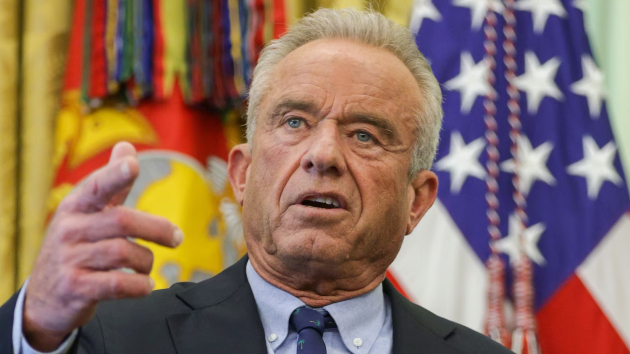
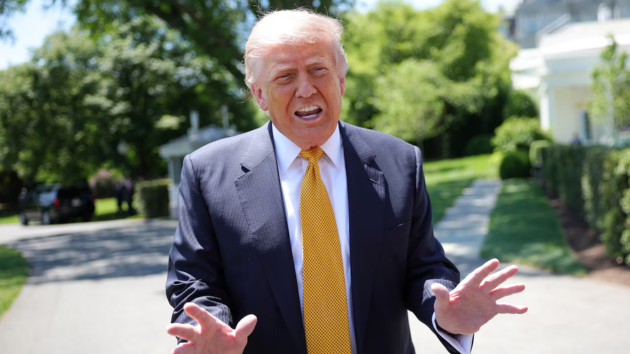
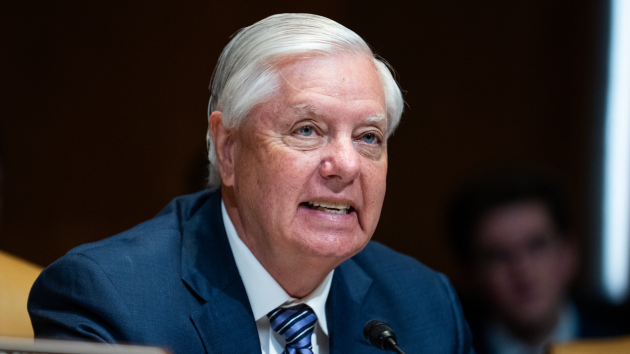
Secretary of Health and Human Services Robert F. Kennedy Jr. speaks during an event on advancing health care affordability in the Oval Office of the White House, April 23, 2026 in Washington. (Alex Wong/Getty Images)
(WASHINGTON) — One of Health Secretary Robert F. Kennedy Jr.’s top public affairs spokespeople resigned from his post over the FDA’s fruit-flavored e-cigarettes authorization and its potential impact on minors, according to a resignation letter to President Donald Trump reviewed by ABC News.
In the letter, Richard Danker, the former assistant secretary for public affairs at the Department of Health and Human Services, accuses senior agency officials in Kennedy’s immediate office of approving e-cigarette flavors that would allegedly expose children to “nicotine addiction, lung damage, and a higher risk of cancer.”
Danker also said the vape authorization “undermines” the department’s recent guidance document related to youth risks of flavored nicotine, according to the letter.
He thanked Trump for the “honor of a lifetime” to serve in both presidential administrations. Danker’s work portfolio includes economic regulatory roles, including a senior advisor position at the Department of Treasury during the first Trump administration. Danker hadn’t worked in healthcare prior to his time at HHS.
The Trump administration’s Make America Healthy Again movement has touted its focus on combatting chronic disease and improving children’s health. In a statement to ABC News, an HHS spokesperson said Kennedy is advancing the MAHA agenda to confront the chronic disease epidemic head-on.
“Political appointees are here to execute that mission with urgency, discipline, and focus,” according to the spokesperson.
“Individuals who lose sight of the mission and the responsibility they were entrusted with are free to move on from the agency. HHS remains fully committed to delivering results for the American people,” the spokesperson said.
Danker provided ABC News with a copy of the resignation letter, but did not provide further comment.
The White House did not immediately respond to ABC News’ requests for comment.
The news comes as former Food and Drug Administration Commissioner Marty Makary left office after clashing with the White House over pressure from Trump to authorize the flavored vapes, sources familiar with the matter told ABC News.
The issue has raised concerns with Makary, pediatrician groups and advocacy organizations about the potential impact on minors, ABC News reported.
The FDA approved four new devices made by Glas, including classic menthol, fresh menthol, gold, and sapphire pods. “Gold” is mango-flavored and “sapphire” is blueberry-flavored.
While the FDA said on its website last week that it continues to prioritize the removal of illicit vapes — including those that target minors — the approval of a flavored vape represents a significant shift for the agency.
Makary told ABC News’ Linsey Davis in July, “There is not an approved vaping product in the United States that has one of these cutie-fruity flavors.”
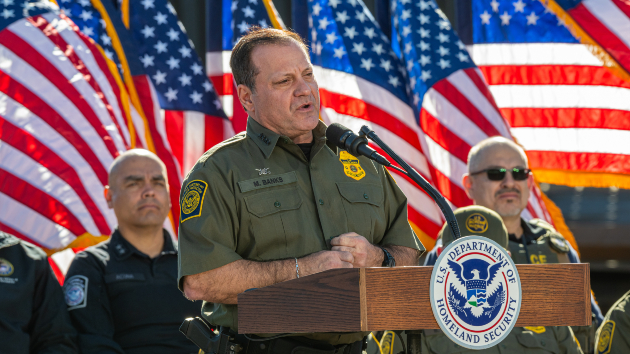
Michael Banks, chief of the US Border Patrol, speaks during a news conference in Nogales, Arizona, US, on Wednesday, Feb. 4, 2026. (Ash Ponders/Bloomberg via Getty Images)
(WASHINGTON) — Michael Banks, the head of U.S. Border Patrol, is stepping down, U.S. Customs and Border Protection Commissioner Rodney Scott confirmed on Thursday.
This is a developing story. Please check back for updates.
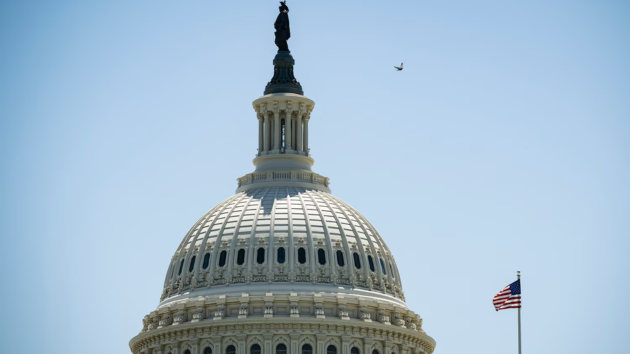
The U.S. Capitol Building dome, on May 12, 2026, in Washington, DC. (Graeme Sloan/Getty Images)
(WASHINGTON) — Senators adopted a resolution by unanimous consent on Thursday to withhold their own pay during government shutdowns.
The legislation, which won’t take effect until after the November 2026 election, instructs the secretary of the Senate to place senators’ paychecks on hold during the duration of any future federal government shutdowns.
Those payments would be released to lawmakers only after the government reopens.
The Senate resolution does not need to be passed by the House or signed by President Donald Trump. While multiple similar House bills have been introduced, it’s unclear if legislation in the lower chamber will pass.
The measure in the Senate was introduced by Republican John Kennedy and advanced in a unanimous 99-0 vote on Wednesday.
“Take your brain with you, because this is about shared sacrifice. This is about putting our money where our mouth is,” Sen. Kennedy said on the Senate floor ahead of Wednesday’s vote.
Kennedy’s resolution comes after federal workers faced a historic 43-day government shutdown late last year caused by a deadlock between parties over Affordable Care Act subsidies.
During that time, approximately 670,000 federal workers were furloughed, 60,000 workers outside the federal government lost their jobs and Supplemental Nutrition Assistance Program (SNAP) recipients lost out on benefits all while members of Congress continued to get paid — highlighting the disparity of financial pain endured by members of Congress and the people they serve.
Calls for withholding pay from members of Congress continued to grow this year during the record 75-day partial shutdown of the Department of Homeland Security. Transportation Security Administration agents, Coast Guard members and other department employees went without pay as a stalemate played out on Capitol Hill over immigration enforcement funding and oversight reforms.
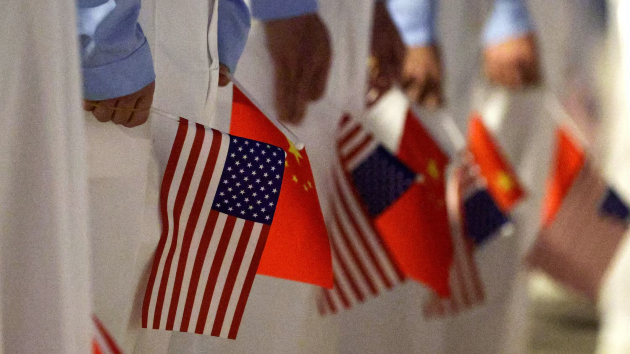
Chinese youth hold American and Chinese flags as they join officials to welcome U.S. President Donald Trump at Beijing Capital International Airport, May 13, 2026 in Beijing, China. (Alex Wong/Getty Images)
(BEIJING, China) — Chinese President Xi Jinping issued a warning to President Donald Trump during their high-stakes summit in Beijing, saying that if the issue of Taiwan is handled “improperly,” the two nations could “come into conflict,” according to China’s official state broadcaster Xinhua.
The trip came at a crucial time for Trump as the war with Iran loomed and was leading to economic consequences for Americans at home. China is Iran’s principal oil consumer.
Particularly thorny for China is the issue of Taiwan and the U.S. position on the matter has long been delicate.
However, Xi did say that if the issue is handled “properly,” “bilateral relations can remain generally stable.”
After a dramatic welcoming ceremony, Trump sat down with Xi on the first day of a multi-day summit, during which Trump said he’d seek to deepen diplomatic and economic ties between the world’s two largest economic powers.
Trump and Xi had a “good meeting,” according to a White House official, but the official readout has no mention of Taiwan — which Xi earlier warned of a “conflict” if the issue was handled improperly.
Iran was also discussed between the leaders, with both sides agreeing that the Strait of Hormuz should remain open. This is a position China has already held.
“The two sides agreed that the Strait of Hormuz must remain open to support the free flow of energy. President Xi also made clear China’s opposition to the militarization of the Strait and any effort to charge a toll for its use, and he expressed interest in purchasing more American oil to reduce China’s dependence on the Strait in the future. Both countries agreed that Iran can never have a nuclear weapon.”
The meeting also covered investments, economic cooperation, fentanyl and increasing Chinese purchases of American farm products.
The bilateral meeting between the two leaders in the Great Hall of the People lasted about 2 hours and 15 minutes, according to pool reporters traveling with the president.
Ahead of the meeting, after Trump and a slate of other U.S. officials had gathered around the negotiating table, Trump called Xi a “great leader” and touted their relationship.
“Such respect for China, the job you’ve done. You’re a great leader. I say it to everybody. You’re a great leader,” Trump said. “Sometimes people don’t like me saying it, but I say it anyway, because it’s true. I always say the truth.”
“We’ve had a fantastic relationship. We’ve gotten along,” Trump said. “When there were difficulties, we worked it out. I would call you, and you would call me, and whenever we had a problem — people don’t know — whenever we had a problem, we worked it out very quickly, and we’re going to have a fantastic future together.”
In his opening remarks, Xi told Trump that China and the U.S. “both stand to gain from cooperation and lose from confrontation.”
“We should be partners, not rivals, “he continued. “We should help each other succeed and prosper together and find the right way for major countries to get along well with each other in the new era.”
According to a bulletin from Xinhua, Xi emphasized that the issue of Taiwan is “the most important issue in China-U.S. relations,” saying if they are “if handled improperly, the two countries will clash or even come into conflict, pushing the entire China-U.S. relationship into a very dangerous situation.”
Ahead of the visit, Secretary of State Marco Rubio told Fox News that the U.S. will urge China to take a more assertive role in resolving the U.S.’s war with Iran during Trump’s meeting with Xi.
“It’s in their interest to resolve this. We hope to convince them to play a more active role in getting Iran to walk away from what they’re doing now and trying to do now in the Persian Gulf,” Rubio said during an interview taped on Air Force One Tuesday while Rubio and Trump were on their way to Beijing.
“We’ve made clear to them, you know, that any support for Iran would obviously be detrimental for our relationship. That obviously is going to come up in this conversation,” Rubio said.
Ahead of the state dinner, Trump was asked whether the pair would discuss diplomatic ways to end the war with Iran, which is in its third month. China is a key buyer of Iranian oil, which could give it considerable diplomatic leverage over Tehran, experts told ABC News. Trump said the U.S. had Iran “very much under control,” adding that it would be among the topics discussed.
“We’re either going to make a deal or they’re going to be decimated, one way or the other. We win,” Trump said. “We’re going to be talking about, we’re going to be talking with President Xi.”
In remarks at the Great Hall this morning, President Trump delivered a history lesson of the “special” US-China relationship, while thanking his “friend” President Xi for a “magnificent welcome like none other.”
Trump called this a “historic visit” that resulted in “extremely positive and productive conversations,” even extending an invite for Xi to visit the U.S on Sept. 24.
The last time Xi visited the White House was in September 2015 when former President Obama hosted him for a State Visit. The visit will be one of four meetings that the leaders wanted to have this year as part of their agreement last fall that put a pause on the tit-for-tat tariff war last year.
Trump said on social media on Tuesday that he planned to ask Xi to “open up” the Chinese economy. The U.S. delegation includes Rubio, Treasury Secretary Scott Bessent, Defense Secretary Pete Hegseth, U.S. Ambassador to China David Perdue and U.S. Trade Representative Jamieson Greer. CEOs Elon Musk of Tesla and SpaceX, Tim Cook of Apple and Jensen Huang of NVIDIA as well as the president’s son Eric Trump and daughter-in-law Lara Trump were also present.
Trump said the business leaders joined him to “pay respects” to Xi.
“We asked the top 30 in the world. Every single one of them said ‘yes,’ and I didn’t want the second or the third in the company. I wanted only the top. And they’re here today to pay respects to you and to China, and they look forward to trade and doing business, and it’s going to be totally reciprocal on our behalf,” Trump said.
The White House said one of Trump’s goals going into the summit with Xi is to secure purchasing agreements with China in the aerospace, agriculture and energy sectors and the CEOs traveled with the president to help push for that.
China’s Foreign Ministry spokesperson, Guo Jiakun, said that the scheduled diplomatic meetings were expected to play “an irreplaceable role in providing strategic guidance for China-U.S. relations.”
“During the visit, the two heads of state will have an in-depth exchange of views on major issues concerning China-U.S. relations and world peace and development,” Guo added, according to a transcript published by the ministry. “China stands ready to work with the U.S. to expand cooperation and manage differences in the spirit of equality, respect and mutual benefit, and provide more stability and certainty for a transforming and volatile world.”
ABC News’ Mariam Khan and Fritz Farrow contributed to this report.
The U.S. Capitol Building dome, on May 12, 2026, in Washington, DC. (Graeme Sloan/Getty Images)
(WASHINGTON) — In an unanimous 99-0 vote, the Senate on Wednesday advanced a resolution to withhold pay from senators during a government shutdown.
Republican Sen. Pete Ricketts did not vote on the resolution, which was introduced by Republican Sen. John Kennedy of Louisiana.
The vote was a procedural one. The legislation now moves toward final passage, and is expected to pass with resounding support.
The legislation, which would take effect after the November 2026 election, would instruct the secretary of the Senate to place senators’ paychecks on hold during the duration of any future federal government shutdowns. Those payments would be released to lawmakers only after the government reopens.
While multiple similar House bills have been introduced, it’s unclear if legislation in the lower chamber will pass.
“Take your brain with you, because this is about shared sacrifice. This is about putting our money where our mouth is,” Sen. Kennedy said on the Senate floor ahead of Wednesday’s vote.
Kennedy’s resolution comes after federal workers faced a historic 43-day government shutdown late last year caused by a deadlock between parties over Affordable Care Act subsidies.
During that time, approximately 670,000 federal workers were furloughed, 60,000 workers outside the federal government lost their jobs and Supplemental Nutrition Assistance Program (SNAP) recipients lost out on benefits all while members of Congress continued to get paid — highlighting the disparity of financial pain endured by members of Congress and the people they serve.
Calls for withholding pay from members of Congress continued to grow this year during the record 75-day partial shutdown of the Department of Homeland Security. Transportation Security Administration agents, Coast Guard members and other department employees went without pay as a stalemate played out on Capitol Hill over immigration enforcement funding and oversight reforms.
Cranes overlook the White House, as construction of the new ballroom extension continues, following demolition of the East Wing, on April 11, 2026. (Al Drago/Getty Images)
(WASHINGTON) — ABC News has obtained a one-page breakdown of how the White House says it intends to spend the $1 billion that some Republicans want to approve for President Donald Trump’s East Wing renovation to the White House, which includes the construction of Trump’s massive ballroom.
The document — which was provided without elaboration — was presented by U.S. Secret Service Director Sean Curran to Senate Republicans during a luncheon on Tuesday.
The price breakdown for each target area of the project area is:
$220 million for White House hardening $180 million for White House visitor security screening facility $175 million for Secret Service training $175 million for enhancements for Secret Service protectees $150 million for evolving threats and technology $100 million for events of national significance
Axios was first to report the news.
While the White House has insisted the funding is necessary in the wake of the assassination attempt against Trump at the White House Correspondents’ Association dinner, Senate Republicans still appeared skeptical of the $1 billion request following Curran’s briefing.
“He gave us a list that breaks down the spending in a little more detail, but … there are still a lot of questions,” said Republican Sen. John Kennedy. “It’s not the only concern, but one of the biggest concerns on our side is adding to the deficit.”
While Senate Majority Leader John Thune remains adamant that the request could be tucked into the ongoing reconciliation process, it faces an uphill battle earning 50 Republican votes.
It’s also not clear whether the provision will make it through the Senate’s rigorous review process. Democrats are expected to argue before the Senate’s parliamentarian that the spending is extraneous and therefore should not be allowed to be included in a reconciliation bill. Since news of Republicans’ intention to include funding for the ballroom became public last week, Democrats have repeatedly hammered the proposal. Senate Minority Leader Chuck Schumer criticized the administration for focusing on the ballroom instead of lowering consumer costs during a speech on the Senate floor on Wednesday morning.
“At a time when 77% — that’s 77% — of Americans say that Donald Trump’s policies have increased their cost of living, Trump and the Senate GOP try to force through a bill that would spend a billion taxpayer dollars on a gilded ballroom and not one penny on bringing down costs,” Schumer said, referencing a CNN poll out earlier this week that found 77% say that Trump’s policies have increased the cost of living in their own community.
“Trump may be trying to build a ballroom but clearly he is living in the theater of the absurd,” Schumer added.
The $1 billion request is in addition to the annual USSS budget, $3.2 billion in FY 2025.
Chinese youth hold American and Chinese flags as they join officials to welcome U.S. President Donald Trump at Beijing Capital International Airport, May 13, 2026 in Beijing, China. (Alex Wong/Getty Images)
(BEIJING, China) — President Donald Trump arrived on Wednesday in Beijing for a multi-day summit with Chinese President Xi Jinping, during which he said he’d seek to deepen diplomatic and economic ties between the world’s two largest economic powers.
After his arrival at Beijing Capital International Airport on Wednesday evening, Trump’s itinerary included a welcome ceremony, a bilateral meeting with Xi at the Great Hall of the People later in the day and a state banquet that night, according to the White House.
“We have a lot of things to discuss,” Trump said on Tuesday as he departed the White House, where he fielded questions about what would be on the table during the high-stakes summit. The summit begins as the effects of the U.S.-Israeli war with Iran continue to ripple around the globe and the U.S. economy remains a pressing issue at home.
The president was asked whether the pair would discuss diplomatic ways to end the war with Iran, which is in its third month. China is a key buyer of Iranian oil, which could give it considerable diplomatic leverage over Tehran, experts told ABC News. Trump said the U.S. had Iran “very much under control,” adding that it would be among the topics discussed.
“We’re either going to make a deal or they’re going to be decimated, one way or the other. We win,” Trump said. “We’re going to be talking about, we’re going to be talking with President Xi.”
Trump traveled on Air Force One with a more than a dozen U.S. executives, including Nvidia CEO Jensen Huang and Apple CEO Tim Cook. Trump said on social media on Tuesday that he planned to ask Xi to “open up” the Chinese economy.
Asked to respond on Wednesday, China’s Foreign Ministry spokesperson, Guo Jiakun, said that the scheduled diplomatic meetings were expected to play “an irreplaceable role in providing strategic guidance for China-U.S. relations.”
“During the visit, the two heads of state will have an in-depth exchange of views on major issues concerning China-U.S. relations and world peace and development,” Guo added, according to a transcript published by the ministry. “China stands ready to work with the U.S. to expand cooperation and manage differences in the spirit of equality, respect and mutual benefit, and provide more stability and certainty for a transforming and volatile world.”
Army soldiers with the 1st Battalion, 82nd Artillery Regiment, 1st Cavalry Division artillery lookout atop a M109 A7 Paladin self propelled Howitzer during live fire training on April 29, 2026, in Fort Hood, Texas. (Brandon Bell/Getty Images, FILE)
(WASHINGTON) — The Army is grappling with a sudden budget crunch and scrambling to slash training costs across broad swaths of the force, according to internal documents reviewed by ABC News and multiple U.S. officials.
The move is to make up for a shortfall of some $4 billion to $6 billion, according to one of the officials, as the service has drastically expanded its operational footprint at home and abroad.
The cuts, which range from elite schools to unit-level training, have triggered a wave of abrupt cancellations and unusually aggressive spending scrutiny months before the fiscal year ends Sept. 30.
The service’s multibillion-dollar shortfall is the product of a widening set of operational demands and rising costs across the force.
Major drivers, a U.S. official noted, have been costs associated with the Iran war and an expanding mission securing the southern U.S. border.
Additionally, expansive National Guard missions, including the ongoing deployment in Washington, D.C., which alone is projected to cost roughly $1.1 billion this year, according to estimates from the nonpartisan Congressional Budget Office.
At the same time, the service is absorbing ballooning personnel expenses and stepping in to cover missions tied to Department of Homeland Security funding lapses, including at the southern border and construction projects. The Army is expected to be reimbursed for covering down for some of DHS’ expenses incurred during the record 76-day DHS shutdown.
The Army’s III Armored Corps, an umbrella of the Army’s heavy armor and cavalry units, is expected to bear a lot of the brunt, a document outlining projections to units on consequences of funding cuts shows.
That internal plan warns that the corps’ aviation units will deploy next year at “a lower state of readiness,” and “career stagnation” of mid-level officers who would oversee key training events and noted it would take a full year for units to rebuild “combat proficiency.”
The corps commands some 70,000 soldiers representing nearly half of the service’s combat power.
The reductions there include slashing roughly half of the formation’s budget and gutting pilots’ flight hours down to minimum mandatory levels.
The cuts to flights come as the Army’s aviation enterprise faces mounting scrutiny following a string of high-profile mishaps, much of that historically been attributed to fatigue and dwindling pilot flying time in recent years.
Also among the moves: an upcoming Army Sapper Course, the service’s premier combat engineering school, was canceled, while an artillery course set to begin Monday at Fort Campbell, Kentucky, was abruptly called off. Other units and military training courses are also auditing more closely how many soldiers it can train, two U.S. officials explained.
“Army commanders are taking all necessary measures to prioritize critical readiness and operational requirements, ensuring we operate responsibly within our currently enacted funding levels,” Col. Marty Meiners, an Army spokesperson, said in a statement.
The Defense Department declined to say whether similar training cuts are being made across the military or are largely confined to the Army, referring ABC News questions to the individual services.
The cuts come amid skyrocketing fuel costs, which can quickly drive up the price of large-scale training exercises, aviation operations and travel. But it remains unclear whether those soaring costs are directly behind the moves now rippling through Army commands.
The Pentagon’s belt-tightening measures were briefly mentioned on Capitol Hill Tuesday as Secretary of Defense Pete Hegseth testified before lawmakers on the Pentagon’s request for a $1.5 trillion budget. But defense officials never directly addressed the concerns.
“We need to know the impact of what it’s having on the services executing missions beyond the war, the department notified us that the standard fuel price for the services has increased from $154 to $195 a barrel,” Rep. Betty McCollum, D-Minn., said Tuesday during a hearing on the Pentagon’s budget.
“That’s more we have to pay for fuel. Then there’s less money available for training and exercise that the services need to perform,” she added.
Scaling back training late in the summer as the fiscal year winds down is relatively routine inside the Pentagon. But officials say it is far less common to see such sweeping cuts and cancellations this early in the budget cycle.
President Donald Trump speaks to the press as he departs the White House, May 12, 2026 in Washington.(Kevin Dietsch/Getty Images)
(WASHINGTON) — President Donald Trump said Americans’ financial situation was “not even a little bit” of a motivating factor for him reaching a deal to end the war in Iran, despite a new report that inflation rose for a second consecutive month and hit a three-year high.
Trump made the comment on Tuesday as he took questions from reporters as he left the White House for a high-stakes trip to China.
“Not even a little bit,” the president said when asked to what extent Americans’ financial situations were motivating him to make a deal with Iran, as the war stretches into its 11th week.
“The only thing that matters when I’m talking about Iran, they can’t have a nuclear weapon,” Trump continued. “I don’t think about Americans’ financial situation. I don’t think about anybody. I think about one thing: we cannot let Iran have a nuclear weapon. That’s all.”
ABC News White House Correspondent Karen Travers pressed Trump to clarify whether he was considering the financial impact of the war on Americans. He doubled down.
“The most important thing, by far, is Iran cannot have a nuclear weapon,” Trump said.
“What about the pressure on Americans and prices, right now?” ABC’s Travers asked.
“Every American understands,” Trump said.
He added, “They understand that Iran cannot have a nuclear weapon. If Iran has a nuclear weapon, the whole world would be in trouble because they happen to be crazy.”
When pressed on his 2024 campaign promise to bring down inflation in light of Tuesday’s report showing prices rose 3.8% in April compared to last year, Trump insisted his policies are “working incredibly.”
A recent poll from ABC News/Washington Post/Ipsos found about two-thirds of Americans (65%) disapproved of how Trump is handling the economy. About three-quarters of Americans disapprove of how Trump is handling the cost of living in the U.S. (76%) with just about a quarter approving (23%). Nearly as many disapprove of how he’s handling inflation (72%), up from 65% who disapproved in February.
Several of the poll’s participants spoke to ABC News about the financial strain they’re experiencing because of soaring gas prices.
As of Tuesday, the national average for a gallon of gas in the U.S. was $4.50, according to data from AAA, up more than $1.50 since the war began in late February.
Trump, who on Monday floated a gas tax holiday to bring some financial relief to Americans, reiterated on Tuesday his belief that prices will go back down once the conflict comes to an end.
“When it’s over, you’re going to have a massive drop in the price of oil,” Trump told reporters.
Sen. Lindsey Graham, R-S.C., speaks during the Senate Appropriations Subcommittee on Defense hearing titled “A Review of the President’s FY2027 Budget Request for the Department of Defense,” in Dirksen building on Tuesday, May 12, 2026. (Tom Williams/CQ-Roll Call, Inc via Getty Images)
(WASHINGTON) — Republican Sen. Lindsey Graham said Tuesday he does not trust Pakistan and questioned the country’s role as a mediator in negotiations between the U.S. and Iran after a recent report suggested the Pakistanis are working closely with Iran.
“I don’t trust Pakistan as far as I can throw them,” Graham said during a Senate Appropriations subcommittee hearing with Defense Secretary Pete Hegseth and Joint Chiefs Chairman Gen. Dan Caine.
On Monday, CBS News reported U.S. officials told the outlet that Pakistan had allowed Iranian military aircraft to be parked at its airfields, “potentially shielding them from American airstrikes.”
CBS reported the U.S. officials, who spoke only under condition of anonymity to discuss national security issues, said that days after President Donald Trump announced the ceasefire with Iran in early April, Tehran sent multiple aircraft to Pakistan Air Force Base Nur Khan.
Leaving the White House on Tuesday for his trip to China, Trump told reporters the Pakistanis have been “great.”
“The Pakistanis have been great, the field marshal and the prime minister of Pakistan have been great,” he said.
Graham first asked Caine if the report was accurate, but Caine would not comment, citing the classified nature of the intelligence. Graham then asked Caine if such a move would be inconsistent with Pakistan’s role as a mediator.
“I wouldn’t want to comment on that based on the ongoing negotiations impact and Pakistan’s role,” Caine responded.
Graham asked Hegseth the same question.
“Again, I wouldn’t want to get in the middle of these negotiations,” Hegseth responded.
“I want to get in the middle of these negotiations,” Graham replied. “I don’t trust Pakistan as far as I can throw them. If they actually do have Iranian aircraft parked in Pakistan bases to protect Iranian military assets, that tells me we should be looking maybe for somebody else to mediate.”
“No wonder this damn thing is going nowhere,” he added.
In a statement provided to ABC News, the Pakistani Ministry of Foreign Affairs “categorically rejected” the CBS News report, suggesting it was misleading and sensationalized. The statement confirmed that Iranian aircraft are in Pakistan but said American aircraft are also allowed to use its airfields.
“Following the ceasefire and during the initial round of the Islamabad Talks, a number of aircraft from Iran and the United States arrived in Pakistan to facilitate the movement of diplomatic personnel, security teams, and administrative staff associated with the talks process,” the statement said.
“Some aircraft and support personnel remained temporarily in Pakistan in anticipation of subsequent rounds of engagement,” the statement said.
The ministry added that the aircraft within its borders “arrived during the ceasefire period and bear no linkage whatsoever to any military contingency or preservation arrangement.”
The ministry defended Pakistan’s stance as an “impartial, constructive, and responsible facilitator in support of dialogue and de-escalation.”
“Assertions suggesting otherwise are speculative, misleading, and entirely detached from the factual context,” the statement said.