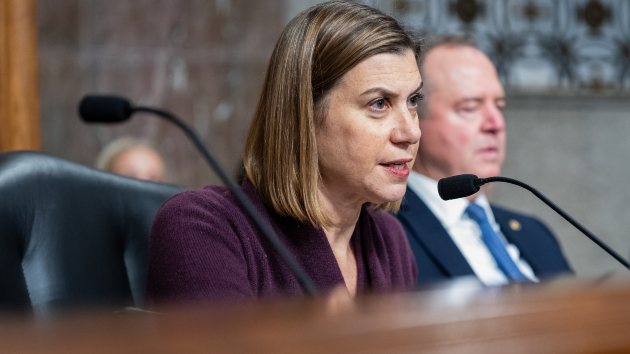
(WASHINGTON) — Sen. Elissa Slotkin, a Democrat from Michigan, said on Wednesday that she is under federal investigation for a video that she and other Democratic lawmakers posted on social media last year that told military service members that they could refuse illegal orders.
“Last week, U.S. Attorney from the District of Columbia, former Fox host Jeannine Pirro, reached out asking to interview me because of a 90-second video that I filmed in November,” Slotkin said in a video posted to X this morning. “This is on top of an FBI inquiry that came in from the counter terrorism division late last year.”
Slotkin, a former CIA officer, first learned that she was being investigated when she was contacted by federal prosecutors — a detail first reported by The New York Times, and confirmed to ABC News by her office.
A spokesperson for the U.S. attorney’s office says they neither confirm nor deny the existence of an investigation. It’s not clear what the basis of the investigation may be.
In the November video under investigation, Slotkin appeared alongside other Democrats who previously served in the military or in the intelligence community telling U.S. service members that they have a right to refuse unlawful orders.
In November, a CIA spokeswoman attacked Slotkin for her participation in the video, saying in a social media post that the senator joins “the ranks of disgraced former intelligence officers” who have abused their “credentials to advance a malicious and disingenuous political agenda.”
The video has been a subject of focus because of separate actions taken by Secretary of Defense Pete Hegseth against Democratic Sen. Mark Kelly, who was also featured in the original post on social media. Hegseth last week moved to censure Kelly, which led Kelly to file a lawsuit against Hegseth arguing the censure violated his constitutional rights.
The censure will result in a reduction in rank and Kelly’s retirement pay, a process Hegseth said would take 45 days.
Democrats involved in the video have defended their message as being in line with the Uniform Code of Military Justice and the Constitution.
Much like Kelly, Slotkin vowed that she won’t be silenced by the investigation.
“This president does not represent the views of the majority of Americans. Even if you voted for him, I do not believe that his vision of America is shared by a majority of Americans because this country is worth fighting for,” Slotkin said in her post on Wednesday. “Our freedom of speech is worth fighting for. Our values, our core values are worth fighting for and right now speaking out against the abuse of power is the most patriotic thing we can do.”
President Donald Trump has criticized the Democrats featured in the video, saying in social media posts in November that they are “traitors” whose actions are “SEDITIOUS BEHAVIOR, punishable by DEATH!”
Asked in November if Trump wants to execute members of Congress, White House press secretary Karoline Leavitt said the president did not — adding that the Democrats in the video are “encouraging [service members] to defy the president’s lawful orders.”
Hegseth said in his censure letter that the video “Undermines the Chain of Command; Creates Confusion About Duty; Brings Discredit Upon the Armed Forces; and Is Conduct Unbecoming an Officer.”
In her video on Wednesday, Slotkin said that following Trump’s posts, threats against her and her family have gone “through the roof.”
“I went on 24/7 security from Capitol Police, I had a bomb threat at my house. My parents were swatted in the middle of the night and my siblings had cop cars placed in their driveways,” Slotkin said.
She said this investigatory move comes from “the president’s playbook.”
“Truth doesn’t matter, facts don’t matter, and anyone who disagrees with him becomes an enemy, and he then weaponizes the federal government against them. It is legal intimidation and physical intimidation meant to get you to shut up.”
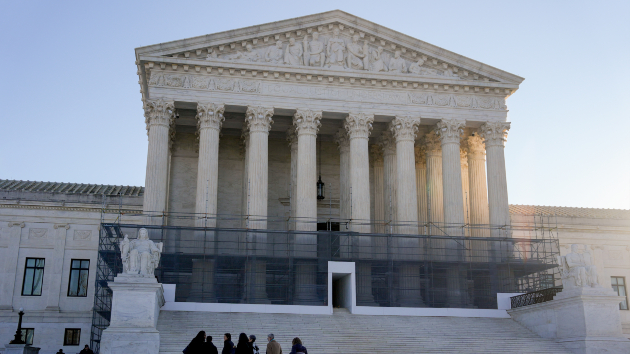
(WASHINGTON) — The Supreme Court on Wednesday significantly expanded the ability of candidates for political office to challenge rules governing an election, rolling back lower court decisions that had said a candidate needed to show concrete harm in order to bring a suit.
The 7-2 decision handed a victory to Republicans in Illinois who are contesting a state policy of counting timely cast but late-arriving mail ballots up to two weeks after Election Day.
It also promises to increase litigation nationwide ahead of the midterm election.
“Candidates have a concrete and particularized interest in the rules that govern the counting of votes in their elections, regardless whether those rules harm their electoral prospects or increase the cost of their campaigns,” wrote Chief Justice John Roberts in the court’s opinion.
Roberts concluded that candidates — by virtue of running for office alone — should have the ability to bring legal challenges over rules governing how campaigns are conducted and votes are cast and counted.
Justices Amy Coney Barrett and Elena Kagan concurred with the court’s judgment in the case but on different grounds, saying candidates should need to show a “pocketbook injury” or other “actual or imminent injury” before being allowed to sue.
In dissent, Justice Ketanji Brown Jackson, joined by Justice Sonia Sotomayor, accused the majority of breaking from settled law and “unnecessarily thrusting the judiciary into the political arena.”
“By carving out a bespoke rule for candidate-plaintiffs — granting them standing to challenge the rules that govern the counting of votes, simply and solely because they are candidates for office — the Court now complicates and destabilizes both our standing law and America’s electoral process,” Jackson wrote.
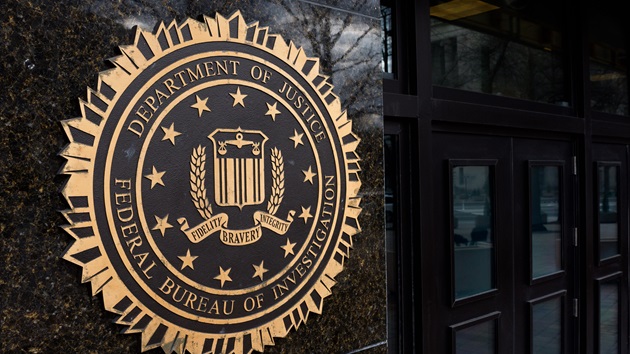
The Department of Justice (DOJ) seal on the J. Edgar Hoover Federal Bureau of Investigation (FBI) building in Washington, DC, US, on Friday, Jan. 2, 2026. Aaron Schwartz/Bloomberg via Getty Images
(WASHINGTON) — The FBI conducted a search of a Washington Post reporter’s home Wednesday morning in search of alleged classified information, according to the newspaper.
The reporter, Hannah Natanson, was at her home in Virginia when FBI agents knocked on her door to execute the search warrant, the newspaper reported.
Agents seized a phone, two laptop computers – one of which was issued to her by the Washington Post – and a Garmin watch, according to the paper.
Investigators told Natanson that the warrant was part of an ongoing investigation into Aurelio Perez-Lugones, according to the newspaper. Perez-Lugones, whom an FBI affidavit describes as a government contractor, was charged in federal court in Maryland last week for alleged unlawful retention of national defense information, according to the affidavit.
Natanson was informed by investigators that she is not the focus of the probe, the newspaper said, adding that she “covers the federal workforce.”
The FBI did not respond to an ABC News request for information about the search. However, FBI Director Kash Patel said in a social media post Wednesday that the FBI “executed a search warrant of an individual at the Washington Post who was found to allegedly be obtaining and reporting classified, sensitive military information from a government contractor – endangering our warfighters and compromising America’s national security. The alleged leaker was arrested this week and is in custody.”
“[A]t the request of the Department of War, the Department of Justice and FBI executed a search warrant at the home of a Washington Post journalist who was obtaining and reporting classified and illegally leaked information from a Pentagon contractor. The leaker is currently behind bars,” Attorney General Pam Bondi posted on X Wednesday morning.
“I am proud to work alongside Secretary Hegseth on this effort. The Trump Administration will not tolerate illegal leaks of classified information that, when reported, pose a grave risk to our Nation’s national security and the brave men and women who are serving our country,” Bondi’s statement continued.
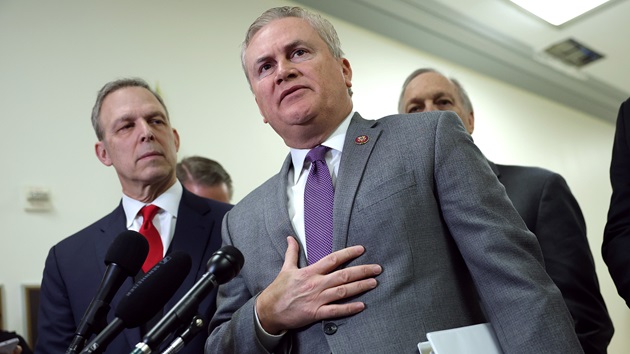
House Oversight and Government Reform Committee Chairman James Comer (R-KY) speaks to reporters after former Secretary of State Hillary Clinton did not appear for a closed-door deposition in the Rayburn House Office Building on Capitol Hill on January 14, 2026 in Washington, DC. Kevin Dietsch/Getty Images
(WASHINGTON) — House Oversight Committee Chairman James Comer said on Wednesday the panel plans to move forward with contempt of Congress proceedings against former Secretary of State Hillary Clinton after she defied a subpoena for a deposition as part of the panel’s probe into convicted sex offender Jeffrey Epstein.
It comes a day after Comer, a Republican, said the committee plans to hold former President Bill Clinton in contempt of Congress as well after he refused to appear for a scheduled deposition. Comer said the committee will vote next Wednesday on holding the Clintons in contempt of Congress.
“Former Secretary of State Hillary Clinton joined her husband in defying a bipartisan, lawful congressional subpoena to show up today,” Comer said, later adding, “We’re going to hold both Clintons in criminal contempt of Congress.”
Comer, asked if he’d be willing to have the Clintons appear for a public hearing, said “that’s something we can talk about.”
On Tuesday, the Clintons sent the committee a scathing four-page letter that potentially signaled a protracted fight with Congress over a move they blasted as “partisan politics.”
“Every person has to decide when they have seen or had enough and are ready to fight for this country, its principles and its people, no matter the consequences,” the Clintons wrote in the letter. “For us, now is that time.”
The Clintons blasted Comer, saying in the letter that, “There is no plausible explanation for what you are doing other than partisan politics.”
“We are confident that any reasonable person in or out of Congress will see, based on everything we release, that what you are doing is trying to punish those who you see as your enemies and to protect those you think are your friends. Continue to mislead Americans about what is truly at stake, and you will learn that Americans are better at finding the truth than you are at burying it,” they wrote.
For months, Republicans on the committee have demanded that the Clintons provide testimony to lawmakers, citing the former president’s travels on Epstein’s private aircraft in the early 2000s and the Clinton “family’s past relationship” with Epstein and his associate, Ghislaine Maxwell. The panel initially issued subpoenas for the Clintons on Aug. 5 to appear in October.
David Kendall, a lawyer for the Clintons, has argued that the couple has no information relevant to the committee’s investigation of the federal government’s handling of investigations into Epstein and Maxwell, and should not be required to appear for in-person testimony. Instead, Kendall said, they should be permitted to provide the limited information they have to the committee in writing.
Hillary Clinton “has no personal knowledge of Epstein or Maxwell’s criminal activities, never flew on his aircraft, never visited his island, and cannot recall ever speaking to Epstein. She has no personal knowledge of Maxwell’s activities with Epstein,” Kendall wrote. “President Clinton’s contact with Epstein ended two decades ago, and given what came to light much after, he has expressed regret for even that limited association,” an Oct. 6 letter to the committee says.
Neither Bill Clinton nor Hillary Clinton has been accused of wrongdoing and denies having any knowledge of Epstein’s crimes. No Epstein survivor or associate has ever made a public allegation of wrongdoing or inappropriate behavior by the former president or his wife in connection with his prior relationship with Epstein.
Comer wrote in a letter to Kendall in October that the committee is “skeptical” that the Clintons have only limited information and stated it was up to the committee, not the Clintons, to make determinations of the value of the information.
Last month, in response to the Epstein Files Transparency Act, the Justice Department released several photographs of former President Clinton apparently taken during his international travels with Epstein and Maxwell from 2002 to 2003, although the released photographs contained no information identifying when or where they were taken. Following that disclosure, a spokesperson for the two-term Democratic president argued that the Trump administration released those images to shield the Trump White House “from what comes next, or from what they’ll try to hide forever.”
To hold someone in contempt of Congress, the Oversight Committee would first mark up and then vote to advance the contempt resolution. Once the committee approves the resolution, which is expected given the GOP majority, the resolution now could go to a vote in the full House.
A simple majority is needed to clear a contempt resolution on the floor. Notably, it does not require passage in the Senate.
The resolution, if passed, would direct the speaker of the House to refer the case to the U.S. Attorney for the District of Columbia — under the Department of Justice — for possible criminal prosecution.
In this Nov. 17, 2025, file photo, President Donald Trump, is shown with Homeland Security Secretary Kristi Noem, at a meeting in the Oval Office of the White House in Washington, D.C. Win McNamee/Getty Images, FILE
(WASHINGTON) — The Trump administration announced Tuesday it will end Temporary Protected Status (TPS) for Somalis in March, effectively forcing as many as 2,400 people out of the U.S., despite the president’s remarks last month that Somalia was “barely a country.”
Somali migrants with TPS will be required to leave the country by March 17, Department of Homeland Security Kristi Noem announced Tuesday. That is, unless a court pauses the TPS revocation.
“Temporary means temporary,” Noem wrote in a statement to ABC News. “Country conditions in Somalia have improved to the point that it no longer meets the law’s requirement for Temporary Protected Status. Further, allowing Somali nationals to remain temporarily in the United States is contrary to our national interests. We are putting Americans first.”
The move comes after President Donald Trump has recently criticized Somali immigrants, describing them as “garbage” and saying he doesn’t want them in the United States during a Cabinet meeting last month.
“We always take people from Somalia, places that are a disaster, right? Filthy, dirty, disgusting, ridden with crime. The only thing they’re good at is going after ships,” Trump said as he addressed supporters in Pennsylvania last month.
DHS made a reference to Tuesday’s announcement in an X post that had a black and white photo of Trump in the Oval Office that referenced the 2013 movie “Captain Phillips,” which dramatized the 2009 merchant boat hostage situation by Somali pirates.
“I am the captain now,” DHS wrote in the post.
TPS is given to nationals of select countries who are unable to return home safely due to conditions such as famine, war and environmental disasters. Immigrants who have TPS designation can not be removed by DHS and are given an Eligible for an Employment Authorization Document that allows them to legally work in the U.S.
Somalia has been under a TPS designation since 1991, when civil war broke out and displaced hundreds of thousands of civilians. It has been renewed several times over the last 34 years as the conflict has grown.
The State Department currently has a travel advisory — in effect since May of last year — warning people not to travel to Somalia due to “crime, terrorism, civil unrest, health, kidnapping, piracy” and other issues.
Noem did not go into further detail about her description of improved conditions in Somalia, which appear to contradict the State Department’s advisory.
As of Tuesday, there are 2,471 Somali nationals currently in the U.S. under TPS, with 1,383 in the country with pending TPS applications, a source with knowledge of the data told ABC News.
As of 2024 there are nearly 260,000 Americans of Somali descent living in the U.S, according to the census. Of that population, more than 115,000 are foreign-born and more than 93,000 — or more than 80% — of the foreign-born population are naturalized U.S. citizens, according to the census data.
Trump has repeatedly bashed the American Somali community, particularly the ones living in Minnesota, which has the largest share of Somali nationals in the country, according to the census.
Minnesota Gov. Tim Walz has slammed Trump for his comments targeting Somalis.
“We’ve got little children going to school today, who their president called them ‘garbage,'” Walz said at an event last month.
Trump has repeated his criticisms against the Somali community following reports of fraud in the state, allegedly perpetrated by Somali immigrants against Minnesota’s social services system.
The allegations are being investigated; Minnesota officials have disputed the allegations.
The Trump administration has revoked and refused to renew TPS protections for several countries since he took office last year — including for Venezuelan nationals.
However, those decisions have been fought in court cases that have argued that DHS has made its moves in part by racial animus, citing the president and Noem’s rhetoric.
ABC News’ Armando Garcia contributed to this report.
(DETROIT) — President Donald Trump on Tuesday is turning his focus to the economy amid his administration’s intense foreign policy push with a speech at the Detroit Economic Club.
Trump’s remarks come as many Americans remain concerned about high prices.
A recent Quinnipiac University poll found 64% of registered voters said the cost of living is a “very serious problem” in the United States. On the economy overall, nearly half of voters said they think it’s getting worse, and 57% of voters said they disapproved of Trump’s handling of the issue.
As Trump left the White House on Tuesday, he touted new inflation data and continued his pressure campaign on Federal Reserve Chairman Jerome Powell to lower interest rates.
“We have very low inflation. So, that would give ‘too-late Powell’ the chance to give us a nice, beautiful, big rate cut, which would be great for the country,” Trump told reporters. “But rates are falling also, and growth is going up. We have tremendous growth numbers. So, growth is going up. So, I’ll be talking about that today in Detroit, the big speech, and I can only say that the country is doing well.”
Powell is now facing criminal investigation by the Justice Department over his testimony last year about the renovation of the central bank’s headquarters in Washington. Powell said he believes the probe is politically motivated.
When asked by ABC News on Tuesday if he approved of the investigation, Trump said, “He’s billions of dollars over budget. So either he’s incompetent or he’s crooked. I don’t know what he is. But certainly he doesn’t do a very good job.”
Inflation held steady at 2.7% in December, U.S. Bureau of Labor Statistics data showed, its lowest level since July but still higher than the Fed’s target rate.
Tuesday’s trip to Michigan is the latest stop in the administration’s push to sell the president’s economic agenda to voters ahead of the 2026 midterm elections.
November’s off-year elections in New York City, New Jersey and Virginia showed pocketbook issues were top of mind for voters. Democrats who focused on affordability won big in those races, according to exit polls. Trump has derided affordability as a “Democratic hoax.”
Trump’s faced criticism from some in his own party, including former Republican Rep. Marjorie Taylor Greene, for not doing more to address the high cost of living and focusing too much on foreign affairs.
In recent days, Trump’s announced several economic proposals — including a ban on large institutional investors from “buying more single-family homes” and a 1-year, 10% cap on credit card interest rates. Trump’s housing plan has been met with some skepticism from analysts, and banks have pushed back on his pitch to cap credit card interest rates.
White House press secretary Karoline Leavitt, previewing Trump’s Detroit speech on Monday, told reporters he would discuss recent news on inflation and mortgage rates.
“These economic policies are really coming into fruition now that we’re in 2026 and we’ll be seeing more tax cuts into the pockets of the American people later this spring as well. So, it’s all good news on the economic front, and I know the president looks forward to talking about that tomorrow in Michigan,” Leavitt said.
House Oversight and Government Reform Committee Chairman James Comer (R-KY) talks to reporters after former President Bill Clinton did not appear for a closed-door deposition in the Rayburn House Office Building on Capitol Hill on January 13, 2026 in Washington, DC. Chip Somodevilla/Getty Images
(WASHINGTON) — The chairman of the Republican-led House Oversight Committee said the panel will move forward with contempt of Congress proceedings against former President Bill Clinton after he failed to appear for a subpoenaed deposition on Tuesday as part of the panel’s investigation into convicted sex offender Jeffrey Epstein.
The committee had threatened to hold the former president and former Secretary of State Hillary Clinton in contempt of Congress if they did not appear for separate scheduled closed depositions set for Tuesday and Wednesday, respectively.
“I think everyone knows by now, Bill Clinton did not show up. And I think it’s important to note that this subpoena was voted on in a bipartisan manner by this committee. This wasn’t something that I just issued as chairman of the committee. This was voted on by the entire committee in a unanimous vote of the House Oversight Committee to subpoena former President Clinton and former Secretary of State Hillary Clinton,” Oversight Chairman James Comer said Tuesday morning.
“We will move next week in the House Oversight Committee markup to hold former President Clinton in contempt of Congress,” Comer, a Republican, later added.
A lawyer for the Clintons, David Kendall, has not responded to requests for comment on whether Hillary Clinton will appear on Capitol Hill for her Wednesday subpoenaed deposition.
In a four-page letter posted on social media Tuesday morning, the Clintons publicly called out Comer for threatening to hold them in contempt of Congress.
“Despite everything that needs to be done to help our country, you are on the cusp of bringing Congress to a halt to pursue a rarely used process literally designed to result in our imprisonment. This is not the way out of America’s ills, and we will forcefully defend ourselves,” the letter states.
The Clintons contend in the letter that Comer’s approach to the committee’s work on the Epstein investigation has “prevented progress in discovering the facts about the government’s role” and that the chairman has “done nothing” to force the Justice Department to comply with its disclosure obligations required by Epstein Files Transparency Act, passed late last year.
“We have tried to give you the little information that we have,” the Clintons wrote. “We’ve done so because Mr. Epstein’s crimes were horrific. If the Government didn’t do all it could to investigate and prosecute these crimes, for whatever reason, that should be the focus of your work — to learn why and to prevent that from happening ever again. There is no evidence that you are doing so.”
For months, Republicans on the committee have been demanding that the Clintons provide testimony to lawmakers, citing the former president’s travels on Epstein’s private aircraft in the early 2000s and the Clinton “family’s past relationship” with Epstein and his associate, Ghislaine Maxwell. The panel initially issued subpoenas for the Clintons on Aug. 5 to appear in October.
Kendall has continued to argue that the couple has no information relevant to the committee’s investigation of the federal government’s handling of investigations into Epstein and Maxwell, and should not be required to appear for in-person testimony. Kendall has contended that the Clintons should be permitted to provide the limited information they have to the committee in writing.
“There is simply no reasonable justification for compelling a former President and Secretary of State to appear personally, given that their time and roles in government had no connection to the matter at hand,” Kendall wrote in one of the letters sent to the committee in October of last year. He argued that the committee should excuse the Clintons, as the committee had done for five former attorneys general who were each excused after certifying to the committee that they had no relevant knowledge.
Bill Clinton has not been accused of wrongdoing and denies having any knowledge of Epstein’s crimes. No Epstein survivor or associate has ever made a public allegation of wrongdoing or inappropriate behavior by the former president in connection with his prior relationship with Epstein.
Former Secretary of State Clinton “has no personal knowledge of Epstein or Maxwell’s criminal activities, never flew on his aircraft, never visited his island, and cannot recall ever speaking to Epstein. She has no personal knowledge of Maxwell’s activities with Epstein,” Kendall wrote. “President Clinton’s contact with Epstein ended two decades ago, and given what came to light much after, he has expressed regret for even that limited association,” an Oct. 6 letter to the committee says.
Comer wrote in a letter to Kendall in October that the committee is “skeptical” that the Clintons have only limited information and stated it was up to the committee, not the Clintons, to make determinations of the value of the information.
“[T]he Committee believes that it should be provided in a deposition setting, where the Committee can best assess its breadth and value,” Comer wrote.
Last month, in response to the Epstein Files Transparency Act, the Justice Department released several photographs of former President Clinton apparently taken during his international travels with Epstein and Maxwell from 2002 to 2003, although the released photographs contained no information identifying when or where they were taken. Following that disclosure, a spokesperson for the two-term Democratic president argued that the Trump administration released those images to shield the Trump White House “from what comes next, or from what they’ll try to hide forever.”
“So, they can release as many grainy 20-plus-year-old photos as they want, but this isn’t about Bill Clinton. Never has, never will be,” Clinton’s spokesperson Angel Ureña wrote on X Dec. 22.
Ureña did not respond to an email inquiry from ABC News on Monday.
What is contempt of Congress?
The House of Representatives can hold an individual “in contempt” if that person refuses to testify or comply with a subpoena. The contempt authority is considered an implied power of Congress.
“Congress’s contempt power is the means by which Congress responds to certain acts that in its view obstruct the legislative process. Contempt may be used either to coerce compliance, to punish the contemnor, and/or to remove the obstruction,” according to a report from the Congressional Research Service.
Any person summoned as a congressional witness who refuses to comply can face a misdemeanor charge that carries a fine of up to $100,000 and up to a year in prison if that person is eventually found guilty.
What would the process look like?
To hold someone in contempt of Congress, the Oversight Committee would first mark up and then vote to advance the contempt resolution. Once the committee approves the resolution, which is expected given the GOP majority, the resolution now could go to a vote in the full House.
A simple majority is needed to clear a contempt resolution on the floor. Notably, it does not require passage in the Senate.
The resolution, if passed, would direct the speaker of the House to refer the case to the U.S. Attorney for the District of Columbia — under the Department of Justice — for possible criminal prosecution.
History of contempt
Congress has held Cabinet officials in contempt of Congress for refusing to comply with a House subpoena, including Attorney General William Barr and Commerce Secretary Wilbur Ross in 2019 and then-Attorney General Eric Holder in 2012. The DOJ never prosecuted them even though the House voted to hold them in contempt.
The House held Peter Navarro, a former top trade adviser in the Trump administration, in contempt of Congress in 2022 for defying a subpoena to provide records and testimony to the now-defunct House select committee investigating the Jan. 6 attack on the U.S. Capitol. Navarro was sentenced to jail time.
Steve Bannon, a Trump ally, was also held in contempt of Congress in 2022 for not complying with the Jan. 6 select committee. Bannon was also sentenced to prison time.
The GOP-led House voted to hold Attorney General Merrick Garland in contempt of Congress in 2024 over the DOJ failing to provide audio of then-President Joe Biden’s interview with special counsel Robert Hur. The DOJ did not prosecute the case, but the audio was released.
Sen. Mark Kelly leaves after the Senate voted on the Venezuela War Powers Resolution at the U.S. Capitol, January 08, 2026, in Washington. Kevin Dietsch/Getty Images
(WASHINGTON) — Democratic Sen. Mark Kelly on Monday filed a lawsuit against Secretary of Defense Pete Hegseth arguing that Hegseth’s censure of him last week over his inclusion in a social media video that told U.S. service members they have a right to refuse unlawful orders violated his constitutional rights.
“Pete Hegseth is coming after what I earned through my twenty-five years of military service, in violation of my rights as an American, as a retired veteran, and as a United States Senator whose job is to hold him — and this or any administration — accountable. His unconstitutional crusade against me sends a chilling message to every retired member of the military: if you speak out and say something that the President or Secretary of Defense doesn’t like, you will be censured, threatened with demotion, or even prosecuted,” Kelly said in a statement.
The senator’s lawsuit also names the Department of Defense, Secretary of the Navy John Phelan and the Department of the Navy as defendants.
Kelly alleges, among other things, that actions taken against him violate his First Amendment right to free speech, the speech and debate clause that protects lawmakers and his right to due process.
ABC News has reached out to Department of Defense for comment.
Hegseth censured Kelly on Jan. 5 for “conduct [that] was seditious in nature,” referring to the video Kelly participated in in November alongside other Democrats who previously served in the military or in the intelligence community.
Kelly and the other five Democrats involved in the video have defended their message as being in line with the Uniform Code of Military Justice and the Constitution.
The censure will result in a reduction in rank and Kelly’s retirement pay, a process Hegseth said would take 45 days. Kelly retired as a Navy captain and receives retirement benefits for his more than 20 years of service.
Kelly retired as a Navy captain and receives retirement benefits for his more than 20 years of service.
In an interview with ABC News after the censure, Kelly said he still would “absolutely not” have changed his message to U.S. troops about not following illegal orders.’
“Let me make this perfectly clear, though, that Gabby and I are not people that back down,” Kelly said last Tuesday during an appearance with his wife, former Rep. Gabby Giffords, on “Good Morning America.” “From anything, from any kind of fight.”
(WASHINGTON) — The Justice Department investigation into Federal Reserve Chairman Jerome Powell is drawing backlash from former Federal Reserve and Treasury officials as well as current members of Congress, including those in President Donald Trump’s own party.
A bipartisan group of top economic officials released a blistering statement on Monday calling the probe an “unprecedented attempt to use prosecutorial attacks to undermine” the central bank’s independence.
“This is how monetary policy is made in emerging markets with weak institutions, with highly negative consequences for inflation and the functioning of their economies more broadly. It has no place in the United States whose greatest strength is the rule of law, which is at the foundation of our economic success,” read the statement from Alan Greenspan, Ben Bernanke, Janet Yellen, Tim Geithner, Jacob Lew, Hank Paulson and others.
The investigation, announced by Powell in a rare video message on Sunday, is related to Powell’s testimony last June about the multi-year renovation of the Federal Reserve buildings in Washington. But Trump has made Powell a frequent target of his attacks and push to cut interest rates.
White House National Economic Council Director Kevin Hassett, who is on Trump’s short list to be the next Federal Reserve chair, said time will tell if the probe is a pretext for firing Powell over interest rates.
“Well, in the fullness of time, we’ll find out whether it looks like a pretext,” Hassett, who denied involvement in the probe, told CNBC in an appearance on Monday. “But right now, we’ve got a building that’s got, like, dramatic cost overruns and, you know, plans for the buildings that look inconsistent with the testimony. But, you know, again, I’m not a Justice Department person. I hope everything turns out OK.”
Republican Sen. Thom Tillis, who serves on the Senate Banking Committee, said he will oppose the confirmation of any Trump nominee to the Federal Reserve until legal matters concerning Powell are resolved, which could make it difficult for a nominee to advance out of committee.
“If there were any remaining doubt whether advisers within the Trump Administration are actively pushing to end the independence of the Federal Reserve, there should now be none. It is now the independence and credibility of the Department of Justice that are in question,” Tillis said in a statement on Sunday night.
Republican Sen. Lisa Murkowski, in a post on X on Monday, said Tillis is “right in blocking any Federal Reserve nominees.”
“After speaking with Chair Powell this morning, it’s clear the administration’s investigation is nothing more than an attempt at coercion. If the Department of Justice believes an investigation into Chair Powell is warranted based on project cost overruns — which are not unusual — then Congress needs to investigate the Department of Justice. The stakes are too high to look the other way: if the Federal Reserve loses its independence, the stability of our markets and the broader economy will suffer,” Murkowski posted on X.
House Financial Services Chairman Rep. French Hill, a Republican, said pursuing criminal charges against Powell is “an unnecessary distraction.” Sen. Kevin Cramer, another Republican on the Senate Banking Committee, said that he does not believe Powell is a criminal and that he hopes the criminal matter will soon be put to rest.
House Speaker Mike Johnson told reporters on Monday that “if the investigation is warranted, then they’ll have to play that out.” When pressed if he believed the probe is warranted, Johnson said, “I have not reviewed his testimony, so I am not sure, but that’s not really my lane.”
A spokesperson for Attorney General Pam Bondi said Bondi “has instructed her U.S. Attorneys to prioritize investigating any abuse of taxpayer dollars.” Powell said in his statement the probe was fueled by Trump’s monthslong pressure campaign on him to lower interest rates.
Sen. Elizabeth Warren, the top Democrat on the Senate Banking Committee, slammed Trump as a “wannabe dictator” over his campaign against Powell.
“Acting like the wannabe dictator he is, Trump is trying to push out the chairman of the Federal Reserve Board and complete his corrupt takeover of America’s central bank so that it serves his interests, along with his billionaire friends,” Warren said in a speech about the future of the Democratic Party ahead of 2028 at the National Press Club.
President Trump denied any involvement in the criminal probe during a brief interview with NBC News on Sunday night but continued his criticism of Powell’s leadership.
ABC News’ Lauren Peller contributed to this report.
Becky Pepper Jackson competes in discus and shot put on the girls high school track and field team in her West Virginia hometown. (ABC News)
(WASHINGTON) — The Supreme Court on Tuesday will for the first time wade into the heated national debate over whether transgender girls should be allowed to participate in girls’ and women’s sports.
The justices will hear arguments in a pair of cases from Idaho and West Virginia, where federal courts have blocked state laws that would prohibit trans girls from participating on teams consistent with their gender identity.
The outcome of the cases will determine the fate of those laws and similar measures in 27 other states. There are an estimated 122,000 transgender American teens who participate in high school sports nationwide, according to the Williams Institute at UCLA Law School.
Lower courts have concluded separately that the bans discriminate “on the basis of sex” in violation of Title IX, the landmark civil rights law that has promoted equal opportunities for women and girls in athletics, and the Constitution’s Equal Protection Clause.
The states are asking the justices to overturn those decisions and reinstate their laws, arguing that sex and gender identity are not synonymous when it comes to women’s athletics and that allowing transgender girls to compete against cisgender girls is unfair and unsafe.
“It really comes down to one simple question,” said West Virginia Attorney General John McCuskey in an interview with ABC News. “Is it legal and constitutional for states to delineate their athletic playing fields based on the immutable physical characteristics that people have that are associated with their sex that’s assigned at birth?”
Becky Pepper Jackson, a high school sophomore from Bridgeport, West Virginia, who competes in discus and shot put on the track and field team, brought the legal challenge to her state’s law in 2021. She is the only known openly trans athlete in West Virginia in any sport.
“Someone has to do it. Someone has to do this for all of us,” Becky, 15, told ABC News in an exclusive interview. “Otherwise these laws and bills are just going to stand.”
Transgender athletes make up just over 1% of the more than 8 million teenage student athletes nationwide, according to the Williams Institute.
Idaho college student Lindsay Hecox, a former track and cross-country runner who was barred from trying out for her school teams, sued over her state’s ban in 2020. Last year, she asked the court to drop her case because she no longer wished to compete in sports and didn’t want to be in the spotlight. However, Idaho fought to keep the case alive.
“Everyone has had the experience of being told, look, you can’t play. You have to sit on the bench, or you can’t make the team. And everyone knows how that feels,” said Sasha Jean Buchert, an attorney with Lambda Legal, an LGBTQ advocacy group involved with the cases.
“That’s what’s happening to transgender kids right now,” Buchert said. “And the scope of [these bans] is absolutely absurd.”
Becky, who has openly identified as a girl since third grade, said she has never undergone male puberty, thanks to puberty-blocking medication, and has no physiological advantage over her peers.
“She has testosterone from her adrenal glands just like every female out there, but that’s the only testosterone she has,” said her mother, Heather Jackson. “She’s actually not the biggest person on her team. There’s people taller than her; there’s people shorter than her. She’s just an average female teenager.”
As a young cross-country runner, Becky was consistently at the back of the pack. More recently, she earned a spot in the state championship for discus and shot put, where she placed third and eighth, respectively.
“I put in time over the summer and after practices just trying to improve my technique and get better,” she said.
Her performance at an eighth grade track meet in 2024 drew protests from other athletes who claimed she made them uncomfortable in the locker room and on the field.
“I just didn’t think it was right,” said Sabrina Shriver, 16, a former discus thrower who refused to compete against Becky at the meet and later quit the sport because of her participation in the league. “It was just, I don’t know, we all just felt uncomfortable and we’re just, we didn’t want any part of it.”
The competitive advantage boys and men have physically over girls and women has been well established in physically demanding sports by medical research and serves as a primary basis for distinctions between the sexes in athletics.
Studies have shown testosterone produced during male puberty does lead to more muscle mass, larger hearts and lungs, greater body height and longer limbs on average for boys and men, according to the American College of Sports Medicine.
Before puberty, however, “sex differences in athletic performance are minimal,” the group says research shows.
A key issue in the West Virginia case is a dispute over whether Becky, 15, possesses an advantage at all, given she has not undergone male puberty, takes estrogen supplements and does not produce high levels of testosterone.
“If [sports leagues] look at the medical records of individuals like the Olympic committee does, testing people — they test for performance enhancing medications or drugs that their athletes take — so if we can look at those levels, let’s look at her levels,” Heather Jackson said.
McCuskey says a testing regimen is just not practicable and that Becky can still compete, but on a boys team. “We have to be able to draw a line here,” he said.
“Becky is bigger and stronger and faster than the females that she’s competing against,” said the attorney general.
He has urged the Supreme Court to stay out of the debate, arguing in a court brief that West Virginia’s law “implicates ‘fierce scientific and policy debates’ that elected legislators are best able to resolve.”
The U.S. Olympic Committee, the NCAA and 29 states ban transgender girls and women from competing on teams consistent with their gender identity. The other 21 states do not have bans, including California and New York, which have laws explicitly allowing trans athletes to compete.
Last year, the Supreme Court’s conservative majority upheld a Tennessee law banning some gender-affirming medical treatments for transgender minors, rejecting claims that the law discriminated “on the basis of sex” and saying that states should have leeway to regulate health care in an area of scientific uncertainty.
In 2020, however, the Court concluded in a landmark decision that a Michigan transgender woman fired by her employer for being transgender was discriminated against “on the basis of sex” under Title VII of the Civil Rights Act of 1964.
Justice Neil Gorsuch explained in his majority opinion that her termination was “for traits or actions it would not have questioned in members of a different sex.”
Becky, Lindsay, and their attorneys with the American Civil Liberties Union and Lambda Legal say the same reasoning should be applied to sports bans.
“There’s been a number of setbacks that we’ve experienced over the last few years in the courts, but I do have a sense of optimism with this case in light of the fact that the legal issues at play here are some of the same issues at play five years ago,” said Buchert, the Lambda Legal attorney.
Notwithstanding the legal arguments, 69% of Americans say transgender girls should only be allowed to play on boys teams, according to a June 2025 Gallup survey.
The Trump administration also supports the exclusion of transgender athletes from sports teams. An executive order signed in February 2025 says “it is the policy of the United States to rescind all funds from educational programs that deprive women and girls of fair athletic opportunities.”
Becky says, while she understands public opinion, she is unable to “go against who I am.”
“I’ve been a girl forever,” she said, “and playing on the guys’ team is going backwards.”