Lindsey Halligan, attorney for US President Donald Trump, holds ceremonial proclamations to be signed by US President Donald Trump, not pictured, in the Oval Office of the White House in Washington, DC, US, on Thursday, March 6, 2025. Trump exempted Canadian goods covered by the North American trade agreement known as USMCA from his 25% tariffs, offering major reprieves to the US’s two largest trading partners. (Photographer: Al Drago/Bloomberg via Getty Images)
(WASHINGTON) — Vice President JD Vance and second lady Usha Vance announced Tuesday that the couple is expecting their fourth child.
“We’re very happy to share some exciting news. Our family is growing!” Usha Vance wrote in the post on social media.
This is a developing story. Please check back for updates.
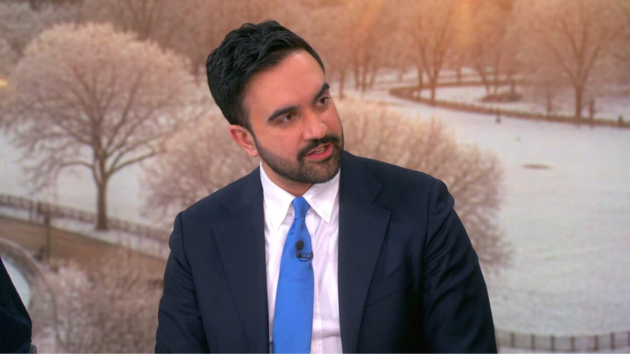
New York City Mayor Zohran Mamdani appears on The View, on Jan. 20, 2026. (ABC News)
(NEW YORK) — New York City Mayor Zohran Mamdani returned to ABC’s “The View” on Tuesday to discuss his first weeks in office and weighed in on the controversial surge by Immigration, Customs and Enforcement (ICE) across the country.
Co-host Alyssa Farah Griffin asked Mamdani about the calls by some Democrats to abolish ICE in light of their activities in places such as Minnesota, where an ICE officer fatally shot Renee Good, a 37-year-old mother of three.
The 34-year-old mayor, who has vowed to protect New York immigrants, said he supports those calls.
“I am in support of abolishing ICE, and I’ll tell you why: Because what we see is an entity that has no interest in fulfilling its stated reason to exist,” said Mamdani, whose Tuesday appearance marked his first time on the show since becoming mayor in the past month.
Mamdani, a naturalized American citizen who was born in Uganda, has been critical of ICE for many years. Last year during his campaign, he said in a June interview that ICE is “a rogue agency, one that has no interest in laws, no interest in order.”
The mayor echoed those sentiments on “The View” Tuesday.
“We’re seeing a government agency that is supposed to be enforcing some sort of immigration law, but instead, what it is doing is terrorizing people no matter their immigration status, no matter the facts of the law, and no matter the facts of the case,” Mamdani said.
“And I’m tired of waking up every day and seeing a new image of someone being dragged out of a car, dragged out of their home and dragged out of their life. What we need to see is humanity,” he added.
Last week, the mayor said he was “outraged” after a New York City council employee was detained by ICE in Long Island during a routine immigration appointment.
“This is an assault on our democracy, on our city, and our values,” he said in a statement on X on Jan. 13. “I am calling for his immediate release and will continue to monitor the situation.”
The Department of Homeland Security contended in a statement that the employee is in the U.S. illegally and has an alleged criminal history that includes an arrest for assault. The agency did not provide additional details on the assault arrest.
City officials, however, said the employee has legal status.
Mamdani was asked by “The View” hosts about his relationship with President Donald Trump following their cordial meeting in the White House after the mayor won his election.
The mayor said that it is his intention to be honest and direct with the president, especially when it came to immigration.
“It’s terrifying to see what is happening in the name of public safety. I’ve said this to the president. These ICE raids, they are cruel, they are inhumane, [and] they do nothing to deliver that public safety,” Mamdani said. “In fact, what they do is leave a sense of fear among so many.”
When asked about Trump’s threats to cut funding to sanctuary cities such as New York, Mamdani said he would fight for New Yorkers.
“What I said is that our values and our laws, they are not bargaining chips. I’m not looking to have a negotiation with New Yorkers’ lives,” he said.
Mamdani noted that sanctuary city laws have been supported by Democrats and Republicans alike and “keep New Yorkers safe.”
“I’ve told the president this directly, which is that what we are talking about is not people who have been convicted of serious crimes. We’re talking about people whose crimes are simply being in New York City,” he said. “And if they were to make good on this threat, it would rip the civic fabric of this city apart.”
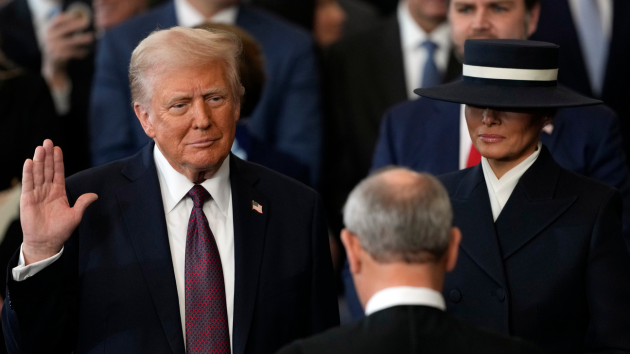
Donald Trump takes office for his second term as the 47th president of the United States. (Julia Demaree Nikhinson – Pool/Getty Images)
(WASHINGTON) — When President Donald Trump capped a historic political comeback on Inauguration Day last Jan. 20, he proclaimed the “Golden Age of America” had arrived, and in his first 12 months, the nation has experienced a whiplash of domestic and foreign policy changes, and political disputes that have stirred intense national debate.
Within hours of taking office, the president signed more than 200 executive actions, including rescinding nearly 80 actions under President Joe Biden, and pardoning 1,500 people convicted of crimes stemming from the Jan. 6 insurrection at the U.S. Capitol.
“From this day forward, our country will flourish and be respected again all over the world. We will be the envy of every nation, and we will not allow ourselves to be taken advantage of any longer. During every single day of the Trump administration, I will very simply put America First,” Trump vowed during his inaugural address.
A look at Trump’s first year shows a mixture of fulfilled promises, dramatic actions and ongoing controversies that show his political ambitions and the divided response from Americans.
Foreign policy
Trump ran on an agenda of “peace through strength,” promising to be a global peacemaker.
“My proudest legacy will be that of a peacemaker and unifier. That’s what I want to be, a peacemaker and a unifier,” Trump said during his address at the inauguration.
Since taking office, the president has made significant foreign policy decisions, from an on-the-ground operation to seize the leader of Venezuela, ratcheting tensions with Europe in an effort to seize Greenland and efforts to achieve peace in global conflicts from Ukraine to the Middle East.
The president achieved one of those goals by securing a ceasefire in the Israel-Hamas war that raged in Gaza. The delicate peace deal has held and recently moved into its second phase. The deal came after months of statecraft by Trump and many of his closest allies.
Trump has also formulated what he calls the “Donroe Doctrine,” a play on words of the Monroe Doctrine that reimagines the American role in the Western Hemisphere. That change in vision was punctuated by an on-the-ground operation in Venezuela to capture then-President Nicolas Maduro and bring him to the U.S. to face charges for allegedly supporting cartels that brought narcotics into the U.S.
That effort came after the administration carried out strikes on boats that were allegedly carrying drugs, killing more than 100 people. Those strikes have faced major questions from Democrats.
The president has also called for the U.S. to own Greenland and is ratcheting up tension with European allies as he tries to make good on his promised efforts to own Denmark’s semiautonomous territory. Those tensions have reached a fever pitch around Trump’s one-year mark in office as the president has not ruled out taking Greenland by force.
Trump vowed on the campaign trail to end the war in Ukraine on Day 1 of his term in office. However, after many meetings with Ukrainian President Volodymyr Zelenskyy and a historic summit on American soil with Russian President Vladimir Putin, that promise has failed to materialize. The war between Russia and Ukraine continues to rage on and Trump has repeatedly said that ending the conflict is more complex than he expected it would be.
Immigration
Trump has followed through on his campaign pledge to aggressively crack down on illegal immigration.
In 2025, the United States experienced negative net migration for the first time in at least 50 years as a result of the Trump administration’s immigration crackdown, according to a report by the Brookings Institution, which added that the number is mostly due to a significant drop in entries into the U.S.
The Department of Homeland Security claims more than 622,000 people have been deported since the president took office.
Throughout the year, the administration significantly expanded Immigration and Customs Enforcement (ICE) operations nationwide, with the White House publicly celebrating rising ICE arrests in multiple states, despite their controversial tactics, deadly force, legal pushback and protests.
A Quinnipiac University poll found 57% of voters disapproving of how ICE is enforcing immigration laws, with 40% approving, largely unchanged from Quinnipiac’s previous polling in July. Most Democrats and independents disapprove of how ICE is enforcing laws; most Republicans approve.
The president surged federal law enforcement and even troops into cities such as Los Angeles, New Orleans and currently Minneapolis, Minnesota, to help carry out immigration enforcement there. However, many local officials have spoken out against the enforcement operations.
Federal restructuring (DOGE)
Trump has also made major changes to the federal government, executing on another of his major changes to the size and powers of the federal government. Trump worked alongside billionaire Elon Musk for the first months of his presidency to enact the policy of the Department of Government Efficiency (DOGE).
DOGE took a chainsaw to much of the government, including shuttering the U.S. Agency for International Development (USAID) and firing or laying off thousands of federal workers.
In May, after months working to reshape the federal workforce and government, Musk said that the DOGE effort, which he promised on the campaign trail would cut $2 trillion in federal spending, saved about $160 million after about five months.
“I think we’ve been effective, not as effective as I’d like, I think we could be more effective, but we made progress,” Musk said in May.
Economic policies
Trump enacted one of his biggest campaign promises during his first year in office: widespread tariffs on goods brought into the U.S. The goal of the tariffs was to onshore manufacturing and slash trade deficits.
On April 2, which Trump dubbed “Liberation Day,” the president announced sweeping tariff policies on almost all of America’s trading partners and went far beyond what many experts expected his tariff policy to look like. Just one day later, the stock market tanked in reaction, with stocks losing nearly $3.1 trillion in value.
A few days later, the president paused those sweeping tariffs to give time for the administration to instead cut deals with nations. Trump said that investors had gotten “the yips,” which is why he pulled back. The administration set to work, promising to strike 90 deals in 90 days with America’s trading partners.
They fell short of that goal, but the White House has since reached deals or frameworks with dozens of America’s trading partners. The White House has also made significant carve-outs for some goods that cannot be produced or grown in the U.S. such as coffee and bananas.
The president came into office promising a “manufacturing boom” and that his policies would create “millions and millions of blue-collar jobs and jobs of every type,” but the final jobs report of 2025 showed hiring in the American economy is cooling.
Roughly 50,000 new jobs were added to the workforce in December, slightly below expectations, but the unemployment rate did drop to 4.4%. Roughly two thirds of overall job gains last year were in the health care sector, while manufacturing, tech and government all lost more jobs than they added, according to the Bureau of Labor Statistics.
The latest CPI report shows inflation up 2.7% from a year ago. Costs continue to rise for energy, medical care and foods such as coffee and ground beef, while wholesale egg prices have dropped to their lowest levels since 2019, according to the USDA.
The typical American household is now spending $184 more a month to purchase the same goods and services as a year ago, and $590 more a month than three years ago, according to Moody’s Analytics.
The president kicked off a tour in December to talk to Americans directly about his administration’s efforts to bring down costs. Trump has continued to insist that “affordability” is a “hoax” that was invented by Democrats.
Trump unveiled a health care plan, which he had promised for nearly a decade in early 2026. The administration unveiled his “great healthcare plan,” but the details are sparse, with top administration officials calling it “broad” and a “framework.”
Trump says he wants to give money directly to Americans so they can buy their own insurance, but it’s unclear how that would work, how much they will get or whether it would cover their health care costs. A recent poll found 52% of voters saying Trump has “hurt” the cost of health care.
The president has also planned to unveil a plan that would lower housing costs during an upcoming trip to Davos, Switzerland. It’s unclear what exactly the plan will entail, but the president has floated “steps to ban large institutional investors from buying more single-family homes” in an effort to improve housing costs.
Changes to the White House
Trump has also made his mark on the physical space of the White House. From ornamental changes to major tear downs, the president has made his mark on the historic home of the commander in chief.
What started with gilded additions to the Oval Office and the usual redecorating quickly became more long-lasting changes to the White House. The president repaved the historic Rose Garden with white stone and added what he dubbed the “Presidential Walk of Fame” which includes portraits and politically charged plaques about American presidents through history.
One of the biggest moves came in October of 2025, when Trump tore down the White House East Wing to make way for a 90,000 square foot ballroom. The major construction and rapid pace of the tear-down faced major criticism from many Democrats.
The president has made his mark on other D.C. landmarks too. The president’s hand-picked board of the Kennedy Performing Arts Center voted in mid-December to rename the structure the “Trump-Kennedy Center.”
The president has followed through of many of his campaign promises. Yet a recent Reuters-Ipsos poll finds that on every issue measured, Trump does not enjoy majority approval. With the midterm elections looming, it remains to be seen whether the president will have the political capital to push through his agenda throughout his historic second term.
Donald Trump takes office for his second term as the 47th president of the United States. (Julia Demaree Nikhinson – Pool/Getty Images)
(WASHINGTON) — When President Donald Trump capped a historic political comeback on Inauguration Day last Jan. 20, he proclaimed the “Golden Age of America” had arrived, and in his first 12 months, the nation has experienced a whiplash of domestic and foreign policy changes, and political disputes that have stirred intense national debate.
Within hours of taking office, the president signed more than 200 executive actions, including rescinding nearly 80 actions under President Joe Biden, and pardoning 1,500 people convicted of crimes stemming from the Jan. 6 insurrection at the U.S. Capitol.
“From this day forward, our country will flourish and be respected again all over the world. We will be the envy of every nation, and we will not allow ourselves to be taken advantage of any longer. During every single day of the Trump administration, I will very simply put America First,” Trump vowed during his inaugural address.
A look at Trump’s first year shows a mixture of fulfilled promises, dramatic actions and ongoing controversies that show his political ambitions and the divided response from Americans.
Foreign policy
Trump ran on an agenda of “peace through strength,” promising to be a global peacemaker.
“My proudest legacy will be that of a peacemaker and unifier. That’s what I want to be, a peacemaker and a unifier,” Trump said during his address at the inauguration.
Since taking office, the president has made significant foreign policy decisions, from an on-the-ground operation to seize the leader of Venezuela, ratcheting tensions with Europe in an effort to seize Greenland and efforts to achieve peace in global conflicts from Ukraine to the Middle East.
The president achieved one of those goals by securing a ceasefire in the Israel-Hamas war that raged in Gaza. The delicate peace deal has held and recently moved into its second phase. The deal came after months of statecraft by Trump and many of his closest allies.
Trump has also formulated what he calls the “Donroe Doctrine,” a play on words of the Monroe Doctrine that reimagines the American role in the Western Hemisphere. That change in vision was punctuated by an on-the-ground operation in Venezuela to capture then-President Nicolas Maduro and bring him to the U.S. to face charges for allegedly supporting cartels that brought narcotics into the U.S.
That effort came after the administration carried out strikes on boats that were allegedly carrying drugs, killing more than 100 people. Those strikes have faced major questions from Democrats.
The president has also called for the U.S. to own Greenland and is ratcheting up tension with European allies as he tries to make good on his promised efforts to own Denmark’s semiautonomous territory. Those tensions have reached a fever pitch around Trump’s one-year mark in office as the president has not ruled out taking Greenland by force.
Trump vowed on the campaign trail to end the war in Ukraine on Day 1 of his term in office. However, after many meetings with Ukrainian President Volodymyr Zelenskyy and a historic summit on American soil with Russian President Vladimir Putin, that promise has failed to materialize. The war between Russia and Ukraine continues to rage on and Trump has repeatedly said that ending the conflict is more complex than he expected it would be.
Immigration
Trump has followed through on his campaign pledge to aggressively crack down on illegal immigration.
In 2025, the United States experienced negative net migration for the first time in at least 50 years as a result of the Trump administration’s immigration crackdown, according to a report by the Brookings Institution, which added that the number is mostly due to a significant drop in entries into the U.S.
The Department of Homeland Security claims more than 622,000 people have been deported since the president took office.
Throughout the year, the administration significantly expanded Immigration and Customs Enforcement (ICE) operations nationwide, with the White House publicly celebrating rising ICE arrests in multiple states, despite their controversial tactics, deadly force, legal pushback and protests.
A Quinnipiac University poll found 57% of voters disapproving of how ICE is enforcing immigration laws, with 40% approving, largely unchanged from Quinnipiac’s previous polling in July. Most Democrats and independents disapprove of how ICE is enforcing laws; most Republicans approve.
The president surged federal law enforcement and even troops into cities such as Los Angeles, New Orleans and currently Minneapolis, Minnesota, to help carry out immigration enforcement there. However, many local officials have spoken out against the enforcement operations.
Federal restructuring (DOGE)
Trump has also made major changes to the federal government, executing on another of his major changes to the size and powers of the federal government. Trump worked alongside billionaire Elon Musk for the first months of his presidency to enact the policy of the Department of Government Efficiency (DOGE).
DOGE took a chainsaw to much of the government, including shuttering the U.S. Agency for International Development (USAID) and firing or laying off thousands of federal workers.
In May, after months working to reshape the federal workforce and government, Musk said that the DOGE effort, which he promised on the campaign trail would cut $2 trillion in federal spending, saved about $160 million after about five months.
“I think we’ve been effective, not as effective as I’d like, I think we could be more effective, but we made progress,” Musk said in May.
Economic policies
Trump enacted one of his biggest campaign promises during his first year in office: widespread tariffs on goods brought into the U.S. The goal of the tariffs was to onshore manufacturing and slash trade deficits.
On April 2, which Trump dubbed “Liberation Day,” the president announced sweeping tariff policies on almost all of America’s trading partners and went far beyond what many experts expected his tariff policy to look like. Just one day later, the stock market tanked in reaction, with stocks losing nearly $3.1 trillion in value.
A few days later, the president paused those sweeping tariffs to give time for the administration to instead cut deals with nations. Trump said that investors had gotten “the yips,” which is why he pulled back. The administration set to work, promising to strike 90 deals in 90 days with America’s trading partners.
They fell short of that goal, but the White House has since reached deals or frameworks with dozens of America’s trading partners. The White House has also made significant carve-outs for some goods that cannot be produced or grown in the U.S. such as coffee and bananas.
The president came into office promising a “manufacturing boom” and that his policies would create “millions and millions of blue-collar jobs and jobs of every type,” but the final jobs report of 2025 showed hiring in the American economy is cooling.
Roughly 50,000 new jobs were added to the workforce in December, slightly below expectations, but the unemployment rate did drop to 4.4%. Roughly two thirds of overall job gains last year were in the health care sector, while manufacturing, tech and government all lost more jobs than they added, according to the Bureau of Labor Statistics.
The latest CPI report shows inflation up 2.7% from a year ago. Costs continue to rise for energy, medical care and foods such as coffee and ground beef, while wholesale egg prices have dropped to their lowest levels since 2019, according to the USDA.
The typical American household is now spending $184 more a month to purchase the same goods and services as a year ago, and $590 more a month than three years ago, according to Moody’s Analytics.
The president kicked off a tour in December to talk to Americans directly about his administration’s efforts to bring down costs. Trump has continued to insist that “affordability” is a “hoax” that was invented by Democrats.
Trump unveiled a health care plan, which he had promised for nearly a decade in early 2026. The administration unveiled his “great healthcare plan,” but the details are sparse, with top administration officials calling it “broad” and a “framework.”
Trump says he wants to give money directly to Americans so they can buy their own insurance, but it’s unclear how that would work, how much they will get or whether it would cover their health care costs. A recent poll found 52% of voters saying Trump has “hurt” the cost of health care.
The president has also planned to unveil a plan that would lower housing costs during an upcoming trip to Davos, Switzerland. It’s unclear what exactly the plan will entail, but the president has floated “steps to ban large institutional investors from buying more single-family homes” in an effort to improve housing costs.
Changes to the White House
Trump has also made his mark on the physical space of the White House. From ornamental changes to major tear downs, the president has made his mark on the historic home of the commander in chief.
What started with gilded additions to the Oval Office and the usual redecorating quickly became more long-lasting changes to the White House. The president repaved the historic Rose Garden with white stone and added what he dubbed the “Presidential Walk of Fame” which includes portraits and politically charged plaques about American presidents through history.
One of the biggest moves came in October of 2025, when Trump tore down the White House East Wing to make way for a 90,000 square foot ballroom. The major construction and rapid pace of the tear-down faced major criticism from many Democrats.
The president has made his mark on other D.C. landmarks too. The president’s hand-picked board of the Kennedy Performing Arts Center voted in mid-December to rename the structure the “Trump-Kennedy Center.”
The president has followed through of many of his campaign promises. Yet a recent Reuters-Ipsos poll finds that on every issue measured, Trump does not enjoy majority approval. With the midterm elections looming, it remains to be seen whether the president will have the political capital to push through his agenda throughout his historic second term.
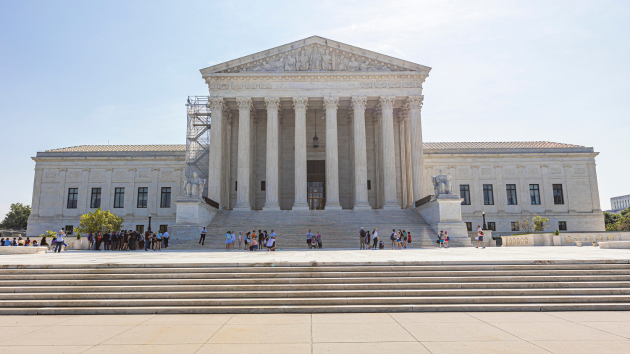
The Supreme Court of the United States SCOTUS in Washington D.C. (Nicolas Economou/NurPhoto via Getty Images)
(NEW YORK) — Three years after affirming a constitutional right of Americans to carry a gun for self-defense, the U.S. Supreme Court on Tuesday will consider whether states can limit the carry of firearms on private property open to the public without first receiving the property owner’s consent.
The case involves a Hawaiian law and similar measures in four other states –- California, Maryland, New York and New Jersey –- where lawmakers set a strict “default rule” prohibiting the possession of handguns in privately-owned places where other members of the public might congregate, unless the owner affirmatively gives permission.
The laws govern locations such as stores, shopping malls, bars, restaurants, theaters, arenas, farms, and private beaches. It does not involve public property, which is subject to different rules.
“This law is extremely restrictive. It bans public carry in 96.4% of the publicly available land in the County of Maui,” said Alan Beck, an attorney for three Maui residents and members of the Hawaii Firearms Coalition who are challenging the law.
“They’d like to carry dropping off money at the ATM late at night or just going to have lunch at a restaurant,” Beck said. “They are unable to carry in any private business that is open to the public that is unwilling to put up a sign saying ‘guns allowed.'”
While property owners have the inherent right to exclude guns from their premises, Beck says the onus should be on them to make their wishes clear, otherwise expect that members of the public can freely exercise their Second Amendment rights as a matter of standard practice.
Unlike Hawaii, 45 states permit licensed handgun owners to presume they can legally carry their weapons onto private property open to the public, unless the owner explicitly bans guns by issuing verbal instructions or posting a sign.
“The express purpose of this law is to make it so that less people exercise their constitutional rights,” Beck said.
Hawaii officials argue in court documents that never in the nation’s history has there been a “right to armed entry onto private property without consent” and that its law is meant to protect a property-owner’s right to exclude guns without having to take extra steps.
“The basic principle is that private property owners are empowered to set the rules for their property, and the state can make it easier for private property owners to do so,” said Douglas Letter, chief legal officer at Brady, a gun safety group.
“Hawaii’s law is obviously eminently reasonable,” Letter added. “Visitors simply must get a private property owner’s permission to bring a firearm onto that property.”
The Supreme Court will evaluate the Hawaii law using a test laid out in a landmark 2022 decision in which Justice Clarence Thomas, writing for the conservative majority, said only gun regulations consistent with “the Nation’s historical tradition of firearm regulation” can stand.
Hawaii points to an 1865 Louisiana law and 1771 New Jersey law as imposing nearly identical property restrictions as its current measure. The plaintiffs say they are “outlier” examples and not the historic norm. The Ninth Circuit U.S. Court of Appeals upheld Hawaii’s law, holding that “a national tradition likely exists of prohibiting the carrying of firearms on private property without the owner’s oral or written consent.”
Beck and co-counsel Kevin O’Grady said they expect the justices will likely reverse that ruling in their favor. “Just because Hawaii is giving lip service to the Second Amendment when they’re doing the kind of things they’re doing — and doing these mental gymnastics to try to justify this law,” O’Grady said, “it will not be tolerated by the U.S. Supreme Court.”
A decision in the case is expected by the end of June.
The Supreme Court of the United States SCOTUS in Washington D.C. (Nicolas Economou/NurPhoto via Getty Images)
(NEW YORK) — Three years after affirming a constitutional right of Americans to carry a gun for self-defense, the U.S. Supreme Court on Tuesday will consider whether states can limit the carry of firearms on private property open to the public without first receiving the property owner’s consent.
The case involves a Hawaiian law and similar measures in four other states –- California, Maryland, New York and New Jersey –- where lawmakers set a strict “default rule” prohibiting the possession of handguns in privately-owned places where other members of the public might congregate, unless the owner affirmatively gives permission.
The laws govern locations such as stores, shopping malls, bars, restaurants, theaters, arenas, farms, and private beaches. It does not involve public property, which is subject to different rules.
“This law is extremely restrictive. It bans public carry in 96.4% of the publicly available land in the County of Maui,” said Alan Beck, an attorney for three Maui residents and members of the Hawaii Firearms Coalition who are challenging the law.
“They’d like to carry dropping off money at the ATM late at night or just going to have lunch at a restaurant,” Beck said. “They are unable to carry in any private business that is open to the public that is unwilling to put up a sign saying ‘guns allowed.'”
While property owners have the inherent right to exclude guns from their premises, Beck says the onus should be on them to make their wishes clear, otherwise expect that members of the public can freely exercise their Second Amendment rights as a matter of standard practice.
Unlike Hawaii, 45 states permit licensed handgun owners to presume they can legally carry their weapons onto private property open to the public, unless the owner explicitly bans guns by issuing verbal instructions or posting a sign.
“The express purpose of this law is to make it so that less people exercise their constitutional rights,” Beck said.
Hawaii officials argue in court documents that never in the nation’s history has there been a “right to armed entry onto private property without consent” and that its law is meant to protect a property-owner’s right to exclude guns without having to take extra steps.
“The basic principle is that private property owners are empowered to set the rules for their property, and the state can make it easier for private property owners to do so,” said Douglas Letter, chief legal officer at Brady, a gun safety group.
“Hawaii’s law is obviously eminently reasonable,” Letter added. “Visitors simply must get a private property owner’s permission to bring a firearm onto that property.”
The Supreme Court will evaluate the Hawaii law using a test laid out in a landmark 2022 decision in which Justice Clarence Thomas, writing for the conservative majority, said only gun regulations consistent with “the Nation’s historical tradition of firearm regulation” can stand.
Hawaii points to an 1865 Louisiana law and 1771 New Jersey law as imposing nearly identical property restrictions as its current measure. The plaintiffs say they are “outlier” examples and not the historic norm. The Ninth Circuit U.S. Court of Appeals upheld Hawaii’s law, holding that “a national tradition likely exists of prohibiting the carrying of firearms on private property without the owner’s oral or written consent.”
Beck and co-counsel Kevin O’Grady said they expect the justices will likely reverse that ruling in their favor. “Just because Hawaii is giving lip service to the Second Amendment when they’re doing the kind of things they’re doing — and doing these mental gymnastics to try to justify this law,” O’Grady said, “it will not be tolerated by the U.S. Supreme Court.”
A decision in the case is expected by the end of June.
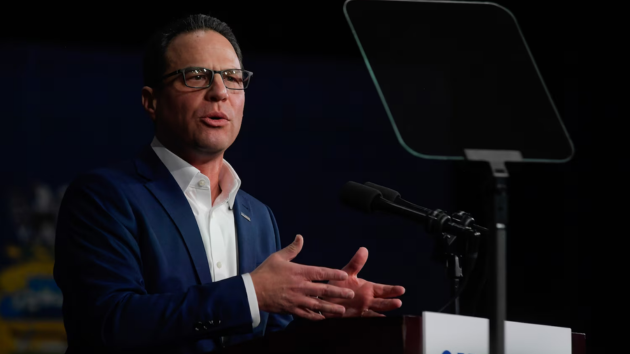
Pennsylvania Gov. Josh Shapiro speaks to suppporters at a rally announcing his reelection bid at the Alan Horwitz “Sixth Man” Center on January 8, 2026, in Philadelphia, Pennsylvania. Matthew Hatcher/Getty Images
(WASHINGTON) — Pennsylvania Gov. Josh Shapiro, in a forthcoming memoir, claimed that the running mate vetting team for Vice President Kamala Harris during her 2024 run for the presidency asked him if he were ever an agent of the Israeli government, ABC News has confirmed.
Shapiro writes in his memoir “Where We Keep the Light,” which is set to be released on Jan. 27, that he was asked last minute by Dana Remus, a former White House counsel and member of the vetting team, if he had ever been an agent for Israel. He said that told Remus he found the question offensive, according to excepts reported by The New York Times.
He wrote that he was also asked by Remus if he ever spoke with an undercover Israeli agent, to which Shapiro said he responded in part, that if they had been undercover, “how the hell would I know?”
Shapiro wrote in his memoir that he understood Remus had to do her job, but criticized the line of questioning, according to the excerpts.
Shapiro — who is Jewish and has been outspoken about his religion, as well as his support of Israel and criticism of the current Israeli government — said he was also asked more general vetting questions about Israel and his handling of campus protests about Gaza.
“I wondered whether these questions were being posed to just me — the only Jewish guy in the running — or if everyone who had not held a federal office was being grilled about Israel in the same way,” Shapiro wrote, according to the excepts.
ABC News has reached out to spokespeople for Shapiro and Harris, and to Remus about the questions she allegedly asked Shapiro.
While Shapiro was a reported contender for Harris’ running-mate spot, amid major debates within the Democratic Party over the Israel-Hamas war and the U.S.-Israel relationship given Israel’s conduct in Gaza, he faced scrutiny from progressives over his pro-Israel views, as well as some previous time spent volunteering in Israel, including on an Israeli army base.
He also faced questions over his college writing on the Israeli-Palestinian conflict where he expressed doubts that Palestinians could come to a peace agreement with Israel.
Shapiro and his spokespeople said at the time that his time volunteering did not include military activity, and that his views on the conflict had evolved to support a two-state solution to the conflict between Israelis and Palestinians.
The vetting process for running mates is known to be intensive and often tries to get ahead of questions that may be asked publicly of candidates.
Harris, in her memoir “107 Days,” wrote that during the vetting process for running mates, she spoke with Shapiro “about how to handle the attacks he’d confronted on Gaza and what effect it might have on the enthusiasm we were trying to build,” and that they discussed the opinion piece Shapiro wrote in college.
“He said he felt he’d been able to deal with critics by stating clearly that his youthful opinion had been misguided and that he was fully committed to a two-state solution. He had also publicly called Netanyahu ‘one of the worst leaders of all time,'” Harris wrote.
She also framed the decision against Shapiro as more about his ambition and fears that he would be frustrated with the vice presidential role — claims Shapiro has rebuffed. Shapiro campaigned as a Harris surrogate even after not getting the running-mate nod.
Some Jewish officials who served in President Joe Biden and Harris’ administration have slammed the alleged vetting question, saying that it ties into antisemitic tropes that American Jews have dual loyalties between the United States and Israel.
Aaron Keyak, former deputy special envoy to monitor and combat antisemitism at the State Department and a board member of the Combat Antisemitism Movement, told ABC News on Monday that he was surprised at “how blatant the rhetoric was when it comes to playing into antisemitic tropes.”
“What’s even the point of asking that question in that way? Were they trying to send some sort of message to Gov. Shapiro? Were they trying to intimidate him?” Keyak said.
Keyak, who is Jewish, said he had also been asked questions during the vetting process for his own Biden administration State Department role that he later heard non-Jewish appointees were not. He said he was not able to share the specifics of the questions, but that the implications of the questions were similar to what Shapiro had allegedly been asked.
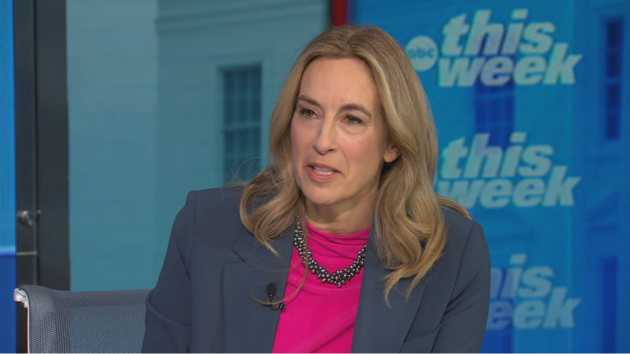
(NEW YORK) — New Jersey Democratic Gov.-elect Mikie Sherrill criticized President Donald Trump on Sunday for pursuing the acquisition of Greenland while the cost of living remains a top issue in the United States.
“There is not one person in New Jersey that wakes up in the morning and says, ‘Gee, I hope today’s the day that the president dumps billions of dollars into buying Greenland while my grocery store costs continue to go up,'” Sherrill told ABC News’ “This Week” co-anchor Jonathan Karl.
Two days before her inauguration, Sherrill talked with Karl in an exclusive interview and pledged to lower costs as governor without going into specific policies she would pursue.
Sherrill said that tariffs Trump has imposed during his first term are raising costs for Americans.
“Right now, the doors to opportunity are being shut down at every level. We see a president who constantly is running this tariff regime, putting more money in his own pocket and raising costs on everybody else,” Sherrill said. “So we are fighting against that.”
Sherrill was elected in November by a double-digit margin, outperforming former Vice President Kamala Harris’ margin in the presidential race in the Garden State. Asked by Karl what lessons the Democratic Party should take away from her victory, Sherrill said Democrats should “listen to people.”
“Get on the street and listen to your constituents or would-be constituents,” Sherrill said. “But the best thing I can do now for the Democratic Party is to govern effectively, to deliver on the promises I made, because, as I’ve mentioned, there’s an affordability crisis.”
Sherrill has previously said she will declare a state of emergency on utility costs, thereby freezing existing rates, on Day 1 in office.
Karl also asked Sherrill about the ongoing immigration enforcement operations in Minneapolis, where protesters clashed with federal agents over the weekend.
“[ICE is] assaulting people on the street. They’re busting through windows in cars … people are getting shot and killed by these out of control proto-military agents,” Sherrill said. “I think the president’s trying to incite the protesters so that he can take America’s eyes off the fact that his militia that he’s building around this country is actually attacking American citizens.”
Karl asked Sherrill, a Naval Academy graduate who flew helicopters in the Navy, “You’re a military veteran … what would it mean if he actually goes through with the threat to invoke the Insurrection Act and send those active duty troops that are now on standby into Minneapolis?”
“[Trump] seems to be trying to incite an insurrection so he can then put troops on the street for the insurrection,” Sherrill said. “This is something that every single American should be concerned about.”
Trump administration officials have said there are no plans to pull federal agents out of Minneapolis, and have defended the conduct of ICE agents following multiple shootings. The fatal shooting of Renee Good in Minneapolis on Jan. 7 by ICE agent Jonathan Ross sparked backlash from Democrats and some residents of the city.
After threatening to invoke the Insurrection Act, Trump told reporters on Friday that he didn’t think he needed to invoke it now.
“If I needed it, I’d use it. I don’t think there’s any reason right now to use it, but if I needed it, I’d use it. It’s very powerful,” Trump said.
Immigration enforcement operations also took place in Sherrill’s home state of New Jersey last week, with one raid in Princeton on Thursday leading to two arrests.
Sherrill previously said that she supports her state’s Immigrant Trust Directive, which orders New Jersey police officers not to comply with ICE operations, but opposes it being signed into law, citing concerns about the law being blocked in court.
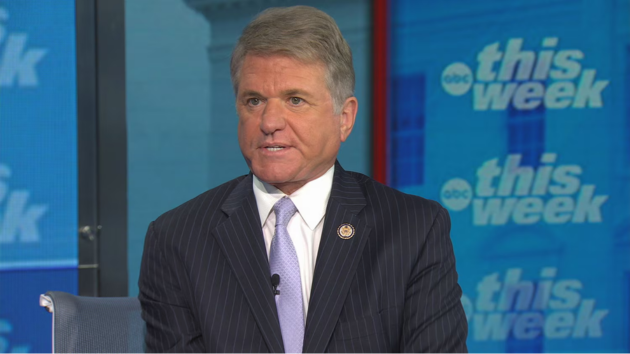
(NEW YORK) — Republican Rep. Michael McCaul warned on Sunday that any U.S. military intervention to obtain Greenland would put America at odds with its NATO allies — and possibly spell the end of the alliance itself.
“What do you make of what’s going on with the president in Greenland? And now he’s slapped tariffs on eight of our allies in Europe; he’s not ruling out military force to get Greenland. What is going on?” “This Week” co-anchor Jonathan Karl asked McCaul, who serves as chairman emeritus of both the House Foreign Affairs and Homeland Security committees.
While McCaul acknowledged the strategic importance of the autonomous island, which is part of the Kingdom of Denmark, and noted that previous Presidents have considered acquiring the territory, he said the U.S. already has a treaty that allows “full access” to protect Greenland — effectively negating the purpose of any invasion.
“The fact is, the president has full military access to Greenland to protect us from any threat,” McCaul said. “So if he wants to purchase Greenland, that’s one thing. But for him to militarily invade would turn Article 5 of NATO on its very head and, in essence, press a war with NATO itself. It would end up abolishing NATO as we know it.”
McCaul added, “If we want to put more military in there, we can; we don’t have to invade it. If he wants to buy it, that’s fine. But I don’t see a willing seller right now.”
Democratic Sen. Chris Van Hollen echoed McCaul’s point on “This Week,” and accused the president of “lying” when he says obtaining Greenland is about national security.
“Denmark and Greenland have both said to the United States, ‘You can take what measures you need to protect the security of the United States and, of course, the NATO alliance,'” Van Hollen said. “We have a base there already, and we can expand that base.”
“This is not about security,” Van Hollen told Karl. “This is about a land grab. Donald Trump wants to get his hands on the minerals and other resources of Greenland, just like the real reason he went into Venezuela had nothing to do with stopping drugs from coming.”
Asked if there was any action that Congress could take to prevent Trump from using force to take over Greenland, Van Hollen called on Congress to invoke the War Powers Resolution.
“We could, for example, cut off any funds that could be used for military purposes with respect to Greenland; we could take action under the War Powers Resolution,” Van Hollen said. “But a lot of our Republican colleagues talk big until it comes time to vote. We saw that just this past week, where two Republican senators who had voted in favor of moving forward the War Powers Resolution on Venezuela backed off. So they have to stop giving Donald Trump a blank check.”
Van Hollen also criticized Trump’s threats to intervene militarily in Iran amid reports that thousands of protesters have been killed in demonstrations against the country’s regime.
“I don’t believe we should be using American military force to try to impose democracy on Iran,” Van Hollen said.
“We should support the protesters,” he added. “But the president of United States should not suggest that we’re going to come in there and provide military support to get rid of the regime.”
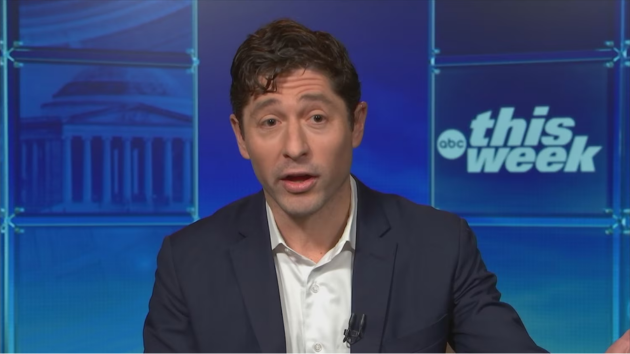
(MINNEAPOLIS)– Minneapolis Mayor Jacob Frey defended himself and Minnesota Gov. Tim Walz on Sunday, insisting they’ve “done nothing wrong” amid what sources say is a new federal investigation targeting the two Democratic officials.
“If the rumors are true, this is deeply concerning, because this is way more important than just me. This is a very serious matter, and this whole investigation would ultimately be the product of one of the most basic foundational responsibilities that I have as mayor, which is to speak on behalf of my constituents,” Frey told “This Week” co-anchor Jonathan Karl. “There are other countries where you get put away for the things that you say. There are other countries where you get investigated for saying something that runs counter to what the federal government states. But in this country, it’s not that way.”
Frey said his office has not received a subpoena from the Department of Justice. He said he intends to comply with the investigation.
“Look, we have done nothing wrong, so of course we will comply in it, but at the same time, we need to be understanding how wild this is. We are doing everything possible right now to keep people safe in our city. We have spoken out to make sure that our residents are protected and people’s constitutional rights are upheld. Speaking out in that way is not illegality,” Frey said.
ABC News reported Friday night that the Justice Department was investigating whether Frey and Walz have been obstructing federal law enforcement activities in the state, according to multiple U.S. officials.
In response, Walz accused the administration of “weaponizing the justice system and threatening political opponents.”
Without directly confirming the investigation, shortly after news broke Attorney General Pam Bondi posted on X, “A reminder to all those in Minnesota: No one is above the law.”
In a separate interview on “This Week,” Rep. Michael McCaul — a Republican member and former chair of the House Homeland Security Committee — said that investigating political leaders like this is “uncommon.”
“It’s a federal offense to impede a federal investigation like we’re seeing in the streets right now. I think that is very uncommon to go after political figures like that. I think it may be more of a statement more than anything else. But you know, we’ll see,” the Texas lawmaker said.
Frey and Walz have clashed with the Trump administration in recent weeks. Up to 3,000 federal agents have been surged to Minnesota to conduct immigration enforcement operations and investigate fraud allegations. Those agents have been met by protesters demanding they cease operations and leave the state.
On Jan. 7, an Immigration and Customs Enforcement officer fatally shot Minneapolis resident Renee Good, a mother of three. The deadly altercation prompted outrage from residents, local officials and Democratic lawmakers, as well as continued protests, which have been mostly peaceful. The Trump administration has defended the officer, asserting he was acting in self defense because it says the shooting victim was attempting to run him over with her vehicle.
Department of Homeland Security Secretary Kristi Noem said there are no plans to pull federal agents from the city.
Walz put the Minnesota National Guard on standby over the weekend in case protests got out of hand. While there were some clashes between protesters and counterprotesters, the Guard has not been deployed to the streets.
On “This Week,” Frey said the federal agents’ presence is to blame for the inflamed tensions on the ground.
“The intensity is caused by the unwanted, uninvited people that are here in the form of ICE,” Frey said, adding that there around about five times as many federal agents in the city than there are city police officers. “The calm exists where you don’t have ICE agents. So, if you are looking to restore order and prevent chaos, there’s a very straightforward antidote, and that is for ICE to leave.”
Frey said he doesn’t regret telling ICE to “get the f— out” of Minneapolis after the fatal shooting of Good.
“I don’t regret it at all,” Frey said. “If I seemed like I was angry and frustrated, I was. And part of my responsibility as mayor is to channel what in our city are feeling. And the people in our city were angry. They were upset.”
McCaul, the Texas Republican, called on everybody to tone down the rhetoric and try to deescalate tensions.
“I think we need to — on both sides — start calming down the rhetoric. I’m glad the president did not invoke the Insurrection Act. To throw our military in the middle of all of this just sort of escalated the violence,” he said.
The president has not ruled out invoking the 1807 law that would allow him to deploy the U.S. military for domestic law enforcement. However, he said on Friday, “I don’t think there’s any reason right now to use it.”
While the administration has defended federal agents’ conduct, McCaul said he thinks “maybe some [officers] need to go maybe have some enhanced training.”
Asked about Vice President JD Vance and White House deputy chief of staff Stephen Miller asserting ICE officers have “immunity” from federal prosecution, McCaul said, “That’s not accurate.”
“I mean, if there’s an unlawful use of force, that is something that can be prosecuted by — under federal law,” said McCaul, who previously worked for the DOJ. “They don’t have full immunity if, you know, if they violate the use of force laws. But at the same time, people who impede a federal investigation don’t have immunity from that either.”
However, McCaul agreed with the administration that immigration enforcement operations are necessary due to the surge in undocumented immigrants who entered the country under the Biden administration.