(WASHINGTON) — Ukrainian President Volodymyr Zelenskyy said Thursday that trilateral talks between Ukraine, Russia and the United States are expected to be held in the United Arab Emirates.
“I think that it will be the first trilateral meeting in Emirates. It will be tomorrow and the day after tomorrow,” Zelenskyy said as he spoke at the World Economic Forum in Davos, Switzerland.
This is a developing story. Please check back for updates.
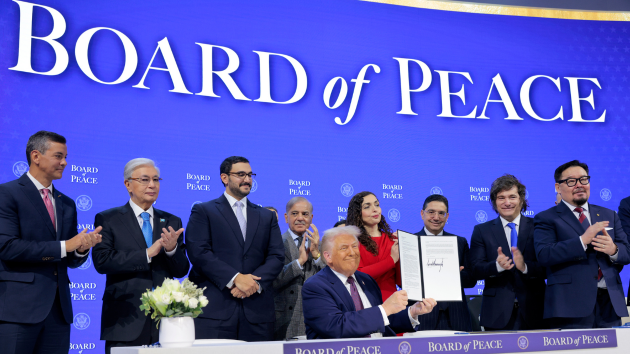
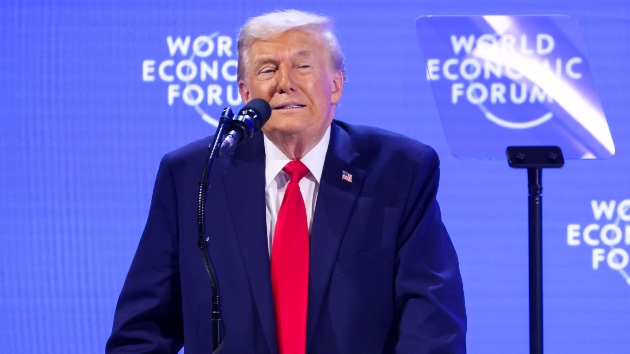
U.S. President Donald Trump holds up his signature on the founding charter during a signing ceremony for the “Board of Peace” at the World Economic Forum (WEF) on January 22, 2026 in Davos, Switzerland. (Chip Somodevilla/Getty Images)
(NEW YORK) — President Donald Trump hosted a signing ceremony for his Board of Peace on the sidelines of the World Economic Forum in Davos on Thursday, saying that it was a “very exciting day” and that the collective would become one of the “most consequential bodies” ever created.
“As everyone can see today, the first steps toward a brighter day for the Middle East and a much safer future for the world are unfolding right before your very eyes,” Trump said in his opening remarks.
He added, “Together we are in a position to have an incredible chance — I don’t even call it a chance, I think it’s going to happen — to end decades of suffering, stop generations of hatred and bloodshed and forge a beautiful, ever-lasting and glorious peace for that region.”
More than two dozen countries have so far accepted Trump’s invitation to join the board, but none of the U.S.’s major European allies have yet made a commitment and some have rejected the idea. Trump was flanked on the stage in Davos by more than a dozen leaders whose countries had agreed to be signatories. He described those who were present as “just the countries that are here.”
U.S. special envoy Steve Witkoff said in an interview on CNBC on Wednesday that up to 25 countries had accepted the invitation to join the board.
Invitations were sent over the weekend to more than 50 world leaders, according to U.S. officials. A White House official said about 30 countries were expected to join.
The initiative has drawn cautious responses from several U.S. allies who did not explicitly endorse the board or accept Trump’s invitation as leaders question whether a U.N. alternative body is necessary.
“I think the board of peace will be the most prestigious board ever, and it’s going to get a lot of work done that the United Nations should have done,” Trump said Wednesday. “And we’ll work with the United Nations. But the Board of Peace is going to be special. We’re going to have peace.”
When asked by a reporter at the White House on Tuesday if the board would replace the U.N., Trump said: “It might.”
France, Norway, and Sweden, have declined or expressed significant reservations about the board, while others like Germany, the United Kingdom, and Italy have remained noncommittal.
Russia was also extended an invitation, the Kremlin confirmed this week, despite the country’s continued assault on Ukraine.
“The proposal made to us primarily concerns the settlement in the Middle East and the search for possible ways to resolve the pressing problems of the Palestinian people and the most acute problems of the humanitarian situation in the Gaza Strip,” Russian President Vladimir Putin told a Russian Security Council meeting, state media reported.
As of Thursday morning, more than 20 countries had said that they had accepted Trump’s invitation. Those countries were: Albania, Argentina, Armenia, Azerbaijan, Bahrain, Belarus, Bulgaria, Egypt, Hungary, Indonesia, Israel, Jordan, Kazakhstan, Kosovo, Kuwait, Mongolia, Morocco, Pakistan, Paraguay, Qatar, Saudi Arabia, Turkey, the United Arab Emirates, Uzbekistan and Vietnam.
“This is the greatest board ever assembled, and everybody wants to be on it,” Trump told reporters in Davos on Wednesday. “I have some controversial people on it, but these are people that get the job done. These are people that have tremendous influence.”
The full invitation list has not been made public by the White House.
Yvette Cooper, the U.K.’s foreign secretary, said during a BBC interview on Thursday that her country would not be among the signatories in Davos. Part of the reasoning behind that decision, she said, was the U.K.’s “concerns” about Putin being invited to be “part of something that’s talking about peace when we’ve still not seen any signs from Putin that there will be commitment to peace in Ukraine.”
The Board of Peace was first introduced last year with a two-year United Nations Security Council mandate to manage and rebuild Gaza, but the board’s charter makes no direct reference to Gaza at all.
A copy of the charter draft reviewed by ABC News makes clear the Board of Peace has a much broader mandate as an “international organization” and “peacebuilding body” seeking to resolve the world’s conflicts and securing enduring peace, akin to a U.S.-led alternative to the United Nations.
Trump, who is expected to chair the board, can potentially hold the position for life.
“The Chairmanship can be held by President Trump until he resigns it,” a U.S. official said. “A future U.S. president, however, may choose to appoint or designate the United States’ representative to the Board.”
The charter draft states that nations that accept the invitation will be given a three-year membership term, but permanent membership would be given to member states that contribute more than $1 billion in cash to the Board of Peace within the first year.
The U.S. official said that contributions to the board are “voluntary” and should not be considered as an entry fee to join. If member states choose to contribute money, the Board of Peace will “implement the highest financial controls and oversight mechanisms,” the official said.
Putin suggested Russia could pay its $1 billion from assets frozen by the U.S. over its war with Ukraine.
The executive committee that would oversee the board will include former British Prime Minister Tony Blair, Canadian Prime Minister Mark Carney and U.S. Secretary of State Marco Rubio, as well as Witkoff and Trump’s son-in-law Jared Kushner.
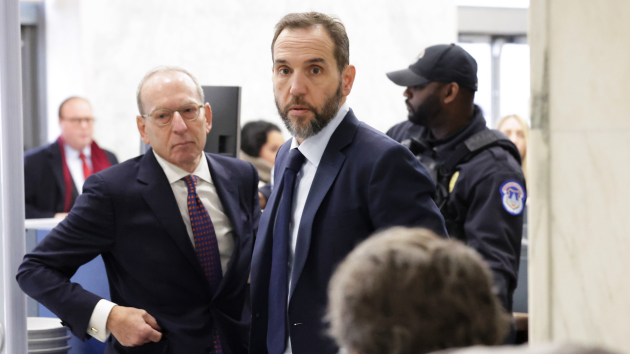
Former Special Counsel Jack Smith (C) arrives to testify during a closed-door deposition before the House Judiciary Committee in the Rayburn House Office Building on Capitol Hill on December 17, 2025 in Washington, DC. (Alex Wong/Getty Images)
(WASHINGTON) — Former special counsel Jack Smith, who charged President Donald Trump with crimes in Florida and Washington, D.C., is set to testify in public before the House Judiciary Committee on Thursday.
Smith was tasked with investigating Trump’s alleged interference in the 2020 election and alleged mishandling of classified documents — and his alleged refusal to turn them back over to the government.
Smith asked the judge overseeing the election interference case to dismiss it after Trump’s election in 2024 due to a long-standing Justice Department policy that bars the prosecution of a sitting president. And he filed a motion to dismiss the appeal of the classified documents case for the same reason.
Trump has denied wrongdoing in both cases.
This will mark Smith’s second time before the committee — he appeared behind closed doors last month. It is customary for former special counsels to appear before Congress publicly to discuss their findings.
Chairman Jim Jordan told ABC News that the committee always intended to have Smith appear in public.
“He’ll be there in a public setting so the country can see that this was no different than all the other lawfare weaponization of government going after President Trump,” Jordan said. “Jack Smith is sort of the culmination of that whole effort to stop President Trump from getting to the White House. But thank goodness it didn’t work and the American people saw through it.”
Smith, according to his team, is voluntarily appearing before the committee and will utilize his experience as a nonpartisan prosecutor.
He will also say that the facts of Trump’s cases would lead to a prosecution of anyone, whether they were a Democrat or Republican, his team said.
In his closed-door testimony, Smith defended his decision to twice bring charges against Trump — telling lawmakers his team “had proof beyond reasonable doubt in both cases” that Trump was guilty of the charges in the 2020 election interference and classified documents cases, according to a transcript of the hearing.
And Smith fervently denied that there was any political influence behind his decision — contrary to allegations of Republicans on the Judiciary Committee, who requested the testimony — such as pressure from then-President Joe Biden or then-Attorney General Merrick Garland, the transcripts shows.
“No,” Smith responded continuously to those allegations, according to the transcript.
Just over an hour before his testimony on Dec. 17, the Department of Justice sent an email to Smith’s lawyers preventing him from discussing the classified documents case, according to the 255-page transcript of the deposition, released last year by the Judiciary Committee along with a video of the hearing.
This meant Smith was unable to answer most questions on that case and the deposition — intended to ask questions about the alleged weaponization of the DOJ against Trump and his allies — mainly focused on the 2020 election case instead.
His team also said Smith will comply with Judge Aileen Cannon’s order that blocked the release of the second volume of his report.
Smith’s counsel said the DOJ also refused to send a lawyer to advise Smith on whether his statements were in line with their determination of what he could or could not say regarding the cases, according to the deposition. Smith did say, however, that Trump “tried to obstruct justice” in the classified documents investigation “to conceal his continued retention of those documents.
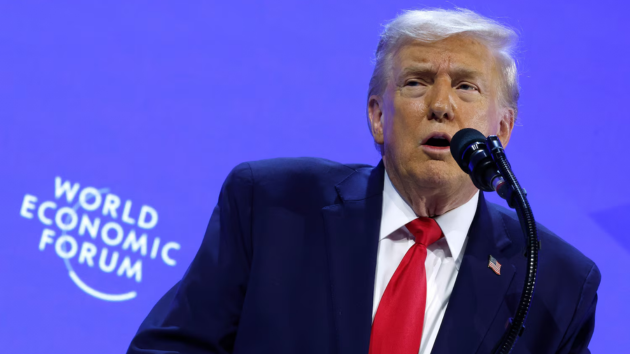
President Donald Trump gives a speech at the World Economic Forum January 21, 2026 in Davos, Switzerland. (Chip Somodevilla/Getty Images)
(WASHINGTON) — President Donald Trump on Wednesday said he and NATO Secretary-General Mark Rutte have “formed the framework of a future deal with respect to Greenland” and as a result he will not be imposing the tariffs he threatened on European allies who didn’t agree to his takeover efforts.
“Based upon a very productive meeting that I have had with the Secretary General of NATO, Mark Rutte, we have formed the framework of a future deal with respect to Greenland and, in fact, the entire Arctic Region,” Trump wrote in a social media post.
“This solution, if consummated, will be a great one for the United States of America, and all NATO Nations. Based upon this understanding, I will not be imposing the Tariffs that were scheduled to go into effect on February 1st,” the president added.
His post did not provide further details on the “framework” for Greenland, a semi-autonomous territory of NATO ally Denmark.
Trump continued to be light on specifics during interviews with CNBC and CNN, particularly on whether the U.S. would have ownership of Greenland as he’s demanded.
“Well, we have a concept of a deal. I think it’s going to be very good deal for the United States, also for them, and we’re going to work together on something having to do with the Arctic as a whole, but also Greenland, and it has to do with the security, great security, strong security and other things,” Trump said on CNBC.
When pressed on whether U.S. ownership of Greenland was involved, Trump said he “didn’t want to say yet” and it was “complex.”
On CNN, Trump said the U.S. got “everything we wanted.”
“It’s the ultimate long-term deal, and I think it puts everybody in a really good position, especially as it pertains to security and minerals and everything else,” Trump said.
He also told CNN the deal would be “infinite,” saying: “It’s a deal that’s forever.”
Earlier Wednesday, while speaking at the world Economic Forum in Davos, Switzerland, Trump notably ruled out using military force to take control of Greenland.
“We probably won’t get anything unless I decide to use excessive strength and force where we would be, frankly, unstoppable. But I won’t do that,” Trump said in his remarks.
Still, Trump argued no other country can defend Greenland but the United States and said he wanted “immediate negotiations” on the issue.
“All we’re asking for is to get Greenland, including right, title and ownership, because you need the ownership to defend it. You can’t defend it on a lease. No. 1, legally it’s not defensible that way, totally. And No. 2, psychologically, who the hell wants to defend a license agreement or a lease which is a large piece of ice in the middle of the ocean, where, if there is a war, much of the action will take place on that piece of ice,” Trump said.
As part of his Greenland push, Trump last week announced a new 10% tariff rate against eight European nations would go into effect next month. Those levies would later be increased to 25% until the U.S. is able to purchase Greenland, the president said.
Those threats resulted in European officials on Wednesday suspending a trade agreement with the U.S. worked out last summer.
(WASHINGTON) — The Supreme Court on Wednesday sharply questioned President Donald Trump’s assertion of unchecked power to remove a member of the Federal Reserve over the mere allegation of gross negligence and without any opportunity for a hearing to dispute the claims.
A majority of justices also appeared likely to deny Trump’s request to immediately remove Lisa Cook from her position as litigation continues, though it was less clear whether the court would definitively weigh in on the substance of the allegations or the proper standard for removal under the law.
This is a developing story. Please check back for updates.
DHS is using the CBP Home Mobile App to incentivize self-deportation. (Department of Homeland Security)
(WASHINGTON) — The Department of Homeland Security announced on Wednesday that it is increasing its stipend for those who are in the United States illegally and self-deport by $1,600.
Previously, DHS offered $1,000 to those who use the Customs and Border Protection (CBP) Home App to self-deport, but now, it’s raising that number to $2,600.
DHS claimed that since January 2025, 2.2 million people who are in the U.S. illegally have voluntarily self-deported — with “tens of thousands” using the CBP app. A report from the Brookings Institution released last week called DHS’ data into question, saying the department’s numbers “should not be considered a serious source.”
“To celebrate one year of this administration, the U.S. taxpayer is generously increasing the incentive to leave voluntarily for those in this country illegally- offering a $2,600 exit bonus,” Homeland Security Secretary Kristi Noem said in a release. “Illegal aliens should take advantage of this gift and self-deport because if they don’t, we will find them, we will arrest them, and they will never return.”
The increased amount is to mark to the first year of President Donald Trump’s term in office, and may only be temporary, DHS said in the release.
For months, the department has been pushing self-deportations — spending millions on advertisements that showcased it’s previous $1,000 payment and a plane ticket that people who register to self-deport are given.
It’s not clear how much money in total has been given to people who have self-deported.
DHS said in the first year of Trump’s term, there were 675,000 deportations. The authors of the Brookings Institution report estimated a figure much lower last week — saying there were between 310,000 and 315,000 removals in 2025.
Deporting migrants who are illegally in the U.S. was one of Trump’s key campaign promises, but advocates have said that Immigration and Customs Enforcement and Border Patrol tactics have gone too far in some cases.
US President Donald Trump, during the World Economic Forum (WEF) in Davos, Switzerland, on Wednesday, Jan. 21, 2026. The annual Davos gathering of political leaders, top executives and celebrities runs from Jan. 19-23. (Photographer: Krisztian Bocsi/Bloomberg via Getty Images)
(DAVOS, Switzerland) — President Donald Trump, speaking Wednesday at the World Economic Forum in Davos, Switzerland amid heightened tensions with Europe, notably ruled out using military force to acquire Greenland.
“We probably won’t get anything unless I decide to use excessive strength and force where we would be, frankly, unstoppable. But I won’t do that,” Trump said.
“I don’t have to use force. I don’t want to use force. I won’t use force,” Trump said.
Still, Trump said no other country can defend Greenland but the United States and said he is seeking “immediate negotiations to once again discuss the acquisition of Greenland by the United States.”
“I have tremendous respect for both the people of Greenland and the people of Denmark, tremendous respect. But every NATO ally has an obligation to be able to defend their own territory, and the fact is, no nation or group of nations is in any position to be able to secure Greenland other than the United States. We’re a great power,” Trump said.
This is a developing story. Please check back for updates.
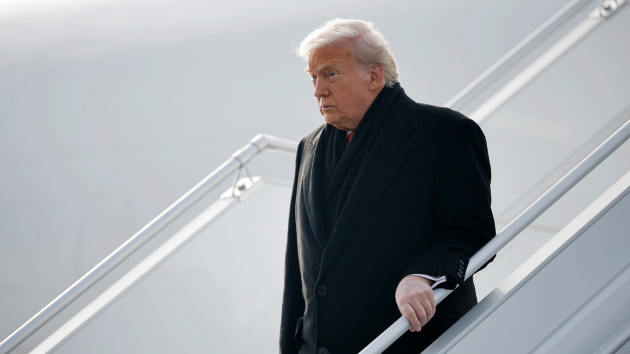
U.S. President Donald Trump disembarks Air Force One as he arrives at Zurich Airport before attending the World Economic Forum (WEF) in Davos, on January 21, 2026 in Zurich, Switzerland. (Chip Somodevilla/Getty Images)
(DAVOS, Switzerland) — President Donald Trump arrived on Wednesday in Zurich, Switzerland, ahead of his scheduled address in Davos.
Air Force One had earlier turned around mid-flight, after the crew identified “a minor electrical issue,” White House press secretary Karoline Leavitt told reporters Tuesday night.
The aircraft turned back and landed at Joint Base Andrews in Maryland, where the president and those traveling with him were set to board a different aircraft and then resume travel to Switzerland for the global economic conference.
The flight issue came as Trump is making his first international trip of 2026.
In Davos, Trump is expected to deliver remarks focused on his vision of American dominance, including his desire to take over Greenland.
Trump’s increasingly antagonistic language over acquiring the Danish territory puts him at odds with fellow NATO countries and other allies.
Trump will lead the largest U.S. delegation to the World Economic Forum, according to event organizers, where he plans to meet with top business CEOs and international leaders, deliver a speech to conference attendees, and participate in the formal signing ceremony to solidify his Board of Peace that was proposed to oversee the recovery of Gaza but has since raised questions that it could expand to rival the United Nations.
This week, Trump will once again face some world leaders he has spent months criticizing as he continues to test the limits of his presidential power and his standing in the world following weeks of reignited controversy over the capture of Venezuelan leader Nicolás Maduro and seizing the country’s oil and his public threats of acquiring Greenland by force, if necessary.
Since the start of his second term, Trump has slowly been building the case for why the U.S. should take control of Greenland, arguing it is vital for U.S. national security needs. In recent weeks his rhetoric on a takeover has escalated as he has refused to rule out military action.
Despite global pushback on his Greenland ambitions, Trump has refused to back down on his threats, saying “You’ll find out” when asked during a White House press briefing on Tuesday on how far he was willing to go to secure Greenland while dismissing the lack of support for a U.S. takeover.
When pressed by ABC News’ Mary Bruce about the many Greenlanders who have loudly voiced disagreement with the idea of U.S. control, Trump said that once he talks to them, they’ll be “thrilled.”
Asked about the possibility of the NATO alliance breaking up if the U.S. seizes Greenland, Trump said: “I think that we will work something out where NATO’s going to be very happy and where we’re going to be very happy. But we need it for security purposes. We need it for national security and even world security. It’s very important.”
“We have a lot of meetings scheduled on Greenland. I’m leaving tonight, as you know, Davos, and we have a lot of meetings scheduled on Greenland, and I think things are going to work out pretty well, actually,” Trump said later.
“So I think something’s going to happen that’s going to be very good for everybody,” he said.
However, the president’s optimistic outlook on a resolution to both sides’ satisfaction comes as he increases attacks on NATO countries who are seeking to protect Greenland. Over the weekend, Trump threatened to impose a 10% tariff on eight NATO countries starting Feb. 1 if no deal is reached. The move, stemmed in part from the countries’ decision to send a small contingent of troops to Greenland in the wake of Trump’s threats.
When Trump travels to Switzerland, the economic forum will be focused on “a spirit of dialogue” about how to better the world; however, ahead of his departure, the president touted his administration’s success during his second term while critiquing the leadership of his European counterparts in a show of force likely to be displayed during his visit.
“I think more than anything else, what I’m going to be speaking about is the tremendous success that we’ve had in one year. I didn’t think we could do it this fast … We have the most successful country in the world. We have the hottest country anywhere in the world by far,” Trump said.
“A lot of them could use some of the advice as to what we did,” he said of European allies, going on to lash out about energy and immigration.
Meanwhile, questions are swirling about the Board of Peace, which was originally billed as a committee that would oversee the reconstruction of Gaza from the Israel-Hamas war.
Critics and government leaders are now decrying the board, saying it undermines the United Nations.
A draft of the charter now says the Board of Peace would “secure enduring peace in areas affected or threatened by conflict,” not just Gaza. It also called for “a more nimble and effective international peace-building body.”
On his domestic agenda, Trump has for weeks now teased unveiling “some of the most aggressive housing reforms in American history” in Davos, including a ban on large institutional investors from buying single-family homes and calling for the federal government to buy $200 billion in mortgage bonds.
Trump’s speech will follow months of the White House recasting the nation’s economic story as one of growth and falling prices due to Trump’s economic policies as the midterm election season looms. The president has spent time traveling the country to deliver this message to Americans, but now he will do so on a global stage.
Despite Trump’s rosy imagery of the state of the American economy, voters are still experiencing rising costs and Republicans have been expressing concerns with messaging on the economy. Pressed about this dichotomy on Tuesday, Trump dismissed assertions that he was failing to address the needs of Americans, once again pointing blame to the Biden administration, calling the job he has done as president “a miracle.”
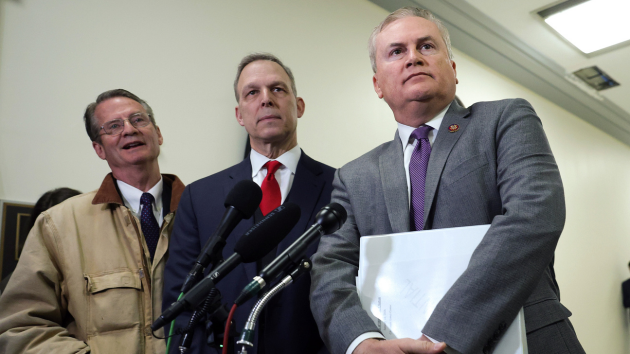
House Oversight and Government Reform Committee Chairman James Comer (R-KY) (R), joined by Rep. Scott Perry (R-PA) (C) and Rep. Tim Burchett (R-TN), speaks to reporters after former Secretary of State Hillary Clinton did not appear for a closed-door deposition in the Rayburn House Office Building on Capitol Hill on January 14, 2026 in Washington, DC. (Kevin Dietsch/Getty Images)
(WASHINGTON) — House Republicans are set to take the next steps on Wednesday to hold former President Bill Clinton and former Secretary of State Hillary Clinton in contempt of Congress for failing to comply with committee subpoenas related to the investigation into Jeffrey Epstein.
On Wednesday, Oversight Chairman James Comer is set to hold a markup of two resolutions finding the Clintons in contempt of Congress after they defied a subpoena for a deposition with the committee last week.
“The Clintons are not above the law, and the House Oversight Committee will move to hold them in contempt of Congress,” Comer, a Republican, said in a statement last week. “If Democrats refuse to hold the Clintons accountable, they will expose themselves as hypocrites.”
The Clintons have insisted that the subpoena is without legal merit, fighting the subpoena for months.
Last summer, Republicans and Democrats on Oversight’s Federal Law Enforcement Subcommittee approved a motion to issue subpoenas to 10 individuals, including Bill and Hillary Clinton, for testimony related to their investigation into Epstein and his associate, Ghislaine Maxwell.
Republicans have pointed at the former president’s travels on Epstein’s private aircraft in the early 2000s and the Clinton “family’s past relationship” with Epstein and Maxwell.
The contempt resolution is expected to advance out of the committee Wednesday afternoon — teeing up a full vote on the House floor days later. The timing of floor consideration won’t become clear until after the committee markup.
If Democrats oppose the floor vote, Speaker Mike Johnson can afford to lose just two Republican votes before a third GOP defector could upset passage.
The resolution, if passed, would direct the speaker of the House to refer the case to the U.S. Attorney for the District of Columbia — under the Department of Justice — for possible criminal prosecution. A simple majority is needed to clear a contempt resolution, though it does not require passage in the Senate.
Besides defying the subpoena, neither Bill Clinton nor Hillary Clinton has been accused of wrongdoing and denies having any knowledge of Epstein’s crimes. No Epstein survivor or associate has ever made a public allegation of wrongdoing or inappropriate behavior by the former president or his wife in connection with his prior relationship with Epstein.
Last month, in response to the Epstein Files Transparency Act, the Justice Department released several photographs of former President Clinton apparently taken during his international travels with Epstein and Maxwell between 2002 and 2003.
Following that disclosure, a spokesperson for the two-term Democratic president argued that the Trump administration released those images to shield the Trump White House “from what comes next, or from what they’ll try to hide forever.”
For months, David Kendall, the Clintons’ lawyer, has continuously argued that the Clintons have no information relevant to the committee’s investigation and should not be required to appear for in-person testimony.
Comer wrote in a letter to Kendall in October that the committee is “skeptical” that the Clintons have only limited information, and argued it was up to the committee, not the Clintons, to make determinations of the value of their testimony.
“[T]he Committee believes that it should be provided in a deposition setting, where the Committee can best assess its breadth and value,” Comer wrote.
Comer said in a statement on Tuesday that Bill Clinton’s lawyers made an offer for Comer, Ranking Member Robert Garcia and two members of each of their staffs to have a conversation with only former President Bill Clinton in New York. A Comer spokesperson said he “rejected the Clintons’ ridiculous offer.”
“The House Oversight Committee rejects the Clintons’ unreasonable demands and will move forward with contempt resolutions on Wednesday due to their continued defiance of lawful subpoenas,” Comer wrote in the statement.
In response to Comer’s statement, Clinton spokesperson Angel Ureña told ABC News that the Clintons “never said no to a transcript.”
“Interviews are on the record and under oath. Whether it was written or typed isn’t why this is happening. If that were the last or only issue, we’d be in a different position,” Ureña said in a statement.
“You keep misdirecting to protect you-know-who and God knows what,” she said, referring to Comer.
Last week, the ex-president’s office publicly released two written declarations — dated Jan. 13 from each of the Clintons — which it said were provided to the Oversight Committee. Both Clintons denied any personal knowledge of the criminal activities of Epstein and Maxwell. Both also denied ever visiting Epstein’s private estate in the U.S. Virgin Islands.
“Once I left office, I devoted my time to the Clinton Foundation. As part of the work of the Foundation, I accepted offers from others to use private air travel for the philanthropic and life-saving humanitarian efforts,” former President Clinton wrote. “In the early 2000s, Mr. Epstein offered a plane that was large enough to accommodate me, my staff, and my U.S. Secret Service detail, in support of visiting the Foundation’s philanthropic work. As has been widely reported, I and my staff took trips on his plane from 2002-2003, visiting Foundation projects and attending conferences and meetings. I have never visited Little St. James Island, and I do not recall speaking to Mr. Epstein for more than a decade prior to his 2019 arrest.”
The former president acknowledges in his declaration that Epstein “may very well have attended” White House events during Clinton’s two terms in office and may have been among the “tens of thousands” of people photographed with him. But Clinton claimed he did “not recall encountering Mr. Epstein, or any specific interaction with him, while in office.”
Each of the Clintons contend that they had no involvement — while in office or afterward — in any criminal investigations or prosecutions of either Epstein or Maxwell.
“I did not direct, oversee or participate in the handling of the investigations or prosecutions of the Epstein or Maxwell cases,” both Clintons stated in their declarations.
Both Clintons also wrote that they could not recall the circumstances of how they met Maxwell — but remember that she later “began a personal relationship with a mutual friend.”
“To be clear, I had no idea of Mr. Epstein’s or Ms. Maxwell’s criminal activities,” former President Clinton wrote. “And, irrespective of any intent either may have ever had, I did not take any action for the purpose of helping them to avoid any type of scrutiny.”
“During my tenure in public office, from 1993 to 2013, I never had any responsibility for, or involvement with, the Department of Justice’s handling of the Epstein and Maxwell investigations or prosecutions,” Hillary Clinton wrote in her declaration.
Lindsey Halligan, attorney for US President Donald Trump, holds ceremonial proclamations to be signed by US President Donald Trump, not pictured, in the Oval Office of the White House in Washington, DC, US, on Thursday, March 6, 2025. Trump exempted Canadian goods covered by the North American trade agreement known as USMCA from his 25% tariffs, offering major reprieves to the US’s two largest trading partners. (Photographer: Al Drago/Bloomberg via Getty Images)
(WASHINGTON) — Vice President JD Vance and second lady Usha Vance announced Tuesday that the couple is expecting their fourth child.
“We’re very happy to share some exciting news. Our family is growing!” Usha Vance wrote in the post on social media.
This is a developing story. Please check back for updates.