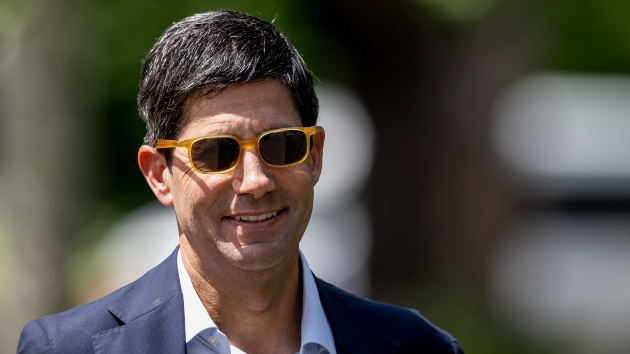
Kevin Warsh, former governor of the US Federal Reserve, walks to lunch during the Allen & Co. Media and Technology Conference in Sun Valley, Idaho, US, on Wednesday, July 9, 2025. The annual event has been a historic breeding ground for media deals and is usually a forum for tech and media elites to discuss the future of their industry. (Photographer: David Paul Morris/Bloomberg via Getty Images)
(WASHINGTON) — President Donald Trump announced conservative economist and former Fed governor Kevin Warsh as his pick to be the new Federal Reserve chairman.
In a post on Truth Social early Friday morning, Trump said that he has “known Kevin for a long period of time, and have no doubt that he will go down as one of the GREAT Fed Chairmen, maybe the best.”
“He will never let you down,” Trump continued.
Warsh previously served on the Fed’s board of governors from 2006 to 2011. He was a top adviser to then-Fed chairman Ben Bernanke during the 2008 financial crisis, serving as a liaison between the central bank and Wall Street. During that time, he was an inflation “hawk” — skeptical of the Fed’s ultra-low interest rate policy. But in more recent interviews, Warsh has heaped praise on Trump and called for “regime change” at the Fed.
On Thursday, Trump said that he had “chosen a very good person” while walking the carpet at the Kennedy Center ahead of the premiere of the documentary about first lady Melania Trump.
Trump said his pick to replace current Chairman Jerome Powell is an “outstanding person and a person that won’t be too surprising to people.”
“A lot of people think that this is somebody that could have been there a few years ago,” Trump went on. “It’s going to be somebody that is very respected, somebody that’s known to everybody in the financial world. And I think it’s going to be a very good choice.”
Trump has repeatedly attacked Powell over the past year for his cautious approach to lowering interest rates.
Powell’s term as chairman expires in May.
Earlier this month, in an extraordinary escalation of the months-long attack on the independence of the Federal Reserve, Powell announced that federal prosecutors had launched a criminal investigation related to a multi-year renovation of the Fed’s headquarters in Washington, D.C.
Earlier this week, at its first meeting since news of the investigation surfaced, the Federal Reserve voted to hold interest rates steady.
Trump said that the Fed governors who voted earlier this week to pause interest rates will change their minds once there is a new chair.
“If they respect the Fed chairman, they’ll be with us all the way,” Trump said. “They want to see the country be great.”
A U.S. Department of Homeland Security (DHS) sign stands at the agency’s headquarters in Washington, D.C., U.S., on Thursday, Dec. 11, 2014. Andrew Harrer/Bloomberg via Getty Images
(WASHINGTON) — The Senate, now facing an impasse in negotiations, did not cast votes on a government funding deal on Thursday, sending the government ever closer to a partial shutdown with a little more than 24 hours until funding runs out.
Senate Democrats announced earlier Thursday they had struck an agreement with the White House to move forward with a plan that would see the Department of Homeland Security funding bill separated from a package of five other bills. Programs funded by the five-bill package would be funded until the end of September. DHS would be funded for two additional weeks to allow lawmakers to negotiate on other provisions in the package.
The Senate must get unanimous agreement to move forward with this plan if it wants to hold votes before Friday night’s deadline. As it stood Thursday night, there seemed to be objections by senators on both sides of the aisle gumming up the works.
“Tomorrow’s another day, and hopefully people will be in a spirit to try and get this done tomorrow,” Majority Leader John Thune said as he was leaving the Capitol late Thursday.
If Senators can’t win over the objectors by Friday, they’ll force the government into a partial shutdown. The Senate will reconvene at 11 a.m. Friday to see if they can reach an agreement. Any agreement they do reach would still need to be approved by the House, so at least a brief partial shutdown is, at this stage, highly likely.
Sen. Lindsey Graham, R-S.C., is the Senate’s most vocal objector to the deal. He stormed into Republican Leader John Thune’s office earlier tonight calling the agreement stuck between Democrats and the White House a “bad deal” and telling reporters he was objecting to its advancement.
Graham called the treatment of ICE officers “unconscionable” as he was asked about his objections to proceeding.
“From a Republican point of view, the cops need us right now. They are being demonized. They’re being spat upon. They can’t sleep at night,” Graham said. “Are they right to want to change some ICE procedures? Absolutely. But I’m not going to lead this debate for two weeks before I can explain to the American people what I think the problem is. The problem is, structurally, for four years, the country was ruined.”
Graham also seems to be opposed to the deal because it would strip a controversial provision, passed in a stopgap funding bill earlier this year, that allows senators to file lawsuits if their phone records are accessed without notice. Graham was one of seven Republican senators whose phone toll data were accessed by Special Counsel Jack Smith during his investigation into the Jan. 6 attack on the Capitol.
“I am not going to ignore what happened,” Graham said. “If you were abused, your phone records were illegally seized, you should have your day in court.
It seems there may be other senators who have separate challenges with the funding bill plan as well, but it’s not yet clear who those senators are.
Minority Leader Chuck Schumer placed blame on Republicans for the stall in votes tonight.
“Republicans need to get their act together,” he said as he left the Capitol.
But when pushed on whether any Democrats had outstanding objections to the bill that might stall things, Schumer didn’t give a clear answer.
Thune said there remains “snags on both sides” stopping the bill from advancing but wouldn’t give details about Democratic objections.
“They’ve got a couple issues on their side they’ve got to clear them up, we’ve got some things we’ve got to work on. But hopefully by sometime tomorrow we’ll be in a better spot,” Thune said.
It is likely that even if the Senate passes the bills, there will still be a short partial shutdown — the bills would need to go back to the House for consideration. It seems unlikely the House, which is in recess until Monday, could pass any of these bills before Friday night’s funding deadline.
Earlier Thursday, House Speaker Mike Johnson told ABC News’ Selina Wang that bringing the House back before Monday “may not be possible.”
“So, we have got some logistical challenges, but we’ll do it as quickly as we can and get everybody back,” Johnson said at the premiere of the “Melania” film. “And if there is a short-term shutdown, I think we’ll get it reopened quickly.”
Asked earlier Thursday if he was on board with the deal struck by Democrats in the Senate, Johnson said he had not yet seen details of the bill. But when asked if he supports Democrats’ demands to reign in federal agents — including prohibiting face masks and requiring body cameras — Johnson said “No.”
Democrats called to separate the DHS funding following the deaths of Renee Good, a mother of three who was fatally shot by an immigration enforcement officer in Minneapolis earlier this month, and became more urgent after the death of Alex Pretti, an ICU nurse, who was killed in a shooting involving federal law enforcement over the weekend.
After Democratic urging, a critical mass of Republicans seemed prepared Thursday afternoon to support an agreement.
Earlier Thursday, Senate Democrats voted unanimously to block the package of six funding bills, with it failing to advance by a vote of 45-55. It would have needed at least 60 votes to proceed. Multiple Republicans also cast votes against the package.
Coming into the negotiations, Senate Democrats laid out a list of additional demands including: ending roving patrols, ensuring federal agents are held to the same use of force policies that apply to state and local law enforcement, preventing agents from wearing masks and requiring body cameras.
On Thursday, President Donald Trump struck an optimistic tone about averting a shutdown.
“Hopefully we won’t have a shutdown and we’re working on that right now. I think we’re getting close,” Trump said during his Cabinet meeting. “The Democrats, I don’t believe want to see it either, so we’ll work in a very bipartisan way.”
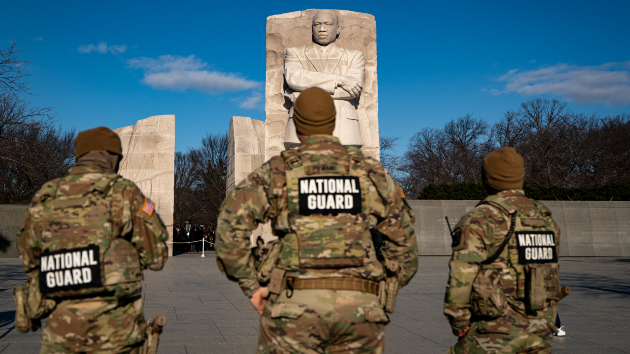
Members of the National Guard stands at the Martin Luther King, Jr. Memorial on MLK Day on January 19, 2026 in Washington, DC. (Al Drago/Getty Images)
(WASHINGTON) — President Donald Trump’s use of federalized National Guard troops in U.S. cities is projected to have cost roughly $496 million last year, according to estimates from the nonpartisan Congressional Budget Office.
If current troop levels are maintained, the deployments could cost as much as $1.1 billion this year, according to CBO estimates.
Monthly costs vary widely by location and troop levels, according to the estimate for 2026, ranging from about $6 million for roughly 350 Guard members in New Orleans, to $28 million for 1,500 troops in Memphis, and $55 million for nearly 2,950 personnel in Washington, D.C., though the precise number of troops fluctuates. Some 200 Guardsmen mobilized in Texas are estimated to cost about $4 million a month.
Sen. Jeff Merkley, the top Democrat on the Senate Budget Committee, requested the analysis in October.
“The American people deserve to know how many hundreds of millions of their hard-earned dollars have been and are being wasted on Trump’s reckless and haphazard deployment of National Guard troops to Portland and cities across the country,” Merkley said in a statement.
Last year, the largest share stemmed from operations in Washington, D.C., at about $223 million, followed by deployments to Los Angeles at $193 million, which included active-duty Marines, and smaller missions in Memphis ($33 million), Portland, Oregon ($26 million), and Chicago ($21 million), according to the CBO.
The estimates include troop pay, hotel lodging and meals. They do not account for longer-term costs, such as education benefits, disability compensation that service members may accrue during the missions, and the use of equipment and military vehicles.
The estimates are further complicated by uncertainty over both the duration and scale of the deployments, according to the CBO report.
“The costs of those or other deployments in the future are highly uncertain, mainly because the scale, length, and location of such deployments are difficult to predict accurately,” the report said. “That uncertainty is compounded by legal challenges, which have stopped deployments to some cities, and by changes in the Administration’s policies.”
Last summer, Trump deployed federalized troops into several Democratic cities. They were later pulled from cities including Los Angeles and Chicago after the Supreme Court ruled the president lacked sufficient legal justification for the deployments.
A U.S. Department of Homeland Security (DHS) sign stands at the agency’s headquarters in Washington, D.C., U.S., on Thursday, Dec. 11, 2014. Andrew Harrer/Bloomberg via Getty Images
(WASHINGTON) — Senate Democrats on Thursday voted unanimously to block a package of six funding bills that would fund large portions of the government through the end of September — meaning a partial government shutdown could still happen in the coming days.
The bill failed to advance by a vote of 45-55. It would have needed at least 60 votes to proceed. Multiple Republicans also cast votes against the package.
The vote came amid news that talks are ongoing between Democrats and the White House over funding for the Department of Homeland Security ahead of the partial government shutdown that would begin at midnight Friday.
Those talks are intensifying in the final hours between the White House and Senate Democrats to reach an agreement over how to advance a package of bills necessary to fund the government — including Democrats’ request to separate the bill that funds DHS.
Democrats want DHS removed from a package that includes five other government funding bills so that changes to the DHS bill aimed at reining in Immigration and Customs Enforcement can be made without affecting the other agencies that still need to be funded.
There were Democratic calls to separate the DHS funding following the deaths of Renee Good, a mother of three who was fatally shot by an immigration enforcement officer in Minneapolis earlier this month, and became more urgent after the death of Alex Pretti, an ICU nurse, who was killed in a shooting involving federal agents over the weekend.
If a deal is locked, Democrats would eventually need to vote yes on advancing this six-bill package. It is the first procedural step in allowing them to vote to modify it.
Although Democrats blocked this bill from moving forward, that doesn’t necessarily mean negotiations have fallen apart.
Majority Leader John Thune retained the right to call up this same vote later Thursday or Friday if he thinks a deal is locked in.
Negotiations are centered around that request from Democrats, sources told ABC News. This would allow the military and critical programs like the Centers for Disease Control and Prevention and Head Start — a federal program run by the U.S. Department of Health and Human Services that provides early childhood education, health, nutrition and family support services to low-income children and families — to be funded through September.
A deal would temporarily extend funding for DHS through a short-term bill, which would give Democrats and the White House more time to discuss any possible policy changes.
Coming into the negotiations, Senate Democrats laid out a list of demands including: ending roving patrols, ensuring federal agents are held to the same use of force policies that apply to state and local law enforcement, preventing agents from wearing masks and requiring body cameras.
Republicans need the support of at least seven Democrats in the Senate to avert a partial shutdown.
The White House has not yet commented on the ongoing negotiations.
While sources indicate Democratic leadership is optimistic that things are headed in their direction, that same level of optimism has not been shared from the White House, sources told ABC News.
It is likely that even if a deal is reached, there will still be a short partial shutdown. Any changes to the government funding bill passed in the Senate would have to go back to the House, which is currently in recess until Monday.
A U.S. Department of Homeland Security (DHS) sign stands at the agency’s headquarters in Washington, D.C., U.S., on Thursday, Dec. 11, 2014. Andrew Harrer/Bloomberg via Getty Images
(WASHINGTON) — There are signs of progress with negotiations over funding for the Department of Homeland Security ahead of a partial government shutdown that would begin at midnight Friday.
Talks are intensifying in the final hours between the White House and Senate Democrats to reach an agreement over how to advance a package of bills necessary to fund the government — including Democrats’ request to separate the bill that funds DHS.
Democrats want DHS removed from a package that includes five other government funding bills so that changes to the DHS bill aimed at reining in Immigration and Customs Enforcement can be made without affecting the other agencies that still need to be funded.
There were Democratic calls to separate the DHS funding following the deaths of Renee Good, a mother of three who was fatally shot by an immigration enforcement officer in Minneapolis earlier this month, and became more urgent after the death of Alex Pretti, an ICU nurse, who was killed in a shooting by federal agents over the weekend.
As of now, there is no firm deal yet, and there is plenty of time for things to fall apart.
Negotiations are centered around that request from Democrats, sources told ABC News. This would allow the military and critical programs like the Centers for Disease Control and Prevention and Head Start — a federal program run by the U.S. Department of Health and Human Services that provides early childhood education, health, nutrition and family support services to low-income children and families — to be funded through September.
A deal would temporarily extend funding for DHS through a short-term bill, which would give Democrats and the White House more time to discuss any possible policy changes.
Coming into the negotiations, Senate Democrats laid out a list of demands including: ending roving patrols, ensuring federal agents are held to the same use of force policies that apply to state and local law enforcement, preventing agents from wearing masks and requiring body cameras.
Republicans need the support of at least seven Democrats in the Senate to avert a partial shutdown.
The White House has not yet commented on the ongoing negotiations.
While sources indicate Democratic leadership is optimistic that things are headed in their direction, that same level of optimism has not been shared from the White House, sources told ABC News.
It is likely that even if a deal is reached, there will still be a short partial shutdown. Any changes to the government funding bill passed in the Senate would have to go back to the House.
The Senate is still slated to take a test vote on the larger package to fund the government (without any of the Democratic demands) Thursday at 11:30 a.m. Democrats have said they intend to block this vote unless modifications are made to meet their demands.
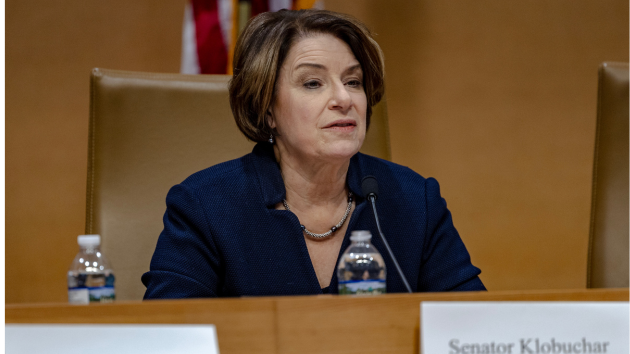
Senator Amy Klobuchar (D-MN) attends a field hearing at the Minnesota Senate Building on January 16, 2026 in St Paul, Minnesota. (Jim Vondruska/Getty Images)
(NEW YORK)– Sen. Amy Klobuchar announced on Thursday her candidacy for governor of Minnesota, saying her home state was in need of a leader who could “fix things in our state” and who would “stand up and not be rubber stamps” to the Trump administration.
“I believe we must stand up for what’s right and fix what’s wrong,” Klobuchar said in a video message announcing her run. “That’s why today, I am announcing my candidacy for governor of the state of Minnesota.”
“I like my job in the Senate,” she added. “But I love our state more than any job.”
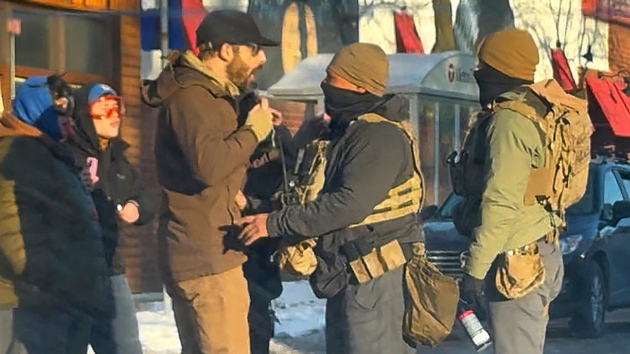
The announcement arrived at a turbulent time in Minnesota, where thousands of federal agents have been carrying out Operation Metro Surge, a Trump administration operation with the stated goal of detaining and deporting undocumented immigrants.
Federal agents have been involved this month the fatal shootings of two protesters in Minneapolis, incidents that have spurred further protests in the state and around the country.
That ongoing operation has been decried by local leaders, including Tim Walz, the current governor, who on Jan. 5 ended his bid for reelection.
Walz, who served as Vice President Kamala Harris’ running mate in 2024, said as he bowed out that he would not be able to give a campaign all of his attention as he worked to defend Minnesota against allegations of fraud and right-wing attacks — including from President Donald Trump.
Prior to his announcement, Walz came under fire amid allegations of fraud by child-care centers in Minnesota. The governor had said the state was investigating alleged fraud and he slammed rhetoric targeting the state’s Somali community, saying those allegations could put people at risk.
Federal Immigration and Customs Enforcement entered Minnesota to begin their operation in December, prior to Walz’ campaign departure. Hundreds more agents arrived in the first weeks of the year, federal officials said. Minnesota officials filed on Jan. 12 a federal lawsuit calling for an end to the surge.
Klobuchar has been outspoken throughout the past year against what she has framed as the overreach of the Trump administration and throughout turmoil in Minnesota, including amidst the recent shootings of protesters Renee Good and Alex Pretti by federal agents in Minneapolis.
“We cannot sugarcoat how hard this is, but in these moments of enormous difficulty, we find strength in our Minnesota values of hard work, freedom, and simple decency and good will,” Klobuchar said in the video message released on Thursday.
She added, “These times call for leaders who can stand up and not be rubber stamps of this administration. But who are also willing to find common ground and fix things in our state.”
Klobuchar, who is also seen as a possible 2028 presidential candidate, was first elected to the Senate in 2006 as the first female U.S. senator elected from Minnesota. She is the ranking member of the Senate Committee on Agriculture, Nutrition, and Forestry, and is a key member of the Senate Judiciary Committee.
The senator had filed paperwork to create a campaign committee to run for governor last week. Election Day is Tuesday, Nov. 3. Klobuchar had previously met with Walz about a possible bid for governor, according to two sources familiar with the meeting.
She told ABC News’ “This Week” on Sunday that ICE, one of the federal agencies operating in Minnesota, is “making us less safe, and they need to get out of our state.”
Alex Pretti is confronted by federal agents prior to being fatally shot in Minneapolis, Jan. 24, 2026. (Obtained by ABC News)
(WASHINGTON) — White House deputy chief of staff Stephen Miller told ABC News that officials are “evaluating” why Customs and Border Protection agents in Minneapolis “may not have been following” protocol in the events that led to the fatal shooting of Alex Pretti by federal agents in Minneapolis on Saturday.
The comments appear to be a shift from Miller, who hours after the shooting, called Pretti, an ICU nurse for the Department of Veteran Affairs, a “domestic terrorist” and “a would-be assassin” without providing evidence. Department of Homeland Security Secretary Kristi Noem called Pretti’s conduct “the definition of domestic terrorism” — also without evidence — which sparked backlash.
Miller’s comments come as the Trump administration grapples with the fallout of Pretti’s shooting — as well as the death of Renee Good, a mother of three, who was shot and killed by Immigration and Customs Enforcement on Jan. 7.
“The initial statement from DHS was based on reports from CBP on the ground,” Miller said in a statement.
“Additionally, the White House provided clear guidance to DHS that the extra personnel that had been sent to Minnesota for force protection should be used for conducting fugitive operations to create a physical barrier between the arrest teams and the disruptors. We are evaluating why the CBP team may not have been following that protocol,” Miller told ABC News.
The administration has sought to create some distance from Miller and Noem’s earlier characterization of the shooting.
Earlier this week, Deputy Attorney General Todd Blanche, walked back the comments that Pretti was a “domestic terrorist.”
“I don’t think anybody thinks that they were comparing what happened on Saturday to the legal definition of domestic terrorism,” Blanche said on Fox News.
Asked by ABC News Chief White House Correspondent Mary Bruce if the president agreed with the characterization of Pretti as a “domestic terrorist,” White House press secretary Karoline Leavitt distanced the president from those comments.
“Look, as I’ve said, I have not heard the president characterize Mr. Pretti in that way,” Leavitt said during the White House press briefing on Monday. “However, I have heard the president say he wants to let the facts in the investigation lead itself.”
DHS did not respond to ABC News’ request for comment.
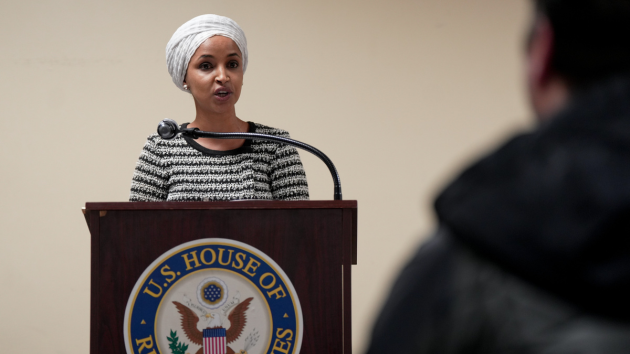
Representative Ilhan Omar, a Democrat from Minnesota, speaks during a town hall event in Minneapolis, Minnesota, US, on Tuesday, Jan. 27, 2026. A man was apprehended during a town hall event with Democratic Representative Ilhan Omar after spraying unknown substance, according the to Associated Press.(Angelina Katsanis/Bloomberg via Getty Images)
(MINNEAPOLIS) — The FBI is now leading the investigation after a man charged the podium where Rep. Ilhan Omar was giving remarks during a town hall in Minneapolis on Tuesday, police said.
The man appeared to squirt a liquid at her and was then tackled to the ground by a security guard after a brief struggle.
The man, identified as 55-year-old Anthony Kazmierczak, was arrested and booked into Hennepin County Jail on suspicion of third-degree assault, Minneapolis police said.
The department said its officers were at the town hall for the event and observed a man use a syringe to spray an unknown liquid onto the congresswoman.
Preliminary reports indicate the liquid was non-toxic, Hennepin County Attorney Mary Moriarty said during a press event Wednesday.
Moriarty said her office is reviewing its charging options, and that she has heard that the federal government “might charge the man as well.”
The Minneapolis Police Department said Wednesday that the FBI is now leading the investigation and that it had no further public information.
The incident sparked cries of alarm from those in attendance. The congresswoman did not appear to be injured.
“I’m going to finish my remarks. It is important for me to continue,” Omar said, using a profanity.
“We will continue,” she said. “These f—— a——- are not going to get away with it!”
The disturbance comes amid tensions in Minneapolis between local officials and the Trump administration over the immigration crackdown in the city that has seen two U.S. citizens killed in shootings involving federal agents.
Shortly before the man charged the podium, Omar called for abolishing Immigration and Customs Enforcement.
Afterward, she told reporters that she won’t be intimidated.
“You know, I’ve survived more, and I’m definitely going to survive intimidation and whatever these people think that they can throw at me because I’m built that way,” she said.’Omar has been the target of attacks from President Donald Trump for years. More recently, his attacks have come alongside escalated rhetoric describing the Somali community in Minnesota, the largest in the nation.
In the past several weeks, Trump has called Omar a “fake sleazebag,” and called for her to be thrown out of the U.S.
In a phone interview Tuesday evening with ABC News’ Senior Political Correspondent Rachel Scott, Trump said he hadn’t seen video of the incident and without providing evidence accused Omar of staging the attack.
“I don’t think about her. I think she’s a fraud,” Trump said. “She probably had herself sprayed, knowing her.”
In a post on X regarding Tuesday’s incident, Omar said: “I’m ok. I’m a survivor so this small agitator isn’t going to intimidate me from doing my work. I don’t let bullies win. Grateful to my incredible constituents who rallied behind me. Minnesota strong.”
In a statement, U.S. Capitol Police said: “Tonight, a man is in custody after he decided to assault a Member of Congress — an unacceptable decision that will be met with swift justice.” The department said it is “working with our federal partners to see this man faces the most serious charges possible to deter this kind of violence in our society.”
Capitol Police said threats against members of Congress increased for the third year in a row. The department said it investigated 14,938 concerning statements, behaviors and communications directed against members of Congress, their families and their staff last year — compared to 9,474 in 2024.
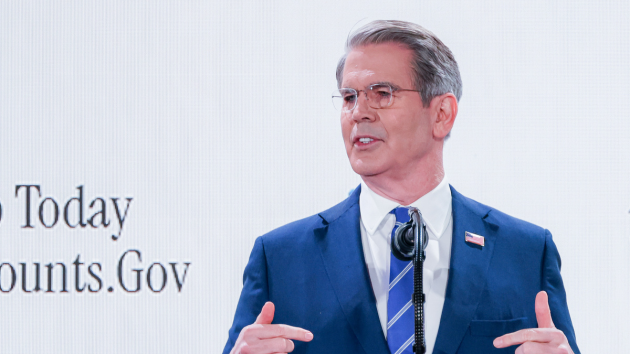
Scott Bessent, US treasury secretary, speaks during the Trump Accounts Launch Summit in Washington, DC, US, on Wednesday, Jan. 28, 2026. The US Treasury Department is bringing together senior administration officials, everyday Americans, and key stakeholders to highlight the upcoming launch of Trump Accounts. Photographer: Valerie Plesch/Bloomberg via Getty Images
(WASHINGTON) — As the cost of many basic goods, including groceries, continues to rise, Treasury Secretary Scott Bessent said in an interview with ABC News Senior White House Correspondent Selina Wang, he understands the hardships facing millions of people, but argued that the Biden administration is responsible for the rising costs.
“Look, Americans should be worried about affordability. The Biden administration destroyed affordability,” he told ABC News on Wednesday, contending inflation under the Biden administration was the worst in 49 years.
Bessent did not provide more details about how the previous administration was responsible for rising costs, but claimed that the Trump administration was “getting inflation under control.”
Yet prices for goods are seeing mixed results, according to Consumer Price Index data.
For example, gas prices have decreased over the last year, while coffee prices have risen by nearly 20% and ground beef prices have risen by 15.5% during the same period, CPI data showed.
When pressed on those statistics, Bessent said people need to see costs in a broader context.
“When you step on the scale, you don’t look at the composite number of how much you weigh and say, ‘Well, my arm weighs this. My head weighs this.’ So I believe that we are quickly going to meet the [Federal Reserve’s] target of 2% inflation,” he said.
Bessent on the Fed
When it came to the Fed, Bessent stressed that President Donald Trump “has great reverence” for the body and respects the central bank but added, “independence does not mean no accountability.”
“I think it’s very important for the Fed to be both independent but accountable,” he said.
Earlier this month, the Justice Department announced a probe into Fed Chair Jerome Powell, alleging he misled Congress about costs over the renovation of Federal Reserve buildings.
Powell said in a statement that the probe is part of the administration’s push to lower interest rates.
“This is about whether the Fed will be able to continue to set interest rates based on evidence and economic conditions — or whether instead monetary policy will be directed by political pressure or intimidation,” he said in a video message on Jan. 11.
A bipartisan group of senators and former Fed chairs slammed the Justice Department for the probe.
Bessent allegedly warned Trump that the investigation “made a mess” and could be bad for financial markets, according to a report by Axios. When asked about those alleged concerns, the treasury secretary told ABC News he has “repeatedly called for the Fed to do its own investigation.”
Trump accounts
Bessent was slated to appear with the president on Wednesday to discuss his “Trump Accounts” plan for families.
Under Trump’s signature tax and spending legislation, starting this July, the federal government will deposit $1,000 for every baby born between 2025 and 2028. Families can contribute up to $5,000 annually. Employers can contribute up to $2,500 per year per employee.
Michael Dell and his wife announced late last year they are donating $6.25 billion to seed savings accounts for up to 25 million American children — depositing $250 for every child age 10 and under, who lives in a zip code where the median income is below $150,000.
Bessent told ABC News that 600,000 families have already gone online to open accounts. He said he expects states to make contributions, in addition to new contributions from companies and philanthropists.
“So there will be government contribution. We believe that many states will make contributions,” he said.
“Employers are going to contribute, philanthropists are going to contribute, companies are going to contribute,” Bessent added.
JP Morgan and Bank of America announced Wednesday that they will match employees’ “Trump Accounts” by $1,000.
Venezuela
Bessent said “things are moving very quickly” when it comes to oil companies committing to invest in rebuilding Venezuela’s oil sector.
He didn’t provide the dollar amount that’s been committed, but said they’re seeing “great demand.”
Shortly after the U.S. removed the Venezuelan president from power on Jan. 3, Trump said that he expects at least $100 billion in investments from major companies.
But during a roundtable Trump held earlier this month with oil executives, several CEOs expressed reservations.
-ABC News’ Taylor Dunn contributed to this report.
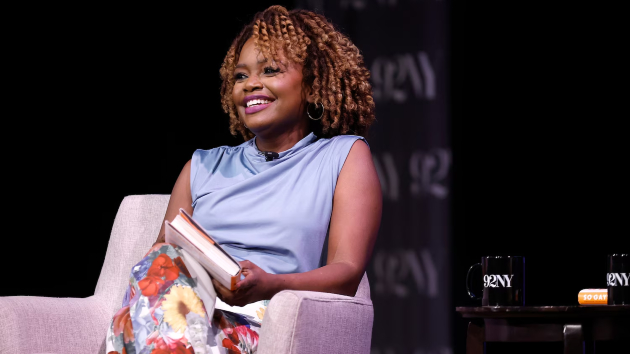
In this June 3, 2025, file photo, Karine Jean-Pierre speaks at an event at 92NY in New York. (John Lamparski/Getty Images, FILE)
(WASHINGTON) — With a polarized political climate approaching the high-stakes 2026 midterm elections, more Americans are identifying as independents than ever before, according to a Gallup poll conducted throughout 2025.
A record-high 45% of Americans called themselves political independents in 2025. The figure is a record since Gallup started measuring in 1988 — with the previous high for independents at 43% in 2014, 2023 and 2024.
Gallup found that an equal share of Americans identified as Republicans and Democrats — 27% each.
These findings come as the midterm elections approach in November and several tight races are expected as Republicans in the House try to maintain their slim majority so they can work to push President Donald Trump’s agenda. Both Republicans and Democrats will have to appeal to independents to win any tight races nationwide.
Thomas Nickel, an 85-year-old who lives in California, told ABC News that he has been independent for several years after leaving the Democratic Party. Nickel left his former party because he said he believes Democrats have not pushed hard enough for issues that are “necessary” — specifically mentioning health care coverage. He said universal health coverage is a priority for him, which he said he believes neither party has focused on.
Trump, who has been a vocal critic of President Barack Obama’s Affordable Care Act, unveiled his new health care proposal earlier this month, which presents a proposal to shift government insurance subsidies directly to consumers through health savings accounts and take advantage of his “most favored nation” drug price initiative. However, Trump’s proposal has left experts unsure on how impactful these ideas could be.
When asked about his thoughts on the president’s recent health care proposal, Nickel called it “ridiculous,” and added that an average person won’t be able to afford to pay for their own insurance with money they would receive directly. When asked what he would like to see Democrats do, Nickel noted that the ACA is “a step in the right direction,” but that “there’s going to be 25% of people that can’t even afford the health care premiums for the Medicare assistance.”
A Louisiana resident who did not want to disclose his name told ABC News that he is an independent because of how “divisive” politics have become. He said he remains a registered Republican so that he can vote in Republican primaries. Some states hold closed primaries where only voters registered with a certain party can vote in that party’s primary; other states hold open primaries where voters of any affiliation can vote in the primary of any party.
“I think, in recent years, especially the last decade or so, things have gotten so divisive that it feels like the minority on both sides speak for the majority,” he said, adding that he believes both parties “had alienated their voter base by being so polarizing.” He cited the Trump administration’s push to acquire Greenland as “a game of Risk,” but didn’t give specifics on Democrats’ actions he found polarizing.
Zach Servis — a 27-year-old independent who lost his bid for mayor for Jackson, Mississippi, last year — also said that the political climate is “way too polarized and hateful.”
Servis said he left the Republican Party around 2020 during the height of COVID after recognizing what he described as “hypocrisy” of his former party. He pointed to Republicans not supporting social programs such as the ACA, but willingness to help other countries — something he said is not in line with Trump’s “America First” slogan.
Looking ahead to this year’s midterm elections, Servis said he believes that independent voters have enough “power to shift which side wins.”
“I think that independent politics have an opportunity to shape this midterm where some of these parties are going to have to shift a little bit in how they win these voters — and if they’re not willing to come a little more to the middle or reach across the aisle, they’re going to risk people crossing the aisle entirely and voting even for a party they don’t believe in because at least that person’s willing to listen,” Servis said.
Generational shifts in political affiliations
The increase in the share of independents is partly attributable to a larger percentage of younger generations of Americans remaining independent as they age — compared to older generations who are less likely to remain unaffiliated, according to Gallup.
Generation Z, born between 1997 and 2007, has the highest percentage of independents, with 56% identifying as independent, Gallup found.
Gen Z is also less likely to identify as Republican compared to older generations, with 17% identifying as Republican compared to 37% of the Silent Generation (born before 1946).
Gallup found 27% of Gen Z identifying as Democrats compared to 32% of the Silent Generation.
Karine Jean-Pierre, who became an independent after serving in the Biden administration as White House press secretary, told ABC News that she believes the growing percentage of independents is not “temporary” and will continue to reshape the electorate in this 2026 election year.
“I do think there’s power amongst independents. The thing that is changing the electorate is changing in the sense of that you’re seeing more and more independents,” Jean-Pierre told ABC News.
Jean-Pierre also noted that younger generations may be reluctant to join a political party as a way to “express moral concern” over U.S. involvement in global issues.
She also noted that young independents deserve a seat at the table as the midterms approach.
“I don’t think independents, especially young independents, are disengaged,” Jean-Pierre said. “I think what they’re doing is they’re growing numbers — put pressure on both political parties to earn support with real policy results, rather than just assuming loyalty based on branding or identity.”
The Gallup poll was conducted throughout 2025 among 13,454 U.S. adults nationwide and has a margin of error of +/- 1 percentage point.