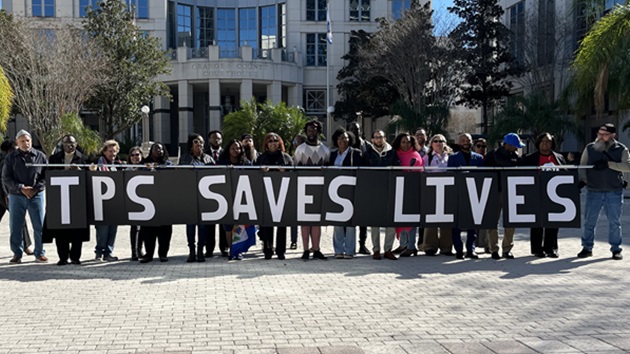
On Thursday, Jan. 29, 2026, in front of the Orange County Courthouse, advocates and former elected officials asked President Trump to create a pathway to permanent residency for Haitians who face deportations as their temporary protected status expires on Feb. 3. (Natalia Jaramillo/Orlando Sentinel/Tribune News Service via Getty Images)
(WASHINGTON) — A federal judge on Monday blocked the Trump administration from ending Temporary Protected Status for more than 350,000 Haitian immigrants.
In an 83-page opinion, U.S. District Judge Ana Reyes granted a stay maintaining the legal status of Haitian nationals “pending judicial review.” In her ruling, she accused Department of Homeland Security Secretary Kristi Noem of “preordaining” her termination decision, saying she “did so because of hostility to nonwhite immigrants.”
“There is an old adage among lawyers,” Judge Reyes wrote. “If you have the facts on your side, pound the facts. If you have the law on your side, pound the law. If you have neither, pound the table.”
“Secretary Noem, the record to-date shows, does not have the facts on her side — or at least has ignored them,” Reyes continued. “Does not have the law on her side — or at least has ignored it. Having neither and bringing the adage into the 21st century, she pounds X (f/k/a Twitter).”
Judge Reyes wrote that while Noem has a First Amendment right “to call immigrants killers, leeches, [and] entitlement junkies,” she is constrained by the Constitution and federal law to “apply faithfully the facts to the law in implementing the TPS program.”
“The Government does not cite any reason termination must occur post haste,” Reyes wrote. “Secretary Noem complains of strains unlawful immigrants place on our immigration-enforcement system. Her answer? Turn 352,959 lawful immigrants into unlawful immigrants overnight.”
The federal judge noted that Noem “has terminated every TPS country designation to have reached her desk — twelve countries up, twelve countries down.”
“The statutory design is straightforward: TPS exists because threats to life exist; when the threat persists, so should TPS protection, unless the Secretary articulates a well-reasoned and well-supported national interest to the contrary,” she wrote.
The D.C. federal judge listed the five plaintiffs by name, saying, “They are not, it emerges, ‘killers, leeches, or entitlement junkies.'”
“They are instead: Fritz Emmanuel Lesly Miot, a neuroscientist researching Alzheimer’s disease; Rudolph Civil, a software engineer at a national bank; Marlene Gail Noble, a laboratory assistant in a toxicology department; Marica Merline Laguerre, a college economics major; and Vilbrun Dorsainvil, a full-time registered nurse,” Judge Reyes wrote.
DHS Assistant Secretary Tricia McLaughlin released a statement to ABC News on Monday night, saying, “Supreme Court, here we come.”
“This is lawless activism that we will be vindicated on. Haiti’s TPS was granted following an earthquake that took place over 15 years ago, it was never intended to be a de facto amnesty program, yet that’s how previous administrations have used it for decades. Temporary means temporary and the final word will not be from an activist judge legislating from the bench,” McLaughlin said.
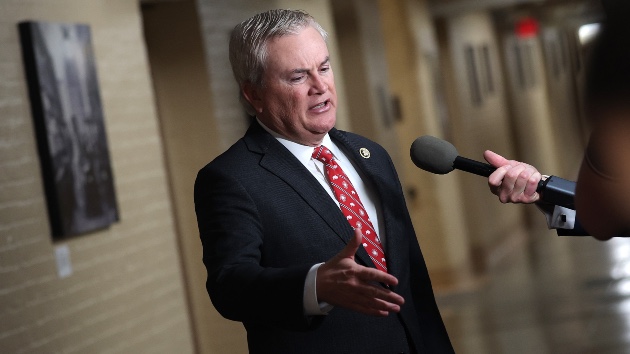
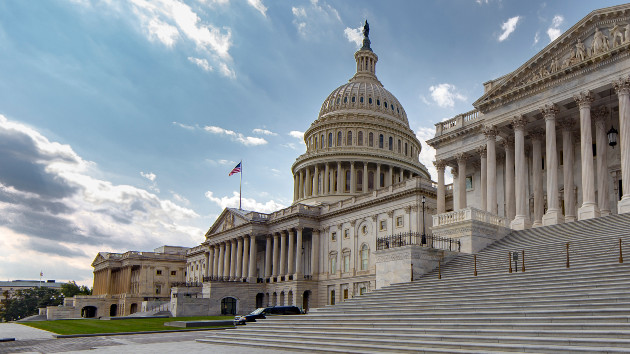
Chairman of the House Committee on Oversight and Accountability Rep. James Comer (R-KY) speaks to reporters as he arrives for a House Republican Conference meeting at the U.S. Capitol on February 03, 2026 in Washington, DC. Photo by Kevin Dietsch/Getty Images)
(WASHINGTON) — House Oversight Chairman James Comer has set a noon deadline Tuesday for Bill and Hillary Clinton to agree to the GOP’s specific terms for depositions that the Clintons signaled Monday night they generally would comply with, warning that if they do not then Republicans will reconvene to move contempt resolutions toward a full House vote.
“The Oversight Committee is seeking clarification the Clintons accepted the standard deposition terms that they were subpoenaed for: transcribed, filmed depositions in February with no time limit pursuant to the committee’s investigation. The depositions are pursuant to the Committee’s investigative purpose as laid out across its letters and contempt reports,” a person familiar with the matter told ABC News.
House Majority Leader Steve Scalise, in a news conference Tuesday alongside House GOP leadership, said Comer was “in the middle of a negotiation with the Clintons.”
“They have until noon today to fully comply, otherwise we will move contempt tomorrow against the Clintons,” Scalise reiterated.
Former President Bill Clinton and former Secretary of State Hillary Clinton agreed on Monday evening to sit for closed-door depositions in the committee’s Jeffrey Epstein investigation.
“They negotiated in good faith. You did not,” Clinton spokesperson Angel Ureña posted on X. “They told you under oath what they know, but you don’t care. But the former President and former Secretary of State will be there. They look forward to setting a precedent that applies to everyone.”
For months, the Clintons had insisted that the subpoenas were without legal merit. Comer, a Republican, has pushed back, saying the Clintons are not above the law and must comply with a subpoena.
Besides defying the subpoenas to testify before the House committee, neither Bill Clinton nor Hillary Clinton has been accused of wrongdoing and both deny having any knowledge of Epstein’s crimes. No Epstein survivor or associate has ever made a public allegation of wrongdoing or inappropriate behavior by the former president or his wife in connection with his prior relationship with Epstein.
In a letter dated Jan. 31, the Clintons’ legal teams wrote the committee to lay out the parameters of a prospective interview — alongside a request for the committee to withdraw its subpoena and contempt resolution — proposing a four-hour transcribed interview in lieu of a deposition conducted under oath.
The letter states the interview should occur in New York City — open to all committee members — while the scope of questions would be “confined to matters related to the investigations and prosecutions of Jeffrey Epstein.” The president also asked to designate his own transcriber, alongside a court reporter employed by the House.
“This framework is consistent with your priorities as communicated by Committee staff and as identified during the business meeting on January 21st,” the letter, signed by Clinton attorneys Katherine Turner and Ashley Callen, stated. “Pursuant to your request for this comprehensive written proposal, we ask that you respond in kind should there remain any specific area of disagreement to continue this good-faith effort to avoid legal proceedings that will prevent our clients from providing testimony in addition to the sworn statements they already submitted.”
Comer wrote back Monday, citing “serious concerns with the offer,” beginning with the proposed scope restriction — predicting President Clinton “would refuse to answer questions” related to his personal relationship with Jeffrey Epstein and Ghislaine Maxwell.
Comer also balked at the proposed four-hour time limit for the interview, and the president’s bid to break blocks of questioning into 30-minute periods — rather than 60-minute periods — that alternate between Republicans and Democrats.
“A hard time-limit provides a witness with the incentive to attempt to run out the clock by giving unnecessarily long answers and meandering off-topic. This is a particular concern where a witness, such as President Clinton, has an established record of being a loquacious individual,” Comer said.
“Limiting President Clinton’s testimony to four hours is insufficient time for the Committee to gain a full understanding of President Clinton’s personal relationship with them, his knowledge of their sex-trafficking ring, and his experience with their efforts to curry favor and exercise influence to protect themselves,” he added of President Clinton’s relationship with Epstein and Maxwell.
Finally, Comer took umbrage with the proposition for a transcribed interview, not a sworn deposition.
“A transcribed interview is voluntary, meaning that the subject may refuse to answer questions absent any assertion of privilege or constitutional right,” Comer noted. “The conditions requested thus would enable President Clinton to refuse to answer whatever questions he wanted for whatever reasons he wanted and leave as the Committee’s only recourse to again subpoena President Clinton’s testimony, effectively restarting this entire process from the beginning.”
As for Hillary Clinton, the lawyers’ letter echoes her sworn declaration, stating she “never held an office with responsibility for, or involvement with, DOJ’s handling of these investigations or prosecutions,” adding “the same is true as a private citizen after leaving office in 2013.”
The lawyers also requested that Comer withdraw the subpoena and resolution of contempt “so that we may continue to work in good faith toward an agreement that meets the Committee’s needs while accounting for the limited information Secretary Clinton can provide.”
In response, Comer emphasized “the necessity” of Hillary Clinton’s in-person testimony juxtaposed against the “unacceptability of simple sworn declarations.”
Comer concluded that the Clintons’ “desire for special treatment is both frustrating and an affront to the American people’s desire for transparency.”
House Speaker Mike Johnson faces an incredibly tight margin as he can only afford to lose one Republican vote if all members are present and voting on the funding package.
First, Johnson has to clear a procedural vote before debate can begin on the floor and a vote on final passage can be held.
Johnson told reporters on Tuesday that he is confident the package, passed in the Senate after an 11th-hour deal between Senate Democrats and the White House, will pass.
“This may be hard for some of y’all to believe, but I never doubted this,” Johnson said at his weekly news conference Tuesday morning.
The agreement separates a Department of Homeland Security funding bill from five others funding other agencies for the rest of the fiscal year, and grants two weeks of extended DHS funding to negotiate Democratic demands for restrictions on Immigration and Customs Enforcement amid its immigration enforcement operation, including requiring agents to wear body cameras turned on and to not wear masks.
The funding fight over DHS erupted in the aftermath of the death of Alex Pretti, an ICU nurse, who was killed in a shooting involving federal law enforcement in Minneapolis on Jan. 24.
House Minority Leader Hakeem Jeffries told Johnson over the weekend that Democrats would not help Republicans expedite the funding package.
Meanwhile, hard-line Republicans also threatened to hold the package up in hopes of attaching an unrelated bill that would require a proof of citizenship in federal elections known as the SAVE Act. Though some hard-liners, including Reps. Anna Paulina Luna and Tim Burchett, appear to be backing down on their demands.
President Donald Trump said Monday that he has spoken to congressional leaders on both sides of the aisle and expressed confidence in a resolution coming soon.
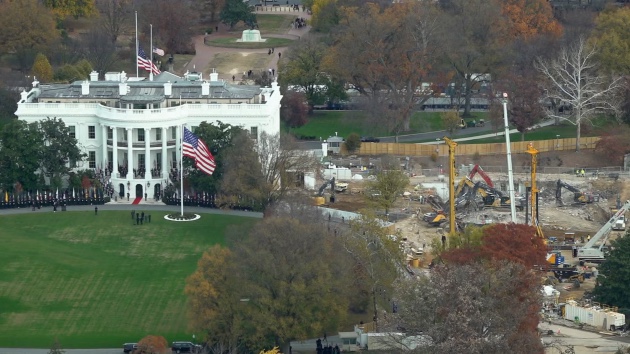
The construction for the ballroom on the White House’s East Wing as seen from the top of the Washington Monument, Nov. 17, 2025. (ABC News)
(WASHINGTON) — Even before a federal judge has decided whether he’ll halt construction of the White House ballroom, the Trump administration has preemptively asked the judge to stay any injunction he might issue, warning that the project is “imperative for reasons of national security.”
The government’s overnight filing, entered just before the end of the day Monday, also says halting the construction would “leave an unsightly excavation site in President’s Park indefinitely.”
The administration’s stay motion comes a week-and-a-half after Judge Richard Leon publicly aired his deep skepticism of the government’s arguments that the president has the power to build a ballroom with private donations and without express authorization from Congress, comparing the plan to a “Rube Goldberg contraption.” Leon also said he expected the losing side of the case to appeal.
The Justice Department’s filing restates many of the arguments its lawyer made before Leon last month, including the administration’s view that it would be “unworkable” to allow security-related portions of the project to continue while work on the ballroom has been stopped.
“[A]s the Secret Service attested, halting construction would imperil the President and others who live and work in the White House,” the administration argues, citing a senior agency official who said in court papers last month that the current open construction site is, “in and of itself, a hazard and complicates Secret Service operations.”
The government now says it will submit a second classified declaration from the Secret Service that further explains why halting construction “will endanger national security and therefore impair the public interest.”
It’s widely believed the plan is to replace the bunker FDR had built underneath the East Wing — destroyed in the demolition.
The filing also casts the National Trust for Historic Preservation’s challenge to the project as one that presents questions judges have never grappled with before, including whether a 1912 statute prohibiting the construction of federal buildings absent congressional authorization applies to the president.
Acknowledging Leon’s own expectation of an appeal by the losing side, the Justice Department is preemptively asking him to press pause on a potential ruling against the government.
“The D.C. Circuit should have the opportunity to weigh in on these significant and novel issues of first impression before the President is ordered to stop work in the middle of a high-priority construction project that implicates national security,” the filing concludes.
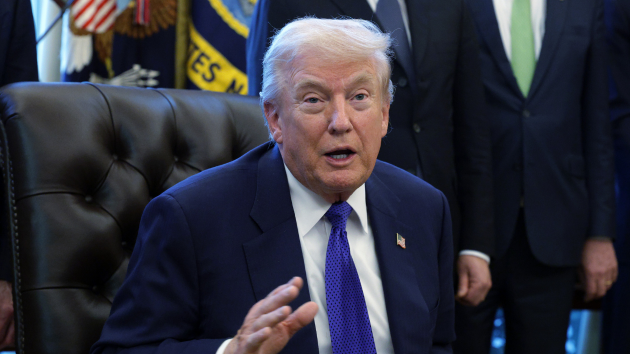
U.S. President Donald Trump in the Oval Office on February 02, 2026. (Alex Wong/Getty Images)
(WASHINGTON) — President Donald Trump on Monday called on Republicans to “take over” and “nationalize” voting as he continued to make false claims about the electoral process in the U.S. with the 2026 midterm elections on the horizon.
Trump made the comments in an interview with former FBI Director Dan Bongino, who resigned from his post in December and returned to podcasting.
Trump alleged noncitizen voting was improperly influencing election outcomes, though experts insist such instances are incredibly rare and already illegal, and told Bongino it was “amazing that the Republicans aren’t tougher on it.”
“The Republicans should say, ‘We want to take over,'” Trump said. “We should take over the voting … in at least many, 15 places. The Republicans ought to nationalize the voting. We have states that are so crooked and they’re counting votes.”
The Constitution gives states the authority to conduct federal elections, subject to laws passed by Congress. The elections clause states, in part, that “state legislatures will establish the times, places, and manner of holding elections for the House of Representatives and the Senate.”
Trump didn’t elaborate on how he wanted Republicans to “nationalize” voting.
Asked by ABC News for specifics on what Trump meant, White House spokesperson Abigail Jackson responded, “President Trump cares deeply about the safety and security of our elections — that’s why he’s urged Congress to pass the SAVE Act and other legislative proposals that would establish a uniform standard of photo ID for voting, prohibit no-excuse mail-in voting, and end the practice of ballot harvesting.”
Senate Minority Leader Chuck Schumer, the chamber’s top Democrat, slammed Trump over his comments to Bongino.
“Just a few hours ago, Donald Trump said he wants to nationalize elections around the country. That’s what Trump said. You think he believes in democracy? He said, ‘We want to take over, the Republicans ought to nationalize the voting,'” Schumer said on the Senate floor. “Does Donald Trump need a copy of the Constitution? What he is saying is outlandishly illegal.”
Trump’s agenda is at stake in this year’s elections, where all seats in the House and 35 in the Senate will be up for grabs. Currently, Republicans hold narrow margins in both chambers — but midterm cycles are historically unkind to the sitting president’s party.
Last year, Trump and other Republicans pushed for mid-decade redistricting in order to gain additional House seats. The president warned Republicans last month that they have to win the midterms or he will get “impeached.”
Trump also continues to litigate his 2020 election loss, spreading false claims of fraud.
Last week, the FBI searched and seized original 2020 voting records from the Fulton County Elections and Operations Hub in Georgia, a swing state that went blue in 2020 and helped secure Joe Biden’s victory.
“Now you’re going to see something in Georgia where they were able to get, with a court order, the ballots. You’re going to see some interesting things come out,” Trump said on Bongino’s podcast.
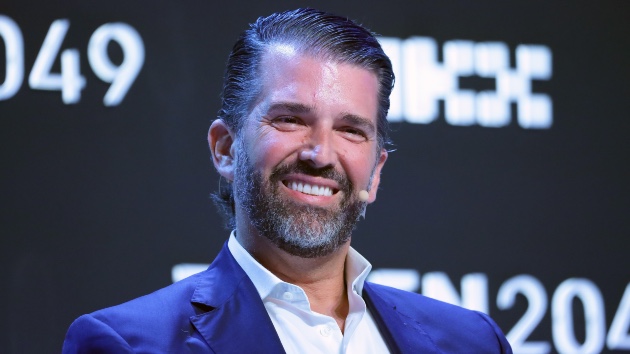
Donald Trump Jr., co-founder of World Liberty Financial, during the Token2049 conference in Singapore, on Wednesday, Oct. 1, 2025. The crypto conference runs through Oct. 2. (Photographer: Suhaimi Abdullah/Bloomberg via Getty Images)
(WASHINGTON) — President Donald Trump’s cryptocurrency firm, World Liberty Financial, sold a $500 million stake to a member of the Emirati royal family shortly before his inauguration last January, The Wall Street Journal reported on Saturday, sparking concerns over a potential conflict of interest.
According to the Journal, which reviewed undisclosed corporate documents, a firm associated with Sheikh Tahnoon bin Zayed Al Nahyan, an Abu Dhabi royal who operates an enormous state investment fund, purchased a 49% stake in World Liberty, which is co-owned by Middle East envoy Steve Witkoff and his family, just four days before the Trump administration swept into office.
Months later, the Trump administration agreed to supply the UAE with highly coveted American-made AI chips despite the prior administration’s concern that they may fall into the hands of the Chinese.
David Wachsman, a spokesperson for World Liberty Financial, acknowledged the existence of the deal in a statement to ABC News, but insisted that “neither President Trump nor Steve Witkoff had any involvement whatsoever in this transaction” and that “any claim that this deal had anything to do with the Administration’s actions on chips is 100% false.”
“We made the deal in question because we strongly believe that it was what was best for our company as we continue to grow. The idea that, when raising capital, a privately-held American company should be held to some unique standard that no other similar company would be held is both ridiculous and un-American,” the statement continued.
David Warrington, the White House counsel, told ABC News in a statement that “the President has no involvement in business deals that would implicate his constitutional responsibilities,” and that “President Trump performs his constitutional duties in an ethically sound manner and to suggest so otherwise is either ill-informed or malicious.”
But the Journal’s report adds yet another wrinkle to the U.S. decision to sell highly coveted advanced chips to the Emiratis.
As ABC News previously reported, shortly before the chips deal was announced, a UAE-backed investment firm called MGX announced last May that it would use a digital token minted by World Liberty Financial to finance a $2 billion investment in a crypto exchange Binance, a major boon for the firm.
Shiekh Tahnoon, who is the brother of the UAE’s president, also serves as MGX’s chairman.
The Biden administration declined to provide the UAE with the chips, which power some of the most sophisticated weapons on the planet, for fear they might be redirected into China.
Peter Wildeford, the head of policy at the AI Policy Network, a nonpartisan advocacy group, warned that could close the U.S.’s advantage in the AI race and compromise American security.
“If China gets their hands on these chips at scale, they would be able to launch cyberattacks against the U.S., they could build autonomous weapons that could find and sink our Navy ships — they could close the military technology gap that’s currently keeping us safe,” he said.
World Liberty has emerged as perhaps the most lucrative of the Trump family’s various business ventures, either in cryptocurrency or real estate. ABC News reported last year that the Trump family secured a roughly $5 billion windfall when trading of World Liberty’s digital token opened.
According to the Journal, Shiekh Tahnoon agreed to pay half of his investment in World Liberty up front. Based on the ownership structure of the company at the time, that meant a payment of as much as $187 million into the Trump family’s coffers on the eve of his return to office.
Ethics experts said the concept of a foreign government official secretly directing hundreds of millions of dollars to a company owned in part by the president has no known precedent — and raises a host of ethical and national security concerns.
“Maybe the President would have reached the same decision over the transfer of high techn [chips] to UAE if he wasn’t also getting money from them,” said Robert Weissman, the co-president of the advocacy group Public Citizen. “But we’ve got no way to know that, and we do know there was a lot of opposition inside the government to do exactly what he has OK’d.”
White House spokeswoman Anna Kelly maintained that the president “only acts in the best interests of the American public,” and said that no conflict of interest exists in part because the president’s assets are held in a blind trust managed by his children. Typically, a blind trust would operate with an independent trustee.
“President Trump’s assets are in a trust managed by his children,” Kelly added. “There are no conflicts of interest.”
The Trump Organization did not immediately respond to a request for comment.
Congressional Democrats leapt at new details in the report, characterizing the transaction as further evidence of alleged pay-for-play. Sen. Chris Murphy, D-Conn., alleged “mind blowing corruption,” in a post to X.
Sen. Elizabeth Warren, D-Mass., issued a statement calling the deal “corruption, plain and simple.”
“Foreign countries are bribing our president to sell out the American people,” Sen. Chris Van Hollen, D-Md., claimed in a post to X.
Shortly before the chips deal was announced last May, a UAE-backed investment firm called MGX said it would use a digital token minted by World Liberty Financial to finance a $2 billion investment in a crypto exchange Binance. Tahnoon also serves as MGX’s chairman.
MGX is also one of the few companies with a major ownership stake in the new TikTok U.S. joint venture, with a 15% stake in the new entity.
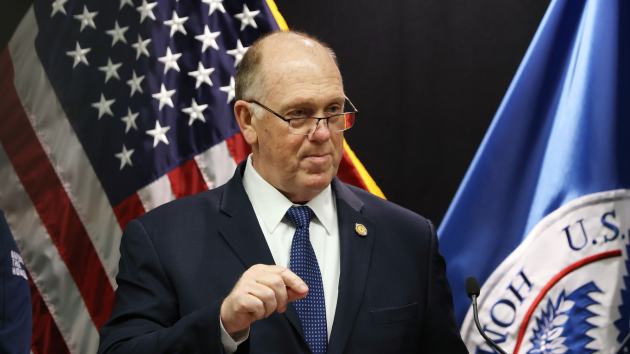
Border czar Tom Homan speaks during a news conference about ongoing immigration enforcement operations on January 29, 2026 in Minneapolis, Minnesota. (Scott Olson/Getty Images)
(NEW YORK) — President Donald Trump took to social media to show his support for two of his administration leaders amid the leadership shakeup following last week’s fatal shooting in Minneapolis.
The president praised the work of Department of Homeland Security Secretary Kristi Noem, who came under fire following the deaths of Minneapolis residents Alex Pretti and Renee Good at the hands of federal agents, and thanked Border Czar Tom Homan, who he sent to Minneapolis this week to smooth over boiling tensions.
Despite several videos showing the 37-year-old Pretti did not have a firearm in his hands when he encountered federal agents on Jan 24, Noem initially claimed, without evidence, that the nurse brandished a weapon, was “wishing to inflict harm” and the officers were “attacked.”
Multiple videos of the incident taken by civilians show that Pretti, a licensed gun owner, was disarmed by a law enforcement officer just before the first shot rang out.
The FBI is leading the investigation into Good’s shooting on Jan. 7. DHS said that Good was allegedly attempting to run over law enforcement officers when an ICE agent shot her, which local leaders and her family have disputed.
Trump, who has backed Noem all of this week, lashed out at her critics in a social media post posted early Saturday.
“The Radical Left Lunatics, Insurrectionists, Agitators, and Thugs, are going after Kristi Noem, the Secretary of Homeland Security, because she is a woman, and has done a really GREAT JOB!,” he said.
Noem walked back her initial comments on the shooting of Pretti later in the week, contending that DHS were getting information from “what we knew to be true on the ground.”
Homan was sent to Minneapolis this week and Border Patrol Commander Greg Bovino was ordered by the administration to return to California, sources told ABC News.
Although Homan said he had “productive” discussions with Gov. Tim Walz and Minneapolis Mayor Jacob Frey, he criticized sanctuary city laws and called on local leaders to assist with federal immigration law enforcement. Homan announced a “draw down” of federal agents in Minneapolis later in the week.
“Border Czar (Plus!) Tom Homan is doing a FANTASTIC JOB. He is one of a kind. Thank you Tom!!!,” Trump said in another post.
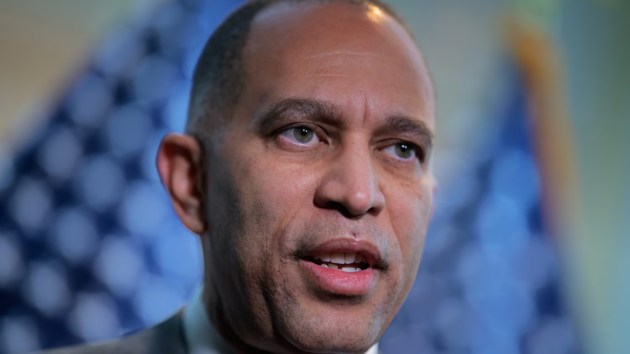
House Minority Leader Hakeem Jeffries talks to reporters at the U.S. Capitol, January 30, 2026, in Washington. (Chip Somodevilla/Getty Images)
(WASHINGTON) — The Senate on Friday is one step closer to passing a funding package after Republican Sen. Lindsey Graham ended his blockade — still a partial government shutdown is all but certain to happen.
After intense negotiations proceeded throughout the day, an 11th-hour deal struck by Senate Democrats and White House, which would see the Department of Homeland Security funding bill separated from a package of five other funding bills, obtained the consent of all 100 senators to advance ahead of Friday night’s deadline.
But it is likely that even if the Senate passes the bills, there will still be a short partial shutdown as the legislation would need to go back to the House for reconsideration.
Sen. Graham earlier Friday had outlined his demands for lifting his blockade: a promise of a vote at a later date on his bill to end so-called sanctuary cities that resist the administration’s immigration policies, and a vote related to controversial Arctic Frost provisions, which allow members of Congress to sue the government if federal investigators gain access to their phone records without their knowledge. Those provisions were stripped out of the funding package passed by the House.
In a statement on Friday afternoon, Graham said Senate Majority Leader John Thune was supportive of his stipulations.
“I will lift my hold and vote for the package,” Graham said.
Thune said the Senate is set to vote on the slate of amendments Friday evening.
Meanwhile, the House is in recess until Monday, and Speaker Mike Johnson told ABC News Senior White House Correspondent Selina Wang on Thursday night that bringing lawmakers back before then “may not be possible.”
House Minority Leader Hakeem Jeffries, the chamber’s top Democrat, earlier Friday would not say whether he supported the spending agreement reached between Senate Democrats and the White House.
“There’s no agreement that’s been before us,” Jeffries said. “Right now, Lindsey Graham apparently is holding up the agreement, threatening to shut down the government, because apparently Senate Republicans still support using taxpayer dollars to brutalize American citizens and on top of it to make matters worse.”
The agreement announced Thursday would see most of the federal government funded through September, while DHS would be funded for two additional weeks at current spending levels to allow lawmakers to negotiate on other provisions in the package.
The funding fight over DHS erupted in the aftermath of the death of Alex Pretti, an ICU nurse, who was killed in a shooting involving federal law enforcement in Minneapolis over the weekend.
Jeffries insisted Democrats will not back down on their demands for reform at the department, including obtaining judicial warrants — rather than the lower bar of administrative warrants, barring Immigration and Customs Enforcement personnel from wearing masks and mandating that body-worn cameras be turned on, and ending roving raids by ICE.
“Democrats in the Senate, led by Chuck Schumer, supported by the House, made a clear demand: Separate out the five bills that clearly have bipartisan support, and then separately we can deal with making sure that ICE is brought under control in a variety of different ways, including our demand, which we will not walk away from, which is that judicial warrants should be required before ICE can storm homes and rip people out of their cars,” Jeffries said.
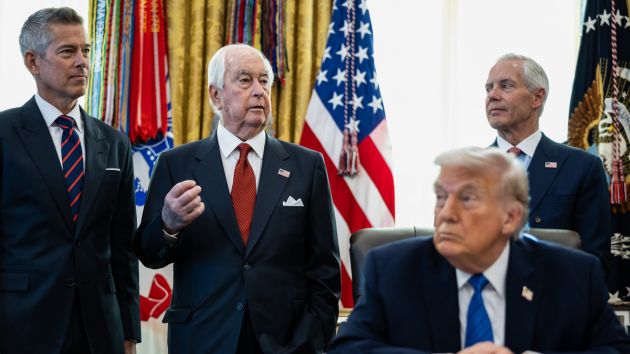
Roger Penske, chairman and chief executive officer of Penske Corp., second left, speaks during an executive order signing with US President Donald Trump, second right, in the Oval Office of the White House in Washington, DC, US, on Friday, Jan. 30, 2026. Trump signed an executive order intended to launch an IndyCar race on the streets of Washington as part of a series of America250 celebrations. (Photographer: Francis Chung/Politico/Bloomberg via Getty Images)
(WASHINGTON) — President Donald Trump signed an executive order on Friday to hold an IndyCar street race in Washington this summer, as part of his “America 250” push to commemorate the nation’s birthday.
Trump, joined in the Oval Office by auto racing legend Roger Penske, announced the Freedom 250 Grand Prix will be held Aug. 21 through Aug. 23.
“We’re celebrating greatness with American motor racing,” Trump said.
“And I said, pick our best site. It’s very important. Pick the best site. Don’t go for second or third because there are a lot of different routes. I said pick, even if it’s more difficult to get approved, pick the absolute best site,” the president continued.
The U.S. Department of the Interior and Transportation Department will be officially charged with designing a race route along the National Mall, home to iconic monuments, the U.S. Capitol and the White House. The race is free and open to the public and will be broadcast live on FOX, according to the Transportation Department.
“To think, 190 miles an hour down Pennsylvania Avenue, this is going to be wild,” said Transportation Secretary Sean Duffy.
But in order to hold the race, Trump could need congressional approval due to a ban on advertising on Capitol grounds.
Last week, during an interview with the New York Post, Trump said that Senate Minority Leader Chuck Schumer was opposed to his racing plans.
“We can’t get Schumer. Schumer is making it very difficult,” Trump told The Post. “What’s wrong with him? Everybody wants to. Schumer doesn’t because he doesn’t want to see advertising near the Capitol,” the president added. “The cars have ads. If you didn’t, they wouldn’t look as good, right? That’s the only reason.”
ABC News has asked Schumer’s office for a response to Trump’s order on Friday and whether he’d work to block the race from occurring.
Still, Trump and Penske touted the upcoming festivities.
“We’re excited. The areas for people to see most of the grounds will be free. So, it’s going to be an economic benefit to the area, to the city,” Penske said. “So, thank you, Mr. President, for allowing us to come into your city.”
D.C. Mayor Muriel Bowser, a Democrat, told ABC affiliate WJLA she was “thrilled” to welcome the racing event.
“Soon-to-be the home of every major sports franchise, Washington, D.C. is the undisputed Sports Capital,” Bowser said. “But we don’t stop there and work to attract major events. That’s why I am thrilled to welcome the Freedom 250 to the Nation’s Capital this August. The race weekend will rev up the economic engine of DC by filling our hotels and restaurants and by showing visitors, residents and the sports world that there’s no better city, people and backdrop for major sports events. I invite all sports fans to come enjoy the Freedom 250 and all that Washington, DC has to offer.”
In the Oval Office executive order signing, Bud Denker, the president of the Penske Corporation, extended thanks to Bowser.
“She has been a great partner in this process as well too,” Denker said.
President Trump’s announced a number of events to mark the nation’s 250th birthday, including a UFC fight on the South Lawn and the construction of a “Triumphal Arch.”
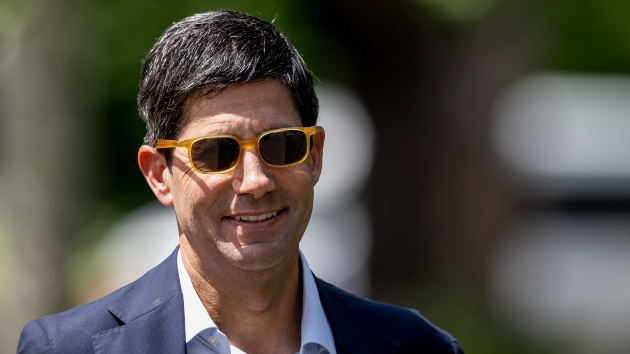
Kevin Warsh, former governor of the US Federal Reserve, walks to lunch during the Allen & Co. Media and Technology Conference in Sun Valley, Idaho, US, on Wednesday, July 9, 2025. The annual event has been a historic breeding ground for media deals and is usually a forum for tech and media elites to discuss the future of their industry. (Photographer: David Paul Morris/Bloomberg via Getty Images)
(WASHINGTON) — President Donald Trump announced conservative policymaker and former Fed governor Kevin Warsh as his pick to be the new Federal Reserve chairman.
In a post on Truth Social early Friday morning, Trump said that he has “known Kevin for a long period of time, and have no doubt that he will go down as one of the GREAT Fed Chairmen, maybe the best.”
“He will never let you down,” Trump continued.
Warsh previously served on the Fed’s board of governors from 2006 to 2011. He was a top adviser to then-Fed chairman Ben Bernanke during the 2008 financial crisis, serving as a liaison between the central bank and Wall Street. During that time, he was an inflation “hawk” — skeptical of the Fed’s ultra-low interest rate policy. But in more recent interviews, Warsh has heaped praise on Trump and called for “regime change” at the Fed, while also supporting lower interest rates.
On Thursday, Trump said that he had “chosen a very good person” while walking the carpet at the Kennedy Center ahead of the premiere of the documentary about first lady Melania Trump.
Trump said his pick to replace current Chairman Jerome Powell is an “outstanding person and a person that won’t be too surprising to people.”
“A lot of people think that this is somebody that could have been there a few years ago,” Trump went on. “It’s going to be somebody that is very respected, somebody that’s known to everybody in the financial world. And I think it’s going to be a very good choice.”
Trump has repeatedly attacked Powell over the past year for his cautious approach to lowering interest rates.
Powell’s term as chairman expires in May.
Earlier this month, in an extraordinary escalation of the months-long attack on the independence of the Federal Reserve, Powell announced that federal prosecutors had launched a criminal investigation related to a multi-year renovation of the Fed’s headquarters in Washington, D.C.
Earlier this week, at its first meeting since news of the investigation surfaced, the Federal Reserve voted to hold interest rates steady.
Trump said that the Fed governors who voted earlier this week to pause interest rates will change their minds once there is a new chair.
“If they respect the Fed chairman, they’ll be with us all the way,” Trump said. “They want to see the country be great.”