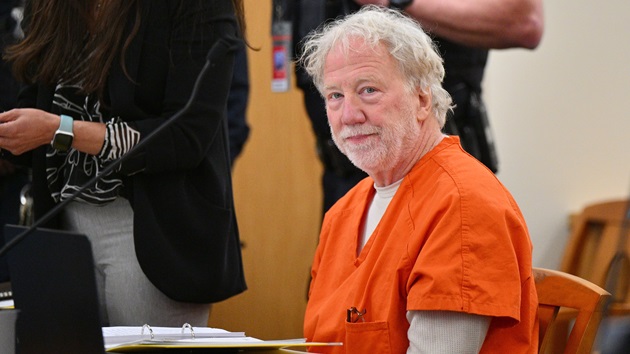
Director and actor Timothy Busfield looks on before a hearing in the Second District Judicial Court at the Bernalillo County Courthouse on January 20, 2026 in Albuquerque, New Mexico. Sam Wasson/Getty Images
(ALBUQUERQUE, N.M.) — A grand jury has indicted actor Timothy Busfield on child sex abuse contact charges after his arrest last month, according to officials.
Busfield is facing multiple counts of criminal sexual contact of a child, according to Bernalillo County District Attorney Sam Bregman.
“District Attorney Sam Bregman emphasized that protecting children remains a top priority for his office. The Bernalillo County District Attorney’s Office remains committed to doing everything possible to protect children and ensure justice for victims,” the district attorney’s office said in a statement Friday.
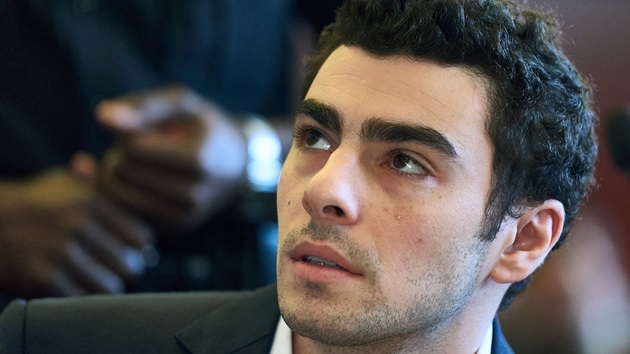
Luigi Mangione appears for a suppression of evidence hearing in the killing of UnitedHealthcare CEO Brian Thompson in Manhattan Criminal Court on December 18, 2025 in New York City. Curtis Means-Pool/Getty Images
(NEW YORK) — Luigi Mangione spoke out in court on Friday as Judge Gregory Carro tentatively scheduled his state murder case to begin on June 8.
Last week, U.S. District Judge Margaret Garnett announced that Mangione’s federal trial will begin with jury selection on Sept. 8 and opening statements on Oct. 13. But Carro said Friday that he believes the state case should go to trial first.
“It appears that the federal government has reneged on their agreement to let the state, who did most of the work in this case, to go first,” he remarked at the beginning of the hearing.
Carro ended the hearing with a stern directive to defense lawyers, who repeatedly pushed back on the June 8 trial date.
“You have done a great job, so be ready on June 8,” Carro told the defense. “That’s it.”
Seconds later, Mangione himself protested the judge’s decision as he was escorted out of court.
Mangione, shackled and wearing tan jail attire, looked toward the gallery and loudly said, “One plus one is two. Double jeopardy, by any common-sense definition.”
Defense attorney Karen Friedman Agnifilo repeatedly argued during the hearing that the June date would leave them unprepared and would be unfair to Mangione.
“The defense will not be ready on June 8,” she said. “Mr. Mangione is being put in an untenable situation that is a tug of war between two different prosecution officers.”
Prosecutor Joel Seidemann responded by arguing that the defense is trying to deprive [them] of a right to try the case” by creating a double jeopardy issue.
“It is absolutely unfair that Mr. Seidemann wants two bites of the apple,” Friedman Agnifilo said. “New York state has a double jeopardy law for a reason.”
“Counsel is seeking to jeopardize us out of the federal case,” Seidemann responded. “We have every reason to be the prosecuting authority.”
Seidemann argued that state prosecutors and investigators have done the bulk of the investigation and should be able to try a murder that took place on the streets of Manhattan. He claimed that the family of the victim, UnitedHealthcare CEO Brian Thompson, requested that the state case go first.
“That’s something certainly to be considered,” Seidemann said.
While Carro suggested that defense lawyers could resolve the conflict by asking the federal judge to delay the federal case, Friedman Agnifilo said she would not do so.
“It would be legal malpractice for us to do something that is not in our client’s best interest,” she said. “We have been working round the clock in both cases, fighting both cases.”
Carro said he could push the trial date to Sept. 8 if the Department of Justice decides to appeal a ruling in Mangione’s federal case.
Mangione, who is accused of gunning down Thompson outside a Midtown Manhattan hotel in December 2024, has pleaded not guilty to the state and federal charges. The federal judge last week took the death penalty off the table in the federal case.
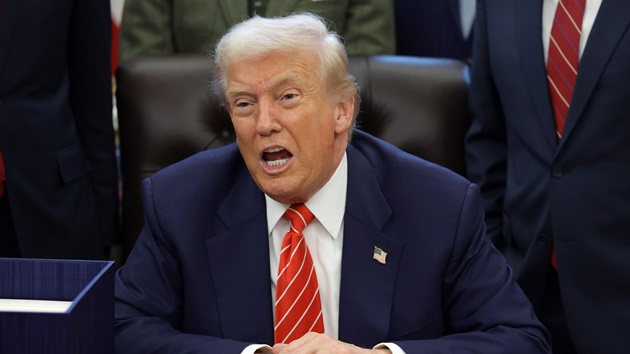
U.S. President Donald Trump speaks during a bill signing in the Oval Office of the White House on February 03, 2026 in Washington, DC. Alex Wong/Getty Images
(WASHINGTON) — President Donald Trump shared on his social media platform overnight a video that includes a racist animation of former President Barack Obama and former first lady Michelle Obama depicted with the bodies of apes, sparking condemnation from some lawmakers and demands that the post be taken down.
Trump reposted the roughly minutelong video, which focused on debunked claims about the 2020 election, to his social media platform.
At the end of the video, the Obamas’ faces appear abruptly and without explanation for seconds with the song “The Lion Sleeps Tonight” playing over it. The video then ends back on similar imagery of the conspiracy video footage.
The Obamas had no comment when ABC News reached out to their representatives for a response.
White House press secretary Karoline Leavitt, when asked for comment, said, “This is from an internet meme video depicting President Trump as the King of the Jungle and Democrats as characters from the Lion King. Please stop the fake outrage and report on something today that actually matters to the American public.”
The video reposted by Trump overnight includes only imagery of the Obamas.
The meme video referenced by Leavitt was shared in October by the Hardin County Republican Party of Kentucky on Facebook, which led the chairman to issue an apology and deleted the post after swift backlash noting the long history of racist tropes depicting Black people as apes or monkeys — a tool of slave traders and segregationists to dehumanize them.
Trump’s overnight repost was condemned by some lawmakers on Capitol Hill.
House Democratic Leader Hakeem Jeffries, the first Black leader of a party in Congress, wrote on X: “President Obama and Michelle Obama are brilliant, compassionate and patriotic Americans. They represent the best of this country. Donald Trump is a vile, unhinged and malignant bottom feeder.”
“Every single Republican must immediately denounce Donald Trump’s disgusting bigotry,” Jeffries wrote.
Republican Sen. Tim Scott, the only Black Republican in the Senate and also the head of the National Republican Senatorial Committee, posted on X: “Praying it was fake because it’s the most racist thing I’ve seen out of this White House. The President should remove it.”
Senate Minority Leader Chuck Schumer, a Democrat, wrote in a post: “Racist. Vile. Abhorrent. This is dangerous and degrades our country — where are Senate Republicans? The President must immediately delete the post and apologize to Barack and Michelle Obama, two great Americans who make Donald Trump look like a small, envious man.”
Luigi Mangione appears for a suppression of evidence hearing in the killing of UnitedHealthcare CEO Brian Thompson in Manhattan Criminal Court on December 18, 2025 in New York City. Curtis Means-Pool/Getty Images
(NEW YORK) — Luigi Mangione’s state murder case is tentatively scheduled to begin on June 8, Judge Gregory Carro said on Friday.
Carro said he could push the trial date to Sept. 8 if the Department of Justice decides to appeal a ruling in Mangione’s federal case.
Mangione, who is accused of gunning down UnitedHealthcare CEO Brian Thompson in Midtown Manhattan in December 2024, has pleaded not guilty to state and federal charges.
This is a developing story. Please check back for updates.
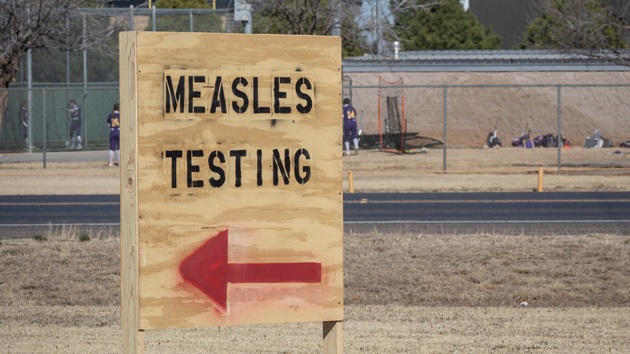
Signs point the way to measles testing in the parking lot of the Seminole Hospital District across from Wigwam Stadium on February 27, 2025 in Seminole, Texas. Jan Sonnenmair/Getty Images
(NEW YORK) — There have been at least 733 confirmed measles cases reported across the nation, the latest data from the Centers for Disease Control and Prevention showed Friday.
In just a few weeks, the United States reported four times as many cases than typically seen throughout an entire calendar year.
Before last year, which had a record breaking 2,276 cases, the U.S. averaged 180 cases annually since measles was declared eliminated in 2000.
The record numbers come as South Carolina is dealing with the largest outbreak recorded in recent memory.
Other states that have reported cases and are dealing with ongoing outbreaks include Arizona, California, Florida, Georgia, Idaho, Kentucky, Minnesota, Nebraska, North Carolina, North Dakota, Ohio, Oklahoma, Oregon, Pennsylvania, South Dakota, Utah, Virginia, Washington, and Wisconsin.
Most of the outbreaks occurring across the country are in pockets of under-vaccinated or unvaccinated communities.
The rate of kindergartners vaccinated with the measles, mumps, and rubella (MMR) vaccine has fallen from 95% in 2019 to below 93% in 2025, CDC data shows. Herd immunity, a threshold for vaccination rates that slow a virus’ ability to spread, is typically achieved at 95% vaccination rates, public health experts say.
Declining vaccination rates have left approximately 300,000 kindergarteners unprotected from measles infection.
The MMR vaccine is given in two doses, the initial shot given after the first year of life and the second shot given after the fourth year of life.
This is a developing story. Check back for updates.
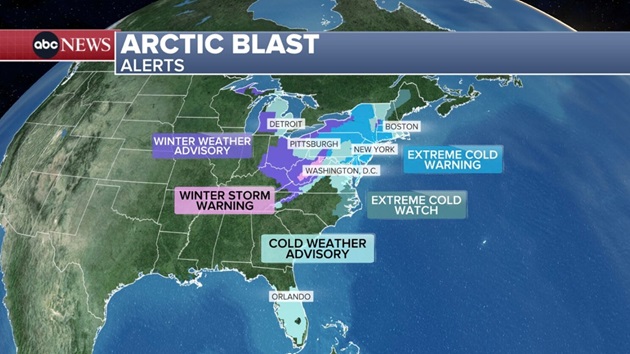
(NEW YORK) — At least 100 million Americans are on alert for dangerous cold weather in the coming days across the East as brutal, eye-watering cold winds — the coldest of the season for some — are expected across the Northeast this weekend.
Wind chills in the -20s are possible in Michigan and northern Ohio through Saturday morning, with -10s for southern Ohio and West Virginia.
Richmond, Virginia, could reach below-zero wind chills this weekend.
Extreme cold warnings are in place across much of the Northeast, including Pennsylvania, New Jersey, New York, Connecticut, Massachusetts and Vermont.
New York City could reach as low as -20 this weekend, and upstate New York around Saranac Lake could reach -40. Frostbite can occur in 10 minutes on exposed skin.
Much of this extreme cold is due to strong winds gusting 30 to 50 mph this weekend, especially Saturday.
Monday morning will still be very cold across the Northeast, but the wind will be calmer, so wind chills won’t be as extreme.
Slowly through the week, a warming trend is expected across the East, with high temperatures going above freezing for New York City and Boston on Wednesday, possibly even on Tuesday.
The end of next week is looking above average across the middle of the country, while the Northeast feels seasonal mid-February winter temperatures.
The system ushering in the brutal cold also brings some snow.
Friday morning, snow was falling over Michigan, Indiana, Ohio, West Virginia, western Pennsylvania and western New York.
By Friday afternoon, snow will become more scattered and fall from the Appalachians of western North Carolina through upstate New York.
A few light snow showers or flurries will pass over New York City on Friday night, and much of Saturday is looking dry. A dusting up to 1 inch of snow is possible over the city on Friday night.
On Saturday, Boston and much of New England will continue to see passing snow showers.
Boston could see 2 to 4 inches of snow through Saturday evening.
The western New York I-90 corridor could see 2 to 5 inches of snow through Saturday evening, including Syracuse, Rochester and Buffalo.
Signs point the way to measles testing in the parking lot of the Seminole Hospital District across from Wigwam Stadium on February 27, 2025 in Seminole, Texas. Jan Sonnenmair/Getty Images
(NEW YORK) — There have been at least 733 confirmed measles cases reported across the nation, the latest data from the Centers for Disease Control and Prevention showed Friday.
It comes as South Carolina is dealing with the largest outbreak recorded since measles was declared eliminated within the U.S. in the year 2000.
A total of 20 states have reported cases so far including Arizona, California, Florida, Georgia, Idaho, Kentucky, Minnesota, Nebraska, North Carolina, North Dakota, Ohio, Oklahoma, Oregon, Pennsylvania, South Carolina, South Dakota, Utah, Virginia, Washington, and Wisconsin.
Last year had a record breaking 2,276 cases nationwide, the highest number since 1992. There were also three measles deaths, the first in a decade.
This is a developing story. Check back for updates.
Grocery Store Shopping Supermarket (Oscar Wong/Getty Images)
(NEW YORK) — Consumer sentiment ticked higher in February for the second consecutive month as inflation fears appeared to ease, though shopper attitudes remained well below levels registered a year ago, University of Michigan data on Friday showed. The reading exceeded economists’ expectations
At its low point in November, consumer sentiment fell close to its worst level since a pandemic-era bout of acute inflation. Modest gains in recent months indicate some positive momentum for shoppers.
Year-ahead inflation expectations dropped from 4% in January to 3.5% in February, the data showed. The outcome anticipated by respondents would put inflation above its current level of 2.7%.
The labor market has slowed in recent months, while inflation has hovered above the Federal Reserve’s target rate of 2%.
Despite these challenges, some major economic indicators remain upbeat.
In the fall, shoppers helped propel the fastest quarterly U.S. economic growth in two years, federal government data in December showed.
Meanwhile, a relatively small fraction of American adults are unemployed and looking for work. The unemployment rate dropped to 4.4% in December from 4.6% in November, the U.S. Bureau of Labor Statistics said, putting unemployment at a low level by historical standards.
Turmoil in markets this week, however, has prompted concern among some observers about the financial outlook.
Some major tech stocks plummeted in recent days after Anthropic unveiled an artificial intelligence tool viewed by some investors as a potential replacement for widely-used software products.
The price of bitcoin plunged more than 10% on Thursday, sinking the world’s largest cryptocurrency to its lowest level since October 2024 and erasing sizable gains made since then.
Geopolitical conflict also looms amid negotiations over Greenland, U.S.-backed leadership in Venezuela, the ongoing war between Russia and Ukraine, as well as persistent tensions between the U.S. and Iran.
In recent weeks, Trump has threatened tariffs against Canada, South Korea and eight European countries, invoking the tool as means of exerting pressure over a range of foreign-policy issues.
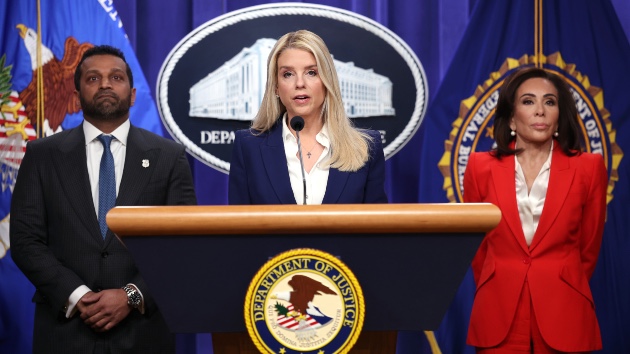
U.S. Attorney General Pamela Bondi (C), Federal Bureau of Investigation (FBI) Director Kash Patel (L) and U.S. Attorney for Washington, DC Jeanine Pirro make a press announcement at the Department of Justice on February 6, 2026 in Washington, DC. Bondi announced the FBI has captured and extradited Zubayr al-Bakoush, a suspect in the 2012 attack on the US Embassy in Benghazi, Libya. (Photo by Kevin Dietsch/Getty Images)
(NEW YORK) — A suspect in the 2012 terrorist attack on the U.S. embassy in Benghazi, Libya, has been arrested and brought back to the United States, Attorney General Pam Bondi said Friday.
Zubayr al-Bakoush was brought back to Andrews Air Force Base at 3 a.m., she said.
On Sept. 11, 2012, a group of men stormed into the diplomatic compound in Benghazi. Four Americans were killed in the attack.
The suspect is charged with the murder of Ambassador Chris Stevens and three others, according to the U.S. attorney.
“Bakoush was first charged by complaint in 2015 which was sealed for 11 years, an indictment, an eight count indictment, has been unsealed, and it charges Bakoush with the murder of Ambassador Chris Stevens, the murder of State Department employee Sean Smith, the attempted murder of State Department Special Agent Scott Wicklund and conspiracy to provide materials for terrorists and support that resulted in the death of four Americans, as well as arson at the special mission,” U.S. Attorney Jeannine Pirro said alongside the Bondi and FBI Director Kash Patel.
This is a developing story. Please check back for updates.
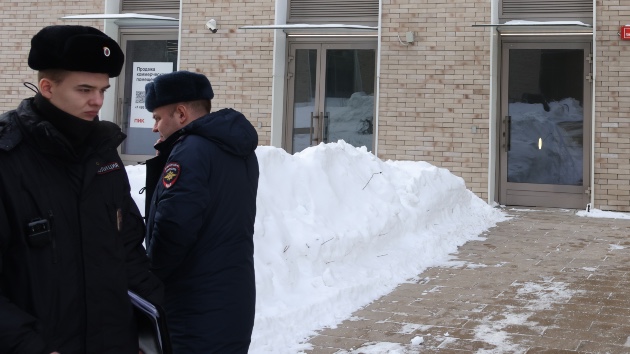
Russian Police officers walk next to the entrance of a residential building on Volokolamsk Highway, where an assassination attempt on General Lieutenant Alexeyev (Alekseev) was made earlier in the morning, on February 6, 2026, in Moscow, . (Photo by Contributor/Getty Images)
(LONDON) — Lt. Gen. Vladimir Alexeyev, a high-ranking Defense Ministry official, was shot and injured in an ambush-style attack on Friday in a residential area of Moscow, according to the Investigative Committee of Russia and state-affiliated media.
“According to investigators, on Feb. 6, 2026, in a residential building located on Volokolamskoye Highway in Moscow, an as-yet-unidentified individual fired several shots at a man and fled the scene,” Svetlana Petrenko, the committee’s spokesperson, said in Russian on the Telegram messaging app.
The victim was transported to a local hospital, Petrenko said. She did not immediately describe the extent of his injuries.
State-affiliated news outlet TASS identified the victim as Alexeyev, adding that a criminal investigation had been launched.
“Special services are currently doing their job,” Kremlin spokesperson Dmitry Peskov said. “Of course, this has been reported to the head of state. We wish the general a speedy recovery.”
Sergey Lavrov, Russia’s foreign minister, claimed without evidence that Ukraine and its president, Volodymyr Zelenskyy, may be responsible for the shooting. He suggested that it may be an attempt by Ukraine to disrupt negotiations between Washington, Kyiv and Moscow.
“The regime is ready to do anything to convince its Western sponsors not to lag behind the United States in their desire to derail the process of achieving a just settlement,” Lavrov told reporters at a briefing on Friday.
ABC News’ Joe Simonetti, Dragana Jovanovic and Anna Sergeeva contributed to this report.