(NEW YORK) — Frank Carone, a former chief of staff to ex-New York Mayor Eric Adams, was arrested on Wednesday morning along with his brother Anthony and two others as part of a federal bribery case, sources familiar with the case told ABC News.
Carone and the others were expected to be arraigned in Brooklyn federal court on Wednesday. Their indictment remained sealed on Wednesday, so the exact charges were not immediately known.
The case centers on a city contract issued during the Adams administration, sources told ABC News.
Carone helped with Adams’ transition into office in January 2022 and served as the mayor’s chief of staff until that December, when he departed the administration. He said as he departed that it had been an “honor keeping the trains running for this administration,” according to a press release from the time.
This is a developing story. Please check back for updates.
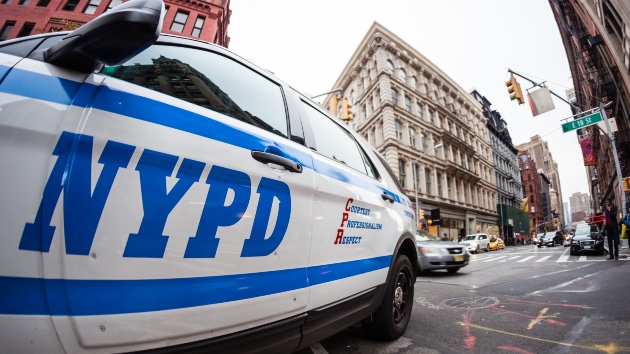
Close up of the NYPD logo on a police car. (Tim Drivas Photography/Getty Images)
(NEW YORK) — The FBI and New York Police Department conducted searches on Wednesday morning at various locations around the city as part of an ongoing investigation into alleged corruption at the nation’s largest police department.
The investigation is targeting current and former police executives, sources familiar with it told ABC News.
Police Commissioner Jessica Tisch issued a statement confirming the searches, saying the NYPD’s Internal Affairs Bureau was working alongside the FBI in executing search warrants “as part of a criminal investigation being pursued by the NYPD, the FBI, and the U.S. Attorney’s Office for the Southern District of New York.”
“The investigation is ongoing and concerns conduct by former and current members of the NYPD,” she said.
The investigation is examining, among other things, promotions and assignments and how they were carried out, the sources said. Tisch in her statement did not identify potential suspects or charges.
“When I became Police Commissioner, I promised New Yorkers that under my leadership the NYPD would conduct itself with integrity and that there would be a thorough investigation of any claim that members of service failed to meet that standard,” Tisch said. “This investigation and our actions this morning are part of the ongoing effort to fulfill that commitment and hold the Department to its highest ideals.”
The investigation was targeting the current chief of Manhattan South, Jimmy McCarthy, who has been placed on modified duty, according to the NYPD. Another target is the department’s former chief spokesman, Tarik Sheppard, sources said.
FBI agents were spotted outside the Brooklyn home of Jeffrey Maddrey, formerly chief of Department, the highest ranking uniformed officer. It was not immediately clear whether Maddrey was a part of the investigation
This is a developing story. Please check back for updates.
(NEW YORK) — France has confirmed its first Ebola case linked to the outbreak in the Democratic Republic of the Congo, officials said.
The patient is a humanitarian doctor who recently returned from the DRC and has been transferred to a specialist hospital, authorities confirmed.
French health officials say the case was detected quickly, the necessary precautions are in place and that there is no indication of local spread.
“France has specialized capabilities for managing highly transmissible infectious diseases,” France’s Ministry of Health said in a statement announcing the case. “Patients are treated in a designated healthcare facility, following strict biosafety protocols (negative pressure room, dedicated equipment and protocols). Health authorities are fully mobilized and the situation is being continuously monitored.”
“All precautionary measures, including the patient’s isolation, were taken upon his arrival in the country, with transfer to the hospital under secure conditions to prevent any risk of contamination,” the statement continued.
Officials said a thorough epidemiological investigation is underway to identify individuals who may have been in contact with the patient and that they will be contacted “without delay” by the regional health agency before undergoing 21 days of home isolation while being closely monitored the entire time.
The European Centre for Disease Prevention and Control has assessed the risk of infection as “low” for European residents and travelers to areas of active transmission, and “very low” for the general European population.
Female doctor talking with young woman in exam room (MoMo Productions/Getty Images)
(NEW YORK) — Cervical cancer deaths are 49% higher for women living in poverty, a major report released on Thursday finds.
Women living in poverty were also 23% more likely to develop cervical cancer compared to those living in higher-income areas, according to the report from the American Association of Cancer Research (AACR).
“The disparities in this situation arise from an access to care issue,” Dr. Paul DiSilvestro, division director of gynecologic oncology at Women and Infants Hospital in Providence, Rhode Island, who was not involved in the report, told ABC News.
“I think we often don’t understand the pressure on women as it relates to screening. Sometimes you have to make a choice between going to work, caring for your children, putting food on the table and getting a screening test,” he added.
Cervical cancer is typically caused by a virus called human papillomavirus (HPV). The disease is now largely preventable thanks to the introduction of the HPV vaccine nearly two decades ago. Studies show the vaccine has drastically reduced mortality rates from cervical cancer.
If cervical cancer is caught early, it is usually easier to treat, according to the National Cancer Institute. However, not all women are able to get vaccinated as a teenager or get regular screenings in adulthood.
Some public health specialists say that new data suggests stark racial disparities appear to be easing, although there is still a long way to go.
In 2000, Hispanic women were 70% more likely to die of cervical cancer compared to white women, according to the AACR report. By 2024, Hispanic women were 10% more likely to die of cervical cancer, the report found.
Efforts and strategies to decrease these disparity gaps have been in effect nationally. The AACR reports that cervical screening increased by 62% after incorporation of patient navigation services.
A study in the AACR summary combined data from 20 trials done across the country, which included information about services including transportation assistance, interpreter services, home visits, patient education, scheduling assistance and individualized financial support.
It found that lay Hispanic/Latino community members who receive specialized training to provide basic health education in the community, known as promotoras, played key roles — alongside social workers, telephone counselors and social workers — in delivering these services.
Policy changes, such as Medicaid expansion, have also produced measurable increases in screening uptake among previously uninsured populations, according to the study.
Despite these efforts, patients living in poorer counties are still experiencing worse outcomes, DiSilvestro said.
“We need to do a better job of delivering the screening to the community as opposed to expecting the community to present itself to us for the screening,” he said.
The Centers for Disease Control (CDC) recommends two doses of the HPV vaccine at age 11 or 12, a shot that has proven to prevent up to 90% of cervical cancer cases.
The CDC also recommends that screening pap smears start at age 21. Pap smears look for cell changes on the cervix that could develop into cervical cancer.
“I think we can’t forget that in this situation, cervical cancer screening works,” DiSilvestro said. “But it only works if we can provide it to the people.”
Areta Bojko, MD is a board-certified OBGYN and gynecologic oncology fellow at Women and Infants Hospital and a member of the ABC News Medical Unit.
Lesley Groff (C), a former assistant to Jeffrey Epstein, arrives to testify at a closed-door interview with the House Oversight Committee on Capitol Hill on June 09, 2026, in Washington, DC. (Chip Somodevilla/Getty Images)
(WASHINGTON) — Lesley Groff, the former executive secretary of convicted sex offender Jeffrey Epstein, attempted to deflect any culpability in Epstein’s crimes, telling lawmakers that she routinely scheduled massages for her boss but never booked appointments for anyone she knew to be underage, according to a House Oversight Committee transcript released Tuesday.
“I never met these women, so I didn’t know if they were young or how old they were,” Groff said during her appearance earlier this month. “I thought that it was just something that he did, like going to the gym.”
Groff, who worked for Epstein in New York for more than 18 years, was previously described by her boss as an “extension of my brain.” She appeared as part of the committee’s ongoing inquiry into the federal government’s handling of investigations into Epstein and his alleged accomplices.
Once identified by federal prosecutors as a potential co-conspirator in Epstein’s crimes, Groff said she hoped her interview would “dispel the false notions” that she “knowingly enabled or conspired with him to commit his evil acts.”
Over the course of an eight-hour interview, Groff faced at times skeptical inquiries from committee members and staff, who questioned how she could have been unaware of Epstein’s predilection for sexualized massages, the transcript shows.
“You want us to believe that after 18 years working in the employ of Mr. Jeffrey Epstein that not on one occasion did you believe that any of your contacts in setting up these appointments with Jeffrey Epstein were either a minor or an underage person, correct?” asked Rep. Raja Krishnamoorthi, D-Ill.
“Ms. Groff, do you think that a 14-year-old sounds the same as a person in their 20s or 30s or 40s?” asked an attorney for the committee.
“It’s possible. I don’t know. I was not evaluating voices,” Groff replied. “Nobody ever sounded like they were underage.”
Groff, now 59, appeared voluntarily for the interview, which was not under oath and not recorded. It marks the first time she has faced questions since speaking to the FBI in New York in 2021, two years after Epstein’s death. Later that year, prosecutors informed her that she would not be charged, according to her attorneys.
Groff told the committee that she was hired by Epstein in 2001 and was immediately “astonished by the truly impressive people in his circle,” including past presidents, actors, musicians and scientists.
“I actually felt lucky to have found such an amazing job. I was thrust into the lifestyles of the rich and famous,” she said in her prepared opening remarks.
She said Epstein’s directive for daily massages was a “very small part” of her duties in coordinating Epstein’s schedule. From the moment she was hired, Epstein and his then-partner Ghislaine Maxwell “established guardrails” and made it clear that she was never to associate with their friends.
“Their business was none of my business,” she said she was told.
When Epstein came under law enforcement scrutiny in Florida in the mid-2000s — first by the Palm Beach police and later by the FBI — Groff said he told her he had been set up for blackmail by a girl who lied about her age.
“It was a shakedown, he claimed, for money,” Groff said. “At the time, I actually felt sorry for him. I thought, ‘Wow, this must be really difficult to be a wealthy person and not know who you can trust because everybody wants your money.'”
Groff said she first learned of the criminal investigation when the FBI showed up at her home in Connecticut in 2007.
“I let them in my house and sat with them on my sofa, and they started asking me some questions. That’s how I found out,” she said. “I think my head was probably spinning. I had no idea.”
Groff told the committee she excused herself to check on her son and then called Epstein’s in-house lawyer about the FBI visit. She said she was advised not to talk to the agents without a lawyer.
“And so I went downstairs and said, ‘I don’t think I should be speaking to you without an attorney present.’ And they didn’t really like that, and then they left,” she said.
Groff said that after Epstein went to jail in 2008, she considered resigning. She stayed, she said, because she “actually believed he had been set up” and because she saw that the “same VIP’s continued to surround” him after his conviction.
“I looked around the office and I felt people smarter than me were still there and stayed there. All his contacts and business people, no one left,” she said, according to the transcript.
After Epstein’s arrest in July 2019, federal prosecutors in New York included Groff in a list of potential co-conspirators and sent her a subpoena. Her attorney informed the government, just four days after Epstein’s arrest, that Groff “would invoke her Fifth Amendment privilege against compelled self-incrimination” if called to appear before a grand jury, according to DOJ records released in response to the Epstein Files Transparency Act.
Prosecutors informed Groff’s lawyer that “numerous victims [of Epstein] had indicated that she was responsible for scheduling massages during which they were sexually abused,” and that she should consider cooperating with the investigation, according to the DOJ records.
Groff eventually interviewed with the investigators two years later, telling prosecutors that “making massage appointments was just another appointment she had to make” for Epstein.
The DOJ files also include an account from a witness — who was a minor at the time of her alleged abuse by Epstein — who told the FBI that she felt Groff “knew that the massage appointments were sexual” and “felt it was pretty obvious Lesley knew what was going on.” The witness also alleged that she explicitly told Groff she was not 18 years old and needed money for an abortion, according to the FBI report.
Asked by a committee attorney about those allegations, Groff said she felt “terrible for this survivor” but contended the witness’s recollections were inaccurate.
“I’m not saying that what she’s thinking — that she told someone — but she did not tell me,” Groff said. “I think she is mistaken. I know she is mistaken.”
Groff said that after Epstein was released from jail in 2010, she was never again asked to book a massage appointment for him. She acknowledged she booked travel — at Epstein’s direction — for women who would later allege to have been sexually exploited. But she contended she had no reason to think the women were being abused.
“I believed them to be traveling assistants, and none of them ever looked unhappy or under duress,” she said. “In hindsight, it’s terrible, I can’t imagine what they were going through.”
She said she was not alarmed by now-public email messages from Epstein’s associates sharing photographs and information about foreign women — because of Epstein’s connections in the modeling and fashion industries. She conceded that some of the emails released by the Justice Department appear alarming in retrospect, but insisted she had no reason to be concerned at the time.
“I did not know that this was occurring. I never saw anything inappropriate,” she said. “Everything to me — that I was doing, I feel like now, looking through a dirty lens, things look dirty. But at this time, I was unaware of anything that was going on.”
Groff said that since Epstein’s arrest in 2019, she has struggled to sleep and eat, been the target of harassment and death threats, and been “shunned” by many of her friends and acquaintances.
She was one of four women listed as potential co-conspirators in Epstein’s controversial non-prosecution agreement in 2007, which she said, “remains her scarlet letter.”
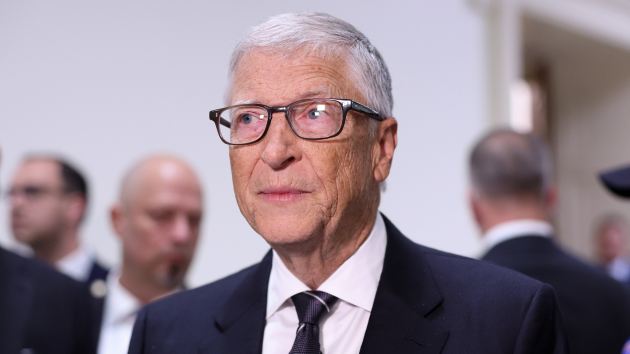
Microsoft Co-Founder Bill Gates stops to speak to the media as he arrives to testify at a closed-door interview with the House Oversight Committee on Capitol Hill on June 10, 2026, in Washington, DC. The committee is continuing to hold closed-door interviews as part of their investigation into convicted sex offender Jeffrey Epstein. (Photo by Tom Brenner/Getty Images)
(WASHINGTON) — After Microsoft co-founder Bill Gates tried to end his relationship with Jeffrey Epstein, the convicted sex offender attempted to use compromising information about Gates’ extramarital affairs to force his way back into Gates’ life — but never explicitly threatened him, Gates told the House Oversight Committee earlier this month, according to a transcript of the closed-door session released Tuesday.
Gates appeared before the panel on June 10 as part of its ongoing probe into the government’s handling of its investigations into Epstein.
Gates, according to the transcript, said Epstein used an adviser to send him “veiled” threats, appeared to coach Gates’ adviser on how to potentially blackmail him, and mixed fact and fiction to leverage compromising information against the software billionaire.
“I was not blackmailed, but, you know, as you look at these emails, you know, it looks like Mr. Epstein’s brainstorming was going in that direction,” Gates said about materials from the Epstein files released earlier this year by the Department of Justice. “It appears that in many cases he, at least in emails to himself, was sort of rehearsing how either he or he coaching someone else might choose to blackmail me, but none of those messages were ever sent to me.”
During the interview, Gates acknowledged having at least three extramarital affairs, though he said that Epstein was involved with none of the women and that Epstein only learned about them after he and Epstein had cut ties.
The testimony offers a rare window into how Epstein allegedly tried to use compromising information to manipulate at least one powerful public figure. The Department of Justice said last year it found no credible evidence that Epstein blackmailed prominent individuals.
Gates told lawmakers that his interactions with Epstein were limited to business, that he never witnessed Epstein commit a crime, and that he did not suspect that the women who were traveling with the disgraced financier were victims of sex trafficking. Asked about photos showing him with some of Epstein’s victims, Gates said Epstein occasionally asked to take photographs of Gates with women who Gates said he believed were Epstein’s assistants.
“I have never victimized anyone. While he may have sought to foster a personal relationship, I was never interested in that and never reciprocated,” Gates told lawmakers.
Gates told the Oversight panel that he first began to meet with Epstein in 2011 because he thought the financier’s purported connections with the wealthy could help advance the Gates Foundation’s global health work. When they first began to meet, Gates said he was aware of Epstein’s “bad reputation stemming from his criminal conviction,” but continued to see Epstein.
“I was aware that he had a criminal conviction,” Gates said. “I knew that it was of a sexual nature, but, no, I don’t think I knew, dug into the specifics, although I probably should have.”
Gates said he only became aware of the full extent of Epstein’s crimes in 2018 after the Miami Herald’s in-depth reporting on Epstein’s lenient deal with federal prosecutors.
Gates said he thought the other high-profile individuals with whom Epstein socialized helped create an “image of legitimacy,” acknowledging that his own relationship with Epstein likely bolstered that image.
“I was so focused on the possibility of raising funds for global health that I allowed that goal to override my better judgment,” Gates said. “If the time I spent with Epstein lent him credibility, I am deeply sorry. I’ve learned a significant lesson and am now far more careful about who I engage with, even in a limited capacity.”
Describing Epstein as a “dilettante” with a surface-level knowledge of science and academics, Gates said that Epstein suggested he “provided advice to lots of billionaires” who might be able to advance philanthropic causes.
“He talked about Wall Street billionaires, he talked about Middle East billionaires. He made it sound very extensive … maybe for me to have a good impression of him,” Gates said.
While Gates insisted that his meetings with Epstein “weren’t social,” he recounted that some of those dinners involved “wide ranging discussion” with academics and bankers, including one dinner that included entertainment from magician David Blaine. Gates also said that Epstein repeatedly invited him to his private island, as well as an erotic show in Paris — invites that Gates said he refused.
According to Gates, his science adviser claimed they could likely go backstage to meet some of the performers that Epstein had dated, but Gates said he did not want to be spotted at an erotic show with Epstein.
“It wasn’t consistent with the relationship I had with Epstein,” Gates said. “I guess not only is my appearing at an erotic event a risk to my reputation, it would be compounded by appearing with somebody who, although I didn’t know the full extent of it, had been convicted of a sexually related crime.”
After occasionally meeting with Epstein for about three years, Gates said he began to express concerns that Epstein was “stringing” him along with his claims that he could deliver “meaningful philanthropic support.” According to Gates, Epstein set up a series of meetings in 2014 with high-profile individuals including hotel billionaire Thomas Pritzker, media billionaire Mort Zuckerman, and private equity investor Leon Black to demonstrate his connections to purportedly help Gates’ philanthropy work, though Gates said the meetings were a “dead end.”
“At that point, I concluded Epstein would never deliver on his promises. I told him we would go no further and stopped communicating or meeting with him,” Gates told the panel.
After Gates tried to cut ties with Epstein in 2014, he said the disgraced financier attempted to force his way back into his life, including by leveraging his knowledge of Gates’ extramarital affairs.
While Gates said he never disclosed the affairs to Epstein, he speculated that Epstein learned about the indiscretions through his relationship with Gates’ science adviser Boris Nikolic. Gates said that Nikolic was aware of the affairs because of their close relationship, including at least one instance when he used meeting with Nikolic as an alibi to rendezvous with one of the women.
“One time it was a scheduling thing, when we were in London, where I said to him I was going to disappear and wanted him to show that I was meeting with him at that time,” Gates said.
When Nikolic began the process of leaving the Gates Foundation, he engaged Epstein to help him negotiate the terms of his departure, Gates said. Epstein traveled to Seattle at one point to assist in Nikolic’s negotiation, Gates said, and Nikolic eventually began to make “veiled” threats via email.
“It’s hard to characterize the Epstein stuff because there was never a direct threat of any kind. There was always this veiled language like ‘we should remain friends,’ you know, which made me wonder what Dr. Nikolic had shared with him,” Gates said.
Asked about two draft emails released by the Department of Justice seemingly written by Epstein on behalf of Nikolic, Gates said the notes — which vaguely referenced the affairs and suggested that Gates has contracted a sexually transmitted disease — appeared to be part of a plot to attempt to “blackmail” him.
While Gates acknowledged at least three affairs, he explicitly denied contracting a sexually transmitted disease from the affairs, suggesting Epstein mixed falsehoods with known compromising information to use as leverage.
“If those emails that contained some truth and some false things were ever sent, then we could say there was an attempt at blackmail that never happened,” Gates said.
After he severed his relationship with Epstein, Gates claimed that the disgraced financier attempted to force his way back into his orbit, including by seeking reimbursement for money he claimed to have paid a woman with whom Gates had an affair. He told lawmakers that Epstein had nothing to do with the relationship and said he was unaware of any money that Epstein may have paid the woman, telling lawmakers that he believed the requests for payment were a “tactic [for Epstein] to reengage” him.
“I’d never asked him to do anything with respect to the person we’re discussing, so I was rather surprised. That was the first time I knew explicitly that he’d become aware of that affair,” Gates told lawmakers.
ABC News’ John Parkinson contributed to this report.
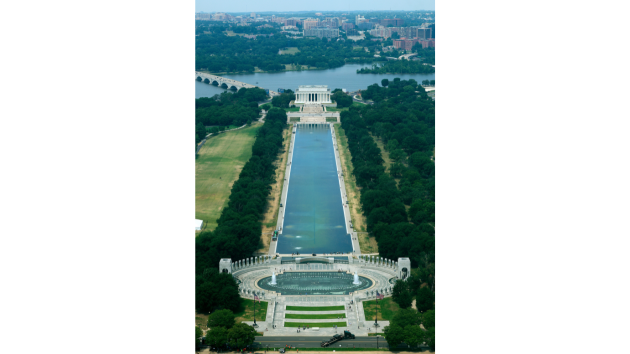
The Lincoln Memorial Reflecting Pool continues to show signs of an algae bloom on the National Mall on June 22, 2026, in Washington, DC. President Donald Trump said that another round of repairs to the iconic basin will begin immediately after paint started peeling following the completion of a recent $14 million no-bid restoration project. (Photo by Chip Somodevilla/Getty Images)
(WASHINGTON) — President Donald Trump said Tuesday the Lincoln Memorial Reflecting Pool will be drained again for “permanent repair” around the Fourth of July, and said that six people have now been arrested for alleged damage to the site.
The Reflecting Pool has been plagued with algae and peeling paint in the days since the Trump administration completed its renovation, which cost taxpayers more than $16 million.
Trump said in a social media post that “large areas of grass are being replaced” around the pool and that the administration “will drain some of the water, either immediately before or after the Fourth of July, to do the permanent repair.” Trump has blamed the Reflecting Pool’s issues on vandals, though has yet to offer evidence.
“Six people have been arrested, and seven people have been cited, for the damage they did to our Country’s now beautiful Reflecting Pool,” Trump wrote in the post.
“The 350 foot gash, made by a very sharp knife or razors, is actually numerous slashes over a very long 350 foot length. It was purposefully and criminally done, and somebody had to work very hard, probably in the dark of night, to create such a condition. Likewise, the small area at the bottom of the Pool was cut and powerfully lifted off the surface leaving very jagged, uneven edges,” Trump wrote.
On Monday, during an Oval Office event, Trump directed reporters to the Interior Department and the Parks Department for information on ongoing investigations into alleged damages but provided no evidence himself.
The Interior Department and the U.S. Park Police have not responded to multiple outreaches for evidence of the alleged vandalism.
Trump’s post comes after White House press secretary Karoline Leavitt, during a Fox News interview on Monday night, said the number of vandalism-related arrests had risen to six.
Earlier on Monday afternoon, an Interior Department spokesperson said there had been five arrests for vandalism, five federal citations and 14 vandalism-related police reports.
Algae and leaks have long plagued the Reflecting Pool, which was constructed in the 1920s. Former President Barack Obama made his own attempt at renovations during his administration and spent roughly $35 million on the changes.
(WASHINGTON) — The Senate on Tuesday adopted a House-passed Iran war powers resolution by a 50-48 vote in a symbolic, yet rare, rebuke of President Donald Trump.
This is a developing story. Please check back for updates.
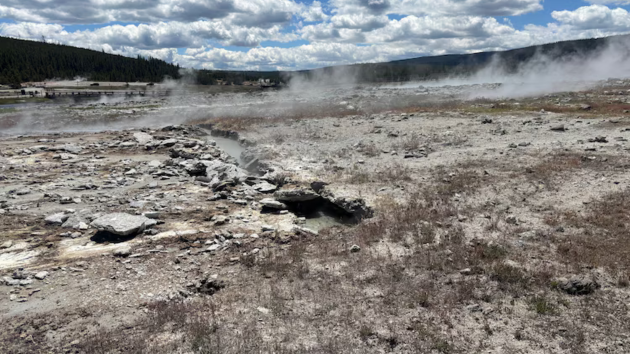
Looking south, toward Black Diamond Pool (steaming blue area in the left middle ground) along a fissure that formed during a small hydrothermal explosion on June 13, 2026, in Biscuit Basin, Yellowstone National Park. The fissure is about 18.5 meters (61 feet) long and filled with near-boiling water. (USGS)
(WYOMING) — Another hydrothermal explosion has occurred at Yellowstone National Park, highlighting the unstable nature of the reserve’s extensive volcanic network, the U.S. Geological Survey says.
On June 13, a small hydrothermal explosion occurred at Yellowstone’s Biscuit Basin — a popular thermal area located less than 2 miles northwest of Old Faithful, according to the USGS.
The explosion occurred at 5:09 a.m. local time and did not cause any injuries, according to the USGS. A new pool formed as a result of activity.
Monitoring equipment at Biscuit Basin registered anomalous activity, including seismic activity and infrasound — a low-signal acoustic signal — coming from the direction of the Black Diamond Pool, where a hydrothermal explosion occurred on July 23, 2024.
When park rangers went to investigate, they noticed that water in the Firehole River flowing downstream from Biscuit Basin included a light-gray to milky runoff, an “odd” observation, according to the USGS.
A camera installed at the Black Diamond Pool in 2025 recorded a dark-colored stream jetting out of the ground north of the pool. Geologists assessing the activity discovered that large volumes of hydrothermal water had surged into the Firehole River from three sets of newly formed vents in the Black Diamond Pool.
The vents allowed pathways to the surface for water measuring at or slightly above boiling temperatures. As the water converted to steam, it triggered a hydrothermal explosion, the USGS said.
One of the vents was found to be a crack to the north-northwest of the pool measured about 61 feet long and 5 feet wide in some places. The crack was surrounded by several rocks that had been ejected during the explosion. Another linear vent located to the northeast measured about 49 feet long.
The water measured between 185 degrees and 200 degrees Fahrenheit, the USGS said.
Days after, geologists found that a new pool containing “vigorously” boiling water — described as gray in color and full of silt — had formed near the middle of the vent group.
The pool likely formed as a result of collapse of the land beneath it.
Camera observations taken on June 18 showed intermittent episodes of spouting within the pool. Some of the water spouts reached between 20 feet and 30 feet, geologists said. When not displaying geyser-like activity, the pool was actively boiling.
The explosion emphasizes the unstable and hazardous nature of hydrothermal activity in the region, the USGS said.
No one was impacted by the latest incident because Biscuit Basin has been closed since the 2024 explosion.
Temporary seismic monitoring stations have been installed within the basin to record signals related to the evolution of the newly formed vents, the USGS said.
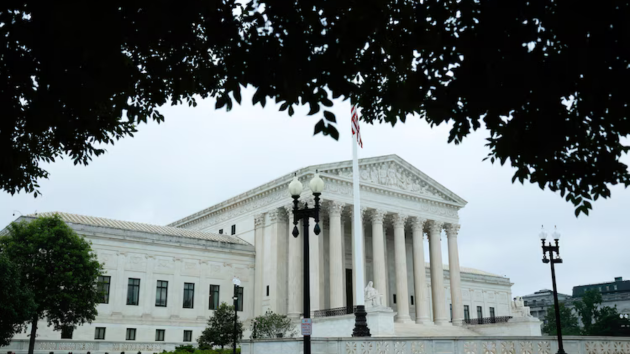
A light rain falls outside of the U.S. Supreme Court ahead of the release of new opinions, on June 23, 2026, in Washington, D.C. (Chip Somodevilla/Getty Images)
(WASHINGTON) — The U.S. Supreme Court’s conservative majority on Tuesday bolstered the ability of federal border agents to remove from the country lawful permanent residents, or green card holders, who may have committed a crime involving “moral turpitude.”
In a 6-3 decision by Justice Clarence Thomas in Blanche v. Lau, the court said border agents do not bear the burden of having to prove by “clear and convincing evidence” that an immigrant seeking to re-enter the country after a trip abroad had committed a crime before denying them admission, but need only show that there was reason to believe they had.
“The Immigration and Nationality Act does not impose that requirement,” Thomas wrote. The ruling effectively makes it easier for border officials to strip lawful permanent resident (LPR) status from people as they arrive at U.S. ports of entry.
It is also a setback for plaintiff Muk Choi Lau, a Chinese citizen and U.S. green card holder who was deemed inadmissible at New York’s John F. Kennedy International Airport in 2012 as he was returning from a trip to China. Officials denied his formal re-entry into the U.S. because he faced New Jersey state charges for trademark counterfeiting at the time, though he was conditionally allowed readmission.
.S. immigration law states that green card holders who legally leave the U.S. for short periods should be allowed to re-enter, but there are exceptions – among them if the green card holder is convicted of or admits to having committed “a crime involving moral turpitude.”
A year later, Lau pleaded guilty to the counterfeiting charge and was subsequently ordered deported. He continued to contest his removal, arguing that the crime didn’t constitute one of “moral turpitude.”
In a dissent, Justice Ketanji Brown Jackson, joined by justices Sonia Sotomayor and Elena Kagan, argued that the government must bear the burden of first proving that a green card holder had, in fact, committed a crime before stripping their status.
“I worry that the court has now handed the government a massive blank check,” Jackson wrote, in part. “With today’s the decision, the Court allows the government to return an LPR to the status of ‘seeking admission’ upon his entry at the border, so long as the government is able to show later that he was eventually convicted. That sequencing undermines the plain terms and basic operation” of the law.