
Trump, Zelenskyy meet privately ahead of pope’s funeral

Trump, Zelenskyy meet privately ahead of pope’s funeral
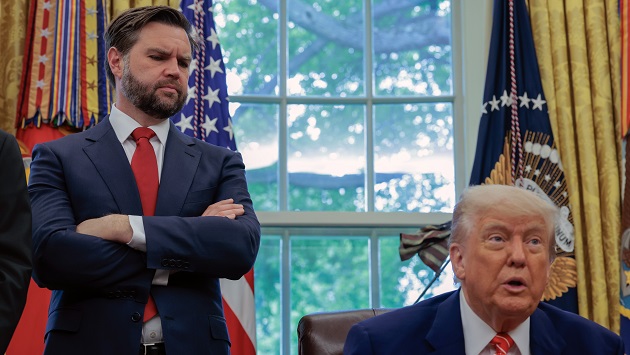
president Donald Trump and his wife Melania Trump are seen arriving at the Pope’s Funeral at the Vatican in Rome, Italy on 26 April, 2025. (Photo by Jaap Arriens/NurPhoto via Getty Images)

(ROME) — President Donald Trump and Ukraine’s President Volodymyr Zelenskyy met privately in Rome Saturday before attending the funeral for Pope Francis.

White House Communications Director Steven Cheung told the press pool traveling with Trump that the two men had a “very productive session.” More details about the meeting “will follow,” he said.

This was the first meeting between the two men since their contentious encounter in the White House Oval Office in late February.

Late Friday, following Special Envoy Steve Witkoff’s meeting with President Vladimir Putin in Moscow earlier in the day, Trump posted that it was “A good day in talks and meetings with Russia and Ukraine,” and suggested it’s now time for the two sides to meet at “very high levels.”

“They are very close to a deal, and the two sides should now meet, at very high levels, to “finish it off,” he wrote on his social media site.

“Most of the major points are agreed to. Stop the bloodshed, NOW. We will be wherever is necessary to help facilitate the END to this cruel and senseless war!” Trump added in the post, but provided no additional information about the apparent progress.

President Zelenskyy and his wife, Olena Zelenska, were seated about seven people away from Trump and the first lady Melania Trump, according to the press pool.

Former President Biden and former first lady Jill Biden were about four rows behind them.

Copyright © 2025, ABC Audio. All rights reserved.
Pope Francis remembered at his funeral as ‘pope among the people’ who aimed to ‘build bridges’

Pope Francis remembered at his funeral as ‘pope among the people’ who aimed to ‘build bridges’
(Antonio Masiello/Getty Images)

(ROME) — At his funeral, Pope Francis was remembered and venerated as a pontiff with “strength and serenity” who modeled his pontificate on St. Francis of Assisi. The dean of the College of Cardinals, Giovanni Battista Re, delivered the homily in front of some 200,000 mourners in St. Peter’s Square.

Here are the remarks translated into English:

In this majestic Saint Peter’s Square, where Pope Francis celebrated the Eucharist so many times and presided over great gatherings over the past twelve years, we are gathered with sad hearts in prayer around his mortal remains.

Yet, we are sustained by the certainty of faith, which assures us that human existence does not end in the tomb, but in the Father’s house, in a life of happiness that will know no end.

On behalf of the College of Cardinals, I cordially thank all of you for your presence. With deep emotion, I extend respectful greetings and heartfelt thanks to the Heads of State, Heads of Government and Official Delegations who have come from many countries to express their affection, veneration and esteem for our late Holy Father.

The outpouring of affection that we have witnessed in recent days following his passing from this earth into eternity tells us how much the profound pontificate of Pope Francis touched minds and hearts.

The final image we have of him, which will remain etched in our memory, is that of last Sunday, Easter Sunday, when Pope Francis, despite his serious health problems, wanted to give us his blessing from the balcony of Saint Peter’s Basilica. He then came down to this Square to greet the large crowd gathered for the Easter Mass while riding in the open-top Popemobile.

With our prayers, we now entrust the soul of our beloved Pontiff to God, that he may grant him eternal happiness in the bright and glorious gaze of his immense love.

We are enlightened and guided by the passage of the Gospel, in which the very voice of Christ resounded, asking the first of the Apostles: “Peter, do you love me more than these?” Peter’s answer was prompt and sincere: “Lord, you know everything; you know that I love you!” Jesus then entrusted him with the great mission: “Feed my sheep.”

This will be the constant task of Peter and his successors, a service of love in the footsteps of Christ, our Master and Lord, who “came not to be served but to serve, and to give his life a ransom for many” (Mk 10:45).

Despite his frailty and suffering towards the end, Pope Francis chose to follow this path of self-giving until the last day of his earthly life. He followed in the footsteps of his Lord, the Good Shepherd, who loved his sheep to the point of giving his life for them.

And he did so with strength and serenity, close to his flock, the Church of God, mindful of the words of Jesus quoted by the Apostle Paul: “It is more blessed to give than to receive” (Acts 20:35).

When Cardinal Bergoglio was elected by the Conclave on 13 March 2013 to succeed Pope Benedict XVI, he already had many years of experience in religious life in the Society of Jesus and, above all, was enriched by twenty-one years of pastoral ministry in the Archdiocese of Buenos Aires, first as Auxiliary, then as Coadjutor and, above all, as Archbishop.

The decision to take the name Francis immediately appeared to indicate the pastoral plan and style on which he wanted to base his pontificate, seeking inspiration from the spirit of Saint Francis of Assisi.He maintained his temperament and form of pastoral leadership, and through his resolute personality, immediately made his mark on the governance of the Church. He established direct contact with individuals and peoples, eager to be close to everyone, with a marked attention to those in difficulty, giving himself without measure, especially to the marginalized, the least among us.

He was a Pope among the people, with an open heart towards everyone. He was also a Pope attentive to the signs of the times and what the Holy Spirit was awakening in the Church.

With his characteristic vocabulary and language, rich in images and metaphors, he always sought to shed light on the problems of our time with the wisdom of the Gospel. He did so by offering a response guided by the light of faith and encouraging us to live as Christians amid the challenges and contradictions in recent years, which he loved to describe as an “epochal change.”

He had great spontaneity and an informal way of addressing everyone, even those far from the Church.

Rich in human warmth and deeply sensitive to today’s challenges, Pope Francis truly shared the anxieties, sufferings and hopes of this time of globalization. He gave of himself by comforting and encouraging us with a message capable of reaching people’s hearts in a direct and immediate way.

His charisma of welcome and listening, combined with a manner of behavior in keeping with today’s sensitivities, touched hearts and sought to reawaken moral and spiritual sensibilities.

Evangelization was the guiding principle of his pontificate. With a clear missionary vision, he spread the joy of the Gospel, which was the title of his first Apostolic Exhortation, Evangelii gaudium. It is a joy that fills the hearts of all those who entrust themselves to God with confidence and hope.

The guiding thread of his mission was also the conviction that the Church is a home for all, a home with its doors always open. He often used the image of the Church as a “field hospital” after a battle in which many were wounded; a Church determined to take care of the problems of people and the great anxieties that tear the contemporary world apart; a Church capable of bending down to every person, regardless of their beliefs or condition, and healing their wounds.

His gestures and exhortations in favor of refugees and displaced persons are countless. His insistence on working on behalf of the poor was constant.

It is significant that Pope Francis’ first journey was to Lampedusa, an island that symbolizes the tragedy of emigration, with thousands of people drowning at sea. In the same vein was his trip to Lesbos, together with the Ecumenical Patriarch and the Archbishop of Athens, as well as the celebration of a Mass on the border between Mexico and the United States during his journey to Mexico.

Of his 47 arduous Apostolic Journeys, the one to Iraq in 2021, defying every risk, will remain particularly memorable. That difficult Apostolic Journey was a balm on the open wounds of the Iraqi people, who had suffered so much from the inhuman actions of ISIS. It was also an important trip for interreligious dialogue, another significant dimension of his pastoral work.

With his 2024 Apostolic Journey to four countries in Asia-Oceania, the Pope reached “the most peripheral periphery of the world.”

Pope Francis always placed the Gospel of mercy at the centre, repeatedly emphasizing that God never tires of forgiving us. He always forgives, whatever the situation might be of the person who asks for forgiveness and returns to the right path.

He called for the Extraordinary Jubilee of Mercy in order to highlight that mercy is “the heart of the Gospel.”

Mercy and the joy of the Gospel are two key words for Pope Francis.

In contrast to what he called “the culture of waste,” he spoke of the culture of encounter and solidarity. The theme of fraternity ran through his entire pontificate with vibrant tones.

In his Encyclical Letter Fratelli tutti, he wanted to revive a worldwide aspiration to fraternity, because we are all children of the same Father who is in heaven. He often forcefully reminded us that we all belong to the same human family.

In 2019, during his trip to the United Arab Emirates, Pope Francis signed A Document on Human Fraternity for World Peace and Living Together, recalling the common fatherhood of God.

Addressing men and women throughout the world, in his Encyclical Letter Laudato si’ he drew attention to our duties and shared responsibility for our common home, stating, “No one is saved alone.”

Faced with the raging wars of recent years, with their inhuman horrors and countless deaths and destruction, Pope Francis incessantly raised his voice imploring peace and calling for reason and honest negotiation to find possible solutions. War, he said, results in the death of people and the destruction of homes, hospitals and schools. War always leaves the world worse than it was before: it is always a painful and tragic defeat for everyone. “Build bridges, not walls” was an exhortation he repeated many times, and his service of faith as Successor of the Apostle Peter always was linked to the service of humanity in all its dimensions.

Spiritually united with all of Christianity, we are here in large numbers to pray for Pope Francis, that God may welcome him into the immensity of his love. Pope Francis used to conclude his speeches and meetings by saying, “Do not forget to pray for me.”

Dear Pope Francis, we now ask you to pray for us. May you bless the Church, bless Rome, and bless the whole world from heaven as you did last Sunday from the balcony of this Basilica in a final embrace with all the people of God, but also embrace humanity that seeks the truth with a sincere heart and holds high the torch of hope.

Copyright © 2025, ABC Audio. All rights reserved.
Pope Francis remembered at his funeral as ‘pope among the people’ who aimed to ‘build bridges’

Pope Francis remembered at his funeral as ‘pope among the people’ who aimed to ‘build bridges’
(Antonio Masiello/Getty Images)

(ROME) — At his funeral, Pope Francis was remembered and venerated as a pontiff with “strength and serenity” who modeled his pontificate on St. Francis of Assisi. The dean of the College of Cardinals, Giovanni Battista Re, delivered the homily in front of some 200,000 mourners in St. Peter’s Square.

Here are the remarks translated into English:

In this majestic Saint Peter’s Square, where Pope Francis celebrated the Eucharist so many times and presided over great gatherings over the past twelve years, we are gathered with sad hearts in prayer around his mortal remains.

Yet, we are sustained by the certainty of faith, which assures us that human existence does not end in the tomb, but in the Father’s house, in a life of happiness that will know no end.

On behalf of the College of Cardinals, I cordially thank all of you for your presence. With deep emotion, I extend respectful greetings and heartfelt thanks to the Heads of State, Heads of Government and Official Delegations who have come from many countries to express their affection, veneration and esteem for our late Holy Father.

The outpouring of affection that we have witnessed in recent days following his passing from this earth into eternity tells us how much the profound pontificate of Pope Francis touched minds and hearts.

The final image we have of him, which will remain etched in our memory, is that of last Sunday, Easter Sunday, when Pope Francis, despite his serious health problems, wanted to give us his blessing from the balcony of Saint Peter’s Basilica. He then came down to this Square to greet the large crowd gathered for the Easter Mass while riding in the open-top Popemobile.

With our prayers, we now entrust the soul of our beloved Pontiff to God, that he may grant him eternal happiness in the bright and glorious gaze of his immense love.

We are enlightened and guided by the passage of the Gospel, in which the very voice of Christ resounded, asking the first of the Apostles: “Peter, do you love me more than these?” Peter’s answer was prompt and sincere: “Lord, you know everything; you know that I love you!” Jesus then entrusted him with the great mission: “Feed my sheep.”

This will be the constant task of Peter and his successors, a service of love in the footsteps of Christ, our Master and Lord, who “came not to be served but to serve, and to give his life a ransom for many” (Mk 10:45).

Despite his frailty and suffering towards the end, Pope Francis chose to follow this path of self-giving until the last day of his earthly life. He followed in the footsteps of his Lord, the Good Shepherd, who loved his sheep to the point of giving his life for them.

And he did so with strength and serenity, close to his flock, the Church of God, mindful of the words of Jesus quoted by the Apostle Paul: “It is more blessed to give than to receive” (Acts 20:35).

When Cardinal Bergoglio was elected by the Conclave on 13 March 2013 to succeed Pope Benedict XVI, he already had many years of experience in religious life in the Society of Jesus and, above all, was enriched by twenty-one years of pastoral ministry in the Archdiocese of Buenos Aires, first as Auxiliary, then as Coadjutor and, above all, as Archbishop.

The decision to take the name Francis immediately appeared to indicate the pastoral plan and style on which he wanted to base his pontificate, seeking inspiration from the spirit of Saint Francis of Assisi.He maintained his temperament and form of pastoral leadership, and through his resolute personality, immediately made his mark on the governance of the Church. He established direct contact with individuals and peoples, eager to be close to everyone, with a marked attention to those in difficulty, giving himself without measure, especially to the marginalized, the least among us.

He was a Pope among the people, with an open heart towards everyone. He was also a Pope attentive to the signs of the times and what the Holy Spirit was awakening in the Church.

With his characteristic vocabulary and language, rich in images and metaphors, he always sought to shed light on the problems of our time with the wisdom of the Gospel. He did so by offering a response guided by the light of faith and encouraging us to live as Christians amid the challenges and contradictions in recent years, which he loved to describe as an “epochal change.”

He had great spontaneity and an informal way of addressing everyone, even those far from the Church.

Rich in human warmth and deeply sensitive to today’s challenges, Pope Francis truly shared the anxieties, sufferings and hopes of this time of globalization. He gave of himself by comforting and encouraging us with a message capable of reaching people’s hearts in a direct and immediate way.

His charisma of welcome and listening, combined with a manner of behavior in keeping with today’s sensitivities, touched hearts and sought to reawaken moral and spiritual sensibilities.

Evangelization was the guiding principle of his pontificate. With a clear missionary vision, he spread the joy of the Gospel, which was the title of his first Apostolic Exhortation, Evangelii gaudium. It is a joy that fills the hearts of all those who entrust themselves to God with confidence and hope.

The guiding thread of his mission was also the conviction that the Church is a home for all, a home with its doors always open. He often used the image of the Church as a “field hospital” after a battle in which many were wounded; a Church determined to take care of the problems of people and the great anxieties that tear the contemporary world apart; a Church capable of bending down to every person, regardless of their beliefs or condition, and healing their wounds.

His gestures and exhortations in favor of refugees and displaced persons are countless. His insistence on working on behalf of the poor was constant.

It is significant that Pope Francis’ first journey was to Lampedusa, an island that symbolizes the tragedy of emigration, with thousands of people drowning at sea. In the same vein was his trip to Lesbos, together with the Ecumenical Patriarch and the Archbishop of Athens, as well as the celebration of a Mass on the border between Mexico and the United States during his journey to Mexico.

Of his 47 arduous Apostolic Journeys, the one to Iraq in 2021, defying every risk, will remain particularly memorable. That difficult Apostolic Journey was a balm on the open wounds of the Iraqi people, who had suffered so much from the inhuman actions of ISIS. It was also an important trip for interreligious dialogue, another significant dimension of his pastoral work.

With his 2024 Apostolic Journey to four countries in Asia-Oceania, the Pope reached “the most peripheral periphery of the world.”

Pope Francis always placed the Gospel of mercy at the centre, repeatedly emphasizing that God never tires of forgiving us. He always forgives, whatever the situation might be of the person who asks for forgiveness and returns to the right path.

He called for the Extraordinary Jubilee of Mercy in order to highlight that mercy is “the heart of the Gospel.”

Mercy and the joy of the Gospel are two key words for Pope Francis.

In contrast to what he called “the culture of waste,” he spoke of the culture of encounter and solidarity. The theme of fraternity ran through his entire pontificate with vibrant tones.

In his Encyclical Letter Fratelli tutti, he wanted to revive a worldwide aspiration to fraternity, because we are all children of the same Father who is in heaven. He often forcefully reminded us that we all belong to the same human family.

In 2019, during his trip to the United Arab Emirates, Pope Francis signed A Document on Human Fraternity for World Peace and Living Together, recalling the common fatherhood of God.

Addressing men and women throughout the world, in his Encyclical Letter Laudato si’ he drew attention to our duties and shared responsibility for our common home, stating, “No one is saved alone.”

Faced with the raging wars of recent years, with their inhuman horrors and countless deaths and destruction, Pope Francis incessantly raised his voice imploring peace and calling for reason and honest negotiation to find possible solutions. War, he said, results in the death of people and the destruction of homes, hospitals and schools. War always leaves the world worse than it was before: it is always a painful and tragic defeat for everyone. “Build bridges, not walls” was an exhortation he repeated many times, and his service of faith as Successor of the Apostle Peter always was linked to the service of humanity in all its dimensions.

Spiritually united with all of Christianity, we are here in large numbers to pray for Pope Francis, that God may welcome him into the immensity of his love. Pope Francis used to conclude his speeches and meetings by saying, “Do not forget to pray for me.”

Dear Pope Francis, we now ask you to pray for us. May you bless the Church, bless Rome, and bless the whole world from heaven as you did last Sunday from the balcony of this Basilica in a final embrace with all the people of God, but also embrace humanity that seeks the truth with a sincere heart and holds high the torch of hope.

Copyright © 2025, ABC Audio. All rights reserved.
American Kielce Gussie does 1st reading at Pope Francis’ funeral

American Kielce Gussie does 1st reading at Pope Francis’ funeral
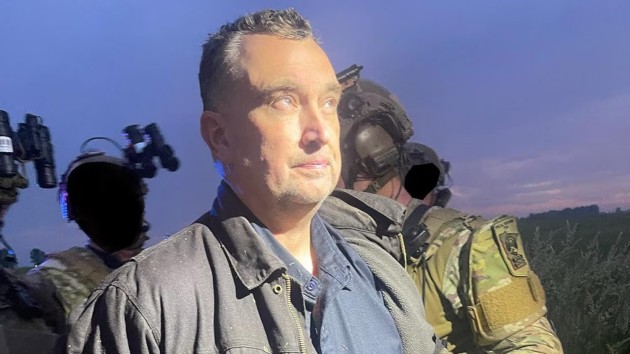
American Kielce Gussie, who works as a journalist at Vatican News, did the first reading in English — several verses from the Acts of the Apostles — at the funeral of Pope Francis. Image via ABC News.

(ROME) — American Kielce Gussie, who works as a journalist at Vatican News, did the first reading in English — several verses from the Acts of the Apostles — at the funeral of Pope Francis on Saturday.

Gussie, originally from Florida, completed her undergraduate degree in theology at Mount St. Mary’s University.

The university featured her in an article in March 2019, saying that she planned on incorporating her faith with media.

“While in Rome, Gussie will pursue an internship with either EWTN or Catholic Bytes,” Mount St. Mary’s University said in 2019. “After completing her Licentiate, she hopes to continue working in Rome with a Catholic media company. Her goal is to incorporate her Catholic faith with media directed toward youth evangelization. Assistant Professor of Communication Mary Catherine Kennedy, Ph.D., is confident that Gussie will succeed. ‘Kielce is a go-getter. She came to the Mount with an idea of what she wanted to pursue after graduation,’ Kennedy said. She has paired her communication classes with her theology classes to pursue work in the Church. Her ambition and desire to serve others is spectacular, and I expect her to do well in her graduate studies in Rome.'”

Copyright © 2025, ABC Audio. All rights reserved.
American Kielce Gussie does 1st reading at Pope Francis’ funeral

American Kielce Gussie does 1st reading at Pope Francis’ funeral
American Kielce Gussie, who works as a journalist at Vatican News, did the first reading in English — several verses from the Acts of the Apostles — at the funeral of Pope Francis. Image via ABC News.

(ROME) — American Kielce Gussie, who works as a journalist at Vatican News, did the first reading in English — several verses from the Acts of the Apostles — at the funeral of Pope Francis on Saturday.

Gussie, originally from Florida, completed her undergraduate degree in theology at Mount St. Mary’s University.

The university featured her in an article in March 2019, saying that she planned on incorporating her faith with media.

“While in Rome, Gussie will pursue an internship with either EWTN or Catholic Bytes,” Mount St. Mary’s University said in 2019. “After completing her Licentiate, she hopes to continue working in Rome with a Catholic media company. Her goal is to incorporate her Catholic faith with media directed toward youth evangelization. Assistant Professor of Communication Mary Catherine Kennedy, Ph.D., is confident that Gussie will succeed. ‘Kielce is a go-getter. She came to the Mount with an idea of what she wanted to pursue after graduation,’ Kennedy said. She has paired her communication classes with her theology classes to pursue work in the Church. Her ambition and desire to serve others is spectacular, and I expect her to do well in her graduate studies in Rome.'”

Copyright © 2025, ABC Audio. All rights reserved.
Trump DOJ rescinds Biden-era protections for news media

Trump DOJ rescinds Biden-era protections for news media
Anna Moneymaker/Getty Images

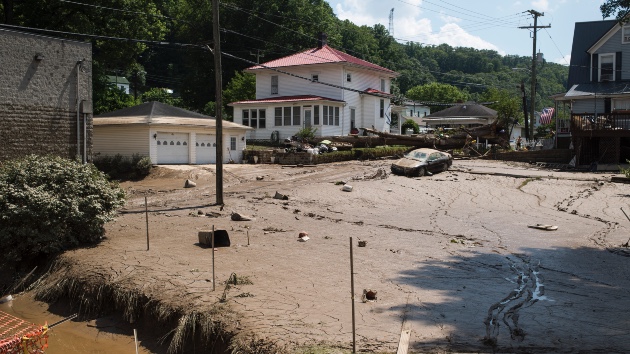
(WASHINGTON) — The Justice Department has rescinded a policy implemented during the Biden administration that restricted prosecutors from seizing reporters’ records in criminal investigations, according to an internal memo obtained by ABC News.

The move could signal a broader effort by Trump-appointed leadership to more aggressively pursue leaks coming from within the administration and directly target journalists for their reporting.

It was not immediately clear whether the impending policy change was prompted by any current ongoing investigation being pursued by the Trump Justice Department. But in her memo rescinding the policy, Attorney General Pam Bondi pointed to recent alleged leaks of potentially classified information to The New York Times.

“Federal government employees intentionally leaking sensitive information to the media undermines the ability of the Department of Justice to uphold the rule of law, protect civil rights, and keep America safe. This conduct is illegal and wrong, and it must stop,” Bondi said. “Therefore, I have concluded that it is necessary to rescind (former Attorney General) Merrick Garland’s policies precluding the Department of Justice from seeking records and compelling testimony from members of the news media in order to identify and punish the source of improper leaks.”

Bondi added she has directed the DOJ’s Office of Legal Policy to publish new language that reflects the department “will continue to employ procedural protections to limit the use of compulsory legal process to obtain information from or records of members of the news media, which include enhanced approval and advance-notice procedures.”

“These procedural protections recognize that investigative techniques relating to newsgathering are an extraordinary measure to be deployed as a last resort when essential to a successful investigation or prosecution,” Bondi said.

The 2022 Biden-era policy was formalized following extensive negotiations between news outlets and Justice Department leadership under Garland. It restricted prosecutors from using “compulsory process” such as subpoenas, search warrants or other court orders to seize reporters’ records with very limited exceptions.

It was implemented after the department disclosed several instances during the previous Trump administration where prosecutors secretly obtained records from several journalists from The New York Times, The Washington Post and CNN as part of criminal leak investigations.

“Because freedom of the press requires that members of the news media have the freedom to investigate and report the news, the new regulations are intended to provide enhanced protection to members of the news media from certain law enforcement tools and actions that might unreasonably impair news gathering,” Garland said in a statement announcing the revised media guidelines.

Last month, Deputy Attorney General Todd Blanche announced the opening of a criminal investigation into the leak of an intelligence document reported by The New York Times related to the Tren de Aragua gang that he described as “inaccurate, but nevertheless classified.”

Department of Homeland Security Secretary Kristi Noem has also said her department and the FBI are pursing criminal charges against officials who she said have leaked details about pending deportation operations to members of the media.

Prior to his confirmation as FBI director, Kash Patel said in several media appearances that the Trump administration would “come after” journalists who reported on President Donald Trump’s 2020 election loss.

“We’re going to come after the people in the media who lied about American citizens, who helped Joe Biden rig presidential elections,” Patel said in a 2023 podcast interview with Steve Bannon. “Whether it’s criminally or civilly, we’ll figure that out.”

The policy shift also comes as DOJ and FBI leadership have downplayed recent revelations of senior Trump officials sharing sensitive details about military operations in Yemen over the encrypted app Signal, which national security experts have argued likely included classified information that would normally prompt some kind of federal investigation.

Bondi signaled late last month that any criminal investigation into the matter was unlikely.

Copyright © 2025, ABC Audio. All rights reserved.
‘No one is above the law’: AG Bondi blasts judges accused of helping undocumented immigrants evade arrest

‘No one is above the law’: AG Bondi blasts judges accused of helping undocumented immigrants evade arrest
amphotora/Getty Images

(MILWAUKEE) — The federal government announced two separate arrests Friday of a current judge and a former judge alleged to have assisted undocumented immigrants who authorities claim were violent criminals, moves that have raised red flags among Democrats and others.

Milwaukee County Circuit Judge Hannah Dugan was arrested Friday by the FBI over allegedly helping an undocumented immigrant evade arrest last week. Her arrest took place hours after federal authorities arrested former New Mexico Judge Joel Cano and his wife Nancy Cano for allegedly housing a Venezuelan national with reported gang ties, Attorney General Pam Bondi said.

Bondi spoke with ABC News Live’s Kyra Phillips Friday afternoon to discuss the cases and dismissed critics who accused the Trump administration of intimidating judges who oppose their crackdown on undocumented immigrants.

“Nobody is above the law, not even a judge,” Bondi told Philips.

FBI Director Kash Patel announced Judge Dugan’s arrest earlier Friday in a social media post, which was briefly deleted and reposted.

“Just NOW, the FBI arrested Judge Hannah Dugan out of Milwaukee, Wisconsin on charges of obstruction — after evidence of Judge Dugan obstructing an immigration arrest operation last week,” Patel said in the new post. “We believe Judge Dugan intentionally misdirected federal agents away from the subject to be arrested in her courthouse, Eduardo Flores Ruiz, allowing the subject — an illegal alien — to evade arrest.”

Dugan was charged with two criminal counts of “obstructing and impeding a proceeding before a department or agency of the United States” and “concealing an individual to prevent his discovery and arrest,” according to a criminal complaint unsealed Friday.

County court records show the undocumented immigrant in the Milwaukee case — Eduardo Flores-Ruiz — was set to appear in court on April 18 before Dugan for a pretrial conference in a case where he has been charged with three misdemeanor counts of battery/domestic abuse connected to an incident on March 12. The case is ongoing.

Federal prosecutors allege Flores-Ruiz illegally entered the U.S. from Mexico and was issued an Expedited Removal order in January 2013, according to a criminal complaint.

Bondi alleged that Flores-Ruiz beat his roommate and a woman so badly that they needed to be hospitalized and that he continued to be belligerent in the hospital before his arrest.

According to the complaint, Dugan allegedly sought to help Flores-Ruiz evade arrest by federal officers from an ICE task force.

When Judge Dugan learned ICE officers were present in court to arrest Flores-Ruiz, she became “visibly angry” and said the situation was “absurd” before leaving the bench and entering her chambers, according to the complaint, which cited witnesses who spoke to the FBI.

Dugan and another unidentified judge then allegedly approached the arrest team in the public hallway, according to the complaint. She was “visibly upset and had a confrontational, angry demeanor” and asked one of the officers whether they were present for a court appearance, the complaint alleged.

When the officer replied they were there to make an arrest, the complaint alleges Judge Dugan asked if they had a judicial warrant, to which the officer responded, “No I have an administrative warrant.”

Multiple witnesses cited in the complaint later allegedly said Judge Dugan returned to her courtroom after directing members of the arrest team to the office of the court’s chief judge.

“The courtroom deputy then saw Judge DUGAN get up and heard Judge DUGAN say something like ‘Wait, come with me,'” the complaint states. “Despite having been advised of the administrative warrant for the arrest of Flores-Ruiz, Judge DUGAN then escorted Flores-Ruiz and his counsel out of the courtroom through the ‘jury door,’ which leads to a nonpublic area of the courthouse.”

“So she continues, continues with her docket, finishes her docket. Two victims sit in court all morning long waiting and at the end. The prosecutors say ‘What happened? Why didn’t the case get called?'” Bondi said.

A DEA agent saw Flores-Ruiz and his attorney in the public hallway of the courthouse and he appeared to be making efforts to evade arrest, the complaint says. After he was encountered by FBI and DEA agents outside the building, Flores-Ruiz “turned around and sprinted down the street” before he was ultimately apprehended, according to the complaint.

Dugan was arrested Friday morning at the courthouse, a law enforcement official confirmed to ABC News.

She appeared in U.S. District Court for the Eastern District of Wisconsin on Friday on the two charges, but did not enter a plea. She was released on her own recognizance.

Dugan retained former United States Attorney Steven Biskupic to represent her and he said in a statement that the judge will “defend herself vigorously and looks forward to being exonerated.”

“Judge Hannah C. Dugan has committed herself to the rule of law and the principles of due process for her entire career as a lawyer and a judge,” Biskupic said in a statement.

If convicted on the charges, Dugan could face up to six years in prison.

Bondi responded to the statement by stating that everyone is entitled to their day in court but reiterated that so are victims of crimes.

“They didn’t get it because she let a criminal defendant walk out a door. She helped them. She obstructed justice,” Bondi told Phillips.

Judge Dugan’s arrest angered Milwaukee Mayor Cavalier Johnson, who accused the federal agents of “showboating” and contended Dugan was not a flight risk.

“They’re just trying to have this show of force and in the process of a courthouse where people need to go for court proceedings, they’re scaring away people from participating in the court process,” the mayor told reporters.

Wisconsin Gov. Tony Evers, in a statement on Friday afternoon, criticized President Donald Trump and the White House for what he said were efforts “to attack and attempt to undermine our judiciary at every level.”

Evers said he would continue to have faith in the justice system “as this situation plays out in the court of law.” He did not mention Dugan by name.

In an interview Friday, Phillips asked AG Bondi if she thought the government’s actions were intimidating people in the court system, but she dodged the question.

“We’re attempting to protect citizens, make America safe again,” she said.

Bondi brought up the New Mexico case, where former Judge Joel Cano faces a charge of tampering with evidence.

Court documents allege that on Feb. 28, an alleged Venezuelan Tren de Aragua gang member was arrested at the Canos’ residence.

On April 24, agents served a search warrant at their residence and conducted an interview with Cano where he admitted to destroying a cell phone that belonged to the alleged gang member by smashing it with a hammer and throwing it in the trash, according to the complaint and Bondi.

“Cano stated that he destroyed the cellphone and further admitted that he believed the cellphone contained photos or videos that would reflect negatively on Ortega,” the complaint states. “Through further questioning, agents ascertained that … Cano destroyed the cellphone believing that it contained photographs of Ortega holding firearms that Ortega had uploaded onto social media platforms which would be additional incriminating evidence against him.”

Cano and his wife have not yet entered pleas in their cases, according to court records, and did not immediately have defense attorneys listed for them.

Bondi reiterated that the immigrants connected to the judges were allegedly violent.

Phillips again pushed Bondi about the arrests, asking if there was concern that the federal government was just going after judges, but the AG maintained that the charges were serious.

“Those are the people that have to be arrested and taken out of our country. Doesn’t matter who you are, no one can harbor them, not even a judge,” she said.

Phillips questioned how far the government was willing to go to arrest undocumented immigrants, and if that meant that mayors and governors could be targeted.

Bondi appeared to dodge the question and reiterated that the administration’s goal is to keep people safe.

“I would hope a mayor, I would hope a governor would never harbor anyone,” she said.

Copyright © 2025, ABC Audio. All rights reserved.

IDF investigation finds Israeli tank fire responsible for death of UN staffer

IDF investigation finds Israeli tank fire responsible for death of UN staffer
Anadolu via Getty Images

(GAZA) — Initial findings in an ongoing Israel Defense Forces investigation found that Israeli tank fire caused damage to a United Nations structure in central Gaza in March, killing one UN staffer and injuring five others.

The incident occurred one day after the ceasefire collapsed, according to a release from the IDF on Thursday. The IDF said it attacked the structure because of “suspicions of enemy presence.”

UN staffer Marin Marinov was killed in the Deir al Balah strike, UN Secretary General Deputy spokesperson Farhan Haq told ABC News in an email in March.

The injured staffers were Neil Arnold, Joel Fournet, Nicolas Berthon, Alexandru Baban and David Petrov, Haq said.

The IDF initially denied involvement in the strike, saying it “did not strike a UN compound in Deir al Balah.” On Thursday, it apologized for “the unintentional harm to the UN employee and share the grief of the family.”

“The IDF continues to conduct thorough investigation processes in order to draw lessons and examine additional steps to prevent incidents of this type,” it said. “The IDF sees great importance in continuing the dialogue with international organizations, as part of efforts to coordinate, draw lessons, and prevent similar incidents in the future.”

The UN has opened its own fact-finding mission to learn more surrounding the circumstances of the strike.

Jorge Moreira da Silva, UN under-secretary-general and UNOPS executive director, responded to the IDF’s latest statement on the incident, saying: “We acknowledge the reported initial findings of the Israeli Defense Forces today that a tank round was the cause of the death of a UNOPS colleague in Deir al Balah. This is consistent with known facts to the UN: this incident was a result of a tank round into a fully deconflicted UNOPS premises. Full accountability must be ensured with respect to the grave violations of international law that have been committed.”

A week after the incident, the UN said it was “comfortable with the assertion” that rounds were fired by an Israeli tank during its initial gathering of security information, Haq told ABC News last month.

The UN secretary general announced that the organization planned to “reduce the Organization’s footprint in Gaza” on March 24, four days after the strike.

“In the past week, Israel carried out devastating strikes on Gaza, claiming the lives of hundreds of civilians, including United Nations personnel, with no humanitarian aid being allowed to enter the Strip since early March,” Stephane Dujarric, a spokesperson for UN secretary general, said in a statement in March. “As a result, the Secretary-General has taken the difficult decision to reduce the Organization’s footprint in Gaza, even as humanitarian needs soar and our concern over the protection of civilians intensifies.”

The Israeli government has blocked the delivery of all goods, food and medical supplies into Gaza for more than eight weeks. Israeli Prime Minister Benjamin Netanyahu said he was blocking aid because Hamas refused to release more hostages in an extension of the U.S.-brokered ceasefire. Fifty-eight hostages remain in Gaza since Oct. 7, 2023.

The March 19 strike brought the number of UN staff members killed in Gaza since Hamas’ surprise attack on southern Israel on Oct. 7, 2023, to 280 people, the UN secretary general said in March.

The March UN building strike is one of several incidents where the IDF has acknowledged accountability.

It recently took responsibility for misidentifying targets and firing on a convoy of emergency medical vehicles on March 23, killing 15 medical and humanitarian workers.

It’s unclear from the IDF if any Israeli soldiers will be held accountable for deadly UN strike.

Copyright © 2025, ABC Audio. All rights reserved.
‘Conclave’ author explains secretive Vatican process after Pope Francis’ death

‘Conclave’ author explains secretive Vatican process after Pope Francis’ death
Max Cisotti/Dave Benett/Getty Images, FILE

(NEW YORK) — With Pope Francis’s funeral drawing more than 200,000 expected attendees on Saturday, interest in the papal succession process has intensified. It’s driving viewers to the film “Conclave” — based on the Robert Harris novel of the same name.

The Oscar-winning 2024 movie, which explores the secretive process of selecting a new pope, has seen a surge in viewership following the pontiff’s death. Speaking to ABC News on Friday, Harris compared himself to “one of those people who writes a Christmas hit and then it just keeps coming round and round again.”

Harris described the papal conclave as “the most extraordinary event, centuries old, steeped in mystique and secrecy… a psychological contest that produces the leader of 1.4 billion Catholics worldwide.”

Drawing from historical precedent, Harris noted the unpredictable nature of papal selection.

“Anyone who thinks they can predict the outcome of a conclave is a fool,” he said, explaining that frontrunners often face challenges.

He cited the 2005 conclave that saw Cardinal Ratzinger become Pope Benedict as an example, where there was “an attempt to block him.” During that conclave, the liberal candidate who was expected to challenge Ratzinger “failed in the early ballots. This led that candidate’s supporters to back Cardinal Bergoglio, who lost on that occasion but was elected as Pope Francis in 2013.

“The moment I came across that story, I realized here are three characters now: the conservative, the liberal whose time has passed, and the outsider who people are ready to rally behind,” Harris explained.

The voting process requires a two-thirds majority, with two votes in the morning and two in the afternoon.

“It’s in those times [between votes] that almost inevitably, they talk about what is happening,” Harris said, offering rare insight into the deliberation process.

He noted that these breaks for lunch and evening provide crucial opportunities for “wheeling and dealing.”

Harris, who conducted extensive research, including conversations with cardinals who participated in previous conclaves. “Conclave” follows the dean of the College of Cardinals, played by Ralph Fiennes in the movie.

“A decent man but who is having doubts, and he has to struggle with his own spiritual doubts as he has to organize this huge election,” Harris said.

The author believes the current speculation about the next pope’s identity will likely miss the mark, noting that Pope Francis was “completely off the radar at the last conclave, and nobody tipped him as the likely winner, even though he’d been the runner up the previous conclave.”

Harris observed that the media often lags behind actual developments behind the closed doors of the conclave, saying reporters outside are “always predicting the man who’s just been knocked out.”

“I hope they get a better sense of how a conclave operates,” Harris said of viewers discovering his work. He emphasized that his portrayal aimed to be “more sympathetic than a lot of media portrayals of the Catholic Church.”

Copyright © 2025, ABC Audio. All rights reserved.

George Santos sentenced to over 7 years in federal fraud case

George Santos sentenced to over 7 years in federal fraud case
Michael M. Santiago/Getty Images

(NEW YORK) — Disgraced former U.S. Rep. George Santos was sentenced to more than seven years in federal prison — the maximum he faced — on Friday after pleading guilty to a series of fraudulent schemes.

U.S. District Judge Joanna Seybert sentenced him to 87 months in prison, followed by two years of supervised release.

A tearful Santos told the judge he regrets defrauding the voters who supported his 2022 run for Congress before she handed down the sentence.

“My conduct betrayed my supporters and the institutions I swore to uphold,” he said during his sentencing hearing in a New York federal court.

He began to cry and struggled to get out the words as he tried to express remorse for the crimes he committed.

“I undermined the faith in the very institutions I swore to uphold,” he said. “I cannot rewrite the past but I can control the road ahead.”

He urged Seybert to impose a lenient sentence, arguing he can positively contribute to the community he “robbed.”

Judge rebukes Santos’ repeated lies

Santos, 36, was convicted of wire fraud and aggravated identity theft. He faced a sentence of 75 to 87 months imprisonment, including a mandatory minimum two-year sentence for aggravated identity theft.

Santos did not take any questions from reporters as he arrived at federal court in Central Islip for the Friday morning sentencing hearing.

His attorney, Andrew Mancilla, described his client’s conduct bluntly, arguing the former congressman is “forever stained” by his actions.

“Everyone hates George Santos,” Mancilla told the court ahead of the sentencing, claiming his client is not the “caricature drawn by the media.”

“He is a 36-year-old gay man with no criminal record who came from a broken family,” Mancilla said. “He built this ego of a man he wanted to be, not who he was.”

But prosecutors argued Santos has shown little remorse for his crimes, has blamed the Department of Justice and committed an “unprecedented” series of crimes.

“He has committed crime after crime after crime,” Assistant U.S. Attorney Ryan Harris said. “He has repeatedly proven he is unable to tell the truth.”

Harris rebuked Santos for suggesting the prosecution was politically motivated and argued the former congressman has demonstrated a “genuine lack of contrition.”

“This case is not the product of so-called lawfare. It is the result of years and years of deceit,” he said.

Seybert agreed, calling out Santos for his repeated lies and lack of remorse.

“It’s incredible that he did not stop with the lies,” she said. “It’s incredible now that he tries to blame the government.”

Before imposing her sentence, Seybert noted she has “sympathy” for Santos, believes he is a talented man and hopes he will eventually contribute to society.

“Mr. Santos, words have consequences,” she said, noting the same words that won him a seat in Congress landed him in court.

“You have a future, and I am sad to say in one sense that it is going to be shortened by the sentence I am about to impose,” she added.

As the sentence was read, Santos covered his face with his hands.

He was not immediately remanded and will report to prison at a future date.

Prosecutors highlight ‘social media blitz’

In a court filing ahead of Friday’s sentencing hearing on Long Island, federal prosecutors requested the maximum possible sentence — amounting to seven years and three months — calling his conduct a “brazen web of deceit” that defrauded donors and misled voters.

They also argued the former New York congressman’s recent “social media blitz” shows he “remains unrepentant for his crimes” in a subsequent filing. In one example, prosecutors pointed to an April 4 post on Santos’ X account that stated, “No matter how hard the DOJ comes for me, they are mad because they will NEVER break my spirit.” The post was made the same day the DOJ filed its initial sentencing recommendation.

Santos, meanwhile, insisted in a letter to Seybert this week that he has “accepted full responsibility” for his crimes. He said he can be both “profoundly sorry” and upset by the Justice Department’s recommendation of a lengthy prison sentence.

“But saying I’m sorry doesn’t require me to sit quietly while these prosecutors try to drop an anvil on my head. True remorse isn’t mute; it is aware of itself, and it speaks up when the penalty scale jumps into the absurd,” Santos’ letter said.

Santos included a selective chart to suggest the government’s sentencing recommendation is out of step with other political prosecutions, citing former Illinois Rep. Jesse L. Jackson Jr. being sentenced to 30 months for misusing $750,000 in campaign funds or ex-New York Rep. Michael Grimm being sentenced to eight months for concealing $900,000 in wages and taxes.

Santos had asked for a two-year prison sentence.

Former campaign treasurer set to be sentenced

Prosecutors alleged Santos, with the help of his former campaign treasurer, Nancy Marks, falsified Federal Election Commission filings, fabricating donor contributions and inflating fundraising totals to meet the $250,000 threshold required to join the National Republican Congressional Committee’s coveted “Young Guns” program.

Marks pleaded guilty to a federal conspiracy charge in 2023 and is awaiting sentencing in May.

Santos pleaded guilty in August 2024. The Republican was expelled from Congress in December 2023.

As part of his plea deal, he agreed to pay nearly $600,000 in restitution and forfeiture.

The judge agreed to delay Santos’ sentencing, which had initially been scheduled for Feb. 7, after Santos asked for more time to make money off of his podcast to satisfy his restitution and forfeiture.

Members of the Concerned Citizens of NY-03, an organization formed in 2023 by voters from across the region Santos once represented in response to his actions, spoke out following the hearing.

“My reaction in sitting in the courtroom was, ‘Cry me a river,’ when he got that sentence,” Jody Kass Finkel, the head of Concerned Citizens of NY-03, said outside the courthouse. “He has betrayed the public trust.”

Copyright © 2025, ABC Audio. All rights reserved.