(WASHINGTON) — The Supreme Court on Wednesday upheld a Tennessee law banning certain gender-affirming care treatment for minors.
The court ruled 6-3, with Chief Justice John Roberts authoring the opinion. The court’s three liberal justices dissented.
The decision in the case, U.S. v. Skrmetti, is one of the most significant LGBTQ rulings to come from the Supreme Court and marks the first time the justices have weighed in on an anti-trans state law.
“This case carries with it the weight of fierce scientific and policy debates about the safety, efficacy, and propriety of medical treatments in an evolving field,” Roberts wrote. “The voices in these debates raise sincere concerns; the implications for all are profound.”
The chief justice wrote that the court’s majority found the Tennessee law did not violate the equal protection guarantee of the Fourteenth Amendment, and it was leaving “questions regarding its policy to the people, their elected representatives, and the democratic process.”
“The Equal Protection Clause does not resolve these disagreements. Nor does it afford us license to decide them as we see best. Our role is not “to judge the wisdom, fairness, or logic” of the law before us … but only to ensure that it does not violate the equal protection guarantee of the Fourteenth Amendment,” he wrote.
Tennessee is one of 24 states with laws in effect banning all gender-affirming care for transgender minors.
There are 1.6 million Americans over 13 who identify as transgender, including an estimated 300,000 ages 13-17. A third of those people live in states that ban gender-affirming care, according to the Williams Institute at UCLA.
Roberts rejected arguments by a group of transgender teenagers and their parents that denying the kids access to puberty blockers and hormone therapy amounts to sex discrimination.
He said the playing field is level for all under Tennessee’s law, SB1: “No minor may be administered puberty blockers or hormone therapy to treat gender dysphoria,” he wrote.
Justice Sonia Sotomayor read her dissent from the bench, sharply disagreeing with the majority’s ruling.
The decision “invites legislatures to engage in discrimination,” she wrote. It will “authorize untold harm to transgender children and parents and families who love them.”
“By retreating from meaningful judicial review exactly where it matters most, the Court abandons transgender children and their families to political whims. In sadness, I dissent,” she wrote.
ACLU attorney Chase Strangio was the first openly transgender person to argue a case before the Supreme Court in Skrmetti. He called the decision a “devastating loss.”
“Though this is a painful setback, it does not mean that transgender people and our allies are left with no options to defend our freedom, our health care, or our lives,” Strangio said. “The Court left undisturbed Supreme Court and lower court precedent that other examples of discrimination against transgender people are unlawful. We are as determined as ever to fight for the dignity and equality of every transgender person and we will continue to do so with defiant strength, a restless resolve, and a lasting commitment to our families, our communities, and the freedom we all deserve.”
This is a developing story. Please check back for updates.
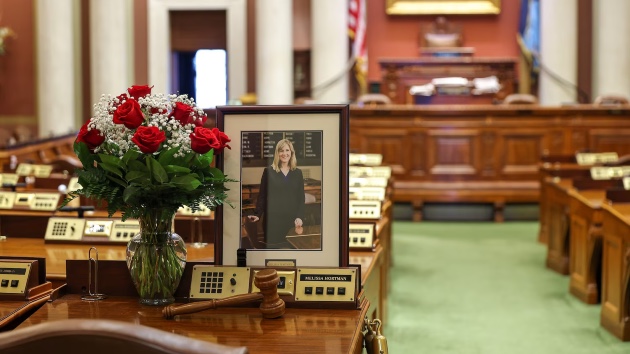
A memorial is seen on the desk of DFL State Rep. Melissa Hortman in the House chambers at the Minnesota State Capitol/Steven Garcia/Getty Images
(GREEN ISLE, Minn.) — Vance Boelter was preoccupied with societal problems and how he could fix them to serve the greater good, according to some of his previous writings and the man who worked with Boelter for more than a decade doing web design for a series of his projects.
Before allegedly carrying out a “political assassination” on Saturday, Boelter was “clearly very religious, very passionate,” and “devout, and sincere in his beliefs,” said Charlie Kalech, CEO of the web design firm J-Town, commissioned by Boelter. But at that time, Boelter appeared to show no signs of the violent extremism of which he’s now accused, Kalech said.
Boelter is charged with killing Democratic Minnesota state Rep. Melissa Hortman and her husband, Mark, and wounding Democratic state Sen. John Hoffman and his wife. Allegedly posing as a police officer over Father’s Day weekend, authorities said Boelter “shot them in cold blood” in an alleged early-morning rampage that launched a two-day manhunt.
However, in the preceding years, Boelter seemed like a hard worker striving to make his ideas real, and sometimes, struggling to make ends meet. His fervent personality frothed with big, civic-minded ideas on how to “make the world a better place,” Kalech said. In the professional relationship they had, Boelter was clearly “idealistic.”
“I think he sincerely believed in the projects that we worked on, that he was acting for the greater good,” Kalech told ABC News. “I certainly never got the impression he saw himself as a savior. He just thought of himself as a smart guy who figured out the solution to problems, and it’s not so difficult – so let’s just do it. Like a call to action kind of person.”
Most of those grand-scale projects never came to fruition, and the last time Kalech said he had contact with Boelter was May 2022. But in planning documents and PowerPoint presentations shared with ABC News, which Kalech said Boelter wrote for the web design, Boelter detailed lengthy proposals that expressed frustration with what he saw as unjust suffering that needed to be stopped. Some of those projects were also sweeping, to the point of quixotic — even for the deepest-pocketed entrepreneur.
Boelter first reached out to Kalech’s firm for a book he had written, “Revoformation,” which Kalech took to be a mashup between “revolution” and “reformation.” It’s also the name of the ministry Boelter had once tried to get off the ground, according to the organization’s tax forms.
“It seemed to me like maybe he volunteered more than what was good for him. In other words, he gave too much away instead of worrying about earning money, because he didn’t always have money,” Kalech said. “It was never clear to me if the ministry really existed. Are there congregants? Is there a constituency? I don’t know. Or was it like something in his head that he was trying to make? That was never clear to me.”
Kalech recalled that Boelter chose his firm for the work because they are Jerusalem-based, and he wanted to support Israel.
Boelter’s interest in religion’s impact on society is reflected in a “Revoformation” PowerPoint that Kalech said Boelter gave him, dated September 2017.
“I am very concerned that the leadership in the U.S. is slowly turning against Israel because we are losing our Judaic / Christian foundations that was [sic] once very strong,” the presentation said. “I believe that if the Christians are united and the people who are leading this Revoformation are a blessing to Israel that it will be good for both Israel and the U.S.”
Over the years, Boelter would reach out with what appeared to be exponentially ambitious endeavors, Kalech said: “What he wanted to take on, I think, might have been bigger.”
Boelter wanted to end American hunger, according to another project’s PowerPoint. And while the idea would require massive changes to current laws and food regulation, it appeared Boelter dismissed that as surmountable if only elected officials could get on board.
“American Hunger isn’t a food availability problem,” the presentation said. “American Hunger is a tool that has been used to manipulate and control a vast number of American’s [sic], with the highest percentage being people of color. This tool can and should be broken now, and failure to do so will be seen as intentional criminal negligence by future generations.”
“We should be embarrassed as a nation that we let this happen and have not correctly [sic] this injustice 100 years ago,” one slide said.
One slide described how his own lived experience informed his idea, referring to him in the third person: “several times in his life Vance Boelter was the first person on the scene of very bad head on car accidents,” and that he was able to help “without fear of doing something wrong” because he was “protected” by Good Samaritan law – which could and should be applied to food waste, the slide said.
To keep an eye on which lawmakers supported the necessary legislation, “there needs to be a tracking mechanism,” the presentation said, where citizens could “see listed every singe [sic] elected official and where they stand on the Law (Food Providers Good Samaritan Law).”
“Those few that come out and try to convince people that it is better to destroy food than to give it away free to people, will be quickly seen for who they are. Food Slavers that have profited off the hunger of people for years,” the 18-slide, nearly 2,000-word presentation said.
“At least in his mind and on paper, he was solving problems,” Kalech told ABC News. “He would think about things and then have a euphoric moment and write out a manifesto of, How am I going to solve this? And then bring those thoughts to paper and bring that paper to an action plan and try to implement it.”
The last project Kalech said Boelter wanted to engage him for was a multifaceted collection of corporations to help start-up and expanding businesses in the Democratic Republic of Congo, all under the umbrella “Red Lion Group.”
The 14-page, over 6,000-word planning document for the project outlined ideas for what Red Lion Group would offer: ranging widely from “security services” to agricultural and weapons manufacturing sectors, medical supplies, investment services, martial arts, oil and gas and waste management. Red Lion would also serve in media spaces: with “CONGOWOOD” Film Productions “to be what Hollywood is to American movies and what Bollywood is to Indian movies.”
Boelter was to have a 49% minority ownership of the group, with a business partner owning 51%.
“The Africa thing, the Red Lion thing, we didn’t really get into it, because it became pretty apparent pretty soon that he just didn’t have the funds to go ahead,” Kalech said – at least, as far as his web design services were concerned.
“He was interested in doing good,” Kalech said. “But moderation in all things, and when good becomes extreme, it actually becomes bad,” adding that hurting anyone crosses a “red line.”
“The question one keeps coming back to is – what makes the seesaw tip? Like, he’s good, he’s good, he’s good, he’s acting for the greater good, he has all these good ideas, he’s trying to engage community, serving on a government committee, he’s engaging churches and places of worship, and then something happens, and he goes ballistic,” Kalech said.
“Who would do that? Someone who’s absolutely desperate, just seeing that there’s no other choice. That’s the only thing I can imagine. But look, obviously someone like this is not operating on the same frequency as we are,” Kalech said. “They’re blinded by their faith, or their beliefs. And, you know, especially something like murder, it’s so ironic, because that’s one of the big 10.”
Jackie Talarico said she grew tired of being harmed by her home. Now, the Navy wife says she is taking her former landlords to court.
“Our houses are not our safe place,” said Talarico. “We were told there was no mold in our house. We were told there was no lead. We were told there is no asbestos, and they lied.”
Talarico used to live in privatized military housing while her husband, a U.S. Navy cryptologic technician, was stationed at Naval Air Station Key West in Florida.
Talarico documented issues from mold to water damage, and said the ceiling collapsed in her child’s bedroom. Once repaired, Talarico said it began to cave in again.
The Talaricos and nearly 200 current and former tenants in the Florida Keys are now suing Balfour Beatty, one of the largest privatized military housing providers in the United States. The lawsuit alleges Balfour Beatty “systematically failed to properly repair and remediate significant problems in the homes, including water damage, mold, structural defects, HVAC, plumbing issues, electrical problems and the presence of lead paint and asbestos.””We are aware of the lawsuit and intend to defend ourselves vigorously,” Balfour Beatty Communities said in a statement to ABC News.
A spokesperson for Balfour Beatty Communities said, “The health, safety, and well-being of our residents is our top priority. NAS Key West’s climate creates an environment that is more conducive to mold growth than other areas of the country.”
In 2021, Balfour Beatty pleaded guilty to fraud in a federal case, accused of falsifying maintenance records of military housing, having to pay more than $65 million after prosecutors said they “lied about the repairs to pocket millions of dollars in performance bonuses” from the military.
The current case from Key West involves one of the 14 current private-sector military housing providers across the U.S. According to the Military Housing Association, currently about 99% of military family housing in the United States is owned and operated by private companies.
“Our servicemembers give so much every day and put so much on the line for our country, one thing they should not have to sacrifice is their children and their families’ life, health and safety when they do that every day for the rest of America,” Talarico said.
Talarico joined other military wives on Capitol Hill in April to advocate for a Senate bill that would conduct studies on the health effects of mold growth in military installations.
“My number one fear throughout this has always been my husband’s career,” said Talarico. “Luckily his command has been nothing but supportive.”
When the Department of Defense decided to get out of the housing business in 1996, it received Congressional approval to engage private investors with expertise to renovate or replace old, inadequate housing, establishing the Military Housing Privatization Initiative (MHPI). The contracts were often decadeslong to incentivize the massive undertaking, according to congressional research. Since the implementation during the defense cuts of 1996, some housing conditions have seemingly deteriorated, sparking Senate hearings in 2019 for reforms.
The Department of Defense’s inspector general acknowledged in a 2024 report that mismanagement of living facilities, including reports of environmental hazards, such as mold, could impact the health and readiness of the military, including recruitment and retention, across all types of military housing.
The report cited GAO’s 2023 findings that the DoD has taken steps “to increase assistance to residents of privatized housing, ensure the DoD has adequate personnel to conduct oversight activities and improve the Dod’s oversight of the condition of private housing units. However, the GAO found a need for more detailed formal dispute resolution guidance, improved guidance on the role of the tenant advocate, and better oversight of the condition of private housing units.”
In Texas, the house where Lt. Col. Travis Allen previously lived is now unoccupied after mold overtook the property. He served in Iraq in 2007 and is now the chaplain at Joint Base San Antonio-Randolph. He moved his family three years ago.
“This was supposed to be my best assignment,” Allen told ABC News. “This was supposed to be the crowning jewel of my career. To move from the tactical level to the operational level. But immediately, all that excitement about being here was derailed.”
Instead, he says he later found out there were leaking sewage pipes under the home that the housing company, Hunt Military Communities, said it had already repaired.
Allen’s wife, Stacey, and daughter, Sydney, were by his side to address health issues, including visits to specialists who couldn’t understand why they couldn’t control the inflammation and pressure in his eyes.
“So we had the house tested, and that’s when we found out that there was black mold coming through the air ducts,” said Allen. “Green mold in the house, too.”
Environmental consultant Joe Reiss, who tests species of molds though is not involved in any of these cases, told ABC News that this fungus thrives in damp environments and “will look for an opportunistic colony.”
Allen says he has incurred out-of-pocket expenses totaling thousands of dollars. He has now moved his family off base with only the essential clothes and furniture they could salvage from the mold.
Hunt Military Communities said it remains committed to providing affordable, well-maintained housing. “We have rigorous processes in place to thoroughly investigate and address maintenance-related concerns,” it said in a statement to ABC News.
These stories have been repeated with numerous lawsuits nationwide, dating back more than a decade. As a result of the Senate hearings on conditions of MHPI, the National Defense Authorization Act for Fiscal Year 2020 established the Tenant Bill of Rights, which some critics say has not been enforced.
“It’s more like guidelines,” said attorney Ryan Reed, about the MHPI’s implementation of the Tenant Bill of Rights. “If the landlord doesn’t follow it, there’s no meaningful consequence. Many of the rights are written so vaguely that multiple interpretations could be had of what exactly that means.”
Reed said his firm has represented around 150 military families over the last six years in litigation involving their private military housing. He said the problems can be traced back to the Military Housing Privatization Initiative itself.
“At that point, the military was powerless to police their partner,” Reed told ABC News. “They were the minority partner. They were not the expert. And by and large, they just allowed the housing companies to do whatever the housing company said was right.”
Reed said the lack of consensus on how to fix the problem is a larger issue. One of the components in the Tenant Bill of Rights is the formal dispute resolution process.
“What we discover at the end of the day is that process really has no teeth,” said Reed.
The Department of Defense told ABC News it intends to complete reforms and hold private companies accountable for fixing these problems.
“I know firsthand that our warfighters cannot deliver if they are sidelined by problems at home, especially those that can negatively affect health and quality of life,” Assistant Secretary of Defense Dale Marks said in a statement to ABC News. “Secretary Hegseth and I are committed to rebuilding military readiness and appreciate the support from Congressional committees to make much-needed housing reforms.”
“Together, we will complete implementation of these reforms and hold private companies accountable to fixing these problems,” said Marks, who was confirmed in June and will serve as Hegseth’s chief housing official.
Talarico, formerly based at Naval Air Station Key West, Florida, said she wants the failures to be addressed.
Balfour Beatty Communities, which oversees some privatized homes at NAS Key West, told ABC News that they are currently working to install new HVAC systems, among other improvements to vapor barriers and weather sealants to prevent deterioration.
“We understand that residents would like all the older homes at NAS Key West to be extensively renovated or rebuilt, but our joint venture with the Navy does not currently have the funding to undertake such a project,” said a spokesperson for Balfour Beatty Communities. “As funding becomes available, we are committed to working with the Navy to improve aging housing.”
Talarico, Allen and other military families hope additional reforms will provide safe, affordable and accessible housing.
“Housing, shelter, is a war fighter’s basic need,” Allen said. “And for some of us, that need is going unmet and we need help.”
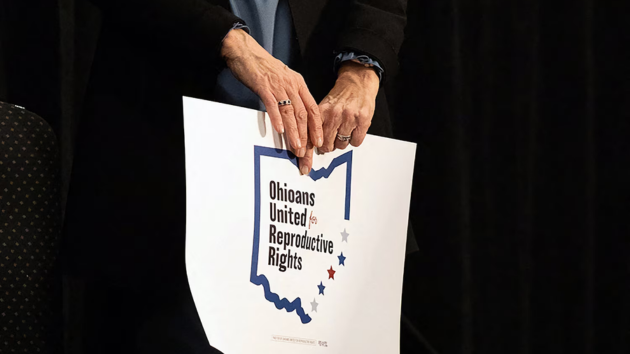
(OHIO) — Republican lawmakers in Ohio are planning on introducing a bill on Wednesday that would ban almost all abortions and criminalize the procedure.
The “Ohio Prenatal Equal Protection Act” would overturn the amendment to the Ohio constitution, voted on in 2023, that establishes “an individual right to one’s own reproductive medical treatment, including but not limited to abortion” before viability.
Reproductive medical treatment includes contraception, fertility treatments and miscarriage care.
Abortions are currently allowed up to 20 weeks since fertilization, according to the Guttmacher Institute, a research group that studies sexual and reproductive rights.
“[It] is a very, very simple and beautiful piece of legislation in that all it does is identify all human beings as persons deserving equal protection of the law, both born humans and pre-born humans,” anti-abortion advocate Austin Beigel, with End Abortion Ohio, told ABC News. “So, it identifies those personhood rights starting at the moment of fertilization, when the new distinct organism is formed, the new human life that being that person now has equal protection under the law.”
Kellie Copeland, executive director of Abortion Forward, which helped pass the 2023 amendment in Ohio, said the bill goes against the will of voters.
“This is the most extreme and anti-life legislation that you can imagine,” she told ABC News. “It would strip Ohioans of their constitutionally guaranteed right to bodily autonomy, and that’s the goal of this legislation.”
When Beigel was asked if he was concerned that the bill may go against the will of the voters, he said he was not because “the will of the voters was evil.”
“In many times in our country’s history, the majority of people have desired evil things. We have discriminated horribly against the Black man and woman, and people wanted that,” he continued. “So, I have no qualms about saying I oppose the majority of the will of the people when the people desire something that is evil.”
Copeland replied that “subjecting people to the loss of bodily autonomy, taking basic human rights away from Ohioans is the real evil that we’re talking about here.”
Beigel said he has been working with Republican state Reps. Levi Dean and Jonathan Newman on the bill, which uses the U.S. Constitution’s equal protection clause — part of the Fourteenth Amendment — to override Ohio’s constitutional amendment. Beigel said the co-sponsors will be announced on Wednesday.
Dean’s and Newman’s offices did not immediately return ABC News’ request for comment.
The bill would ban abortion with no exceptions for rape or incest. The only exceptions would be for a spontaneous miscarriage or to save the life of the pregnant woman.
The bill would also criminalize those who have abortions, not just the providers who perform the procedure.
Copeland she is worried the bill could lead to attacks on people who support abortion rights or who underwent abortions.
“When people equate reproductive health care with murder, that kind of rhetoric invites violence,” Copeland said. “It invites violence that we have seen at abortion clinics that we have seen perpetrated against abortion providers.”
Beigel said the bill does not outlaw contraception and is not designed to outlaw in-vitro fertilization (IVF).
However, he did say that IVF may not be able to function the way that it does now if the bill is passed because it would apply equal protection to “pre-born humans.”
“The courts are going to have to debate the implications of this,” he said. “Is it actually moral to freeze a young human being in a cryochamber and preserve them at the age they are and not let them grow?”
Ohio’s history of abortion bills
In 2019, Ohio lawmakers passed a so-called heartbeat bill that bans abortions after cardiac activity can be detected, which occurs as early as six weeks of pregnancy, before many women know they’re pregnant. It was signed into law by Gov. Mike DeWine.
The ban had no exceptions for rape or incest. The only exceptions were cases of ectopic pregnancies and to prevent the mother’s death or impairment of a major bodily function.
A federal judge blocked the ban in 2019, but it was reinstated just hours after the Supreme Court decision to overrule Roe v. Wade.
Much of the six-week ban was rendered unconstitutional after the amendment went into effect in December 2023, Ohio’s Attorney General Dave Yost said earlier this year.
However, some lawmakers have tried to maintain other parts of the ban, including reporting requirements and a 24-hour waiting period before an abortion can be administered. An Ohio judge temporarily blocked the 24-hour waiting period in August 2024.
(WASHINGTON) — As Israel and Iran continue to trade strikes in the Middle East, lawmakers are set to introduce bills and resolution aimed at preventing the United States from getting involved in Israel’s military campaign against Iran.
While the efforts are in their early stages, the legislation is unlikely to garner sufficient support to override the will of President Donald Trump and his supportive Republican majorities in both chambers of Congress.
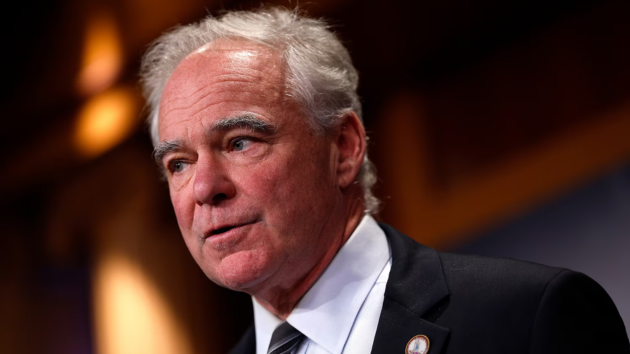
Democratic Sen. Tim Kaine, a member of the Senate Foreign Relations Committee, on Monday introduced a resolution he says will “prevent war with Iran” as he expresses concern at the idea that the U.S may get involved in Israel’s campaign against Iran.
“It is not in our national security interest to get into a war with Iran unless that war is absolutely necessary to defend the United States. I am deeply concerned that the recent escalation of hostilities between Israel and Iran could quickly pull the United States into another endless conflict,” Kaine, D-Va., said. “The American people have no interest in sending service members to fight another forever war in the Middle East. This resolution will ensure that if we decide to place our nation’s men and women in uniform into harm’s way, we will have a debate and vote on it in Congress.”
Separately, Vermont independent Sen. Bernie Sanders introduced the No War Against Iran Act on Monday to “prohibit the use of federal funds for any use of military force in or against Iran absent specific Congressional authorization.” Sanders has several co-sponsors including Democratic Sens. Peter Welch of Vermont, Elizabeth Warren of Massachusetts, Jeff Merkley of Oregon, Chris Van Hollen of Maryland, Ed Markey of Massachusetts, Tammy Baldwin of Wisconsin, and Tina Smith of Minnesota.
“[Israeli Prime Minister Benjamin] Netanyahu’s reckless and illegal attacks violate international law and risk igniting a regional war. Congress must make it clear that the United States will not be dragged into Netanyahu’s war of choice,” Sanders wrote in a statement. “Our Founding Fathers entrusted the power of war and peace exclusively to the people’s elected representatives in Congress, and it is imperative that we make clear that the President has no authority to embark on another costly war without explicit authorization by Congress.”
Senate Majority Leader John Thune avoided saying whether he would put Kaine’s resolution on the Senate floor when asked on Tuesday. He said that any action on the matter would be “getting the cart ahead of the horse,” but that there could be a more “fulsome discussion” later on what the role of Congress should be amid the conflict.
“This is something that’s happened the last few days. I think the President is perfectly within his authority in the steps that he has taken. You know clearly, if this thing were to extend for some period of time, there could be a more fulsome discussion about what the role of Congress should be, and and and whether or not we need to take action,” Thune said.
A resolution is a statement or expression of a sentiment that, if passed, has no legal authority. An act has legal authority, but even if passed by the Republican-controlled Congress, it would have to be signed into law by Trump.
In the House, Kentucky Republican Thomas Massie joined California Democrat Ro Khanna to introduce a bipartisan War Powers resolution on Tuesday meant to ensure that Congress asserts its constitutional authority to declare war under 50 U.S. Code Ch. 33.
“This is not our war. But if it were, Congress must decide such matters according to our Constitution,” Massie said. “I’m introducing a bipartisan War Powers Resolution tomorrow to prohibit our involvement. I invite all members of Congress to cosponsor this resolution.”
Khanna, one of the bill’s initial cosponsors, quote tweeted Massie’s post, calling for “No war in Iran,” and equating the current situation in Iran to Operation Iraqi Freedom, the 2003 invasion of Iraq.
“No war in Iran. It’s time for every member to go on record. Are you with the neocons who led us into Iraq or do you stand with the American people?” Khanna posted. “I am proud to co-lead this bipartisan War Powers Resolution with Rep. Massie that is privileged and must receive a vote,”
Shortly after Massie’s and Khanna’s posts, New York Democratic Rep. Alexandria Ocasio-Cortez and fellow Squad member Rashida Tlaib of Michigan expressed their support for the effort.
Ocasio-Cortez, in a reply to Massie, said that she would be “signing on,” to the resolution.
In her post, Tlaib, said that the American people wouldn’t fall for “it” again, contrasting today’s debate on Iran’s nuclear capabilities to October of 2002, when Congress approved a bipartisan Authorization for the Use of Military Force ahead of the 2003 invasion of Iraq.
“I look forward to supporting this War Powers Resolution. The American people aren’t falling for it again,” Tlaib said. “We were lied to about “weapons of mass destruction” in Iraq that killed millions (plus) forever changed lives. It’s (unconstitutional) for Trump to go to war without a vote in Congress.”
ABC News’ Isabella Murray and John Parkinson contributed to this report.
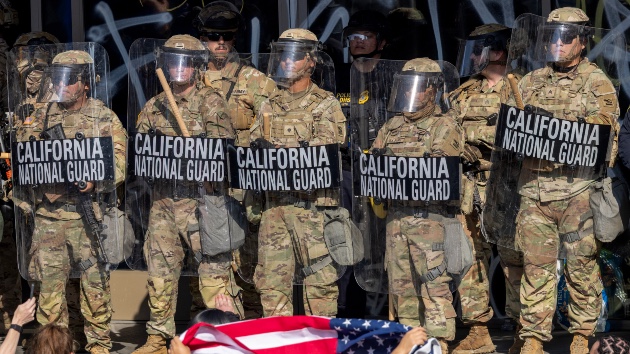
(LOS ANGELES) — The legal battle over the Trump administration’s deployment of the National Guard in California continued in a federal appeals court on Tuesday.
The Ninth Circuit Court of Appeals presided over a remote hearing regarding California’s challenge to President Donald Trump‘s federalization of the state’s National Guard troops amid protests over immigration enforcement in the Los Angeles area.
Meanwhile, Los Angeles Mayor Karen Bass, who had instituted a curfew within downtown LA amid the protests, announced Tuesday she was lifting the measure.
“The curfew, coupled with ongoing crime prevention efforts, have been largely successful in protecting stores, restaurants, businesses and residential communities from bad actors who do not care about the immigrant community,” Bass said in a statement. “I am lifting the curfew effective today, and as we continue quickly adapting to chaos coming from Washington, and I will be prepared to reissue a curfew if needed. My priority will continue to be ensuring safety, stability and support in the Downtown neighborhoods.”
The hourlong hearing took place before a three-judge appeals court panel — made up of two judges nominated by Trump and one nominated by former President Joe Biden.
Brett Shumate, representing the federal government, said the appeals court should grant the Trump administration’s request for a stay of a lower court’s order, which would have blocked would have blocked Trump’s deployment of the troops and returned control of the California National Guard to Gov. Gavin Newsom, who did not consent to the Guard’s activation.
Shumate said the “extraordinary” court order, which was put on hold by the appeals court, interferes with the president’s commander-in-chief powers and “upends the military chain of command.”
Shumate argued that Trump acted within his discretion in calling up the National Guard “based on his determination that the violent riots in Los Angeles constituted a rebellion against the authority of the United States and rendered him unable to execute federal laws.”
He continued, “Yet the district court improperly second-guessed the president’s judgment about the need to call up the guard in order to protect federal property and personnel from mob violence in Los Angeles.”
Shumate also argued that Trump has “unreviewable” powers as commander-in-chief to deploy troops as he sees fit for any reason.
Meanwhile, Samuel Harbourt — the attorney representing the state of California and Newsom — asked the appeals court to deny the federal government’s motion, calling the federalization of the National Guard an “unprecedented, unlawful executive action.”
“To be sure, Los Angeles has seen certain episodes of unrest and even violence in recent days, including violence directed at state and local law enforcement officials. The state has strongly condemned these acts, and it has responded forcefully to them,” he said, going on to argue that the federal government provided no evidence that they “even contemplated more modest measures to the extreme response of calling in the National Guard and militarizing the situation.”
Harbourt said diverting thousands of National Guardsmen for a deployment up to 60 days takes them away from “critical work” such as wildfire prevention and drug interdiction, defies state sovereignty and “would allow defendants to further escalate tensions” in Los Angeles.
The judges did not issue a ruling on Tuesday or give any indication on when they would decide, while acknowledging that there is another hearing set by the lower court judge, U.S. District Judge Charles Breyer, on Friday.
To send thousands of National Guardsmen to Los Angeles, Trump invoked Section 12406 of Title 10 of the U.S. Code on Armed Services, which allows a federal deployment in response to a “rebellion or danger of a rebellion against the authority of the Government of the United States.” In his order, Trump said the troops would protect federal property and federal personnel who are performing their functions.
Breyer, the lower court judge, had called Trump’s actions “illegal.”
“At this early stage of the proceedings, the Court must determine whether the President followed the congressionally mandated procedure for his actions. He did not,” Breyer said in his June 12 order granting the temporary restraining order sought by Newsom. “His actions were illegal — both exceeding the scope of his statutory authority and violating the Tenth Amendment to the United States Constitution. He must therefore return control of the California National Guard to the Governor of the State of California forthwith.”
The order did not limit Trump’s use of the Marines, which had also been deployed to LA.
In a press conference after the district court’s order, Newsom said he was “gratified” by the ruling, saying he would return the National Guard “to what they were doing before Donald Trump commandeered them.”
In its appeal to the Ninth Circuit, administration lawyers called the district judge’s order “unprecedented” and an “extraordinary intrusion on the President’s constitutional authority as Commander in Chief.”
Some 4,000 National Guardsmen and 700 Marines were ordered to the Los Angeles area following protests over immigration raids. California leaders claim Trump inflamed the protests by sending in the military when it was not necessary.
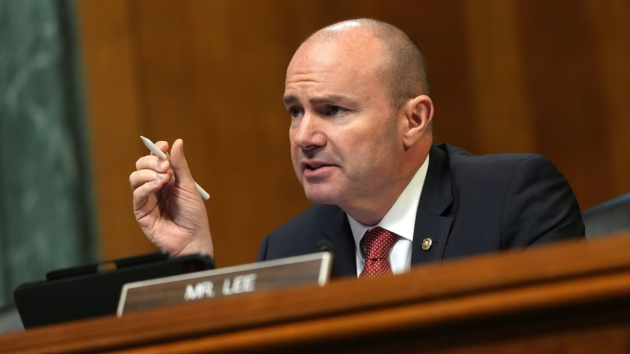
(WASHINGTON) — Republican Sen. Mike Lee deleted his controversial social media posts about the assassination of a Minnesota lawmaker and her husband after several people criticized the Utah Republican for his comments.
On Sunday night — a day after a masked gunman disguised as a police officer shot and killed Democratic State Rep. Melissa Hortman and her husband Mark at their Minnesota home — Lee made posts referencing the attack and featuring images of Vance Boelter, the suspect in the shooting.
The first post was captioned “This is what happens When Marxists don’t get their way” and the second says “Nightmare on Waltz street,” seemingly blaming Minnesota Gov. Tim Walz for the shootings — which the governor called an “act of targeted political violence.” The posts were deleted from his account Tuesday afternoon.
During a press conference at the Capitol Tuesday, Minnesota Sen. Amy Klobuchar said she spoke with Lee — but didn’t explicitly say whether he removed the posts because she asked him to.
“Senator Lee and I had a good discussion, and I’m very glad he took it down,” Klobuchar said of the posts.
The Minnesota Democrat declined to provide specific details on her discussion with Lee.
“I told him what I’ve said publicly — that this isn’t one bit funny for my state. They spent the weekend, many of them, locked in their homes in certain areas, depending on where they thought that the murderer went,” Klobuchar said.
Lee, during a brief conversation with reporters on Tuesday, also acknowledged he had a “quick” conversation with Klobuchar.
Lee’s posts prompted immediate backlash from Democrats who condemned Lee for making them.
“To attempt to politicize this tragedy is absolutely unacceptable. This rhetoric from elected officials is beyond dangerous and incites even more violence,” Democratic Sen. Dick Durbin said on the Senate floor Monday. “It is reprehensible, and it must be called out — on both sides of the aisle — both sides of the aisle. Because in the land of the free and the home of the brave, everyone should feel safe expressing their political views — and we must never do so in a way that condones violence or intimidation.”
Democratic Rep. Hillary Scholten criticized Lee’s posts during an interview on ABC News Live Tuesday: “Shame, shame on you, senator. You know better than that.”
“I also hope that my Republican colleagues in the House and the Senate will condemn these actions,” Scholten said, later adding, “We need to come together, regardless of party, when this type of violence raises its head and condemn it in the strongest possible terms.”
Former RNC Chair Michael Steele told Lee to “grow the hell up” in a post on X.
Leaving a meeting at the Capitol Monday night, Lee ignored questions from reporters about the posts.
ABC News has reached out to his office for comment.
(WASHINGTON) — President Donald Trump met with advisers in the Situation Room on Tuesday afternoon, a White House official confirmed, as Israel and Iran continue to trade strikes.
The meeting came some nine hours after Trump arrived back at the White House after abruptly leaving the G7 summit in Canada early, citing tensions in the Middle East and instructing his national security team on Monday night to be ready in the Situation Room upon his arrival. Pool reporters received word that the meeting was taking place just after 2:20 p.m. ET, though the exact start time was unclear.
A White House official confirmed that he spoke with Israeli Prime Minister Benjamin Netanyahu during the day.
But early on Tuesday, he denied having had contact with leaders in Iran, saying he hadn’t reached out about a potential ceasefire and that he was “not too much in the mood” to negotiate with Iran.
“I’ve been negotiating. I told them to do the deal,” Trump told reporters aboard Air Force One. “They should have done the deal. The cities have been blown to pieces, lost a lot of people. They should have done the deal. I told them do the deal, so I don’t know. I’m not too much in the mood to negotiate.”
He appeared to dismiss a recent assessment from Director of National Intelligence Tulsi Gabbard, who had said in March that Iran wasn’t building a nuclear weapon. Trump said on Tuesday he thought Iran was “very close” to having such a weapon.
Trump in a post on his Truth Social network also said that he hadn’t reached out to Iran “in any way, shape or form,” calling reports that he had done so “fabricated.”
“If they want to talk, they know how to reach me,” Trump said in a social media post early on Tuesday. “They should have taken the deal that was on the table — Would have save a lot of lives!!!”
Israel on Friday began an attack on Iran, launching a series of aerial strikes that Israeli officials described as a preemptive strike. Israeli leaders and Trump have separately called for Tehran to put an end to efforts to create nuclear weapons.
Diplomats from the United States and Iran held a series of talks in Muscat, Oman, beginning in April, with the sixth round due to begin last Sunday. Those talks were cancelled as the conflict between Israel and Iran began.
Trump was asked on Tuesday about Gabbard’s testimony in March before the Senate Intelligence Committee, where she said Iran was not building a nuclear weapon.
When pressed about Gabbard’s comments, Trump dismissed them.
“I don’t care what she said, I think they were very close to having one,” Trump said.
Trump has not ruled out American participation in the conflict, although the U.S. has remained on the sidelines so far. Trump has issued, however, a stern warning to Iran on Tuesday over U.S. troops and assets in the region, instructing Tehran “not to touch our troops.”
“We’ll come down so hard if they do anything to our people,” Trump told reporters aboard Air Force One.
Kyic Oleksandr Gusev/Global Images Ukraine via Getty Images
(KYIV, Ukraine) — Massive overnight Russian strikes on Kyiv killed 15 people, Ukrainian officials said, as Moscow launched hundreds of drones and missiles at targets across the country.
The strikes wounded at least 177 others in the Ukrainian capital, according to officials. A United States citizen was among the 15 killed, according to Ukrainian President Volodymyr Zelenskyy.
Nearly 150 residential buildings were damaged in Kyiv, Zelenskyy said, with search and rescue efforts ongoing.
“Rescuers and police officers continue to work at the sites where residential infrastructure was hit,” Ihor Klymenko, Ukraine’s minister of internal affairs, said in a post on the Telegram messaging app. “The rescue operation is ongoing at two locations in Kyiv. There are still people trapped under the rubble, so the work will not stop until everyone is found.”
At a residential building in the Solomianskyi district, “an entire entrance collapsed,” Kyiv Mayor Vitali Klitschko said in an update on Telegram.
The mayor posted a video to Telegram showing what he said were Russian cluster munitions found at one of the impact sites in the capital. Klitschko later declared Wednesday a day of mourning for the victims of the attack.
Ukraine’s air force said in a post to Telegram that the attack consisted of 440 drones and 32 missiles — of which 402 drones and 26 missiles were shot down or otherwise neutralized. The air force reported impacts in 10 locations and downed debris in 34 locations. The attack is believed to have been one of the largest on the capital in several months.
Kyiv bore the brunt of the strikes, Zelenskyy said, with impacts also reported in Odesa, Zaporizhzhia, Chernihiv, Zhytomyr, Kirovohrad and Mykolaiv.
At least two people were killed and 18 injured in Odesa, according to officials. The deceased were recovered from under rubble, Klymenko said.
“Such attacks are pure terrorism,” Zelenskyy wrote on Telegram. “And the whole world, the U.S. and Europe must finally react the way a civilized society reacts to terrorists.”
Russian President Vladimir Putin, Zelenskyy said, “is doing this solely because he can afford to continue the war. He wants the war to continue. It is bad when the powerful of this world turn a blind eye to this. We are contacting all partners at all possible levels to ensure an appropriate response. It is the terrorists who should feel the pain, not normal, peaceful people.”
The attacks came as G7 leaders gathered in Canada, where Russia’s ongoing war on Ukraine is one of several key topics of discussion. President Donald Trump on Monday suggested that Russia — previously a member of the group when it was known as the G8 — should not have been expelled from the bloc in 2014 after its invasion and annexation of Crimea.
Putin “sends a signal of total disrespect to the United States and other partners who have called for an end to the killing,” Ukraine’s Foreign Minister Andrii Sybiha said in a post on X. “Putin’s goal is very simple: make the G7 leaders appear weak. Only strong steps and real pressure on Moscow can prove him wrong.”
ABC News’ Ellie Kaufman contributed to this report.
(WASHINGTON) — President Donald Trump’s meeting with advisers in the Situation Room was underway on Tuesday afternoon, a White House official confirmed, as Israel and Iran continue to trade strikes.
The meeting came hours after Trump arrived back in Washington after leaving the G7 summit in Canada early, citing tensions in the Middle East and instructing his national security team on Monday night to be ready in the Situation Room upon his arrival.
Trump early on Tuesday denied having had contact with leaders in Iran, saying he hadn’t reached out about a potential ceasefire and that he was “not too much in the mood” to negotiate with Iran.
“I’ve been negotiating. I told them to do the deal,” Trump said. “They should have done the deal. The cities have been blown to pieces, lost a lot of people. They should have done the deal. I told them do the deal, so I don’t know. I’m not too much in the mood to negotiate.”
He also seemed to dismiss a recent assessment from Director of National Intelligence Tulsi Gabbard, who had said Iran wasn’t working on a nuclear weapon. Trump said on Tuesday he thought Iran was “very close” to having such a weapon.
Trump in a post on his Truth Social network also said that he hadn’t reached out to Iran “in any way, shape or form,” calling reports that he had done so “fabricated.”
“If they want to talk, they know how to reach me,” Trump said in a post early on Tuesday. “They should have taken the deal that was on the table — Would have save a lot of lives!!!”
Israel on Friday began an attack on Iran, launching a series of aerial strikes that Israeli officials described as a preemptive strike. Israeli leaders and Trump have separately called for Tehran to put an end to efforts to create nuclear weapons.
Diplomats from the United States and Iran held a series of talks in Muscat, Oman, beginning in April, with the sixth round due to begin last Sunday. Those talks were cancelled as the conflict between Israel and Iran began.
Trump was asked on Tuesday about Gabbard’s testimony in March in front of the Senate Intelligence Committee, where she said Iran was not building a nuclear weapon.
When pressed about Gabbard’s comments, Trump dismissed them.
“I don’t care what she said, I think they were very close to having one,” Trump said.
Trump has not ruled out American participation in the conflict, although the U.S. has remained on the sidelines so far. Trump has issued, however, a stern warning to Iran on Tuesday over U.S. troops and assets in the region, instructing Tehran “not to touch our troops.”
“We’ll come down so hard if they do anything to our people,” Trump told reporters aboard Air Force One.
This is a developing story. Please check back for updates.