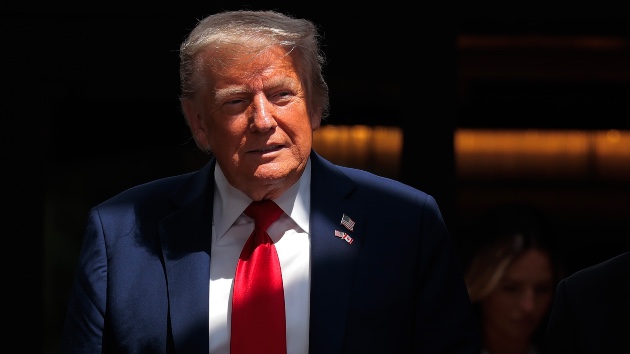
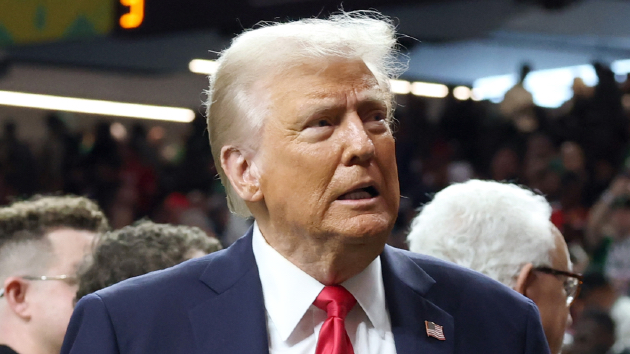
(WASHINGTON) — President Donald Trump denied early on Tuesday having had contact with leaders in Iran, saying he hadn’t reached out about a potential ceasefire and that he was “not too much in the mood” to negotiate with Iran.
“I’ve been negotiating. I told them to do the deal,” Trump said. “They should have done the deal. The cities have been blown to pieces, lost a lot of people. They should have done the deal. I told them do the deal, so I don’t know. I’m not too much in the mood to negotiate.”
The comments came as Trump returned early Tuesday to the White House, where he’d asked his top national security staff to assemble in the Situation Room, after he departed the Group of Seven leadership summit in Canada early.
He also seemed to dismiss a recent assessment from Director of National Intelligence Tulsi Gabbard, who had said Iran wasn’t working on a nuclear weapon. Trump said on Tuesday he thought Iran was “very close” to having such a weapon.
Trump in a post on his Truth Social network also said that he hadn’t reached out to Iran “in any way, shape or form,” calling reports that he had done so “fabricated.”
“If they want to talk, they know how to reach me,” Trump said in a post early on Tuesday. “They should have taken the deal that was on the table — Would have save a lot of lives!!!”
Israel on Friday began an attack on Iran, launching a series of aerial strikes that Israeli officials described as a preemptive strike. Israeli leaders and Trump have separately called for Tehran to put an end to efforts to create nuclear weapons.
Diplomats from the United States and Iran held a series of talks in Muscat, Oman, beginning in April, with the sixth round due to begin last Sunday. Those talks were cancelled as the conflict between Israel and Iran began.
Trump was asked on Tuesday about Gabbard’s testimony in March in front of the Senate Intelligence Committee, where she said Iran was not building a nuclear weapon.
When pressed about Gabbard’s comments, Trump dismissed them.
“I don’t care what she said, I think they were very close to having one,” Trump said.
Trump has not ruled out American participation in the conflict, although the U.S. has remained on the sidelines so far. Trump has issued, however, a stern warning to Iran on Tuesday over U.S. troops and assets in the region, instructing Tehran “not to touch our troops.”
“We’ll come down so hard if they do anything to our people,” Trump told reporters aboard Air Force One.
This is a developing story. Please check back for updates.
Kyic Oleksandr Gusev/Global Images Ukraine via Getty Images
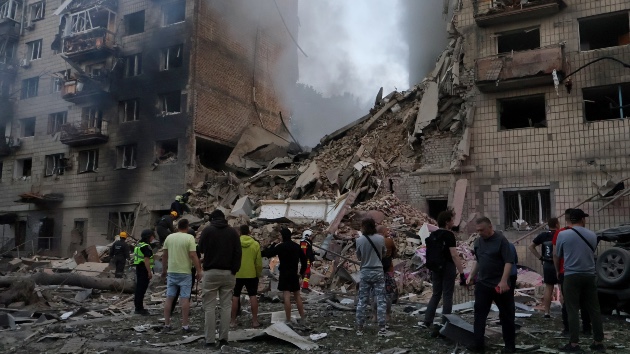
(KYIV, Ukraine) — A massive overnight Russian strike on Kyiv killed 14 people and wounded more than 100 others, local officials in the Ukrainian capital said early Tuesday, as Moscow launched hundreds of drones and missiles at targets across the country.
It was not immediately clear whether others may be trapped beneath the rubble, Kyiv Mayor Vitali Klitschko said in an update on the Telegram messaging app. Emergency personnel were working at several sites, including a residential building in the Solomianskyi district, where “an entire entrance collapsed,” Klitschko said.
The mayor posted a video to Telegram showing what he said were Russian cluster munitions found at one of the impact sites in the capital. Klitschko later declared Wednesday a day of mourning for the victims of the attack.
Ukraine’s air force said in a post to Telegram that the attack consisted of 440 drones and 32 missiles — of which 402 drones and 26 missiles were shot down or otherwise neutralized. The air force reported impacts in 10 locations and downed debris in 34 locations. The attack is believed to have been one of the largest on the capital in several months.
President Volodymyr Zelenskyy said the nationwide attack killed at least 15 people were killed. Kyiv bore the brunt of the strikes, Zelenskyy wrote, with impacts also reported in Odesa, Zaporizhzhia, Chernihiv, Zhytomyr, Kirovohrad and Mykolaiv.
At least one person was killed in Odesa and 17 others injured, according to a Telegram post by local Governor Oleg Kiper.
“Such attacks are pure terrorism,” Zelenskyy wrote on Telegram. “And the whole world, the U.S. and Europe must finally react the way a civilized society reacts to terrorists.”
Russian President Vladimir Putin, Zelenskyy said, “is doing this solely because he can afford to continue the war. He wants the war to continue. It is bad when the powerful of this world turn a blind eye to this. We are contacting all partners at all possible levels so that there is an appropriate response. It is the terrorists who should feel the pain, not normal, peaceful people.”
The attacks came as G7 leaders gathered in Canada, where Russia’s ongoing war on Ukraine is one of several key topics of discussion. President Donald Trump on Monday suggested that Russia — previously a member of the group when it was known as the G8 — should not have been expelled form the bloc in 2014 after its invasion and annexation of Crimea.
Putin “sends a signal of total disrespect to the United States and other partners who have called for an end to the killing,” Ukraine’s Foreign Minister Andrii Sybiha said in a post on X. “Putin’s goal is very simple: make the G7 leaders appear weak. Only strong steps and real pressure on Moscow can prove him wrong.”
ABC News’ Ellie Kaufman contributed to this report.
(LOS ANGELES) — The legal battle over the Trump administration’s deployment of the National Guard in California heads to a federal appeals court on Tuesday.
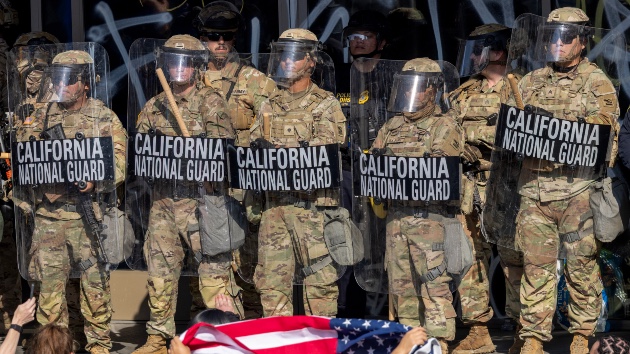
The Ninth Circuit Court of Appeals will preside over a remote hearing regarding California’s challenge to President Donald Trump’s federalization of the state’s National Guard troops amid protests over immigration enforcement in the Los Angeles area.
Last week, a federal judge in California issued a temporary restraining order that would have blocked Trump’s deployment of the troops and returned control of the California National Guard to Gov. Gavin Newsom, who did not consent to the Guard’s activation.
However, following an appeal by the Trump administration, a panel of three judges on the Ninth Circuit Court of Appeals issued an administrative stay of the lower court’s order, dealing the Trump administration a temporary reprieve to what would have been a major reversal of its policy on the protests in Los Angeles.
The three-judge panel — made up of two judges nominated by Trump and one nominated by former President Joe Biden — scheduled the hearing on the matter for Tuesday afternoon.
The district judge’s order called Trump’s actions “illegal.”
“At this early stage of the proceedings, the Court must determine whether the President followed the congressionally mandated procedure for his actions. He did not,” U.S. District Judge Charles Breyer said in his June 12 order granting the temporary restraining order sought by Newsom. “His actions were illegal — both exceeding the scope of his statutory authority and violating the Tenth Amendment to the United States Constitution. He must therefore return control of the California National Guard to the Governor of the State of California forthwith.”
The order did not limit Trump’s use of the Marines, which had also been deployed to LA.
In a press conference after the district court’s order, Newsom said he was “gratified” by the ruling, saying he would return the National Guard “to what they were doing before Donald Trump commandeered them.”
In its appeal to the Ninth Circuit, administration lawyers called the district judge’s order “unprecedented” and an “extraordinary intrusion on the President’s constitutional authority as Commander in Chief.”
Some 4,000 National Guardsmen and 700 Marines were ordered to the Los Angeles area following protests over immigration raids. California leaders claim Trump inflamed the protests by sending in the military when it was not necessary.
(NEW YORK) — A federal judge in Massachusetts ruled on Monday that directives from the Trump administration that led to the cancellations of several research grants from the National Institutes of Health (NIH) were “void” and “illegal.”
U.S. District Judge William Young said the cancellation of the grants — related to studies involving LGBTQ+ issues, gender identity and diversity, equity and inclusion (DEI) — violated federal law, saying it was a case of racial discrimination and discrimination against the LGBTQ+ community, according to the plaintiffs in the case.
Two lawsuits had been filed against the administration: One led by the American Public Health Association and the other filed by a group of 16 states. Some estimates have suggested that up to $1.8 billion in research funding had been cut. Young, an appointee of President Ronald Reagan, said he was ordering the NIH to restore the grants that were terminated.
In a statement, Andrew Nixon, the director of communications for the Department of Health and Human Services, said the agency stands by its decision to end funding for research “that prioritized ideological agendas over scientific rigor and meaningful outcomes for the American people. Under the leadership of Secretary Kennedy and the Trump administration, HHS is committed to ensuring that taxpayer dollars support programs rooted in evidence-based practices and gold standard science – not driven by divisive DEI mandates or gender ideology.” Nixon said HHS is “exploring all legal options, including filing an appeal and moving to stay the order.”
Among the plaintiffs is Dr. Brittany Charlton, an associate professor at Harvard T.H. Chan School of Public Health, who had all her grants terminated by the NIH.
One of the terminated grants focused on documenting obstetrical outcomes for lesbian, gay and bisexual women and another focused on how discriminatory laws impact mental health among LGBTQ+ teens.
“As a plaintiff, I felt truly seen — it was a rare moment when the deep harm caused to researchers and the communities we serve was acknowledged out loud, in front of the world,” Charlton told ABC News in a statement.
“Sitting there, I felt a wave of relief and hope as the judge condemned the government’s actions and ordered the grants to be reinstated,” the statement continued. “After so much uncertainty and disruption, it finally felt like justice and the value of our research — and the communities at its heart — were being affirmed.”
The terminations came after President Donald Trump passed a flurry of executive orders including vowing to “defend women from gender ideology extremism” and aiming to dismantle DEI initiatives.
According to termination letters sent to researchers at various universities that were reviewed by ABC News, the administration said the canceled projects do not serve the “priorities” of the current administration.
“Research programs based on gender identity are often unscientific, have little identifiable return on investment, and do nothing to enhance the health of many Americans. Many such studies ignore, rather than seriously examine, biological realities. It is the policy of NIH not to prioritize these research programs,” some of the termination letters read.
“The premise…is incompatible with agency priorities, and no modification of the project could align the project with agency priorities,” the letters continued.
ABC News’ Sony Salzman contributed to this report.
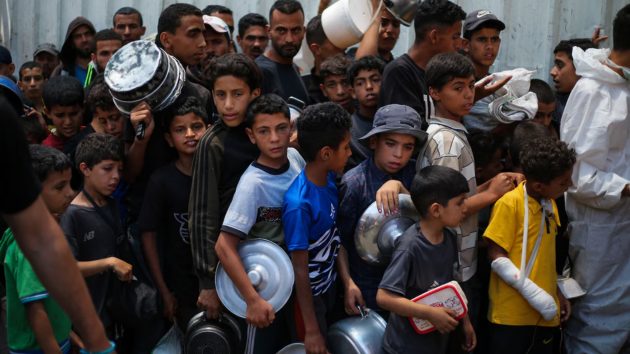
(LONDON) — More than 30 people in Gaza were killed on Monday by alleged Israeli gunfire while trying to reach food aid distribution centers, the Hamas-run Gaza Ministry of Health (MOH) said.
One person was killed near the Netzarim corridor at a distribution site in central Gaza and 33 people were killed near an aid distribution center in Rafah in southern Gaza, according to the ministry.
An additional four people were killed at the site near the Netzarim corridor on Sunday but were not found until Monday, the MOH told ABC News.
The Israel Defense Forces (IDF) did not immediately return ABC News’ request for comment on the incident.
The Rev. Dr. Johnnie Moore, the executive chairman of GHF, did not address the alleged incidents in a post on X on Monday afternoon, where he said aid distribution at four sites “proceeded without incident.” He said three American contract staff sustained “minor injuries” during Iranian attacks on Israel on Sunday, but received medical attention and were diagnosed with concussions.
So far on Monday, 68 people have been killed in Gaza and at least 180 people have been injured, according to the ministry.
The aid sites, run by the U.S.-backed Gaza Humanitarian Foundation (GHF), have been steeped in controversy since they opened about three weeks ago.
The new distribution system was imposed by Israel after the government partly lifted a two-and-a-half-month blockade on all humanitarian aid, which caused widespread malnutrition and famine-like conditions, according to food security experts.
International aid organizations refused to participate in the new system, with deputy U.N. spokesperson Farhan Haq saying the plan is not impartial, neutral or independent.
The IDF has previously released statements about the reports, saying that video footage allegedly showing the shootings is “under review.” The IDF also said it has fired “warning shots” towards people who were allegedly “advancing while posing a threat to the troops.”
The GHF previously denied reports of chaos at the distribution sites but has closed them at times due to “maintenance” and “repair work.”
Gazans have said neither the amount of aid distributed, nor the calories within the aid packages from GHF, is enough to meet the needs of the civilian population.
Dr. Abdulwhhab Abu Alamrain, a physician at Al-Aqsa Martyrs Hospital in central Gaza, said having distribution sites — as opposed to meeting people where they are — does not allow for equitable aid access.
“Vulnerable families with elderly, widows with kids and sole survivor kids can never get aid [because] they would never be able to walk miles or [carry] the package or fight to get a turn in [an] unorganized aid distribution center,” he told ABC News.
Previously, aid was distributed by organizations such as the United Nations Relief and Works Agency for Palestine Refugees in the Near East (UNRWA), which ran hundreds of sites across the strip.
However, Israel has accused of the U.N. of being “anti-Israel and anti-Semitic” and UNRWA as being “infiltrated” by terrorism. Israel has also accused Hamas militants of stealing aid meant for civilians. Hamas denies the accusations and claims that Israel is weaponizing aid through GHF.
Dr. Ayesha Khan, a U.S. emergency medicine physician and humanitarian aid worker who did a month-long medical mission at Al-Aqsa Martyrs Hospital in late 2024, said it is frustrating to see the new distribution plan because the U.N.’s method for distributing aid in Gaza has been successful for decades.
“We have a way to distribute aid,” Khan told ABC News. “In my opinion, this GHF, the Gaza Humanitarian Foundation, was created in order to weaponize humanitarian aid.”
Khan said she spoke to a friend in Gaza who said he didn’t consider the GHF plan to be “humanitarian aid” but rather “humiliation aid.”
“You’ve eliminated everybody being able to get aid because getting aid is contingent upon you coming to the distribution point,” she said. “And sure enough, as soon as the people were told that there was food, after 11, 12, weeks of starvation, they swarmed the area, desperate to get food, of which there was not enough, and the soldiers opened fire.”
“The U.N. has global rules around humanitarian principles: humanity, neutrality, impartiality, independence. Those are those rules are not being followed by GHF,” Khan added.
The most recent deaths at distribution sites come as U.N. Human Rights Chief Volker Türk described Israel’s warfare in Gaza as inflicting “horrifying, unconscionable suffering” on civilians.
“Israel’s means and methods of warfare are inflicting horrifying, unconscionable suffering on Palestinians in Gaza,” Turk said during a meeting of the Humans Rights Council on Monday. “Israel has weaponized food and blocked lifesaving aid. I urge immediate, impartial investigations into deadly attacks on desperate civilians trying to reach food distribution centers. Disturbing, dehumanizing rhetoric from senior Israeli government officials is reminiscent of the gravest of crimes.”
Turk also said Israel’s refusal to allow international journalists to report from Gaza has helped Hamas “avoid transparency and accountability.”
Since Oct. 7, 2023, when Hamas launched a surprise terrorist attack in Israel, more than 55,400 people have been killed in Gaza and more than 128,900 have been injured, according to the MOH.
During Hamas’s surprise attack, the militant group murdered nearly 1,200 Israelis and took captive 251 others, according to Israeli officials. Hamas is still holding 53 hostages, living and dead. Among them are the bodies of two Americans.
ABC News’ Ellie Kaufman contributed to this report.
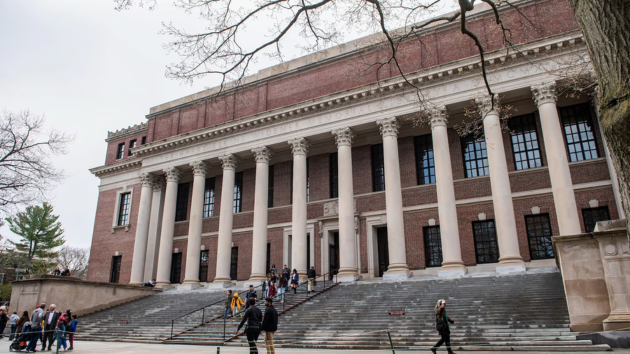
(CAMBRIDGE, Mass.) — A temporary restraining order on President Donald Trump barring foreign Harvard University students from entering the U.S. will remain in effect until next Monday while a federal judge considers arguments made for a preliminary injunction.
The temporary block was due to expire on Thursday before being extended Monday by U.S. District Court Judge Allison Burroughs.
Harvard’s lawyers argued Trump’s proclamation violates its First Amendment rights and is outside the authority of the executive branch. Listing the actions taken by the government against Harvard in recent weeks, attorney Ian Gershengorn argued in a court hearing Monday in Boston that the move was retaliation and viewpoint discrimination against the institution.
Gershengorn argued the president is not restricting entry, but instead limiting what you do and who you associate with after you enter. The permissible way to classify a class of aliens is based on the character of the alien, he argued.
The government pushed back, arguing the administration does not “trust” Harvard and that it did not monitor the “aliens” that it brought into the U.S. The government said bringing in foreigners is a privilege not a right, according to Tiberius Davis, counsel to the assistant attorney general.
“We don’t trust Harvard to vet, host, monitor or discipline” foreigners, Davis argued. Davis also raised concerns about Harvard’s “foreign entanglements” with the Chinese government and said it did not provide sufficient information to the government on foreign students — which Harvard has denied.
Harvard University filed the lawsuit against the government after U.S. Department of Homeland Security Secretary Kristi Noem announced it was canceling Harvard’s Student and Exchange Visitor Program certification, which would bar the school from enrolling foreign students.
The suit was later amended to include the proclamation and Harvard moved to request a second block on Trump’s proclamation. That would have gone into effect for at least six months before it was blocked by Burroughs.
The judge questioned arguments made by the government over its concerns about Harvard that motivated the proclamation.
“I can’t imagine that anything that you just described applies only to Harvard,” Burroughs said.
Davis argued the government is free to investigate other institutions and said that “a lot of these other universities are willing to” do more to address issues on campus.
Davis also argued that different government agencies chose to terminate grants with Harvard because they believed the institution was not following the law, saying that move was not retaliation either. Davis also said Harvard is not being singled out with grant terminations because other institutions have suffered the same.
The government argued it is not singling out Harvard, but rather other institutions have been more willing to take action to address issues on campus, while Harvard has not, Davis said.
“There’s a lack of evidence of retaliation here,” Davis said in court.
Burroughs said if the point is to root out antisemitism, “Why aren’t we letting in people from Israel?”
Davis argued antisemitism was just one part of the issue, along with foreign entanglements and not providing sufficient information to the government. Because of their other conduct on campus and their inattentiveness to it “we don’t trust them,” Davis said.
“They don’t have to pull over everybody who’s speeding. Frankly they can’t do that,” Davis said.
Pushing back on arguments that it did not monitor its students, Harvard said it is the government’s responsibility to vet students being allowed into the country.
“The vetting is done by the State Department in their visa process,” Gershengorn said.
At one point in the Monday hearing, the judge asked Harvard’s attorneys why it did not name the president in its lawsuit, asking if he needed to appear in this case.
Gershengorn said it sued the people who are tasked with implementing the proclamation.
Gershengorn argued Trump’s usage of the proclamation to block entry of foreign Harvard students is a “vast new authority to regulate the domestic conduct of domestic institutions,” a departure from how this proclamation has been used in the past. Gershengorn said it has been used to block the entry of individuals or nationals of a country that have “done something bad.”
The question is not whether the action is lawful or not, Gershengorn argued. If lawful action is taken as a First Amendment-motivated action, it is no longer lawful, he added.
Gershengorn said what Harvard has suffered over the last two months is probably the most “irregular” and “improper” action any institution has suffered.
Harvard pushed back against claims there is widespread violence on campus, saying the story the government cites identified two incidents of violence on the basis of religion. The government is “throwing things at the wall to see what sticks,” Gershengorn said.
Harvard has alleged that the administration is in an “escalating campaign of retaliation” against the school. After Harvard publicly refused to comply with demands made by the Trump administration, the administration responded by freezing more than $2.2 billion in grants and $60 million in contracts to the school.
(NEW YORK) — Oil prices fell and stocks closed higher on Monday, indicating optimism among investors about the limits of economic fallout from the ongoing Israel-Iran conflict.
The Dow Jones Industrial Average closed up 317 points, or 0.7%, erasing much of the losses suffered on Friday as back-and-forth strikes broke out between the two countries.
The S&P 500 climbed 0.9% on Monday, while the tech-heavy Nasdaq jumped 1.5%. In each case, the gains erased nearly all of the losses suffered as the conflict began days earlier.
Oil prices, meanwhile, ticked slightly lower on Monday, easing a surge in prices set off late last week as investors feared a wider regional war in the oil-rich Middle East.
The U.S. West Texas Intermediate futures price — a key measure of U.S. oil prices — dropped 2.3% on Monday. Brent crude future prices, another top measure of oil prices, also fell about 1.8%. Each index had climbed as much as 10% in the immediate aftermath of the conflict.
Aerial attacks between Israel and Iran continued overnight into Monday, marking a fourth day of strikes following Israel’s Friday attack. That surprise operation hit at the heart of Iran’s nuclear program, striking key facilities and killing several nuclear scientists as well as high-ranking military leaders, according to Israeli officials.
The U.S. did not provide any military assistance or have any involvement in Israel’s Friday strikes, a U.S. official told ABC News. President Donald Trump told ABC News on Sunday, “It’s possible we could get involved.” The U.S. did provide assistance in shooting down incoming missile and drone attacks from Iran in response to Israel’s initial barrage, officials said.
The drop in oil prices may ease a potential uptick in the price of gasoline for U.S. drivers.
Since crude oil makes up the top ingredient in car fuel, the Israel-Iran conflict threatened to modestly increase prices over the coming days and significantly hike them in the event of a wider war, experts previously told ABC News.
“By later this week, we’ll likely see nearly all states with price increases as retail gas prices rise following Iran/Israel attacks,” Patrick de Haan, the head of petroleum analysis at GasBuddy, said on Monday in a post on X.
The move higher for U.S. stocks mirrored gains in markets across Asia and Europe. The STOXX Europe 600 index ticked up 0.3% by mid-afternoon local time. In Japan, the Nikkei 225 in Tokyo climbed 1.2% on Monday.
ABC News’ David Brennan contributed to this report.
(WASHINGTON) — Senators will be briefed by law enforcement on Tuesday on safety and security after the murder of a Minnesota lawmaker and her husband and the wounding of another and his wife on Saturday.
House Republicans held a conference call, which was described as “tense,” on Saturday with the House sergeant at arms and U.S. Capitol Police to discuss their concerns, multiple sources familiar with the call told ABC News. Several Republicans said on the one-hour call that they feel unsafe in their home districts and want more protection, sources said.
The key source of contention in particular was the request of police outside their homes at all times and law enforcement authorities saying they need more funding from Congress to provide that.
Senators will be briefed by the Senate sergeant at arms and Capitol Police on Tuesday morning, two sources familiar told ABC News, after it was requested by Majority Leader John Thune and Minority Leader Chuck Schumer.
House Democrats are expected to have a similar call in the coming days. Minority Leader Hakeem Jeffries said in a statement Saturday that he asked the sergeant at arms and Capitol Police to “ensure the safety” of the Minnesota delegation and members of Congress “across the country.”
While House and Senate leadership are provided with a security detail, rank-and-file members are not routinely protected unless there is a specific threat.
Minnesota Sen. Amy Klobuchar told ABC News’ “This Week” on Sunday that political violence is a “rampant problem.” Fellow Minnesota Sen. Tina Smith told NBC News on Sunday, “I don’t want to think that I have to a personal security detail everywhere I go, but I think we really have to look at the situation that we’re in.
“This is no way for our government to work when people, any number of us, feel this kind of threat,” she said.
Rep. Jared Moskowitz said he might force a vote on a “secret session” in the House to discuss security and so that “members can handle this ourselves.”
Vance Boelter, 57, faces multiple federal charges in the killing of Democratic Minnesota state Rep. Melissa Hortman and her husband, Mark, and wounding Democratic state Sen. John Hoffman and his wife, Yvette, in “political assassinations,” acting U.S. Attorney for the District of Minnesota Joseph Thompson said Monday.
In a 20-page affidavit, prosecutors outlined how they say Boelter “embarked on a planned campaign of stalking and violence, designed to inflict fear, injure and kill members of the Minnesota state legislature and their families.” He allegedly had firearms and a list of 45 elected officials, “mostly or all Democrats,” according to prosecutors. Authorities say Boelter traveled to the homes of at least four public officials during the early morning hours of Saturday before the killings.
The number of threats and “concerning statements” against members of Congress, their families and staffs has risen for the past two years, according to Capitol Police, which pointed out that threats tend to increase during election years. The Capitol Police’s Threat Assessment Section investigated 9,474 threats and statements in 2024 and 8,008. It investigated 3,939 cases in 2017.
ABC News’ Isabella Murray contributed to this report.
(WASHINGTON) — President Donald Trump on Monday doubled down on his goal to conduct mass deportations in some of the country’s biggest cities, specifically those run by Democrats.
As he met with Canadian Prime Minister Mark Carney at the G7 summit in Alberta on Monday, Trump said Immigration and Customs Enforcement should turn its attention to New York and Chicago in addition to Los Angeles.
“I want them to focus on the cities because the cities are where you really have what’s called ‘sanctuary cities,'” Trump told reporters. “And that’s where the people are.”
The comments came after Trump’s lengthy social media post on Sunday in which said he was ordering ICE to do “all in their power” to oversee the largest mass deportation program in history.
“In order to achieve this, we must expand efforts to detain and deport Illegal Aliens in America’s largest Cities,” Trump wrote.
The president said those cities are “the core of the Democrat Power Center” and accused Democrats of using illegal immigration to influence elections — despite the fact that noncitizens can’t vote in federal or state elections and instances where it occurs are rare. He also claimed without evidence that illegal immigrants were being used to “grow the Welfare State.”
“To ICE, FBI, DEA, ATF, the Patriots at Pentagon and the State Department, you have my unwavering support. Now go, GET THE JOB DONE!” Trump wrote in the post.
Trump’s determination on deportations follows protests in LA and in other areas around the country last week to his administration’s immigration crackdown. This past Saturday, immigration was one focus of nationwide “No Kings Day” demonstrations against Trump and his policies that drew thousands of people.
Amid the pushback, Trump last week shifted his stance on undocumented immigrants who work in the farming and hospitality industries.
Trump acknowledged on social media that his “aggressive policy” was “taking very good, long time workers away.” The Department of Homeland Security later confirmed they received new guidance to pause most raids on farms, restaurants and hotels.
“Our farmers are being hurt badly, they have good workers that have worked for them for 20 years. They are not citizens, but turned out to be great. We will do something about that,” Trump said at a White House event last week.
Such comments undercut what he and his top officials have said would be a focus on the “worst of the worst” violent or criminal offenders in their deportation efforts.
ABC News’ Hannah Demissie contributed to this report.
Jabin Botsford/The Washington Post via Getty Images
(NEW YORK) — The Trump Organization on Monday announced a mobile phone service and a Trump-branded smartphone, extending the family real estate company into the vast U.S. telecom market.
The announcement arrives exactly 10 years after the launch of President Donald Trump’s first presidential campaign, and it features a monthly mobile plan priced at $47.45, an apparent reference to Trump’s résumé as the nation’s 45th and 47th president.
“I’m incredibly excited to step into this new digital space, hard-working Americans deserve a wireless service that’s affordable, reflects their values, and delivers reliable quality they can count on,” Eric Trump, executive vice president of the Trump Organization, said in a statement on Monday.
Trump Mobile follows a long line of various products featuring the Trump family name that President Trump and his family have promoted, including the Trump meme coin, Trump sneakers and Trump guitars.
Here’s what to know about Trump Mobile:
What products does Trump Mobile offer?
Trump Mobile offers both a cellular plan and a smartphone.
The company provides 5G service through what it calls “The 47 Plan.” Under the service, customers will access the “same coverage as the 3 nationwide phone service carriers,” Trump Mobile says on its website. The three top U.S. wireless carriers are Verizon, T-Mobile and AT&T.
Trump Mobile boasts customer perks such as unlimited talk, text and data; roadside assistance; telehealth services; and free international calling to more than 100 countries. The unlimited texting may be subject to data limits, the company’s website says.
The company also sells a smartphone, which it calls, “The T1 Phone.”
The gold-colored phone features a built-in camera and 256 gigabyte storage. An American flag and “T1” are inscribed on the back of the phone, according to an image on the company’s website.
What are the prices and release dates of Trump Mobile products?
The company’s cellular service is priced at $47.45 per month. The company’s website says the cellular service is available now.
The Trump Mobile smartphone will cost $499, including a $100 down payment. The smartphone will be released in August, Trump Mobile said on Monday.
Who will lead Trump Mobile?
On Monday, the Trump Organization announced the cellular offerings as a joint venture led by Donald Trump’s sons, Eric Trump and Donald Trump Jr., as well as staff at the newly formed Trump Mobile.
“Trump Mobile is going to change the game, we’re building on the movement to put America first, and we will deliver the highest levels of quality and service. Our company is based right here in the United States because we know it’s what our customers want and deserve,” an executive vice president at The Trump Organization told ABC News.