(NASHVILLE, Tenn.) — A Tennessee man is facing federal charges after allegedly brandishing a firearm at protesters earlier this month, with prosecutors expressing concerns about his “desire to commit an act of mass violence,” according to court documents.
Elijah Millar, 19, of Murfreesboro, Tennessee, was charged Friday with unlawful possession of a firearm, the Justice Department announced. He faces up to 15 years in federal prison and a maximum fine of $250,000 if convicted.
According to prosecutors, Millar, dressed in all-black clothing and wearing a mask, confronted demonstrators at a “No Kings” protest near Nashville’s Bicentennial Mall on June 14.
Witnesses reported that Millar spat at protesters, yelled at them, and brandished a Sig Sauer 9mm pistol before being apprehended by Metropolitan Nashville Police Department officers, the DOJ said.
Just three days after being released on bond, Millar was arrested again when Murfreesboro Police Department officers discovered another loaded 9mm firearm in his waistband, authorities said.
Court documents said Millar was previously subject to a 2023 emergency conservatorship order in Rutherford County, Tennessee, which prohibited him from possessing firearms after finding he was “at risk of substantial harm to his health, safety, and welfare.”
A subsequent order in September 2024 designated him as a “disabled person needing care” and further restricted his access to firearms.
“The right to peaceably protest government action is guaranteed by the First Amendment and cannot be infringed upon by armed individuals whose actions put people in danger,” said Acting United States Attorney Robert E. McGuire.
On Sunday, prosecutors urged the court to keep Millar in custody, citing social media posts and online activity that suggested “a desire to commit an act of mass violence.”
The incident comes amid heightened tensions at “No Kings” protests nationwide. In a separate incident on the same day in Utah, a protest turned deadly when a safety volunteer accidentally shot and killed a demonstrator while responding to another armed individual who allegedly approached the crowd with a rifle.
The case is being investigated by the FBI’s Nashville Field Office, the Metropolitan Nashville Police Department, and the Murfreesboro Police Department.
ABC News’ Alexander Mallin contributed to this report.
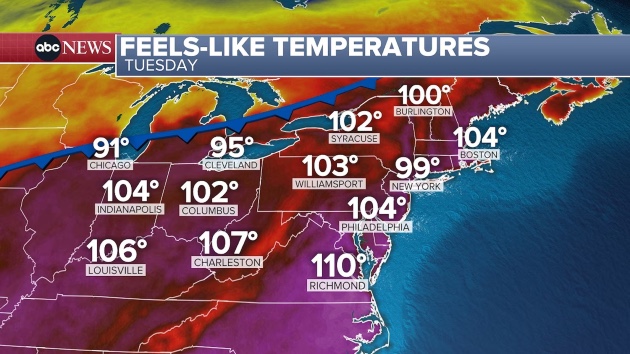
(NEW YORK) — A dangerous heat wave has set in, leaving nearly 150 million people from Texas to Maine under heat alerts on Monday.
In some regions of the country, including the Northeast, thermometers are expected to rise this week to the highest temperatures in more than decade.
Nearly 50 cities could see daily high temperature records broken, including New York City, Philadelphia and Washington, D.C.
“This level of HeatRisk is known for being rare and/or long duration with little to no overnight relief, and affects anyone without effective cooling and/or adequate hydration,” the National Weather Service (NWS) said in an advisory issued Monday morning.
A heat wave is a continuous period of abnormally hot weather, generally lasting over two days, according to the NWS.
However, the definition of a heat wave varies by region. In the Midwest and the Northeast, a heat wave is defined as three or more consecutive days of at least 90 degrees.
On Monday, the heat index, a measurement of what the sweltering weather feels like as opposed to the actual temperature reading, is forecast to soar above 100 degrees for much of the Northeast and Mid-Atlantic, as well as in the Midwest from Cedar Rapids, Iowa, to Memphis, Tenn.
Philadelphia is forecast to reach a high of 100 degrees on Monday, a temperature the city hasn’t seen since July 2012.
In anticipation of the first heat wave of the season, Philadelphia city officials declared a heat health emergency that began at noon on Sunday and will stay in place until at least 8 p.m. on Wednesday.
Dr. Palak Raval-Nelson, Philadelphia’s health commissioner, said a heat health emergency is declared when the temperature gets high enough to increase “the risk of getting sick or dying from the heat” — especially for elderly people, individuals with chronic medical conditions and pregnant women.
“The best way to protect our loved ones is to make sure they can get into air conditioning during the hottest part of the day,” Raval-Nelson said in a statement.
Philadelphia is opening more than 40 cooling centers across the city to help people beat the heat.
In New York City, the temperature surpassed 90 degrees by 11 a.m. and expected to rise to the mid-90s to upper 90s on Monday afternoon and reach the upper 90s on Tuesday.
The last time New York City hit 100 degrees was in July 2012.
“Extreme heat will not just be uncomfortable and oppressive for New Yorkers this coming week, it will be brutal and it will be dangerous,” New York City Mayor Eric Adams said in a statement.
On Tuesday, temperatures across the Northeast and Midwest are expected to be slightly higher than on Monday, and the heat index will make cities like Syracuse, New York, and Burlington, Vermont, feel over 100 degrees.
Nighttime temperatures are expected to provide little relief and could be particularly dangerous for people without air conditioning. Overnight temperatures are forecast to be hovering near 80 degrees.
The heat wave is expected to subside on Wednesday, but it will take until Thursday for much of the eastern United States to see real relief from the extreme temperatures.
Elsewhere across the country, the cold front that will help break the heat wave will move through the upper Midwest, producing severe thunderstorms from Kansas to Michigan. The primary risks for the Midwest will be damaging winds, hail, flash flooding and the possibility of tornadoes.
(WASHINGTON) — President Donald Trump’s strike against Iran will be met with pushback on Capitol Hill this week as some lawmakers argue the military action was unconstitutional.
There are several bipartisan resolutions that could receive a vote in coming days that may put some lawmakers in uncomfortable positions as they consider whether Trump ignored the role of Congress in striking Tehran.
It’s unlikely though, at this stage, that Trump’s rank-and-file Republican base will abandon him by supporting these bills. If any were to make it to Trump’s desk, there likely wouldn’t be enough votes to override his veto.
Trump’s decision to hit Iran in the stated aim of wiping out its nuclear capabilities follows a decades-long pattern of presidents taking military action and not waiting for Congress to sign off. Other examples include Joe Biden’s airstrikes in Syria in 2021, Barack Obama’s military campaign against ISIS in Syria and Iraq as well as George H.W. Bush’s invasion of Panama.
House and Senate lawmakers are expected to receive briefings on the Iran strike on Tuesday.
Trump faces bipartisan blowback Republican Rep. Thomas Massie and Democratic Rep. Ro Khanna introduced a War Powers Resolution last week to prohibit “United States Armed Forces from unauthorized hostilities in the Islamic Republic of Iran.”
Democratic Sen. Tim Kaine is leading a similar Senate resolution, which could come up sometime this week as the chamber tries to move forward with a megabill to fund much of Trump’s domestic policy agenda.
All three appeared on “Face the Nation” on CBS News on Sunday to make their case.
Massie contended there was “no imminent threat to the United States” that would authorize the president to strike Iran without congressional approval.
Kaine similarly said: “This is the U.S. jumping into a war of choice at Donald Trump’s urging without any compelling national security interests for the United States to act in this way, particularly without a debate and vote in Congress. We should not be sending troops and risking troops’ lives in an offensive war without a debate in Congress.”
Kaine added that he hopes Republicans push back.
“I know many Republicans will fall in line and say a president can do whatever he wants. But I hope members of the Senate and the House will take their Article I responsibilities seriously,” the Virginia Democrat said.
Khanna warned there is a possibility the strike is not a one-time occurrence.
“There are people who want regime change in Iran. And they are egging this president on to bomb. I hope cooler heads will prevail,” Khanna said on CBS. “We need to pass Thomas Massie and my War Powers Resolution to make it clear that we’re not going to get further entrenched into the Middle East.”
Trump lashed out at Massie in a lengthy social media post on Sunday, writing the Republican congressman is “not MAGA” and that “MAGA doesn’t want him” and “doesn’t respect him.” Trump said he’ll campaign for Massie’s Republican primary opponent in the next election.
Congress has twice before called out Trump on his use of military force without congressional approval.
In 2019, Congress approved a bill to end U.S. support for the war in Yemen, which Trump vetoed. In 2020, Trump ordered the drone strike that killed top Iranian general Qassem Soleimani. In response, Congress passed legislation seeking to limit a president’s ability to wage war against Iran, which was again quickly rejected by Trump.
What is the 1973 War Powers Resolution? The legislation introduced by Massie and Khanna seeking to limit Trump’s ability to take U.S. military action against Iran cites the 1973 War Powers Resolution, which states that the president “in every possible instance shall consult with Congress before introducing United States Armed Forces into hostilities or into situation where imminent involvement in hostilities is clearly indicated by the circumstances.”
It also states that in the absence of a declaration of war but when armed forces are introduced, the president must report to Congress within 48 hours the circumstances necessitating their introduction and must terminate the use of U.S. armed forces within 60 days unless Congress permits otherwise. If approval is not granted and the president deems it an emergency, then an additional 30 days are granted for ending operations.
Trump admin says strike was legally justified
Top officials defended the military action over the weekend. Defense Secretary Pete Hegseth said the administration “complied with the notification requirements” of the War Powers Resolution, saying members of Congress were notified “after the planes were safely out.”
Vice President JD Vance and Secretary of State Marco Rubio also sought to emphasize the U.S. is not at war with Iran.
Trump, though, warned that more strikes could come if Iran doesn’t negotiate a deal.
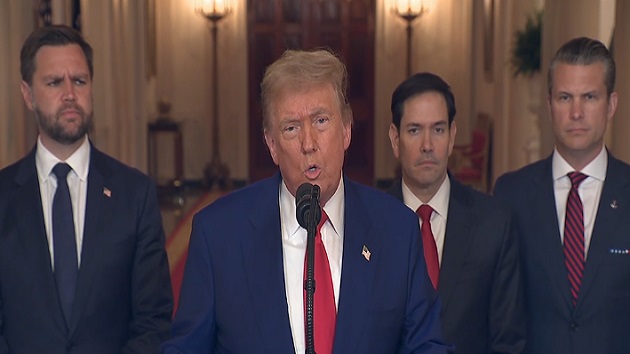
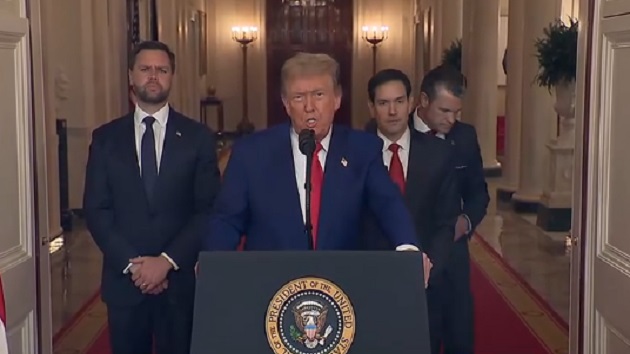
“If peace does not come quickly, we will go after those other targets with precision, speed and skill,” he said in his address to the nation on Saturday night.
Republican Sen. Lindsey Graham, a vocal supporter of military action against Iran leading up to Trump’s decision, argued on NBC News that Trump has all the authority he needs under Article II of the Constitution.
“Congress can declare war or cut off funding,” Graham said. “We can’t be the commander in chief. You can’t have 535 commanders-in-chief.”
The administration could also cite an existing military authorization as grounds for legal justification for striking against Iran.
The 2001 Authorization for Use of Military Force (AUMF) is a joint resolution passed by Congress that authorized counterterrorism operations by U.S. military forces against those responsible for the 9/11 attacks. Congress passed another AUMF targeting Iraq in 2002. Both have since been cited to authorize military force in more than 20 countries, including Afghanistan, Iraq, Syria and Somalia due to the broad language in the resolutions.
Critics have often said the 2001 and 2002 AUMFs grant the president powers to unilaterally wage “perpetual worldwide wars” and some lawmakers have been keen to repeal it — but those efforts have all been unsuccessful.
Ihor Kuznietsov/Novyny LIVE/Global Images Ukraine via Getty Images
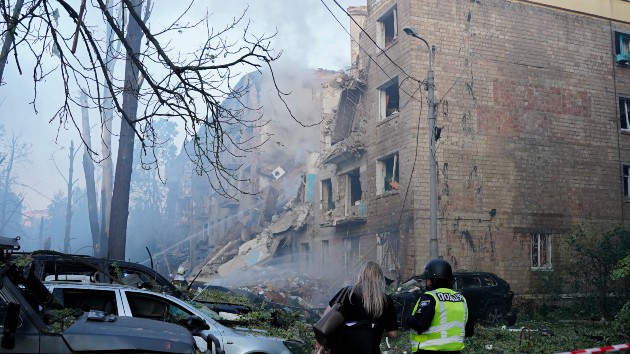
(LONDON) — At least seven people were killed and 28 injured in Kyiv overnight as Russian drone and missile attacks again rocked Ukraine’s capital, Mayor Vitali Klitschko said on Monday, describing Moscow’s latest attack as “terrible.”
Most casualties came from a single strike on a residential building in Kyiv’s northwestern Shevchenkivskyi district, Klitschko said in a post to Telegram, alongside which he published a video from the impact site showing extensive damage to nearby apartment blocks.
Ukraine’s air force said in a post to Telegram that Russia launched 352 drones and 16 missiles into the country overnight, with Kyiv the primary target. Of those, the air force said 339 drones and 15 missiles were shot down or otherwise neutralized.
Direct hits were reported in six locations, the air force said, with falling debris reported in 25 locations.
Ukrainian President Volodymyr Zelenskyy posted a statement on Telegram condemning the “cynical strike,” which he said included the use of North Korean ballistic missiles.
Noting Russia’s condemnation of recent Israeli and U.S. strikes on Iran, Zelenskyy said Moscow remains “silent” on its own ongoing bombardment of Ukrainian cities using Iranian-supplied attack drones.
“A significant part of the drones and missiles were shot down by our sky defenders,” Zelenskyy wrote. “But not all. And everyone in countries close to Russia, Iran and North Korea should think about whether they will be able to protect lives there if this coalition of killers persists and continues to spread terror.”
The Ukrainian president will visit the U.K. on Monday, as British leaders prepare for the NATO summit in the Netherlands on Tuesday.
Zelenskyy said that air defense capabilities will be among the topics to be discussed, capabilities he said “should become the basis for a much stronger joint defense.”
“And we will also agree on new and strong steps to put pressure on Russia for this war and to stop the strikes,” Zelenskyy wrote in his statement.
Russia’s Defense Ministry, meanwhile, said its forces shot down 23 Ukrainian drones overnight.
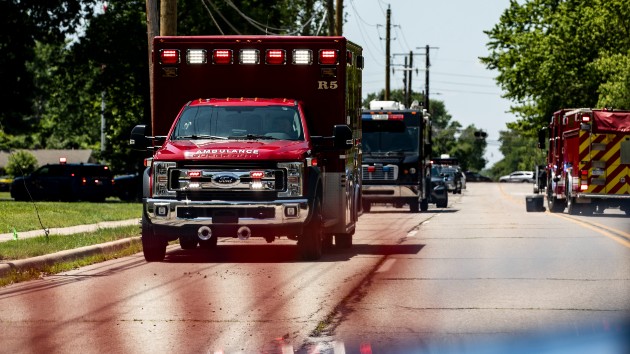
Multiple ambulances and police cars on the scene of a shooting at CrossPointe Community Church on June 22, 2025 in Wayne, Michigan. Police report that a shooting suspect was shot dead by a security guard after opening fire at the church leaving one person injured. (Photo by Emily Elconin/Getty Images)
(WAYNE, Mich.) — An alleged active shooter intent on attacking a Michigan church on Sunday was shot and killed by a security guard who “prevented a large-scale mass shooting,” police said.
The shooting unfolded around 11:15 a.m. local time at the CrossPointe Community Church in the Detroit suburb of Wayne, according to the Wayne Police Department.
“We are grateful for the heroic actions of the church’s staff members who undoubtedly saved many lives and prevented a large-scale mass shooting,” Wayne Police Chief Ryan Strong said during a press conference on Sunday.
The gunman was identified as Brian Anthony Browning, 31, from Romulus, Michigan. His motivations are unknown, according to police, though officials said he appeared to be suffering from a mental health crisis.
Browning had no criminal history. His mother is a member of the church and the suspect attended two or three services over the course of the last year, police said.
Police said the suspect exited his Nissan truck wearing a tactical vest, armed with a long gun and a handgun, when he approached the church building and began firing his weapon. Several staff members from the church approached the gunman, police said, adding that a parishioner struck the gunman with his vehicle as the gunman shot the vehicle repeatedly.
At least two staff members shot the gunman, causing fatal wounds. One staff member, a member of the security team, was shot once in the leg by the suspect. They underwent a successful surgery and are expected to recover, police said.
The church staff members do not wish to be identified, police said.
At this point, the Wayne Police Department is still investigating this incident, with the assistance of multiple local, state and federal partners.
A bomb-sniffing dog was brought to the scene by the Michigan State Police and a police bomb squad was also brought to the scene, according to officials, but there was no immediate confirmation from police that explosives were involved in the incident.
“Our leadership and support teams are on the ground, at the scene, in Wayne, Michigan providing assistance and investigative support,” FBI Deputy Director Dan Bongino said in a statement.
The church shooting came during a heightened threat environment across the country following the U.S. attack overnight in Iran that destroyed or severely degraded three of Iran’s nuclear facilities, according to White House officials.
Police said, “There is no evidence to believe that this act of violence has any connection with the conflict in the Middle East.”
Acknowledging the heightened threat environment, Homeland Security Secretary Kristi Noem said in a statement that “it is our duty to keep the nation safe and informed, especially during times of conflict.”
“The ongoing Israel-Iran conflict brings the possibility of increased threat to the homeland in the form of possible cyberattacks, acts of violence, and antisemitic hate crime,” Noem said.
The attack in Wayne came in the wake of a public bulletin the Department of Homeland Security issued after the U.S. strikes in Iran, warning that “low-level cyber attacks” against U.S. targets “are likely” and that extremists inside the U.S. would be more likely to turn to violence if Iranian leadership calls for such retaliation.
The bulletin further urges the public to report any suspicious activity.
It was not immediately known if the church attack has any connection to the U.S. attack on Iran’s nuclear facilities.
The attack occurred about a half-hour after Sunday-morning services at CrossPointe Community Church started, according to police.
Officers arriving at the scene quickly evacuated the church after learning that a security guard stopped the attack by shooting and killing the suspect, according to police.
The suspect’s name was not immediately released. The security guard was also not immediately identified by authorities.
ABC News’ Luke Barr, Pierre Thomas, Mariama Jalloh, Victoria Arancio and Jessica Gorman contributed to this report.
The United States struck three nuclear sites in Iran on Saturday, plunging the U.S. into a pitched battle that has been waged over the past several days between Israel and Iran.
The full ramifications of the U.S. action, announced by President Donald Trump as “very successful” were not clear. Trump and his closest advisers had been weighing for days how to proceed, debating the costs of involvement and inaction. Democrats and some Republicans had already criticized the strike just minutes after it was announced.
Defense Secretary Pete Hegseth told reporters at the Pentagon on Sunday morning that the attack “devastated” and “obliterated” the Iranian nuclear program, describing the operation — named “Midnight Hammer” — as “bold and brilliant.” He added of Trump, “When this president speaks, the world should listen.”
Chairman of the Joint Chiefs of Staff Air Force Gen. Dan Caine also took part in the briefing, telling reporters that the seven B-2 bombers involved conducted the longest flight involving the B-2 fleet since 2001, refueling multiple times in-flight and linking up with escort fighter aircraft on their way east.
The bombers took off from Whiteman Air Force Base in Missouri, crossing the Atlantic Ocean and the Mediterranean Sea to reach the Middle East.
A total of 14 “bunker-buster” bombs known as MOPs — Massive Ordnance Penetrators — were dropped on the three sites at Fordo, Natanz and Isfahan, with the first two munitions dropped at 2 a.m., Caine said.
The attack also involved a U.S. submarine that launched more than two dozen Tomahawk land attack cruise missiles at what Caine called “key surface infrastructure targets” at Isfahan.
Iran did not deploy fighters or surface-to-air missiles during the mission, Caine said. “Throughout the mission, we maintained the element of surprise,” Caine said. “We are currently unaware of any shots fired at the U.S. strike package on the way in,” he added.
The chairman said the operation included deception and suppression tactics to ensure the safety of the U.S. aircraft. This included the use of decoys, “high speed suppression weapons” and “preemptive suppressing fires,” he said. More than 125 aircraft participated in the mission.
Caine said of extent of the damage caused by the U.S. strike, “I know that battle damage is of great interest. Final battle damage will take some time, but initial battle damage assessments indicate that all three sites sustained extremely severe damage and destruction.”
The 30,000-pound MOPs had never before been used in combat, but were expected to be able to tunnel 200 feet into the ground before exploding, a U.S. official said. The MOPs had been tested and were believed necessary to access underground nuclear sites like those at Fordo.
Hours earlier, sources told ABC News that B-2 stealth bombers, the only planes capable of carrying the MOP “bunker-buster” bombs, were headed to Guam. Caine said Sunday that those aircraft flew west to Guam as part of the Pentagon’s deception effort.
According to an Israeli official, the U.S. notified Israel ahead of the strike. Sources said House Speaker Mike Johnson was also briefed ahead of time. But other sources said that the full “Gang of Eight,”, including key Democrats, was not briefed until after the strikes. Some Democrats reacted harshly to the precarious military action in the volatile region, with New York Rep. Alexandria Ocasio-Cortez calling it “ground for impeachment” and that Trump was in in “grave violation of the Constitution” by not seeking congressional authorization.
‘Tremendous success,’ Trump says
Trump first announced the strikes on Truth Social, a move that surprised many given his statement on Friday that there was a “substantial chance” of negotiations.
“A full payload of BOMBS was dropped on the primary site, Fordow,” Trump posted on Truth Social. “All planes are safely on their way home.”
“There is not another military in the World that could have done this,” he added. “NOW IS THE TIME FOR PEACE! Thank you for your attention to this matter.”
Trump, who spoke to Israeli Prime Minister Benjamin Netanyahu, according a senior administration official, briefly addressed the nation.
“Our objective was the destruction of Iran’s nuclear enrichment capacity, and a stop to the nuclear threat posed by the world’s number one state sponsor of terror. Tonight, I can report to the world that the strikes were a spectacular military success,” Trump said in his address.
The president said that Iran’s key uranium enrichment sites were “completely and totally obliterated.”
And he warned Iran that it must now “make peace.”
“If they do not, future attacks will be far greater and a lot easier,” Trump said. Many targets inside Iran remain, Trump said. “But if peace does not come quickly, we will go after those other targets with precision, speed and skill.”
The Iranian Atomic Energy Organization condemned the strikes as “a heinous act in contradiction with the international law, especially the NPT.”
“This invasion occurred in violation of the international law, unfortunately amid indifference, and even companionship, of the IAEA,” the organization added.
Iran’s Foreign Minister Abbas Araghchi said in a post to X in the early hours of Sunday that the U.S. strikes on Iranian nuclear sites were “outrageous and will have everlasting consequences.”
“In accordance with the UN Charter and its provisions allowing a legitimate response in self-defense, Iran reserves all options to defend its sovereignty, interest and people,” he added.
Days of missile barrages
Israel and Iran have been exchanging missile barrages since Israel launched a preemptive strike against Iran’s nuclear program. Israeli officials said they felt Iran was getting too close to being able to produce a nuclear weapon.
Israel’s operation, “Rising Lion,” came after Israeli officials felt that Iran had enough nuclear material for several bombs, according to the Israel Defense Forces and an Israeli official familiar with the operation. In the initial preemptive attack, Israel hit the same three sites targeted by the U.S.
Several top Iranian nuclear scientists and the top general in the Islamic Revolutionary Guard Corps were killed in the operation, according to Iran.
In the wake of the Israeli strike on June 13, the two countries exchanged strikes daily, and Trump weighed whether or not to get involved. The U.S. was the only country with the plane — the B-2 — capable of carrying the MOP that could penetrate the mountain under which the Fordo centrifuge operation was hidden.
On Friday, Trump, who has long criticized U.S. involvement in overseas wars, said in a statement read by press secretary Karoline Leavitt that there was a “substantial chance” of negotiations. Trump gave the two-week time frame hoping Iran would “come to their senses.”
The White House said last week they felt that Iran had all of the materials it needed for a nuclear weapon and could produce one in a “couple of weeks.”
In March, Director of National Intelligence Tulsi Gabbard testified before Congress that Iran was not “building” a nuclear bomb.
The move, which many feared would draw the U.S. into a widening conflict, came just days after Trump said that he would make a decision about hitting Iran within two weeks.
Reactions pour in
The strikes sparked a range of reaction from American leaders.
House Speaker Mike Johnson lauded the move.
“The military operations in Iran should serve as a clear reminder to our adversaries and allies that President Trump means what he says,” Johnson wrote on X.
“The President gave Iran’s leader every opportunity to make a deal, but Iran refused to commit to a nuclear disarmament agreement,” he continued.
Similarly, Senate Majority Leader John Thune said in a statement that Iran “has rejected all diplomatic pathways to peace.”
“The mullahs’ misguided pursuit of nuclear weapons must be stopped,” said Thune. “As we take action tonight to ensure a nuclear weapon remains out of reach for Iran, I stand with President Trump and pray for the American troops and personnel in harm’s way.”
Sen. John Cornyn, R-Texas, said, “Trump made the courageous and correct decision to eliminate the Iranian nuclear threat.”
But Republican Thomas Massie wrote on X, “This is not Constitutional.” Democrats, including Sen. Bernie Sanders, joined the chorus.
“Not only is this news that I’ve heard this second alarming — all of you have just heard — but it is so grossly unconstitutional,” Sanders said at an event in Oklahoma. “All of you know that the only entity that can take this country to war is the U.S. Congress. The president does not have the right,” Sanders told the crowd at an event in Tulsa, Oklahoma.
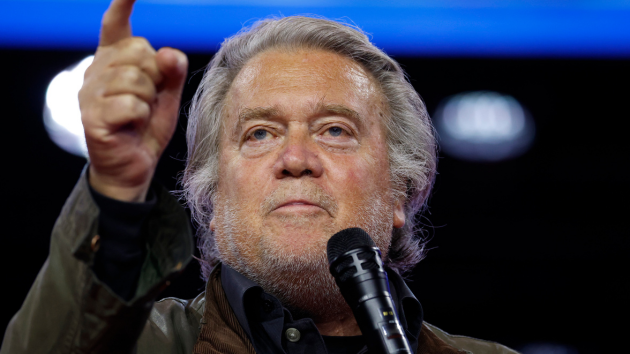
Many within Trump’s own party were opposed to striking Iran and feared the consequences, including prominent MAGA podcaster and former Trump adviser Steve Bannon.
House Minority Leader Hakeem Jeffries said that Trump “misled” the country.
“President Trump misled the country about his intentions, failed to seek congressional authorization for the use of military force and risks American entanglement in a potentially disastrous war in the Middle East,” Jeffries said in a statement.
Fears at home and abroad
In the wake of the action, the NYPD deployed officers to sensitive locations and Israel tightened rules for public gatherings.
The Center for Internet Security, a nonpartisan think tank, in an assessment to law enforcement Friday, said, “Tehran is likely to leverage a combination of direct, proxy, and irregular/inspired forces to conduct physical, cyber, or terrorist attacks against U.S. interests both at home and abroad.”
The assessment said that in the wake of Israeli strikes, Iran would rely on “crude or escalatory tactics” and that the likelihood would increase with U.S. involvement.
ABC News’ Josh Margolin contributed to this report.
This is a developing story. Please check back for updates.
Congressional leaders expressed surprise Saturday night about President Donald Trump’s announcement he had ordered a U.S. attacked on three Iranian nuclear sites, with some Republicans praising the move and some Democrats questioning the president’s authority.
South Carolina Republican Sen. Lindsey Graham, an Iran hawk, said in an X post moments after Trump announced the attack that it was “the right call.”
“The regime deserves it. Well done, President @realDonaldTrump,” he said. “To my fellow citizens: We have the best Air Force in the world. It makes me so proud.”
But the top Democrat in the House, Minority Leader Hakeem Jeffries, said Trump had “misled the country.”
“Donald Trump promised to bring peace to the Middle East. He has failed to deliver on that promise. The risk of war has now dramatically increased, and I pray for the safety of our troops in the region who have been put in harm’s way,” he said in a statement.
“President Trump misled the country about his intentions, failed to seek congressional authorization for the use of military force and risks American entanglement in a potentially disastrous war in the Middle East,” he continued.
“First, the Trump administration bears the heavy burden of explaining to the American people why this military action was undertaken. Second, Congress must be fully and immediately briefed in a classified setting. Third, Donald Trump shoulders complete and total responsibility for any adverse consequences that flow from his unilateral military action,” he added.
Independent Sen. Bernie Sanders of Vermont was on stage at one of his “Fight Oligarchy” events in Tulsa, Oklahoma, when he read a portion of President Trump’s post about the strikes to an audience that immediately began booing.
“Not only is this news this that I’ve heard this second alarming — all of you have just heard. But it is so grossly unconstitutional. All of you know that the only entity that can take this country to war is the U.S. Congress. the president does not have the right,” he added.
Rep. Rick Crawford, an Arkansas Republican and chair of the House Intelligence Committee, said in a statement that he was in touch with the White House before the attack and still monitoring the situation.
“As I have said multiple times recently, I regret that Iran has brought the world to this point. That said, I am thankful President Trump understood that the red line — articulated by Presidents of both parties for decades — was real,” he said.
At least one Republican in the House, however, questioned the president’s action without congressional authorization.
“This is not Constitutional,” GOP Rep. Tom Massie of Kentucky posted.
Rep. Jim Himes of Connecticut, the top Democrat on the House Intelligence Committee, posted on X, “According to the Constitution we are both sworn to defend, my attention to this matter comes BEFORE bombs fall. Full stop.”
“We need to immediately return to DC and vote on @RepThomasMassie and my War Powers Resolution to prevent America from being dragged into another endless Middle East war,” Rep. Ro Khanna, D-Calif., said in an X post.
House Speaker Mike Johnson was briefed ahead of the U.S. strikes on Iran’s nuclear sites, according to a source familiar with the matter.
Johnson was supposed to be in Israel Sunday to address the Knesset, but the trip was scrapped because of the ongoing conflict.
The speaker also put out a statement endorsing the strikes, calling it a “decisive” action that prevents terrorism.
Senate Majority Leader John Thune was also briefed ahead of the U.S. strikes on Iran, according to two sources familiar with the conversation.
GOP Sen. John Barrasso of Wyoming posted, “President @realDonaldTrump’s decision to strike Iran’s nuclear program is the right one. The greatest threat to the safety of the United States and the world is Iran with a nuclear weapon. God Bless our troops”
Texas Republican Sen. John Cornyn posted, “President Trump made the courageous and correct decision to eliminate the Iranian nuclear threat. God Bless the USA. Thank you to our extraordinary military and our indomitable @POTUS This is what leadership on the world stage looks like.”
Pennsylvania Democratic Sen. John Fetterman said on X, “As I’ve long maintained, this was the correct move by @POTUS. Iran is the world’s leading sponsor of terrorism and cannot have nuclear capabilities. I’m grateful for and salute the finest military in the world. 🇺🇸”
Democratic Rep. Alexandria Ocasio-Cortez of New York posted that President Trump’s strike on Iran constitutes “ground for impeachment,” saying he was “in grave violation of the Constitution” without first receiving congressional authorization.
“The President’s disastrous decision to bomb Iran without authorization is a grave violation of the Constitution and Congressional War Powers. He has impulsively risked launching a war that may ensnare us for generations. It is absolutely and clearly grounds for impeachment,” she posted.
Editor’s note: This article has been updated to note that Rep. Rick Crawford is from Arkansas and said he was in touch with the White House, not the president, before the attack.
(NEW YORK) — Columbia University activist Mahmoud Khalil landed at Newark Airport on Saturday, one day after a federal judge ordered his release from Immigration and Customs Enforcement detention.
Despite being held in detention for over three months, Khalil vowed to continue advocating for Palestinian rights.
“Even if they would kill me, I would still speak up for Palestine,” he said.
Khalil also thanked those who have supported him during his months-long detention.
“Thank you so much for everything, not only for today, just for every day. Your words of support, your messages, have kept me going,” Khalil said.
Khalil, a green card holder who is married to an American citizen, has been held in a Louisiana detention facility since he was arrested by ICE agents in New York City in March. His son was born while he was in custody.
The ruling came at the same time an immigration judge in Jena, Louisiana, denied Khalil’s request for asylum and ordered him to remain detained — but U.S. District Judge Michael Farbiarz’s order supersedes that.
When asked Saturday what his message to the Trump administration was, Khalil answered, “The fact that all these attempts to suppress pro-Palestine voices have failed now — My existence is a message. The Palestinian existence is a message to this administration.”
“Whether you are a citizen, an immigrant, anyone on this land, you’re not illegal,” he said. “That doesn’t make you less of a human. And this is what the administration is trying to do to dehumanize me, to dehumanize the immigrants, to dehumanize anyone who actually does not agree with what the administration is doing.”
Rep. Alexandria Ocasio-Cortez welcomed Khalil home to New York, at a press conference Saturday.
“Mahmoud Khalil was imprisoned for 104 days by this administration, by the Trump administration, with no grounds and for political reasons, because Mahmoud Khalil is an advocate for Palestinian human rights. He has been accused baselessly of horrific allegations simply because the Trump administration and our overall establishment disagrees with his political speech,” Ocasio-Cortez said.
“The Trump administration knows that they are waging a losing legal battle,” she said. “They are violating the law, and they know that they are violating the law, and they are trying to use these one-off examples to intimidate everyone else from not going to school, from not using their speech, et cetera. And so we hope we’ve seen that a judge has tossed out their actions, not just once, but twice, and we hope to continue to advocate for the administration to follow the law, frankly.”
Trump administration officials have said Khalil was detained for his purported support of Hamas — a claim his legal team has disputed. A memo signed by Secretary of State Marco Rubio said Khalil’s presence in the U.S. “would compromise a compelling U.S. foreign policy interest.”
The decision to release Khalil was sharply criticized by the administration.
“An immigration judge, not a district judge, has the authority to decide if Mr. Khalil should be released or detained,” the Department of Homeland Security said in a statement posted online. “On the same day an immigration judge denied Khalil bond and ordered him removed, one rogue district judge ordered him released.”
(ENDERLIN, ND) — At least three people were killed in North Dakota after severe weather swept across the region overnight, authorities said.
The Cass County Sheriff’s Office said it was dispatched to rural Enderlin, North Dakota, for tornado damage at a residence at approximately 11:40 p.m. local time on Friday night.
Once deputies arrived on the scene, the Enderlin Fire Department let them know that storm chasers had located two deceased people as a result of the tornado, according to a statement from the sheriff’s office.
“Shortly after learning of this, the Enderlin Fire Department was dispatched to another location, and a third deceased person was found as a result of the tornado,” officials said. “Deputies found extensive damage to the area and began conducting well-being checks on people with several partner agencies.”
Law enforcement, the Enderlin Fire Department, and other first responders will continue searching the area and checking on residents, the sheriff’s department said.
“The storm was still active when they responded, and was very dangerous,” Cass County Sheriff Jesse Jahner told reporters Saturday, according to ABC affiliate WDAY in Fargo, North Dakota. “And to come across the scene … people that they’re familiar with is a difficult situation.”
A long-lived destructive thunderstorm event, known as a “derecho” had slammed an area more than 300 miles long with wind gusts between 70 and up to 106 mph.
Nine tornadoes were reported with these strong thunderstorms in eastern North Dakota, and greater than baseball-sized hail was also seen from eastern Montana to northwestern Minnesota.
Heavy rain from the storm complex also produced spotty flash flooding, which prompted multiple water rescues in Fargo.
(WASHINGTON) — By the time President Donald Trump and MAGA podcaster Steve Bannon sat down for lunch on Thursday, the president had already approved a plan on how the U.S. might attack an Iranian nuclear facility.
American diplomats and their family members were being offered military evacuations from Israel, while the military began moving aircraft and ships to the region.
The USS Nimitz – an aircraft carrier that can carry some 60 fighter jets – was set to arrive in the Middle East by the weekend with several smaller ships by its side.
Officials said the extraordinary show of force would be needed if Trump pulled the trigger on the military option – both to strike Iran’s deeply buried nuclear facility and to protect the some 40,000 U.S. troops who Iran and proxy militant groups could target for retaliation.
Trump had just emerged from a meeting with advisers in the Oval Office, where sources say he was warned: A U.S. attack on a key Iranian nuclear facility could be risky, even with a massive “bunker-buster” bomb believed to be able to penetrate some 200 feet through hardened earth.
The bomb, known as the Massive Ordnance Penetrator, had only been tested, but never used in a real-life tactical situation, experts say. And the exact nature of the concrete and metal protecting the Iranian nuclear site known as Fordo isn’t known, introducing the chance that a US strike would poke a hornet’s nest without destroying it.
Bannon, who had already spoken with the president by phone ahead of their lunch, thought all of it was a bad idea, according to several people close to him.
Sources say he arrived at the White House for his previously scheduled lunch with Trump armed with specific talking points: Israeli intelligence can’t be trusted, he planned to say, and the bunker-buster bomb might not work as planned. The precise risk to the U.S. troops in the Middle East, particularly the 2,500 in Iraq, also wasn’t clear if Iran retaliated, he would add.
A White House official insists that by the time Trump sat down with Bannon for lunch the president had already made a decision to hold off on a strike against Iran. That decision was relayed to White House Press Secretary Karoline Leavitt who then went to the podium, telling reporters the president would decide “whether or not to go” within two weeks.
Another senior administration official dismissed the idea that the “bunker-buster” bomb might not work.
“This Administration is supremely confident in its abilities to dismantle Iran’s nuclear program. No one should doubt what the U.S. military is capable of doing,” the official said.
Still, Bannon’s extraordinary access to Trump this week to discuss a major foreign policy decision like Iran is notable considering Bannon holds no official role in the military or at the State Department. Bannon declined to comment on his lunch with Trump, saying only Israeli Prime Minister Benjamin Netanyahu “needs to finish what they started.”
“Bannon in a lot of ways has been – day in and day out – delivering a very, very tough and clear message” against military action, said Curt Mills, executive director of The American Conservative, who also opposes military action in Iran.
That strategy, Mills said, has been key to countering other Trump loyalists who favor teaming up with Israel for a strike.
“You can call it infantile. You can call it democratic, or both,” Mills told ABC News. “This is a White House that is responding in real time to its coalition [which is] revolting to show it’s disgusted with the potential of war with Iran.”
At odds with Bannon’s viewpoint on Iran are other influential conservatives.
“Be all in, President Trump, in helping Israel eliminate the nuclear threat,” Sen. Lindsey Graham, R-South Carolina, told Fox News host Sean Hannity this week. “If we need to provide bombs to Israel, provide bombs. If we need to fly planes with Israel, do joint operations.”
According to one U.S. official, Defense Secretary Pete Hegseth mostly ceded the discussion to military commanders, including Gen. Erik Kurilla, commander of military forces in the Mideast, and Gen. Dan Caine, chairman of the Joint Chiefs of Staff, who have spent considerable time talking with Trump by phone and in person in recent weeks about his options with Iran and the risks involved, which can be extraordinarily complicated.
“Anybody will tell you the biggest threat to the region is a nuclear-armed Iran,” the official said. “No one wants Iran to have a nuke.”
Sean Parnell, chief Pentagon spokesperson, pushed back on the suggestion Hegseth hasn’t taken a lead role in the talks, calling it “completely false.” He said Hegseth speaks with Trump “multiple times a day each day,” and attended meetings with the president in the Situation Room.
“Secretary Hegseth is providing the leadership the Department of Defense and our Armed Forces need, and he will continue to work diligently in support of President Trump’s peace through strength agenda,” Parnell said.
Sources say Secretary of State Marco Rubio, who is also the president’s interim national security adviser, has been another constant presence at the president’s side during the discussions along with Trump’s Mideast adviser Steve Witkoff.
Once seen as one of Trump’s most hawkish cabinet members, Rubio espoused a hardline stance on Iran for years and warned last month that the country was now “a threshold nuclear weapons state.”
But since then, sources say, Rubio has become much more closely aligned with MAGA’s “America First,” noninterventionist stance, adding that he is acutely aware of the political repercussions that a direct attack on Iran could bring about.
U.S. and Israeli intelligence agree that Iran has been enriching uranium to a dangerously high concentration and could quickly amass enough of it to build several nuclear weapons.
But U.S. intelligence also cautions that its supreme leader, Ayatollah Ali Khamenei, hasn’t given the order to build those devices. The question now is how soon Iran could declare itself a nuclear power after that decision was made.
The uncertainty has drawn comparisons in MAGA circles to faulty intelligence in Iraq, which supporters of the movement blame for the lengthy war.
Tulsi Gabbard, Trump’s director of national intelligence, who has warned on social media of “warmongers,” told Congress this spring that “Iran is not building a nuclear weapon.” When asked Friday about that assessment, Trump responded that the intelligence community “is wrong” and “she’s wrong.” Gabbard later said her testimony was being taken out of context.
“America has intelligence that Iran is at the point that it can produce a nuclear weapon within weeks to months, if they decide to finalize the assembly. President Trump has been clear that can’t happen, and I agree,” she wrote in a post on Friday.
Sources say another factor could have played a role in Trump’s decision to hold off on striking Iran for now despite his insistence that Iran was close to a nuclear bomb. A third aircraft carrier, the USS Gerald R. Ford and its guided-missile destroyers are set to deploy early next week to head toward Europe, according to the Navy.
The carrier strike group needs time to travel before it could be in a position to help protect troops in theater should Trump opt to move ahead with the strike two weeks from now.
Officials caution that any success Bannon might have in pulling the president back from the brink of war could be brief. When asked on Friday by reporters if he would ask Israel to stop bombing Iran to enable diplomatic negotiations, Trump said probably not.
“If someone is winning, it’s a little bit harder to do than if someone is losing,” Trump said of the Israelis.
“But we’re ready, willing and able and have been speaking to Iran and we’ll see what happens. We’ll see what happens.”
ABC News’ Beatrice Peterson contributed to this report.
Editor’s note: This story has been corrected to reflect that Thursday’s meeting took place in the Oval Office, not the Situation Room.