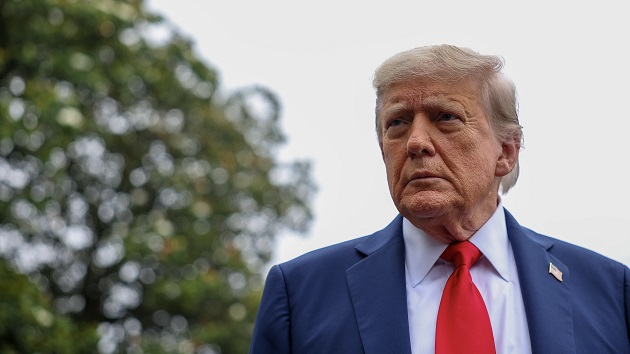
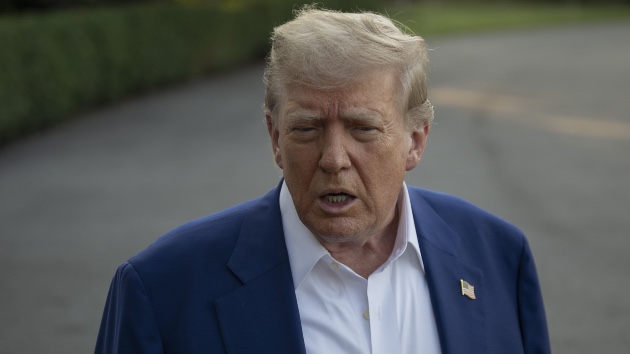
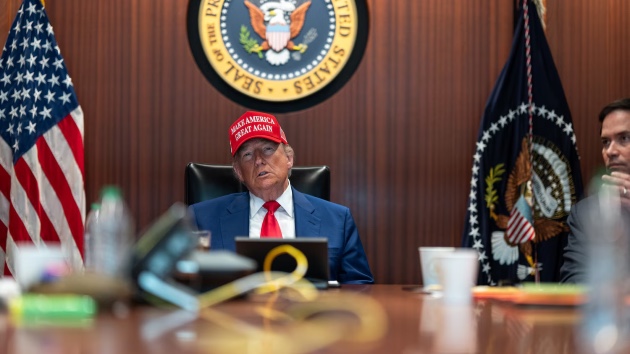
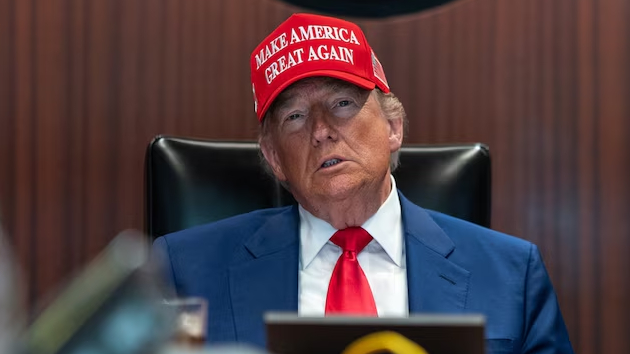
(WASHINGTON) — President Donald Trump on Tuesday morning had strong words for Israel and Iran as he accused both nations of violating a ceasefire agreement he announced just the night prior.
“We basically have two countries that have been fighting so long and so hard, that they don’t know what the f— they’re doing. Do you understand that?” Trump told ABC News Senior Political Correspondent Rachel Scott when asked if both nations were committed to peace.
Trump was clearly frustrated as he spoke with reporters before departing the White House for a NATO summit at The Hague in the Netherlands.
“Israel says Iran violated the peace agreement and the ceasefire agreement. Do you believe that Iran is still committed to peace?” Scott asked the president.
“I do, yeah. They violated it but Israel violated it, too,” Trump responded.
Scott then asked Trump if he was questioning Israel’s commitment to peace.
“Israel as soon as we made the deal, they came out and dropped a boat load of bombs the likes of which I’ve never seen before,” Trump said. “The biggest load that we’ve seen, I’m not happy with Israel. Ok, when I say now you have 12 hours, you don’t go out in the first hour and just drop everything you have on them. So I’m not happy with him. I’m not happy with Iran either.”
Neither Iran nor Israel have publicly commented on Trump’s remarks about the apparent ceasefire violations.
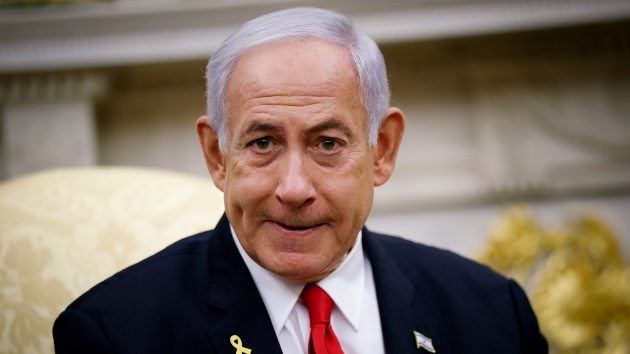
Trump spoke with Israeli Prime Minister Benjamin Netanyahu on Tuesday morning, sources familiar with the call told ABC News.
A White House source provided a brief readout of the call: “President Trump was exceptionally firm and direct with Prime Minister Netanyahu about what needed to happen to sustain the ceasefire. The Prime Minister understood the severity of the situation and the concerns President Trump expressed.”
Trump said on social media Monday evening that Israel and Iran had agreed to a ceasefire, signaling a possible end to nearly two weeks of escalating air assaults by the two countries.
The agreement described by Trump involved two 12-hour ceasefire periods, starting at about 12 a.m. EDT starting with Iran. That would come “when Israel and Iran have wound down and completed their in progress, final missions,” Trump said in the post.
Israel would then follow with a second 12-hour ceasefire, Trump said.
After 24 hours, the war would be officially declared ended, according to Trump.
A man in Washington state was rescued after falling from a tree and spending four to five days in the woods, according to the Kitsap County Sheriff’s Office. Kitsap County Sheriff’s Office
(POULSBO, Wash.) — A Washington state man who was “stuck in the woods for days” after falling from a tree was rescued and is now recovering, according to the Kitsap County Sheriff’s Office.
The man was found on Saturday in Poulsbo, Washington — located in the Puget Sound region — after someone nearby called 911 when they heard a “voice in the woods calling for help,” the sheriff’s office said in a statement.
When a deputy arrived on the scene, he could hear a “faint, distressful voice” of a man saying “he had fallen from a tree,” the sheriff’s office said.
Officials and canines began a search and rescue operation, and after “combing through the area,” they were able to locate the man at approximately 7 a.m. on Saturday, the sheriff’s office said.
Once rescued, the man told authorities he had been lost for four to five days “while trying to take a shortcut through the woods,” officials said.
He was taken to St. Michael’s Medical Center for evaluation and treatment, officials said.
(NEW YORK) — Consumer confidence soured in June, erasing some of the boost in shopper attitudes that took hold last month as President Donald Trump rolled back tariffs, Conference Board data on Tuesday showed. The reading fell short of economists’ expectations.
The fresh data resumes a trend of worsening consumer confidence that stretches back to the outset of 2025. Last month, a burst of enthusiasm appeared to snap the malaise but fresh data suggests shoppers remain concerned about the path of the U.S. economy.
The decline in consumer confidence took hold across all age, income demographics and political affiliations, the Conference Board said, noting an especially large dropoff among Republicans.
“Consumer confidence weakened in June, erasing almost half of May’s sharp gains,” Stephanie Guichard, senior economist for global indicators at the Conference Board, said in a statement.
In recent weeks, Trump has dialed back some of his steepest levies, easing costs imposed upon companies and alleviating concern about a sharp surge of inflation. Importers typically pass along a share of the higher tax burden in the form of price hikes.
A trade agreement last month between the U.S. and China slashed tit-for-tat tariffs between the world’s two largest economies and triggered a surge in the stock market. Within days, Wall Street firms softened their forecasts of a downturn.
Still, an across-the-board 10% tariff applies to nearly all imports, except for semiconductors, pharmaceuticals and some other items. Those tariffs stand in legal limbo, however, after a pair of federal court rulings late last month.
Warning signs point to the possibility of elevated prices over the coming months, however.
Nationwide retailers like Walmart and Best Buy have voiced alarm about the possibility they may raise prices as a result of the levies.
The Organization for Economic Co-operation and Development, or OECD, said this month it expects U.S. inflation to reach 4% by the end of 2025, which would mark a sharp increase from current levels.
Federal Chair Jerome Powell, in recent months, has warned about the possibility that tariffs may cause what economists call “stagflation,” which is when inflation rises and the economy slows.
Stagflation could put the central bank in a difficult position. If the Fed were to raise interest rates, it could help ease inflation, but it may risk an economic downturn. If the Fed were to cut rates in an effort to spur economic growth, the move could unleash faster price increases.
The Federal Reserve held its benchmark interest rate steady last week, continuing a wait-and-see approach adopted by the central bank in recent months as it observes the potential effects of tariffs.
Speaking at a press conference in Washington, D.C., Powell said tariffs would likely “push up prices and weigh on economic activity” over the course of this year. But, he added, the effects would depend on the “ultimate level” of tariffs, which have frequently fluctuated.
“For the time being, we are well positioned to wait to learn more about the likely course of the economy before considering any adjustments to our policy stance,” Powell said.
(LONDON) — Police in France say that 14 people have been arrested after 145 people reported being ‘pricked’, possibly by syringes, at a nationwide music festival on Saturday.
Most of the victims were women and the attacks happened during France’s annual “Festival of Music” — Fête de la Musique — which is a series of musical events in towns and cities across the country.
The 145 people who were either pricked, or believe they were pricked, were typically attacked when they were in a crowd and were pricked either in the arm or the back, police say. Most of the victims didn’t see their attacker.
Victims reported feeling an array of symptoms such as hot flushes, dizziness, loss of consciousness and visible marks or bruises on their skin.
Some victims were treated by medics at the festival, but some were taken to hospital where they gave saliva, urine and blood samples to detect whether they had been injected with substances, according to police.
It is not yet clear whether substances have been detected following those tests.
In a video posted on X on Monday evening, French police said they have so far arrested 14 suspects in connection with the attacks.
French police are now warning people attending future events to be vigilant and to seek help immediately if they feel any symptoms. They have also urged people to contact the police and visit a hospital to be tested for any potential substances.
Just before the Festival of Music, a French feminist influencer had posted on social media warning women that men were threatening to prick people during Saturday’s nationwide event in France.
The investigation into the incident is currently ongoing.
(NEW YORK) — The Fourth of July holiday is fast approaching — and it’s going to be a busy one.
A record high of 72.2 million people are expected to travel at least 50 miles from home over the July Fourth holiday period (from June 28 to July 6), according to AAA. This is 1.7 million more people than last year and 7 million more than in 2019, according to AAA.
Here’s what you need to know before you to head to the airport or hit the highway:
Air travel
AAA anticipates a record 5.84 million passengers will fly domestically over the holiday — a 1.4% jump from last year.
Domestic airfare is averaging $260 round trip — the lowest price in four years, according to Hopper. International airfare is down, as well, with round trip tickets to Europe averaging $840.
Thursday, July 3, will be the busiest day to leave for the holiday, according to Hopper and Expedia. Tuesday, July 8, will be the least busy and most affordable day to fly home, Expedia found.
United Airlines said it projects Friday, June 27, and Thursday, July 3, to be its busiest days with about 580,000 passengers each day.
Expedia said its most popular destinations are Las Vegas; New York City; Miami; Orlando, Florida; and Cancun, Mexico. Los Angeles and Seattle are also top cities, according to Hopper.
Road travel
This year is expected to be the busiest Independence Day ever on the roads. AAA projects 61.6 million people will travel by car — a 2.2% increase from last year.
But good news for drivers: Summer gas prices are the lowest they’ve been since 2021, according to AAA.
(NEW YORK) — The U.S. Marshals in Florida have led a missing child operation this month that “resulted in the recovery or safe location of 60 critically missing children,” across the state, officials said.
The U.S. Marshals Service Middle District of Florida — working with a number of law enforcement partners — launched Operation DRAGON EYE, a two-week initiative geared to “recover or safely locate the most critically missing youth” that the U.S. Marshals are calling “the most successful missing child operation in USMS history,” according to a statement from the U.S. Marshals Service on Monday.
“This operation had three primary objectives: recover critically missing youth, provide them with essential services including appropriate placement, and to deter bad actors exploiting missing child vulnerabilities,” officials said in their announcement of the results of the operation. “DRAGON EYE resulted in eight arrests, including charges of human trafficking, child endangerment, narcotics possession, and custodial interference.”
Authorities said that Operation DRAGON EYE was the product of a “multidisciplinary task force of federal, state, and local government agencies, as well as social service entities, the medical community, and non-governmental organizations.”
The USMS defines “critically missing” children as those at risk of crimes of violence or those with other elevated risk factors such as substance abuse, sexual exploitation, crime exposure, or domestic violence, authorities said, and recovered children were provided with medical resources, nourishment, social services and child advocates.
Officials working on Operation DRAGON EYE said they are proud of this operation’s achievements which located children across Hillsborough, Pinellas and Pasco counties in Florida.
“I have to curtail my enthusiasm because of the sensitivity of the victims involved in this operation, but the successful recovery of 60 missing children, complemented with the arrest of eight individuals, including child predators, signifies the most successful missing child recovery effort in the history of the United States Marshals Service; or to my knowledge, any other similar operation held in the United States,” said William Berger, U.S. Marshal for the Middle District of Florida. “The unique part of this operation was the fact that underaged critically missing children ranging from age 9 to 17 were not only recovered but were debriefed and provided with physical and psychological care. This operation further included follow-up assistance in hopes that these youth will not return to the streets to be further victimized.”
Said Callahan Walsh, Executive Director, National Center for Missing & Exploited Children: “The success of Operation DRAGON EYE is a testament to what’s possible when agencies unite with a shared mission to protect children,” “We’re proud to have supported the U.S. Marshals Service and our partners in Florida to recover these missing children and provide critical support to those who need it most. NCMEC is honored to stand alongside these teams and will continue working tirelessly to help make sure that every child has a safe childhood.”
(WASHINGTON) — President Donald Trump departed early Tuesday for the NATO summit in The Hague, Netherlands, just days after he made the decision to launch strikes on Iranian nuclear sites and hours after he announced a ceasefire in the Israel-Iran conflict. It will be the first time Trump will face European U.S. allies since returning to the White House in January.
On the eve of Trump’s departure, Iran carried out retaliatory strikes at a U.S. base in Qatar. Trump said Monday that 13 of those missiles were intercepted and a 14th was off target.
“I am pleased to report that NO Americans were harmed, and hardly any damage was done,” Trump posted on social media, adding that Iran gave the U.S. “early notice.”
Then hours later, Trump posted on his social media platform that the two countries had agreed to a ceasefire that would end hostilities.
“This is a War that could have gone on for years, and destroyed the entire Middle East, but it didn’t, and never will!” Trump posted early Monday evening.
But as left the White House, Trump told ABC News on Tuesday he is “not happy” with either Israel or Iran after the opening hours of a nascent ceasefire between the two combatants were marred by reported exchanges.
Trump said Iran and Israel both “violated” the ceasefire.
“Israel, as soon as we made the deal, they came out and dropped a boat load of bombs the likes of which I’ve never seen before,” Trump said. “The biggest load that we’ve seen, I’m not happy with Israel.”
“OK, when I say now you have 12 hours, you don’t go out in the first hour and just drop everything you have on them,” the president added. “So, I’m not happy with him. I’m not happy with Iran either.”
Trump said he was “unhappy if Israel is going out this morning because of one rocket that didn’t land, that was shot perhaps by mistake, but didn’t land,” referring to Israeli allegations — denied by Tehran — that Iran fired missiles toward Israel on Tuesday after the ceasefire came into effect.
The conflict will undoubtedly loom large over this summit just as it did with the G7 summit in Canada last week — which Trump left early to monitor the growing crisis between Israel and Iran back at the White House.
The trip will be brief. Trump is expected to leave the White House early Tuesday morning and return to the U.S. on Wednesday evening. Upon his arrival in the Netherlands on Tuesday night, Trump will head straight into the pomp and circumstance. He will attend a formal dinner at the Netherlands Royal Palace alongside the King and Queen of the Netherlands. He will also take a NATO family photo that evening.
On Wednesday, Trump will attend the NATO summit where he will participate in a NATO family photo, a photo spray at the top of NATO Secretary General Mark Rutte’s remarks and then the first plenary session with NATO leaders. The president will then spend a few hours engaged in bilateral meetings, although it is not not yet known which leaders he plans to meet with on the sidelines of the summit. Trump will then hold a news conference where he will surely face questions about his order to strike Iranian nuclear sites and the impact of that mission. After the news conference, Trump is set to leave the Netherlands and return to the U.S.
Trump is going into the conference with a key priority: he wants the alliance to codify an increase in defense spending across all member nations, from 2% of their gross domestic product to 5%. This has been a signature issue for Trump well before the new Middle East conflict. The president has long complained that the U.S. has been subsidizing the defense of its allies — and has even gone so far as threatening that he would not come to the defense of nations not fully paying their way, a radical departure from NATO’s Article 5, which says an attack on one is an attack on all.
Trump’s criticisms go back as far as the 2017 NATO summit, when he accused his European counterparts of failing to pay what he said was their “fair share.”
Though Trump’s top advisers have signaled confidence that the 5% threshold will be agreed to by a vote at this year’s summit, some nations like Spain have other plans. Spain’s prime minister announced over the weekend that it forged an agreement that will allow it to remain in NATO without meeting the new defense spending threshold, instead contributing only 2.1% of the nation’s GDP.
Trump has a few other aims for the conference, including urging alliance members to revitalize their industrial capacities for critical minerals and weapons and bilateral meetings with world leaders to reaffirm a commitment to allies, a senior administration official said last week in a call previewing the trip.
In the time since Trump last attended a NATO summit, Russia invaded Ukraine. The war in Ukraine has raged on for more than three years and Trump has repeatedly claimed it would not have happened if he were in office. He has also blamed the war on Ukraine’s desire to join NATO. Ukrainian President Volodymyr Zelenskyy has been a featured guest at NATO summits since the war, including the one former President Joe Biden hosted in Washington last year, but it’s reported that Zelenskyy’s involvement will be limited this year — including not having a seat at the table.
This is also Trump’s first NATO summit of his second term, a reemergence in the alliance that he sharply criticized during his first term. It also comes after many NATO leaders have already returned to the White House for bilateral meetings to discuss key issues and to gain favor with Trump. Under the shadow of the growing conflict in the Middle East, world leaders will be watching closely for how Trump will enact his America First policy in his second term and how that policy will impact American alliances overseas.
ABC News’ Rachel Scott and Aïcha Elhammar contributed to this report.
Israeli Prime Minister Benjamin Netanyahu/ Kevin Dietsch/Getty Images)
(WASHINGTON) — President Donald Trump said on social media Monday evening that Israel and Iran had agreed to a ceasefire, signaling a possible end to nearly two weeks of escalating air assaults by the two countries.
The agreement described by Trump involved two 12-hour ceasefire periods, starting at about 12 a.m. EDT starting with Iran. That would come “when Israel and Iran have wound down and completed their in progress, final missions,” Trump said in the Truth Social post.
Israel would then follow with a second 12-hour ceasefire, Trump said.
After 24 hours, the war would be officially declared ended, according to Trump.
“On the assumption that everything works as it should, which it will, I would like to congratulate both Countries, Israel and Iran, on having the Stamina, Courage, and Intelligence to end, what should be called, ‘THE 12 DAY WAR,'” Trump wrote in the post. In the immediate aftermath of Trump’s announcement, neither Israeli nor Iranian officials publicly commented on the proposal.
In the final hours before the ceasefire was set to go into effect, under the terms described by Trump, Israel said Iran had launched a barrage of missiles, killing at least three people.
Earlier, in a post on social media, Iran’s foreign minister, Abbas Araghchi had denied there was a ceasefire agreement. However, he said if Israel halted its strikes by 4 a.m. Tehran time (8:30 p.m. EDT) “we have no intention to continue our response afterwards.”
Araghchi said a final decision “on the cessation of our military operations” would be made later and he thanked Iranian armed forces who he said “responded to any attack by the enemy until the very last minute.”
Trump’s surprise ceasefire announcement came two days after the U.S. joined Israel’s war, launching strikes on three Iranian nuclear targets.
The war began June 12 when Israel launched a series of strikes against Iran that included dozens of military targets, including the country’s nuclear program. Defending what it called a “preemptive” strike, Israel cited intelligence that it said indicated Iran had “significantly advanced” toward obtaining a nuclear weapon — claims Iran denied.
Earlier Monday, Iran fired missiles targeting Al Udeid Air Base in Qatar — the largest U.S. military base in the region — raising concerns about potential escalation after the U.S.. However, a U.S. official told ABC News the U.S. intercepted the missiles with assistance from Qatar and Trump, who called the response “very weak,” struck a de-escalatory tone on social media. One source later called Iran’s move a “failed retaliation.”
(WASHINGTON) — President Donald Trump’s strike against Iran will be met with pushback on Capitol Hill this week as some lawmakers argue the military action was unconstitutional.
There are several bipartisan resolutions that could receive a vote in coming days that may put some lawmakers in uncomfortable positions as they consider whether Trump ignored the role of Congress in striking Tehran.
It’s unlikely though, at this stage, that Trump’s rank-and-file Republican base will broadly abandon him by supporting these bills. If any were to make it to Trump’s desk, there likely wouldn’t be enough votes to override his veto.
“I don’t think this is an appropriate time for a war powers resolution, and I don’t think it’s necessary,” House Speaker Mike Johnson told reporters Monday afternoon at the Capitol.
Fears of escalation ramped up on Monday as Iran retaliated against the U.S. with a missile attack on a U.S. military base in Qatar. The missiles were intercepted and there were no immediate reports of casualties at the base, according to U.S. officials.
Johnson said it’s up to Trump whether the United States responds to Iran’s attempt to retaliate on Monday.
“The president warned them not to retaliate, but he was also very clear that the threat of Iran obtaining nuclear capability is a threat not just to Israel and the Middle East, but to the United States as well. They’ve been very clear about their intentions and how much they hate us,” Johnson said. “The president made an evaluation that the danger was imminent enough to take his authority as commander in chief.”
House Minority Leader Hakeem Jeffries expressed skepticism about Trump’s decision to strike Iran’s nuclear sites over the weekend.
“We’ve seen no evidence to date that an offensive strike of this nature was justified under the War Powers Act or the Constitution,” Jeffries said at a news conference in the Capitol on Monday. “And what I can say is not a scintilla of evidence to date has been presented that I have seen to justify the notion that there was an imminent threat to the United States of America.”
Trump’s decision to hit Iran in the stated aim of wiping out its nuclear capabilities follows a decades-long pattern of presidents taking military action and not waiting for Congress to sign off. Other examples include Joe Biden’s airstrikes in Syria in 2021, Barack Obama’s military campaign against ISIS in Syria and Iraq as well as George H.W. Bush’s invasion of Panama.
House and Senate lawmakers are expected to receive briefings on the Iran strike on Tuesday.
Trump faces bipartisan blowback
Republican Rep. Thomas Massie and Democratic Rep. Ro Khanna introduced a War Powers Resolution last week to prohibit “United States Armed Forces from unauthorized hostilities in the Islamic Republic of Iran.”
Democratic Sen. Tim Kaine is leading a similar Senate resolution, which could come up sometime this week as the chamber tries to move forward with a megabill to fund much of Trump’s domestic policy agenda.
All three appeared on “Face the Nation” on CBS News on Sunday to make their case.
Massie contended there was “no imminent threat to the United States” that would authorize the president to strike Iran without congressional approval.
Kaine similarly said: “This is the U.S. jumping into a war of choice at Donald Trump’s urging without any compelling national security interests for the United States to act in this way, particularly without a debate and vote in Congress. We should not be sending troops and risking troops’ lives in an offensive war without a debate in Congress.”
Kaine added that he hopes Republicans push back.
“I know many Republicans will fall in line and say a president can do whatever he wants. But I hope members of the Senate and the House will take their Article I responsibilities seriously,” the Virginia Democrat said.
Khanna warned there is a possibility the strike is not a one-time occurrence.
“There are people who want regime change in Iran. And they are egging this president on to bomb. I hope cooler heads will prevail,” Khanna said on CBS. “We need to pass Thomas Massie and my War Powers Resolution to make it clear that we’re not going to get further entrenched into the Middle East.”
Trump lashed out at Massie in a lengthy social media post on Sunday, writing the Republican congressman is “not MAGA” and that “MAGA doesn’t want him” and “doesn’t respect him.” Trump said he’ll campaign for Massie’s Republican primary opponent in the next election.
Congress has twice before called out Trump on his use of military force without congressional approval.
In 2019, Congress approved a bill to end U.S. support for the war in Yemen, which Trump vetoed. In 2020, Trump ordered the drone strike that killed top Iranian general Qassem Soleimani. In response, Congress passed legislation seeking to limit a president’s ability to wage war against Iran, which was again quickly rejected by Trump.
What is the 1973 War Powers Resolution?
The legislation introduced by Massie and Khanna seeking to limit Trump’s ability to take U.S. military action against Iran cites the 1973 War Powers Resolution, which states that the president “in every possible instance shall consult with Congress before introducing United States Armed Forces into hostilities or into situation where imminent involvement in hostilities is clearly indicated by the circumstances.”
It also states that in the absence of a declaration of war but when armed forces are introduced, the president must report to Congress within 48 hours the circumstances necessitating their introduction and must terminate the use of U.S. armed forces within 60 days unless Congress permits otherwise. If approval is not granted and the president deems it an emergency, then an additional 30 days are granted for ending operations.
Trump admin says strike was legally justified
Top officials defended the military action over the weekend. Defense Secretary Pete Hegseth said the administration “complied with the notification requirements” of the War Powers Resolution, saying members of Congress were notified “after the planes were safely out.”
Vice President JD Vance and Secretary of State Marco Rubio also sought to emphasize the U.S. is not at war with Iran.
Trump, though, warned that more strikes could come if Iran doesn’t negotiate a deal.
“If peace does not come quickly, we will go after those other targets with precision, speed and skill,” he said in his address to the nation on Saturday night.
Republican Sen. Lindsey Graham, a vocal supporter of military action against Iran leading up to Trump’s decision, argued on NBC News that Trump has all the authority he needs under Article II of the Constitution.
“Congress can declare war or cut off funding,” Graham said. “We can’t be the commander in chief. You can’t have 535 commanders-in-chief.”
The administration could also cite an existing military authorization as grounds for legal justification for striking against Iran.
The 2001 Authorization for Use of Military Force (AUMF) is a joint resolution passed by Congress that authorized counterterrorism operations by U.S. military forces against those responsible for the 9/11 attacks. Congress passed another AUMF targeting Iraq in 2002. Both have since been cited to authorize military force in more than 20 countries, including Afghanistan, Iraq, Syria and Somalia due to the broad language in the resolutions.
Critics have often said the 2001 and 2002 AUMFs grant the president powers to unilaterally wage “perpetual worldwide wars” and some lawmakers have been keen to repeal it — but those efforts have all been unsuccessful.
ABC News’ John Parkinson and Lauren Peller contributed to this report.
(WASHINGTON) — President Donald Trump warned Iran against retaliation several times following U.S. strikes against Tehran’s nuclear facilities on Saturday night.
On Monday, Iran fired missiles targeting Al Udeid Air Base in Qatar — the largest U.S. military base in the region, raising concerns about escalation. A U.S. official told ABC news the U.S. intercepted Iranian missiles with assistance from Qatar.
President Trump was meeting on Monday with his national security team in the Situation Room and has not yet responded to Iran’s retaliatory attack.
In his address to the nation on Saturday night regarding the U.S. strikes against Iran, Trump cautioned Tehran not to hit back.
“Iran, the bully of the Middle East, must now make peace. If they do not, future attacks would be far greater and a lot easier,” Trump said.
“There will be either peace, or there will be tragedy for Iran, far greater than we have witnessed over the last eight days,” Trump said, referencing the aerial strikes exchanged between Israel and Iran in the days leading up to U.S. involvement.
“Remember, there are many targets left,” Trump added. “Tonight’s was the most difficult of them all, by far, and perhaps the most lethal. But if peace does not come quickly, we will go after those other targets with precision, speed and skill. Most of them can be taken out in a matter of minutes.”
Trump issued a similar message in all capital letters on social media: “ANY RETALIATION BY IRAN AGAINST THE UNITED STATES OF AMERICA WILL BE MET WITH FORCE FAR GREATER THAN WHAT WAS WITNESSED TONIGHT.”
Vice President JD Vance was further asked about the possibility of retaliation from Iran during an appearance on ABC News’ “This Week” on Sunday.
Vance said “what happens next is up to the Iranians.”
“If they’re willing to choose the smart path, they’re certainly going to find a willing partner in the United States to dismantle that nuclear weapons program,” Vance said. “But if they decide they’re going to attack our troops, if they decide they’re going to continue to try to build a nuclear weapon, then we are going to respond to that with overwhelming force.”
Top administration officials said over the weekend the U.S. was prepared for potential action from Iran.
Joint Chiefs Chairman Gen. Dan Caine told reporters on Sunday that before the U.S. strike against Iran on Saturday, the military elevated force protection measures across the region.
While the administration says it is not interested in a wider war with Iran, Trump’s strikes against Tehran on Saturday prompted concern about the potential for escalation from Democrats and some Republicans.
This week, some lawmakers may try to advance bipartisan resolutions seeking to limit Trump’s war powers and prohibit U.S. forces from unauthorized hostilities with Iran, though those measures face an uphill battle in the GOP-controlled Congress.