(PHILADELPHIA, Pa. ) — Pennsylvania is experiencing “intermittent” statewide 911 outages, officials confirmed on Friday.
The Pennsylvania Emergency Management Agency confirmed on social media there are “some outages” and they are working to resolve the issue and restore service.
“Please only call 911 for true emergencies. Do not call just to check whether it is working,” the agency said.
The Philadelphia Police Department said the outage is “intermittent” and that “some calls are still successfully going through.”
The outage may impact that the ability of some residents to reach emergency services through the traditional 911 system, police said.
If residents are unable to reach 911, police urge residents to call their local Philadelphia Police District directly.
This is a developing story. Please check back for updates.
(WASHINGTON) — The State Department is sending formal layoff notices to 1,107 civil service employees and 246 foreign service officers with domestic assignments, according to internal department communication reviewed by ABC News.
All notifications for civilian service employees and foreign service officers are expected to go out by the end of the day on Friday, according to the communication.
Impacted civil service employees will generally be placed on 60 days of administrative leave before termination, while foreign service officers will be placed on administrative leave for 120 days and then separated from the department.
Officials say more areas of the department were impacted than originally anticipated. ABC News was told that the workforce reduction includes multiple employees within the population, refugees and migration wings of the State Department and within the diplomatic security bureau.
There were also many cuts from the areas of the department that were anticipated, including its energy resources and conflict and stabilization operations wings, the Office to Monitor and Combat Trafficking in Persons and the Office of Global Women’s Issues. Other impacted areas include Bureau of Democracy, Human Rights, and Labor, the Bureau of Oceans and International Environmental and Scientific Affairs, the Bureau of Educational and Cultural Affairs, and the Bureau of International Organization Affairs, officials said.
In all, 3,000 employees are expected to depart as part of the reduction in force, according to the communication, but that number also includes voluntary departures.
Department leadership previously emphasized that they wanted to handle the layoffs with care, individually notifying each impacted employee; however, many are learning of the change in their employment status by seeing a downloadable Official Personnel Folder that was added to an online human resources portal in the overnight hours.
Employees have been informed they will lose access to the building, their email and some applications by the end of the day. Boxes for personal effects are being distributed at multiple points across the State Department’s campus. The department has also set up “Transition Day Out Processing” stations through the department
Impacted employees are also being instructed to send their teams a “brief update” on their projects, leave any hard files in their work area and to set an out-of-office message.
While these layoffs are focused of the domestic work force, they are based on personnel assignments on May 29 of this year. As such, a limited number of the impacted employees have been transferred abroad between then and now. They are being told to follow checkout procedures at their respective posts.
The State Department released a letter to all employees Thursday evening informing them that the department was officially moving to implement a “targeted reduction in domestic workforce.”
“Soon, the Department will be communicating to individuals affected by the reduction in force. First and foremost, we want to thank them for their dedication and service to the United States,” the letter, signed by Deputy Secretary for Management and Resources Michael Rigas, reads.
The letter advised that once these notifications have taken place, the department will go into the “final stage” of reorganization, where the new organizational chart unveiled by Secretary of State Marco Rubio earlier in the year will fully take effect.
Senior State Department officials described the changes as “the most complicated reorganization in government history,” emphasizing that the cuts were largely made to eliminate Cold War-era redundancies as well as eliminating functions that were “no longer aligned with the president’s foreign policy priorities.”
“At the end of the day, we have to do what’s right for the mission,” one senior official said.
“There’s a tremendous amount of sort of unnecessary bureaucracy,” the second official asserted.
The State Department previously reported to Congress that it would aim to reduce its domestic workforce by around 15% as part of the reorganization. However, the senior officials specified that more than half of that goal would be met through “voluntary reductions” — people who elected to take the deferred resignation plan offered through the “Fork in the Road” emails earlier this year.
The officials also said the department did not have current plans to reduce its force overseas.
“The secretary wants to take this one step at a time,” one official said.
The officials also defended the department’s decision to cut some highly trained foreign service officers rather than reassign them.
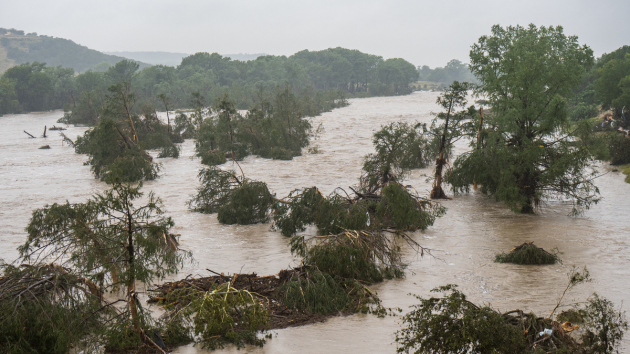
(Texas) — Central Texas is continuing to recover from one of the deadliest floods in the state’s history, which killed more than 120 people, many of whom were children.
While there is an economic toll from floods due to the damage it causes to property, commerce and transportation, there is a risk to public health as well.
Although rainwater is not harmful, flooding increases the risk of injury, illness and death. Heavy rainfall can cause waterways to overflow and overwhelm sewer and septic systems, environmental health experts told ABC News.
Floodwaters can be contaminated with debris, as well as high levels of bacteria, chemicals, waste and other pollutants, which can cause prolonged health risks, the experts said.
Floodwaters can be “filled with lots of different pathogens that can get in from having lots of backed-up sewage, septic tanks that overflow,” Natalie Exum, an assistant professor in the department of environmental health and engineering at the Johns Hopkins Bloomberg School of Public Health, told ABC News.
“If you’re in more rural, farm-based areas, there’s just lots of fecal material from farm animals outside that can kind of wash into your home,” she said. “So, it really serves as this potential stew of ways that these bacteria can get you.”
Contaminated floodwaters can cause more benign conditions like skin irritations. More serious conditions like infection can also occur if contaminated water enters small cuts or open wounds in the skin, and can progress to sepsis if left untreated.
If contaminated floodwater is swallowed, or pollutes drinking water, this can lead to gastrointestinal illnesses such as stomach pain, diarrhea, nausea and vomiting.
A 2023 study from researchers at the Yale School of Public Health found that severe flooding was linked to an increased diarrhea risk among children.
There are long-term health impacts as well due to mold that can grow in houses and on surfaces, according to Kai Chen, an associate professor of epidemiology in the department of environmental health sciences at the Yale School of Public Health and faculty director of the Yale Center on Climate Change and Health.
“Even months after the flood, what we see is there’s increased risk for chronic illnesses such as heart disease, and there can be also, in fact, respiratory illnesses like pulmonary disorders,” he told ABC News. “So, if you’re breathing in this moldy air, it can induce these chronic conditions, respiratory illnesses.”
Chen said an analysis conducted with colleagues in 2023 found that, in the U.S., even as long as 12 months after the floods, there can be increased mortality from chronic conditions like cardiovascular disease and respiratory illnesses.
Although it’s best to avoid floodwater when possible, Chen recommends taking precautions if you need to be near or in floodwater.
“Wash your hands with soap and make sure you have safe drinking water,” he said. “Even though you think, ‘I just live nearby the flood. The flood water doesn’t come into our neighborhood,’ it could also contaminate the groundwater.”
Exum said people can call their county health department if they have a water well that they suspect may have been contaminated during the floods.
Mosquitoes pose another risk as standing floodwater can serve as a breeding ground, which can lead to the harboring of diseases, such as West Nile virus.
Exum said it’s understandable that some people would want to enter their homes to remove the standing water and salvage their property, but added that it’s important to take precautions.
“If you do want to get into your home … put on some big rubber boots, put on some eye protection, put on gloves, wear long pants, and just recognize that even though it may look like it’s just water, it actually could be a pretty meaningful risk for you,” she said.
Photo by Sen. Van Hollen’s Office via Getty Images
(NEW YORK) — Kilmar Abrego Garcia’s legal team asked a judge at a hearing Friday to order that he not be removed from the United States without at least 72 hours notice should he be released on bond from detention in Tennessee.
On Day 3 of a hearing in Maryland on the government’s plans for the longtime Maryland resident this week, U.S. District Judge Paula Xinis repeatedly blasted the government for what she said was an insufficient effort to address what exactly will be done to ensure due process for Abrego Garcia if he’s taken into ICE custody following his release.
“We’re asking for 72 hours, 72 hours notice, so that my client can have an opportunity to run to whatever is the appropriate court at that moment to get relief before he’s shipped off to an as-yet-unidentified country and he’s potentially subject to torture or persecution in violation of a court order. That’s all we’re asking,” Abrego Garcia’s attorney told the judge.
The judge did not rule from the bench but said she would do so soon.
Abrego Garcia, a Salvadoran native, was deported in March to El Salvador’s CECOT mega-prison — despite a 2019 court order barring his deportation to that country due to fear of persecution — after the Trump administration claimed he was a member of the criminal gang MS-13, which he denies.
He was brought back to the U.S. last month to face charges in Tennessee of allegedly transporting undocumented migrants within the U.S. while he was living in Maryland. He has pleaded not guilty.
Government attorneys have said that, should Abrego Garcia be released on bond, he could be deported again, but Abrego Garcia’s legal team has argued he should be transferred from Tennessee to Maryland to await trial.
Judge Xinis, however, acknowledged the government’s position that there’s no ICE detention facility in Maryland.
The judge also said that restoring the status quo would mean returning Abrego Garcia to Maryland as that’s where “he was arrested in Baltimore without any proof” — but the government argued that his removal process started in Texas when he was taken into ICE custody.
“We may have a disagreement on what the status quo is, Your Honor … with respect, we disagree, but obviously your opinion matters more,” the DOJ attorney said.
Xinis said she doesn’t necessarily think sending Abrego Garcia back to his family in Maryland is the “proper full relief,” but added, “I do know there’s a real question in my mind: Does he get the process to start over through Immigration in Maryland?”
The judge also slammed the lack of detailed answers provided by ICE official Thomas Giles during his testimony Thursday, when he was asked to explain the government’s plans for Abrego Garcia’s deportation.
“The reality is, this has been a process. From Day 1, you have taken the presumption of regularity and you have destroyed it, in my view, because I can’t presume anything to be regular in this highly irregular case,” the judge said at the start of Friday’s hearing when a DOJ attorney wasn’t able to produce Abrego Garcia’s detainer document that she had asked for on Thursday.
The government subsequently produced the document later in the hearing.
Declaring that Giles’ testimony “insults my intelligence,” Judge Xinis said that getting specific information is critical due to the extraordinary situation in which the government has already wrongfully deported Abrego Garcia once.
“So this — we’re not operating on a clean slate at all,” she said. “It seems like this would be the case where you’d want to put a little meat on the bones of exactly how you’re going to do this lawfully and constitutionally.”
DOJ attorneys said the government has yet to decide if Abrego Garcia will be removed to a third country or if proceedings to remove him back to El Salvador will be reopened, and that the decision will be made by a case officer once he comes under ICE’s custody.
When the government said an ICE case officer will decide how to move forward with Abrego Garcia’s deportation process once he’s in ICE custody, the judge expressed doubt about the agency’s process, saying Abrego Garcia’s removal process has been “altered, all depending on” the Trump administration’s interests.
“That is plainly insufficient to tell me what’s going to happen to Mr. Abrego apart from what you would have me believe, which is that we’ve given this no thought, no conversation, no pre-planning, we’re just going to roll the dice on Wednesday or whatever day he’s released, if he’s released to ICE custody. And I’m just telling you, I’m not buying that,” Judge Xinis said.
When a DOJ attorney said that’s not a fair characterization of the government’s position, saying the decision will be made by an ICE officer like all other cases, the judge accepted the answer but remarked that it makes their argument “weaker.”
Judge Xinis also repeatedly pressed the government on what she described as an “inconsistent” policy in its third-country removal process — comparing a DHS memo from March to an email advisory ICE sent out to its officers earlier this month, the latter of which described the possibility of a person being removed from the U.S. without an opportunity to contest it based on fear of torture or persecution.
A government attorney replied that “there is no meaningful difference between what’s set forth in the March 30, 2025, process and the July 9 process,” and that should the third-country removal process take place, Abrego Garcia will be given written notice and an opportunity to contest it.
(WASHINGTON) — President Donald Trump is touring the devastation left by flash flooding in central Texas amid growing questions about how local officials responded to the crisis as well as questions about the federal response — including the fate of the Federal Emergency Management Agency — that he has so far avoided.
Trump’s visit on Friday comes a week after heavy rainfall caused the Guadalupe River in Kerr County to rise 26 feet in less than an hour, killing at least 121, including dozens of children at the nearby Christian summer camp, Camp Mystic.
He and first lady Melania Trump will see flood-affected areas and participate in a roundtable with first responders and local officials. The two left the White House on Friday morning, with the president stopping to take some questions from reporters.
“It’s a horrible thing. A horrible thing. Nobody can even believe it,” Trump said of the catastrophic flash flooding.
“But we’re going to be there with some of the great families and others, the governor, everybody,” he added.
Accompanying him to Kerr County, one of the hardest hit areas, are Republican Sens. Ted Cruz and John Cornyn.
The search for more than 170 people still missing continues with more than 2,100 responders on the ground in Texas from local, state and federal agencies.
Meanwhile, local officials are under scrutiny about what steps were taken to adequately warn people and how long it took for authorities to take action based on escalating weather and other alerts.
Trump, notably, hasn’t engaged in similar criticism about how the crisis was handled — as he has done in the case of other disasters.
“I would just say this is a hundred-year catastrophe, and it’s just so horrible to watch,” Trump said on Sunday.
Instead, Trump has largely focused on his relationship with Texas Gov. Greg Abbott — a Republican and strong ally of the president.
“We’ve been in touch with Gov. Abbott, I’m very close to Gov. Abbott, and everybody in Texas,” Trump said on Sunday.
It’s a marked contrast to how Trump has reacted in the past, including to the California wildfires earlier this year, where he blasted California’s Democratic Gov. Gavin Newsom and other local Democratic officials.
Some of the hardest-hit areas of central Texas, including Kerr County, are areas of strong Republican support that voted for Trump in the 2024 election.
Trump approved a major disaster declaration for Texas earlier this week.
Abbott said during a news conference on Tuesday that he spoke with Trump that morning and received assurances that assistance would be provided.
“He could not stop talking about how sad he was for all the little girls who have lost their lives,” Abbott said. “He recounted his own understanding of what happened with what was really a tsunami wave, a wall of water, that swept too many of them away.”
“And he cares a lot about those young ladies. And he wants to step up and make sure that any need that we have here in Texas is going to be met very quickly,” Abbott continued.
The White House has pushed back heavily on criticism of the administration’s cuts to the National Weather Service, which led to some to question if staffing levels or forecasting abilities were impacted.
“Blaming President Trump for these floods is a depraved lie, and it serves no purpose during this time of national mourning,” White House press secretary Karoline Leavitt said from the briefing room podium on Monday.
Trump’s also avoided answering questions on whether he is still aiming to phase out FEMA.
Department of Homeland Security Secretary Kristi Noem, discussed the federal response to the floods during a Cabinet meeting on Tuesday.
“We as a federal government don’t manage these disasters, the state does,” Noem contended. “We come in and support them. And that’s exactly what we did here in this situation. FEMA went to an enhanced level immediately. But as soon as you signed the major disaster declaration, we were able to get them resources and dollars right away, just like you envisioned through state lot grants to help them with cleanup. And we’re still there in presence.”
Later in the week, though, Noem went after FEMA during the Biden and other previous administrations — alleging the agency has suffered from “gross mismanagement and negligence.”
“The list of famous failures is staggering,” Noem claimed in comments to the FEMA Advisory Council, a task force designed to recommend reforms to the agency, including possible dismantlement of the agency as it exists today. Trump appointed Abbott as a new member to the group back in April.
Acting FEMA Administrator David Richardson had yet to visit the affected areas in Texas as of Thursday afternoon.
ABC News’ Luke Barr and Kelsey Walsh contributed to this report.
(WASHINGTON) — Secretary of State Marco Rubio said on Friday after his first meeting with Chinese Foreign Minister Wang Yi that their talks were “positive and constructive” and could pave the way for a meeting between the two countries’ heads of state.
“The president wants to do it. The Chinese side wants to see it happen. President Xi said that publicly. So I think the odds are high,” Rubio said. “I don’t have a date for you, but I think it’s coming.”
Rubio said he and his counterpart, in their first meeting and the secretary’s first trip to Asia, did not focus on tariff tensions between the nations.
Trump’s so-called reciprocal tariffs on almost every foreign country are set to take effect on Aug. 1. He initially delayed “reciprocal tariffs” in April, vowing to strike roughly 90 trade deals in 90 days.
Goods from China are already hit with a 30% tariff.
So far, the White House says it has reached trade agreements with only the United Kingdom and Vietnam, as well as a preliminary accord with China.
It was Rubio’s second high-stakes meeting with the top diplomat of a U.S. adversary after he and Russian Foreign Minister Sergei Lavrov met for 40 minutes on the sideline of summit for the Association of Southeast Asian Nations in Malaysia.
Rubio emerged from that Thursday meeting calling it a “frank” conversation in which he relayed Trump’s “frustration” for Moscow’s inflexible approach to the negotiating table for peace in Ukraine.
On Friday, Rubio said he shuttled the Russians’ message back to Trump in a phone call Thursday night, but tempered expectations for progress.
“I don’t want to oversell it, OK, but it was constructive, and there was some things that perhaps we can build on. [But] maybe not, I don’t know. We’ll find out, but there are some things that we will potentially explore,” he said.
The president has said this week that the U.S. will send weapons to Ukraine, expressing distrust in Russian president Vladimir Putin — and reversing course on a pause in specific munitions scheduled to head to Ukraine.
“You’ll be seeing things happen,” the president suggested Friday, in support of Ukraine.
United Cajun Navy’s Ryan Logue, a resident of Kerrville, Texas, is determined to find every last victim, he told ABC News. ABC News
(KERRVILLE, Texas) — A week after catastrophic flooding claimed at least 121 lives in Texas Hill Country, search efforts continue with volunteers working tirelessly to find victims and bring closure to families.
The United Cajun Navy, a volunteer organization that’s been coordinating disaster response since Hurricane Katrina in 2005, remains on the ground in Kerr County, where at least 96 people, including 36 children, lost their lives after the Guadalupe River rose 26 feet in less than an hour early on July 4.
“At the beginning, it was mostly ground crews on foot, checking everything we could visually see,” Ryan Logue, the Texas incident commander for the United Cajun Navy, told ABC News on Friday. “Now we’ve got canine crews, search and rescue, and swim teams deployed.”
However, the recovery effort faces mounting challenges. As days pass, conditions on the ground are becoming more difficult. Logue explained that mud and silt washed down by the floodwaters are now “becoming almost like concrete” as they dry, making it harder for search teams to dig through debris.
For Logue, this mission hits close to home. As a Kerrville local, he’s not just leading the search effort — he’s helping rebuild his own community.
“This is my backyard. The place on the river that I’m at right now is where I take my daughter swimming,” Logue said. “I’m not going anywhere until we find every last victim and provide closure to this community.”
The dual role of helper and community member fuels Logue’s determination, he noted.
“The fire inside of me to help my community burns so strong,” he said, recounting how locals have embraced him with hugs and gratitude when they spot him wearing his United Cajun Navy shirt.
With President Donald Trump visiting the devastated region with First Lady Melania Trump on Friday, questions continue to mount about the local and federal response to the disaster.
Despite this, the focus remains clear for volunteers like Logue: bringing closure to families still waiting for news of their loved ones.
“This isn’t just a disaster you’re deployed to,” Logue said. “You have to process what’s going on because this is my backyard. But I know I have to put on my game face and make sure we’re doing everything we can to find anybody who was impacted by this.”
(WASHINGTON) — The State Department is sending formal layoff notices to 1,107 civil service employees and 246 foreign service officers with domestic assignments, according to internal department communication reviewed by ABC News.
All notifications for civilian service employees and foreign service officers are expected to go out by the end of the day on Friday, according to the communication.
Impacted civil service employees will generally be placed on 60 days of administrative leave before termination, while foreign service officers will be placed on administrative leave for 120 days and then separated from the department.
In all, 3,000 employees are expected to depart as part of the reduction in force, according to the communication, but that number also includes voluntary departures.
Department leadership previously emphasized that they wanted to handle the layoffs with care, individually notifying each impacted employee; however, many are learning of the change in their employment status by seeing a downloadable Official Personnel Folder that was added to an online human resources portal in the overnight hours.
Employees have been informed they will lose access to the building, their email and some applications by the end of the day. Boxes for personal effects are being distributed at multiple points across the State Department’s campus. The department has also set up “Transition Day Out Processing” stations through the department
Impacted employees are also being instructed to send their teams a “brief update” on their projects, leave any hard files in their work area and to set an out-of-office message.
While these layoffs are focused of the domestic work force, they are based on personnel assignments on May 29 of this year. As such, a limited number of the impacted employees have been transferred abroad between then and now. They are being told to follow checkout procedures at their respective posts.
The State Department released a letter to all employees Thursday evening informing them that the department was officially moving to implement a “targeted reduction in domestic workforce.”
“Soon, the Department will be communicating to individuals affected by the reduction in force. First and foremost, we want to thank them for their dedication and service to the United States,” the letter, signed by Deputy Secretary for Management and Resources Michael Rigas, reads.
The letter advised that once these notifications have taken place, the department will go into the “final stage” of reorganization, where the new organizational chart unveiled by Secretary of State Marco Rubio earlier in the year will fully take effect.
Senior State Department officials described the changes as “the most complicated reorganization in government history,” emphasizing that the cuts were largely made to eliminate Cold War-era redundancies as well as eliminating functions that were “no longer aligned with the president’s foreign policy priorities.”
“At the end of the day, we have to do what’s right for the mission,” one senior official said.
“There’s a tremendous amount of sort of unnecessary bureaucracy,” the second official asserted.
The State Department previously reported to Congress that it would aim to reduce its domestic workforce by around 15% as part of the reorganization. However, the senior officials specified that more than half of that goal would be met through “voluntary reductions” — people who elected to take the deferred resignation plan offered through the “Fork in the Road” emails earlier this year.
The officials also said the department did not have current plans to reduce its force overseas.
“The secretary wants to take this one step at a time,” one official said.
The officials also defended the department’s decision to cut some highly trained foreign service officers rather than reassign them.
(WASHINGTON) — President Donald Trump ratcheted up tariffs on Canada late Thursday, stoking tensions with a top U.S. trade partner as the two sides try to hash out a trade agreement by the end of the month.
The Dow Jones Industrial Average tumbled 250 points, or 0.5%, in early trading on Friday, erasing some of the index’s gains in recent weeks as it approached a record high. The S&P 500 dipped 0.4%, while the tech-heavy Nasdaq fell 0.2%.
Canadian Prime Minister Mark Carney struck a forceful but measured tone in a response late Thursday night, saying on X that Canada would continue trade negotiations while defending its national interests.
Here’s what to know about new U.S. tariffs on Canada, and what they mean for fraught economic relations between the two allies:
When will Trump’s new tariffs on Canada take effect?
The fresh round of 35% tariffs on Canadian goods will take effect on Aug. 1, which matches the start date of levies issued for more than 20 other countries in recent days.
Aug. 1 also marks the deadline for ongoing trade negotiations between the U.S. and Canada.
Canada already faces 25% tariffs on exports to the U.S., though those levies exclude a host of goods compliant with the United States-Mexico-Canada Agreement, or USMCA, a free trade agreement.
Trump threatened to escalate tariffs beyond 35% if Canada opts to retaliate with tariffs on U.S. goods.
Canadian goods are also subject to sector-specific tariffs, such as 50% levies on steel and aluminum as well as 25% tariffs on non-USMCA compliant autos and auto parts.
Why did Trump propose new tariffs on Canada?
Trump offered up two reasons for the fresh round of tariffs, which align with grievances voiced by Trump in previous trade announcements targeting Canada.
First, Trump faulted Canada for its alleged failure to stop the transport of fentanyl into the U.S.
“As you will recall, the United States imposed tariffs on Canada to deal with our Nation’s Fentanyl crisis, which is caused, in part, by Canada’s failure to stop the drugs from pouring into our Country,” Trump wrote in a letter to Carney, which was posted on social media late Thursday.
Between September and April, nearly all fentanyl seized by the U.S. came through the southern border with Mexico, according to U.S. Customs and Border Patrol, or CBP. Less than 1% of fentanyl was seized at the northern border with Canada, CBP found.
Next, Trump sharply criticized tariffs and other trade barriers erected by Canada that put U.S. businesses at a disadvantage when seeking to reach Canadian shoppers. Those barriers, Trump said in the letter, have brought about a U.S. trade deficit with Canada.
Last year, the U.S. ran a trade deficit with Canada of $63 billion, which marked a slight decrease from the previous year, according to the Office of the U.S. Trade Representative. By comparison, the U.S. ran a larger trade deficit last year with its other top trading partners: A $295 billion deficit with China and a $171 billion deficit with Mexico.
How did Canada respond to Trump’s new tariffs?
Carney posted a 114-word response on X late Thursday that appeared to avert further escalation of trade tensions while striking a firm posture in defense of Canada’s economic interests.
“Throughout the current trade negotiations with the United States, the Canadian government has steadfastly defended our workers and businesses,” Carney said. “We will continue to do so as we work towards the revised deadline of August 1.”
Carney responded directly to Trump’s allegations about Canada’s failure to address fentanyl, saying Canada had “made vital progress to stop the scourge of fentanyl in North America.”
“We are committed to continuing to work with the United States to save lives and protect communities in both our countries,” Carney added.
The tit-for-tat public proclamations from Trump and Carney follow a hiccup in trade negotiations late last month, when Trump suspended talks over Canada’s plans for a Digital Service Tax, which would have imposed a 3% levy on U.S. technology companies. Talks resumed days later after Canada abandoned plans for the tax.
Canada previously retaliated against tariffs with levies on U.S. goods, slapping tariffs on $20.7 billion of goods in March as well as 25% tariffs on non-USMCA compliant autos in April. As of early Friday, Canada had not announced another round of retaliatory tariffs in response to the latest levies.
In his social media post on Thursday, Carney noted that Canada has sought trade agreements with other countries in an effort to bolster its economy.
(NEW YORK) — Senior Israeli officials are acknowledging that some enriched uranium may have survived the powerful U.S. strikes on Iran’s key nuclear sites last month.
One of the multiple senior Israeli officials involved in the matter told ABC News that Israel has concluded that facilities at Fordo and Natanz were effectively destroyed in the U.S. bombing. But at Isfahan, where the stockpile is believed to be more protected and stored much deeper underground, there’s less certainty, and it’s possible some of the regime’s uranium — enriched to a near weapons-grade 60% — survived the attack, according to an official.
However, an official stressed that Israel’s campaign against the Iranian regime, which began when the Israeli military launched airstrikes on June 12 in what it called “a preemptive strike,” was not just about targeting its uranium. Rather, an official said, it was about dismantling Iran’s ability to rebuild its internationally scrutinized nuclear program.
During the strikes early on in the 12-day war, Israel says it targeted and killed at least nine Iranian scientists involved in the nuclear program. In addition, personnel, infrastructure, command systems and the entire support ecosystem — from trucking fleets to specialized parts manufacturing — were all systematically attacked, according to an official.
It’s believed design archives were likely destroyed and core conversion facilities were rendered unusable, an official said.
The assessment by Israel comes amid varying conclusions about the extent of the destruction of the Iranian nuclear program from the U.S. strikes. The New York Times first reported details of the assessment.
U.S. President Donald Trump, who ordered “Operation Midnight Hammer” on June 21, said during the weekend of the strikes that all three Iranian nuclear facilities were “completely and totally obliterated” by the operation, which involved the largest B-2 bomber strikes and bunker-busting bombs.
An initial assessment by the U.S. Defense Intelligence Agency indicated the strike might only have set back Iran’s program by months. But intelligence officials in the Trump administration later said that was only a low-confidence preliminary report.
Last week, the Pentagon sharpened its assessment, declaring that Iran’s ability to build a nuclear weapon following the U.S. strike on its nuclear facilities was “closer to two years” away.
The head of the International Atomic Energy Agency, the nuclear watchdog of the United Nations, said earlier this month that he believed Iran could begin enriching uranium in a matter of months.
In addition to concerns about Iran’s nuclear program, Israel decided to launch strikes against Iran last month after Israeli intelligence detected a surge in production of ballistic missiles in Iran following Israel’s assassination of Hezbollah leader Hassan Nasrallah in Beirut airstrikes last September, according to an Israeli official. If left unchecked, the build-up of missiles — as many as 300 per month, some the size of buses and able to level entire blocks — would have become an existential danger within two to three years, an official said.
Before launching its strikes on Iran, an official said, Israel did not ask permission from the United States, and if the U.S. hadn’t decided to join the effort by striking Iran’s nuclear facilities, Israel was prepared to go it alone. That likely would have meant a very different kind of operation, including commandos on the ground — a much higher cost in terms of lives, an official said.