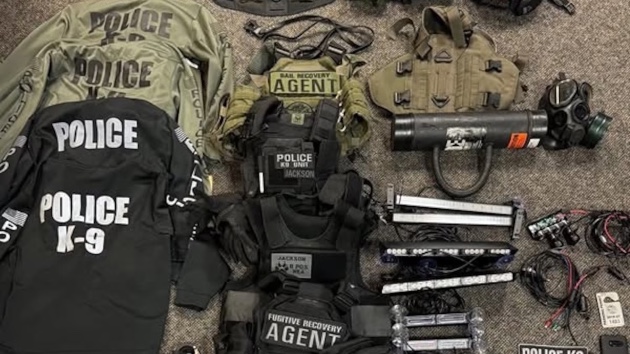
(SANTA ROSA, Calif) — A Northern California military veteran was arrested for posing as a cop and a bounty hunter, according to the Sonoma County Sheriff’s Office.
Gregg Jackson, 40, from Santa Rosa, California, was arrested earlier this week for impersonating a law enforcement officer, specifically “using a vehicle outfitted with red and blue emergency lights and was identifying himself as a bounty hunter,” the sheriff’s office announced on Tuesday.
Jackson had been on a pretrial release for felony charges and “as part of the terms of his release, he was subject to search of his home and vehicle,” the sheriff’s office said.
While officials were searching his home, they said they found “several items that falsely identified him as a police officer.”
“During the investigation, it was determined that he was not licensed to operate as a Fugitive Recovery Agent,” officials said.
Jackson was arrested and booked for impersonating a police officer and two violations of his pretrial release conditions, officials said.
As of Friday, he remains in custody at the Sonoma County Main Adult Detention Facility and bail has been set at $56,000, officials said.
The case remains under investigation and officials said they believe Jackson “may have unlawfully acted as a Fugitive Recovery Agent in multiple states.”
The suspect’s friend, Tim Sutton, told San Francisco ABC station KGO he was “completely blown away” when he heard the news of Jackson’s arrest. He also revealed that Jackson is a military veteran and has post-traumatic stress disorder.
“The idea of Gregg doing that with malicious intent does not sound like the Gregg I know, he’s an easy-going guy to talk to,” Sutton told KGO.
Jackson has previously been arrested for driving under the influence, assault with a deadly weapon and carrying a concealed weapon with a prior conviction, according to court records.
His next court appearance is scheduled for Friday at 2 p.m. local time, according to court records.
The public defender’s office representing Jackson did not immediately respond to ABC News’ request for comment.
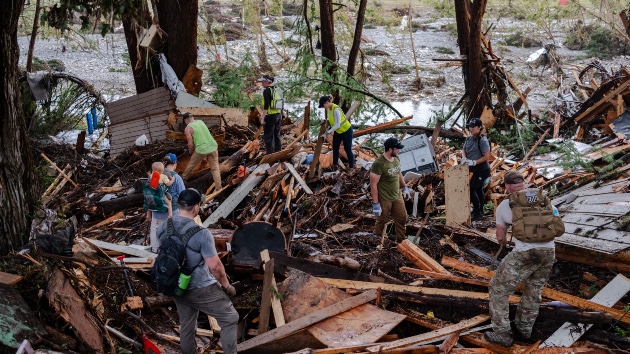
(NEW YORK) — The risk of the catastrophic flooding that struck Texas Hill Country as people slept on July 4 and left at least 120 dead was potentially underestimated by federal authorities, according to an ABC News analysis of Federal Emergency Management Agency data, satellite imagery and risk modeling.
Some of the youth camps and recreational areas most devastated by the extreme weather were established on land designated by the FEMA as “special flood hazard areas” or in the river’s floodway, making them especially vulnerable to the July 4 flash floods that exceeded some federal estimates for a worst-case scenario.
At some points, water extended for hundreds of feet outside the Guadalupe River’s banks and beyond FEMA estimates, according to satellite data. First Street, a risk modeling company, told ABC News that the company believes that more than double the 8 million homes nationwide that are designated by FEMA to be in flood zones are actually at risk, finding that government models are outdated and fail to consider extreme weather events. Devastated camp ‘predominantly in a flood zone’
Along the river banks in Kerr County, the all-girls Camp Mystic was overrun by flood waters, which claimed the lives of 27 campers and counselors and swept multiple buildings from their foundations. According to FEMA maps, more than a dozen of the 36 cabins were located within areas designated as high risk for potential flooding on the river and nearby Cypress Creek.
“We knew this camp was predominantly in a flood zone, and even the areas that we showed that were outside were right on the edge of a flood zone,” said Jeremy Porter, the head of climate implications research at First Street, which provides climate data for companies like Zillow and Redfin.
Multiple buildings at Camp Mystic, including four cabins, were built within the Guadalupe River’s “regulatory floodway,” where most new construction is severely limited due to flood risk and to “protect human life and health,” according to Kerr County’s Flood Damage Prevention Order from 2020. The document noted that the stretch of land where Camp Mystic is situated is “an extremely hazardous area due to the velocity of flood waters which carry debris, potential projectiles and erosion potential.”
An additional 12 cabins at Camp Mystic were built on land designated as “special flood hazard areas,” where residents face a 1% chance of flooding annually and are normally required to have flood insurance.
“These should guide where you should or should not construct, whether you should have mitigation processes in place, like putting homes on elevated beds,” said Jonathan Sury, a senior staff associate at the National Center for Disaster Preparedness at Columbia University in Manhattan.
But some of those structures at the nearly 100-year-old camp were built decades before FEMA began issuing its flood maps in the 1960s and were likely permitted to remain despite modern construction regulations, Porter noted.
A row of cabins at Camp Mystic sat directly behind the “special flood hazard area” and was deemed a lower risk for typical flooding. However, the extreme flash-flooding over Independence Day weekend inundated even the area thought to be at lower risk for flooding, satellite and radar analysis show.
‘Outdated’ maps
At its maximum point, the floodwaters were recorded to be more than 500 feet from the Guadalupe River banks, and more than 200 feet from the edge of the FEMA Special Flood Hazard Area, according to the satellite data. The satellite data was collected and provided to ABC News by ICEYE, a company operating synthetic aperture radar satellites, which can obtain real-time data worldwide by using radar pulses to generate data. The data collected measures the depth of the water in a given location.
Other areas along the Guadalupe River were not only vulnerable to flooding but also saw a higher-than-expected water level, exceeding the area marked for a 0.2% annual chance of inundation. Experts told ABC News that Texas practices “very little oversight” over youth camps, and state officials last week approved Camp Mystic’s emergency plans.
At the Heart O’ the Hills Camp for Girls – where 1 person was killed – at least seven structures were built in the Special Flood Hazard Area. The data shows that the floodwater reached up to 220 feet from the riverbed.
Floodwaters devastated RV parks north of the other camps on the Guadalupe River. More than 60 RV spots had been situated in the FEMA-designated Special Flood Hazard Area. Satellite data shows the area was covered in floodwater spanning the entire RV park.
Lorena Guillen, the owner of the Blue Oak RV Park, told ABC News that she was familiar with where her business fell on the FEMA flood map and never considered that the floodwaters could reach as far as they did last week.
“It’s always come up…but there was nothing that would give us an indication that the flood was going to get all the way up 35, 40 feet high in 40 minutes,” she said. “Everything is gone. And there is so much debris, so much cleanup to do that it is going to take, it’s going to take months and months.”
Requests for comment to the camps and FEMA were not immediately answered.
“Our City of Kerrville and Kerr County leadership are committed to a transparent and full review of processes and protocols,” the Kerr County Joint Information Center said in an email. “The special session [of the state legislature] will be a starting point in which we will begin this work, but our entire focus since day one has been rescue and reunification.”
According to Porter, the extent of the flooding at Camp Mystic and other areas is representative of a broader problem with FEMA’s modeling, which places 8 million properties across the country at risk of a 100-year flood.
FEMA’s flood maps are generally used by the government to determine what insurance requirements are needed for homeowners, according to Lidia Cano Pecharroman, a researcher at MIT Department of Urban Studies and Planning.”When planning for flooding we cannot be over-reliant on these maps,” she said. “They are a useful tool but they are based on limited modeling and data.”
FEMA’s model considers factors like coastal storm surge and risks of flooding along river channels, but does not take into account heavy precipitation, such as the extreme rains that swept across Texas last week, Porter said.
“They’re outdated in the sense that they’re not climate corrected,” Porter said. “As those intensities increase of those rainfall events, we’re getting more rainfall happening all at once. It’s filling the waterways, and we’re seeing rapid increases in the river levels.”
First Street estimates that there are more than 2.2 times the number of properties at risk of hundred-year floods than FEMA’s model suggests.
“It’s a devastating event that occurred, but people should look at it and say, you know, if we know our risk, we should retrofit our buildings,” said Porter. “We should make sure that they’re designed to a standard that can withstand the risk that exists in an area right outside of that flood zone.”
(WASHINGTON) — When public school teachers return to classrooms this fall, they will confront a new legal landscape that has given parents expanded veto power over certain aspects of a child’s education.
A sweeping constitutional interpretation issued last month from the U.S. Supreme Court recognizes a fundamental right under the First Amendment to opt-out from classroom lessons that may pose what it called a “very real threat of undermining” sincerely held religious beliefs.
It has school districts and their attorneys nationwide scrambling to review curriculum for possible conflicts and fine tune protocols for when and how students can be excused from certain material.
“It marks a significant challenge for public education nationwide,” the Montgomery County, Maryland, Board of Education, which lost the case, said in a statement on the decision.
The board had been sued by a group of Muslim, Jewish and Christian parents after it refused to permit families to opt-out their children from exposure to storybooks with LGBTQ themes.
“The right of parents to direct the religious upbringing of their children would be an empty promise if it did not follow those children into the public school classroom,” Justice Samuel Alito wrote in the majority opinion.
The ruling effectively requires schools to notify parents in advance of any classroom concepts that might be contrary to a particular religion and to accommodate requests to provide alternative instruction.
Sarah Parshall Perry, a former U.S. Department of Education attorney and current vice president of the conservative advocacy group Defending Education, called it a clear “directive” to districts.
“In making the decision, the high court expanded an earlier religious liberty in schools case, Wisconsin v. Yoder,” Perry wrote in a blog post. “In that 1972 decision, the court held that Amish families could opt their children out of compulsory education past eighth grade because continuing in school longer would be a violation of their religious beliefs.”
While religious rights advocates hailed the ruling as common sense, some civil rights groups, educators, and parents fear it now undermines the very foundation of public education.
“This decision could have a chilling effect,” said Becky Pringle, president of the National Education Association, the nation’s largest union of public school teachers, “and could lead to more educators self-censoring, shelving books and lessons, and preventing some already marginalized students from being seen and acknowledged.”
Some school officials have privately worried about a “Pandora’s box” of administrative burdens that sweeping opt-out rights now present, and said they may consider preemptively removing content from the curriculum entirely in order to avoid confrontations with parents.
“I’m sure there will be more parents that are going to exercise this right,” said Jim Walsh, a Texas lawyer who represents school boards and is a member of the National School Attorneys Association.
Federal courts have already fielded numerous disputes in recent years over religious objections to classroom lessons, including faith-based opposition to teaching women’s empowerment, the theory of evolution, coed physical education, and celebration of Halloween.
“There are religions that oppose medical science, surgery, psychiatry, interracial marriage, monogamy, woman’s suffrage, the right of gay people to marry, and so on,” said Rep. Jamie Raskin, D-Md., an attorney and law professor. “All of them will now be able to flood the courts with claims that particular curricular teachings and books offend their sincere values and their children should not be exposed to the offensive doctrines.”
To evaluate the claims, frontline educators could be put in a tough spot.
“School administrators will have to become experts in a wide range of religious doctrines in order to predict, in advance, whether a parent may object to a particular text, lesson plan, or school activity as contrary to their religious beliefs,” wrote Justice Sonia Sotomayor in her dissent in the case. “The result will be chaos.”
Walsh offered a more sanguine appraisal based on the experience of Texas, which has had an expansive statewide opt-out available to parents for 30 years.
“Parents can opt out of anything they have a religious or moral objection to and the school has to accommodate that. It has not caused significant problems,” Walsh said. One reason the impact has been muted, he said, is that “kids are frequently embarrassed when their parents do this.” As for concerns that schools might self-censor material so as to avoid conflicts with parents, Walsh said it’s a likely possibility.
“Sotomayor predicts a lot of litigation. I think she’s probably right about that, but I think if districts adopt a policy and transparency — and allow opt-out with some limitations on that — I think that’s going to go a long way for reducing that.”
(WASHINGTON) — President Donald Trump travels to Texas on Friday amid growing questions about how local officials responded to the devastating floods, as well as questions about the federal response — including FEMA’s fate — that he has so far avoided.
Trump’s visit comes a week after heavy rainfall caused the Guadalupe River in Kerr County to rise 26 feet in less than an hour, killing at least 121, including dozens of children at the nearby Christian summer camp, Camp Mystic.
He and first lady Melania Trump will visit flood-affected areas, according to a statement from the first lady’s office.
The search for more than 170 people still missing continues with more than 2,100 responders on the ground in Kerr County from local, state and federal agencies.
Meanwhile, local officials are under scrutiny about what steps were taken to adequately warn people and how long it took for authorities to take action based on escalating weather and other alerts.
Trump, notably, hasn’t engaged in similar criticism about how the crisis was handled — as he has done in the case of other disasters.
“I would just say this is a hundred-year catastrophe, and it’s just so horrible to watch,” Trump said on Sunday.
Instead, Trump has largely focused on his relationship with Texas Gov. Greg Abbott — a Republican and strong ally of the president.
“We’ve been in touch with Governor Abbott, I’m very close to Governor Abbott, and everybody in Texas,” Trump said on Sunday.
It’s a marked contrast to how Trump has reacted in the past, including to the California wildfires earlier this year, where he blasted California’s Democratic Gov. Gavin Newsom and other local Democratic officials.
Some of the hardest-hit areas of central Texas, including Kerr County, are areas of strong Republican support that voted for Trump in the 2024 election.
Trump approved a major disaster declaration for Texas earlier this week.
Abbott said during a news conference on Tuesday that he spoke with Trump that morning and received assurances that assistance would be provided.
“He could not stop talking about how sad he was for all the little girls who have lost their lives,” Abbott said. “He recounted his own understanding of what happened with what was really a tsunami wave, a wall of water, that swept too many of them away.”
“And he cares a lot about those young ladies. And he wants to step up and make sure that any need that we have here in Texas is going to be met very quickly,” Abbott continued.
The White House has pushed back heavily on criticism of the administration’s cuts to the National Weather Service, which led to some to question if staffing levels or forecasting abilities were impacted.
“Blaming President Trump for these floods is a depraved lie, and it serves no purpose during this time of national mourning,” White House press secretary Karoline Leavitt said from the briefing room podium on Monday. Trump’s also avoided answering questions on whether he is still aiming to phase out the Federal Emergency Management Agency.
Department of Homeland Security Secretary Kristi Noem, discussed the federal response to the floods during a Cabinet meeting on Tuesday.
“We as a federal government don’t manage these disasters, the state does,” Noem contended. “We come in and support them. And that’s exactly what we did here in this situation. FEMA went to an enhanced level immediately. But as soon as you signed the major disaster declaration, we were able to get them resources and dollars right away, just like you envisioned through state lot grants to help them with cleanup. And we’re still there in presence.”
Later in the week, though, Noem went after FEMA during the Biden and other previous administrations — alleging the agency has suffered from “gross mismanagement and negligence.”
“The list of famous failures is staggering,” Noem claimed in comments to the FEMA Advisory Council, a task force designed to recommend reforms to the agency, including possible dismantlement of the agency as it exists today. Trump appointed Abbott as a new member to the group back in April.
Acting FEMA Administrator David Richardson had yet to visit the affected areas in Texas as of Thursday afternoon.
ABC News’ Luke Barr and Kelsey Walsh contributed to this report.
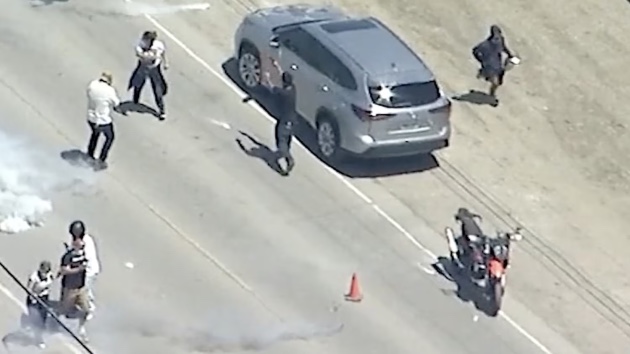
(CAMARILLO, Calif.) — The FBI offered a $50,000 reward for a person who appeared to point and fire a weapon at federal law enforcement officers in Southern California on Thursday.
The alleged shooting occurred in Camarillo, in Ventura County, where protesters and federal agents were clashing over immigration raids. It allegedly happened just before 2:30 p.m. on Laguna Road, U.S. Attorney Bill Essayli said in a statement.
“FBI has issued a $50,000 award for information leading to the conviction of an Unknown Subject who appeared to fire a pistol at Federal Law Enforcement Officers near Camarillo,” Essayli said on social media.
Essayli, who heads the Central District of California office, added a photo of the suspect. He also shared a video of the incident that was shot by ABC News’ Los Angeles station KABC. The person in the photo and video appeared to be wearing a black T-shirt and a white medical mask.
“Make no mistake: anyone who targets our agents will face the full force of federal prosecution,” U.S. Customs and Border Protection said in a statement posted on social media.
This is a developing story. Please check back for updates.
(WASHINGTON) — Dogs across the U.S. could soon get longer-lasting protection against pesky parasites thanks to a new treatment approved by federal regulators Thursday.
The U.S. Food and Drug Administration has given the green light to Bravecto Quantum, the first-ever flea and tick preventative that can protect dogs for up to 12 months with a single injection. The treatment is approved for dogs and puppies 6 months and older.
The new shot is an alternative to treatments that usually need to be given every month or every few months.
“Fluralaner, the active ingredient in Bravecto Quantum, can be an important part of parasite control depending on where pet owners live in the country,” said Dr. Tina Wismer, senior director of toxicology at ASPCA Poison Control, in an email to ABC News. “A long-term flea and tick preventative can be a useful option for dog owners who live in areas where year-round protection is necessary, or for those who might not be able or remember to administer treatment on a monthly or quarterly basis.”
The injectable treatment must be administered by a licensed veterinarian, who will determine whether an 8- or 12-month protection period is appropriate based on local tick species. Veterinarians will also monitor for potential side effects.
While the drug belongs to a commonly used and safe class of medications called isoxazolines, some dogs may experience neurologic side effects, including muscle tremors and seizures.
Julie Cappiello, with Voters For Animal Rights, an advocacy organization, said she welcomes the new treatment but emphasized caution.
“As someone who spends a great deal of time outdoors with my dog, I see the convenience of a long-lasting, 12-month flea and tick preventative like Bravecto Quantum,” she said in a statement. “However, it’s important to recognize that no single treatment is right for every dog, and all medications come with potential risks.”
The new treatment is manufactured by Intervet, Inc., based in Rahway, New Jersey.
Pet owners interested in the new treatment option should consult their veterinarians to determine if it’s appropriate for their dogs, particularly those with a history of neurological issues.
(WASHINGTON) — Since the attempted assassination of Donald Trump last year, the Secret Service has streamlined operations, ensured its workforce is up to meeting its “current and future demands,” enhanced partnerships, modernized the training the service goes through and innovate its technologies, according to a report outlining the changes the agency has made.
On July 13, 2024, an assassin opened fire on a Trump rally in Butler, Pennsylvania, killing one and injuring three others. Trump was hit in the ear by a bullet.
Secret Service Director Sean Curran, who was leading Trump’s protective detail in Butler, said he has kept his experience of July 13 “top of mind” since being appointed director and said the agency has taken “many steps to ensure such an event can never be repeated in the future.”
“Nothing is more important to the Secret Service than the safety and security of our protectees,” Curran said. “As director, I am committed to ensuring our agency is fully equipped, resourced, and aligned to carry out our important mission each and every day.”
The attempted assassination has been the subject of at least three reviews by two of the three branches of government and an independent review — all of which concluded the agency failed on July 13.
The Secret Service said of the more than 40 recommendations made in the wake of the assassination attempt, the agency has implemented 21 of them, 16 are in progress, and nine are addressed to non-Secret Service stakeholders.
“Among the reforms implemented are changes to the Secret Service’s protective operations policies to ensure clear lines of accountability and improved information sharing with local law enforcement partners, the creation of an Aviation and Airspace Security division dedicated to maintaining the agency’s critical aerial monitoring capabilities, and modifications to the agency’s resourcing process, in order to ensure that assets are better accounted for and appropriately applied,” according to the release.
On Wednesday, an official told ABC News that six agents have been issued suspensions for failures connected to the attempted assassination, including the head of the Secret Service’s Pittsburgh field office.
The suspensions, ranging from 10 to 42 days, was issued in recent months and the agents have the right to appeal, according to the official, who was briefed on the agency’s actions.
On Fox News’ “Fox and Friends” on Thursday morning, Department of Homeland Security Secretary Kristi Noem said Trump is “satisfied” with the report and its outcome.
“We changed communication channels and protocol on how Secret Service works with local law enforcement and how they talk during these security events,” she said. “The big, beautiful bill gave them more resources that they needed as far as training and equipment, drone technology, counterdrone technology, all of that was something that needed to be addressed and I’m thankful we have funding we can.”
Derek Mayer, the former deputy special agent in charge of the Secret Service’s Chicago field office told ABC News the agency “continues to improve and evolve every day.”
“All law enforcement agencies learn from events that take place and develop new procedures that make them better,” said Mayer, who now serves as the chief security officer at P4 Security Solutions. “The Secret Service is no different. There were recommended reforms which came from the findings in the Congressional Report and also from the Secret Service’s Mission Assurance Report. These improvements will enhance communication, provide state of the art technology and provide upgrades to ballistic glass and physical security. There has also been the creation of new divisions to guarantee the highest level of standards.”
Mayer said the agency is investing in technology and “human talent” going forward.
(Ukraine) — About 70% of children in Ukraine — roughly 3.5 million — do not have access to basic goods and services, such as adequate food or shelter, more than three years into the country’s ongoing war with Russia, according to new data published Thursday from UNICEF.
This is a four-fold increase from the 18% who were experiencing the same level of “material deprivation” in 2021, before Russia invaded Ukraine.
UNICEF said “continued and relentless attacks” from Russia on Ukrainian infrastructure as well as on homes, schools and health care facilities have led to a rise in material deprivation.
“Seven out of 10 children are experiencing a severe deprivation in one of these areas that we have looked at whether that’s nutritious food, warm clothing, eating, spaces to play all of the things that any person would want for that child,” Joe English, a communications specialist with UNICEF, told ABC News. “And this is the result when you have more than three years of grinding war with little end in sight.”
English added, “It’s 70% who have this material deprivation, but there is not a child in Ukraine who has not been affected by this war today.”
UNICEF also found that one-third of children in Ukraine live in homes without a functioning water supply and sewage, and nearly half of children in the country do not have access to an area to play at home or outside.
English said it’s likely that these shares of children will only increase unless a ceasefire occurs.
Children in Ukraine have been among the casualties of the war. More than 2,700 children have been killed or maimed since February 2022, according to UNICEF.
Due to the destruction of health care infrastructure, English said many children have not been able to get the care they need for injuries and cannot be medically evacuated either.
English said when he was in Ukraine, he met a 15-year-old boy named Andre whose leg was badly injured when a car he was traveling in hit a landmine. Andre was eventually medically evacuated for treatment.
“No parent, no child wants to leave their homeland if they have any kind of choice,” English said. “When I spoke to Andre, he was adamant he would have preferred to stay in Ukraine, been able to have the support there. And so, investing in health facilities, health structures so that families can continue their lives is critical.”
He added that building infrastructure for psychosocial support is also critical due to children who currently need mental health support and will need it years from now.
“Providing that psychosocial support, that starts with a safe space and then professional, dedicated support to help children process the experiences they’ve been through,” he said. “It’s critical because … it really can help children recover.”
The UNICEF report comes as Russia hit Kyiv with another massive air attack overnight, sending missiles and drones over the span of almost 10 hours, according to Ukrainian President Volodymyr Zelenskyy. At least two were killed and 22 others were injured, Ukrainian officials said.
Russia’s Defense Ministry said the July 10 strikes targeted “military-industrial complex facilities” and an airfield.
The first 10 days of July have already seen Russia launch 2,464 drones and 58 missiles into Ukraine, according to Ukrainian air force data.
(WASHINGTON) — In the wake of the flooding event in central Texas, some governors and mayors are raising concerns over how current or potential cuts to agencies that are part of the federal government’s response to major weather events will impact how effectively the government can respond in the future.
The Federal Emergency Management Agency and the National Oceanic and Atmospheric Administration — the latter of which oversees the National Weather Service — have lost hundreds of staff members through layoffs or early-retirement programs, and both face the potential of budget cuts. Budget cuts to NOAA are mostly directed at its climate programs, not forecasting.
Democratic Kentucky Gov. Andy Beshear, speaking with ABC News on Monday, told ABC News that he still feels FEMA helps states like his effectively respond to emergencies and assists through resources such as extra rescue teams and helicopters.
Beshear said he is also concerned about cuts at the National Weather Service.
“The Kentuckians who work for the National Weather Service do an amazing job, and even short staffed, and they are short staffed … I stay awake at night wondering when we don’t have full coverage, or wondering when someone is so tired from how hard they’ve worked, if something’s going to get missed and we’re going to be less safe the next time,” he said.
Beshear emphasized that he did not want to speculate about if any cuts or vacant positions impacted the emergency response in Texas, adding “that needs to ultimately be a fact-based question that’s not politicized, because at a time when this many families are hurting, the last thing they need is a political back and forth.”
There has been no indication of any staffing issues or other concerns related to FEMA, NOAA or NWS connected to the flooding event in central Texas. NOAA told ABC News on Tuesday that NWS planned for extra staffing at the NWS Austin/San Antonio local office ahead of the event and that the local office had five NWS employees working compared to the two who would normally be scheduled.
Department of Homeland Security Secretary Kristi Noem, whose agency oversees FEMA, told the FEMA Advisory Council on Wednesday that how FEMA responded “to Texas is exactly how President Trump imagined that this agency would operate, immediately making decisions, getting them resources and dollars that they need.”
Louisiana’s Republican Gov. Jeff Landry, speaking to reporters on Wednesday after a meeting of the FEMA Review Council, responded to a question about uncertainty over federal funds being interrupted during a potential future disaster by emphasizing his faith in the government’s ability to respond and to get funds states need to them.
“Do you think the president of the United States or members of Congress, certainly those in the Senate, of affected states, would not allow the money to get where it needs to be?” Landry told reporters.
Landry added later, “I am not convinced that the federal government is not going to be there when we need it … It’s not like we’re taking the federal government completely out of the process. What we’re trying to do, what I think they’re trying to do, and certainly what I am advocating for, is a more streamlined process.”
Some mayors shared their concerns about cuts to FEMA and NOAA with ABC News.
Mayor Quinton Lucas of Kansas City, Missouri, a Democrat, said he is very concerned about staffing cuts at NWS given frequent flooding in his city. Those cuts have to be, he said, “one of the most backward things that this country could possibly do … it can’t just be the television meteorologists who rely on information from the National Weather Service.”
But Mayor Dan Davis, the Republican mayor of the city of Manvel, Texas, told ABC News that his city has dealt with hurricanes and other weather events using resources they already have — including a combination of the Texas Department of Emergency Management, the National Weather Service and local agencies and meteorologists. The city also has a full-time staff emergency management coordinator.
He also said he believes the state can provide funding for systems that can help with the city’s emergency response, as long as municipalities apply for those grants. He said, as hurricane season approaches, Manvel secured a grant at the Texas Department of Emergency Management for backup generators for its critical infrastructure.
While Manvel was not impacted by the dramatic flooding in central Texas, the tragedy has rippled across the state.
“You just start tearing up and crying, because I have a daughter that’s 9 years old, and my daughter very well could have been at that camp,” he said.
D.C. Reeves, the Republican mayor of Pensacola, Florida, acknowledged that cuts or changes at the agencies are “a big part of our conversation. It’s a timely question.”
The city just recently introduced its first city emergency coordinator, he added, separating out that role from what used to be done by the city’s fire chief so that the city can be more prepared to manage emergencies.
Florida cities work heavily with county-by-county emergency operation centers as well, he said, adding that “if we ever had a hurricane bearing down on us, or any type of weather event, they are the point person.”
ABC News’ Luke Barr, Kyle Reiman and Dan Peck contributed to this report.
(Texas) — Animal rescue groups are stepping up to take in displaced pets amid the deadly flooding in central Texas, relocating them and keeping them safe until they can be reunited with their owners.
“When the floods occurred, we knew right away from other emergency response situations, such as the fires in Los Angeles, that we have shelters that are full of animals and what we are going to need in any event like this was to make room for displaced pets, lost pets and provide that relief for families that are already going through complete tumultuous situations to maybe have one less thing to worry about,” Marc Peralta, chief program officer for Best Friends Animal Society, said in an interview on ABC News Live.
The organization and its partners airlifted about 130 cats and dogs that were already available in shelters so there was room and time for displaced pets to be able to stay in the community, be safe and hopefully get reunited with their families, Peralta said.
At least 120 people were killed after catastrophic flooding swept through Texas in the overnight hours of the Fourth of July.
Peralta said the organization can facilitate longer stays of pets in emergency situations to allow for reunification, but at some point those pets can be put up for adoption.
“Just like any pet in a shelter, they can go up for adoption. But a lot of times if situations like this occur, we will extend wait periods just to make sure that we are giving ample amount of time because we always want them to go back home first, especially if we know they are stranded or lost,” Peralta said.
Many of the local organizations Best Friends Animal Society is working with on the ground are operating based on donations and there are wish lists available online for anyone interested in purchasing specific things needed by shelters on the ground.
If you are able to take in a pet through adoption or rescue, it will also help make room for other animals who need help because of the flooding, Peralta said.
“Just like for people, we’re just kind of scratching the surface in understanding what the actual devastation is for animals in the area is as well,” Peralta said.