

What to know about birthright citizenship as Supreme Court weighs blocks on Trump’s order to end it

What to know about birthright citizenship as Supreme Court weighs blocks on Trump’s order to end it
Robert Nickelsberg/Getty Images

(WASHINGTON) — The Supreme Court on Thursday heard oral arguments over President Donald Trump’s emergency request to roll back nationwide injunctions blocking his executive order to end birthright citizenship.

The rare May sitting of the court sets the stage for a decision by this summer on whether Trump can move forward with plans to limit U.S. citizenship only to children born on American soil to lawful permanent residents.

The case is also expected to address the legality of individual district court judges single-handedly blocking a presidential policy nationwide. Trump is seeking to dissolve judicial orders preventing mass federal layoffs, funding freezes, and expedited deportation protocols.

For more than a century, courts and the government have interpreted the 14th Amendment’s citizenship clause to apply to anyone born in the U.S., regardless of the citizenship status of a child’s parents.

The Amendment, ratified after the Civil War, states that all “persons born or naturalized in the United States, and subject to the jurisdiction thereof, are citizens of the United States and of the state wherein they reside.”

U.S. Solicitor General D. John Sauer kicked off the first Supreme Court oral argument over Trump’s second-term policies by arguing that the ability of one district judge to issue a nationwide order creates a fundamentally unfair legal playing field for the government.

“Our primary contention is that the citizenship clause related to the children of former slaves, not to illegal aliens who weren’t even present as a discrete class at that time,” he told the justices.

Sauer said that national injunctions force district judges to rush their “high stakes, low information decisions,” encourage forum shopping, and prevent the “percolation of novel and difficult legal questions.”

“They operate asymmetrically, forcing the government to win everywhere, while the plaintiffs can win anywhere,” said Sauer, who last year argued on behalf of Trump in a personal capacity to push for presidential immunity.

His claim was immediately met with skepticism from Justice Sonia Sotomayor, who suggested that such a theory would not only limit the ability of the district court but also the Supreme Court from issuing nationwide relief.

“That makes no sense whatsoever,” she said before making an analogy to when the balance of power shifts in Washington.

“When a new president orders that because there’s so much gun violence going on in the country, and he comes in and he says, ‘I have the right to take away the guns from everyone,’ and he sends out the military to seize everyone’s guns. We and the courts have to sit back and wait until every name plaintiff gets or every plaintiff whose gun is taken comes into court?” she asked.

On the issue of the legality of Trump’s executive order to limit U.S. citizenship only to children born on American soil to lawful permanent residents, Sotomayor was clear on where she stood. The order, she said, was unlawful.

“As far as I see it, this order violates four Supreme Court precedents, and you are claiming that…both the Supreme Court and no lower court can stop an executive from universally violating those holdings by this court,” Sotomayor said.

On his first day in office, Trump signed an executive order unilaterally declaring that only newborns whose parents have permanent legal status are “subject to the jurisdiction” of the U.S. and therefore eligible to be citizens.

“This administration believes that birthright citizenship is unconstitutional,” White House press secretary Karoline Leavitt explained during a February briefing.

Three different sets of plaintiffs sued to block the order, including a group of 22 states, immigrant advocacy groups, and pregnant women whose soon-to-be-born children would be affected.

“Birthright citizenship is at the core of our Nation’s foundational precept that all people born on our soil are created equal, regardless of their parentage,” attorneys for the immigrant advocates wrote in legal briefs.

An estimated 150,000 children are born each year in the U.S. to parents who are not legal permanent residents, according to government data.

“Instead of the right to full participation and belonging in their home country — the United States — these children will be forced to live in the shadow,” the states warned in court filings, “under the constant risk of deportation while the appeals run their course.”

Federal judges in Maryland, Massachusetts and Washington state — and three federal appeals court panels — have issued nationwide injunctions keeping the Trump policy on hold during litigation, concluding that it very likely violates the Constitution and high court precedent.

“I have been on the bench for over four decades. I can’t remember another case where the case presented is as clear as it is here,” said Judge John Coughenour of the Western District of Washington during a January hearing in the case. “This is a blatantly unconstitutional order.”

In 1898, the Supreme Court directly addressed the question of citizenship for children born to non-citizens on U.S. soil, ruling in the landmark case U.S. v Wong Kim Ark that they are Americans under the law.

“The [14th] Amendment, in clear words and in manifest intent, includes the children born, within the territory of the United States, of all other persons, of whatever race or color, domiciled within the United States,” wrote Justice Horace Gray for the 6-2 majority. “Every citizen or subject of another country, while domiciled here, is within the allegiance and the protection, and consequently subject to the jurisdiction, of the United States.”

The issue arrives back at the high court in an unusual posture.

Neither side has briefed the justices on the constitutionality of the executive order. Instead, the primary dispute is over the scope of injunctions issued by individual district court judges.

“It focuses only on whether it is appropriate for courts to issue nationwide injunctions against the President’s egregiously unconstitutional executive order, as opposed to remedies limited to people directly involved in the litigation or those living in states that have sued the government,” said Ilya Somin, a constitutional scholar at the Cato Institute.

The Trump administration has complained that judges should only be allowed to block a contested policy insofar as it impacts the actual plaintiffs who brought the case — not block it universally.

“Only this Court’s intervention can prevent universal injunctions from becoming universally acceptable,” acting solicitor general Sarah Harris wrote in the government’s application to the court.

Many of the administration’s high-profile attempts to reshape the federal government, sharply curtail federal spending, transform immigration policy, and limit protections for LGBTQ people have been blocked by nationwide injunctions issued by district courts.

Justice Department attorneys from administrations of both political parties have long complained about the overuse of nationwide injunctions and alleged incursion on executive branch power. The court may use this case to articulate parameters for when such sweeping injunctions are warranted and when they are not.

“This Court should declare that enough is enough before district courts’ burgeoning reliance on universal injunctions becomes further entrenched,” Harris said, calling on the justices to narrow the injunctions applied to the birthright citizenship order.

Immigrant advocates, civil rights organizations, and Democratic state attorneys general have warned that blocking Trump’s birthright citizenship in some places but not others — or, exempting a small group of plaintiffs but not others — would create chaos.

“A situation where Trump’s order is in force for some people, but not others (or, alternatively, in some states but not others), creates obvious confusion and anomalies,” he said, “especially when it comes to a policy (citizenship rules) that is supposed to be uniform throughout the nation.”

Some legal scholars say it may be impossible for the court to address the question of nationwide injunctions without also resolving the underlying dispute over Trump’s attempt to redefine birthright citizenship.

“They’re going to have to address the whole thing,” said Josh Blackman, a constitutional law scholar and professor at South Texas College of Law. “The only way to avoid the scope of the injunction question is to rule on the merits. I believe they’re going to rule against Trump. He gets maybe one or two votes but not much more than that.”

A decision in the case is expected by early summer.

Copyright © 2025, ABC Audio. All rights reserved.
Milwaukee judge accused of helping undocumented immigrant evade arrest seeks to dismiss indictment

Milwaukee judge accused of helping undocumented immigrant evade arrest seeks to dismiss indictment
ftwitty/Getty Images

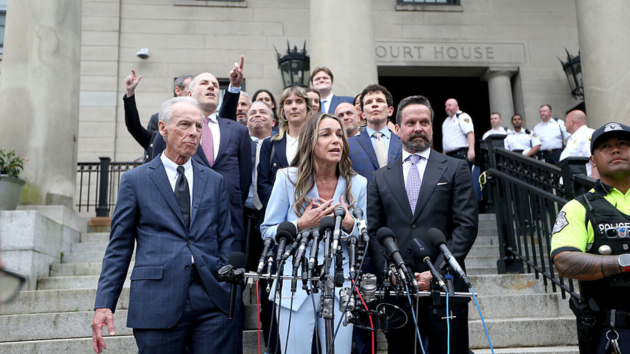
(MILWAUKEE) — Attorneys for Milwaukee County Circuit Court Judge Hannah Dugan are seeking to dismiss her federal indictment on charges alleging she helped an undocumented immigrant evade arrest, claiming in a new court filing that she is immune from federal prosecution for official acts.

In the filing, Dugan’s attorneys cite the U.S. Supreme Court’s decision in President Donald Trump’s immunity case as support.

A federal grand jury indicted Dugan on Tuesday on charges she concealed a person from arrest and obstructed a proceeding before a department or agency of the United States.

Dugan appeared briefly in court Thursday morning. Her lawyers entered a plea of not guilty to the two federal charges.
U.S. Magistrate Judge Stephen Dries, who presided over the arraignment, set a trial date for July 22. The trial will be overseen by U.S. District Court Judge Lynn Adelman, and was estimated to take about a week.

The government has not yet filed a response to Dugan’s motion to dismiss the indictment.

“This is no ordinary criminal case, and Dugan is no ordinary criminal defendant,” her attorneys, Rick Resch and Steven Biskupic, wrote in the motion filed Wednesday. “The government’s prosecution of Judge Dugan is virtually unprecedented and entirely unconstitutional.”

Dugan was arrested on April 25 at the Milwaukee County Circuit Courthouse after being charged in a criminal complaint. Prosecutors allege she was attempting to help a defendant appearing in her courtroom evade federal agents who were in a public hallway outside her courtroom waiting to arrest him for immigration violations.

“The problems with this prosecution are legion, but most immediately, the government cannot prosecute Judge Dugan because she is entitled to judicial immunity for her official acts. Immunity is not a defense to the prosecution to be determined later by a jury or court; it is an absolute bar to the prosecution at the outset,” her attorneys wrote in the motion. “The prosecution against her is barred. The Court should dismiss the indictment.”

In three instances in the motion, Dugan’s attorneys cite the Supreme Court decision in the Trump immunity case as support for their position that Dugan is immune from prosecution for official acts.

Federal authorities allege that Dugan went into a hallway in the Milwaukee courthouse and directed the agents away from her courtroom, then instructed the defendant, Eduardo Flores-Ruiz, to leave the courtroom through a non-public entrance, allegedly in an effort to allow him to evade arrest. In a post on social media following her arrest, FBI Director Kash Patel claimed Dugan “intentionally misdirected federal agents away from the subject to be arrested in her courthouse.”

But Dugan’s lawyers contend in their motion that the doorway Flores-Ruiz used to exit the courtroom leads to the same public hallway a few feet away from the doors to Dugan’s courtroom. There, agents involved in the operation spotted him, followed him to an elevator and then arrested him after a short foot chase outside.

“Even if (contrary to what the trial evidence would show) Judge Dugan took the actions the complaint alleges, these plainly were judicial acts for which she has absolute immunity from criminal prosecution,” her lawyers wrote. “Judges are empowered to maintain control over their courtrooms specifically and the courthouse generally.”

Her lawyers also argued that whatever Dugan’s motivations might have been, they are “irrelevant” to the issue of immunity.

The Wisconsin Supreme Court suspended Dugan in the wake of her arrest, stating in an order that it found it was “in the public interest that she be temporarily relieved of her official duties.”

Dugan’s legal team draws from four different firms and is led by Biskupic, a former Wisconsin federal prosecutor appointed by former President George W. Bush.

Another of her lawyers, Dean Strang, will be familiar to viewers of the Netflix docuseries, “Making a Murderer.” Strang was one of the defense attorneys for Steven Avery in a controversial homicide case, who became an unlikely star.

The legal team also includes Paul Clement. A former U.S. solicitor general during the George W. Bush presidency, Clement has argued before the Supreme Court more than 100 times. His Washington, D.C.-based law firm is listed in a court filing on Wednesday as being part of Dugan’s legal team, but Clement has not yet entered an appearance in the case.

Copyright © 2025, ABC Audio. All rights reserved.
Looming New Jersey Transit strike could impact 350,000 commuters, say officials

Looming New Jersey Transit strike could impact 350,000 commuters, say officials
Gary Hershorn/ABC News

(NEW YORK) — Some 350,000 New Jersey commuters could soon find themselves scrambling for other ways to get to work if contract disagreements between New Jersey Transit and its engineers’ union aren’t resolved, according to transit officials.

The Brotherhood of Locomotive Engineers and Trainmen (BLET) has threatened to strike as early as Friday, May 16 unless NJ Transit and the union are able to agree on new contract terms and conditions for the workers who drive the trains. If no deal is reached, all New Jersey Transit commuter trains – and the MTA Metro-North West of Hudson service – will stop running.

“We have sought nothing more than equal pay for equal work, only to be continuously rebuffed by New Jersey Transit,” BLET General Chairman Tom Haas said during a press conference on May 9. “New Jersey Transit engineers want to keep the trains moving but the simple fact is that trains do not run without engineers.”

BLET National President Mark Wallace said during the press conference that it’s been five years since train engineers working for NJ Transit have received a pay increase. He also said many engineers might seek work at Amtrak or the Long Island Railroad if their contract requirements are not met.

“Reasonable people would vote for an agreement that is fair,” Wallace said.

Haas said during the news conference that engineers working for NJ Transit earn an average salary of $113,000 a year. If New Jersey Transit CEO Kris Kolluri agrees to an average salary of $170,000 a year for engineer operators, then “we got a deal,” Haas said.

“NJ TRANSIT locomotive engineers already have average total earnings of $135,000 annually, with the highest earners exceeding $200,000,” according to a statement on the New Jersey Transit website regarding negotiations with the BLET.

During a separate press conference the same day, Kolluri responded to the union’s arguments, saying Haas previously agreed to a wage increase to $49.82 an hour but then later demanded even higher wages because he thought there was “a better pot at the end of the rainbow.”

“I cannot keep giving money left and right to solve a problem. It all comes down to, who is going to pay for this? Money does not grow on trees,” Kolluri said.

ABC News requests sent to NJ Transit and the BLET for comment regarding Wallace, Haas and Kolluri’s statements concerning pay increase claims did not receive a response.

According to TV station WABC in New York, both sides will meet again Thursday morning for 11th-hour negotiations to avert the strike.

New Jersey Transit and BLET representatives met Monday with the National Mediation Board in Washington, D.C. to continue negotiations.

“We want to thank the National Mediation Board (NMB) for convening today’s meeting,” NJ Transit said in a statement on their website following the meeting. “We found the discussion to be constructive and look forward to continuing negotiations in good faith. To respect the collective bargaining process, we will not be sharing any additional details publicly at this time.”

There was no public BLET statement following the National Mediation Board meeting, nor did BLET immediately respond to an ABC News request for comment.

NJ Transit states that if they were to accept BLET’s terms, it would cost both them and New Jersey taxpayers $1.363 billion between July 2025 and June 2030. Additionally, if BLET chooses to strike, the taxpayer cost of providing a limited alternative service via buses would be $4 million per day, NJ Transit claims.

NJ Transit commuters were already hit with a 15% fare increase on July 1, 2024, with an additional systemwide 3% fare increase scheduled to go into effect July 1 of this year and every subsequent year. NJ Transit said that the increase was necessary in order to cover a budget deficit caused in part by a pandemic-era decrease in ridership, as well as other increased costs, including inflation.

Should the strike commence on May 16, NJ Transit said it “strongly encourages all those who can work from home to do so and limit traveling on the NJ Transit system to essential purposes only.”

NJ Transit officials also said that they’ve developed a contingency plan that includes adding “very limited capacity to existing New York commuter bus routes in close proximity to rail stations and contracting with private carriers to operate bus service” for commuters that typically rely on the trains.

Even with the expanded bus service, however, NJ Transit said that it “estimates that it can only carry approximately 20% of current rail customers” because the bus system doesn’t have the capacity to replace commuter rail service.

Xuan Sharon Di, associate professor of civil engineering and engineering mechanics at Columbia University, told ABC News the potential NJ Transit strike would be a “disaster” for the traffic in Manhattan due to the increased bus and car traffic into the city from commuters unable to take the train. There also will be the added penalty of commuters into Manhattan having to pay recently enacted congestion pricing.

“New Jersey Transit is the backbone for people who live in New Jersey to move around. This is actually shocking to me,” Di told ABC News of the prospect of a strike.

Steven Chien, civil and environmental engineering professor at the New Jersey Institute of Technology, said many of his colleagues use NJ Transit to commute and that a strike will “paralyze vital transportation arteries in our regions.”

Copyright © 2025, ABC Audio. All rights reserved.
Inflation is dropping but these prices are still soaring

Inflation is dropping but these prices are still soaring
Spencer Platt/Getty Images

(NEW YORK) — Inflation cooled in the aftermath of President Donald Trump’s “Liberation Day” levies last month, dropping to a four-year low and defying fears of tariff-driven price hikes, government data this week showed.

Even egg prices — a symbol of rising costs — fell about 10% in April compared to the previous month.

Still, prices for some products continued to soar, including everyday items such as coffee and beef.

It’s normal for some prices to rise at a much faster pace than overall inflation, said Omar Sharif, founder and president of research firm Inflation Insights. The impact, he added, depends on the role such items play in a given person’s finances.

“At the end of the day, what’s important is the weight of the price change in your budget,” Sharif said, noting stubborn price hikes for some goods may be offset by price drops for others.

Here’s what to know about which prices are still climbing and what’s behind the trend:

Coffee

Coffee prices soared 9.6% in April compared to a year ago, marking inflation four times higher than the overall rate. Instant coffee prices climbed even faster, jumping 13.5% over the past year.

The spike in coffee prices comes down to a dearth of supply alongside robust demand, meaning too many dollars are chasing after too few coffee beans, David Ortega, a food economist at Michigan State University, told ABC News.

Recent droughts in Vietnam and Brazil — two of the world’s largest coffee producers — have restricted global output, Ortega said.

“These price increases are primarily driven by weather shocks,” Ortega added.

Meanwhile, coffee drinkers avail themselves of few alternatives, resulting in consistent demand for the product.

Beef

A spike in beef prices also stems from a supply shortage that traces back to drought conditions, Ortega said.

Ground beef prices soared 10% in April compared to a year ago, while the costs of beef steaks increased 7% over that period, government data showed.

In 2022, a major drought in the beef-producing regions of the U.S. forced cattle herders to sell off more animals than usual, since the drought raised costs for cattle feed, which in turn made it more expensive for ranchers to maintain their herds, Ortega said.

Many of those ranchers, he added, sold off cattle necessary to produce future beef supply.

“The national beef herd is at its lowest level in decades – and demand is strong,” Ortega said. “When those two things meet each other, you get this big rise in prices.”

Car repairs

Car repair prices soared 7.6% in April compared to a year earlier, amounting to inflation three times higher than the overall rate.

The trend owes in large part to the rise of high-tech cars, equipped with features like rearview cameras and traffic sensors, which have added cost to even some routine repairs, Brian Moody, executive editor at Autotrader, told ABC News.

A shortage of workers has exacerbated the cost woes for repair companies as they bolster compensation to attract and retain employees, sending prices higher, Moody added.

“More people want technology in their cars,” Moody said. “That technology requires greater skill to manage and fix, but at the same time, there’s a shortage of technicians and workers.”

Men’s and women’s outerwear
Overall apparel prices dropped slightly over the year ending in April, but some items may still deliver sticker shock for spring shoppers.

Prices for men’s outerwear, including suits and sports coats, climbed 5.3% over the year ending in April, which amounts to inflation more than double the overall rate.

Women’s outerwear costs — which include jackets, coats and vests — surged even faster, climbing 6.2%.

Sharif, of Inflation Insights, said the reason for these price increases is murky since they have coincided with a much slower rise in costs for producers of men’s outerwear and an outright drop in production costs for women’s outerwear.

The ample supply of such products means the price hikes likely result from quirks in consumer taste, potentially resulting from the prices commanded by specialty brands, Sharif added.

“Shifting trends in demand may be pushing prices higher,” Sharif said.

Copyright © 2025, ABC Audio. All rights reserved.

Trump says Ukraine-Russia peace ‘not going to happen’ without Putin meet

Trump says Ukraine-Russia peace ‘not going to happen’ without Putin meet
Vladimir Putin & Donald Trump at G20 Osaka Summit 2019/ Mikhail Svetlov/Getty Images

(LONDON )– Ukrainian and Russian representatives will meet in Istanbul, Turkey, on Thursday, for their first meeting since the opening weeks of Moscow’s 3-year-old invasion of its neighbor.

Russian President Vladimir Putin will not attend Thursday’s talks, despite an invitation from Ukrainian President Volodymyr Zelenskyy for a face-to-face meeting between the two leaders. Kremlin spokesperson Dmitry Peskov confirmed to journalists on Thursday that the Russian leader would not be taking part.

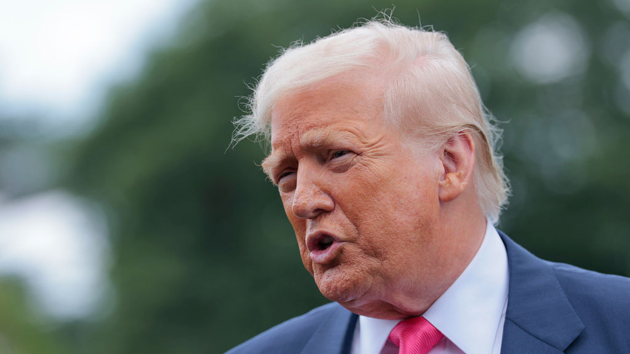
President Donald Trump cast doubt on the potential for success in comments aboard Air Force One on Thursday, despite having this week repeatedly suggested a breakthrough was possible.

“Nothing’s going to happen until Putin and I get together, okay?” Trump said, after it became clear the Russian leader would not attend the talks in Istanbul.

“And obviously he wasn’t going to go,” Trump added. “He was going to go, but he thought I was going to go. He wasn’t going if I wasn’t there. And I don’t believe anything’s going to happen, whether you like it or not, until he and I get together, but we’re going to have to get it solved, because too many people are dying.”

The return to Istanbul is symbolic, the historic Turkish city having played host to arguably the most successful bursts of diplomacy in three years of devastating warfare.

It was there in March 2022 that Ukrainian and Russian negotiators produced the Istanbul Communiqué — the framework of a possible peace agreement to end Russia’s nascent full-scale invasion.

Its tradeoff was essentially one of Ukraine accepting permanent neutrality — meaning forever abandoning any hope of becoming a member of NATO — in exchange for ironclad security guarantees.

The subsequent intensification of the war and emerging evidence of alleged Russian war crimes — as well as suspicions of sabotage operations against peace talks participants — fatally undermined those early peace efforts.

Later, Istanbul was also the hub of the Black Sea Grain Initiative that ran from 2022 to 2023, which with the support of Turkey and the United Nations temporarily allowed for the safe export of grain and other agricultural goods from Ukrainian and Russian ports through the Black Sea — which had by then become a key theater of the fighting — to the rest of the world.

Kremlin aide Vladimir Medinsky — who led talks in 2022 — will lead the Russian delegation.

Medinsky will be joined by Deputy Foreign Minister Mikhail Galuzin, Deputy Defense Minister Alexander Fomin and Igor Kostyukov, the head of Russia’s military intelligence agency.

Zelenskyy and Putin last met in person in France in 2019 for a session of the Normandy Format, a peace forum convened with France and Germany in a bid to end the conflict in eastern Ukraine.

The fighting there was touched off by Russia’s annexation of Crimea and subsequent fomentation of a separatist revolt against Kyiv in the Donbas region. Moscow’s 2022 full-scale invasion was a continuation of that initial cross-border aggression, with Russian columns surging out of occupied Crimea, Donetsk and Luhansk to seize more territory.

Zelenskyy said at a news conference this week he would not meet any other Russian representative, because “everything in Russia depends” on its president.

Zelenskyy arrived in the Turkish capital Ankara on Thursday to meet with President Recep Tayyip Erdogan. Once there, he posted to social media confirming Ukraine’s “top-level delegation,” adding its representatives were “ready to make any decisions that could lead to a long-awaited just peace.”

“I have not yet received official confirmation regarding the Russian level of representation,” he added. “But from what we can observe, it appears theatrical. We will decide on our next steps after the conversation with President Erdogan.”

“We will have several hours for an important discussion and very important decisions,” Zelenskyy wrote. “It is essential to understand the level of the Russian delegation, what mandate they hold, and whether they are authorized to make any decisions at all — because we all know who actually makes decisions in Russia.”

President Donald Trump — who since returning to office has been seeking a ceasefire and eventual peace deal — suggested this week that he hoped for progress at Thursday’s talks.

“I think we’re having some pretty good news coming out of there today and maybe tomorrow and maybe Friday,” Trump said upon arrival in Qatar on Wednesday.

The president even hinted he might even travel to Istanbul, though did not say whether he expected Putin to do the same.

“Well I don’t know if he’s showing up,” Trump said of his Russian counterpart. “He would like me to be there, and that’s a possibility. If we could end the war, I’d be thinking about that,” Trump added.

At a Thursday roundtable in Qatar during the second leg of his ongoing Middle East visit, Trump again floated the idea of traveling to Istanbul.

“If something happened, I’d go on Friday if it was appropriate,” the president said. “But we have people right now negotiating, and I think that I just hope that Russia and Ukraine are able to do something, because it has to stop, not only the money.”

Trump said he did not expect Putin to attend. “I actually said, why would he go if I’m not going? Because I wasn’t going to go. I wasn’t planning to. I would go, but I wasn’t planning to go. And I said, I don’t think he’s going to go if I don’t go. And that turned out to be right.”

The U.S. delegation to Turkey includes Secretary of State Marco Rubio and senior envoys Steve Witkoff and Keith Kellogg. Speaking at a gathering of NATO foreign ministers in Ankara on Thursday, Rubio said of his hopes for the upcoming Ukraine-Russia talks, “We’ll see what happens over the next couple of days.”

“I will say this, and I’ll repeat it, that there is no military solution to the Russia-Ukraine conflict, Rubio continued. “This war is going to end not through a military solution, but through a diplomatic one, and the sooner an agreement can be reached on ending this war, the less people, less people will die and the less destruction there will be.”

Trump, Rubio said, “is interested in building things, not destroying. He wants economies and countries focused on building things, making things, providing opportunity and prosperity for its people, and he’s against all the things that keep that from happening, like wars, like terrorism and all the instability that comes with that.”

Putin proposed the talks last weekend, in response to Ukraine’s demand — backed by the leaders of France, Germany, the U.K. and Poland during a joint visit to Kyiv — for a full 30-day ceasefire during which time peace talks could proceed. Trump agreed to the plan by phone, the European leaders said.

But Trump then also backed Putin’s offer to restart the talks that collapsed in 2022. Trump even publicly pressed Zelenskyy to “immediately” agree to the meeting.

Despite the significance of renewed direct Ukraine-Russia talks, Oleg Ignatov — the International Crisis Group’s senior Russia analyst — told ABC News he had low expectations of an immediate breakthrough.

“The Russians clearly say that they’re interested in keeping military and diplomatic pressure on Ukraine,” he said. “They clearly say that there will be long negotiations and Ukraine should be prepared for this.”

While Trump agitates for a deal he can sell as a political win, Kyiv and Moscow are maneuvering to avoid blame for the failure of peace talks — and dodge Trump’s subsequent wrath.

Ukrainian Foreign Minister Andrii Sybiha met with Rubio on Wednesday in Istanbul. “I reaffirmed Ukraine’s strong and consistent commitment to President Trump’s peace efforts and thanked the United States for its involvement,” the former wrote om X.

“We are ready to advance our cooperation in a constructive and mutually beneficial manner,” he added. “It is critical that Russia reciprocate Ukraine’s constructive steps. So far, it has not. Moscow must understand that rejecting peace comes at a cost.”

Russian Foreign Ministry spokesperson Maria Zakharova, meanwhile, said during a Thursday morning press briefing that Moscow “is ready for serious negotiations.”

Copyright © 2025, ABC Audio. All rights reserved.

Democratic leaders vow to kill colleague’s effort to impeach Trump

Democratic leaders vow to kill colleague’s effort to impeach Trump
Bill Clark/CQ-Roll Call, Inc via Getty Images, FILE

(WASHINGTON) — Democratic Rep. Shri Thanedar is taking an unorthodox step in defiance of his party’s leadership, forcing an impeachment vote against President Donald Trump on Wednesday that both Republicans and his Democratic colleagues threaten to kill.

“We’re going to hear a ton of reasons why not to hold this president accountable. We’re going to hear a ton of reasons from both sides of the aisle, but we are going to press ahead because we believe this is the right thing to do,” Thanedar said at a news conference outside the Capitol early Wednesday.

“We believe this is absolutely the right time. This is absolutely the right thing to do.”

House GOP leaders will introduce a motion to table the legislation, killing Thanedar’s measure, and House Democratic Caucus Chair Pete Aguilar said Democrat leaders would join them.

“Our focus is on health care being stripped away from the American people. That is the most urgent and dire thing that we could be talking about this week. Everything else is a distraction,” Aguilar said at his weekly news conference.

Taking a jab at Thanedar, Aguilar added that while his conference has its differences, “this is one that is a pretty easy call.”

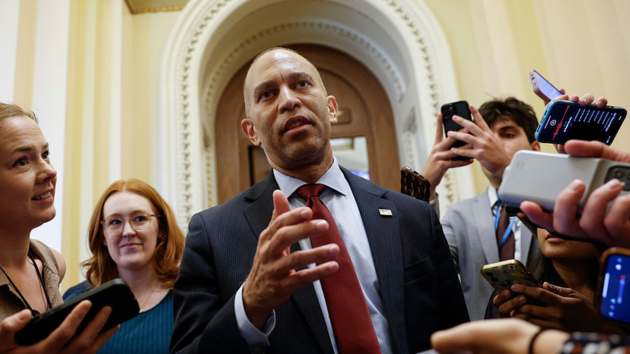
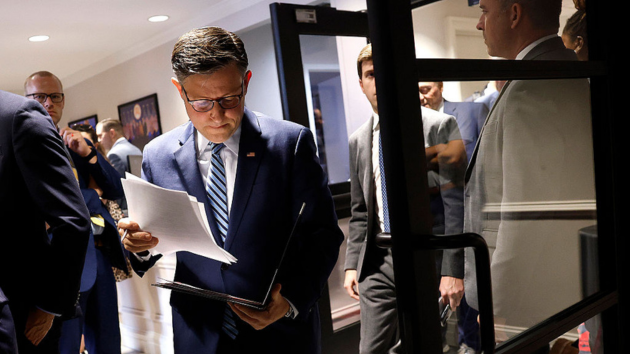
House Speaker Mike Johnson called the effort “another embarrassing political stunt.”

“While Democrats are throwing fits, impeding law enforcement, playing political games, and demonstrating how far out of touch they are — Republicans are working to deliver lower taxes for families, restore American energy dominance, strengthen border security, restore peace through strength, and make government work more efficiently and effectively. The contrast has never been more clear,” Johnson said in a statement.

At a rally last month celebrating his first 100 days, Trump, who was impeached twice during his first term, said, “Here we go again.” He said the fact that Democrats have “no control” over “a dumb guy like this” shows “they have no confidence anymore as a party.”

Thanedar introduced seven articles of impeachment against Trump last month, arguing the president is abusing the power of his office for his own self-interest and repeatedly defied the Constitution, among other broad charges.

Without the backing of the top Democrats in the House nor a majority of his caucus, Thanedar’s effort went nowhere until earlier this week when he introduced his impeachment resolution as “privileged,” forcing the chamber to consider the legislation within two legislative days.

Thanedar promised to fight on.

“Will I succeed this week? Maybe not, but we’ll continue to do this until we have a victory,” he said at his news conference. “We’ll continue to fight until we have a victory, until we remove this president from office for his unconstitutional, illegal, impeachable misconduct. We are going to continue.”

“[House Democratic leaders] want to focus on other issues, which is fine. I just tell them that, hey, we can do that, and we can do this as well.”

However, his move would force Democrats to go on the record on this issue. Thanedar dismissed concerns that his efforts could hurt vulnerable Democratic colleagues, arguing that Republicans would have to vote on it as well.

“We take hard votes every day, every day there is a hard vote to take. That’s my job … They just need to look into not what plays well in politically, not what the polls are saying. We got to do the right thing,” Thanedar argued.

Thanedar, who was elected to the then-open seat in 2022, faces a tough reelection battle. His fellow Michigan Democratic Rep. Rashida Tlaib, a prominent progressive, endorsed Thanedar’s primary challenger, state Rep. Donavan McKinney, earlier this week.

“I’m done with absent members who don’t call their residents back,” Tlaib said in a post on X, referring to Thanedar.

-ABC News’ Lauren Peller and John Parkinson contributed to this report.

Copyright © 2025, ABC Audio. All rights reserved.
RFK Jr. says people should not take medical advice from him, defends HHS cuts during congressional hearings

RFK Jr. says people should not take medical advice from him, defends HHS cuts during congressional hearings
Bill Clark/CQ-Roll Call, Inc via Getty Images

(WASHINGTON) — Health and Human Services Secretary Robert F. Kennedy Jr., one of the nation’s most publicly recognized vaccine skeptics, took a softened approach on vaccines when he answered questions before a House committee Wednesday morning, saying, “I don’t think people should be taking medical advice from me.”

Kennedy, who also testified before a Senate committee the same day, defended the massive cuts to the department’s workforce and laid out his priorities for the Trump administration’s proposed budget.

Kennedy’s congressional committee appearances marked the first time he testified before Congress since his confirmation hearings in late January, and forced Kennedy to confront statements he made that critics said were evidence of promises broken.

Kennedy says his ‘opinions about vaccines are irrelevant’

During the House hearing, Kennedy avoided sharing his own thoughts about vaccines — which have previously invited skepticism — instead deferring to the doctors running the National Institutes of Health and Centers for Disease Control and Prevention.

Asked by Democratic Rep. Mark Pocan if he would today vaccinate his own children for measles and chickenpox, Kennedy said “probably” for measles, but that “what I would say is my opinions about vaccines are irrelevant.”

“I don’t want to seem like I’m being evasive, but I don’t think people should be taking advice, medical advice from me,” Kennedy said.

He said he has directed NIH Director Jay Bhattacharya to try to “lay out the pros and cons, the risks and benefits, accurately as we understand them, with replicable studies,” for people to “make that decision.”

His comments mark a departure from his strong opinions about vaccines before taking office as HHS secretary.

During his confirmation hearing in January, Kennedy said that he supports vaccines, although he refused to unequivocally say that vaccines don’t cause autism, despite numerous existing studies already showing there is no link. However, in March, the HHS confirmed that the CDC will study whether vaccines cause autism.

Shortly after Kennedy said people should not take his medical advice, some public health experts criticized the comments — with one saying that giving people guidance “is [Kennedy’s] job.”

“The problem is that is his job — the top line of his job description — is the nation’s chief health strategist. That is the top line of every health official, federal, state, local leader. That is his job, is to give people the best advice that he can. I believe that he’s giving up on, in my view, his chief responsibility,” Georges Benjamin, executive director of the American Public Health Association, told reporters on a call in which he and other health leaders responded to Kennedy’s testimony in front of the House Appropriations Committee.

Benjamin pointed out that Kennedy has, in fact, seemed to advise people on how to treat measles, leading them toward unproven remedies.

Democrats push Kennedy on cuts: ‘You can’t fire 90% of the people and assume the work gets done’

Democrats on both the House and Senate committees questioned Kennedy about cuts to HHS — with several testy exchanges.

In April, HHS began laying off about 10,000 workers and consolidating 28 institutes and centers into 15 new divisions.

Including the roughly 10,000 people who have left over the last few months through early retirement or deferred resignation programs, the overall staff at HHS is expected to fall from 82,000 to around 62,000 — or about a quarter of its workforce.

Democratic Sen. Tammy Baldwin, quoting ABC News’ reporting last week, asked Kennedy about cuts to the CDC’s lead poisoning prevention program.

Though the program has been completely gutted and the expert staff has been laid off, Kennedy said he believes lead poisoning to be an “extremely significant concern” and said he does not intend to eliminate the program.

Kennedy suggested that HHS would still spend the money appropriated to the program — but didn’t offer any details on how the work would continue without any expert staff.

In another heated exchange, Democratic Sen. Patty Murray asked Kennedy about cuts to National Institute for Occupational Safety and Health, including the reinstatements that are mostly in Ohio and West Virginia. She said no one has been reinstated in the Western states, including at the Spokane, Washington, office that does research into miner safety.

“The work in NIOSH will not be interrupted,” Kennedy said. “We understand it’s critically important function, and I did not want to see it end.”

Murray quipped back, “I would just say you can’t fire 90% of the people and assume the work gets done.”

During the earlier House hearing, Kennedy continued to maintain that widespread cuts at HHS have not impacted key health programs, saying he has not withheld any funding for lifesaving research at NIH and continues to prioritize pillars such as Head Start, Medicare and Medicaid.

But in a tense back-and-forth with Democratic Rep. Rosa DeLauro, ranking Member of the House Appropriations Committee, she demanded Kennedy’s assurance that he would not cut programs that have been approved and funded by Congress, which has “the power of the purse” ascribed to it in the Constitution.

Kennedy said he would spend appropriated money — which drew repeated exasperation from DeLauro, who pointed to $20 billion in cuts to NIH.

Kennedy asserted that his goal at HHS is to focus on the chronic disease epidemic and deliver effective services for those who rely on Medicare, Medicaid and other services by cutting costs to taxpayers.

“We intend to do more, a lot more with less. The budget I’m presenting today supports these goals and reflects two enduring American values, compassion and responsibility,” Kennedy said.

DeLauro slammed Kennedy and the Trump’s administration for the cuts to HHS, including the elimination of entire divisions.

“Mr. Secretary, you are gutting the life-saving work of the Department of Health and Human Services and its key agencies while the Republicans in this Congress say and do nothing,” DeLauro said. “Because of these cuts, people will die.”

DeLauro also finished the hearing with an impassioned plea for Kennedy to stop cutting programs, telling him he does not have the authority to go against what Congress allocated in the budget.

“You do not have the authority to do what you are doing,” she said.

Kennedy defends measles outbreak response, measles vaccine stance

Kennedy rebuked criticism of his agency’s response to the measles outbreak, which has surpassed 1,000 cases for the first time in five years, according to the CDC.

A total of 92 patients have been hospitalized over the course of the outbreak and two school-aged children died in Texas. Both were unvaccinated and had no known underlying conditions, according to the Texas Department of State Health Services.

“We are doing a better job at CDC today than any nation in the world controlling this measles outbreak,” Kennedy said.

DeLauro hit back, saying that Kennedy’s comparison of the U.S. response to measles to the response of other countries was unfair.

“Mr. Secretary, you keep comparing the U.S. to other countries, compare us to Europe, but the Europe you are referring to is the WHO European region, [which] has 53 countries in Europe and in Asia, including those with low … vaccination rates like Romania and that has never eliminated measles,” she said. “If you compare us to western Europe countries that we often compare ourselves to, like Great Britain, they have seen no measles death.”

Kennedy argued that the U.S. is doing better than other countries in the Americas with smaller populations, including Canada and Mexico.

DeLauro scolded Kennedy for promoting vaccine skepticism in the wake of a measles outbreak spreading across the U.S.

Kennedy has shared contradicting views about vaccines. In a post on X on April 6, Kennedy said that the “most effective way to prevent the spread of measles” is to receive the measles, mumps, rubella (MMR) vaccine. However, in a post later that evening, he said more than 300 children have been treated with an antibiotic and a steroid, neither of which are recognized treatments or cures for measles.

A particularly heated moment occurred when Democratic Sen. Chris Murphy told Kennedy that the secretary has equivocated when discussing the measles vaccine. Murphy noted instances in which Kennedy has touted the effectiveness of the vaccine before listing its potential harms.

Kennedy, angry at the line of questioning, interrupted Murphy, claiming his prior comments were true.

When Murphy pressed for Kennedy to say directly whether he recommended the measles vaccine for people, Kennedy, who told CBS News in an April interview that he did recommend the shot, said, “I am not going to just tell people everything is safe and effective if I know that there’s issues. I need to respect people’s intelligence.”

Vaccine specialists say the measles vaccine is durable and two doses in your youth is sufficient for lifelong protection without the need for a booster. The CDC notes on its website that the agency “considers people who received two doses of measles vaccine as children according to the U.S. vaccination schedule protected for life, and they do not ever need a booster dose.”

Numerous studies over decades across multiple countries have confirmed the safety and efficacy of the MMR vaccine, the American Academy of Pediatrics notes. Additionally, monitoring for the safety of a vaccine does not end after the shot has been licensed for use. There are federal health databases in which anyone can report side effects or reactions following a vaccine — officials are then able to review these reports and identify any potential safety issues.

Copyright © 2025, ABC Audio. All rights reserved.

Mother allegedly buys ammunition, tactical gear for son’s planned ‘mass targeted violence’ at middle school: Officials

Mother allegedly buys ammunition, tactical gear for son’s planned ‘mass targeted violence’ at middle school: Officials
Bexar County Sheriff’s Office

(SAN ANTONIO, Texas) — A Texas mother has been arrested and charged for allegedly buying ammunition and tactical gear for her son’s planned “mass targeted violence” at his middle school, officials said.

Ashley Pardo, 33, was arrested on Monday and charged with aiding in commission of terrorism after she allegedly provided ammunition and tactical gear to her son, whose behavior demonstrated plans for a “mass targeted violence” aimed at Rhodes Middle School in San Antonio, according to an affidavit obtained by ABC News.

Back in January, Pardo’s son was first contacted in reference to “drawings of the local school he currently attended,” the affidavit said. These drawings included a map of the school — labeled “suicide route” — and the name of the school written beside a rifle, the affidavit said.

The son, who was not named in the affidavit, was contacted by officials at the time and described a “fascination with past mass shooters,” according to the affidavit.

In April, the son was found researching the 2019 Christchuch mosque shooting in New Zealand — a tragedy that killed 51 people — on a school-issued computer, the affidavit said.

He was “subsequently suspended and later in the day attempted suicide with a straight razor causing significant injuries and requiring over 100 stitches,” the affidavit noted. The boy attended an alternative school until May 7, according to officials.

His grandmother, with whom he had been staying “on various occasions,” contacted police on Monday after she found her grandson “hitting a live bullet with a hammer,” the affidavit said.

The middle schooler told his grandmother he received the bullet from Pardo and that she had “guns and ammunition at her house,” according to the affidavit.

The grandmother told officials Pardo had been taking the boy to a local surplus store and bought him magazines, a tactical black vest “capable of concealing ballistic plates,” a tactical black helmet and various army clothing, the affidavit said.

On Monday, the boy told his grandmother he was “going to be famous” before being picked up by his mom and taken to school, according to officials.

The grandmother then looked through the boy’s bedroom, where she found magazines loaded with live rifle ammunition and pistol magazines loaded with live ammunition, the affidavit said.

She also found an “improvised explosive device” — a mortar-style firework wrapped in duct tape — among the boy’s belongings, the affidavit noted. The explosive device had the words “For Brenton Tarrant,” referencing the shooter in the 2019 mosque attack, along with multiple “SS” symbols and “14 words” — referencing white supremacy — written on it, according to the affidavit.

Along with the weaponry, the grandmother found a handwritten note referring to previous mass shootings, mass shooting suspects and the number of victims in each incident, the affidavit said.

Pardo had been aware of the threats made by her son, expressed to the school her support of his “violent expressions and drawings” and said she did not feel concerned for his behavior, according to the affidavit.

The affidavit noted that Pardo was purchasing the gear and ammunition for her son in exchange for babysitting his younger siblings.

Copyright © 2025, ABC Audio. All rights reserved.

Democrats say it’s a ‘sad day for DHS’ under Kristi Noem’s leadership in fiery House hearing

Democrats say it’s a ‘sad day for DHS’ under Kristi Noem’s leadership in fiery House hearing
Anna Moneymaker/Getty Images

(WASHINGTON) — Homeland Security Secretary Kristi Noem came under fire from House Democrats while testifying before the House Homeland Security Committee on her department’s 2026 budget on Wednesday.

The hearing quickly turned to immigration and featured back-and-forths with Democrats on the committee, with ranking member Bennie Thompson, D-Miss., telling Noem that under her leadership, it is a “sad day for DHS.”

“Frankly, I’ve never seen anything like this that served as a lead Democrat on this committee. Even when, madam secretary, my Republican colleagues and I had strong disagreements, we still have productive conversations and did our duty keep America safe. But that’s not the case any longer,” Thompson told Noem, adding that he is glad that Noem “found time among your many photo ops and costume changes to testify.”

“On your watch, the department is breaking the law, it’s hurting people, and it’s making America less safe,” he added. “The Trump administration is outright lying to the courts and the American people.”

Noem was asked about what occurred last week in New Jersey as three members of Congress attempted to gain access to Delany Hall, a private detention center that is holding ICE detainees, and testified that it was “lawless.” The incident outside the detention center resulted in a melee and ended with the Newark Mayor Ras Baraka, a Democrat who is also running for New Jersey governor, getting arrested.

“We have footage of those members of Congress slamming their bodies into our law enforcement officers, shoving them screaming profanities in their faces, striking them with their fists and otherwise assaulting law enforcement,” Noem testified. “The behavior was lawlessness, and it was beneath this body. Members of Congress should not break into detention centers or federal facilities. Had these members requested a tour, we certainly would have facilitated a tour.”

Delany Hall falls under the purview of the Department of Homeland Security and U.S. Immigration and Customs Enforcement, and the members of Congress argued they had a right to conduct lawful “oversight” on the facility through their congressional responsibilities.

“They were cooperating with criminals to create criminal acts. This wasn’t oversight. This was committing felonies,” Noem said earlier this week on Fox News. “This was going out and attacking people who stand up for the rule of law, and it was absolutely horrible.”

Later in the hearing, Rep. Seth Magaziner, D-R.I., slammed Noem for what he said was a lack of access to legal counsel.

“You are deporting children with cancer, children who are U.S. citizens, a gay makeup artist who committed no crime and didn’t even enter the country illegally,” Magaziner told Noem. “Instead of focusing on real criminals, you have allowed innocent children to be deported while you fly around the country playing dress-up for the cameras.”

Meanwhile, Noem and House Republicans highlighted what she called “total operational control” of the southern border. Noem said she doesn’t know how many immigrants lacking legal status to be in the U.S. were released into the country during the Biden administration and touted that the Trump administration has focused on fixing the border crisis.

“We truly don’t have any idea how many dangerous individuals are still in the United States of America. Since President Trump has been in office, just in these few short months, we have deported over 250 known terrorists out of the country,” she said.

Noem was also pressed on whether everyone ICE has arrested has received due process — and she answered yes, through the tools that Congress has given it, arguing that expedited removal is a tool that Congress has allowed.

Later in the hearing, the DHS chief was asked about suspending habeas corpus, which ensures people are not unjustly detained or imprisoned, and whether it falls under the constitutional guidelines that a president can suspend it.

“I’m not a constitutional lawyer, but I believe it does,” Noem said, adding that it isn’t her authority to do so. “Well, this is something that’s not in my purview to weigh in on. This is the president’s prerogative, and he has not indicated that they will or will not be taking action.”

Stephen Miller, the deputy chief of staff, has floated this idea.

Sparking a contentious back-and-forth, Rep. Eric Swalwell, D-Calif., showed Noem a picture of Kilmar Abrego Garcia’s hand that appeared to have the letters MS-13 on his hands to represent what the tattoos mean.

Noem would not answer the question as to whether the photo was edited or manipulated to put the letters on his knuckles, and she appeared to avoid analyzing the photo.

“You won’t look at the photo, and we will not be bringing was it doctored or not in staying here, and you look to your right, the photo in front of madam secretary,” Swalwell said. “Can you look to the right at the photo in front of you?”

“And the letters MS and the numbers 13 — are those doctored or not?” he asked.

“I don’t have any knowledge as to this photo,” she said, adding it is “unbelievable” that Swalwell wanted to focus on Abrego Garcia.

Copyright © 2025, ABC Audio. All rights reserved.

Supreme Court to weigh blocks on Trump’s order to end birthright citizenship

What to know about birthright citizenship as Supreme Court weighs blocks on Trump’s order to end it
Robert Nickelsberg/Getty Images

(WASHINGTON) — The Supreme Court will hear oral arguments on Thursday over President Donald Trump’s emergency request to roll back nationwide injunctions blocking his executive order to end birthright citizenship.

The rare May sitting of the court sets the stage for a decision by this summer on whether Trump can move forward with plans to limit U.S. citizenship only to children born on American soil to lawful permanent residents.

The case is also expected to address the legality of individual district court judges single-handedly blocking a presidential policy nationwide. Trump is seeking to dissolve judicial orders preventing mass federal layoffs, funding freezes, and expedited deportation protocols.

For more than a century, courts and the government have interpreted the 14th Amendment’s citizenship clause to apply to anyone born in the U.S., regardless of the citizenship status of a child’s parents.

The Amendment, ratified after the Civil War, states that all “persons born or naturalized in the United States, and subject to the jurisdiction thereof, are citizens of the United States and of the state wherein they reside.”

On his first day in office, Trump signed an executive order unilaterally declaring that only newborns whose parents have permanent legal status are “subject to the jurisdiction” of the U.S. and therefore eligible to be citizens.

“This administration believes that birthright citizenship is unconstitutional,” White House press secretary Karoline Leavitt explained during a February briefing.

Three different sets of plaintiffs sued to block the order, including a group of 22 states, immigrant advocacy groups, and pregnant women whose soon-to-be-born children would be affected.

“Birthright citizenship is at the core of our Nation’s foundational precept that all people born on our soil are created equal, regardless of their parentage,” attorneys for the immigrant advocates wrote in legal briefs.

An estimated 150,000 children are born each year in the U.S. to parents who are not legal permanent residents, according to government data.

“Instead of the right to full participation and belonging in their home country — the United States — these children will be forced to live in the shadow,” the states warned in court filings, “under the constant risk of deportation while the appeals run their course.”

Federal judges in Maryland, Massachusetts and Washington state — and three federal appeals court panels — have issued nationwide injunctions keeping the Trump policy on hold during litigation, concluding that it very likely violates the Constitution and high court precedent.

“I have been on the bench for over four decades. I can’t remember another case where the case presented is as clear as it is here,” said Judge John Coughenour of the Western District of Washington during a January hearing in the case. “This is a blatantly unconstitutional order.”

In 1898, the Supreme Court directly addressed the question of citizenship for children born to non-citizens on U.S. soil, ruling in the landmark case U.S. v Wong Kim Ark that they are Americans under the law.

“The [14th] Amendment, in clear words and in manifest intent, includes the children born, within the territory of the United States, of all other persons, of whatever race or color, domiciled within the United States,” wrote Justice Horace Gray for the 6-2 majority. “Every citizen or subject of another country, while domiciled here, is within the allegiance and the protection, and consequently subject to the jurisdiction, of the United States.”

The issue arrives back at the high court in an unusual posture.

Neither side has briefed the justices on the constitutionality of the executive order. Instead, the primary dispute is over the scope of injunctions issued by individual district court judges.

“It focuses only on whether it is appropriate for courts to issue nationwide injunctions against the President’s egregiously unconstitutional executive order, as opposed to remedies limited to people directly involved in the litigation or those living in states that have sued the government,” said Ilya Somin, a constitutional scholar at the Cato Institute.

The Trump administration has complained that judges should only be allowed to block a contested policy insofar as it impacts the actual plaintiffs who brought the case — not block it universally.

“Only this Court’s intervention can prevent universal injunctions from becoming universally acceptable,” acting solicitor general Sarah Harris wrote in the government’s application to the court.

Many of the administration’s high-profile attempts to reshape the federal government, sharply curtail federal spending, transform immigration policy, and limit protections for LGBTQ people have been blocked by nationwide injunctions issued by district courts.

Justice Department attorneys from administrations of both political parties have long complained about the overuse of nationwide injunctions and alleged incursion on executive branch power. The court may use this case to articulate parameters for when such sweeping injunctions are warranted and when they are not.

“This Court should declare that enough is enough before district courts’ burgeoning reliance on universal injunctions becomes further entrenched,” Harris said, calling on the justices to narrow the injunctions applied to the birthright citizenship order.

Immigrant advocates, civil rights organizations, and Democratic state attorneys general have warned that blocking Trump’s birthright citizenship in some places but not others — or, exempting a small group of plaintiffs but not others — would create chaos.

“A situation where Trump’s order is in force for some people, but not others (or, alternatively, in some states but not others), creates obvious confusion and anomalies,” he said, “especially when it comes to a policy (citizenship rules) that is supposed to be uniform throughout the nation.”

Some legal scholars say it may be impossible for the court to address the question of nationwide injunctions without also resolving the underlying dispute over Trump’s attempt to redefine birthright citizenship.

“They’re going to have to address the whole thing,” said Josh Blackman, a constitutional law scholar and professor at South Texas College of Law. “The only way to avoid the scope of the injunction question is to rule on the merits. I believe they’re going to roll against Trump. He gets maybe one or two votes but not much more than that.”

A decision in the case is expected by early summer.

Copyright © 2025, ABC Audio. All rights reserved.