Peter Braunstein is escorted on a perp walk by NYPD detectives as he is brought back to New York City to face justice in December 2005. WABC
(NEW YORK) — Nearly two decades after disguising himself as a firefighter to commit one of the most twisted sex crimes in New York City history, Peter Braunstein is days away from his first parole hearing and the prosecutor who put him in prison contends he’s still a “danger to society.”
Braunstein, a 61-year-old former fashion magazine writer who was sentenced to 18 years to life in prison, is scheduled to have his initial parole hearing the week of Aug. 18, a spokesperson for the New York State Department of Corrections told ABC News. But prosecutors claim that his nearly 20 years of incarceration have done little to reform him.
“He has shown himself to be a determined, angry and vengeful man. Time and again he has demonstrated that he is a danger to society, and he has clearly and repeatedly stated that should he be released from prison he will continue to be a danger to society,” Maxine Rosenthal, senior counsel for the Special Victim’s Division of the Manhattan District Attorney’s Office, wrote in a July 25 letter to the Parole Board, urging the panel to reject Braunstein’s bid for parole.
The assistant district attorney who prosecuted Braunstein added, “In sum, this defendant is not a worthy candidate for release.”
Rosenthal noted that in a series of media interviews following his conviction, Braunstein never expressed remorse, and in several interviews said, “I regret the choice of victim, but not the crime itself” and that he believed “the crime was justified.”
The prosecutor also said that even after being convicted and sent to prison, Braunstein violated court orders by continuing a “campaign of harassment and intimidation” of an ex-girlfriend until at least 2014 by sending letters or attempting to call her, her employer and her relatives from prison. Braunstein pleaded guilty to menacing the ex-girlfriend, a magazine beauty editor, and was placed on probation just three months before committing the infamous sex attack.
“In response, letters were sent to the prison superintendent requesting that a negative correspondence order be issued prohibiting the defendant from having any further contact with the former girlfriend,” Rosenthal wrote in the letter to the Parole Board.
The ex-girlfriend, who testified against Braunstein at his trial, died in June from cancer.
Braunstein, who is serving his sentence at the Wende Correctional Facility near Buffalo, has not replied to a letter from ABC News requesting comment.
His former defense attorney, Robert Gottlieb, told ABC News that Braunstein should be set free.
“Peter was and, I’m sure, still is very smart and enormously creative and talented. I can only hope that the Parole Board will give him the chance to enjoy life and to enjoy it beyond the walls of a prison,” said Gottlieb, who used an insanity defense at Braunstein’s 2007 trial that was rejected by the jury.
‘The crime stood out then, and it stands out now’
In 2007, Braunstein, a former writer for the fashion magazine Women’s Wear Daily, was sentenced to 18 years to life in prison after a Manhattan jury convicted him of first-degree sexual abuse, kidnapping, robbery and other crimes tied to the infamous attack on Halloween night 2005.
During his sentencing, Manhattan Supreme Court Justice Thomas Farber told Braunstein that by committing the crime as a fake firefighter, he had not only terrorized the victim, but “every woman living in New York who might trust a fireman or a policeman in a similar situation,” The New York Times reported.
According to prosecutors, Braunstein sexually tormented a then-36-year-old woman for more than a dozen hours after staging an elaborate hoax to coax her into opening her door by pretending to be a firefighter responding to a blaze at her apartment building in the Chelsea neighborhood of Manhattan after he set off smoke bombs in the hallway.
The victim was a former colleague of Braunstein, who had worked closely with his ex-girlfriend at W magazine, a sister publication of Women’s Wear Daily. In a series of media interviews he did from prison after his conviction, Braunstein said he targeted her after becoming obsessed with her as a symbol of what he hated about the fashion industry and blamed for his downfall after he was fired from his magazine job.
“She was the one I took it out on,” Braunstein told ABC’s “20/20” in a 2007 post-conviction interview. “I was thinking really primarily in terms of revenge and suicide at this point in my life.”
In the interview, he described entering the victim’s building, changing into his firefighter gear, igniting two smoke bombs and banging on the victim’s door, yelling, “Fire Department.”
He told “20/20” that once the victim opened her door, he pulled a gun on her that he said was a replica Baretta and ordered her to “get on the floor if you don’t like want me to blow your head off.”
Braunstein said he put a chloroform-soaked rag over her face, rendering her unconscious, stripped off her clothes and tied her to a bed, placing a pair of high-heeled shoes on her that he found in her closet. Over the next 12 hours, he admitted in the “20/20” interview to touching her sexually, but said he did not rape her.
In her letter to the Parole Board, Rosenthal said Braunstein threatened the victim during the ordeal with a serrated knife.
Asked in the “20/20” interview why he sexually tormented the victim, Braunstein said, “I guess to humiliate her.”
Before leaving the apartment, Braunstein stole a Gucci fur coat, a Louis Vuitton carry-on luggage bag, the victim’s driver’s license, resume and $800 cash, according to prosecutors. With lipstick, he scrawled a departing note on the victim’s bathroom mirror: “Bye — Hope things turn around for U soon.”
The New York Police Department launched a nationwide manhunt that lasted six weeks. Braunstein was captured in Tennessee when a witness recognized him from the show “America’s Most Wanted” and alerted police. As officers approached Braunstein, he attempted suicide by stabbing himself in the neck with a knife, according to Memphis police.
“The crime stood out then, and it stands out now, not only because it was exceptionally violent, but also because the perpetrator impersonated a firefighter. That really creates a ripple effect for the public because people have to wonder now if it’s safe to trust someone who is dressed as a police officer, a firefighter, given that this horrific crime was perpetrated by someone impersonating a member of those services,” Jane Manning, director of the victim rights advocacy group Women’s Equal Justice and a former sex crimes prosecutor, told ABC News.
Manning said one of the most important responsibilities of the Parole Board is to protect the public.
“Based on everything we know about this case, women in New York City are a lot safer with this perpetrator behind bars, and I hope the parole board will make a decision to keep him behind bars,” Manning said. “There are some cases that are a difficult call; this is not one of them. This is not a person who belongs out on the streets.”
‘Sickening and heartbreaking’
Angelo Barela, a former neighbor of Braunstein’s victim, told ABC News the crime jeopardized the lives of him and other residents of his building.
“Let’s put it this way: the man endangered the lives of many people who lived in 45 apartments,” Barela said.
Barela, who has moved out of the state since the crime, recalled noticing the thick smoke filling the halls of his building on the night of the attack.
Barela said he and his partner began banging on doors to alert neighbors, several of them elderly with mobility issues.
“It made me feel that if there was a fire, that certain people were not able or did not want to leave,” Barela said.
He recalled knocking on the door of the victim and getting no answer.
Barela said he learned after the fact that the smoke was a ruse that enabled the perpetrator to get into the victim’s apartment. He said he still feels guilty that he couldn’t help the victim.
“It was sickening and heartbreaking,” Barela said in a phone interview. “I think most of the people in that building felt like we didn’t help her, or couldn’t help her, because we had no idea what was going on.”
Barela said he hopes the Parole Board will keep Braunstein in prison.
“Despite what he might have done to one person,” Barela said, “he affected the whole building and he made women in our building feel bad.”
A Department of Corrections spokesperson said the Parole Board will likely release a decision on Braunstein’s parole within three weeks of the hearing, which is closed to the public.
Sevier County Sheriff’s Office released a photo of David Wright from Washington Utah who went missing in September, 1997. Sevier County Sheriff’s Office
(SEVIER COUNTY, Utah) — Remains of a human foot found inside a hiking shoe on the shores of a lake in Utah belong to a man who went missing in 1997, according to officials.
The remains were found on the shores of Fishlake Utah in May, according to the Sevier County Sheriff’s Office.
Investigators determined the hiking boot was made in 1996 for only one year. Investigators were able to tie the boot to a cold case disappearance from September 1997.
David White intended to go fishing with some friends and had rented a hotel room nearby. When the plans with friends fell through, White went fishing anyway, according to the sheriff’s office.
His boat was later found trolling across Fishlake with no one onboard, according to officials.
“A shoe and hat were found floating in the water giving a possible indication where White was believed to have fallen in. There were no witnesses at the time. All of this was a mystery until now,” the sheriff’s office said in a press release.
The original search for White lasted five days and no further evidence was found at the time.
“This case has been on the mind of every one of the SAR members who were involved in the search 28 years ago. It is good to finally have some closure for the family and the searchers,” Sheriff Nathan Curtis said in a statement.
The medical examiner’s office directed investigators to collect DNA from the foot and DNA from a daughter and sent to Bode Cellmark Forensics.
Testing revealed a parental match with 99.9994% certainty.
“We would like to extend our heartfelt thanks to the Sevier County Sheriff’s Office, SAR’s, Detective Sgt Pearson, Detective Sgt Larsen, Sheriff Curtis, and Gary (Moulton) from Fishlake Lodge for their incredible support and tireless efforts. We are also deeply grateful to the individual and his dog who found the shoe – without them, we would not be where we are today,” Stefanie Bennett, the daughter of White, said in a statement released by officials.
(AUSTIN, Texas) — The redistricting battle in Texas continues to escalate as Republican Gov. Greg Abbott urged the state Supreme Court to remove state Rep. Gene Wu, the chairman of the Texas House Democratic caucus.
Abbott argued that Wu has “forfeited” his office by fleeing the state along with other Democratic lawmakers to prevent the quorum necessary for Texas House to vote on enacting the new GOP-proposed congressional map — with Republican control of the U.S. House of Representatives potentially at stake.
Wu accused Abbott of “silencing my dissent” and said he’s undeterred in his mission to fight the Republican-led redistricting effort.
“Let me be unequivocal about my actions and my duty. When a governor conspires with a disgraced president to ram through a racist gerrymandered map, my constitutional duty is to not be a willing participant,” Wu said in a statement.
Abbott asked the Texas Supreme Court for a ruling by Thursday evening, before Texas Republicans try again Friday to convene the legislature and make a quorum.
Texas Republicans failed for the second time on Tuesday to move ahead with the redistricting effort — one backed by President Donald Trump, who has claimed the GOP is “entitled” to five more U.S. House seats in the state.
The faceoff has nationwide implications, with control of the U.S. potentially at stake. Democrats would need to only net three seats in next year’s midterm elections to win back the House.
Texas Democrats are set to continue speaking out against the redistricting effort across the country on Wednesday. Texas Senate Democrats are hosting a news conference in Massachusetts.
Abbott’s emergency petition to the Texas Supreme Court comes as he and Texas Attorney General Ken Paxton, also a Republican, pursue legal options against Democrats who left the state — including civil arrest warrants and investigations of potential law violations including bribery for soliciting funds to support their effort.
“Representative Wu and the other Texas House Democrats have shown a willful refusal to return, and their absence for an indefinite period of time deprives the House of the quorum needed to meet and conduct business on behalf of Texans. Texas House Democrats abandoned their duty to Texans, and there must be consequences,” Abbott said in his filing to the Texas Supreme Court.
Paxton, though, said the governor does not have the authority to file the emergency petition.
“Texas is taking every available avenue to force runaway Democrats to return to Texas and hold them accountable for breaking quorum,” Paxton said in a statement released on Tuesday evening. “Under the Texas Constitution and Texas law, the Office of the Attorney General has the legal authority to bring these cases against the renegade House members. I have alerted the Texas Supreme Court that I will be making additional filings on Friday if the Democrats continue to abandon their legislative duties.”
U.S. Sen. John Cornyn, a Texas Republican, requested the FBI work with Abbott and state law enforcement to help bring back and investigate Texas Democrats.
ABC News Chief White House Correspondent Mary Bruce asked President Trump on Tuesday afternoon if he wanted the FBI to get involved.
“Well, they may have to. They may have to,” Trump responded.
“No, I know they want them back. Not only the attorney general. The governor wants them back. If you look, I mean, the governor of Texas is demanding they come back. So a lot of people have demanded they come back. You can’t just sit it out. You have to go back. You have to fight it out. That’s what elections are all about,” the president added.
ABC News’ Alexandra Hutzler contributed to this report.
Aimee Dilger/SOPA Images/LightRocket via Getty Images
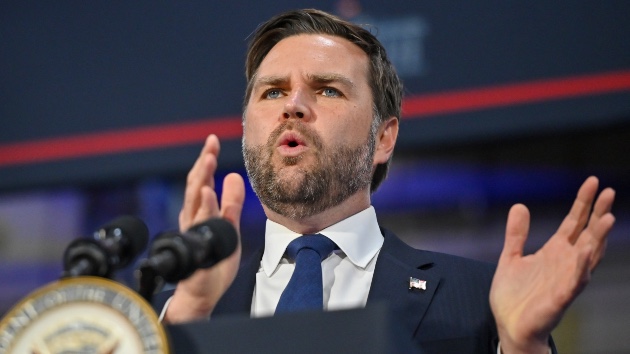
(WASHINGTON) — Vice President JD Vance on Wednesday evening is expected to host a group of top administration officials at his residence for a strategy session as the administration considers whether to release the transcript from the Department of Justice interview with Ghislaine Maxwell, sources familiar with the matter told ABC News.
It’s one of many meetings that has consumed the White House and top administration officials as they attempt to quell the fallout from their handling of the Epstein files and as pressure mounts for the DOJ and the White House to be transparent about what Maxwell said in her nine hours of meetings last month with Deputy Attorney General Todd Blanche.
During her interview, Ghislaine Maxwell said nothing that would be harmful to President Donald Trump, telling Blanche that Trump had never done anything in her presence that would have caused concern, according to sources familiar with what Maxwell said.
Attorney General Pam Bondi, Blanche, FBI Director Kash Patel and White House chief of staff Susie Wiles are expected to attend the session with Vance, the sources said.
As ABC reported Tuesday, the administration could release a transcript of the interview as soon as this week.
The White House didn’t immediately respond to request for comment.
Vance’s office didn’t immediately respond to a similar request.
Kremlin Press Office / Handout/Anadolu via Getty Images
(LONDON) — President Donald Trump’s special envoy Steve Witkoff was greeted by Russian President Vladimir Putin in Moscow on Wednesday ahead of expected talks, the Kremlin said in a short statement.
The meeting between Putin and Witkoff ended after around three hours, according to Russian state media.
Yuri Ushakov, a top aide to Putin, told reporters that the meeting was “a very useful and constructive conversation,” in comments reported by Russia’s Tass state news agency.
The two main topics discussed were “the Ukrainian crisis” and “the prospect of possible development of strategic cooperation between the United States and Russia,” Ushakov said.
“On our part, in particular on the Ukrainian issue, some signals were transmitted,” Ushakov said. “The corresponding signals were received from President Trump. Now the situation is such that our president has complete information — that is, our signals, the signals from President Trump — and the results of these conversations have not yet been reported to Trump.”
“Therefore, I would refrain from more detailed comments,” Ushakov said. “Let’s see when Witkoff will be able to report to Trump about the conversation that took place today. After that, obviously, we will be able to add my comments to something more substantial.”
Witkoff was met on his arrival in Moscow by Kirill Dmitriev — the head of the Russian Direct Investment Fund — at the capital’s Vnukovo Airport, according to state media agencies Tass and Interfax.
The visit is Witkoff’s fifth to Moscow since Trump took office, with the special envoy at the forefront of White House efforts to end Russia’s full-scale invasion of Ukraine, which began in February 2022.
A source familiar with Witkoff’s plans told ABC News on Tuesday that the special envoy was expected to hold meetings with Russian leadership on Wednesday.
Tass reported that Witkoff and Dmitriev walked in the Zaryadye Park in central Moscow before Witkoff’s convoy traveled to the Kremlin.
Witkoff was last in Moscow on Apr. 25, when he met with Russian Putin at the Kremlin.
Last month, Trump said he would impose additional economic measures — including secondary sanctions on Russian fossil fuel export customers, the largest of which are India and China — if Putin failed to agree to a ceasefire by Aug. 8.
Trump cited Russia’s continued drone and missile strikes on Ukraine when issuing his ultimatum to the Kremlin, which was initially set at 50 days but later shortened to only 10 days. In July, Russia set a new monthly record for long-range attacks on Ukraine, per data from the Ukrainian air force, firing 6,443 drones and missiles into the country.
Ukraine is backing the U.S. demand for an immediate ceasefire, after which negotiations as to a full peace deal can take place. On Tuesday, Ukrainian President Volodymyr Zelenskyy said he “coordinated” positions with Trump in a phone conversation.
“Today, we coordinated our positions — Ukraine and the United States,” Zelenskyy wrote in a post to X. “We exchanged assessments of the situation: The Russians have intensified the brutality of their attacks. President Trump is fully informed about Russian strikes on Kyiv and other cities and communities.”
On Monday, Kremlin spokesperson Dmitry Peskov said Russia was open to more meetings with Witkoff. “The dialogue continues and the United States continues its efforts to mediate in the search for a Ukrainian settlement,” he said, as quoted by Tass.
“These efforts are very important, including in the context of the ongoing process of direct Russian-Ukrainian negotiations,” Peskov said. “Work is continuing, and we remain committed to the idea that a political and diplomatic solution to the Ukrainian problem is, of course, our preferred option.”
ABC News’ Joe Simonetti, Shannon K. Kingston, Yuriy Zaliznyak and Ellie Kaufman contributed to this report.
(AUSTIN, Texas) — Texas Gov. Greg Abbott doubled down on his assertion that he has the right to file a lawsuit to the Texas Supreme Court, despite Texas Attorney Gen. Ken Paxton, also a Republican, asserting otherwise.
The potential legal battle comes as several Democrats in the Texas House remain outside the state, meaning the remaining House members have been unable to make a quorum as Republicans seek to push through a divisive congressional redistricting plan.
“To be clear, the lawsuit I filed today seeks relief directly from the Supreme Court based on authority of the Texas Constitution, Section 22 of the Government Code & Supreme Court precedent. I am not seeking relief from a trial court under Chapter 66 of the Civil Practice & Remedies Code,” Abbott said in a social media post on X. “The runaway Democrats must be held accountable immediately. This letter is filed with the Texas Supreme Court to make clear the authority I have to bring this lawsuit.”
The House special session is set to meet again Friday afternoon to attempt a quorum once more.
Paxton said the governor does not have the authority to file the emergency petition but that he would take action Friday if Democrats refuse to return to the special session.
“Texas is taking every available avenue to force runaway Democrats to return to Texas and hold them accountable for breaking quorum,” said Attorney General Paxton said in a statement released Tuesday evening. “Under the Texas Constitution and Texas law, the Office of the Attorney General has the legal authority to bring these cases against the renegade House members. I have alerted the Texas Supreme Court that I will be making additional filings on Friday if the Democrats continue to abandon their legislative duties.”
The Texas House of Representatives failed again on Tuesday when they reconvened to move forward on their redistricting effort as several Democratic members have fled the state over the proposed congressional maps.
On Monday, Abbott ordered the Texas Department of Public Safety to find and arrest those Democrats, an order Abbott said will remain in effect until they are “accounted for and brought back” to Austin.
Rep. Gene Wu, chair of the Texas House Democratic Caucus, issued a statement Tuesday, saying that “denying the governor a quorum was not an abandonment of my office; it was a fulfilment of my oath. Unable to defend his corrupt agenda on its merits, Greg Abbott now desperately seeks to silence my dissent by removing a duly-elected official from office.”
ABC News’ Brittany Shepherd, Oren Oppenheim and Alexandra Hutzler contributed to this report.
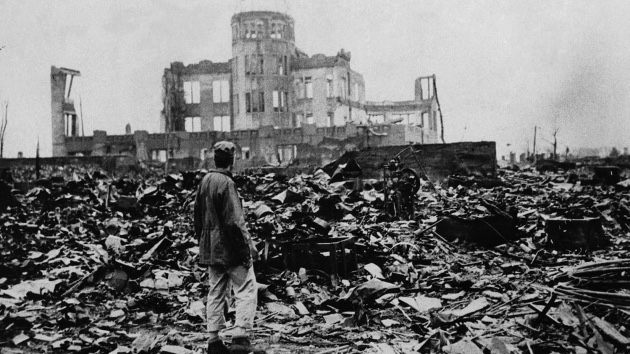
World War II, after the explosion of the atom bomb in August 1945, Hiroshima, Japan. Photo by: Universal History Archive/Universal Images Group via Getty Images
(TOKYO) — The atomic bombings of Hiroshima on August 6, 1945, and Nagasaki three days later brought a scale of destruction the world had never seen. Many who survived the blasts died in the weeks, months and years that followed. Japan surrendered six days after the Nagasaki bombing, bringing an end to World War II.
Today, the only nation to have suffered atomic bombings is protected by the U.S. nuclear umbrella. More than 50,000 U.S. military personnel are stationed in Japan. The country has fired almost no shots in anger in eight decades.
But that postwar identity is shifting.
The Japanese constitution, drafted during the U.S. occupation, renounces war as a means of settling disputes. Japan hasn’t revised that pacifist charter. But the space around it has changed. Many here now perceive real and growing threats. Topics that were politically untouchable a decade ago are now freely debated.
Conflicts no longer seem regional but interconnected. North Korea, now a front-line participant in the war in Ukraine, continues to launch missiles in defiance of sanctions. China tests boundaries and dares others to push back.
In recent years, Japan has asserted itself more openly, sending a warship through the Taiwan Strait in 2024 and dispatching a prime minister to Ukraine for face-to-face talks with President Volodymyr Zelenskyy in 2023 — the first time a Japanese prime minister has visited an active combat zone since World War II.
Leading up to this year’s anniversary, the tone has shifted from remembrance to readiness. “Ukraine today may be East Asia tomorrow,” said former Prime Minister Fumio Kishida during that 2023 visit.
Earlier this year, U.S. Defense Secretary Pete Hegseth visited Tokyo, where, according to Reuters, the two sides agreed to accelerate co-production of missile systems. Japan also pledged to expand joint operations and upgrade its Self-Defense Forces’ command structure to better align with U.S. forces.
Current Prime Minister Shigeru Ishiba affirmed the shared U.S.-Japan vision for a “Free and Open Indo-Pacific.”
Japan now participates in multinational drills near flashpoints. It provides naval support to the Philippines. It seeks better ties with South Korea.
But rearmament takes money, and public support for a bigger military budget remains uncertain.
One group has stayed firmly opposed to nuclear weapons, Nihon Hidankyo, formed in 1956 representing survivors of Hiroshima and Nagasaki. In 2024, it received the Nobel Peace Prize for decades of testimony and efforts to persuade governments to disarm.
“We atomic bomb survivors call on all countries to sign and ratify the Treaty on the Prohibition of Nuclear Weapons for peace,” reads a flyer distributed by the group.
In Japan, survivors are known as hibakusha. They became symbols of peace, a living reminder of what must never happen again. Now, there are fewer of them, but they are still speaking out.
Tomoko Matsuo was 12 years old when the bomb fell on Nagasaki. She was at home on summer break, less than 2 miles from the hypocenter, the area directly underneath where the bomb exploded. A hill, she says, may have blocked the worst of the blast and saved her life.
“I was working on the sewing machine when I heard a huge sound,” she told ABC News in Nagasaki on June 27. “It was enormous and unforgettable.” She ran to a nearby bomb shelter. When she emerged, her house was still standing. Nagasaki was ablaze.
They searched for her older sister Eiko, who was 16. “It was a sea of flames. We gave up the search.” Two days after the bombing, Eiko returned.
“I can’t imagine how she made it home,” Matsuo says.
Eiko was burned. She couldn’t keep food down. There was no proper medical care. “We spoke encouraging words to her. It’s painful to think of that.” They took her to a nearby aid station, gave her water, tried a blood transfusion from her brother. But she died soon after.
“This young life was lost. It’s unbearable. She wanted to see her family, and she worked enormously hard to come home.”
Now 92, Matsuo tells her story to keep Eiko’s memory alive. But the chance of nuclear weapons never being used again is far from certain.
Kazuko Hikawa, Vice Director of the Research Center for Nuclear Weapons Abolition at Nagasaki University, says the goal may be harder to reach than many realize. The problem, she says, is something called the security paradox.
“Countries chase nuclear weapons thinking it will stop others from attacking them with nuclear weapons,” she tells ABC News. “Nuclear deterrence may prevent nuclear war, but it actually increases the risk of conflict involving conventional weapons, as seen in Ukraine and Palestine. These are not nuclear wars, but they happen under the shadow of nuclear power.”
In 2015, ABC News met a Hiroshima survivor, Sunao Tsuboi, who has since passed away.
U.S. Ambassador George Glass attended the memorial ceremonies in Hiroshima and and will also attend the ceremony in Nagasaki later this week. His remarks focused on reconciliation and the strength of the U.S.-Japan alliance.
Crowds form as Palestinians, including children, line up in Gaza City, Gaza to receive food distributed by a charity amid ongoing Israeli blockade and attack/Abdalhkem Abu Riash/Anadolu via Getty Images
(LONDON) — At least five people died of hunger in the Gaza Strip over the past 24 hours, Gaza’s Hamas-run Ministry of Health said Wednesday morning.
A total of 193 people, including 96 children, have died of “famine and malnutrition” in Gaza since the ongoing war began, according to the health ministry.
Israel is under increasing international pressure to facilitate the entry of more aid into Gaza, which has been devastated by nearly two years of conflict between the Israel Defense Forces (IDF) and Palestinian militant groups, chief among them Hamas, which is designated as a terrorist organization by the U.S. and the European Union.
The Integrated Food Security Phase Classification — a global initiative monitoring hunger with the backing of governments, the U.N. and nongovernmental organizations — warned last week that the “worst-case scenario of famine” is unfolding in Gaza.
Aid distribution in Gaza is being conducted via sites run by the U.S.- and Israel-backed Gaza Humanitarian Foundation, which started operating in Gaza in late May. Israel says aid distribution must go through GHF to prevent Hamas seizing aid.
Israel also said it allows the GHF “to operate independently” in the distribution of aid and that troops operate “in proximity” to make sure food is delivered in an “orderly fashion.”
Almost 1,400 Palestinians have been killed while traveling to collect aid in the months since those sites opened, the United Nations said in a statement last week.
ABC News’ Samy Zyara, David Brennan, Somayeh Malekian, Diaa Ostaz and Mary Kekatos contributed to this report.
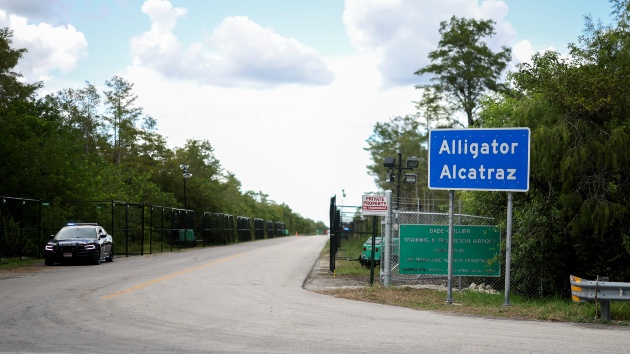
The entrance to the state-managed immigration detention center dubbed Alligator Alcatraz/Joe Raedle/Getty Images
(NEW YORK) — Known for the eponymous reptiles that inhabit the nearby swamps, the migrant detention center dubbed “Alligator Alcatraz” faces the possibility of being shut down over concerns about some of the area’s lesser-known inhabitants — the Everglades’ bats, panthers, and storks.
A federal judge on Wednesday is set to hold an evidentiary hearing over whether to block operations at the controversial facility because construction of the site allegedly bypassed federally required environmental impact studies.
The hearing — at which federal, state, and tribal officials are expected to testify — comes amid heightened scrutiny of the facility, which was once touted as a “one-stop shop to carry out President Trump’s mass deportation agenda.”
Immigrant advocates have alleged that detainees have endured inhumane conditions, including flooded facilities, spoiled food, and sweltering heat — and that they have limited access to their attorneys and are effectively housed in a jurisdictional “black hole.”
In a separate case challenging the legality of the facility, a federal judge ordered federal and state officials by Thursday to provide documentation showing which government or contractor is authorized to detain people at the sprawling complex. With state and federal officials dodging responsibility for the site, advocates have criticized the government for being vague about who runs the facility in order to bypass oversight.
While Wednesday’s hearing is limited to environmental issues — including impacts on the nearby Big Cypress National Preserve — the testimony is expected to shine a light on the operations of the facility and could result in a federal judge ordering the facility to be shut down until the required environmental impact studies are conducted.
“They have a lot of bodyguards and a lot of cops that are in the form of alligators. You don’t have to pay them so much,” Trump said last month when visiting the facility, adding that he’d like to see similar facilities constructed.
On Tuesday, the Department of Homeland Security announced a similar partnership — this time between the federal government and the state of Indiana — to construct a migrant detention facility dubbed the “Speedway Slammer.”
Located 50 miles west of Miami in the heart of the Florida Everglades, “Alligator Alcatraz” was quickly constructed over a matter of weeks, utilizing hundreds of tents, trailers, and other temporary facilities to potentially house more than 3,000 detainees. The facility was built on the grounds of the Dade-Collier Training and Transition Airport, a sparsely used piece of tarmac owned by Miami-Dade County.
The site was initially conceived in the late 1960s as part of an ill-fated plan to build the “Everglades Jetport.” As President Richard Nixon ushered in an era of new environmental protections — including the law now being used to challenge Alligator Alcatraz — the plan to build the site was scuttled, and the remaining tarmac was later used as an aviation training site.
“Now, history is repeating itself as [plaintiffs] once again must act to prevent destructive development in the heart of the Everglades ecosystem in the same location,” the current lawsuit says.
The facility sits next to the Big Cypress National Preserve and the Big Cypress Area, ecologically sensitive and protected areas that house threatened species including the Everglade snail kite, Florida panther, wood stork, and Florida bonneted bat.
Alligator Alcatraz also neighbors land leased to the Miccosukee Indian Tribe, including villages, a school, traditional hunting areas, and sacred sites. The Miccosukee Tribe joined the lawsuit last month, arguing that the facility threatens to damage nearby tribal villages.
“The hasty transformation of the Site into a mass detention facility, which includes the installation of housing units, construction of sanitation and food services systems, industrial high-intensity lighting infrastructure, diesel power generators, substantial fill material altering the natural terrain, and provision of transportation logistics (including apparent planned use of the runway to receive and deport detainees) poses clear environmental impacts,” the lawsuit said.
The environmental groups and the tribe that brought the case allege that the sprawling facility was built without the federal or state government conducting an environmental impact statement, which is required under the National Environmental Policy Act (NEPA) so the public and lawmakers can understand the impact of a project. They also argue that the government failed to get public input on the project.
The groups are asking U.S. District Judge Kathleen Mary Williams, an Obama appointee, to block ongoing operations at the facility until the government fully complies with NEPA and stop any ongoing construction.
Florida Department of Emergency Management executive director Kevin Guthrie, a named defendant in the lawsuit, has argued the facility is run by the state, which is not subject to NEPA regulations. He also claims that the site’s environmental impact is minimal because it was built on a location already serving as an active airfield.
The Department of Justice has also argued that the environmental groups cannot prove irreparable harm and that NEPA does not give a court the power to block the use of the facility.