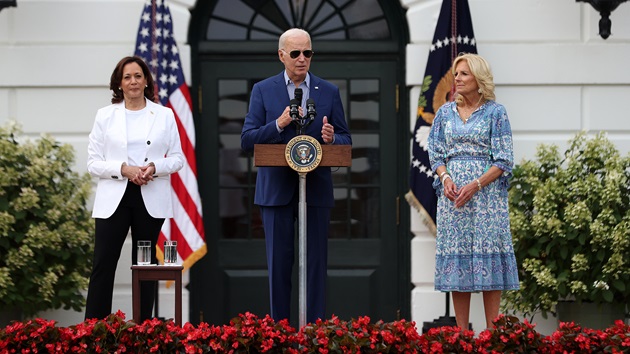
(WASHINGTON) — One week after announcing an end to the requirement that passengers remove their shoes when undergoing airport security screening, the Department of Homeland Security could also alter another post-9/11 mainstay of air travel – the amount of liquid ounces that people can take with them onboard commercial planes.
“The liquids I’m questioning, so that may be the next big announcement is what size your liquids need to be,” DHS Secretary Kristi Noem said at an event in Washington, D.C., on Wednesday. “We’re looking at our scanners, what we have put in place in TSA, multi-layered screening process that allows us to change some of how we do security and screening so it still is safe.”
Noem didn’t indicate when the updated policy announcement might be made.
The Transportation Security Administration (TSA) in 2006 implemented a policy limiting liquids, gels and aerosols in passenger carry-on luggage to 3.4-ounce containers or smaller, to lessen the chances of liquid explosives being brought onboard commercial aircraft.
Noem announced on July 8 that DHS was ending the nearly 20-year requirement that passengers remove their shoes for inspection before boarding commercial aircraft. The policy was implemented in 2006 after the so-called “shoe bomber,” Richard Reid, unsuccessfully attempted to detonate plastic explosives concealed in his shoes onboard a flight from Paris, France to Miami, Fla. On Dec. 22, 2001.
Noem said during last week’s announcement that DHS was able to terminate the shoe removal policy due to the “layered security” by the TSA now place. These layers include additional officers at security checkpoints, new scanners and technology and the recently enforced REAL ID requirement, Noem said.
Secretary Noem was also asked about the current threat environment in the United States.
“We have the threat from terrorists that are in our country today that we need to remove,” she said. “We also have the crimes that are happening on our streets by those individuals that are murderers and rapists that affect families immediately.”
Noem said the U.S. critical infrastructure is also vulnerable to attack and pointed to various cyber incidents that have occurred in the past year.
(PAWLEYS ISLAND, S.C.) — A Georgia father drowned after saving five people from a rip current at a beach in South Carolina, according to the Pawleys Island Police Department.
At approximately 4:45 p.m. on Sunday, police received a call for “multiple swimmers in distress” in Pawleys Island, South Carolina, and once on the scene, they discovered one person was missing and a “search was initiated.”
Then at approximately 6:15 p.m., the body of the missing person was found and identified as 38-year-old Chase Childers, officials said.
Officials later found out that Childers — a former professional baseball player for the Baltimore Orioles’ minor league team and police officer — and one other individual entered the water to help a family of five, with Childers getting “caught in the rip current.”
“He died trying to save others,” police said.
Childers’ family said in a statement that they are “devastated by the tragic loss of our beloved Chase Childers” and that the news feels “surreal, incredibly hard to grasp and profoundly unfair.”
His family described his death as a “heroic act,” where he paid the “highest sacrifice with his life in front of his three children and wife.”
“Word are hard to find at the moment,” the family said in a statement shared on social media.
Childers leaves behind three children and his wife, the family said. He would have turned 39 next month, his brother-in-law confirmed to ABC News.
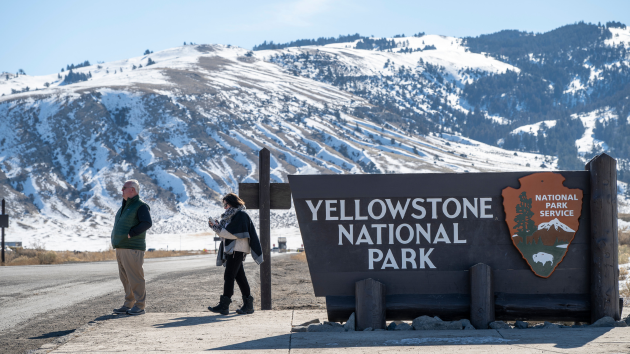
(WYOMING) — More geological changes are occurring at Yellowstone National Park, as another hole forms in one of the park’s basins.
The hole is a blue water spring, discovered by geologists in April as they conducted routine maintenance of temperature logging stations at Norris Geyser Basin, according to the U.S. Geological Survey.
The pool, located in the Porcelain Basin sub-basin west of a patch of vegetation known as “Tree Island,” was not there during their last visit to the area in the fall, according to the USGS.
The water is light blue in color and is about 1 foot deep below the rim. It’s geological features indicate it formed as a result of a hydrothermal explosion — an event caused by pressure changes that result from the transition of liquid water to steam, according to the USGS.
The pool measures about 13 feet in diameter and is surrounded by numerous small rocks about 1 foot across. The rocks are covered by light gray, sandy mud.
It is “not surprising” that a hydrothermal explosion occurred at the site, as it has happened several times in recent decades, according to the USGS. The North Geyser Basin is the “most dynamic” area in Yellowstone, the agency said.
High-resolution satellite imagery indicates that the hole was not present on Dec. 19, but images taken on Jan. 6 show a depression that had formed in the area. By Feb. 13, the pool had been filled with water, the satellite images show.
More will hydrothermal explosions will likely be recorded, as a monitoring station installed in 2023 can detect geophysical data indicating an explosion.
In April 2024, a “small” explosion at the Porcelain Terrace left a crater measuring several feet across in diameter, according to the USGS.
A hole that formed in Yellowstone’s Biscuit Basin, near Old Faithful, in July 2024 was also attributed to a hydrothermal explosion, according to the National Park Service.
While that hole likely formed in a single major explosive event, the newest thermal feature appears to have formed by multiple small events that initially threw rocks but later threw silica mud a short distance, creating a small pit that became filled with silica-rich water.
Geologists estimate that the feature probably started to develop on Dec. 25, with further activity occurring through late January and early February, according to the USGS.
Beneath Yellowstone National Park lies a complex and extensive volcanic system. The park is thoroughly monitored by the USGS and the Yellowstone Volcano Observatory.
Lev Radin/Pacific Press/LightRocket via Getty Images
(NEW YORK) — The nation’s largest police force is “criminal at its core,” according to a new federal lawsuit by former interim New York City Police Commissioner Thomas Donlon.
Donlon said the NYPD “functions as a racketeering enterprise,” at the direction of Mayor Eric Adams.
In addition to Adams, the lawsuit named Deputy Mayor for Public Safety Kaz Daughtry, Chief of Department John Chell and former Deputy Commissioner Tarik Sheppard among others.
“Senior leadership had abandoned lawful governance and engaged in outright malfeasance by using the NYPD to consolidate political power, obstruct justice, and punish dissent,” the lawsuit said. “The Defendants engaged in a coordinated pattern of racketeering activity that was deliberate, sustained, and directed from the highest levels of the NYPD and City Hall.”
The accusations in Donlon’s lawsuit are “absurd,” Adams’ press secretary, Kayla Mamelak Altus, said in a statement in response to the lawsuit.
“These are baseless accusations from a disgruntled former employee who — when given the opportunity to lead the greatest police department in the world — proved himself to be ineffective. This suit is nothing more than an attempt to seek compensation at the taxpayer’s expense after Mr. Donlon was rightfully removed from the role of interim police commissioner,” Altus said.
“The NYPD is led by the best, brightest, and most honorable professionals in the nation — and their results speak for themselves: crime continues to fall across the city, with shootings at the lowest level in recorded history. We will respond in court, where we are confident these absurd claims will be disproven,” she added.
Adams appointed Donlon interim commissioner in 2024 after Edward Caban resigned the post following an FBI search of his home. Caban has not been charged with any wrongdoing and said at the time he was resigning because the raids “created a distraction.”
In the complaint, Donlon said he was commissioner “in name only” and true authority remained with an inner circle of Adams’ loyalists.
“The Defendants undermined Donlon’s authority by blocking his merit-based promotions and instead elevating unvetted individuals of their choosing. The Defendants then fraudulently used Donlon’s official Police Commissioner stamp — without his consent — to legitimize and carry out their corrupt scheme,” the lawsuit said.
The lawsuit also accused several of the defendants of carrying out “a calculated and deeply personal act of vengeance” by orchestrating the false arrest of Donlon’s wife and leaking it to the press. Donlon’s wife was arrested for expired car insurance last December, sources told the New York Post.
“This was not a mistake. It was a deliberate abuse of power designed to punish and intimidate Donlon for exposing their misconduct,” the lawsuit said. “This coordinated humiliation was a direct warning: the NYPD Defendants would stop at nothing to silence and personally destroy Donlon, even if it meant violating the constitutional rights of his spouse.”
Donlon is looking for compensatory, emotional and punitive damages as well as injunctive relief, with “the full extent of damages incurred by Donlon are to be determined at trial.”
Adams is currently running for a second term as mayor, but chose not to run in the Democratic primary and will run for reelection as an independent instead.
(WASHINGTON) — House Republicans on Wednesday followed directions from President Donald Trump to move forward with a package of legislation that includes three cryptocurrency measures — a day after hard-liners defied the president and tanked it.
The House passed the procedural motion after the hard-liners failed to advance it on Tuesday. Still there was some drama as several Republicans voted against it before changing their votes.
On Tuesday, Trump said he made a deal with the Republicans who voted against the crypto bills — CLARITY, GENIUS and Anti CBDC Surveillance Act.
Trump — who has said crypto is a top priority for his administration — said in a social media post on Tuesday that he met in the Oval Office with 11 of the 12 GOP members needed to pass the package and that they “all agreed to vote tomorrow morning in favor of the Rule.” Trump did not provide specifics about the deal.
That conservatives who voted against the rule on Tuesday wanted the crypto bills combined into one big package, rather than take separate standalone votes on each measure.
Johnson on Tuesday thanked Trump for helping lock down the necessary votes to advance the crypto legislation.
“I’m thankful for President Trump getting involved tonight to ensure that we can pass the GENIUS Act tomorrow and agreeing again to help us advance additional crypto legislation in the coming days,” Johnson said, referencing the name of one of the bills.
Earlier Tuesday, a dozen House Republicans bucked Trump and Johnson to prevent the legislation from advancing on the floor — joining the entire Democratic caucus — and, at least temporarily, freezing activity in the House. The final tally was 196-223.
Johnson had said earlier that while he anticipated that there may be enough opposition to defeat the effort, he felt that it was “important” to try to advance the bills. Republicans have a narrow majority in the House — with 220 Republicans compared to 212 Democrats.
“This is the legislative process. We have some members who really, really want to emphasize the House’s product,” Johnson said. “They want to, want to push that and merge them together. We’re trying to work with the White House and with our Senate partners on this. I think everybody is insistent that we’re going to do all three, but some of these guys insist that it needs to be all in one package.”
Trump touted the legislation on Tuesday, urging Republicans to advance the bills.
“The GENIUS Act is going to put our Great Nation lightyears ahead of China, Europe, and all others, who are trying endlessly to catch up, but they just can’t do it,” Trump posted on Truth Social Tuesday. “Digital Assets are the FUTURE, and we are leading by a lot! Get the first Vote done this afternoon (ALL REPUBLICANS SHOULD VOTE YES!).”
The vote came during what the White House is calling “Crypto Week” and marks a rare instance when House Republicans have defied Trump’s direction.
Trump, who launched his own crypto meme coin earlier this year, recently said he is a “fan of crypto” and called it a “very powerful industry” that the U.S. has “dominated.”
“I’m president. And what I did do there is build an industry that’s very important,” Trump said last month. “If we didn’t have it, China would.”
Once a crypto skeptic, Trump and his family have fully immersed themselves in the cryptocurrency marketplace, developing not only the $TRUMP meme coin, but also a bitcoin mining firm, a stablecoin firm and a crypto reserve.
ABC News’ Sarah Beth Hensley contributed to this report.
(WASHINGTON) — President Donald Trump continued Wednesday to dismiss calls within his own party for more transparency into the Jeffrey Epstein investigation and made claims, without evidence, that the controversy was designed to undermine him.
In a lengthy social media post, which included references to the president’s previous claims about the 2017 Russian election interference probe, Trump blamed Democrats for creating what he called a “scam” and “hoax.”
“Their new SCAM is what we will forever call the Jeffrey Epstein Hoax, and my PAST supporters have bought into this ‘b——–,’ hook, line, and sinker,” he wrote.
Trump and Attorney General Pam Bondi have come under fire from conservatives on the Hill and across the country for declining to release the Epstein probe files in their entirety.
The Justice Department and FBI last week stated they found no evidence the deceased financier kept a “client list” of associates whom he blackmailed or conspired with to victimize dozens of women.
House Speaker Mike Johnson said Tuesday that Bondi should explain the administration’s handling of the case especially after she told Fox News in February that Epstein’s alleged “client list” was “sitting on my desk now to review.”
Johnson also did not rule out responding to growing calls from Republican lawmakers to have Epstein’s convicted associate, Ghislaine Maxwell, testify before Congress.
“I’m for transparency. We’re intellectually consistent in this,” Johnson said when asked about Maxwell potentially testifying before Congress.
In his post, Trump disavowed those who focus on the Epstein story rather than his accomplishments.
“Let these weaklings continue forward and do the Democrats work, don’t even think about talking of our incredible and unprecedented success, because I don’t want their support anymore!” Trump said.
(NEW YORK) — The largest Mars meteorite ever found on Earth was sold at a Sotheby’s auction in New York on Wednesday for $4.3 million.
The Martian rock, known as NWA 16788, weighs more than 54 pounds, is nearly 15 inches long and is 70% larger than the next biggest piece of Mars that has been recovered, according to the auction house.
Sotheby’s said the piece broke from the surface of Mars following a recent asteroid strike and traveled more than 140 million miles across the Solar System.
It crashed in the Sahara Desert in the Agadez region of Nigeria and was found by a meteorite hunter in November 2023, Sotheby’s said.
“This is the largest piece of Mars on planet Earth. The odds of this getting from there to here are astronomically small,” Cassandra Hatton, vice chairman of science and natural history at Sotheby’s, said in a video posted online. “Remember that approximately 70% of Earth’s surface is covered in water. So we’re incredibly lucky that this landed on dry land instead of the middle of the ocean where we could actually find it.”
The auction house said the reddish brown rock is “unbelievably rare” because meteorites from Mars make up just 400 of the 77,000 officially recognized meteorites. According to Sotheby’s, the rock that was sold represents 6.5% of all Martian material currently on Earth.
Hatton said a sample of the rock was sent to a specialized laboratory to be tested for Maskelynite glass, which is only found in meteorites.
Testing determined the rock is an olivine-gabbroic shergottite, which is a relatively new type of Martian meteorite, according to an April 2024 report from researchers the U.S. and Canada. It was formed from the as magma on Mars slowly cooled, Sotheby’s said, and contains materials such as olivine, which is also found in Earth’s upper mantle.
“This isn’t just a miraculous find, but a massive data set that can help us unlock the secrets of our neighbor, the red planet,” Hatton said.
Prior to going up for auction at Sotheby’s, the rock was in a public exhibit at the Italian Space Agency in Rome during the 2024 European Researchers’ Night and in a private gallery in Arezzo, Tuscany.
It’s unclear who the current owner is and if the Martian rock will be in a public or a private collection.
Also up for auction was a Ceratosaurus skeleton from the late Jurassic period, about 154 to 149 million years ago, which was sold for $30.5 million, and the skull of a Pachycephalosaurus from the late Cretaceous period 72 million to 66 million years ago for $1.75 million.
Wednesday’s auction, containing 122 items, is part of Sotheby’s Geek Week, which holds sales for items related to natural history, the history of science and technology, and space exploration.
Among the items up for sale on Thursday, the final day of Geek Week, include a first generation of Apple-1 computer from the first batch of 50 built by Steve Jobs and Steve Wozniak in 1976.
Ramez Habboub / GocherImagery/Future Publishing via Getty Images
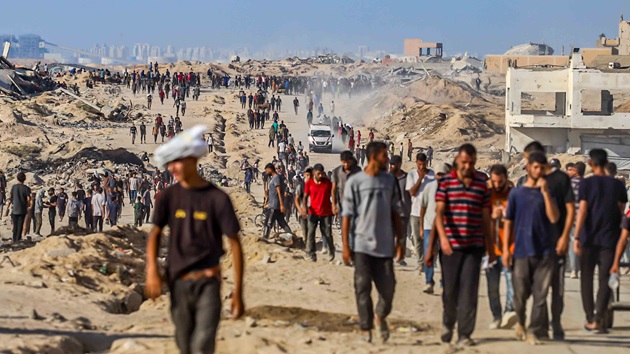
(LONDON) — At least 20 people were killed in an incident at one of the Gaza Humanitarian Foundation aid distribution sites in the southern Gaza Strip, the U.S.-backed group said in a statement on Wednesday.
The GHF said in a post to X that 19 of the dead were “trampled” and another was stabbed, in what it described as a “chaotic and dangerous surge.” The GHF blamed “agitators in the crowd” for the stampede.
The Hamas-run Ministry of Health in Gaza said that 15 of those killed “died of suffocation as a result of tear gas fired at the starving people and the subsequent stampede.” The ministry said at least 21 people were killed in the incident. The GHF denied using tear gas, saying instead that there was a “limited use” of pepper spray.
Video filmed by local journalist Abdallah Alattar and verified by ABC News appeared to show lifeless bodies being unloaded from a cart outside Nasser Hospital in Khan Younis.
A man could be seen holding a boy whose head appears to be limp and telling the cameraman, “They died by suffocation. There was a stampede.”
Marwan Al Hams, director-general of field hospitals in Gaza, told ABC News that victims arriving there showed signs of bruising on the face and body, injuries that the source said were consistent with intense crowding. Victims also showed notable indications of “oxygen deprivation,” the source said.
As of July 13, at least 875 people have been killed in recent weeks while trying to get food in Gaza, according to Thameen Al-Kheetan, a spokesperson for the U.N.’s Office of the High Commissioner for Human Rights. Of those, 674 were killed “in the vicinity of GHF sites,” Al-Kheetan said.
The GHF is backed by the U.S. and Israeli governments, with the U.N. and other aid organizations refusing to collaborate with the group, citing concerns about its transparency and political impartiality.
The GHF has consistently rejected criticisms by the U.N. and other aid groups of its aid distribution operations and multiple deadly incidents occurring among groups of Palestinians on their way to collect food.
In its statement on Wednesday’s deadly stampede, the GHF said it had “credible reason to believe that elements within the crowd — armed and affiliated with Hamas — deliberately fomented the unrest.”
“For the first time since operations began, GHF personnel identified multiple firearms in the crowd, one of which was confiscated,” the group alleged. “An American worker was also threatened with a firearm by a member of the crowd during the incident.”
“We mourn the lives lost today, and we remain committed to providing humanitarian aid as safely and responsibly as possible,” it added. “GHF exists to serve the people of Gaza with compassion and integrity, and our mission has never been more urgent or more challenged.”
The Hamas-run Government Media Office in Gaza issued a statement rejecting the GHF allegations.
This week, the GHF unveiled a new “flag system” to indicate the status of its sites to Palestinians seeking aid. A red flag will be flown to signify that the site is closed, while a green flag will indicate it is open, the group said in a Monday post to social media.
The Israeli government says the GHF is required to prevent Hamas fighters from seizing humanitarian aid, which Israel has accused the terror group of throughout the war in Gaza. Hamas has denied such thefts.
On Saturday, the Israel Defense Forces told ABC News in a statement that it “allows the American civilian organization (GHF) to distribute aid to Gaza residents independently, and operates in proximity to the new distribution zones to enable the distribution alongside the continuation of IDF operational activities in the Gaza Strip.”
Previous deadly incidents attributed to Israeli military action at or near the GHF sites, the IDF said, “are under review by the competent authorities in the IDF.”
Hungry Palestinians say they have to go to the sites to collect aid, with few other options.
“How can I go and buy 1 kg of flour for 70 shekels ($20) when I don’t have that kind of money?” Mohanned Al Tifi, awaiting treatment inside Nasser Hospital, told ABC News on Wednesday morning. “This is what forced me to go there, the hunger.”
Al Tifi said he suffered a pelvic fracture in the morning’s chaos. He had to wait for 3 hours before he was helped to safety at the aid site by a “good Samaritan,” he said.
“Let me tell you if I could bring 5 kg of flour I will go home happy,” he said.
(WASHINGTON) — House Oversight Committee Chairman James Comer told reporters that former Vice President Kamala Harris and former first lady Jill Biden “should” be subpoenaed in the panel’s investigation into former President Joe Biden’s mental capacity while in office after another top Biden official pleaded the Fifth today.
“Well, I think they should,” Comer told ABC when asked if the committee should subpoena Harris and Jill Biden. “They should have already issued statements. They should have already done public relations campaign to sit down and answer questions. They should go on FOX, they should go on CNN and answer questions.”
Anthony Bernal, a veteran aide of three Democratic presidential administrations — Bill Clinton, Barack Obama, and Joe Biden — whose service culminated as assistant to the president and chief of staff to the first lady, on Wednesday invoked the Fifth Amendment twice during a closed-door deposition before the committee investigating former President Biden’s mental capacity while in office.
Comer also said the committee has scheduled a slate of depositions with former Biden officials in the GOP’s investigation of the Biden administration’s use of the presidential auto-pen. At President Donald Trump’s urging, Republicans have taken aim at Biden’s clemency actions signed during his final hours in office — wondering whether staff acted on their own accord or at the direction of the president.
“So we’re going to bring in everyone. We’re moving up the line,” Comer later added. “So we’ve started with the lower-level staffers that we think were the ones that actually put the documents in the autopen and pressed power. Now we’re moving up to the people that we think told the staffers to use the autopen. So we’ll — we’ll see where that takes us. But I think the possibility is very good that — that we’ll be asking members of the family to come in and talk.”
(LONDON) — The Israel Defense Forces said it struck “the entrance” of Syria‘s military headquarters in Damascus on Wednesday.
Syria’s Ministry of Health told the state-run Syrian Arab News Agency that at least one person was killed and 18 others were injured Wednesday in the Israeli airstrikes on the capital, Damascus.
The high-profile strike came amid a wave of sectarian violence in the southern Syrian city of Sweida, where the Druze population has clashed with local Bedouin Sunni tribes and the recently installed Syrian government, headed by Interim President Ahmed Al-Sharaa who toppled former President Bashar Al-Assad in December.
The Druze are an offshoot of a branch of Shiite Islam. Around 1 million Druze are spread across Syria, Israel and Lebanon. The majority live in Syria, concentrated in the south of the country.
“The IDF continues to monitor developments and the regime’s actions against Druze civilians in southern Syria,” the IDF said in a statement. “In accordance with directives from the political echelon, the IDF is striking in the area and remains prepared for various scenarios.”
In a post to X, Israeli Defense Minister Israel Katz said: “The warnings in Damascus have ended — now painful blows will come.”
“The IDF will continue to operate forcefully in Sweida to destroy the forces that attacked the Druze until their complete withdrawal,” Katz added.
More than 250 people have been killed in Sweida province as of Wednesday morning since the violence erupted on Sunday, according to the Syrian Observatory for Human Rights, a U.K.-based war monitoring group. Those deaths included 21 people who were killed in “field executions” by local groups in Sweida, the organization said.
Syrian government forces were deployed to the Sweida region — home to the largest population of the Druze religious minority in Syria — on Monday in an effort to restore order but ultimately clashed with the Druze militias themselves. On Tuesday, Syrian Defense Minister Murhaf Abu Qasra announced a ceasefire agreement in Sweida, saying government forces would “respond only to the sources of fire and deal with any targeting by outlaw groups.” But clashes continued.
As that sectarian violence has grown, the Israeli military has taken action against the Syrian government, the IDF said.
Over the past day, the IDF has struck and continues to strike tanks, rocket launchers, weapons, and pickup trucks loaded with heavy machine guns on their way to the As Suwayda area in southern Syria,” the IDF said in a statement Wednesday, using another common spelling for Sweida.
The IDF said it has “decided to reinforce its forces in the area of the Syrian border” and “will continue to operate, both in defense and offense, to ensure the security of Israeli civilians.”
The office of Syria’s interim president said in a statement Wednesday that it “has followed with great concern the unfortunate violations that have recently occurred in some areas of Sweida Governorate.”
“These acts, which fall within the category of criminal and illegal behavior, are unacceptable under any circumstances and completely contradict the principles upon which the Syrian state is based,” the presidency added. “We, in the Syrian government, strongly condemn these shameful acts and affirm our full commitment to investigating all related incidents and holding accountable all those proven to be involved.”
Israeli Prime Minister Benjamin Netanyahu also urged Israeli Druze groups not to cross into Syria to join the fighting.
“We are working to save our Druze brothers and to eliminate the regime’s gangs,” he said in a statement posted to X on Wednesday.
Addressing those crossing the border or attempting to, Netanyahu added: “You are citizens of Israel. Do not cross the border. You are risking your lives; you could be murdered, you could be kidnapped, and you are harming the efforts of the IDF. Therefore, I ask you — return to your homes, let the IDF act.”