(WASHINGTON) — Kilmar Abrego Garcia is expected to appear before immigration authorities on Monday morning in Baltimore, where he faces the possibility of being detained again.
Less than 24 hours after being released from criminal custody in Tennessee on Friday, Immigration Customs Enforcement notified Abrego Garcia’s attorneys that he may be deported to Uganda and ordered him to report to their office in Maryland.
The notification from ICE came after Abrego Garcia rejected a plea deal to be deported to Costa Rica in exchange for pleading guilty to human smuggling charges and remaining in jail, according to a court filing from his attorneys.
In the filing, Abrego Garcia’s attorneys accused the federal government of trying to force their client to accept a guilty plea or face deportation to East Africa.
It is unclear if Abrego Garcia will be put into immigration custody on Monday.
In July, U.S. District Judge Paula Xinis ordered the government to “restore Abrego Garcia to his ICE Order of Supervision out of the Baltimore Field Office.”
But Xinis also said that if the government intends to deport Abrego Garcia to a third country, it needs to provide 72 hours’ notice.
The order allowed President Donald Trump’s administration to initiate “lawful immigration proceedings” when Abrego Garcia returned to Maryland.
The immigration proceedings may or may not include “lawful arrest, detention and eventual removal,” Xinis said in July.
(NEW YORK) — For the second time in less than a week, Villanova University was the scene of an active shooter hoax report on Sunday, prompting police to clear buildings at the Pennsylvania campus before investigators determined the incident was not legitimate, officials said.
The false call came in at around 11 a.m. and was directed at Austin Hall, a student dormitory on the campus in Radnor, Pa., a suburb of Philadelphia, authorities said.
“Law enforcement has confirmed the call to be false. Officers are working to clear the campus and restore normal operations,” the Radnor Police Department said in a social media post around 11:39 a.m. local time.
It was the second time in four days that Villanova had been targeted in what authorities described as a “swatting incident,” a fake report intended to prompt a large law enforcement response. On Thursday, Villanova University received a report of a possible shooter at its law school but the report was later determined to be a hoax after university officials issued an alert warning of an active shooter on campus.
Thursday’s incident, which came as the school was celebrating its orientation mass to welcome new students, caused “panic and terror” to ensue on campus, Villanova President Rev. Peter Donohue said in a statement to the school community.
The incident caused a large-scale response from local and federal police as officers in tactical gear conducted a sweep of the law school’s Scarpa Hall as students and faculty were ordered to shelter in place.
“Mercifully, no one was injured, and we now know that it was a cruel hoax – there was no active shooter, no injuries and no evidence of firearms present on campus,” Donohue said in a statement to the school community following Thursday’s incident. “While that is a blessing and a relief, I know today’s events have shaken our entire community.”
Delaware County District Attorney Jack Stollsteimer said his office and the FBI are investigating Thursday’s incident, adding, “We’re going to work to try to get to the bottom of who might have done this.” There was no immediate response from Stollsteimer’s office following Sunday’s incident.
After Thursday’s incident, Pennsylvania Gov. Josh Shapiro noted that swatting is illegal and said that he had directed Pennsylvania State Police to “use every tool at our disposal to find the person or people who called in this fake threat and hold them accountable.”
Another unfounded active shooter scare occurred earlier Thursday at the University of Tennessee in Chattanooga.
Around 12:30 p.m. on Thursday, a 911 call came in “indicating that there was an active shooter” at the campus, the school said. State, county and federal agencies responded and members of the school community were advised to “Run. Hide. Fight.”
After several areas of the campus were cleared, there was no evidence of any shooting or injuries reported, the university said.
The Chattanooga incident is also under investigation by multiple agencies, including the FBI, the school said.
(NEW YORK) — A fire at plant in Louisiana continues to burn and an evacuation order within a 1-mile radius of the facility remains in place following an explosion Friday, officials said at a press conference.
As of Saturday, 42 people are at a shelter, according to officials. About 800 residents were affected by the explosion, Tangipahoa Parish Sheriff Gerald Sticker said in an update.
The fire was 90% contained by Saturday evening, response officials said in a press release posted by the Louisiana State Police.
“Response crews have worked diligently throughout the day and will continue operations through the night to strengthen containment and support recovery efforts,” the release said.
In a Sunday update, the Louisiana State Police said the fire was still 90% contained and that the mandatory 1-mile radius evacuation remained in effect.
“Overnight, additional resources, including specialized heavy equipment, arrived. Response crews began removing structural debris and addressing covered hotspots. A containment berm is being established around the site, and recovery operations will continue throughout the day,” the Sunday statement said.
The statement added that “environmental response efforts” were underway to address the fire’s potential effect on the nearby Tangipahoa River and adjacent waterways. It also said that “all air monitoring results have shown either non-detectable readings or levels well below health-based or actionable thresholds,” and that “continuous air monitoring remains in place.”
“To date, no injuries have been reported. Nearly 150 personnel are engaged in field operations, representing all levels of government and contracted support,” Sunday’s Louisiana State Police update further said.
Though most chose to follow the evacuation, some of the residents within the one-mile evacuation zone chose to stay, Sticker said Friday. Deputies were maintaining a perimeter as firefighters continued to fight the fire.
Residents have been asked to to avoid direct contact with soot as a result of the fire as it is believed to contains both combustibles and hydrocarbon chemicals, Louisiana State Police Sgt. William Huggins said Saturday.
Authorities asked residents to remain indoors when possible, wash hands frequently, avoid touching their face and avoid direct contact with the soot.
Officials said they are are aware of debris in the Tangipahoa River and said water samples will be collected for environmental impact analysis. What is exactly in the soot is also under investigation.
The most recent air quality readings indicated results “below an actionable threshold” at this time, Huggins said Saturday.
Overnight a number of small explosions occurred, consistent with what has been happening since the beginning of the fire, Huggins said.
The incident occurred at Smitty’s Supply, a lubricant manufacturer located in Roseland in Tangipahoa Parish, local officials said. A large plume of smoke could be seen following the explosion.
The explosion was reported shortly before 1 p.m. local time Friday, according to Tangipahoa Parish President Robby Miller.
The Tangipahoa Parish government ordered a mandatory evacuation for those in the immediate area, which then expanded to within a 1-mile radius of the plant.
The sheriff’s office said any residents that need to return home for medication or pets should coordinate with their department to receive an escort.
“Relocate IMMEDIATELY and stay away from this area until further notice,” the Tangipahoa Parish Sheriff’s Office said on X.
An elementary school located within the evacuation zone evacuated students to a location in Amite City.
No injuries have been reported, “which is a godsend,” Miller said at a press briefing late Friday afternoon.
The Louisiana Department of Environmental Quality has been monitoring the environment, Miller said. It’s unclear what caused the explosion, he said.
Smitty’s Supply manufacturers and distributes lubricant, including motor oils, according to its website. About 400 people work at the plant, according to Miller.
Highway 51 at Highway 10 in Roseland closed following the explosion.
“We are monitoring this situation closely. Please follow the guidance of your local officials,” Louisiana Gov. Jeff Landry said in a statement on X. “We are praying for everyone’s safety.”
(NEW YORK) — A man was killed and four other people were injured when gunfire broke out on Saturday night at a New York City park where a large crowd had gathered for a basketball tournament, according to police.
The gunfire erupted around 7:27 p.m. as multiple shooters opened fire inside Haffen Park in the Bronx, prompting the crowd on hand to scatter and seek cover, according to the New York Police Department (NYPD).
Officers responded to the park in the Baychester neighborhood of the Bronx after 911 callers reported multiple people had been shot, according to a statement from the NYPD.
ABC New York City station WABC reported that the shooting occurred as a crowd had gathered for a youth basketball tournament.
Upon arrival to the park, officers found a 32-year-old man who had been shot in the chest and a 17-year-old girl who had been shot in the face, according to the police statement.
Both victims were taken to Jacobi Medical Center in the Bronx where the male victim was pronounced dead, police said. The wounded teenage girl was listed in critical condition as of Sunday, according to police.
Three other victims wounded in the park shooting showed up at hospitals in private vehicles, including a 30-year-old man and a 29-year-old woman, who were who were both shot in the back and were listed in stable condition, police said on Sunday morning. A 42-year-old man was also shot in the arm during the incident and was taken by private vehicle to Montefiore Hospital in the Bronx, where he was in stable condition on Sunday.
Police said they are withholding the name of the man who was killed pending notification of his family.
At least four people were detained for questioning shortly after the shooting, according to police, who haven’t said if those people have been charged in connection with the incident.
A motive for the shooting remains under investigation, according to police, who are asking anyone who may have witnessed the shooting to contact detectives immediately.
Saturday’s shooting marked the second consecutive weekend that the NYPD responded to a mass casualty shooting.
Three men were killed and 11 people were wounded during an Aug. 17 incident in which multiple shooters opened fire inside the Taste of the City Lounge, a bar and restaurant in Brooklyn’s Crown Heights neighborhood. Police said two of the three people killed were involved in the shooting and that one man who was fatally shot was an uninvolved bystander.
Two other perpetrators who allegedly opened fire inside the lounge remain at large, authorities said. NYPD Commissioner Jessica Tisch said investigators have determined that lounge shooting was gang related.
The shootings occurred as the most recent NYPD crime statistics show homicides citywide are down by 19.6% so far this year compared to the same year-to-date period in 2024. The data also show that the number of shooting victims are down 19.4% this year compared to 2024, and the number of shooting incidents has fallen by nearly 20% over the same period compared to last year.
Stephen Lam/San Francisco Chronicle via Getty Images
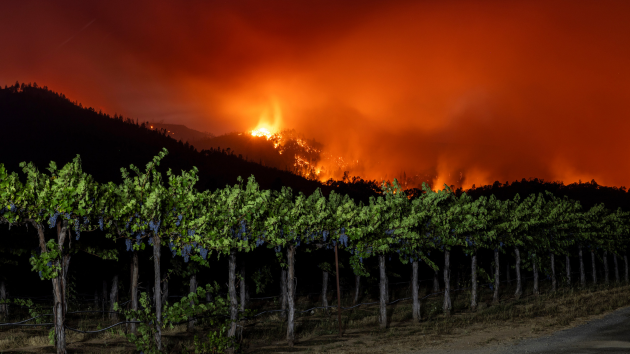
(LOS ANGELES) — A fast-spreading wildfire in California’s wine country prompted mandatory evacuation orders as firefighters continued to battle the blaze from the ground and air on Sunday.
The Pickett Fire in Northern California’s Napa County has burned some 6,531 acres since it broke out Thursday, according to the California Department of Forestry and Fire Protection.
As of late Saturday night, the fire was 11% contained, CalFire said.
The fire broke out around 3 p.m. local time on Thursday near the town of Calistoga, officials said. The cause of the blaze remains under investigation.
In an update Saturday on its website, CalFire said crews have been aided during the nighttime fighting of the fire by night-flying helicopters and drones.
The fire is in the same region as the massive Glass Fire that scorched more than 11,000 acres in 2020.
“Leadership with prior experience in this rugged terrain, specifically from the 2020 Glass Fire, has been instrumental in guiding effective suppression efforts,” CalFire said in its update.
The fire comes as parts of the West Coast swelter under a heat wave.
In Southern California, the extreme heat also led to elevated fire concerns, with red flag warnings in place for the mountains north of Los Angeles and Santa Barbara.
(LONDON) — Russia launched drones and a missile into Ukraine overnight into Sunday, the air force in Kyiv said, as the country kicked off independence day celebrations marking the anniversary of its 1991 declaration of independence from the Soviet Union.
Ukraine’s air force said Russia launched 72 drones and one Iskander-M ballistic missile into the country in its latest overnight barrage, of which 48 drones were intercepted or suppressed. The missile and 24 drones impacted across 10 locations, the air force said.
On Sunday morning, Ukrainian President Volodymyr Zelenskyy’s office published a statement to mark 34 years of independence, in which Zelenskyy said the previous 1,278 days of war with Russia constitute the country’s “war for independence.”
Ukraine marks its independence day amid U.S.-led efforts to end Russia’s full-scale invasion of the country, which began in February 2022 and followed nearly a decade of cross-border aggression and land grabs by Moscow.
Zelenskyy posted to social media to share a letter from U.S. President Donald Trump, in which the American leader said that the Ukrainian people “have an unbreakable spirit, and your country’s courage inspires many. The United States respects your fight, honors your sacrifices, and believes in your future as an independent nation.”
“Now is the moment to bring an end to the senseless killing,” Trump continued, calling for a “negotiated settlement that leads to a durable, lasting peace that ends the bloodshed and safeguards Ukraine’s sovereignty and dignity.”
Zelenskyy thanked Trump for his letter. “We appreciate your kind words for the Ukrainian people, and we thank the United States for standing shoulder to shoulder with Ukraine in defending what is most valuable: independence, freedom, and guaranteed peace,” Zelenskyy wrote.
“We believe that by working together, we can put an end to this war and achieve real peace for Ukraine,” he added.
Ukraine continued its own long-range attacks on Russia overnight, according to Russia’s Defense Ministry. Russian forces shot down 95 Ukrainian drones over 14 regions during the latest exchange, the ministry said in a Sunday morning statement.
At least one drone was shot down on approach to Moscow, local officials said, with at least six shot down over the Leningrad region and St. Petersburg, according to the Defense Ministry.
Two people were injured by drone attacks in the western Russian region of Bryansk, according to local authorities, with damage reported to homes and cars.
There were reports of explosions related to drone attacks at the Syzran oil refinery in Samara region, as well as a fire at the Novatek gas terminal at the port of Ust-Luga, west of St. Petersburg.
Sources inside the Security Service of Ukraine (SBU) told ABC News that drones struck the Ust-Luga port, targeting the Novatek gas facility.
The SBU previously struck Ust-Luga in January 2025. The terminal handles Russian oil and gas exports including via the country’s so-called “shadow fleet” of tankers used to evade international sanctions.
The SBU described Saturday night’s attack as “a gift for Russia on Ukraine’s independence day.”
Russia’s federal air transport agency, Rosaviatsiya, reported temporary flight restrictions at at least 11 airports across Russia, including in Pskov, Saratov, Volgograd and St. Petersburg.
In the western Kursk region, officials said a downed Ukrainian drone caused a fire at the Kursk Nuclear Power Plant. “Upon impact, the drone detonated, resulting in damage to an auxiliary transformer,” the plant’s press service wrote on Telegram.
The statement said that radiation levels were normal and there was no immediate danger.
The International Atomic Energy Agency said in a post to X that its Director General Rafael Grossi stressed that “every nuclear facility must be protected at all times.”
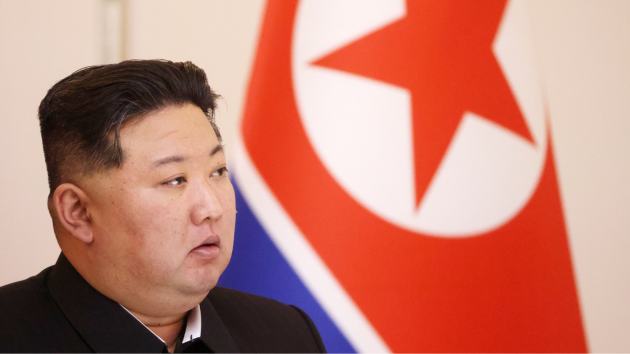
(LONDON) — North Korean leader Kim Jong Un oversaw the test-firing of two newly developed types of missiles, state media reported, launches that came as the United States and South Korea held their annual military drills to the south.
The two missiles tested on Saturday were designed to target aerial threats, including attack drones and cruise missiles, the Korea Central News Agency reported on Sunday.
State media reported few details on the projectiles, other than describing them as “improved” versions, saying they were “based on unique and special technology.”
The launches came days after the Monday start of “Ulchi Freedom Shield 25,” joint military exercises that are ongoing in South Korea. Those training exercises, which include live-fire drills, were scheduled to run through Thursday.
The U.S. State Department in announcing that the drills had begun said they were intended to reaffirm “the ironclad commitment between the U.S. and South Korea to defend their homelands.”
A North Korean military official described those exercises as destabilizing for the Korean Peninsula, accusing the United States and South Korea of “the destruction of balance of power in the region.”
A spokesperson for the Korean People’s Army told Rodong Sinmun, a state-owned newspaper, that the “reckless” drills were being run by “warmongers,” adding that the exercises were pushing the Korean Peninsula into “extreme tension.”
North Korean state media published on Sunday an image of Kim meeting with military officials, along with several images of missiles in mid-air. It was not immediately clear where the missile tests had taken place.
As the drills began on Monday, Kim was touring a North Korean naval destroyer, KCNA reported. He reportedly said during that visit that the U.S.-South Korea drills could “ignite a war” and that North Korea should push for a “rapid expansion of nuclearization.”
Jay L. Clendenin / Los Angeles Times via Getty Images
(NEW YORK) – The Powerball jackpot is expected to climb to $750 million for Monday’s drawing, a prize that ranks as the 10th largest in the lottery’s history, after no single player matched all numbers drawn on Saturday, Powerball said early Sunday.
Monday’s drawing has an estimated cash value of $338.6 million, the lottery said in a press release.
The winning numbers for an estimated $700 million jackpot were drawn Saturday night. The white balls were 11, 14, 34, 47, 51, and the red Powerball 18. Tickets sold in Maine and Massachusetts matched the five white balls, winning $1 million each, the lottery said.
“A third ticket sold in South Dakota also matched all five white balls, and because the ticket included the Power Play option for $1 more, it doubled the winnings to $2 million,” Powerball said early Sunday.
There had been no winner after the last drawing on Wednesday, which marked the 36th consecutive round without a grand prize winner since a $204.5 million ticket was claimed in California on May 31. The numbers drawn on Wednesday were 31, 59, 62, 65, 68, and Powerball 5.
While nobody matched all six numbers, Wednesday’s drawing produced several other winners, according to Powerball. A Tennessee player matched five numbers and included the Power Play option, securing a $2 million prize. Two other tickets matched five numbers for $1 million each.
Additionally, 30 tickets won $50,000 by matching four numbers plus the Powerball, with eight of those winners doubling their prize to $100,000 through the Power Play option.
The current jackpot towers above other 2025 prizes, though it hasn’t reached the heights of 2024’s staggering $1.3 billion jackpot claimed by Cheng “Charlie” Saephan in Oregon last April. The second-highest prize this year was a $526.5 million jackpot won by a California ticket holder.
Players can purchase $2 tickets in 45 states, the District of Columbia, Puerto Rico, and the U.S. Virgin Islands. Some states offer online purchasing options through official channels or licensed services. The drawing is scheduled for 10:59 p.m. ET on Saturday.
For an additional dollar, players can add the Power Play option, which multiplies non-jackpot prizes by up to five times. In select states, a separate Double Play option allows participants to enter a second drawing for up to $10 million.
(WASHINGTON) — Former CIA Director and retired Army Gen. David Petraeus said Sunday that he’s dubious that Russian President Vladimir Putin and Ukrainian President Volodymyr Zelenskyy will meet to discuss ending the war in Ukraine.
“There’s not that much right now that would lead us to believe that,” Petraeus told ABC News’ “This Week” co-anchor Jonathan Karl. “I don’t think, in fact, out of the last two weeks, really, Jonathan, I think what should be clear to all, and I think it is even clear to President Trump, is that despite all of his efforts, again, which we applaud to end the war, to stop the killing, Vladimir Putin clearly has no intention of doing that unless he’s given additional territory, which is heavily fortified, and Russian forces would have to fight for years at the pace that they’re going.”
Petraeus’ comments come after Ukrainian President Volodymyr Zelenskyy met with President Trump last week in Washington alongside a contingent of other European leaders in pursuit of gathering more support to broker a ceasefire between Russia and Ukraine.
Ukraine’s air force said Russia launched 72 drones and one Iskander-M ballistic missile into the country in its latest overnight barrage, of which 48 drones were intercepted or suppressed, as the country marked the anniversary of its 1991 declaration of independence from the Soviet Union. Ukraine continued its own long-range attacks on Russia overnight, according to Russia’s Defense Ministry, which said it shot down 95 Ukrainian drones over 14 regions during the latest exchange.
Petraeus said that currently the “obstacle to peace” is Putin. He says that the U.S. should reconsider restrictions on some weapons that it won’t send to Ukraine and send more aid to ultimately bring an end to the 3 1/2-year war.
“And what we need to do is change those dynamics by helping Ukraine far more than we have so far. Lifting restrictions on them, seizing the $300 billion of frozen reserves and European countries of Russian money, giving it to Ukraine. More sanctions on Russia, even including the Gazprom bank, and curtailing the export of oil further than we have already,” Petraeus said.
Petraeus referred to a Wall Street Journal report that the Pentagon is limiting Ukraine’s use of U.S.-made long-range missiles against targets in Russia.
“This is another case where it appears that the Pentagon is carrying out policies that conflict with President Trump’s inclination. Now, I can understand why they would limit the use of certain long-range systems against Russia when they think that Russia might still be willing to make a deal. But that should be very clear not to be the case, at this moment, and I hope that there will be a review of that policy,” Petraeus said.
Nonetheless, Petraeus said he knows the war cannot last forever, saying that the war so far has killed and wounded 1.06 million Russians, including more than 500,000 that haven’t been able to return to the front lines due to the severity of their injuries, and is also having a “very substantial impact” on its civilian workforce.
“This has to have, over time, a very, very substantial impact on the ability of Russia just to find a civilian workforce as well. In fact, it’s reported that they were actually looking in Africa for women who can actually replace some of the men in Russia, in various industries,” Petraeus said.
Petraeus also responded Sunday to the Trump administration either firing or reassigning 16 top military officers, seven of whom are women, thus far into his second term. The latest removals happened Friday, including the head of the Defense Intelligence Agency, Lt. Gen. Jeffrey Kruse, just weeks after he oversaw a preliminary report that contradicted Trump’s assertion that Iran’s nuclear sites were obliterated by U.S. strikes in June.
“I think it has to be a concern. Obviously, it’s unprecedented. There’s never been anything like this,” Petraeus said. “There have been cases in the past where individuals who’ve gotten crosswise with the president or with the secretary of defense certainly, usually on a policy issue in which they should not have spoken out and indeed were replaced. But the numbers here obviously are much more significant than that.”
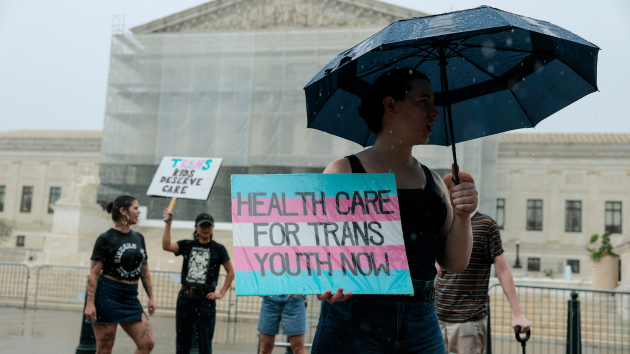
(NEW YORK) — Two U.S. hospitals are the latest to announce they will be ending some, or all, of their pediatric gender-affirming care services at the end of the month.
Kaiser Permanente, a health care company that manages 40 hospitals across several states — including California, Oregon and Virginia — said it is pausing gender-related surgeries for patients under age 18 on Aug. 29. It noted that other gender-related care will continue.
Children’s National Hospital in Washington, D.C. said it will also stop prescribing gender-affirming medications on Aug. 30. It follows a move the hospital made in late January to pause all puberty-blockers and hormone prescriptions for minors.
Since President Donald Trump’s second term began in January, at least 17 major hospital systems in at least nine states and the District of Columbia have paused, discontinued, canceled or ended pediatric gender services, according to an ABC News tally, amid mounting legal and regulatory concerns.
In January, Trump signed an executive order stating the U.S. would not “fund, sponsor, promote, assist, or support” gender transition of those under age 19 and would “rigorously enforce all laws that prohibit or limit these destructive and life-altering procedures.”
Transgender adults and youth may experience extreme psychological distress due to a mismatch in their gender presentation and identity. They experience significantly higher rates of suicide than the general population, but some studies suggest gender-affirming care eases those feelings of distress.
While some individuals and groups have called for a slower approach to gender-affirming care for minors, other pediatric gender care experts and advocates have said ending such care can have a harmful effect on patients’ mental health and well-being.
They say the government is interfering in conversations meant to be held only between patients, their families and doctors, and that doctors are not being allowed to follow the established medical guidelines that medical associations like the American Academy of Pediatrics, the Endocrine Society and the World Professional Association for Transgender Health have endorsed.
“This is health care provided by licensed clinicians according to standards of care that have been around for many years,” Kellan Baker, a senior adviser for health policy with the Movement Advancement Project, a nonprofit think tank that focuses on LGBTQ+ issues, told ABC News.
“To have the government interfering … overreaching into the private conversations between patients and families and their doctors and telling doctors that they cannot provide the care that they know that their patients need — that is a very serious government overreach,” he added.
Evidence for gender-affirming care Gender-affirming care may include medical, surgical, mental health and non-medical services. It can range from allowing a child to pick their pronouns to more invasive treatments typically prescribed for older teens.
Early gender affirming care can be “crucial” to overall health and well-being, allowing a child to focus on social transitions and can help build up confidence while dealing with the health care system, the federal Office of the Assistant Secretary for Health wrote during the Biden administration.
Gender-affirming care is supported by multiple major medical organizations. Studies have shown many of the treatment options are generally safe and that care can have a positive impact on mental health, which psychotherapy alone cannot provide, some experts said.
Some experts have questioned the significance of the interventions on long-term mental health as well as the possibility of regret and point out potential risks on future fertility.
“It’s deeply disappointing that hospital systems have relented to the political pressure, not scientific pressure, to end these sorts of programs,” Dr. Marci Bowers, a gynecologic and reconstructive surgeon at Mills-Peninsula Medical Cener in Burlingame, California, told ABC News. “We have decades of evidence-based information that suggests that gender-related health care is beneficial to patients and their families with very, very, very scant incidences of regret or disappointment in that care.”
A spokesperson for Children’s National Hospital told ABC News it was discontinuing the prescription of gender-affirming medications in light of “escalating legal and regulatory risks” to the hospital, its providers and families.
“We know this change will have a significant impact on affected patients, families and staff, and our care teams are working directly with families of current patients to support them,” the statement read, in part. “Mental health and other support services for patients remain available. LGBT patients are always welcome at Children’s National for other medical needs and treatment.”
Similarly, a spokesperson for Kaiser Permanente pointed ABC News to actions from the administration, including the Department of Justice issuing subpoenas to doctors and clinics providing gender-affirming care to transgender youth.
“As the legal and regulatory environment for gender-affirming care continues to evolve, we must carefully consider the significant risks being created for health systems, clinicians, and patients under the age of 19 seeking this care,” the statement read, in part. “After significant deliberation and consultation with internal and external experts, including our physicians, we’ve made the difficult decision to pause surgical treatment for patients under the age of 19 in our hospitals and surgical centers.”
The hospital said it would work to identify clinicians performing surgery if a patient’s planned operation was canceled and, if a clinician is available, the hospital said it will work with patients and their families to coordinate care and provide coverage for surgical treatment.
Bowers — the Mills-Peninsula gynecologic and reconstructive surgeon — said if somebody is in treatment and that treatment is suddenly withdrawn, it can be extremely difficult, and patients can experience psychosocial and personal setbacks. She said treatment gave patients a psychological boost.
‘When you look and you talk to these individuals, they are happier about themselves,” she said. “They’re happier about their bodies. They’re happier about their choice of friends, how they see themselves in the world. They’re more optimistic. So those are softer measures, but they’re important, and those things matter.”
She also said withdrawing medical care can be a major disruption to patients’ lives because families may have to move to receive care that is now no longer being provided locally.
Baker — the Movement Advancement Project’s health policy adviser — said he sees the actions from the administration as a “campaign of terror” against health care institutions, doctors and families, and that decisions about continuing or discontinuing gender-affirming care should remain between patients and their health care providers.
“This is about health care providers working together with patients and parents to get kids what they need,” Baker said. “It’s nothing more. It’s nothing less. All that trans people are trying to do is live their lives, and all the parents of trans kids are trying to do is love their kids.”
Concern after HHS report Not all experts are opposed to the closures. Dr. Kristopher Kaliebe, a child and adolescent psychiatrist and professor at the University of South Florida Morsani College of Medicine, believes the retrenchment reflects long-standing scientific concerns.
“Clinicians have quietly recognized for years that the evidence base for these interventions in minors is weak,” he told ABC News. “There’s no strong proof that they improve mental health, and we simply don’t know the long-term outcomes.”
In May, the Department of Health and Human Services (HHS) released what it called a “comprehensive review” of transgender care for children and teens, calling for broader use of psychotherapy for young people with gender dysphoria rather than gender-affirming care.
The authors of the review were not named, so their credentials have not been reviewed and the paper has not yet been peer-reviewed by independent scientists yet — a step this is typically necessary before changing any guidelines that health care providers follow.
The more than 400-page document details possible harm from medical interventions for youth, including the use of puberty blockers and potentially associated risks, such as infertility.
It follows systematic reviews from Sweden, Finland and the U.K. that have resulted in the three countries restricting gender-affirming care. England’s National Health Service ended prescribing puberty blockers for minors experiencing gender dysphoria outside of clinical trials. Sweden and Finland have followed psychotherapy-first models.
Kaliebe called the HHS review a needed step, saying, “For the first time, the federal government acknowledged openly that these interventions are experimental and that we need high-quality data, especially long-term tracking of outcomes.”
However, Bowers dismissed the HHS review as derivative, saying the team that put the report together didn’t appear to conduct its own review and rather “pirated” reviews conducted overseas.
“There were a lot of other mischaracterizations throughout that report,” Bowers said. “Most experts, frankly, scoff at what they saw. … It’s disappointing. It sounds more like politics than it does practical and factual matter.”
Baker concurred, referring to the report as a “really shocking government document,” suggesting it was commissioned right after Trump’s January executive order with a pre-determined outcome.
“I’m a health services researcher by training … and I’m very familiar with evidence-based medicine and systematic reviews, and one of the ways that you need to make sure that you’re approaching work like that is to not have your thumb on the scale,” he said. “You don’t go in with a research question that has already been decided, where the outcome has already been decided. That’s not good science. It’s not science at all.”
He said producing the report so quickly after the executive order was issued — a little over three months — was too short of a timeline for a thorough review and he criticized not having the names of the authors on the report to ensure there were no conflicts of interest and that the authors were experts in their field.
Experts have said they are in favor of more research being conducted — Kaliebe emphasized the need for rigorous tracking of harms and a clearer study of psychotherapeutic approaches.
Bowers argued that while stronger research is welcome, cutting off services altogether harms real people.
“We know from decades of clinical experience that when care is affirming, young people are happier and healthier,” she said. “That’s what parents see, even if politics obscures it.”
If you or someone you know is struggling with thoughts of suicide, free, confidential help is available 24 hours a day, seven days a week. Call or text the national lifeline at 988.