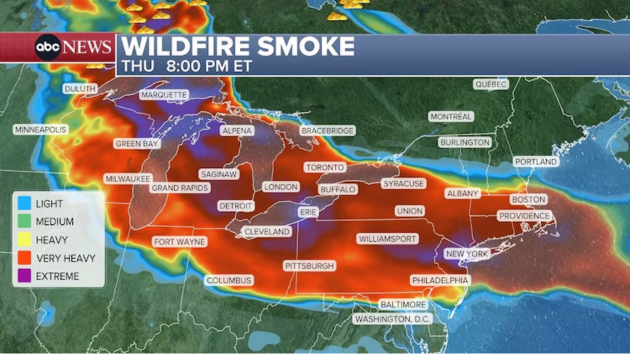
An ABC News graphic shows the forecast for Thursday, July 16, 2026. (ABC News)
(NEW YORK) — Air quality alerts are in place on Thursday across at least 17 states, from Minnesota to New Hampshire to Virginia, as dangerous smoke drifts into the U.S. from Canadian wildfires.
Smoke from the more than 180 wildfires burning in Canada is traveling more than a thousand miles to reach places like New York City. At least another nine large fires are burning in northern Minnesota.
Detroit, Michigan, and Minneapolis, Minnesota, have the worst air quality in the world among major cities, with extremely hazardous air quality.
Detroit reaching an air quality index, or AQI, around an astronomical 600 on Thursday morning. The most dangerous level, “hazardous,” begins at an AQI of 300 plus.
This extreme smoke is expected to continue east and continue through the Northeast.
New York City could see orange skies on Thursday, as plumes of hazardous smoke make their far enough to be dense.
By Friday morning, the smoke is expected to push farther south, affecting areas through Ohio and Virginia, including D.C. and Baltimore, through the day on Friday.
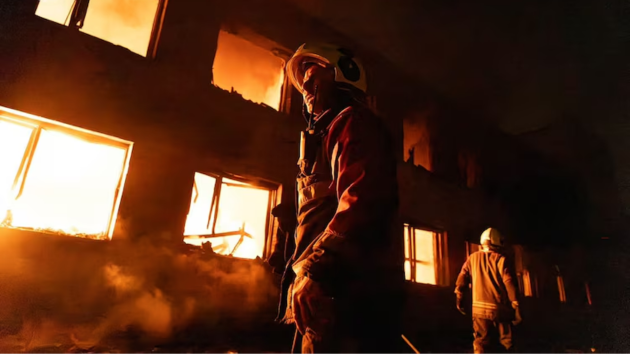
This handout photograph taken and released by the State Emergency Service of Ukraine on July 16, 2026, shows Ukrainian firefighters working to extinguish a fire at the site of a Russian air attack in Kyiv. (Handout/State Emergency Service of Ukrai)
(LONDON) — At least 200 Ukrainian drones were launched toward Moscow overnight into Thursday morning, the city’s Mayor Sergey Sobyanin said, as Kyiv continued its nightly long-range strike campaign deep into Russia.
From Wednesday evening until 9 a.m. local time on Thursday, “More than 200 drones were flying towards the Moscow region. Most of them were neutralized by air defense systems at a distance,” Sobyanin wrote in a post to Telegram. Ten drones “were destroyed as they approached Moscow,” the mayor said.
Russia’s Defense Ministry said its forces downed at least 375 Ukrainian drones overnight. The ministry said in a post to Telegram that drones were intercepted over 18 Russian regions — including Moscow — as well as Crimea, the Black Sea and the Sea of Azov.
Ukraine has been significantly expanding its drone campaign — referred to in Kyiv as “long-range sanctions” — in recent months, targeting major Russian cities, Russian oil infrastructure, military and logistics targets.
Ukraine has been significantly expanding its drone campaign — referred to in Kyiv as “long-range sanctions” — in recent months, targeting major Russian cities, Russian oil infrastructure, military and logistics targets.
The Russian Defense Ministry publishes only the number of Ukrainian drones and other projectiles it claims to have intercepted. Sobyanin releases real time statements when Ukrainian drones are reported shot down while heading toward the capital.
ABC News cannot independently verify the figures from either the ministry or the mayor. But the increasing scale and rate of such reports could be seen as indicative of Ukraine’s growing ability and willingness to target sites within Russia.
So far this year, Sobyanin has reported the downing of 1,420 Ukrainian drones on approach to Moscow, according to his Telegram posts, collated and analyzed by ABC News. Across all of 2025, Sobyanin only reported the downing of 734 Ukrainian drones near the city.
More than four years after Moscow launched its full-scale invasion of Ukraine, Ukrainian President Volodymyr Zelenskyy has made clear Kyiv’s intentions to return the war back to Russian soil. Key targets have included Moscow and the so-called “second capital” St. Petersburg.
“Our responses to Russia’s prolonging of the war and strikes on our cities and communities are completely fair,” Zelenskyy wrote on Telegram in May. “The Moscow region has Russia’s densest concentration of air defenses. But we are getting through,” he added.
Ukraine’s Wednesday night attacks also reportedly targeted the Engels-2 airbase in Saratov — a key hub for Russian long-range aviation, including strategic bombers. Andriy Kovalenko, the head of the Counter-Disinformation Center operating as part of Ukraine’s National Security and Defense Council, said in a post to Telegram, “Engels is on fire.”
Russia’s federal air transport agency, Rosaviatsiya, meanwhile, announced that temporary flight restrictions were introduced at Saratov airport during the overnight attacks. Restrictions were also put in place at airports in Nizhny Novgorod, Penza, Samara, Ivanovo, Yaroslavl, Cherepovets and Gelendzhik.
Flights operating from all four of Moscow’s international airports were also put under temporary flight restrictions overnight, Rosaviatsiya said.
Russia continued its own long-range strike campaign against Ukraine. Ukraine’s air force said in a post to Telegram that Russia launched 18 missiles and 146 drones into the country overnight into Thursday morning, of which 12 missiles and 129 drones were intercepted, suppressed or failed to reach their targets.
Six missiles and 16 drones impacted across 15 locations, the air force said.
Zelenskyy said in a post to Telegram that at least two people were killed by a Russian missile strike in Kyiv, with five other people injured. Other targeted regions included Kharkiv, Sumy, Zaporizhzhia, Vinnytsia, Zhytomyr, Mykolaiv and Donetsk, Zelenskyy said.
“Moscow is relying on terror through ballistic missiles and continues its attacks,” Zelenskyy wrote.
Authorities responded after a boat sank near Alcatraz Island in San Francisco on Tuesday, prompting a search-and-rescue mission. (KGO)
(SAN FRANCISCO) — The Coast Guard said it has suspended search operations for the three people unaccounted for after a boat capsized and sank in San Francisco Bay near Alcatraz Island.
Jarod Toczko, the commander for U.S. Coast Guard Sector San Francisco, told reporters earlier that the decision to suspend the search was not easy, but his teams swept through 950 square nautical miles and hadn’t found the missing people or the boat.
“We have completely saturated the search area,” he said.
“We always hold out hope,” he later added.
Overall, crews spent a total of 54 combined hours searching for the missing people, the Coast Guard said in a statement late Wednesday announcing the search had been suspended.
Authorities said they believe 20 people were aboard the Volare, a 50-foot cabin cruiser based out of Stockton, California, when it was hit by a wave Tuesday evening, causing it to capsize.
One man who was aboard was taken to the shore severely injured and, despite CPR being administered, was pronounced dead, officials said. He was identified on Wednesday by the Office of the Chief Medical Examiner as 79-year-old Clifford Joseph Boisa.
A dog was also killed in the incident, San Francisco Fire Chief Dean Crispen told reporters Wednesday.
Three people were taken to the hospital and later released, according to Crispen.
Crispen told reporters that authorities believe that there was a memorial service that the 20 passengers, all adults and mostly comprised of family members, were taking part in on the vessel when it capsized.
Toczko told reporters that there was a “high possibility that individuals could have been trapped in the vessel.”
One survivor said it was a memorial for her sister, ABC San Francisco station KGO reported.
Rescuer Justin Marceline told KGO that some passengers were “banging on the windows, trying to get out” of the boat.
“It was pretty wild, seeing that, honestly,” Marceline said, adding that conditions in the water were “really bad.”
“The people that were bobbing in the water, we pulled them out first,” Marceline said. “The people in the water were elderly folks, they were conscious, but people were too tired and worn out.”
Toczko praised the work of the Good Samaritans who jumped to save the passengers.
“No question, no doubt…those people saved lives,” he said.
The San Francisco Fire Department said it initially received a call for a fire on the boat at 3:30 p.m. local time. However, authorities said they haven’t yet seen evidence that there was a fire on board.
Earlier, authorities said they believed there were 19 people aboard and that they were looking for two missing passengers.
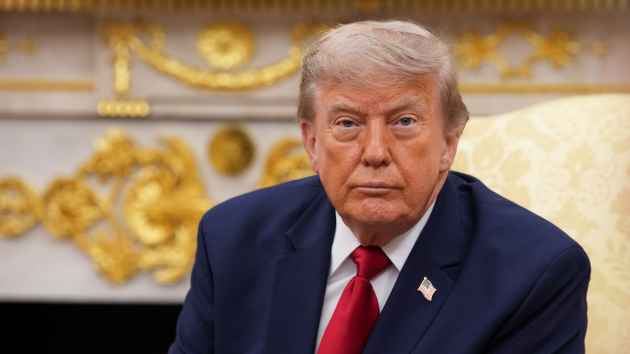
U.S. President Donald Trump looks on during a bilateral meeting with the Prime Minister of Iraq Ali al-Zaidi, in the Oval Office of the White House on July 14, 2026 in Washington, DC. (Photo by Andrew Harnik/Getty Images)
(NEW YORK) — President Donald Trump is set to deliver a primetime address Thursday evening, during which he is expected to detail information that he has recently received from the Office of the Director of National Intelligence related to the 2020 election, sources familiar with the matter tell ABC News.
Trump has long pushed debunked conspiracy theories to claim that his 2020 election loss was fraudulent. It’s not immediately clear what allegations he will make as part of his speech.
Sources caution Trump’s plans can always change, but at this point “election fraud” is the topic of his 9 p.m. address.
Despite Trump’s claims of voter fraud that contributed to his 2020 election loss, officials have found no evidence of widespread voter fraud.
Asked about the speech, which he announced on his social media platform on Monday, Trump said it was “really big news,” mentioning the importance of “free and fair elections.”
“Thursday is, it doesn’t get bigger because without free and fair elections, you don’t have a country. We’ll be discussing other things, too. But — but it’s going to be a very big announcement,” Trump said in the Oval Office on Tuesday.
Trump recently installed loyalist Bill Pulte, who has no previous national security experience, to lead DNI and has said that he wanted Pulte to declassify information and fire scores of experienced career staff.
Under the first Trump administration, officials already detailed efforts by Iran, China and Russia to influence the 2020 election, though officials later determined that none of their interference would have changed the election result. Initially Trump administration officials suggested China was also involved in influencing the election, a claim that was later determined by Trump’s intelligence community to be false.
The White House is remaining tight-lipped about the president’s Thursday night speech.
“The truth is, nobody knows yet what President Trump will ultimately say, which is why everyone should tune in,” White House press secretary Karoline Leavitt said in a statement about the remarks.
(HOUSTON, Texas) — Deputies responded to reports of multiple people shot inside a Kroger outside Houston, Texas on Wednesday afternoon, the Harris County Precinct 4 Constable’s Office said.
The incident took place at the Cypresswood Drive location in the Houston area around 3:00 p.m. CT.
A possible suspect was detained, according to law enforcement.
The scene was closed off as investigators searched searched the area. It was not immediately clear how many victims were involved.
This is a developing story. Please check back for updates.
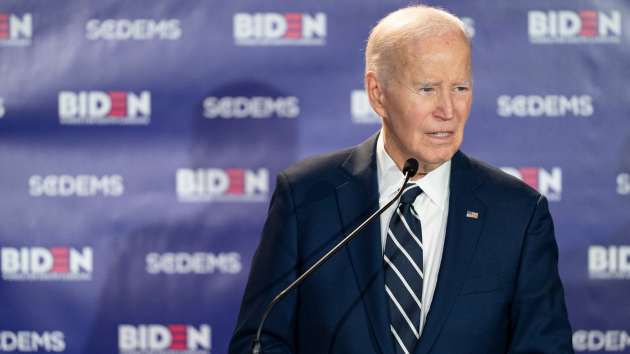
Former President Joe Biden speaks to a crowd during a fundraising event with the South Carolina Democratic Party at the Columbia Museum of Art on February 27, 2026, in Columbia, South Carolina. The event marked the sixth anniversary of Biden’s presidential primary win in the early voting state of South Carolina. (Photo by Sean Rayford/Getty Images)
(WASHINGTON) — Former President Joe Biden announced in a video message on Wednesday that he has written a book which is set to be released after the November midterm elections.
The book is titled “Promise Me, America” and is out on Nov. 17.
Biden said the book is about the decisions he made as president and touches on response to the COVID-19 pandemic, the economy, “restoring our democracy” after Jan. 6, and conflicts in Afghanistan and Ukraine. It will also discuss why he chose to run for re-election and his decision to step aside.
“Most of all, it’s about my faith in the promise of America. The promise we made to those that have come before us and to honor their sacrifice,” Biden said.
The book’s release, which will come two weeks after the midterms, could pull attention back to the former president just as Democrats hope to keep it fixed on President Donald Trump’s record, with promotional efforts risking distraction.
The former president said since he’s left office, he’s been spending time with his family and getting treatment for his prostate cancer, which he says has been going “really well.”
In the summer of 2024, Biden dropped his presidential bid after a widely criticized debate performance that prompted questions about his mental fitness. Former Vice President Kamala Harris, who has detailed her run for office in a memoir, “107 Days,” said that it was “recklessness” to allow Biden to make the decision alone on running for re-election.
Former first lady Jill Biden wrote in her memoir “View from the East Wing,” releases last month, that she was concerned her husband might have been drugged ahead of his debate performance.
Joe Biden’s two earlier books include “Promises to Keep” and “Promise Me, Dad,” a memoir on his older son Beau who died of brain cancer.
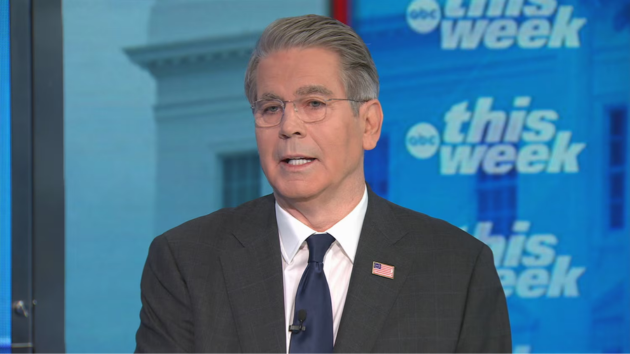
Treasury Secretary Scott Bessent appears on ABC News’ ‘This Week’ on Jan. 25, 2026. (ABC News)
(WASHINGTON) — Treasury Secretary Scott Bessent on Wednesday released a rendering of a commemorative coin featuring President Donald Trump, saying that the U.S. Mint will begin striking the $1 piece to commemorate the 250th anniversary of the signing of the Declaration of Independence.
“As America commemorates 250 years of independence, the [U.S. Mint] will begin striking this new $1 gold coin to honor the enduring legacy of liberty and a lasting symbol of patriotism,” Bessent wrote in a social media post. “Featuring President Trump, it celebrates the strength of American values, and the promise of a nation dedicated to preserving freedom for all.”
The coins — which are not real gold but will feature a gold-like finish — will be available in the fall, a Treasury Department spokesperson said.
The last and only time a living president was featured on hard currency struck by the U.S. Mint was a century ago for the U.S. Sesquicentennial. The half-dollar coin featured then-President Calvin Coolidge silhouetted behind the bust of President George Washington. At the time, the Mint produced a million of the coins with 860,000 of them ultimately returned and melted due to low demand.
While living presidents are generally barred from appearing on U.S. currency, the Trump administration has argued that the Circulating Collectible Coin Redesign Act of 2020 permits the design because it authorizes the Treasury secretary to oversee the minting of special commemorative coins for the nation’s Semiquincentennial. And while the same law bars any person from appearing on the tail side of a commemorative coin, the restriction doesn’t apply to its face.
Federal law also stipulates that coin designs be selected by the Treasury secretary after consultation with the Commission of Fine Arts, which approved the design last March, and review from the bipartisan Citizens Coinage Advisory Committee, an 11-person body established by Congress in 2003 to advise on designs of hard currency.
But the Treasury Department appears to have skipped the latter committee, raising questions about the legality of the coin’s production.
Donald Scarinci, a numismatist and Democrat who’s spent over two decades on the committee, said aside from a last-minute attempt by the Mint to present the proposed coin to the committee in December, the body never had a chance to review the design as required by law.
“We’ve never seen any design with the portrait of Donald Trump on it,” Scarinci told ABC News on Wednesday.
Scarinci said the proposed December meeting ultimately didn’t occur because it was impossible to reach a quorum of members on such short notice.
During the committee’s February meeting, another member of the board, Kellen Hoard, a coin collector who represents the general public, also said that the board received no opportunity to weigh in on the coin, nor did they review the designs ultimately selected for the Semiquincentennial series of quarters.
“I have never reviewed the Semiquincentennial $1 coin portfolio, much less been given an opportunity to review it. Is it legal now for the Mint to move forward with creating the Semiquincentennial $1 coin despite me never having the opportunity to review the piece?” Hoard asked acting Mint Chief Counsel Greg Weinman at the meeting.
Weinman replied that he did not agree with Hoard’s characterization and said that the Mint’s position is the board made the decision to not review the design.
“I think the Mint made a significant effort to request the CCAC to review the portfolio. There was clearly a conscious decision not to do so. The Mint has moved forward accordingly. I am not prepared to discuss more than that at this meeting,” Weinman said.
“I believe the CCAC was given — at least the chair of the CCAC was given a full opportunity to review this portfolio,” Weinman added later. “The Mint, in my opinion, attempted multiple times to find an opportunity for the CCAC to review the portfolio. The CCAC made a decision not to. At least the chair of the CCAC made the decision not to.”
“The concept that the secretary of the Treasury can create his own coin — it’s illegal,” Scarinci said of the move, adding that Congress would have the authority to confiscate and demonetize the coins and that concern about the coin crosses partisan boundaries on the committee.
“This is not a Democrat-Republican issue as far as the coin is concerned,” he said.
A Treasury spokesperson told ABC News, “During the January meeting, Megan Sullivan, the acting chief of the U.S. Mint’s office of design management, assured board members that ‘legal research from both the Mint and the Department of the Treasury determined that the proposed coin would not violate any laws and is legal under the law authorizing the minting of coins for the Sesquicentennial.'”
The coin is not the only piece of currency that the Treasury Department is putting Trump’s imprint on. Paper currency printed this year will also feature Trump’s signature above that of Bessent’s — a first for an American president. Bessent told Fox News earlier this week that, too, would go into circulation this fall.
In May, Trump administration officials pushed the Bureau of Engraving and Printing to move forward with designing a commemorative $250 bill with Trump’s portrait and signature, should legislation to create the new currency pass, according to two people with knowledge of the discussions.
That bill has been stuck in the House Financial Services Committee for more than a year.
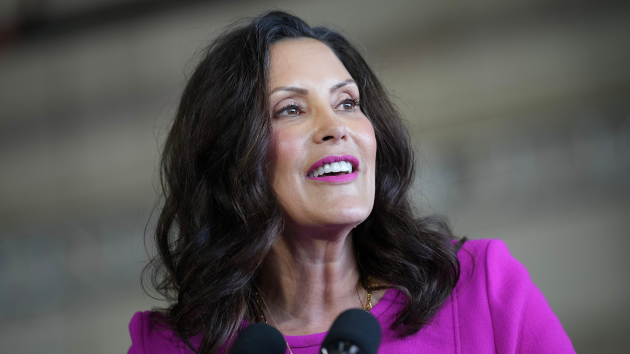
Michigan Gov. Gretchen Whitmer speaks before Democratic presidential candidate, U.S. Vice President Kamala Harris and Democratic vice presidential candidate Minnesota Gov. Tim Walz appear on stage during a campaign event on August 7, 2024, in Detroit, Michigan. Kamala Harris and her newly selected running mate Tim Walz are campaigning across the country this week. (Photo by Andrew Harnik/Getty Images)
(ST. LOUIS COUNTY, Minn.) — A northern Minnesota county declared a state of emergency and an air quality alert was issued on Tuesday due to wildfires raging across northern Minnesota and Canada.
St. Louis County in northeast Minnesota issued a State of Local Emergency and a State of Local Disaster due to wildfire damage and the utilization of public resources needed.
The U.S. Forest Service reported at least 17 wildfires burning across Superior National Forest, including three in the Boundary Waters Canoe Area Wilderness, on Tuesday.
“I’ve seen a lot of fire in my 25 years on this forest,” Nick Petrack, fire staff officer for the Superior and Chippewa National Forests, said at a Wednesday press conference. “This is probably the most and the largest number of fires that I have seen in July.”
The Minnesota Pollution Control Agency issued an air quality alert across much of the state due to wildfire smoke from 9 a.m. on Tuesday through 11 a.m. Friday.
Air quality reached the hazardous category in parts of the state Wednesday afternoon. The agency advised anyone in the hazardous region to avoid all outdoor activity and remain indoors.
Firefighters and first responders are continuing to evacuate visitors and nearby residents as the fires burned across the region.
Petrack said it is “no easy feat” evacuating visitors from the region, as first responders access parts of the boundary waters via canoe.
Phil Manuel, incident meteorologist at the National Weather Service, said in the press conference that hot, dry and windy conditions, along with a high number of lightning strikes, have allowed the fire to spread.
“Normal high temperatures here are in the upper 70s,” Manuel said. “Where have we been the last three days? Over 100 degrees in some cases. I saw some temperatures of 104.”
Though rain is in the forecast in the coming days, Manuel said the scale of the fires and the low probability that rain would stop the fires entirely.
“Odds are, these fires will be here until it snows,” Manuel said.
While fires are natural in these forests, as they are fire-dependent ecosystems, blazes at this scale are not normal, officials said.
The fires have burned through at least 33,000 acres as of Tuesday afternoon, according to the U.S. Forest Service.
Officials said they are awaiting the arrival of federal first responders who plan to assist in firefighting efforts.
In a social media post Wednesday, Minnesota Gov. Tim Walz said two groups of YMCA campers stranded by the wildfires near the Minnesota-Canada border were rescued.
The smoke has also spread into Michigan. Michigan’s Department of Environment, Great Lakes and Energy issued an air quality alert for Wednesday and Thursday across the state.
Michigan Gov. Gretchen Whitmer urged Michiganders to limit time spent outdoors, especially seniors, children and anyone with respiratory conditions.
Tom Hall, agency administrator for Superior National Forest, said in the press conference that first responders conducted 17 air rescues on Monday and none have been conducted since.
St. Louis County said it set up temporary evacuation points at a municipal center to serve people from St. Louis and Lake Counties impacted by the fires. It said public health staff is at the evacuation points to connect people with necessary resources.
In this April 29, 2024, file photo, Yale University President Maurie McInnis attends an event in New York. (John Lamparski/Getty Images, FILE)
(NEW HAVEN, Conn.) — Yale University said it’s negotiating with the Department of Justice over a potential resolution of the Trump administration’s findings of alleged racial discrimination in its medical school’s admissions processes, according to a statement by the university’s president.
President Maurie McInnis also confirmed for the first time that the DOJ’s inquiry extends beyond Yale’s medical school, with two pending investigations into admissions processes at Yale College and Yale Law School.
The statement issued on Monday describes recent university-wide changes to admissions processes to meet federal guidelines, stating that “academic strength” is its main consideration when evaluating Yale College applicants.
“We now state explicitly that academic strength has long been the predominant criterion in our holistic evaluation of applicants,” McInnis said.
ABC News has reached out to Yale University and the Department of Justice for a comment.
In May, following a yearlong investigation, the DOJ released a letter of findings alleging that the Yale School of Medicine discriminated based on race in its admissions practices. Title VI of the Civil Rights Act of 1964 — which prohibits discrimination in any program receiving federal funding — requires that the government seek a voluntary resolution with the institution following an investigation.
McInnis characterized Yale’s decision to engage in this process as “standard” and “required” by law, saying in her statement: “These investigations concern university compliance with federal law…As a university committed to the rule of law, we take that obligation seriously.”
Three legal experts on higher education told ABC News that although, historically, it has been customary for universities to undergo the resolution process, they say it is not required.
“Going back several administrations, there was always the opportunity to say, ‘No, thank you. I don’t want to go through voluntary resolution,'” explained Dr. Peter Lake, law professor and director of Stetson University’s Center for Excellence in Higher Education Law and Policy. “…Most institutions wouldn’t pick that option for various reasons because the consequences could be very severe.”
However, norms surrounding the voluntary resolution process have been called into question since the start of President Donald Trump’s second term, according to legal experts.
“In this instance, and I think that this is why a lot of individuals at Yale and others are raising alarm over a quick settlement is that, we are in uncharted waters with how this administration has used legal mechanisms to try to get higher education to do what it wants,” said Dr. Neal Hutchens, a professor at the University of Kentucky specializing in legal and policy issues in higher education.
“This is pushing an investigation based on a DOJ memorandum that may not have conclusions or interpretations of law that are necessarily sound or that would be backed by courts,” Hutchens continued. “I think there are real questions there, and so, I think there are some real legal questions about why you would necessarily fold too quickly on this.”
Dr. Jonathan Feingold, a professor at the Boston University School of Law, told ABC News that he believes Yale does not “even come close” to violating federal law and criticized the university for engaging with the Trump administration in “good faith.”
“From my perspective, as someone who cares about higher education but has no personal relationship with Yale, even the posture of treating the Trump administration’s investigation as legitimate in entering this sort of process is a betrayal to the entire Yale community,” he said.
Feingold also sees the pursuit of settlements — in lieu of litigation in court — as a common tactic by the Trump administration to place what he sees as undue pressure on universities.
He explained, “I think the institution would benefit, and the community would benefit, actually, from the litigation because you get to put all facts on the table and you don’t get to allow the Trump administration to sort of manufacture the story that it wants to.”
When reports of potential resolution talks first circulated last week, a wide coalition of critics emerged — including the national American Association of University Professors, the Yale undergraduate student government, and Connecticut senator and Yale Law School alum Richard Blumenthal. In various petitions and statements, they have called for the university to resist a settlement and to defend its admissions practices through legal channels.
While Yale’s talks follow a string of settlements between American universities and the Trump administration, other universities have resisted talks with the Trump administration — most notably Harvard University, which is currently fighting DOJ lawsuits over its admissions records and handling of campus protests.
“For instance, Harvard engaged with the new government, but certainly didn’t just accept the demands, and they challenged it in court,” Hutchens told ABC News. “And so, I think Harvard charts a path of just not acquiescence or just not folding, that Yale will have a decision potentially to make.”
In early June, the DOJ announced investigations into the admissions practices of fifteen additional medical schools. These investigations have not yet concluded.
Following McInnis’ statement Monday evening, the Yale chapter of the AAUP — which represents 300 Yale faculty — renewed their call for transparency.
A spokesperson for the Yale AAUP chapter confirmed to ABC News Tuesday that they are currently reviewing legal options, including litigation to “assert our rights as faculty in this matter.”
“[This case] has implications for Yale, but there are [also] a lot of institutions around the country that are wanting to understand what they can do in terms of race-neutral alternatives to still try to assemble classes,” said Lake.
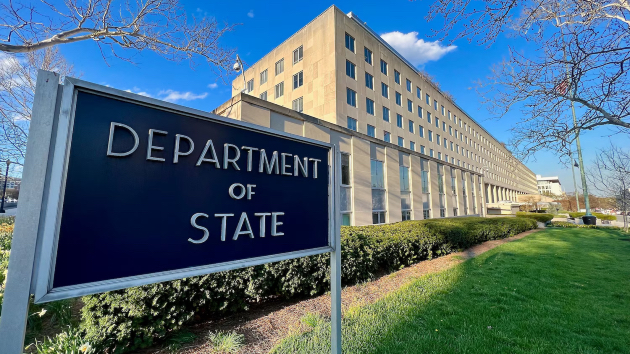
In this undated file photo, the State Department building is shown in Washington, D.C. (STOCK PHOTO/Getty Images)
(WASHINGTON) — The Iranian American Legal Defense Fund filed a motion Wednesday asking for a stay and a preliminary injunction barring the U.S. government from “sharing the confidential information of Iranian asylum seekers with the Iranian Government” while the issue is adjudicated in court.
The filing came a week after the organization sued the Trump administration over those allegations.
According to that complaint, many Iranian asylum seekers are pro-democracy protesters, members of religious minorities, or members of the LGBTQ community who have sought refuge in the U.S. — and that disclosing their confidential information to the Iranian government puts them “at risk of persecution, torture, and death” should they be deported back to Iran.
Wednesday’s motion also asks the government “to take the necessary steps to prevent the removal of any detained individuals whose confidential information has already been shared with the Iranian Government,” according to the filing.
In the filing, the IALDF alleges that the sharing of information was started in March of 2025, and that since late September 2025, at least three deportation flights have taken place, returning more than 100 Iranian nationals to Iran.
The filing includes 11 declarations by Iranian detainees in the U.S., more than half of which describe interactions, while in detention, with Iranian officials who knew details about their asylum claims.
“It’s shocking to think that at the same time the United States is engaged in hostilities with Iran, that the United States is handing over immigration files from ICE to the Iranian Interest Section in Washington, DC,” said Michael Kirkpatrick, an attorney for Public Citizen who filed the case on behalf of IALDF. “These files are full of extremely confidential and sensitive information.”
“It basically spells out all the reasons somebody in the United States fears being returned to Iran and that could be because they participated in pro-democracy demonstrations; it could be because they have converted to a minority religion like Christianity; it could be that they’re part of the LGBTQ community,” Kirkpatrick said. “That kind of information is exactly the kind of information that they — that would result in their persecution if they went back to Iran.”
“They are terrified,” said Ali Rahnama, the interim executive director of IALDF, saying they’re scared not only for themselves but for family and friends back in Iran. “I want everyone to know these are not statistics; these are human beings who trusted the U.S. government and our laws,” he said.
The documents in the filing also relate details about an alleged phone call and meeting between IALDF board member Cyril Mehri and a senior Iranian official with the Iranian Interest Section in the United States. “According to the Senior Official, ICE has provided the Iranian Government with immigration documents related to each detainee, including asylum applications and related case files,” the filing said.
The IALDF argues that the government’s actions in sharing information without the consent of the detained individuals are unlawful.
The Department of Homeland Security has denied sharing information with the Iranian government, writing in a social media post, “These allegations that ICE shared asylum application records with the Iranian government are FALSE. ICE meets and works to get travel documents for detainees with every country. ICE is committed to ensuring that illegal aliens are informed of their right to communicate with their consular representatives.”
“Consistent with established protocols, ICE provides illegal aliens the opportunity to contact their consular post and facilitates consular access to detained individuals, in accordance with applicable laws, regulations, and agency policy,” the DHS post said. “We will continue to use all lawful options to deport illegal aliens including murderers, rapists, pedophiles, gang members, and terrorists from American communities.”
A State Department spokesperson, following the filing of the lawsuit last week, said that the department, as a general matter, does not comment on pending or ongoing litigation, or on private diplomatic discussions.