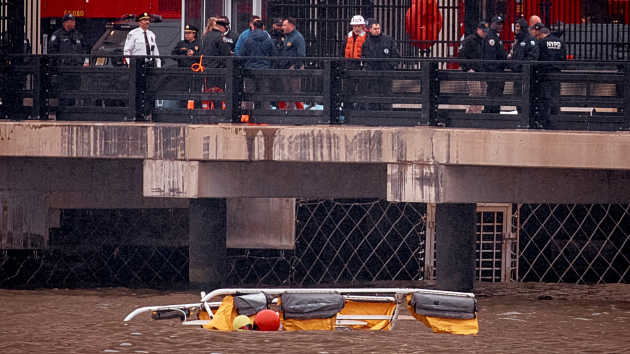
Police and firefighters work on the site after a helicopter crashed in the Hudson River on April 10, 2025, in Jersey City, New Jersey. All six people on board were killed when a helicopter plunged into the Hudson River off of Lower Manhattan. (Photo by Andres Kudacki/Getty Images)
(NEW YORK) — A bird strike likely caused last year’s tourist helicopter crash in New York City’s Hudson River that killed all six people on board, according to the National Transportation Safety Board.
The more than 2,000 pages of information released by the NTSB is not the final report and does not state the probable cause, but the documents show the chopper slammed into multiple large birds before the crash.
The birds hit the rotor blades and the horizontal stabilizer, according to an analysis by the Smithsonian Institution’s Feather Identification Lab. Samples of “mixed species” of birds were found, including Canada Geese and black-backed Gull. Canadian Geese can sometimes weigh more than 10 pounds each.
Videos showed the rotors flying off the helicopter as it plummeted to the water.
The chopper crashed into the Hudson in April 2025 while carrying a pilot and a family from Spain: Siemens executive Agustin Escobar, his wife Merce Camprubi Montal, and their three children.
One witness told ABC News she watched the helicopter “fall out of the sky” from her apartment window.
“I heard five or six loud noises that sounded almost like gunshots in the sky and saw pieces fall off, then watched it fall into the river,” she said.
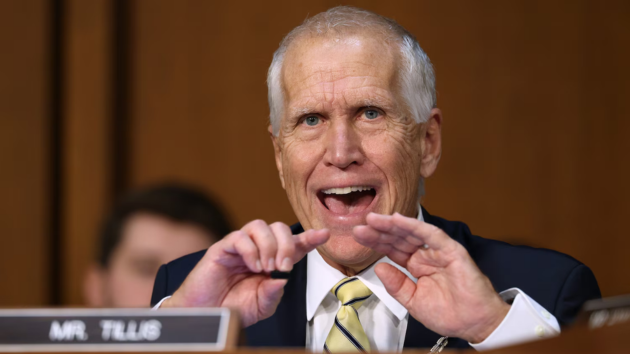
Sen. Thom Tillis attends the confirmation hearing by the Senate Judiciary Committee for acting Attorney General Todd Blanche on Capitol Hill, July 15, 2026, in Washington. Win McNamee/Getty Images
(WASHINGTON) — A key GOP member of the Senate Judiciary Committee whose vote is needed to secure acting Attorney General Todd Blanche’s confirmation as the next attorney general said Thursday that he will require Blanche to sit down with victims of deceased convicted sex offender Jeffrey Epstein before he can vote for him.
Sen. Thom Tillis, R-N.C., announced the new condition during a hearing Thursday where one of the witnesses was Epstein victim Dani Bensky.
Facing a potentially rocky confirmation, Blanche made a brief attempt to meet with Epstein survivors on Capitol Hill Thursday afternoon.
He and his team arrived at a Senate Judiciary Committee office where they sat for about half an hour, but no one joined them.
“I rearranged my schedule to try to meet with them,” Blanche told ABC News after leaving the office. “I’ve been here waiting. It didn’t work out, so we’re going to see if there’s a way we can meet either later today or sometime soon.”
“There’s nothing newsworthy about this fact because the Department of Justice will always meet with victims or their representatives, and if those victims or their representatives have evidence that anybody committed a crime, whether it has to do with Jeffrey Epstein, anybody else that was associated with Jeffrey Epstein, or anybody else, we will of course move forward and investigate and prosecute,” Blanche said.
Bensky testified in Thursday’s hearing that Blanche has never responded to repeated attempts to reach him to sit down and recount her story.
“Blanche was willing to say that he would meet with [Epstein victims] and counsel — I understand the restriction that counsel has to be present,” Tillis said. “I expect that meeting to occur before I vote to vote out of this committee and I’m trying to get to yes. But this is a very important part of getting to yes.”
“There should not be any reason why, based on what Mr. Blanche said yesterday, if he said that he would do it today, then he can certainly do it over the next two weeks,” Tillis added.
Blanche told lawmakers during his confirmation hearing Wednesday that he would be happy to meet with victims but initially said he couldn’t meet with them personally if they were represented by legal counsel, before correcting himself later in the hearing.
“I never said I can’t meet with them. I said if they were represented, I had to meet through counsel,” Blanche said. “But of course, I can meet with them. I’m the acting attorney general of the United States, so yes, I can.”
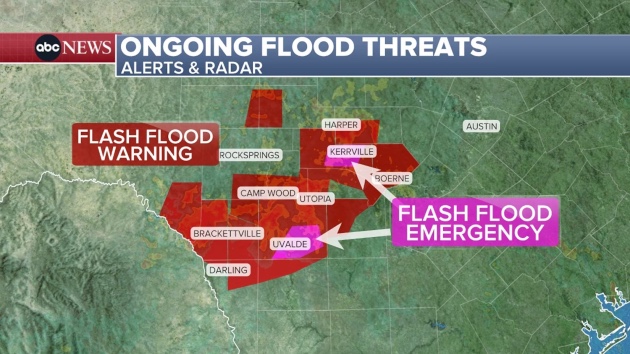
This ABC News graphic shows flood warnings in Texas as of July 16, 2026. (ABC News)
(NEW YORK) — At least one person has died as a result of the flash flooding emergency currently ongoing in Texas, Gov. Greg Abbott confirmed on Thursday.
The death was reported overnight between Kerrville and Comfort, Texas, Abbott said. More than 70 people have been rescued so far, he added.
Rescue operations are underway for people stranded in homes and potentially larger facilities, with 1,300 emergency personnel responding, according to the governor.
Torrential rain from Wednesday into Thursday prompted flash flood emergency warnings for Texas Hill Country as water levels in creeks and rivers rose rapidly.
As of early Thursday morning, there were two flash flood emergencies ongoing in Texas Hill Country, impacting Kerrville — the city where the deadly Camp Mystic flooding occurred in July 2025 — Hunt, Uvalde and Knippa.
Evacuations and water rescues were reported in all four areas, with warnings of life-threatening flash flooding and reports of water entering buildings.
The Guadalupe River at Hunt rose from 9 to 19 feet between 3 a.m. and 4 a.m. CT, cutting off access to some roads and bridges. Just before 6 a.m., the Guadalupe River gauge measured 37 feet at Hunt, and more rise is possible, according to the Kerr County Sheriff’s Office.
No camps along the river had sustained any damage as of Thursday afternoon, Abbott said. Warning sirens were activated and functioned properly.
The National Weather Service issued another flash flood emergency later Thursday morning along the Pedernales River, located just north of the Guadalupe River.
A large and deadly wave is moving down the Pedernales River — with the gauge at Fredericksburg rising to more than 31 feet and counting, according to the NWS.
Engineers assessed the bridge over the Guadalupe River on Highway 87 into Comfort, Texas, due to fears that the force of the water may have made it unstable, Kendall County Judge Shane Stolarcyz told ABC News. The engineers concluded that the bridge is structurally sound for now, ABC News has learned.
There are 63 residents inside the town’s evacuation center with their pets, waiting out the storm.
The fast-moving water below the bridge could be seen carrying debris within the current. The water is starting to recede, but authorities anticipate there could be a second wave later Thursday. They do not believe it will be anywhere near the level seen in the morning.
The National Weather Service elevated the flash flood emergency on Thursday to say a “large and deadly flood wave” had begun along the Guadalupe River around Kerrville and was moving through Center Point, which is downstream of Kerrville, and on to Comfort and Waring, Sisterdale, Crown and Bergheim.
The river gauge at Center Point rose 32 feet in four hours and was expected to reach a crest similar to the catastrophic July 4, 2025, river flood.
A rainfall rate of 2 to 4 inches per hour was forecast for the region. Up to 20 inches of rain had fallen in the Uvalde area over the previous 48 hours — more than six months’ worth of rain for this area — with 8 inches falling in 2 hours.
Abbott said in a press conference on Wednesday that disaster declarations had been made for 59 counties, with the possibility of more being added.
He said that more than 75 people had been rescued so far and that the expected rainfall from this storm could exceed 30 inches, 10 inches more than the level recorded during last year’s deadly floods.
“We are dealing with and responding to a flood that is likely going to break records,” Abbott said. “There are over 1,300 state personnel from more than 30 agencies that are already activated. More than 800 vehicles, more than 75 boats, and 20 aircraft have been deployed. Our primary focus right now and throughout the remainder of this torrential rain is saving lives.”
The NWS issued a flash flood emergency warning for Boerne, located in Texas Hill Country about 55 miles southeast of Camp Mystic, on Wednesday afternoon, urging residents to relocate to higher elevations immediately.
“This is a PARTICULARLY DANGEROUS SITUATION,” the NWS warning stated. “SEEK HIGHER GROUND NOW!”
A rain gauge near Boerne measured 3.5 inches of rain within one hour Wednesday morning, according to the NWS. The Cibolo Creek rose 10 feet in just 90 minutes — between 9:45 and 11:15 a.m. local time, and measured at a record-high level of more than 22 feet.
A flash flood emergency was also issued for D’Hanis, Texas, about 60 miles southwest of Boerne, where between 4 and 10 inches of rain have fallen, according to the NWS. The Seco Creek is rapidly rising, prompting local officials to advise those in flood-prone areas to move to higher ground without delay.
Intense rainfall began in parts of Texas Hill Country on Tuesday, where some areas received between 6 inches and 16 inches of rainfall in 24 hours.
The NWS had previously issued a high risk for flash flooding — a level 4 out of 4 — for the same region on Wednesday due to a forecast of an additional 6 to 12 inches of rain.
A “high risk” is a rare occurrence. It’s only issued about 4% of days, but accounts for around one-third of all flood-related fatalities and 80% of all flood-related damages, according to the National Weather Service.
Between 4 and 12 inches of rain had fallen by noon Wednesday, and an additional 1 to 2 inches of rain were possible in the area. Flash flood warnings were also issued for Kerrville, Uvalde and just north of San Antonio.
Life-threatening flash flooding occurred at low water crossings, small creeks and streams, urban areas, highways, streets and underpasses, according to the NWS.
In Uvalde County, about 100 miles southwest of Boerne, at least 25 rescues had occurred by 9 a.m. on Wednesday. Additional rescues were underway Wednesday afternoon in North County, where the Leona River gauge reached nearly 20 feet, according to the Uvalde Police Department.
When will the heavy rain, flooding risk end
The flood watch across Texas Hill Country remains in effect through Thursday.
The same area faces a level 4 of 4 risk for flash flooding on Thursday, with the heaviest rain expected between 2 a.m. and 2 p.m. Another round of heavy rain could occur Thursday night.
Isolated additional rain totals of more than a foot are possible through Thursday, forecasts show.
Why Texas Hill Country is prone to flash flooding
Texas Hill Country is often referred to as “Flash Flood Alley,” one of the most flood-prone regions in the U.S., because the weather and landscape in the south-central Texas allow for rapid flood events, according to the Texas Water Resources Institute (TWRI).
The “alley,” which stretches from Dallas to San Antonio and encompasses the Colorado and Guadalupe River basins, is highly susceptible to dangerous flood events due to its steep terrain, shallow soil and repeated high rainfall events.
Much of the region is situated on a floodplain between tall hills, funneling any rainfall into rivers and creeks, causing them to rapidly rise. In addition, the clay soil does not easily absorb water and triggers high water runoff once wet, the TWRI said.
Major floods have occurred over nearly all sections of the Guadalupe River Basin, according to U.S. Geological river streamflow records dating back to the 1800s.
High rainfall intensities are a common occurrence because the Gulf provides an infinite source of moist air, as does the Pacific, which produces monsoonal moisture as well as cool air masses from the north that converge to produce extreme rainfall events.
Last year, more than 100 people died, including 25 girls at Camp Mystic, as a result of catastrophic flooding along the Guadalupe River during the Fourth of July weekend.
The torrential rain that turned the river into a raging wall of water was fueled by unique atmospheric conditions, meteorologists and climate scientists told ABC News last year.
Heavy rain combined with slow-moving thunderstorms caused the Guadalupe River to rise 26 feet in less than an hour, officials said.
ABC News’ Melissa Griffin and Faith Abubey contributed to this report.
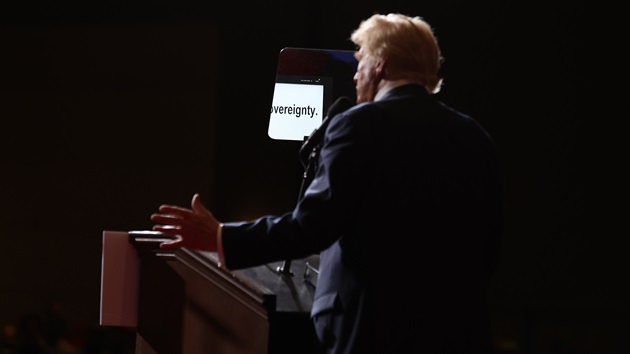
A teleprompter is in front of U.S. President Donald Trump as he speaks during a campaign rally at the Grand Sierra Resort on October 11, 2024 in Reno, Nevada. (Justin Sullivan/Getty Images)
(WASHINGTON) — President Donald Trump’s longtime teleprompter operator is believed to have made tens of thousands of dollars by placing bets on more than a dozen of Trump’s speeches on the prediction market Kalshi, federal investigators with the Commodity Futures Trading Commission found, sources familiar with the matter told ABC News.
Gabriel Perez, a technical assistant to the president who has been operating Trump’s teleprompter since 2016, is in talks with federal regulators to settle allegations he used his inside knowledge of the president’s speeches to win more than $100,000, the sources said.
According to the sources, Kalshi alerted its regulator, the Commodity Futures Trading Commission (CFTC), to the suspicious activity on its “Mentions” market, where users can bet on whether specific words, phrases or topics are uttered during a public speech.
“Our surveillance team promptly flagged and referred these trades to the CFTC, and we are cooperating and assisting regulators,” Kalshi’s lead lawyer, Bobby DeNault, said in a statement provided to ABC News.
White House Press Secretary Karoline Leavitt told reporters Thursday afternoon, following ABC News’ report, that Perez has been put on unpaid administrative leave. Leavitt said she spoke with President Trump about it, and he thought it was a “disgrace” and made the decision himself to put Perez on unpaid leave.
Leavitt said she was unaware of any other White House staffers who have made such trades.
“The White House has strict ethics guidelines that we expect all staffers and officials to follow,” said White House spokesperson Davis Ingle when contacted by ABC News.
A spokesperson for the CFTC declined to comment.
In addition to February’s State of the Union address, sources said CFTC investigators discovered that Perez placed bets on more than a dozen Trump speeches over a three-month period, including a December primetime address, a January speech at the World Economic Forum in Davos, Switzerland, and Trump’s remarks in March during a Medal of Honor ceremony.
Later in March, the White House issued an internal memo warning staff against using nonpublic information to place bets on prediction markets, sources previously confirmed to ABC News.
Perez continues to serve as one of Trump’s teleprompter operators — a role he has served since Trump’s first presidential campaign.
Of all Trump’s closest aides, sources say Perez typically has the final eyes on nearly all of the president’s prepared remarks — and is often known to take last-minute edits from Trump himself. He previously came under scrutiny by congressional and federal investigators over the edits that were made prior to the delivery of Trump’s remarks surrounding the Jan. 6, 2021, attack on the U.S. Capitol.
Trump is known to frequently deviate from his prepared remarks, as he himself often acknowledges.
“You know, when you go up here, you take a big chance, especially me because I go off teleprompter about 80% of the time,” Trump said during remarks in January to the Detroit Economic Club, another speech federal investigators believe was among those Perez betted on.
In certain instances, investigators uncovered times when Perez would back out of certain bets mid-speech when Trump skipped over a portion of the speech that included a word he had previously bet would be mentioned, the sources said.
According to sources familiar with the investigation, Perez sat for an interview with regulators in recent months and acknowledged some of the trades. At some point during the investigation, the sources said the CFTC alerted federal prosecutors in Manhattan, who declined to open a criminal investigation.
Regulators at the CFTC have expressed a willingness to settle with Perez, and have discussed terms with him that would require Perez to give back his profits and refrain from making similar trades, according to sources familiar with the ongoing discussions.
Kalshi has a policy against users placing bets based on information obtained as part of their jobs.
Last month, the company updated its policies to require users to disclose their place of employment.
“If you have information by virtue of your job or your employment, something that you have a legal duty surrounding, and you have an obligation not to take that, misappropriate it for yourself,” DeNault told ABC News in May.
The Department of Justice in recent months brought the two first cases of insider trading on prediction markets, involving a special forces soldier who allegedly bet on the capture of Venezuelan President Nicolás Maduro, and, separately, a Google employee who allegedly bet on user searches using internal company data. Both pleaded not guilty.
President Trump has occasionally criticized prediction markets, but said in April that he supports them because the United States could be “left out in the cold” if the country does not allow companies like Kalshi and Polymarket to operate.
“Well the whole world, unfortunately, has become somewhat of a casino, and you look at what’s going on all over the world in Europe and every place they’re doing these betting things. I was never much in favor of it. I don’t like it conceptually, but it is what it is,” Trump told reporters.
Last October, Trump’s social media company, Trump Media and Technology Group, announced it was looking into launching its own prediction market offering.
People walk by the Comcast building which houses NBC Studios in Manhattan on June 29, 2026 in New York City. (Spencer Platt/Getty Images)
(NEW YORK) — A man is in custody after he allegedly snuck into an NBC building at New York City’s Rockefeller Center on Thursday morning, authorities said.
The suspect said he was looking for “Today” show weather anchor Al Roker, and he allegedly repeatedly uttered a racial slur, police said.
He also made other statements that lead police to believe he is emotionally disturbed, police said.
The man was detained by an NYPD officer working a paid detail, police said.
Charges are pending, police said.
ABC News has reached out to NBC for comment.
NBC News told Variety in a statement, “An individual entered an unauthorized area in a vestibule near Studio 1A. The person approached anchor Craig Melvin, who alerted security.”
“The individual was detained and taken into custody by law enforcement without further incident. There was no altercation, and no one was injured,” NBC said.
NBC said it takes “the safety and security of our employees, talent, staff and guests extremely seriously. We are reviewing the incident and our security protocols and remain committed to providing a safe and secure environment for everyone who works at and visits our studios.”
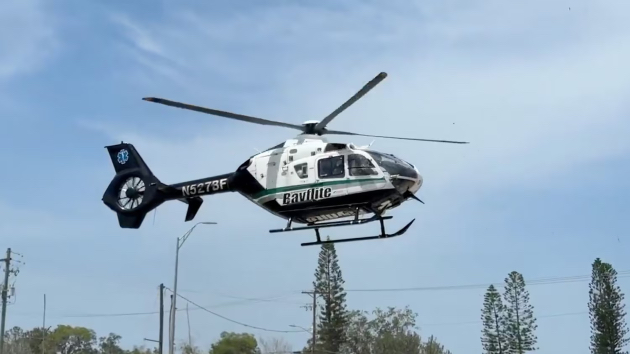
A helicopter airlifts two deputies to the hospital after they were shot on July 16, 2026 in Ruskin, Fla. (Hillsborough County Sheriff’s Office)
(RUSKIN, Fla.) — Two deputies were airlifted to a Florida hospital Thursday after they were shot in an incident, according to the Hillsborough County Sheriff’s Office.
Police are on the scene of the shooting, which took place on West Shell Point Road in Ruskin, Florida, south of Tampa, the sheriff’s office reported.
The two deputies were medevaced to Tampa General Hospital after being shot, according to the sheriff’s office.
The suspect was also shot and is being transported to the hospital, the sheriff’s office said.
The sheriff’s office said there is no threat to public safety at this time.
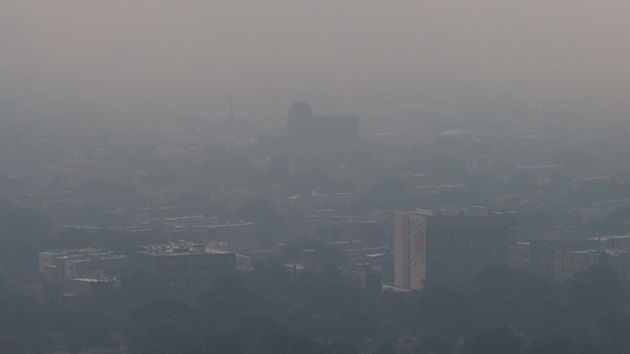
An aerial shows smoke from Canadian wildfires blanketing the city on July 16, 2026 in Chicago, Illinois. (Scott Olson/Getty Images)
(MINNEAPOLIS) — Minneapolis’ air quality ranked the worst in the world among major cities Thursday due to thick smoke from wildfires burning throughout northern Minnesota and Ontario, Canada.
Much of the city’s air quality entered the “hazardous” category Wednesday night and remained there into Thursday.
Parts of the city reached an air quality index, or AQI, of 460. A hazardous AQI is categorized as 300 and above.
The air quality in Detroit also ranked worst in the world alongside Minneapolis.
All people are advised to remain indoors while the air quality is hazardous.
Minneapolis Mayor Jacob Frey urged residents to “please take this seriously” in a post on X Thursday morning.
“If you can, stay indoors, avoid activity outside, and keep indoor air as clean as possible,” Frey said in the post. “The risks are greater for kids, older adults, and anyone with heart or lung conditions.”
As of midday Wednesday, there are 15 active wildfires burning across Superior National Forest, including four in the Boundary Waters Canoe Area Wilderness, according to the U.S. Forest Service. The Forest Service noted several fires have merged since earlier reports.
In a press briefing Wednesday, officials warned the fires could keep burning until the fall.
While light rain is in the forecast in northern Minnesota on Thursday, Phil Manuel, incident meteorologist at the National Weather Service, said in the briefing it would not be enough to put out the fires.
“How are we going to end this? Weather’s going to have to change,” Manuel said. “It takes rain with a name to put out big fires.”
The fires in northern Minnesota come amid a slew of wildfires raging throughout Canada, which are sending dangerous smoke down to the Northeast and upper Midwest of the United States.
More than 183 wildfires were burning in Ontario on Wednesday, its Ministry of Natural Resources reported.
The Minnesota fires spread so rampantly because of hot, dry and windy conditions, as well as increased lightning strikes, officials said during the briefing.
Temperatures in the area recently rose into the 100s, while they typically only get to the upper 70s at this time of year, Manuel said.
First responders conducted door-to-door evacuations to bring residents and visitors to safety, and were continuing evacuations as of Wednesday, according to officials.
Firefighters continue working to extinguish the fires in coordination with Canadian first responders.
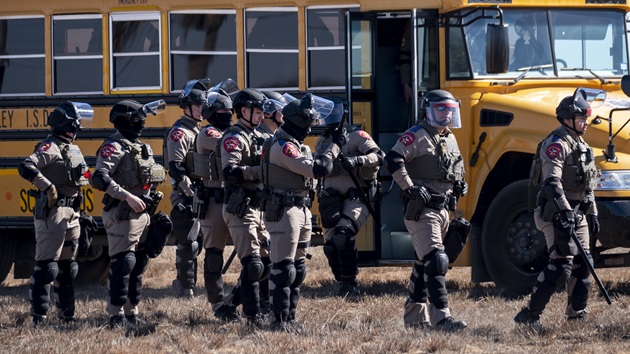
Texas State Troopers arrive in a Dilley I.S.D. school bus before dispersing a crowd protesting Immigration and Customs Enforcement at the South Texas Family Residential Center on January 28, 2026 in Dilley, Texas. (Joel Angel Juarez/Getty Images)
(WASHINGTON) — Rep. Joaquin Castro, along with more than 110 Democratic members of Congress, has sent a letter to Secretary of Homeland Security Markwayne Mullin urging the shutdown of the Dilley Immigration Processing Center in Texas.
The facility, which is the only family detention center in the country, was closed during the Biden administration but was reopened last year as part of the Trump administration’s ongoing immigration crackdown.
In the letter, which was first obtained by ABC News, they write, “There is no humane way to imprison a child and their family. It is nothing more than a trailer prison that detains families. In fact, the Dilley facility is the only place in the United States dedicated to detaining families with children who have not been charged with a crime.”
“Former and current detained families describe horrific conditions perpetuated by CoreCivic and Immigration and Customs Enforcement (ICE) that are meant to strip them of their dignity and make them feel hopeless,” the letter says, referring to the private prison contractor that operates the Dilley facility.
The letter outlines how parents have described “horrendous conditions at Dilley,” including allegations of food “contaminated with worms and mold,” drinking water that leaves detainees feeling sick, lights that stay on through the night and inadequate education and medical care that has led to “severe depression, hopelessness and suicidal ideation amongst their children,” according to the letter.
Medical care “is delayed, denied, and in many cases outright dismissed, even when children are suffering life threatening medical emergencies,” the letter says, describing an alleged incident in which a young boy was not taken to the hospital until after several days of “severe stomach pain,” after which he was diagnosed with appendicitis and required surgery.
Immigrant advocates, medical professionals and lawmakers have previously raised concerns about conditions at the South Texas facility.
ABC News in February interviewed a couple who said their 1-year-old daughter contracted COVID-19 and RSV during their 60-day detention. The family alleged that medical staff at Dilley dismissed their daughter’s symptoms.
Rep. Castro raised his own concerns about a 2-month old he encountered while visiting another family at the facility in February.
At the time, the top medical official at the Department of Homeland Security, which operates the nation’s migrant detention centers, disputed any suggestion that detainees are being denied proper care.
“These allegations of illegal aliens being denied proper medical care in ICE custody are FALSE,” DHS Chief Medical Officer Dr. Sean Conley told ABC News in a statement. “It is both policy and longstanding practice for aliens to receive timely and appropriate medical care from the moment they enter ICE custody. This includes medical, dental, women’s health, mental health services, any needed follow up medical appointments, as well as 24-hour emergency care.”
“This is better, more responsive health care than many aliens have ever received in their entire lives,” Conley’s statement said.
“These representatives remain quiet about the humanitarian crisis that was manufactured by the Biden Administration’s open border policies over the last four years and the scores of children exploited, trafficked and missing,” a DHS spokesperson said. “Do they plan to mention the psychiatric impact on the tens of thousands of children who were smuggled across the border — many by human and sex traffickers?”
“We’ve jumpstarted our efforts to rescue children who were victims of sex and labor trafficking by working with our state and local law enforcement partners to locate these children. President Trump and DHS are laser-focused on protecting children and will continue to work with federal, state, and local law enforcement to reunite children with their families,” the spokesperson said.
“These allegations are not consistent with documented conditions at Dilley,” CoreCivic spokesperson Steven Owen said in a statement. “Independent state and local testing confirms the water — the same municipal water the surrounding community drinks — is safe. Families receive three meals daily from menus reviewed and approved by a registered dietitian, and care from pediatricians, child psychiatrists and other clinicians who serve them every day with skill and compassion.”
“Decisions about who is detained and for how long rest with the federal government, not CoreCivic,” Owen said.
The Democrats’ letter claims that children are held at the Dilley facility beyond the general 20-day limit established under the Flores Settlement Agreement, a legal settlement from the 1990s that outlines appropriate protections and conditions for detaining minors.
“Families at Dilley report being held well beyond that limit with no clear timeline or explanation,” the letter says. “In February and March 2026, the government has stated that children’s average time in custody at Dilley was approximately 57 days, and the median time in custody was approximately 44 days, with 92 children being detained for 61-90 days, and 80 children detained for more than 91 days.”
A DHS spokesperson, responding to a February ABC News report about the extended custody times, said, “For years, the Flores consent decree has been a tool of the left to promote an open borders agenda. It is long overdue for a single district in California to stop managing the Executive Branch’s immigration functions. The Trump administration is committed to restoring common sense to our immigration system.”
“No child should be in a place like the Dilley Trailer Prison,” Castro said in a statement. “Under Trump, ICE is ripping children away from their families, school, and lives. They should be treated like kids — not criminals. I am grateful that over 100 of my colleagues in Congress are joining the fight to shut down the Dilley Trailer Prison.”
In addition to shuttering Dilley, the letter demands that DHS terminates the contract it has with CoreCivic, alleging that “CoreCivic is prioritizing profits over humane treatment of its detainees.”
“No child and family should be imprisoned for seeking safety by legitimately following United States immigration laws,” the letter says. “The United States has the tools, the resources, and the legal framework to process these families without detention.”
Illustration of the Ebola virus, a deadly pathogen that causes severe hemorrhagic fever. )RUSLANAS BARANAUSKAS/SCIENCE PHOTO LIBRARY/Getty Images)
(NEW YORK) — Americans will no longer be able to fly directly home from the Democratic Republic of the Congo (DRC) under a new process outlined by U.S. officials amid the ongoing Ebola outbreak
The Centers for Disease Control and Prevention and the Department of Homeland Security are working together on a “Do Not Board” process for Americans in the DRC, the CDC said in a social media post Wednesday.
“The Do Not Board list prevents a person from obtaining a boarding pass for any flight into, out of, or within the United States,” the CDC website reads.
Previously, only non-citizens had been barred from traveling back to the U.S. from the Ebola outbreak regions, and American travelers were being screened at select airports for any signs of the virus.
Now, under the new measure, Americans departing from the DRC will only be able to return to the U.S. 21 days after leaving that country.
The moves comes as the DRC has seen over 2,000 cases and 750 deaths from Ebola, making it the third largest outbreak on record.
Earlier this week, the CDC announced a second American infected with Ebola in the DR had been transferred to Germany for care. The CDC said the unnamed patient works for a humanitarian aid organization.
The first American infected with Ebola was a doctor who contracted the disease while treating patients in the DRC. Dr. Peter Stafford was evacuated to Germany at the time to receive specialty care.
Stafford was discharged from the hospital in June, and the family has since returned to the United States.
This ABC News graphic shows flood warnings in Texas as of July 16, 2026. (ABC News)
(NEW YORK) — Torrential rain through Wednesday into Thursday prompted flash flood emergency warnings for Texas Hill Country as water levels in creeks and rivers rose rapidly.
As of Thursday morning, there were two flash flood emergencies ongoing in Texas Hill Country, impacting Kerrville — the city where the deadly Camp Mystic flooding occurred in July 2025 — Hunt, Uvalde and Knippa.
Evacuations and water rescues were reported in all four areas, with warnings of life-threatening flash flooding and reports of water entering buildings.
The Guadalupe River at Hunt rose from 9 to 19 feet between 3 a.m. and 4 a.m. CT, cutting off access to some roads and bridges.
The National Weather Service elevated the flash flood emergency on Thursday to say a now “large and deadly flood wave” had begun along the Guadalupe River around Kerrville and was moving through Center Point, which is downstream of Kerrville, and on to Comfort and Waring, Sisterdale, Crown and Bergheim.
The river gauge at Center Point rose 32 feet in 4 hours and was expected to reach a crest similar to the July 4, 2025 catastrophic river flood.
A rainfall rate of 2 to 4 inches per hour was forecast for the region. Up to 20 inches of rain had fallen in the Uvalde area over the previous 48 hours — more than six months’ worth of rain for this area — with 8 inches falling in 2 hours.
Gov. Greg Abbott said in a press conference on Wednesday that disaster declarations had been made for 59 counties, with the possibility of more being added.
He said that more than 75 people had been rescued so far and that the expected rainfall from this storm could exceed 30 inches, more than 10 inches from what fell during last year’s deadly floods.
“We are dealing with and responding to a flood that is likely going to break records,” Abbott said. “There are over 1,300 state personnel from more than 30 agencies that are already activated. More than 800 vehicles, more than 75 boats, and 20 aircraft have been deployed. Our primary focus right now and throughout the remainder of this torrential rain is saving lives.”
The NWS issued a flash flood emergency warning for Boerne, located in Texas Hill Country about 55 miles southeast of Camp Mystic, on Wednesday afternoon, urging residents to seek higher ground immediately.
“This is a PARTICULARLY DANGEROUS SITUATION,” the NWS warning stated. “SEEK HIGHER GROUND NOW!”
A rain gauge near Boerne measured 3.5 inches of rain within one hour Wednesday morning, according to the NWS. The Cibolo Creek rose 10 feet in just 90 minutes — between 9:45 and 11:15 a.m. local time, and measured at a record-high level of more than 22 feet.
A flash flood emergency was also issued for D’Hanis, Texas, about 60 miles southwest of Boerne, where between 4 and 10 inches of rain have fallen, according to the NWS. The Seco Creek is rapidly rising, prompting local officials to advise those in flood-prone areas to move to higher ground immediately.
Intense rainfall began in parts of Texas Hill Country on Tuesday, where parts of Texas Hill Country received between 6 inches and 16 inches of rainfall in 24 hours.
The NWS had previously issued a high risk for flash flooding, a level 4 out of 4, for the same region on Wednesday due to a forecast of an additional 6 to 12 inches of rain.
A “high risk” is a rare occurrence. It’s only issued about 4% of days — it but accounts for around one-third of all flood-related fatalities and 80% of all flood-related damages, according to the National Weather Service.
Between 4 and 12 inches of rain had fallen by noon Wednesday, and an additional 1 to 2 inches of rain were possible in the area. Flash flood warnings were also issued for Kerrville, Uvalde,and just north of San Antonio.
Life-threatening flash flooding occurred at low water crossings, small creeks and streams, urban areas, highways, streets and underpasses, according to the NWS.
In Uvalde County, about 100 miles southwest of Boerne, at least 25 rescues had occurred by 9 a.m. on Wednesday. Additional rescues were underway Wednesday afternoon in North County, where the Leona River gauge has reached nearly 20 feet, according to the Uvalde Police Department.
When will the heavy rain, flooding risk end
The flood watch across Texas Hill Country remains in effect through Thursday.
The same area faces a level 4 of 4 risk for flash flooding on Thursday, with the heaviest rain expected between 2 a.m. and 2 p.m. Another round of heavy rain could occur Thursday night.
Isolated additional rain totals of more than a foot are possible through Thursday, forecasts show.
Why Texas Hill Country is prone to flash flooding Texas Hill Country is often referred to as “Flash Flood Alley,” one of the most flood-prone regions in the U.S., because the weather and landscape in the south-central Texas allow for rapid flood events, according to the Texas Water Resources Institute (TWRI).
The “alley,” which stretches from Dallas to San Antonio and encompasses the Colorado and Guadalupe River basins, is highly susceptible to dangerous flood events due to its steep terrain, shallow soil and repeated high rainfall events.
Much of the region is situated on a floodplain between tall hills, funneling any rainfall into rivers and creeks, causing them to rapidly rise. In addition, the clay soil does not easily absorb water and triggers high water runoff once wet, according to the Texas Water Resources Institute.
Major floods have occurred over nearly all sections of the Guadalupe River Basin, according to U.S. Geological river streamflow records dating back to the 1800s.
High rainfall intensities are a common occurrence because the Gulf provides an infinite source of moist air, as does the Pacific, which produces monsoonal moisture as well as cool air masses from the north that converge to produce extreme rainfall events.
Last year, more than 100 people died, including 25 girls at Camp Mystic, as a result of catastrophic flooding along the Guadalupe River during the Fourth of July weekend.
The torrential rain that turned the river into a raging wall of water was fueled by unique atmospheric conditions, meteorologists and climate scientists told ABC News last year.
Heavy rain combined with slow-moving thunderstorms caused the Guadalupe River to rise 26 feet in less than an hour, officials said.
ABC News’ Melissa Griffin contributed to this report.