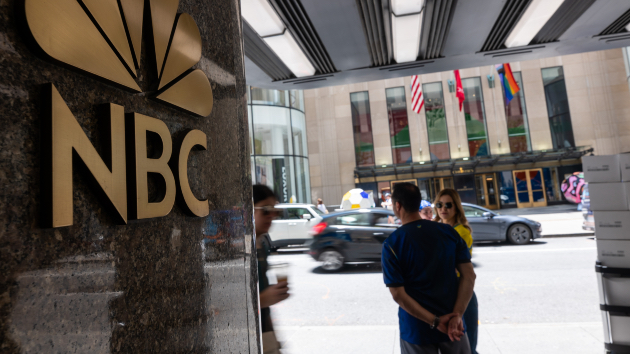
People walk by the Comcast building which houses NBC Studios in Manhattan on June 29, 2026 in New York City. (Spencer Platt/Getty Images)
(NEW YORK) — A man is facing charges, including menacing as a hate crime, after he allegedly snuck into an NBC building at New York City’s Rockefeller Center looking for “Today” show weather anchor Al Roker, authorities said.
The suspect, Andrew Truelove, gained access to the “Today” studio on Thursday morning by entering the lobby and closely following an NBC employee who used an ID card to scan into the building, Rockefeller Center security personnel told authorities.
Truelove allegedly loitered at the bottom of a stairwell before calling out, “Where is Roker?” according to a criminal complaint.
He then allegedly took steps toward “Today” anchor Craig Melvin and repeatedly uttered a racial slur, the complaint said.
Truelove, 41, of Manhattan, was detained by an NYPD officer working a paid detail, police said.
He was charged with burglary as a hate crime, menacing as a hate crime, criminal trespass as a hate crime and harassment, according to police. He appeared in court on Friday, where a judge set bail at $10,000.
Police sources told ABC News Truelove is a Sandy Hook school shooting denier who has been arrested numerous times, including in his native Virginia, for allegedly stealing signs dedicated to Sandy Hook victims.
Melvin wrote on Instagram after Thursday’s incident, “I’m doing just fine. Thanks for reaching out.” He added on “Today” on Friday, “We are cooperating fully with the NYPD as they investigate the matter and we are just very happy that everyone is safe.”
Roker wrote on Instagram Friday morning, “A really heartfelt thank you to all who reached out over the last 24 hours to check in on my brother, craigmelvinnbc. We are both okay. It’s moments like these that serve to pull us together.”
NBC News did not respond to ABC News’ request for comment, but Melvin shared a statement from NBC News on Instagram, which said the person “entered an unauthorized area ” and “approached anchor Craig Melvin, who alerted security.”
“The individual was detained and taken into custody by law enforcement without further incident. There was no altercation, and no one was injured,” NBC said.
NBC said it takes “the safety and security of our employees, talent, staff and guests extremely seriously. We are reviewing the incident and our security protocols and remain committed to providing a safe and secure environment for everyone who works at and visits our studios.”
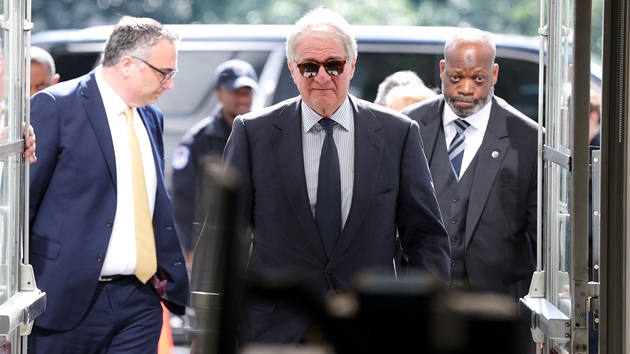
Former CEO of Apollo Global Management Leon Black arrives to testify at a closed-door interview with the House Oversight Committee on Capitol Hill on June 26, 2026 in Washington, DC. (Kevin Dietsch/Getty Images)
(WASHINGTON) — Private equity billionaire Leon Black walked out of his transcribed interview with the House Oversight Committee regarding his decades-long relationship with Jeffrey Epstein after refusing to answer questions about nondisclosure agreements allegedly related to the disgraced sex offender, according to a transcript of the June 26 interview released by the committee Friday.
While he said he would be willing to talk about three women involved in lawsuits against him, Black repeatedly declined to answer questions about how many nondisclosure agreements he was involved in, citing the advice of his attorneys.
“I’m not here to talk about confidential NDAs,” Black said, later adding. “I’m not here to talk about who has NDAs.”
Black was issued two subpoenas after his refusals — one compelling him to participate in a deposition and another to turn over any NDAs. A House Oversight Committee spokesperson said Black’s attorney confirmed Black would appear for a deposition on Sept. 3, and he will turn over the NDAs sometime next week.
Black, who maintained a social relationship with Epstein since the mid-1990s and eventually paid him more than $170 million for “tax and estate planning advice,” according to the Senate Finance Committee, appeared before the Oversight panel as part of its ongoing probe into the government’s investigation of the convicted sex offender.
Black acknowledged that he discussed at least one nondisclosure agreement with Epstein, though he denied he sought Epstein’s advice on the matter. According to Black, he agreed to pay a woman with whom he had a six-year affair after she allegedly “blackmailed and extorted” him, ultimately agreeing to pay her more than $21 million over 15 years. Because Epstein was helping manage his finances, Black said he made Epstein aware of the agreement and payments.
“I don’t know whether he had any experience on NDAs. He was not my NDA adviser,” Black said of Epstein, according to the transcript.
Black was served the two subpoenas after he declined to answer broader questions about other alleged nondisclosure agreements. His lawyers argued that Black was not at liberty to discuss confidential agreements he was a party to, and called the subpoenas a stunt.
“Mr. Black came here voluntarily to assist the committee. This was nothing more than a planned political stunt,” said Black’s attorney Aaron Cutler. “Mr. Epstein had no involvement with any NDAs, whether they exist or not.”
Before the interview was cut short, Black faced questions about his decades-long relationship with Epstein, who he first began to see socially before hiring him to manage part of his estate. While Black acknowledged that he saw Epstein somewhat regularly — about once a month — he claimed they were not close friends.
“Friendship is an amorphous term. This is somebody who knew intimately the goings on in my family tax and estate planning entities. It’s also something where, as I mentioned, I’d go over and meet his friends. I know there are emails where he claims that we’re best friends. We were never best friends,” Black said, per the transcript.
Lawmakers pushed back when Black sought to distance himself from Epstein, including by asking about a message Black wrote for a book that Maxwell, Epstein’s longtime associate, created for Epstein’s 50th birthday. According to the Wall Street Journal, Black wrote a two-line poem — “Blonde, Red or Brunette, spread out geographically … with this net of fish, Jeff’s now ‘The Old Man and The Sea'” — which he signed “Love and kisses, Leon.”
Asked to explain the note, Black said he was referencing how Epstein “seemed to know women all over the world,” though he denied knowing any of the women were underage.
“He enjoyed the company of good-looking women, and he was a bachelor,” Black said, saying how Epstein’s surrounding himself with “mostly good-looking women” was “a little bit out of like a James Bond movie.”
The interview was cut short after the topic transitioned to nondisclosure agreements, and Black was not asked about the more than $158 he paid Epstein for “tax and estate planning advice.” During his opening remarks, Black claimed that he paid Epstein so much because he solved a “massive estate problem … that would have destroyed enormous value.” He denied that the money was related to any illegal activities.
“I have never paid Epstein for access to women. I was never blackmailed by Epstein. I was not involved with, and had no knowledge of, any of Epstein’s heinous conduct,” Black said, according to the transcript.
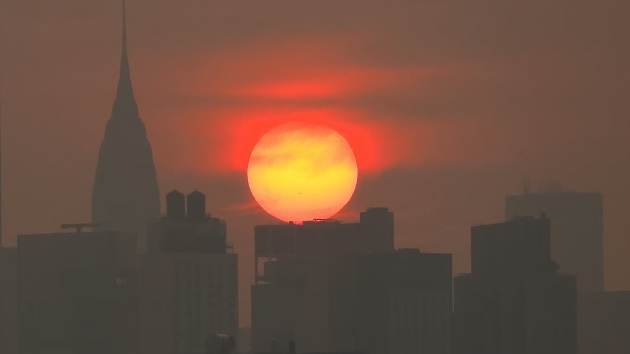
Wildfire smoke from Canada shrouds the sun as it rises behind the Chrysler Building in New York City, July 17, 2026. (Gary Hershorn/ABC News)
(NEW YORK) — Philadelphia issued a “Code Purple Air Quality Emergency Day” on Friday as smoke from hundreds of Canadian wildfires seeps down to more than a dozen states in the Midwest and the Northeast.
“Everyone may experience negative health effects from particulate matter in the air,” Philadelphia officials warned. “Members of sensitive groups may experience more serious health effects.”
Canada has nearly 900 wildfires burning, with over 100 categorized as out of control. Almost 200 of the fires are in Ontario.
Heavy rain moving over the Minnesota/Canada border Friday morning should help with some fires, but the storms could also bring strong winds and lightning, which can spark new fires and create more erratic fire activity.
Passing showers and thunderstorms are also possible in Ontario Friday, but that rain won’t be enough to put the wildfires out, and the winds may make conditions worse and lightning could spark new wildfires. There are more chances for rain over Ontario Sunday through Tuesday.
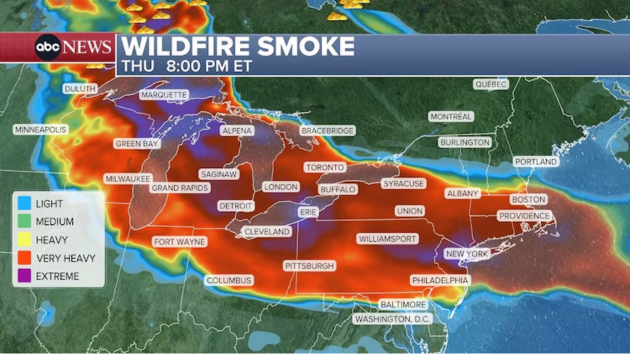
The smoke from Canada has moved south and is at dangerous levels Friday from Duluth, Minnesota, to Richmond, Virginia, impacting states including Wisconsin, Michigan, Ohio, New York, Pennsylvania, New Jersey, Maryland and Delaware.
By Friday afternoon, the worst air quality is expected from Detroit to Cleveland to Pittsburgh to Washington, D.C.
Saturday morning will bring a welcome reprieve from smoke in Detroit and Chicago, but heavy smoke will continue from Buffalo, New York, to Boston, to Washington, D.C.
By Saturday evening, the smoke will be over New England and returning to the Great Lakes.
Smoke is probable over New York City on Sunday when Spain plays Argentina in the FIFA World Cup Final at MetLife Stadium in New Jersey, though it is still too early to know exactly where the smoke will be. Sources familiar with the situation told ABC News that “all involved authorities are monitoring.”
Smoke contains fine particles that can travel deep into the lungs. For those who need to work outdoors, are more sensitive to smoke or are in a high-risk group, Kai Chen, an associate professor of epidemiology at Yale School of Public Health, told ABC News that the best type of mask to wear is an N95, which is designed to filter at least 95% of airborne particles.
In New York City, Mayor Zohran Mamdani said free KN95 masks are available at hundreds of locations.
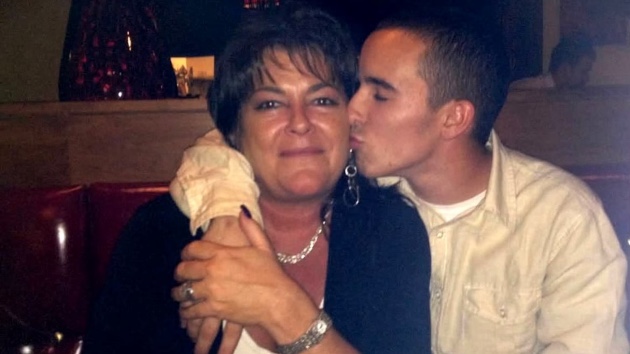
An undated photo of Tondra Madruga who died when a boat capsized in San Francisco Bay on July 14, 2026. (Madruga Family)
(SAN FRANCISCO) — The body of a 58-year-old woman has been recovered after a boat capsized and sank near Alcatraz Island in San Francisco Bay, marking the second person confirmed dead from the incident.
The San Francisco Medical Examiner’s Office identified the second victim as Tondra Madruga. Two people remain missing.
Madruga’s relatives said in a statement that they’re “heartbroken by the loss of our beloved mother, daughter, sister, and aunt.”
“Our hearts remain with every family impacted, and we sincerely appreciate your kindness and understanding,” the family said. “We extend our heartfelt thanks to the U.S. Coast Guard, the San Francisco Fire Department, the San Francisco Police Department, all of the first responders, and the civilian boaters and community members who selflessly assisted in the search and rescue efforts. Your dedication and support mean more to our family than words can express.”
Authorities said they believe 20 people were aboard the Volare, a 50-foot cabin cruiser based out of Stockton, California, when it was hit by a wave Tuesday evening, causing it to capsize.
One man who was aboard was taken to the shore severely injured and, despite CPR being administered, was pronounced dead, officials said. He was identified by the Office of the Chief Medical Examiner as 79-year-old Clifford Joseph Boisa.
A dog also died, San Francisco Fire Chief Dean Crispen said.
Three people were taken to the hospital and later released, Crispen said.
Crispen told reporters that authorities believe there was a memorial service that the 20 passengers, all adults and mostly comprised of family members, were taking part in on the vessel when it capsized. One survivor said it was a memorial for her sister, ABC San Francisco station KGO reported.
The Coast Guard announced Wednesday that it suspended search operations
Jarod Toczko, commander for U.S. Coast Guard Sector San Francisco, said the decision to suspend the search was not easy, but his teams swept through 950 square nautical miles and hadn’t found the missing people or the boat.
Toczko said there was a “high possibility that individuals could have been trapped in the vessel.”
Rescuer Justin Marceline told KGO that some passengers were “banging on the windows, trying to get out” of the boat.
“It was pretty wild, seeing that, honestly,” Marceline said, adding that conditions in the water were “really bad.”
“The people that were bobbing in the water, we pulled them out first,” Marceline said. “The people in the water were elderly folks, they were conscious, but people were too tired and worn out.”
Toczko praised those who jumped to save the passengers.
“No question, no doubt…those people saved lives,” he said.
ABC News’ Emily Shapiro and Jennifer Watts contributed to this report.
Former Russian Prime Minister Mikhail Kasyanov attends a march in memory of Russian opposition leader and former Deputy Prime Minister Boris Nemtsov on March 1, 2015 in Moscow, Russia. (Sasha Mordovets/Getty Images)
(LONDON) — Once one of the most powerful men in Russia, Mikhail Kasyanov now lives in exile in Latvia, his name on a list of “extremists and terrorists” that the Kremlin alleges are trying to overthrow the state.
Kasyanov first served as Russia’s finance minister before being elevated to prime minister under President Vladimir Putin from May 2000 to February 2004 — the early years of Putin’s time in office when the future strongman was embedding his control and beginning to formulate his vision of a revitalized Russia.
Putin’s decades-long project culminated in the February 2022 full-scale invasion of Ukraine, a gambit now in its fifth year. Kasyanov told ABC News last week that the campaign has achieved none of Putin’s goals and could yet prove an existential challenge to the Kremlin regime.
In recent months, Kasyanov told ABC News on the sidelines of the Chatham House think tank conference in London, “the overall sentiment, overall attitude, to Putin started to change.”
Among the factors applying more pressure to the Kremlin are expanding Ukrainian long-range drone strikes on Russia’s oil production, refining and export facilities — plus on the capital Moscow and the so-called “second capital” St. Petersburg — apparent public concern about spreading fuel shortages, troubling macro-economic indicators and new restrictions on internet usage, Kasyanov said.
Putin, Kasyanov said, built his image around providing both stability and security. “There is nothing on this — no stability and no security,” he said, adding, “The situation now has started to change in the minds of people — not only the ruling group, but also just the middle class, who in fact, could in any country be a driving force for any changes.”
That middle class is a key constituency for the Kremlin. Concentrated in Russia’s largest cities, analysts have watched keenly for any hint of dissent from this social strata.
Putin’s continued refusal to order a general mobilization despite Russia’s enormous battlefield losses and reported manpower strains have been interpreted by some analysts as a tacit acknowledgement that the Kremlin does not want to risk urban, middle class ire. “Putin is very much concerned about this,” Kasyanov suggested.
In cities like Moscow, St. Petersburg and Yekaterinburg, Kasyanov said, it had until recently been possible to continue as if “nothing is happening.”
“But, in the spring and now, of course, Ukraine changed their attitude. They have an advantage in long-range missiles and they have an advantage in drones,” Kasyanov said.
“Gradually, they moved the war from being an ‘accident’ somewhere, an emergency case somewhere in the corner of Russia, to Russia — even to Moscow. And that is quite a significant change.”
‘He needs pressure’
Kayanov said Western powers should seek to exploit the growing pressure on Putin and force him back to the negotiating table with genuine concessions, not the same maximalist demands the Kremlin has long made of Ukraine.
“It could happen by the end of the year if consistent pressure continues,” Kasyanov said. Russia’s growing budget deficit — which as of last month reached 2.5% of GDP, according to preliminary Finance Ministry data — could prove a particular pain point, he added.
So too might international sanctions on — and long-range Ukrainian drone attacks on — Russia’s vital oil industry, Kasyanov added. “By the end of the year, he will face a big problem,” Kasyanov said of Putin.
Kremlin spokesperson Dmitry Peskov this week acknowledged some economic strains, telling reporters that Russia’s rate of growth is currently “insufficient.” But Peskov said the problems facing the country were not critical, but rather a reflection of the “rather dire state” of the global economy.
On the diplomatic front, Kasyanov said Moscow has largely failed to convert apparent diplomatic openings with Washington — for example its success at Putin’s summit with President Donald Trump in Anchorage in August 2025.
“What Putin wanted was to divide the transatlantic unity, dreaming of what they call the ‘Anchorage spirit,'” Kasyanov said, referring to the U.S.-Russian understanding that Moscow said was reached at the Alaska summit, which was widely interpreted as a diplomatic coup for the Kremlin.
Broadly, Kasyanov suggested that Washington had a “wrong understanding of the whole problem.” He added, “All those years, it was a useless undertaking trying to give a carrot to Putin. Because they don’t understand what the Putin regime is about.”
The negotiations, Kasyanov suggested, were interpreted by the Kremlin “as a demonstration of weakness.” Nonetheless, both Moscow and Kyiv have acknowledged that the current conflict can only end with a diplomatic settlement.
Trump has repeatedly said he is the only Western leader capable of pressuring Putin and Ukrainian President Volodymyr Zelenskyy to agree a deal to end the fighting. This week, Trump told Fox News he believes that Putin is “ready to make a deal,” possibly “soon.”
“I tell him the same thing all the time. I don’t want to go into great detail, but I say: ‘Vladimir, it’s time for you to stop. It’s time for this war to end,'” Trump said. “It takes two to tango. But I think he’s ready to make a deal,” Trump added.
Earlier this month, Trump told ABC News of a potential deal, “We’re getting much closer than people realize, and President Putin wants it to end.”
But for all the Russian maneuvers and White House criticism directed toward Kyiv, Western funds and weapons have continued to flow into Ukrainian hands.
Last week, during a warm face-to-face meeting with Zelenskyy, Trump said Ukraine would be allowed to produce key Patriot surface-to-air system interceptors.
“That is, I think, creating a shock in Moscow,” Kasyanov said of the resolute Western backing of Ukraine.
Life after Putin
Putin dismissed Kasyanov and his cabinet in early 2004, weeks before that year’s presidential election. In the years that followed, Kasyanov became a prominent opposition figure, faced fraud charges — which he denied — and was blocked from standing as a candidate in Russia’s 2008 presidential election.
After Putin launched his full-scale invasion of Ukraine In 2022, Kasyanov left Russia. He now leads the People’s Freedom Party from Riga — “temporarily,” according to his business card.
Kasyanov, 68, said he has no concrete political ambitions in a post-Putin Russia. Rather, he suggested that the best case scenario would be a “long process” of political normalization and eventual democratization.
A years-long “gray period,” he said, could see Putin’s successors allow “imitation” or “quasi” elections and the return of a true political opposition, which Kasyanov hopes will eventually give way to a genuine vote that draws real legitimacy from the population.
“If Putin stays in power, it means there will be another period in which Russia will represent a threat and there will continue to be some kind of negotiations and preparations for some kind of revanche, as we saw in previous years,” Kasyanov said.
For the time being, Kasyanov said he expects Putin to simultaneously seek to “destroy unity” within Europe and within the transatlantic system and seek negotiations.
On the domestic front, Putin will continue to keep a tight grip on the narrative, Kasyanov said, lionizing Russian achievements in the war like the retention of Crimea, further territorial gains in southern and eastern Ukraine and a supposed defeat of NATO.
In the long term, Kasyanov said he still hopes for Putin to leave the scene, one way or another. But he doubts Putin will be overthrown from the inside.
“I don’t think there will be a coup, because there are no such people. All those people inside who were capable, with strength, disappeared,” Kasyanov said. There are, he added, people in Russia who are “ready for changes, but they are not ready to fight, because they immediately will be in jail.”
“When the situation starts to change, some of us could come back to participate in quasi-elections, which will happen not in two years after Putin, maybe in three years, maybe in four years. And at that time, real change could start,” he said.
“I hope my country will be a normal European state,” Kasyanov said. “We’ll see.”
U.S. President Donald Trump looks on during a bilateral meeting with the Prime Minister of Iraq Ali al-Zaidi, in the Oval Office of the White House on July 14, 2026 in Washington, DC. (Photo by Andrew Harnik/Getty Images)
(WASHINGTON) — President Donald Trump, in a primetime address on Thursday, announced he has declassified a slew of documents he claims reveal vulnerabilities in America’s elections systems, election fraud and interference in elections by China, and ordered the Department of Justice to prosecute those believed to be involved.
“America is back and doing really well, but we still have a major challenge that must be urgently addressed because no country can be great without fair and honest elections, you have to trust your country,” Trump said. “Because if there can be no trust, there can be no greatness, and that’s very simple: no trust, no greatness.”
But throughout the more than 20-minute speech, the president did not provide specific evidence that the election outcome, or any votes, were altered in the 2020 election, despite his repeated claims that the election was “stolen” or “rigged.”
Trump has long pushed debunked conspiracy theories to claim that his 2020 election loss was fraudulent.
The president’s speech led to his main argument: he wants Congress to pass the SAVE America Act, his sweeping elections reform bill that Senate Majority Leader John Thune has repeatedly said does not have enough Republican votes to pass.
In his remarks, the president said that he would immediately declassify the release of “critical intelligence, revealing shocking vulnerabilities in our election infrastructure.”
According to the president, the documents focus on what he said were a number of areas of concern, including claims that China “compromised” election data during the 2020 election, and attempts to downplay the extent of China’s efforts.
Trump argued that the intelligence community suppressed information about China accessing 220 million voter files and trying to turn American opinion against him in the run-up to the 2020 election.
The president also accused the “deep-state” of keeping information about election meddling from him.
Trump claimed that U.S. intelligence agencies learned that tens of millions of voters’ data in 18 states had been “bought, stolen, or hacked” by China, and that the intelligence community deliberately kept this information from him while he was president.
Trump’s remarks asserting that the Chinese undertook a far more ambitious role in attempting to dictate the outcome of the 2020 election goes beyond what U.S. intelligence community has previously assessed.
In March 2021, two months into the Biden administration, a declassified “Intelligence Community Assessment” (ICA) that was produced at the end of Trump’s first term publicly acknowledged the belief among some intelligence officials that “China took at least some steps to undermine former President Trump’s reelection chances.” But the ICA said any such actions were “primarily through social media and official public statements and media,” not through interference with “election processes.”
Further, the ICA said that while China was “probably” trying “to gather information on U.S. voters and public opinion; political parties, candidates and their staffs; and senior government officials,” the more reliable intelligence indicated that such efforts were not actually intended to undermine Trump but instead to “predict electoral outcomes and to inform its efforts to influence US policy toward China under either election outcome.”
The heavily redacted documents released by the White House on Thursday do not appear to back up Trump’s assertions, instead containing scattershot intelligence that descries efforts to obtain — but not alter — voter records and to conduct social media activity to sow social discord.
One heavily-redacted document titled “200M Voter Records Compromised. repeatedly references personally identifiable information being compromised. This information includes names, phone numbers and addresses — which can also be found from many other sources.
In another series of near-completely redacted memos, words such as “state voter registration data” and “personal identifiable information” appear between large blocks of black redaction markings. It is impossible to surmise the meaning of these records without context, but they appear to point to some Chinese efforts to gather American voter data, much of which is publicly available.
Notably, these memos document Chinese activities ahead of both the 2020 and 2024 presidential elections.
Elsewhere in his remarks, Trump alleged that former Justice Department officials slow-walked an investigation in Michigan that involved the submission of voter registration applications that had forged signatures and other indications of fraudulent applications. Trump called on FBI Director Kash Patel to look into whether any charges can still be brought.
Local media at the time said that a state-level investigation was halted so the FBI could continue with a related investigation. It’s unclear why no federal charges were ever brought or if federal charges were warranted.
At the time, state officials said that the fact that the fraudulent applications were detected shows that the system worked.
The president also said the documents released Thursday include a Department of Homeland Security report he called “stunning,” alleging approximately 278,000 non-citizens were included on voter rolls.
In the documents released by the White House, the DHS report that alleged 250,000 noncitizen voters on the rolls came from a review of “public voter files” that appear to have come from four states: California, New Jersey, Pennsylvania and Nevada. DHS did not provide any methodology about how it reached that number, nor does it specify what “public voter files” it reviewed.
DHS acknowledged it did not have access to those states’ voter rolls, and alleges that in the 10 states that provided the federal government access to their rolls, the agency found 28,000 noncitizen voters.
Findings from the conservative-leaning Heritage Foundation have found only around 100 verified instances of non-citizen voting going back two decades.
-ABC News’ Lucien Bruggeman and Mike Levine contributed to this report.
U.S. Senate Minority Leader Sen. Chuck Schumer (D-NY) speaks to members of the media outside the U.S. Capitol on June 18, 2026, in Washington, DC. Sen. Schumer blasted President Trump’s new agreement with Iran, calling it an “epic failure” that keeps Americans in the dark due to a lack of transparency while leaving the U.S. in a worse strategic and security position. (Photo by Alex Wong/Getty Images)
Georgia Democratic Sen. Jon Ossoff, whose home state has been the target of many of the administration’s election challenges, told reporters Thursday, “If the president declares Georgia’s elections illegitimate, or if the president declares Georgia’s sitting United States senators illegitimate, he is declaring Georgia voters illegitimate. It’s Donald Trump who tried to defraud Georgia voters in that election.”
Ossoff is up for re-election in November and his seat is being targeted by Republicans as a possible pickup opportunity. He predicted that Trump would use his speech to rehash challenges to the 2020 election that failed in court.
“Here’s what’s going to happen tonight: the world’s most famous sore loser will deliver a prime-time presidential sour grapes address to pursue his six-year-old grievances about the 2020 election, while his war in the Middle East spirals out of control and the cost of living continues to rise for Americans across the country,” Ossoff said.
In a White House briefing Thursday, press secretary Karoline Leavitt was tight-lipped about what the president would say besides that he will discuss “protecting the integrity of our elections.”
When pressed by a reporter about concerns from some Republicans that the president was litigating past elections that could turn off some swing voters, Leavitt said that Trump would focus on secure elections as key to American democracy.
“I’ve seen a lot of reporting and, frankly, misreporting about what the president will say. I think the American people will be relieved to hear what they are hearing from the president of the United States and his commitment to transparency and the focus on the integrity of our elections tonight,” she said.
When later pressed by ABC News’ Rachel Scott about the political concerns of some Republicans, Leavitt said only that people should wait until they’ve heard the speech.
Outgoing Republican Sens. Thom Tillis and John Cornyn and Rep. Thomas Massie said Trump looking back on the 2020 elections is not a productive message for the party as it heads into the upcoming midterm cycle.
Asked if he thought Trump focusing on the 2020 election going into the midterms was a good messages for Republicans, Tillis said, “No, not at all. Look, we can’t re-prosecute that campaign. Anytime you’re looking back, you’re not looking ahead and I’m looking ahead to these elections, and the president should as well.”
Massie said that the White House was “trying to convince the American people the problem is the elections” rather than other issues they are concerned about.
“The problem is not that we didn’t win the elections. The problem is that we broke our promises when we got here … So, it’s a ruse because they’re trying to convince the American people the problem is the elections. The problem is the people that they’ve elected.”
Cornyn said that he wasn’t pleased with Jay Clayton’s answers on the 2020 election during his Senate Intelligence Committee confirmation hearing to be Trump’s director of national intelligence on Tuesday when he refused to answer who won.
“I thought a lot of it was pretty silly,” Cornyn said of Clayton’s performance. “I don’t know why we’re still talking about the 2020 election on either side of the aisle. We got important work to do and I think the most important is coming up here in the midterms. “In the meantime, to continue to do the people’s work, and when we’re talking about what happened six years ago, I don’t think we’re doing them any favors.”
Sen. Mark Warner, the top Democrat on the Intelligence Committee, said Trump’s speech could influence how he votes on Clayton.
“If Donald Trump does what I expect and makes outrageous claims and uses those claims as an attempt to interfere in the elections, boy oh boy, more than ever do you need somebody in that role that’ll take truth to power,” he said.
Senate Minority Leader Chuck Schumer told reporters that Trump is “scared to death that he will lose in 2026” and is trying to change the subject.
“The bottom line is, if Trump wants to win the American people over, instead of the bulls— that he’s peddling about 2020, he ought to focus on lowering people’s costs, getting rid of the chaos in administration, getting rid of the corruption,” Schumer said.
ABC News’ Michelle Stoddart contributed to this report.
An ABC News graphic shows the forecast for Thursday, July 16, 2026. (ABC News)
(NEW YORK) — Air quality alerts are in place on Thursday across at least 18 states, from Minnesota to New Hampshire to Virginia, as dangerous smoke continues to waft into the U.S. from Canadian wildfires, including more than 100 blazes burning out of control.
Smoke from at least 850 active wildfires in Canada is traveling more than a thousand miles to reach U.S. locations including New York City. At least another nine large fires are burning in northern Minnesota.
On Thursday afternoon, Minneapolis surpassed Detroit for having the worst measured air quality in the world among major cities, according to the air quality monitoring website IQAir.
Earlier Thursday, Detroit, which dropped to second on the list, reached an air quality index, or AQI, of nearly 570. IQAir rates the most dangerous air quality index, described as “hazardous,” as 301 or above.
Chicago was third on the IQAir’s AQI scale for the worst air quality on the planet while Toronto, Ontario, was sixth on Thursday afternoon. Toronto is more than 1,100 miles from where some 180 wildfires are burning in sparsely populated areas of Ontario province.
Meanwhile, all of New York State, including New York City, and parts of New Jersey are under an Air Quality Advisory on Thursday due to the wildfire smoke.
The extreme smoke will continue through Thursday evening in the Upper Midwest, including northern Wisconsin, northern Michigan, the New York City area and across the Northeast. Heavy smoke will also stretch from Chicago to Detroit and from Philadelphia to Boston.
New York City could see orange skies on Thursday afternoon as dense plumes of hazardous smoke continues pour into the area.
According to the Canadian Wildland Fire Information System, 859 active wildfires are burning as of late Thursday afternoon, including 37 new fires that ignited Thursday. At least 109 of the wildfires were burning out of control Thursday afternoon, according to the agency.
So far this year, according to the agency, Canada has had 3,549 wildfires that have burned a total of 2.3 million hectares, or more than 93,000 square miles, which is roughly the size of the United Kingdom.
The smoke and ash from the Canadian wildfires was even affecting commercial air traffic. On Thursday, the Federal Aviation Administration (FAA) said it was slowing arriving flights into the Philadelphia International Airport due to low visibility from wildfires smoke.
An American Airlines pilot told Philadelphia air traffic controllers on Thursday that ash was sticking the windshield of his aircraft, according to a recording of the communications provided by ATC.com.
“I’ve never seen it stick to the windshield like this,” the pilot was heard telling air traffic controllers.
American Steve Ventling of Montana told ABC News that he witnessed the Canadian wildfires up close this week when a blaze began while he was on a fishing trip in Northern Ontario. Ventling shared photos with ABC News of billowing smoke and flames quickly spreading through a lakeside forest.
“I’ve seen plenty of fires in my lifetime. Nothing prepared me for this. The flames exploded through the treetops. Entire trees vanished in seconds,” said Ventling, adding that he and others he was fishing with evacuated the area in a boat.
On Wednesday, the wildfire smoke cast a yellowish haze over New York City, leaving a strong stench of smoke in the air.
New York City Mayor Zohran Mamdani warned that “a combination of dangerous heat and unhealthy air” will continue to be a serious threat to the health of New Yorkers on Thursday.
“This is very serious,” Mamdani said at a news conference on Thursday morning. “We are reaching into a level of air quality that is dangerous for every single New Yorker.”
In a social media post on Wednesday night, Mamdani advised New Yorkers to “stay somewhere cool with air conditioning, limit your time outdoors, drink plenty of water, and check on your neighbors – especially older New Yorkers and anyone with a health condition.”
The mayor said the city is providing free masks to help people cope with the smoke.
By Thursday noon, air quality was rated as “unhealthy” in New York City, with air quality in the Long Island and Lower Hudson Valley regions forecast to also become unhealthy before the end of the day, according to the air monitoring site AirNow.
Air quality in the Central and Western New York regions and the Eastern Lake Ontario region of New York state were rated as “very unhealthy,” according to AirNow.
New York Gov. Kathy Hochul said smoke will be thick on Thursday and spread across the rest of the state throughout the day.
“Distant wildfires have impacted New York State in recent years, and this week unfortunately will be no different with expected hazy skies and poor air quality,” Hochul said in a statement on Wednesday. “We are now closely tracking these conditions and I strongly encourage New Yorkers to stay informed and take appropriate precautions to stay safe. Sensitive groups should take particular caution.”
By Friday morning, the smoke is expected to push farther south, affecting areas through Ohio and Virginia, including Washington, D.C., and Baltimore, throughout the day.
An ABC News graphic shows the forecast for Thursday, July 16, 2026. (ABC News)
(NEW YORK) — Air quality alerts are in place on Thursday across at least 18 states, from Minnesota to New Hampshire to Virginia, as dangerous smoke continues to waft into the U.S. from Canadian wildfires, including more than 100 blazes burning out of control.
Smoke from at least 850 active wildfires in Canada is traveling more than a thousand miles to reach U.S. locations including New York City. At least another nine large fires are burning in northern Minnesota.
On Thursday afternoon, Minneapolis surpassed Detroit for having the worst measured air quality in the world among major cities, according to the air quality monitoring website IQAir.
Earlier Thursday, Detroit, which dropped to second on the list, reached an air quality index, or AQI, of nearly 570. IQAir rates the most dangerous air quality index, described as “hazardous,” as 301 or above.
Chicago was third on the IQAir’s AQI scale for the worst air quality on the planet while Toronto, Ontario, was sixth on Thursday afternoon. Toronto is more than 1,100 miles from where some 180 wildfires are burning in sparsely populated areas of Ontario province.
Meanwhile, all of New York State, including New York City, and parts of New Jersey are under an Air Quality Advisory on Thursday due to the wildfire smoke.
The extreme smoke will continue through Thursday evening in the Upper Midwest, including northern Wisconsin, northern Michigan, the New York City area and across the Northeast. Heavy smoke will also stretch from Chicago to Detroit and from Philadelphia to Boston.
New York City could see orange skies on Thursday afternoon as dense plumes of hazardous smoke continues pour into the area.
According to the Canadian Wildland Fire Information System, 859 active wildfires are burning as of late Thursday afternoon, including 37 new fires that ignited Thursday. At least 109 of the wildfires were burning out of control Thursday afternoon, according to the agency.
So far this year, according to the agency, Canada has had 3,549 wildfires that have burned a total of 2.3 million hectares, or more than 93,000 square miles, which is roughly the size of the United Kingdom.
The smoke and ash from the Canadian wildfires was even affecting commercial air traffic. On Thursday, the Federal Aviation Administration (FAA) said it was slowing arriving flights into the Philadelphia International Airport due to low visibility from wildfires smoke.
An American Airlines pilot told Philadelphia air traffic controllers on Thursday that ash was sticking the windshield of his aircraft, according to a recording of the communications provided by ATC.com.
“I’ve never seen it stick to the windshield like this,” the pilot was heard telling air traffic controllers.
American Steve Ventling of Montana told ABC News that he witnessed the Canadian wildfires up close this week when a blaze began while he was on a fishing trip in Northern Ontario. Ventling shared photos with ABC News of billowing smoke and flames quickly spreading through a lakeside forest.
“I’ve seen plenty of fires in my lifetime. Nothing prepared me for this. The flames exploded through the treetops. Entire trees vanished in seconds,” said Ventling, adding that he and others he was fishing with evacuated the area in a boat.
On Wednesday, the wildfire smoke cast a yellowish haze over New York City, leaving a strong stench of smoke in the air.
New York City Mayor Zohran Mamdani warned that “a combination of dangerous heat and unhealthy air” will continue to be a serious threat to the health of New Yorkers on Thursday.
“This is very serious,” Mamdani said at a news conference on Thursday morning. “We are reaching into a level of air quality that is dangerous for every single New Yorker.”
In a social media post on Wednesday night, Mamdani advised New Yorkers to “stay somewhere cool with air conditioning, limit your time outdoors, drink plenty of water, and check on your neighbors – especially older New Yorkers and anyone with a health condition.”
The mayor said the city is providing free masks to help people cope with the smoke.
By Thursday noon, air quality was rated as “unhealthy” in New York City, with air quality in the Long Island and Lower Hudson Valley regions forecast to also become unhealthy before the end of the day, according to the air monitoring site AirNow.
Air quality in the Central and Western New York regions and the Eastern Lake Ontario region of New York state were rated as “very unhealthy,” according to AirNow.
New York Gov. Kathy Hochul said smoke will be thick on Thursday and spread across the rest of the state throughout the day.
“Distant wildfires have impacted New York State in recent years, and this week unfortunately will be no different with expected hazy skies and poor air quality,” Hochul said in a statement on Wednesday. “We are now closely tracking these conditions and I strongly encourage New Yorkers to stay informed and take appropriate precautions to stay safe. Sensitive groups should take particular caution.”
By Friday morning, the smoke is expected to push farther south, affecting areas through Ohio and Virginia, including Washington, D.C., and Baltimore, throughout the day.
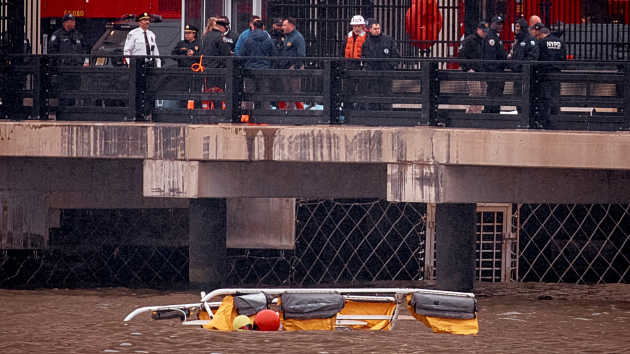
Police and firefighters work on the site after a helicopter crashed in the Hudson River on April 10, 2025, in Jersey City, New Jersey. All six people on board were killed when a helicopter plunged into the Hudson River off of Lower Manhattan. (Photo by Andres Kudacki/Getty Images)
(NEW YORK) — A bird strike likely caused last year’s tourist helicopter crash in New York City’s Hudson River that killed all six people on board, according to the National Transportation Safety Board.
The more than 2,000 pages of information released by the NTSB is not the final report and does not state the probable cause, but the documents show the chopper slammed into multiple large birds before the crash.
The birds hit the rotor blades and the horizontal stabilizer, according to an analysis by the Smithsonian Institution’s Feather Identification Lab. Samples of “mixed species” of birds were found, including Canada Geese and black-backed Gull. Canadian Geese can sometimes weigh more than 10 pounds each.
Videos showed the rotors flying off the helicopter as it plummeted to the water.
The chopper crashed into the Hudson in April 2025 while carrying a pilot and a family from Spain: Siemens executive Agustin Escobar, his wife Merce Camprubi Montal, and their three children.
One witness told ABC News she watched the helicopter “fall out of the sky” from her apartment window.
“I heard five or six loud noises that sounded almost like gunshots in the sky and saw pieces fall off, then watched it fall into the river,” she said.