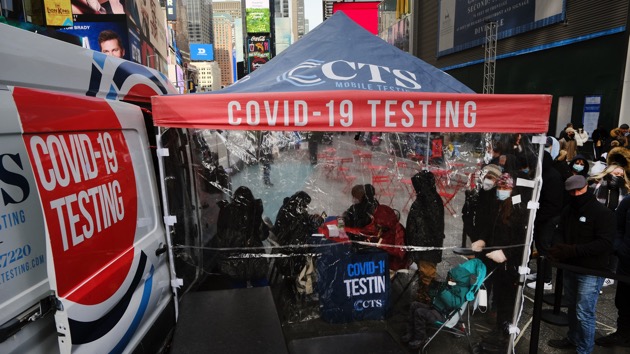
(ATLANTA) — Life expectancy in the United States decreased by nearly two years in 2020, mainly because of the pandemic, a new federal report suggests.
In 2019, Americans had a life expectancy — the average number of years a person is expected to live — of 78.8 years.
But new data from the Centers for Disease Control and Prevention’s National Center for Health Statistics (NCHS) found this figure fell to 77.0 years in 2020, marking the biggest drop seen since World War II.
“The thing that stands out to me is just this staggering decline,” Dr. Robert Anderson, chief of mortality statistics at the NCHS, told ABC News.”I know 1.8 years doesn’t seem like a whole lot but, on a population scale, that’s a huge decline in life expectancy.”
This is the biggest decrease seen since World War II, when life expectancy fell by 2.9 years from 66.2 years in 1942 to 63.3 years in 1943.
Although the report lays bare the impact that the virus has had on life expectancy, the team behind the report said other factors also played a role, including an increase in deaths due to diabetes and accidental injuries, such as drug overdoses.
Diabetes deaths topped 100,000 for the first time, Anderson said, and accidental or unintentional injury deaths, such as drug overdoses, topped 200,000.
However, he said that COVID-19 is undoubtedly the biggest reason for the decline.
According to the report, there were more than 3.38 million deaths in the U.S. last year, about 530,000 more than there were in 2019.
Of that 3.38 million, more than 350,000 deaths were attributed to COVID-19, meaning 10.4% of all deaths in 2020 were caused by the virus.
“I can tell you it’s the primary driver in the decline in life expectancy and the increase in mortality,” Anderson said. “We’re talking about 350,000 deaths. That accounts for the bulk of the increase in morality — the overwhelming majority.”
Men saw a bigger decrease in life expectancy, losing 2.1 years — from 76.3 in 2019 to 74.2 in 2020 — compared to a decline of 1.5 years — from 81.4 in 2019 to 79.9 in 2020 — for women.
COVID-19 was the third leading cause of death in 2020, responsible for 85 deaths per 100,000 people.
Anderson said it is the first time a new disease has entered the top 10 leading causes of death so quickly.
“A disease that comes out of nowhere and ends up in the top 10 or top five? You’d have to go back to the early days of the HIV epidemic to see something similar.”
He said HIV never got higher than the eighth-leading cause of death and, even then, it took a few years after the virus was first identified before it reached the top 10.
“This is sort of similar, but even more dramatic, because in one year it goes from nothing to the third-leading cause of death,” Anderson added. “Remarkable.”
(NEW YORK) — With millions of Americans set to travel and gather for Christmas and the New Year, families across the country are scrambling to try to ensure they are adequately protected against the coronavirus.
Experts suggest a confluence of factors is likely driving the country’s case rate up amid the surge of the omicron variant, most notably the millions of Americans who remain unvaccinated.
Many of those who have yet to get the shot are children, despite the fact that in the U.S. anyone over the age of 5 is eligible for the vaccine. Pfizer shots were authorized by the Food and Drug Administration for those 5 to 11 at the end of October, 12 to 15 in May and are fully approved for those 16 and older.
Since the emergence of the delta variant, children have been a significant driving factor behind the nation’s latest coronavirus surges, accounting for about a quarter of the nation’s reported weekly COVID-19 cases. Since July, more than 3.3 million have tested positive for the virus, representing 1 in every 4 cases, according to data from the American Academy of Pediatrics and the Children’s Hospital Association. In addition, the U.S. has not seen a week with fewer than 100,000 new pediatric cases since early August.
Now, given the potential for the highly transmissible omicron variant to cause an even greater wave of infections, experts say it is more critical than ever for children to be vaccinated in order to protect them and those around them, from severe disease and hospitalization, despite the fact that severe illness remains generally uncommon among children.
“[Omicron’s] increased transmissibility makes it possible that we’ll see very high case numbers in children, especially if they remain unvaccinated,” Dr. Kristin Moffitt, an infectious disease specialist at Boston Children’s Hospital told ABC News. “Even if severe infection remains relatively uncommon in children, if case numbers in children skyrocket, we’ll see many more pediatric hospitalizations.”
Earlier this week, the Centers for Disease Control and Prevention reported that models, which estimate the epidemic trajectory of coronavirus in the U.S., suggest that the new COVID-19 infections are likely to surge in the weeks to come and could exceed previous peaks, due to omicron.
“One of the fundamental drivers of ongoing community transmission is that there remains a significant portion of our population that is not immune to COVID,” C. Buddy Creech, director of the Vanderbilt Vaccine Research Program and associate professor of pediatric infectious diseases, told ABC News.
More than 90 million Americans are currently unvaccinated — including 51 million children under the age of 18.
Child COVID-19 cases on the rise again
Since the onset of the pandemic, nearly 7.4 million children and adolescents have tested positive for coronavirus, and in the last week alone, approximately 170,000 pediatric cases were reported, according to a new report from AAP and CHA, released on Monday.
“I think it is concerning to see these rates increasing,” Dr. Lee Beers, the AAP president, told “GMA3” on Tuesday. “It’s been a long, almost two years, and everyone is tired and everyone is frustrated and that’s all the more reason for us to be coming together to work together to really try to beat this thing and I think our kids are struggling.”
Since the first week of September, there have been nearly 2.3 million child cases — nearly a third of the total pediatric cases reported since the onset of the pandemic — and over the last month, pediatric COVID-19 related hospital admissions have increased by 33%, according to federal data.
“As children make up a larger portion of the unvaccinated population, they will account for a higher percentage of cases,” added Moffitt.
Although young people have largely been spared from acute COVID-19 illness, experts stress that children are not immune from the virus. According to the CDC, children are as likely to be infected with COVID-19 as adults and the virus now one of the top 10 causes of death for children ages 5 through 11 years.
There continues to be the misconception, among some, that children and teenagers may not be as severely affected by COVID-19 as adults, explained Creech. While that seemed to be the case early on in the pandemic, the delta variant proved otherwise.
“We began to see far more infections in children, some of which were severe. In addition, we continue to see long COVID, myocarditis, and multisystem inflammatory syndrome in children who appear to have very mild symptoms at the outset,” said Creech.
Pediatric COVID-19 vaccination rates continue to lag
With less than a third of the pediatric population — those under 18 — fully vaccinated, officials, health experts and pediatricians alike have been urging parents to get their children vaccinated.
“If your child is five years of age and older, please get them vaccinated. We need to protect the children,” Dr. Anthony Fauci, chief medical adviser to the White House, told George Stephanopoulos on ABC News’ “This Week” earlier this month. “This idea that children are not vulnerable at all is not so.”
President Joe Biden echoed Fauci’s sentiment on Tuesday, pleading with all families to get their “children protected today.”
“If your children are not vaccinated, please get them vaccinated,” Biden said. “If you’re a parent, understandably you waited – to see how the first shots went with other kids, before getting your own kid vaccinated, you can stop waiting.”
However, about two-thirds of parents of elementary school-aged children are either holding off on getting their younger children vaccinated or refuse to do so, according to another recent Kaiser Family Foundation poll, conducted before the discovery of omicron.
The safety profile of the Pfizer vaccine for eligible children remains “very reassuring,” added Moffit.
Earlier this month, CDC Director Dr. Rochelle Walensky told ABC News that real-world monitoring revealed vaccines are safe for young children.
Notably, the agency has yet to identify any concerns with the temporary heart inflammation known as myocarditis, a potential side effect of mRNA vaccines seen in rare circumstances in teenagers and young adults.
“We haven’t seen anything yet,” Walensky told ABC News Chief Medical Correspondent Dr. Jennifer Ashton. “We have an incredibly robust vaccine safety system, and so if [problems] were there, we would find it.”
Concerns over omicron
There is still not enough data to indicate how omicron will affect children, or whether it will potentially cause severe illness, compared to earlier variants.
Preliminary evidence indicates that omicron spreads at a rate two to three times faster than the delta variant, which experts say could result in a surge in COVID-19 cases, particularly among the unvaccinated.
“With delta, and now with omicron, we see the virus seeking and finding those who are either unvaccinated or whose circulating antibody levels have waned,” Creech explained.
Preliminary data from South Africa estimates that children had a 20% higher risk of hospitalization in the country’s omicron-driven fourth wave, given the fact that so many children were still unvaccinated, and therefore, unprotected.
In addition to the significant number of children and teenagers who are still unvaccinated, there is a large number of children under the age of five who are not yet eligible for the vaccine.
Late last week, the potential timeline for vaccines for children under 5 was pushed back after early data suggested that two lower doses of the Pfizer vaccine was not as effective for kids ages 2 to 5 as it was for the 16 to 25 population. Thus, scientists will add a third dose and see if the vaccine is as effective. Authorization for those 5 and younger may not come until the second quarter of 2022.
Experts therefore say it is critical for all those eligible to get vaccinated, in order to protect children who are still too young to get the shot.
“Vaccination will prevent infections, and fewer infections will mean lower transmission. Vaccinating everyone in a household who is able to be vaccinated will bring an added layer of protection to the entire household,” said Moffit.
(SAN ANTONIO) — The San Antonio Police Department is asking for the public’s help in finding 3-year-old Lina Sadar Khil who authorities say may be in “grave, immediate danger.”
Lina was last seen on Monday between 4 p.m. and 5 p.m. at a playground in San Antonio, according to police. She was with her mother who left her alone for an unknown amount of time, police said. When Lina’s mother returned, the young girl was gone, according to police.
A department spokesperson told ABC News there is no indication that Lina is with a family member.
Lina is white, about 4 feet tall and weighs 55 pounds. She has straight, shoulder-length brown hair and brown eyes.
Police said she was last seen wearing a black jacket, red dress and black shoes.
This case is still active and being investigated, according to police.
Authorities are asking anyone who has information on the case to call SAPD Missing Person’s Unit at 210-207-7660.
(NEW YORK) — Medical researchers say there is renewed promise in reducing COVID-19-related hospitalizations and deaths by increasing the use of convalescent plasma treatments early on in a coronavirus infection.
And some medical experts are pushing the federal government to allow more patients to receive the treatment, as lab-based monoclonal treatments such as Regeneron have seen lessened effectiveness against the omicron variant.
Researchers at John Hopkins University on Tuesday released the results of a 16-month nationwide study on convalescent plasma use on COVID-19 patients and found it had a 54% relative risk reduction in COVID-19-related hospitalizations.
Dr. Arturo Casadevall, one of the study’s co-authors and chair of the department of molecular microbiology and immunology at Johns Hopkins Bloomberg School of Public Health, told ABC News that the results are promising, especially if the plasma is used early on in the infection period.
“The results show a 54% efficacy in reducing hospitalization if you give it up to day nine. It is clear and highly significant,” he said. “If you look to less than five days, the efficacy is much, much higher.”
Researchers observed 1,181 adults who contracted COVID-19, half of whom were given polyclonal high-titer convalescent plasma that contained a concentrated mixture of SARS-CoV-2 antibodies. The other half were given placebo control plasma with no COVID-19 antibodies,
None of the patients who received the convalescent plasma died, and only 17 were hospitalized within 28 days of their infection, the study said, whereas three patients who received the placebo died, and 37 were hospitalized within 28 days of their infection, according to researchers.
After the Food and Drug Administration granted emergency use authorization for monoclonal treatments made by Regeneron and Eli Lilly, the use of plasma treatments for hospitalized coronavirus patients decreased.
Unlike plasma treatments, monoclonal treatments are not derived from the blood of COVID-19 survivors but instead are a cocktail of lab-created antibodies. Those monoclonal treatments were shown to be very effective at preventing worsening symptoms and deaths in infected patients.
However, Casadevall, warned that plasma treatment options need to be more strongly considered as the omicron variant has made monoclonal antibody treatments less effective.
George Yancopoulos, the president and chief scientific officer at Regeneron, told ABC News his company does have a collection of antibodies that are effective against the omicron variant, but it will take at least a few months before it is authorized and shipped.
“People that are high risk who come down with COVID who receive plasma in lieu of monoclonals hopefully stay out of the hospital,” Casadevall said. “And so plasma holds the line until Regeneron comes out with a new set of monoclonals.”
The John Hopkins study comes two weeks after the World Health Organization advised against the use of treatments that use COVID-19 survivors’ plasma. The WHO said it used data from 16 trials involving more than 16,000 patients around the world and determined that the treatment did not “improve survival nor reduce the need for mechanical ventilation.”
Casadevall told ABC News that the WHO did not use the data from the John Hopkins research in its decision.
“We hope that they reverse their recommendation against convalescent plasma in light of the Hopkins study results, since this therapy is inexpensive and available in resource-poor countries where plasma can provide a major tool to reduce hospitalizations and mortality,” he told ABC News.
Andrea B. Troxel, a professor of population health and the director of the division of biostatistics at NYU School of Medicine who has also written studies on convalescent plasma treatments for COVID-19 patients, told ABC News that previous studies on the effectiveness of plasma treatment have been mixed, but she found the results of the John Hopkins University study to be very encouraging.
Troxel said the issue with plasma treatments is determining the right time for their use during the infection period, and the data in the new study gives doctors a better idea of its effectiveness.
“This is the sweet spot for plasma, early enough in the infection the plasma can do what it needs to do. For other studies, it maybe was a little late,” she told ABC News.
Casadevall said the Food and Drug Administration should extend its emergency use authorization for plasma treatments to the outpatient space to ensure the treatment is given at the right time.
Troxel echoed this call and said plasma treatments should be more widely used for infected patients
“There is a strong benefit for these patients in receiving plasma,” she said. “It is safe and there is no reason not to trust this evidence.”
(NEW YORK) — As the COVID-19 pandemic has swept the globe, more than 5.3 million people have died from the disease worldwide, including over 809,000 Americans, according to real-time data compiled by Johns Hopkins University’s Center for Systems Science and Engineering.
About 61.6% of the population in the United States is fully vaccinated against COVID-19, according to data from the Centers for Disease Control and Prevention.
Here’s how the news is developing. All times Eastern:
Dec 22, 3:46 am
Portugal bans outdoor drinking, large gatherings for New Year’s Eve
Portugal said it would limit outdoor gatherings to 10 people and prohibit outdoor drinking on New Year’s Eve.
The country, which has 52 confirmed omicron cases, will also require most people to work from home starting on Saturday, the president’s office told ABC News on Tuesday.
The new restrictions, which are set to expire Jan. 10, will require people to present negative COVID-19 tests as they enter sporting events, theaters, weddings and other large gatherings.
Bars, discos, and schools will close on Saturday, the president’s office said.
The country reported an uptick in COVID-19 cases between Dec. 16 and Dec. 19, but numbers were slightly down on Tuesday, with 2,752 newly diagnosed cases and 18 deaths, according to the World Health Organization’s COVID-19 dashboard. Portugal’s adult population is 87% fully vaccinated.
-ABC News’ Aicha El-Hammar Castano
Dec 21, 7:53 pm
California to require all health care workers to get booster
California Gov. Gavin Newsom tweeted Tuesday evening that he will require that all health care workers in the state to get their booster shot.
“With Omicron on the rise, we’re taking immediate actions to protect Californians and ensure our hospitals are prepared,” he tweeted.
More details about the order will be shared on Wednesday, according to Newsom.
Dec 21, 7:05 pm
Chicago to institute vaccine mandate for indoor events
Chicago Mayor Lori Lightfoot announced a vaccine mandate for most indoor events as the city grasps with a rise in COVID-19 cases.
Starting Jan. 3, anyone over the age of 5 will have to show proof that they are fully vaccinated to “to dine indoors, visit gyms, or enjoy entertainment venues where food or drink are being served,” the mayor’s office said in a statement.
Patrons 16 and older will also need to “provide identification that matches their vaccination record,” according to the statement.
Chicago is averaging more than 1,700 new COVID-19 cases a day — a 79% increase from one week ago, the mayor’s office said.
Dec 21, 4:36 pm
New Hampshire hospital seeing record-high number of patients
Elliot Hospital in New Hampshire is now seeing three to four times as many patients as it had at the beginning of the pandemic, Dr. Laura McPhee told ABC News.
She said their ICU is full with COVID-19 patients and staff is running thin.
“We’re tired. It’s been extremely hard on everybody,” McPhee said, stressing that “most of the patients that we’re seeing are unvaccinated.”
“Most days I’ve been angry and frustrated. … Because this is preventable. It doesn’t have to happen,” she said. “I’ve not ever seen a patient here in the ICU who has been fully vaccinated with a booster.”
(NEW YORK) — The U.S. Food and Drug Administration (FDA) has approved the first-ever long-acting injectable drug for HIV prevention.
Until this week, the only FDA-licensed and approved medications for HIV pre-exposure prophylaxis, most commonly known as PrEP, were daily oral pills containing the HIV treatment drugs tenofovir and emtricitabine, which slow the progression of an HIV infection in the body.
PrEP is taken daily so that it builds up in your system, to the point that if there is an HIV infection, it prevents the virus from replicating and spreading throughout the body.
When taken as prescribed, PrEP services reduce the risk of getting HIV from sex by about 99%, according to new data from the CDC. Now, individuals who feel at-risk of HIV infection have the option of taking the daily pill, or the new shot every two months, after two initiation injections administered one month apart.
“This injection, given every two months, will be critical to addressing the HIV epidemic in the U.S., including helping high-risk individuals and certain groups where adherence to daily medication has been a major challenge or not a realistic option,” the FDA said in a statement.
According to Dr. Darien Sutton, Emergency Medicine Physician, in an interview with “Good Morning America,” “This is a game-changer in the world of HIV prevention.”
“Patients often have difficulty complying with any oral medication, so a bi-monthly injection can truly change the landscape in terms of HIV prevention. Having a bi-monthly treatment also serves as an opportunity to interact with a patient, share risk reduction sexual health education and complete necessary screenings.”
“Patients on PrEP can often feel stigmatized with taking daily medication,” he told “GMA.” “Some have shared with me that they fear simple actions, like picking up their medications from the pharmacy due to fear of stigmatization. This stigma unfortunately doesn’t stop at the pharmacy, as many also fear being seen carrying their preventative medications in public.”
Sutton added, “The study was also inclusive, including transgender women, which allows better applicability with diverse patient populations.”
CDC data shows that an estimated 34,800 people in the United States acquired HIV in 2019, the most recent year for which data are available.
Men who have sex with men, transgender women who have sex with men, and Black cisgender women are among those disproportionately affected by HIV in the U.S.
Heterosexual people made up 23% of all HIV diagnoses in the U.S. and six dependent areas in 2019. Specifically, heterosexual men accounted for 7% of new HIV diagnoses and heterosexual women accounted for 16%.
The FDA approval comes on the heels of a CDC recommendation this month that there be an expansion of HIV prevention medication to close the gap on PrEP implementation.
In a release, the National Institute of Allergy and Infectious Diseases (NIHAID) also made a nod to the FDA approval, saying in part, “These medications are highly effective at preventing HIV when taken daily as prescribed, however, taking a pill daily while feeling healthy can be challenging.” Adding, “Long-acting injectable cabotegravir PrEP is a less frequent, more discreet HIV prevention option that may be more desirable for some people.”
(DENVER) — Truck driver Rogel Aguilera-Mederos was sentenced on Dec. 13 to 110 years in prison for a 2019 fiery crash just outside Denver that killed four people and injured several others – a sentence that the judge in the case said he wouldn’t have chosen if he had the discretion.
A spokesman for the Colorado First Judicial District Attorney’s Office told ABC News on Tuesday afternoon that the DA’s office “filed a motion to start the reconsideration process” of the sentence on Friday afternoon, and Jefferson County District Attorney Alexis King has requested that the court set a new hearing “as soon as practicable.”
“As Colorado law required the imposition of the sentence in this case, the law also permits the Court to reconsider its sentence in an exceptional case involving unusual and extenuating circumstances,” the motion says.
Mederos, who was 23 years old at the time of the crash, was charged with 42 counts and was found guilty on 27 – the most serious of which was first degree assault.
Prosecutors sought the minimum penalties for each of the charges — the highest of which is 10 years, but the number of the charges and a law that says that some have to be served consecutively resulted in the lengthy sentence.
Progressive prosecutors aim to change the criminal justice system from the inside
“The Eighth Amendment of the Constitution says punishments can’t be cruel and unusual, and as far as Mr. Mederos is concerned, this is a cruel and unusual punishment,” Mederos’ attorney, James Colgan, told ABC News Tuesday.
A Change.org petition advocating for a commutation for Mederos, indicating that the crash was “not intentional,” was signed by more than 4.5 million people as of Tuesday afternoon, becoming one of fastest growing petitions on the website.
Mederos was driving a semitrailer loaded with lumber along a highway in Lakewood, Colorado, on April 25, 2019.
Those killed in the crash on Interstate 70 were Miguel Angel Lamas Arellano, 24; William Bailey, 67; Doyle Harrison, 61; and Stanley Politano, 69.
Prosecutors argued during the trial that Mederos could have taken a runaway truck ramp after losing control of his brakes, instead of driving into traffic.
Colgan said that his client “may have made some negligent mistakes,” but the punishment is “completely disproportionate to what happened.”
“What he did does not deserve a life sentence,” he said.
Why the judge didn’t have a choice
Ian Farrell, a professor of law at the Sturm College of Law at the University of Denver, said that this case has sparked outrage because Mederos “got the same sentence as someone who intentionally killed 100 people would have gotten in Colorado.”
“In every state in the country, which doesn’t have the death penalty, the maximum possible sentence is a life sentence,” Farrell said.
A Jefferson County jury found Mederos guilty of six counts of first-degree assault, 10 counts of attempted first-degree assault, four counts of vehicular homicide, four counts of careless driving causing death, two counts of vehicular assault and one count of reckless driving.
“I will state that if I had the discretion, it would not be my sentence,” the district court judge, A. Bruce Jones, said during the sentencing. ABC News has reached out to Jones but a request for comment was not responded to.
Mederos was sentenced to 10 years each for six counts of first degree assault, as well as five years each for 10 counts of attempted first degree assault, resulting in the 110-year sentence.
“When the judge said he didn’t have discretion, he was accurate,” Colgan said.
Jones was bound by “sentence enhancers” that are outlined in Colorado law, Farrell said, pointing to mandatory minimum penalties for certain crimes and certain classifications that enhance penalties for violent crimes.
Under Colorado law, first degree assault and attempted first degree assault are classified as “crimes of violence,” Farrell said, which mandates that an individual convicted of more than two “crimes of violence” serve the sentences consecutively, not concurrently.
“One of the things that the sentence enhances and mandatory minimums do is it takes power away from the judge, and gives it to the prosecutor,” Farrell said.
Since vehicular homicide, a class four felony, and the remaining lesser charges are not classified as “crimes of violence,” Colgan said that the judge “had discretion to run [them] concurrently, which he did.”
Prosecutors face backlash
Asked about the backlash over the number of charges and the length of the sentence, District Attorney King told ABC News in a statement on Tuesday that prosecutors “initiated plea negotiations but Mr. Aguilera-Mederos declined to consider anything other than a traffic ticket.”
“The actions and decisions of Mr. Mederos resulted in the loss of four lives, devastating injuries to the survivors and – as we heard them state during the sentencing hearing – grave impacts to their families and loved ones,” King said.
Colgan argued Mederos was “overcharged” in an attempt to “coerce” him into pleading guilty.
Domingo Garcia, President of the League of United Latin American Citizens, told ABC News he believes that “racial bias played a big part” in Mederos’ case, pointing to the fact that he is a Cuban immigrant who used a translator during the trial.
Farrell said that it’s “impossible to know” if racial bias played a part, but “Black and brown people are overcharged [and] over sentenced in every different area of the law.”
PHOTO: District Attorney Alexis King speaks during a news conference in Golden, Colo., Nov. 8, 2021.
David Zalubowski/AP, FILE
David Zalubowski/AP, FILE
District Attorney Alexis King speaks during a news conference in Golden, Colo., Nov. 8, 2021.
King’s office did not comment directly on the allegations of racial bias when asked by ABC News, but said in a statement that “the sentence – which our office requested the minimum for – is within the purview of the court and reflects the judgment of the legislature.”
“Just as the law mandates this outcome, it also provides future opportunity to revisit the sentence, and we will again pursue an appropriate outcome if that opportunity arises, after consulting with the victims and survivors and receiving their input,” King said.
Derek Chauvin wants to go to federal prison, even though it means he’ll do more time
Seeking a commutation
On the witness stand, Mederos expressed remorse for those who were killed and injured in the crash and said that the accident was unintentional and he is “not a criminal.”
“I want to say sorry. Sorry for the loss, for the people injured. I know they have trauma, I know, I feel that,” he said while crying.
“But please, don’t be angry with me … I was working hard for a better future for my family. I have never thought about hurting anybody in my entire life,” Mederos, who emigrated from Cuba to the U.S. at the age of 19, said.
Colorado Gov. Jared Polis said during a press conference on Tuesday that he received a clemency application from Mederos’ attorney.
Clemency could mean commutation or a pardon but Colgan told ABC News Tuesday morning he is “actively seeking a commutation” and not a pardon at this time.
Conor Cahill, the press secretary for Polis, told ABC News on Sunday before the application was received that Polis “would expedite consideration.”
A spokesman for LULAC, one of the largest Latino civil rights organizations in the U.S, told ABC News on Tuesday that the organization is set to meet with Polis on Wednesday morning to advocate for Mederos.
Asked if he plans to appeal the case, Colgan said that “everything’s on the table.”
(NEW YORK) — As the COVID-19 pandemic has swept the globe, more than 5.3 million people have died from the disease worldwide, including over 809,000 Americans, according to real-time data compiled by Johns Hopkins University’s Center for Systems Science and Engineering.
About 61.6% of the population in the United States is fully vaccinated against COVID-19, according to data from the Centers for Disease Control and Prevention.
Latest headlines:
-Biden calls out those spreading misinformation ‘that can kill their own customers’
-New York City has highest new case rate in US
-Biden to announce plan to send 500 million free rapid tests to Americans
-Fauci on omicron’s ‘unprecedented’ spread
Here’s how the news is developing. All times Eastern.
Dec 21, 4:36 pm
New Hampshire hospital seeing record-high number of patients
Elliot Hospital in New Hampshire is now seeing three to four times as many patients as it had at the beginning of the pandemic, Dr. Laura McPhee told ABC News.
She said their ICU is full with COVID-19 patients and staff is running thin.
“We’re tired. It’s been extremely hard on everybody,” McPhee said, stressing that “most of the patients that we’re seeing are unvaccinated.”
“Most days I’ve been angry and frustrated. … Because this is preventable. It doesn’t have to happen,” she said. “I’ve not ever seen a patient here in the ICU who has been fully vaccinated with a booster.”
ABC News’ Arielle Mitropoulos
Dec 21, 4:08 pm
Inmates on home confinement due to pandemic can stay out of prison, DOJ says
About 4,000 nonviolent inmates placed under home confinement due to COVID-19 will not be forced to return to prison at the expiration of the public health emergency, as long as officials determine they have not broken rules and made rehabilitative progress during the period of their release, the Justice Department said.
The announcement follows an extensive review by the Justice Department’s Office of Legal Counsel that for months weighed whether there was any way to keep the inmates placed on home confinement from being forced back into incarceration. An earlier OLC opinion released during the final days of the Trump administration determined they would have to return to prison within a month of the emergency’s expiration.
ABC News’ Alexander Mallin
Dec 21, 3:42 pm
Biden calls out those spreading misinformation ‘that can kill their own customers’
With omicron now the dominant variant in the U.S., President Joe Biden said in a public address Tuesday, “If you’re not fully vaccinated, you have good reason to be concerned.”
“The unvaccinated have a significantly higher risk of ending up in a hospital — or even dying,” he said.
Biden said “the unvaccinated are responsible for their own choices” but also blamed “dangerous misinformation on cable TV and social media.”
“These companies and personalities are making money by peddling lies and allowing misinformation that can kill their own customers and their own supporters. It’s wrong. It’s amoral,” he said. “I call on the purveyors of these lies and misinformation to stop it.”
When reporters confronted the president about people struggling to find tests before the holidays, Biden said omicron “spread even more rapidly than anybody thought.”
Biden said the omicron surge created a “big rush” for tests and that this does not resemble a “failure” from the administration.
Biden announced a new plan to distribute 500 million free at-home rapid tests to Americans beginning in January. The free at-home rapid tests will be delivered by mail to Americans who request them. Americans will have to request the tests through a website that will launch in January.
The federal government is also opening more testing sites and mobilizing 1,000 military doctors and nurses to overburdened hospitals.
(NEW YORK) — In an effort to stop bad behavior on planes, unruly passengers could lose their TSA PreCheck privileges.
The Federal Aviation Administration (FAA) is partnering with TSA to share information on passengers facing fines for unruly behavior. After receiving the information, TSA said it can then remove those passengers from its PreCheck program.
“If you act out of line, you will wait in line,” FAA Administrator Steve Dickson said.
The FAA has been cracking down on the unfriendly skies for almost a year, taking a “zero-tolerance approach.” The agency has warned passengers that they could face hefty fines as much as $37,000 for interfering with a flight crew.
Despite the crackdown, there has been a record number of unruly incidents on flights; this year alone the FAA has received 5,664 reports of which 4,000 were mask related.
“Our partnership aims to promote safe and responsible passenger behavior,” Dickson said. “One unruly incident is one too many.”
(NEW YORK) — President Joe Biden on Tuesday announced a plan to distribute 500 million free at-home rapid tests to Americans beginning in January, doubling down on an effort to slow the spread of a highly transmissible variant that has hit the U.S. distressingly close to the holidays.
But he denied it was a failure not to have more tests already available as Americans wanted to get checked days before family gatherings.
“I want to start by acknowledging how tired, worried and frustrated I know you are,” Biden began in his address to the nation from the White House. “For many of you, this will be the first or even the second Christmas, we look across the table to see an empty kitchen chair.”
“If you’re not fully vaccinated, you have good reason to be concerned,” Biden went on, talking about the omicron variant, now the dominant strain in the U.S. “Almost everyone who has died from COVID-19 in the past many months has been unvaccinated. Unvaccinated.”
“You’re putting other people at risk — your loved ones, your friends, neighbors, strangers,” he said to unvaccinated Americans. “You may think you’re putting only yourself at risk. But, it’s your choice. Your choice is not just about you, it affects other people. You’re putting other people at risk. Your loved ones, your friends, neighbors, strangers you run into, and your choice can be the difference between life or death. The longer the virus is around, the more likely variants form that may be deadlier than the ones that have come before,” he said.
Still, the president rejected the idea that the U.S. would go back to March 2020 or impose new lockdowns, and said public health officials have the means this winter to keep schools open safely, for example.
“If you are vaccinated and follow the precautions that we all know well, you should feel comfortable celebrating Christmas and the holidays as you planned it,” he said.
“The best thing to do is get fully vaccinated and get your booster shot — and no, this is not March of 2020. Two hundred million people are fully vaccinated. We’re prepared. We know more. We just have to stay focused,” Biden added.
In his ongoing push to get hesitant Americans vaccinated and boosted, Biden also mentioned that former President Donald Trump this week said he had gotten his booster shot, adding, “Maybe one of the few things he and I agree on.”
He also gave the Trump administration a nod on vaccine development.
“Let me be clear, thanks to the prior administration and our scientific community, America is one of the first countries to get the vaccine,” Biden said. “Thanks to my administration and the hard work of Americans, we led a rollout that made America among the world leaders in getting shots and arms.”
Biden’s new efforts come as the omicron variant became the most dominant COVID strain in the country Monday, accounting for nearly three-quarters of all cases, and just as travel kicks off at nearly pre-pandemic levels for the holiday season.
The Biden administration’s free at-home rapid tests will be delivered by mail to Americans who request them, Biden said, marking a slightly different approach from European countries that chose to send tests to all residents.
“Because Omicron spreads so easily, we’ll see some fully vaccinated people get COVID, potentially in large numbers. There will be positive cases in every office, even here in the White House,” he said, one day after the White House reported the president came in contact with a staffer who later tested positive.
“But these cases are highly unlikely to lead to serious illness. Vaccinated people who get COVID may get ill, but they’re protected from severe illness and death. That’s why you should still remain vigilant,” he said.
Pressed by reporters, Biden rejected suggestions it was a failure to not have the tests readily available in advance of the holidays.
“No, it’s not a failure, but the alarm bell went off. I don’t think anybody anticipated that this was going to be as rapidly spreading as it did,” he said.
Americans will have to request the tests through a website that will launch in January, a senior administration official said on Monday, and it’s not yet clear how many tests Americans will be able to request per household.
The move is a significant departure from the White House’s posture just two weeks ago, when White House press secretary Jen Psaki dismissed the idea of mailing tests to every American as costly and wasteful.
“Should we just send one to every American?” Psaki told a reporter on Dec. 6.
“Then what happens if every American has one test? How much does that cost, and then what happens after that?” Psaki said.
But the effort shows the consensus among White House officials on the need to improve the nation’s testing apparatus, which was caught unprepared by the perfect storm of high demand for pre-holiday testing and a surge of omicron cases.
As a result, Americans have faced long lines and empty shelves this week as they attempt to safely gather for the holidays in keeping with CDC guidance, which calls for families to use at-home rapid tests as an extra layer of prevention before gathering.
Fielding questions after his remarks, Biden was also asked what took so long to get tests out to Americans as the spread of omicron coincides with a greater need for testing ahead of the holidays.
“Come on, what took so long?” Biden quipped back at a reporter.
“Well, what took so long, is it didn’t take long at all. What happened was, the omicron virus spread even more rapidly than anybody thought,” Biden said.
Dr. Sam Scarpino, managing director of pathogen surveillance at the Rockefeller Foundation and a member of their Pandemic Prevention Institute, said the government could have seen this coming.
“Scientists have been warning about the potential for new variants to come along for a year now or more. And we’ve known about omicron since the day before Thanksgiving. It’s been weeks at this point,” he said.
There will be other actions to get ahead of omicron outlined in Biden’s speech on Tuesday, too, like new federal testing sites around the country — the first several of which will launch in New York City by Christmas — and mobilizing 1,000 military doctors and nurses to overburdened hospitals, the senior administration official said.
The military aid will be five-fold the current deployment and could be a big boost to hospitals that have been running on fumes for two years.
There are currently 175 troops spread over four states, and since August 2021, when a joint military operation across the Army, Navy and Air Force began, about 530 medical military personnel have been deployed to work alongside civilian health care providers.
Tuesday marked the second time Biden addresses the nation about the omicron variant in less than a month.
In November, Biden announced a winter COVID plan that included beefing up vaccination and booster clinics to encourage more Americans to get protected and increase testing by getting insurance companies to reimburse the cost of at-home tests.
The 500 million free at-home tests that will be announced on Tuesday will be in addition to getting at-home tests reimbursed, which will go into effect on Jan. 15.
Noticeably missing from the new government efforts will be any attempts to enact further restrictions or lockdowns — which some European countries have opted for as omicron has swept through their populations.
“I know you’re tired. I really mean this, and I know you’re frustrated. We all want this to be over. But we’re still in it,” Biden said in closing. “This is a critical moment. But we also have more tools than we’ve ever had before. We’re ready. We’ll get through this. As we head into the holidays, I want us to all keep the faith.”
ABC News’ Anne Flaherty and Justin Gomez contributed to this report.