
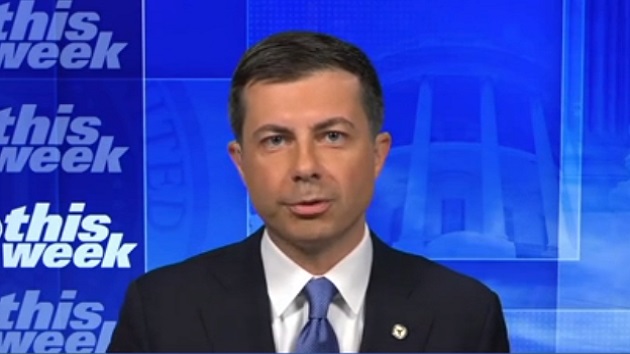
Recession is ‘possible but not inevitable,’ Buttigieg says as he touts supply chain focus

Recession is ‘possible but not inevitable,’ Buttigieg says as he touts supply chain focus
ABC News

(WASHINGTON) — With year-over-year inflation barely easing in the latest Consumer Price Index report despite sharp increases in interest rates meant to cool the economy, Transportation Secretary Pete Buttigieg said Sunday that a recession is “possible but not inevitable.”

Buttigieg was asked in an interview on ABC’s “This Week” if the threat of recession worried him.

“Look, it’s possible but not inevitable. … A part of why we do see a lot of pressure on prices is that while the demand has come back, Americans have more income because Americans have jobs in this almost historically low level of unemployment,” Buttigieg told anchor George Stephanopoulos, adding that it’s “been hard for the supply side to keep up.”

“That’s a big part of what we’re working on — on the infrastructure side — dealing with some of the bottlenecks we have, dealing with some of the constraints that we have in transportation infrastructure that’s needed to be upgraded for decades,” Buttigieg said, referring to a supply-chain crunch exacerbated by the COVID-19 pandemic.

President Joe Biden said last week that he believed an economic downturn was unlikely but conceded there could be a “very slight recession.” His comments came after Jamie Dimon, the CEO of the largest bank in the United States, JPMorgan Chase CEO, warned a recession is likely within six to nine months because of Russia’s war in Ukraine and historically high inflation and the rising interest rates to combat those prices.

The Federal Reserve has raised interest rates five times so far this year and is expected to again next month.

Stephanopoulos pressed Buttigieg on what more Biden could do about rising prices after the president said he would soon be announcing more steps to tackle inflation and, particularly, the cost of gas.

Buttigieg emphasized that he didn’t want to “get ahead of the president,” but he highlighted how Biden had ordered the release of fuel from the country’s strategic petroleum reserve and waived a requirement on ethanol blending for gas stations.

“This is part of a bigger focus that the president has sustained throughout this year on fighting inflation and creating more of that breathing room for American families,” Buttigieg said.

While gas prices have fallen sharply from a summer high — now averaging about $3.90, down from $5.02 in mid-June — they are 20 cents higher than they were just a month ago, according to AAA. Buttigieg laid some of the blame with oil companies, who have defended themselves from criticism of excessive profits.

The economic headwinds could cost Democrats their slim congressional majorities this November.

Stephanopoulos asked Buttigieg how the party should address high inflation with just 23 days until the midterm elections. Polls show it is a major factor in Biden’s low approval rating, with voters giving Republicans the advantage on handling the economy — and Republicans have, in turn, made the state of the economy central to their campaign messaging.

“Good policy is good politics. And we have been doing the right thing for the American people with proposals and achievements, legislatively, that are popular because they make sense,” Buttigieg said. He pointed to a bipartisan infrastructure funding bill that was signed in 2021, which has allowed for improvements to bridges, roads and airports across the country, as well as the recently enacted Infrastructure Reduction Act (IRA), which contains provisions aimed at lowering health care costs.

Buttigieg suggested that the November elections were important for making sure those policies continue: “It’s why we can’t turn back on the progress that’s been made, especially because we know there’s still a long way to go.”

He cited some conservative objections to allowing Medicare to negotiate prescription drug prices, which was a major part of the IRA. GOP lawmakers have said the negotiation power is a “price control” that will hamstring pharmaceutical development.

“It’s the wrong time to do anything that would increase costs for health care or anything else for the American people,” Buttigieg said.

Stephanopoulos asked whether Biden should spend more time highlighting the White House’s other 2021 successes, like the direct COVID relief payments and a temporary expansion of the child tax credit which expired at the end of last year.

Buttigieg said “we are proud of those accomplishments,” and then noted what he believed were others, such as a funding bill for domestic manufacturing, a veterans’ health care bill and Biden’s initial COVID-19 relief bill when the economy “was at risk of going into free-fall.”

“In some ways having achieved so much legislatively makes it hard to talk about all at once because there are just so many,” he said.

Copyright © 2022, ABC Audio. All rights reserved.

Trump testifying live before Jan. 6 committee would require ‘negotiation,’ Kinzinger says

Trump testifying live before Jan. 6 committee would require ‘negotiation,’ Kinzinger says
ABC News

(WASHINGTON) — The House Jan. 6 committee investigating last year’s Capitol riot would need to negotiate with former President Donald Trump if he were to offer to testify live in response to the panel’s subpoena, Rep. Adam Kinzinger said Sunday.

“I think that’s going to be a negotiation,” Kinzinger, R-Ill., a member of the committee, told ABC “This Week” anchor George Stephanopoulos. “I’ll only address that when we know for sure whether or not the president has tried to push to come in and talk to us live.”

“He’s made it clear he has nothing to hide, [that’s] what he said. So he should come in on the day we asked him to come in. If he pushes off beyond that, we’ll figure out what to do next,” Kinzinger said.

He dodged Stephanopoulos’ question on whether Trump should be held in criminal contempt if he does not comply with the subpoena.

“Do you believe that the Justice Department, if the president refuses, should hold him in criminal contempt?” Stephanopoulos asked.

“That’s a bridge we cross if we have to get there,” Kinzinger said, adding, “We’re at a bit of a time limit here. And as we’re wrapping up the investigation, we’re also pursuing new leads and facts.”

Trump has not yet said if he will comply with the committee subpoena but did send the panel a 14-page screed reiterating his election fraud conspiracies.

“We made a decision in front of the American people, not behind closed doors, to begin the process of subpoenaing the former president,” Kinzinger said on “This Week.” “He’s required by law to come in. And he can ramble and push back all he wants.”

Kinzinger’s comments come after the House panel on Thursday voted to subpoena Trump — a rare but not unheard of demand of a former president — as the committee enters the final months of its investigation into the deadly insurrection on Jan. 6, 2021.

Committee members have cast the subpoena as an effort to hear directly from Trump on what he did and did not do and what he did and did not know regarding Jan. 6.

Previous committee hearings have detailed how, according to Trump’s former aides and others, he knew there was no legal basis for his scheme to stay in power and was aware his claims of election fraud in 2020 were baseless but continued to push his supporters to march to the Capitol — even as he knew some of them were armed.

Trump has said the investigation is politically motivated and that he did nothing wrong.

The committee, which is not expected to continue into the next Congress, is in the process of formulating its final report, which will include legislative recommendations on how to stop another insurrection and ensure elections are certified at the state and federal levels.

On Sunday, Stephanopoulos pressed Kinzinger on if the committee will be making a criminal referral, which would be a notable recommendation but is not required to open a probe of Trump’s conduct. Kinzinger noted that the government is already investigating.

“It’s not a mandate, but I think … we’re certainly going to address that issue, and we’ll have more to come on that when we make that decision,” Kinzinger said.

“The Justice Department appears to be pursuing this pretty hard,” he said.

Asked about the “threat” from how widespread election denial has become in the Republican Party, despite the lack of evidence, Kinzinger, who is stepping down as a Republican lawmaker in January, said, “I don’t think this is just going to go away organically.”

The public had power to push back as well, he said: “This is going to take the American people really standing up and making the decision that truth matters.”

Copyright © 2022, ABC Audio. All rights reserved.
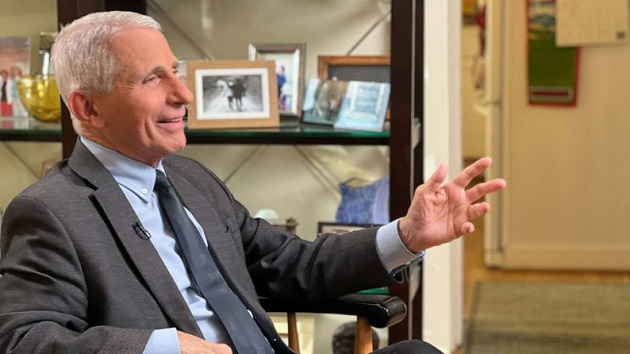
As Dr. Fauci prepares to exit, he reflects on his legacy and COVID decisions he would change

As Dr. Fauci prepares to exit, he reflects on his legacy and COVID decisions he would change
Lauren Lantry/ABC News

(WASHINGTON) — After 54 years at the National Institutes of Health and 38 years as the director of the National Institute of Allergy and Infectious Diseases, Dr. Anthony Fauci will be stepping down from public service at the end of the year.

“I have been driving onto that campus every single day, every single weekend for the last 54 years,” Fauci told ABC News’ chief Washington correspondent and “This Week” co-anchor Jonathan Karl in an interview that aired Sunday. “So I don’t even want to think about what it’s going to be like when I drive off the campus for the last time … That idea just gives me chills just thinking about that.”

In an intimate interview at his home, Fauci sat down with ABC News to talk about his tenure in public service, the COVID-19 pandemic during which he became perhaps the country’s most famous doctor and the controversies that have consumed the last two and a half years — and sometimes ensnared him.

Fauci has lived in the same home since 1977. Pictures hang next to the banister stairwell, dozens of framed photos sit atop a bookshelf and the floor is scuffed from years of use, the carpet worn down too. The mismatched red and brown chairs in the living room are cozy; on one sits an overstuffed pillow that has Fauci’s face on one side and, on the other, a quote reading “‘It is what it is.’ – Anthony S. Fauci, M.D.”

“You became an icon,” Karl told him. “It was kind of wild to see. There were Fauci bobbleheads. People had Fauci shirts that said ‘In Fauci We Trust.’ You became somebody the whole country was turning to. What was that like?”

“I was pretty well known among my peers in science, but certainly not to the extent it is now,” Fauci answered. “You know, I actually think both extremes, Jon, are aberrations of a reflection of the divisiveness in our country.”

As much as Fauci — who served under presidents of both parties as a nonpartisan health official — was respected by many amid the pandemic, he was lambasted and even despised by others. Conservatives on Capitol Hill have criticized his recommendations on COIVD, called for investigations into him, he’s received death threats and at a rally just days before the 2020 election, supporters of former President Donald Trump chanted “Fire Fauci! Fire Fauci!”

“When did it all get so political?” Karl asked.

“It got political very, very quickly,” Fauci responded. “Because we had the misfortune of an outbreak, and a double misfortune of an outbreak in a divided society, and the triple misfortune of a divided society in an election year. I mean, you couldn’t get more — getting the cards stacked against you, than right there. It was a triple whammy.”

Fauci said he has remained dedicated to his work, despite the threats of violence against him and his family.

“I look upon the country, in many respects, as my patient,” he went on to say. “And when you — if you’re a really good physician, you are concerned and worry about every element of your patient.”

“Including how your patient is going to react to something you said?” Karl asked.

“Exactly,” Fauci responded. “Exactly. And even if the patient is somebody who’s not the most attractive person in the world in the sense of personality, you still got to treat them the way you would treat anybody else. We learned that in medical school.”

While Fauci said he hasn’t communicated with Trump since Trump left office, he did praise the former administration on Operation Warp Speed, the program that developed the COVID-19 vaccines in record time.

“Just as he takes the blame for things in the administration, he should take the credit for things in the administration,” Fauci said. “That was a positive thing, Operation Warp Speed. And they should take credit for that.”

COVID-19 has killed more than a million Americans, a death toll higher than any war in which the U.S. has fought. And Fauci was one of the faces of the government’s response. For a time, he appeared nearly constantly at White House briefings and in the media to share the government’s latest, sometimes shifting, pandemic guidance.

“There were a lot of dark days, obviously a lot of deaths,” Karl said. “Was there a day that sticks out to you or a time period that sticks out to you as the darkest?”

“It wasn’t a day,” Fauci answered. “It was a period. I’ve trained a lot of Italian scientists in my lab in the arena of infectious diseases, many of whom went back to Italy and were in the epicenter of the northern Italy disaster there.”

“And when I got on the phone and heard them describe what was going on in the ward, where they were having people packed up in the hallways — who they had to decide who to give a ventilator to, or who to take care of,” Fauci later added. “I knew these people. So I knew what effect it would have on them. And then I said, ‘Whoa, we got a real problem here. We have a real, real problem.'”

For months, cities were locked down. Schools in many areas were closed even longer.

“Obviously, these are local decisions. But was it a mistake in so many states, in so many localities, to see schools closed as long as they were?” Karl asked.

“I think in some — I don’t want to use the word ‘mistake,’ Jon, because if I do, it gets taken out of the context that you’re asking me the question on,” Fauci said. “And I don’t want to do that because that’s just happened too many times over the last years with me.”

“Did we pay too high a price?” Karl pressed.

“Yeah, I would say that what we should realize, and have realized, that there will be deleterious collateral consequences when you do something like that,” Fauci answered.

“That’s the reason why I continually would say on any media appearances I’ve had: We’ve got to do everything we can to keep the schools open,” Fauci said. “The most important thing is to protect the children.”

As the evidence on how the virus changed, the medical advice changed, too. At the very beginning of the pandemic, Fauci told the public that there was no need to wear masks. But that guideline was soon reversed.

“If you are true to the data and the evidence, if something is evolving, means it isn’t the same as it was before and therefore the data are going to allow you to upgrade and update — whether it’s a recommendation, whether it’s a guideline, whether it’s the communication to the public,” Fauci explained.

“Would you take back what you said about masks?” Karl later asked.

“Yeah,” Fauci answered. “I mean, sure, if I had to do it over again. Of course. Again, if I tell you why we did it, it would be interpreted as making an excuse, and I don’t want to go there because that creates nothing but backlash. If I had to do it over again, I would have analyzed it a little bit better.”

Fauci has been the national leading expert on infectious diseases longer than many Americans have been alive. And for 38 years, he hasn’t even changed desks, telling Karl with a laugh that he “didn’t want to ruin taxpayers’ money.”

But as he reaches the final months of his tenure as a public servant, he reflected on how he wants to be remembered.

“I want to be remembered as someone who gave everything they had for the public health of the American public and indirectly for the rest of the world, because we’re such a leader in science and public health,” Fauci said. “I mean, I just want people to know that I gave it everything I had and didn’t leave anything on the field. I was all there.”
 

Copyright © 2022, ABC Audio. All rights reserved.
8 people shot near Virginia’s James Madison University: Police

8 people shot near Virginia’s James Madison University: Police
ABC News

(HARRISONBURG, Va.) — At least eight people were injured early Sunday near the campus of James Madison University in Harrisonburg, Virginia, when gunshots were fired into a crowd gathered outside an off-campus apartment complex, police said.

The gunfire broke out in a neighborhood southwest of the university, police said.

No arrests were announced as investigators were working to identify a suspect or suspects in the shooting, according to the Harrisonburg Police Department.

All of the victims suffered non-life-threatening gunshot wounds, according to police. Five of the victims were taken to nearby Sentara RMH Medical Center and three others were treated at the University of Virginia Medical Center, authorities said.

The victims ranged in age from 18 to 27. It was not immediately clear if any students from James Madison University were among those injured.

“The incident occurred at 2:20 a.m., when an unknown individual or individuals fired multiple times into a crowd at an outdoor gathering,” Harrisonburg police said in a statement.

No suspects were at the scene when officers arrived and began administering aid to those injured, police said.

While the circumstances of the shooting remain under investigation, police officials said it appeared to be an isolated incident and said, “there is not believed to be any threat to the greater community at this time.”

Police said anyone with information about the shooting can call the agency’s tip line at (540) 574-5050.

Copyright © 2022, ABC Audio. All rights reserved.

Despite ‘defunding’ claims, police funding has increased in many US cities

Despite ‘defunding’ claims, police funding has increased in many US cities
KABC

(LOS ANGELES) — In Los Angeles, the county sheriff says local residents are in danger because “defunding has consequences” — even though his agency’s budget is up more than $250 million since 2019.

Sheriff Alex Villanueva is not alone in suggesting to voters that crime is up because Democrats defunded police agencies after nationwide protests following the 2020 murder of George Floyd by a Minneapolis police officer.

Politicians, pundits and police leaders across the country are repeating the accusation as they address concerns about crime heading toward Election Day.

Yet in many communities, defunding never happened.

ABC Owned Television Stations examined the budgets of more than 100 cities and counties and found that 83% are spending at least 2% more on police in 2022 than in 2019.

Of the 109 budgets analyzed, only eight agencies cut police funds by more than 2%, while 91 agencies increased law enforcement funding by at least 2%.

In 49 cities or counties, police funding has increased by more than 10%.

An ‘outbreak of crime’

Despite what the public record shows, an analysis of broadcast transcripts shows that candidates, law enforcement leaders and television hosts discussed the impact of “defunding the police” more than 10,000 times over the last two years, according to the Internet Archive’s TV news transcripts dating back to June 2020 — and the mentions aren’t subsiding during this campaign season.

“In communities across the country, like in Los Angeles, San Francisco, New York, Chicago, so many other places, it is this remarkable, incredible, outbreak of crime,” Texas Gov. Greg Abbott said in a video posted on Twitter in August by the Republican Governors Association.

“You typically see where these crimes are taking place, there has been a de-emphasis of the role that law enforcement plays. It could be defunding law enforcement. It could be a reduction in law enforcement,” Abbott said.

Dr. Rashawn Ray, a sociologist and senior fellow at the Brookings Institution, told KABC in Los Angeles that this false narrative has persisted due to repetition by public officials.

“Overwhelmingly, cities, counties, police departments across the country are not being defunded in any way,” Ray said. “In fact, many of them have increased their budgets. Part of the reason why the ‘defund the police’ narrative has stayed around is because police officers say it and elected officials say it.”

ABC’s analysis of police budget data shows police spending has increased in some of the very cities frequently cited by conservative politicians and pundits as places where Democrats’ defunding has fueled violent crime waves.

The Los Angeles Police Department’s budget is up by 9.4% since 2019. San Francisco’s police budget is up by 4% and Philadelphia’s is up by 3%.

In Chicago, police spending is up 15%, representing almost a quarter billion dollars in new police spending since 2019.

In Houston, where the homicide rate nearly doubled in both 2020 and 2021 before starting to subside this year, local government officials have increased police spending by nearly 9% — almost $80 million — from 2019 to 2022.

President Joe Biden heralded this movement in his 2022 State of the Union address, saying, “The answer is not to defund the police. It’s to fund the police. Fund them!” — a line that drew bipartisan applause.

Perception versus reality

A few cities did try to reallocate police spending following concerns from advocacy groups in the wake of the George Floyd protests.

In Austin, Texas, leaders cut the police budget by about 30% in 2021, proposing to instead spend that money on programs like family violence prevention, mental health responders, and police oversight.

But that lasted only one year. The Texas legislature voted to bar cities in the state from decreasing police budgets, so Austin boosted police spending by 50% in 2022.

In Los Angeles County, where Sheriff Villanueva is engaged in a tight re-election battle, he’s been outspoken for months about the impacts of what he describes as the defunding of his agency, claiming that his budget is being “cannibalized.”

Yet records show his agency’s budget is up about 8% percent — more than $259 million — from 2019 to 2022.

“While the perception may be that defunding is taking place, in fact, the sheriff’s budget has increased,” County Supervisor Kathryn Barger said.

When asked by KABC about his defunding claims, Villanueva acknowledged that his budget is higher — but not enough to cover rising costs. He said that if day-to-day costs grow faster than his budget, that is “direct defunding, of course.”

Barger, in response, said that cost increases impact many county departments and are not unique to the sheriff’s department.

“He plays as though he’s being targeted,” Barger said of Villanueva. “And he’s not.”

In fact, Los Angeles County’s 2023 budget will increase the sheriff’s department budget by another quarter of a billion dollars.

An ‘impossible environment’

Some in law enforcement say that even more than budget cuts, what’s really hurt police departments is anti-police rhetoric.

Following Floyd’s murder in 2020, protesters in New York clashed with NYPD officers for days on end. Officers arrested hundreds of protesters each night, and the department says more than 300 officers were among those hurt.

Seeking accountability, some politicians called for $1 billion to be cut from the NYPD’s budget.

But the billion-dollar cut never happened. The NYPD’s budget fell by just 2.8%, dropping from $5.6 billion in 2019 to $5.4 billion in 2022.

Nevertheless, Police Benevolent Association President Patrick Lynch said the defund movement hurt officer morale.

“More than any budget cut, the greatest damage from the ‘Defund the Police’ movement was done by its anti-police, anti-public safety message,” Lynch told WABC in New York. “It has created an impossible environment on the streets, one where even the simplest interactions turn into a confrontation.”

The result was a massive NYPD exodus. Retirements in 2020 skyrocketed 72% from the previous year, and this year the NYPD lost more employees through the month of August than it had during that same time period in any previous year.

“As more cops quit, the workload becomes more crushing for those who remain,” Lynch said. “Public safety ultimately suffers.”

Being ‘all things to everybody’

Criminal justice experts say that even if the cuts were real, the premise that lower police spending leads to increased crime — or vice versa — is counter to decades of evidence, according to public data.

An ABC analysis of state and local police funding and overall violent crime data in the U.S. between 1985 and 2020 found no relationship between year-to-year police spending and crime rates. An analysis by the Washington Post found similar results from 1960 to 2018.

Further ABC analysis of Los Angeles County’s own crime data shows that, over the last decade, violent crime numbers haven’t moved up or down in relation to the amount of money spent on law enforcement or the number of officers on patrol.

Kimberly Dodson, a retired law enforcement officer who is now a criminologist at the University of Houston-Clear Lake, said that’s because police largely respond to crime instead of deter it.

“Crime happens. Somebody calls the police, and they come and take a report. Then they try to solve the crime after the fact,” Dodson told KTRK in Houston. “So saying that the police deter crime is not actually accurate, because they’re more of a reactive agency.”

Dodson said one reason police agencies feel stretched is because communities have been asking them to “be all things to everybody — and that doesn’t seem fair.”

For example, said Dodson, police these days are asked to respond to problems caused by longstanding mental health issues, family conflicts, or issues related to entrenched poverty that’s taken hold over decades.

“We always talked about, as police officers, we go out for 10 minutes and we fix something that’s been wrong and put a Band-Aid on it, something that’s been wrong for 10 years — and it’s just an impossible task,” said the former officer.

Changing that would mean changing the way emergency calls get handled, says Ray.

The Brookings Institution senior fellow is researching ways to narrow the mission of police so they only handle crime and safety, allowing government resources to be reallocated so problems not requiring police intervention could be handled by others.

“Are there better ways by which to think about calls for service, whether that be with mental health responses, whether that be with different sort of traffic officers handling those particular issues?” he said.

Such an arrangement could provide police even more time to focus on solving crimes and protecting people.

“It could actually free them up,” said Ray.

ABC’s John Kelly, Mark Nichols, Maia Rosenfeld, Lindsey Feingold, Nick Natario, Maggie Green, Lisa Bartley, Carlos Granda, Jared Kofsky and Tonya Simpson contributed to this report.

Copyright © 2022, ABC Audio. All rights reserved.

Suspected Stockton serial killer arrested, was on a ‘mission to kill’

Suspected Stockton serial killer arrested, was on a ‘mission to kill’
Stockton Police Department

(STOCKTON, Calif.) — A suspected serial killer in the California city of Stockton was arrested Saturday and police say they believe he was “out hunting” when he was nabbed.

“We are sure we stopped another killing,” Chief Stanley McFadden, of the Stockton Police Department, said at a news conference Saturday.

Wesley Brownlee, 43, was arrested in connection with six unprovoked murders of men ages 21 to 54 over the last few months. He was booked on a homicide charge Saturday.

Police said that surveillance teams followed Brownlee while he was driving, and stopped in area of Village Green Drive and Winslow Avenue around 2 a.m. Saturday morning.

“Our surveillance team followed this person while he was driving. We watched his patterns and determined early this morning; he was on a mission to kill. He was out hunting,” McFadden said.

McFadden added, “As officers made contact with him, he was wearing dark clothing and a mask around his neck. He was also armed with a firearm when he was taken into custody.”

Brown will be arraigned Tuesday and more charges are likely, police said.

The San Joaquin County’s Office of the Medical Examiner identified the victims. Paul Yaw, 35, was killed on July 8; Salvador Debudey Jr., 43, died on Aug. 11; Jonathan Hernandez Rodriguez, 21, was killed on Aug. 30; Juan Cruz, 52, was the Sept. 21 victim; and Lawrence Lopez Sr., 54, was slain on Sept. 27.

The men were alone at the time when they were fatally shot, officials said. All of the killings took place at night or in the early morning hours, police said.

Another shooting, of a 46-year-old Black woman at Park Street and Union Street in Stockton at 3:20 a.m. on April 16, 2021, was also linked to the investigation, police said earlier this month. The woman survived her injuries in that shooting, they said.

Police said that a motive is not known for the killings but it is believed to have been intentional.

ABC News’ Mark Osborne and Emily Shapiro contributed to this report.

Copyright © 2022, ABC Audio. All rights reserved.
How a 3rd-party candidate upended Oregon governor’s race and may just spoil Democrats’ streak

How a 3rd-party candidate upended Oregon governor’s race and may just spoil Democrats’ streak
ABC News

(PORTLAND, Ore.) — Oregon has had a Democratic governor for 35 years — but this year’s race could very well break that streak thanks to a potent cocktail of local and national issues but, mostly, because of a boisterous third-party candidate drawing double-digit support from voters.

With weeks left until Election Day, race observers and operatives call the contest a jump ball between Democrats and Republicans.

“I’m very concerned,” said Greg Peden, who worked as an aide to former Democratic Gov. John Kitzhaber. “I think this is the tightest race we’ve seen and the most complex race we’ve seen, and I don’t think anybody can really predict even now how exactly this ends up.”

Running to replace term-limited Gov. Kate Brown are former state House Speaker Tina Kotek, the Democratic nominee, and Republican rival Christine Drazan, a former state House minority leader.

But strategists of both parties say that the real twist behind the election’s tightness is the third-party candidacy of former state Sen. Betsy Johnson, who was a Democrat while in office and is now running as an independent.

She was a staunch moderate over her 20 years in the state House and Senate, a reputation that has followed her onto the campaign trail and could be helpful in a state with more non-affiliated voters than registered Democrats.

According to FiveThirtyEight’s polling average, Johnson is earning about 16% support, keeping both Drazan and Kotek in the mid- to high-30s. Kotek had been considered the favorite early in the cycle, given Oregon’s blue hue, but since late September it’s Drazan who has eked out a razor-thin lead.

While Democrats win in Oregon at the federal level with ease, the state has hosted several tight gubernatorial contests, with the past two being decided by about 6 and 7 points, respectively. Still, Republicans have not won the governorship since 1982 and President Joe Biden most recently took the Beaver State by 16 points just two years ago — resulting in Oregon being left out of the core of most prognosticators’ battleground maps this cycle.

In launching her third-party campaign last fall, Johnson acknowledged that “taking on the entrenched two parties will be difficult and expensive” but cast herself as “independent-minded, pro-choice [and] pro-jobs.”

Kotek and Drazan’s campaigns diverge on some priorities — Kotek’s focus includes abortion access and climate change while Drazan highlights resource management and public education — but both of them tout three of the same issues: the economy and the working class; housing and the homeless; and public safety.

Crime and housing have become major concerns in the state at the same time that many in Oregon and elsewhere are grappling with historically high inflation.

Pulling from Democratic and Republican platforms, Johnson has consistently voiced support for abortion access while lambasting crime and homelessness in Portland and describing herself as a “lifelong responsible gun owner and collector.”

Johnson’s campaign did not respond to requests for comment for this story but she told Fox News earlier this month that “people are frightened and they’re mad” and on education said, “Let’s not worry about pronouns. Let’s worry about mathematics.”

Johnson also brings significant personal wealth to the race and has received $3.75 million from Nike co-founder Phil Knight.

“Oh, absolutely,” Oregon Democratic strategist Jake Weigler said when asked if Kotek would have the advantage in a two-person race without Johnson. “It would probably be a more competitive race than the Democrats have had in the past … But I think it would be a completely different conversation.”

Johnson’s estimated appeal among disaffected voters unwilling to back Drazan also dovetails with another challenge for Kotek.

FiveThirtyEight reported earlier this month that Gov. Brown, who has served since 2015, is not widely popular, which some Democrats worry tarnishes the party brand — and Kotek by extension.

“The race is agonizingly tight because Betsy is taking more votes from Tina than from Christine. But it’s also in part because people equate Tina with Gov. Brown, who has a low approval rating. That is unfair because they are completely different people, with different styles of governing,” said one former Democratic state legislator.

Republicans are also bullish that Drazan will be able to go on offense on some policies, seizing on economic worries and the scars over the violence and social justice-related unrest in Portland — which have all taken place while Democrats have complete control in Salem.

Oregon had the seventh-highest homeless population in 2020, according to federal government data, and Portland has experienced an increase in crimes like murder and assault, according to the city’s police. Drazan has blanketed the airwaves with ads featuring tents lining Portland streets and broader questions about Oregonians’ satisfaction with the current state of affairs, all while staying away from thornier issues like her support for Donald Trump or abortion restrictions.

“Oregonians really feel like this just is not being addressed, and the state doesn’t want to be known for that. We don’t want people afraid to come to the state because they’re afraid of crime, but it’s a reality,” said Oregon GOP strategist Rebecca Tweed. She argued that “businesses are leaving, people are stopping visiting, regular day-to-day folks just don’t feel safe anymore. So it’s certainly a much bigger issue.”

Still, Kotek has hefty advantages

Chief among them is Democrats’ inherent edge in the state. Johnson appears to have hit a ceiling in voter surveys, and there are almost 300,000 more registered Democrats than Republicans. And Democrats have decades of institutional knowledge on how to win gubernatorial races.

“On the polling, it looks like a toss-up, but when you look at the advantage in terms of registration numbers and past history, even with close elections, I think that advantage still has to lie with Kotek,” said Pacific University political science professor Jim Moore. “That’s a big hill to climb for the Republicans.”

On policy, Kotek is hammering hard on abortion access, pressing Drazan to take a more definitive stance on how she’d approach the issue as governor. And Kotek is trying to tie her Republican opponent to the most radical flank of the GOP, highlighting Drazan’s expressed support for the entire ticket, which includes a Senate candidate who has talked approvingly about elements of the QAnon conspiracy theory.

That strategy is reflected in an advertising blitz, including in a clip comparing Drazan’s policies on abortion to remarks from Supreme Court justices who indicated during their confirmation hearings that they’d back Roe v. Wade before ultimately voting to overturn it.

“We have a very high-propensity voting population of women, they tend to be more progressive. We have more Democrats just in population alone. And if female Democrat voters show up to vote, it’ll be a very difficult campaign for Drazan,” Tweed, the Republican strategist, conceded. “If I’m Tina Kotek, I’m talking about that issue all day every day until the election’s over … and if I’m Drazan, I’m trying to lean away from it as much as I can.”

“We’re already seeing that shift,” Tweed added. “I think that’ll only increase from here on out.”

Kotek has also not shied away from crime and homelessness, releasing ads and a proposal to increase housing. Drazan, too, leads her platform with a plan for “the crisis in our streets” and to “restore community safety.”

Those dynamics are setting the stage for a combustible finish to the surprisingly tight race.

The Democratic Governors Association has invested about $5 million this cycle, while its Republican counterpart has invested $4.1 million, and each of the three candidates have fearsome war chests. In another sign of broader GOP interest in the race, Virginia Gov. Glenn Youngkin — who last year won in a blue state — is campaigning with Drazan in Aurora on Tuesday, and Knight switched camps from Johnson to give Drazan $1 million.

Biden is set to appear with Kotek on Saturday after attending a “grassroots volunteer event with the Oregon Democrats” on Friday, according to the White House.

Turnout is also anticipated to be high given that every active registered voter is mailed a ballot — starting on Wednesday — and ballots can then be dropped off as late as 8 p.m. local time on Election Day.

“We’re not going to know the outcome of this very close race until maybe Friday of that week or maybe even later,” said Greg Leo, the former executive director of the Oregon GOP. “It’s gonna be a very long couple of days after the polls close.”

Copyright © 2022, ABC Audio. All rights reserved.

‘Protect Black art’: How the indictment of Young Thug and Gunna sparked a movement

‘Protect Black art’: How the indictment of Young Thug and Gunna sparked a movement
Paras Griffin/Getty Images

(NEW YORK) — Rap lyrics have been used by prosecutors in the U.S. for decades as alleged evidence in criminal cases, helping put rappers behind bars. But it wasn’t until lyrics were used in the indictment of hip-hop stars Young Thug and Gunna on gang-related charges that the controversial practice sparked a movement in the music industry and fueled a wave of support for legislation seeking to limit the practice.

“I will protect Black art like it’s my family because it’s my family,” Kevin Liles, the former president of Def Jam Recordings, told “Nightline,” adding that to him, this is not just about the lyrics – “our culture is on trial.”

Liles is backing federal legislation that would limit the use of rap lyrics in court and is joined by the top power players in the music industry, including the Recording Academy, the Recording Industry Association of America, Universal Music Group, Sony Music Group, Warner Records, Atlantic Records, Warner Music Group and the Black Music Action Coalition.

“I’m proud that the Recording Academy … that many of my friends – rock friends, pop friends, country friends, alternative friends, and jazz friends have joined the movement of protecting Black art,” Liles said.

The music industry also backed a California bill that was signed into law by Gov. Gavin Newsom earlier this month that limits the use of rap lyrics as evidence in court. A bill banning the practice is being proposed in New Jersey and one that limits the practice stalled in the New York state assembly last year.

Hip-hop artist Fat Joe, who is advocating for such legislation, told “Nightline” that the practice is “unfortunate.”

Referencing lyrics from rapper Rakim, “we like to exaggerate, dream and imaginate,” the Grammy-winning New York rapper said. “This is all art, and to actually use something that was just made up and use it against you in a trial, it’s very dangerous.”

Hip-hop artist E-40 backed the legislation in his home state of California and spoke with Newsom about the importance of the bill.

“Just like people write books, we write lyrics and make music and songs,” he told “Nightline. “Music is our art…and the goal is to protect our heart and our creative expression.”

Attorney Areva Martin told “Nightline” that the growing movement could lead to change on the legislative front.

“As rappers become businessmen and as they become involved in social justice and social action movements, I think we are going to see some changes, at least in liberal states and liberal counties,” she said.

Referencing the lyrics of hip-hop artists in criminal charges – some of which mention acts of violence or criminal activity – is a practice that has drawn criticism from both freedom-of-speech advocates and the musicians themselves, who argue that introducing lyrics into case with the implication that they are reflections of reality, discounts rap as a form of artistic expression.

“Violence in music is nothing new. Whether it’s outlaw country music or rap music. But what I saw in my childhood is that rap was treated radically different,” said Atlanta hip-hop artist Killer Mike, who has been advocating against the practice for years.

According to Erik Nielson, the co-author of the 2019 book “Rap on Trial: Race, Lyrics, and Guilt in America,” rap lyrics used by prosecutors in court usually lack a factual connection to an alleged crime and are often used as a form of character evidence that could prejudice a jury and prevent a defendant from getting a fair trial.

“It’s absolutely racist,” Nielson said. “Rap music is the only art form that’s targeted this way.”

Nielson, who has served as an expert witness in close to 100 cases across the country in which rap lyrics were used as alleged evidence in court, has been advocating against the use of rap lyrics in court for years. He said that the indictment of Young Thug brought national attention to the controversial practice.

“This practice targets amateurs, up-and-coming artists who don’t have name recognition and who typically don’t have the resources to mount a vigorous defense,” Nielson said. “Young Thug is one of the most prominent artists to be caught in this web.”

Young Thug, whose legal name is Jeffrey Lamar Williams, was initially charged with one count of conspiring to violate the state’s Racketeer Influenced and Corrupt Organizations (RICO) Act and one count of participating in street gang activity, according to charging documents obtained by ABC News. He now also faces six additional drugs and weapons charges after law enforcement searched his home following his arrest.

“Mr. Williams has committed no violation of law, whatsoever. We will fight this case ethically, legally and zealously. Mr. Williams will be cleared,” Young Thug’s attorney Brian Steel told ABC News.

Meanwhile, Grammy-nominated rapper Gunna, whose real name is Sergio Kitchens, was charged with one count of conspiring to violate the RICO Act.

“Mr. Sergio Kitchens, known as Gunna, is innocent. The indictment falsely portrays his music as part of criminal conspiracy,” the rapper’s attorneys, Steve Sadow and Don Samuel, told ABC News.

Both rappers pleaded not guilty and were repeatedly denied bond.

Their trials were scheduled for January 2023, Fulton County District Attorney Fani Willis requested a 2-month delay.

Although the scope of the indictment, which names 28 individuals, goes far beyond the lyrics, the use of rappers’ lyrics as part of the alleged evidence is what has drawn pushback from the music industry.

“We gotta stop somewhere,” Liles said. “… that next kid that’s coming up on YouTube, that next kid that’s thinking about being creative, I’m fighting for them too.”

But Willis argued that Young Thug is the ringleader of the YSL gang and his lyrics are fair game.

The district attorney defended the use of lyrics as alleged evidence in the YSL indictment, saying in a May 10 press conference, “the First Amendment does not protect people from prosecutors using it as evidence.”

“We put it as overt within the RICO count because we believe that’s exactly what it is,” she added.

The DA’s office did not immediately reply to ABC News’ request for comment.

Copyright © 2022, ABC Audio. All rights reserved.

Offering abortion pills on campus could eliminate boundaries to access, students say

Offering abortion pills on campus could eliminate boundaries to access, students say
Peter Dazeley/Getty Images/STOCK

(NEW YORK) — Colleges and universities offering the abortion pill on campus could help reduce barriers to abortion care access, even in states that currently have protections for this care, students advocating for abortion rights say.

Students in California and New York told ABC News that increasing the points of access to care, such as requiring schools to provide medication abortions, would likely go a long way toward lightening the burden on clinics that are being overwhelmed with patients traveling from other states.

A 2019 law signed by California Gov. Gavin Newsom will require state colleges and universities to provide abortion pills on campus starting on Jan. 1. This summer, Massachusetts also enacted a law requiring public universities to submit a plan for providing medication abortions on campus by November 2023.

A similar bill is in the works in New York State. It would require that all student health centers on college and university campuses in the state offer medication abortion services free of charge.

The University of California, Berkeley, already offers medication abortions at its student health center for pregnancies up to 10 weeks. Recently, Barnard College, a women’s only school in New York, announced it would offer medication abortions starting in Fall 2023.

The decision at Barnard came after over two years of pressure from student groups on campus, led by a group called the Reproductive Justice Collective.

The RJC found a need for access to abortion pills on campus for three main reasons: overwhelmed New York abortion clinics; the high cost of abortion care; and long travel time to reach clinics off campus, Niharika Rao, a student at Barnard and activist with the RJC, told ABC News in an interview.

Rao said that clinics in New York are overwhelmed and have long wait times, with many patients coming from Pennsylvania and Ohio for care. Long wait times can often lead to patients needing more complicated and expensive abortion care.

Medication abortion is approved by the Food and Drug Administration for up to 10 weeks into pregnancy, but some studies have shown it is an effective method of abortion up to 11 weeks. 

The closest Planned Parenthood clinic to Barnard’s campus is a 40-minute train ride away, according to Rao.

Rao said many students hope that abortion services at Barnard will be subsidized by the university and be more affordable to students than care at clinics unaffiliated with the school.

“If students who are obviously going to Planned Parenthoods now are able to access this type of care on their campus, then we’re hoping that reduces the load on [New York’s] clinics. It also hopefully reduces the funding pressure on our abortion funds,” Rao said.

The RJC is also advocating for medication abortion to be available on campus for students at other New York schools including Columbia University, New York University and CUNY system schools.

Even in states like New York that protect abortion rights, “very real barriers to care and access still exist, despite the fact that abortion is very much legal. And if we want to be a sort of pro-choice, abortion friendly state, then we have to reconcile and deal with those barriers,” Rao said.

When campuses require that a student go off campus for care, that often means they miss school, miss assignments, have to pay for travel, have to miss jobs or internships, according to Tamara Marzouk, director of abortion access at Advocates for Youth, a non-profit that helps youth, including the RJC, organize around reproductive justice issues.

While California is a state that protects abortion rights, students told ABC News that similar barriers to abortion care exist there as well.

Abortion care being offered on campuses would especially make a difference for undergraduate students who may not have local providers they trust or a means of transportation to get them to off-campus services, MacKenna Rawlins, a graduate student at the University of California, San Diego, and the vice president of external affairs for the school’s Graduate and Professional Student Association, told ABC News.

That being said, Rawlins said she has not seen a lot of student activism surrounding abortion care on her campus after Roe fell, which she largely attributes to the perceived “safety net” of living in California, where there are protections for the right to abortion.

Lauren Adams, a student at the University of California, Berkeley, told ABC News that she feels supported by her university but also recognizes her responsibility to demand more protections and fight for women in other states where the right to abortion is being taken away.

Student in nearly 30 states staged protests earlier this month, demanding their universities step in and protect their reproductive rights, months after the U.S. Supreme Court ruled to overturn Roe v. Wade, ending federal protections for abortion rights.

Copyright © 2022, ABC Audio. All rights reserved.

Police find multiple human remains in Oklahoma river amid search for four missing men

Police find multiple human remains in Oklahoma river amid search for four missing men
Okmulgee Police Department/Facebook

(OKMULGEE, Okla.) — The Okmulgee Police Department recovered four male bodies from a river on Friday. The discovery came as police search for four close friends in Oklahoma after their mysterious disappearance last Sunday.

Mark Chastain, 32; Billy Chastain, 30; Mike Sparks, 32, and Alex Stevens, 29, were last seen leaving one of their homes in Okmulgee around 8 p.m. Sunday reportedly riding bicycles, according to the Okmulgee Police Department. Both of the Chastain men and Sparks were reported missing by one of their spouses during the overnight hours on Monday, police said. Stevens’ mother contacted authorities a few hours later also to report her son’s disappearance.

The bodies recovered from the river are being taken to the medical examiner’s office in Tulsa for autopsy.

No identifications were made at the scene and the medical examiner will have to make the official identifications, according to police.

In a press conference, Okmulgee Police Chief Joe Prentice said a passerby noticed suspicious items in the river near Sharp Road and reported it just before 2 p.m. on Friday.

Officers responded and discovered what appeared to be multiple human remains partially submerged in a river, he said.

The families of the missing men were notified of the discovery, but police were not able to make an identification at the scene.  

Both of the Chastain men and Sparks were reported missing by one of their spouses during the overnight hours on Monday, police said. Stevens’ mother contacted authorities a few hours later also to report her son’s disappearance.

The Okmulgee Police Department gathered video and additional GPS information and followed up on potential sightings on Thursday, but said they were unable to confirm any reported sightings of the men.

According to investigators, two of the men are believed to have cellphones with them, however, attempts to contact them go straight to voicemail.

Chastain’s cellphone was tracked to an area south of Okmulgee, but was turned off or lost power at some point. Officers checked the area, but found no sign of the men, police said.

Copyright © 2022, ABC Audio. All rights reserved.