How to watch the coronation of King Charles III and Queen Camilla in the US

How to watch the coronation of King Charles III and Queen Camilla in the US
Max Mumby/Indigo/Getty Images

(NEW YORK) — The invitations have been sent and rehearsals have been done for the coronation of King Charles III and his wife Queen Camilla.

Even without an invitation, and even if you’re not in the United Kingdom, you can still get an up-close view of the coronation, an event that last happened 70 years ago when Charles’ mother, the late Queen Elizabeth II, was crowned.

Charles and Camilla’s coronation will take place Saturday, May 6, at Westminster Abbey in London.

Cameras are allowed inside Westminster Abbey, so all of us at home will get a chance to see the biggest moments of the day, from the coronation service to a procession through London and Charles’ first wave as king from the balcony of Buckingham Palace.

Home viewers can also catch a glimpse of the special guests attending the coronation — including first lady Jill Biden — and all the best fashion.

How to watch the coronation in the US

ABC News and Good Morning America will have special TV coverage of the coronation on Saturday, May 6, from 5 to 10 a.m. ET.

The five hours of special coverage will also be available to stream on ABC News’ digital platforms, including ABCNews.com and GoodMorningAmerica.com, mobile apps, social platforms and over-the-top (OTT) services.

ABC News’ digital platforms will also re-air the coronation service throughout the day on May 6.

See the coronation day schedule below and get ready to watch history!

Coronation schedule of events

Buckingham Palace has yet to confirm timings for Charles’ coronation day so the below timings are estimated and scheduled to change.

Approximately 5:30 a.m. ET: Charles and Camilla depart Buckingham Palace and travel to Westminster Abbey in the Diamond Jubilee State Coach, which was created for Elizabeth in 2012. The procession will take Charles and Camilla down The Mall and around the east and south sides of Parliament Square to Broad Sanctuary and, finally, to the sanctuary of Westminster Abbey.

6 a.m. ET: The May 6 coronation service will begin at 11 a.m. local time, 6 a.m. ET, and is expected to last around 90 minutes. During the ceremony, Charles will sign an oath pledging to serve the people and will be crowned with the St. Edward’s Crown, marking the only time the king will ever wear that specific crown. Camilla will be crowned with the Queen Mary’s Crown. At the end of the service, Charles will exchange his crown for the Imperial State Crown, or Crown of State.

Approximately 7:30 a.m. ET: Charles and Camilla will depart Westminster Abbey in a procession back to Buckingham Palace. This procession, known as the Coronation Procession, will follow the same route as they took earlier in the day, but will be larger in scale and will include Armed Forces from the U.K. and across the Commonwealth.

Charles and Camilla will travel in this procession in the Gold State Coach, which has been used in every coronation since 1831. The coach was last used at the Platinum Jubilee for Elizabeth in 2022.

Approximately 8 a.m. ET: At the end of the procession, Charles and Camilla will receive a royal salute and three cheers from members of the Armed Forces. They will then appear on the balcony of Buckingham Palace, where they will give their first balcony waves to the public as king and queen.

The rest of the coronation weekend — which includes a bank holiday in the U.K. on Monday, May 8 — will include celebrations across the country.

Buckingham Palace is encouraging people to host Coronation Big Lunches to celebrate together throughout the weekend.

On Sunday night, a coronation concert featuring Katy Perry, Lionel Richie, Andrea Bocelli and others will be held on the grounds of Windsor Castle.

On Monday, the palace is encouraging people to volunteer in their communities.

Copyright © 2023, ABC Audio. All rights reserved.

Sharing deepfake pornography could soon be illegal in America

Sharing deepfake pornography could soon be illegal in America
Photo by Mike Kline (notkalvin)/Getty Images

(WASHINGTON) — A new piece of legislation being introduced this week would make sharing non-consensual AI-generated pornography illegal in the United States, and open up new legal avenues for those impacted.

“This bill aims to make sure there are both criminal penalties, as well as civil liability for anyone who posts, without someone’s consent, images of them appearing to be involved in pornography,” explained Congressman Joe Morelle who authored the Preventing Deepfakes of Intimate Images Act.

The rise of AI-generated content has exploded in recent years due to the accessibility and ease of use of tools that allow users to create hyper-realistic synthetic media.

Although a fabricated image of Pope Francis in a puffer jacket grabbed international headlines earlier this year, there’s a dark underbelly that doesn’t always make it into the public sphere — a large percentage of deepfakes are pornographic, non-consensual, and involve primarily women.

In 2019, synthetic media expert Henry Ajder and his colleagues set out to map out the state of deepfakes online. They found that 96% of the 14,000 deepfake videos found online were porn.

“If we fast forward to today, that number is infinitesimally small compared to the landscape as it is now,” Ajder told ABC News. “And that’s because these tools have become so much more accessible, awareness of these technologies has really grown. And so, I think we’re in a position now where we’re talking probably millions of women as victims.”

Deepfake pornography is often referred to as described by advocates as image-based sexual abuse — a term that also includes the creation and sharing of non-fabricated intimate images.

A few years back, a user needed to have a certain level of technical skills to create AI-generated content, but now it’s just a matter of downloading an app or clicking a few buttons.

Now experts say there’s an entire commercial industry that thrives on creating and sharing digitally created content of sexual abuse, including websites that have hundreds of thousands of paying members.

Dr. Mary Anne Franks, a law professor and president of the Cyber Civil Rights Initiative, a non-profit organization dedicated to combatting online abuse, explained that it’s hard to undo the harm once this content, real or fabricated, is shared publicly.

“It is not just the psychological harm, the intense depression, the anxiety, but also the economic consequences, because it can lead to further harassment online, online and offline harassment, requiring a lot of victims to invest in security systems or change the way that they go to work or go to school,” she added.

“My face has been digitally plastered countless times over other people’s naked bodies to create sex content I never consented to,” revealed Gibi, a popular YouTuber, in a video she posted in 2022.

“Porn of myself, I never created, has been viewed, distributed, and sold. It has been used to threaten and humiliate me in an attempt to grab power from myself. And my reality is not unique,” she added.

In a tearful video, a Twitch streamer who goes by QT Cinderella describes finding out how she became the subject of digitally created images of abuse and the toll it took on her.

“It should not be part of my job to have to pay money to have this stuff taken down, it should not be something that is found on the internet,” she said earlier this year.

Experts like Dr. Franks agree that the burden of seeking justice should not fall on the victim, but more should be done to deter perpetrators.

“Our emphasis at the Cyber Civil Rights Initiative has always been on trying to deter this behavior before it starts,” Franks told ABC News.“And that’s really hard to do unless you have a clear criminal prohibition that makes people worried that if they do this, they would face serious penalties.”

That’s exactly what Congressman Morelle hopes to achieve with his new legislation.

“This [bill] will signify to people who are posting this material, that it’s not going to be a free ride anymore, they’re not going to be able to be shielded from prosecution potentially. And they’re not going to be shielded from facing lawsuits,” he added.

Copyright © 2023, ABC Audio. All rights reserved.

Christina Applegate shares how MS has affected her life: ‘It’s never a good day’

Christina Applegate shares how MS has affected her life: ‘It’s never a good day’
Phillip Faraone/Getty Images

(NEW YORK) — Christina Applegate is opening up about how multiple sclerosis has taken a toll on her life.

The actress, who is known for her roles in Dead To Me, The Sweetest Thing and Anchorman, said having MS “f—ing sucks.”

“With the disease of MS, it’s never a good day,” she said in an interview with Vanity Fair. “You just have little s—– days.”

Applegate said that the simplest tasks can be “frightening” like getting in the shower.

“You can fall, you can slip, your legs can buckle,” she said. “Especially because I have a glass shower. It’s frightening to me to get in there. There are just certain things that people take for granted in their lives that I took for granted. Going down the stairs, carrying things — you can’t do that anymore.”

“Gravity can just pull you down and take everything down with you,” she added.

Applegate revealed on social media in 2021 that she was diagnosed with MS.

The disease affects the brain and spinal cord (or central nervous system), according to the National Institute of Neurological Disorders and Stroke .

The National Multiple Sclerosis Society says that women are more likely to have MS, but men can get it too.

Since MS makes patients susceptible to infections, according to the National Library of Medicine , Applegate says she doesn’t “want to be around a lot of people.” She said she also doesn’t want a lot of stimulation of the nervous system so she likes to “keep it as quiet and mellow as possible.”

“It’s exhausting,” she said. “Imagine just being in a crowd of people and how loud that is. It’s like 5,000 times louder for anyone who has lesions on their brains.”

Applegate said she found out while filming the final season of Dead To Me. She told Vanity Fair that the show may be her last time acting on camera.

While she remembers how taxing it was to film during that time and feels relieved that she “no longer has to push so hard to get through my day,” she said she misses her co-stars the most, including Linda Cardellini , who plays Judy Hale in the series.

“Linda and I, from day one, were in love with each other and trusted each other and supported each other,” Applegate said. “I’m probably not going to work on-camera again, but I’m so glad that I went out with someone who is by far the greatest actress I’ve ever worked with in my entire life, if not the greatest human I’ve ever known.”

Copyright © 2023, ABC Audio. All rights reserved.

Anti-monarchists to protest King Charles III’s coronation despite controversial new law

Anti-monarchists to protest King Charles III’s coronation despite controversial new law
Max Mumby/Indigo/Getty Images

(LONDON) — Anti-monarchists are expected to stage large-scale protests in London on Saturday during the coronation of Britain’s King Charles III, despite warnings from authorities and a controversial new law.

Charles and his wife, Queen Consort Camilla, will be coronated side-by-side at Westminster Abbey. The new sovereign and consort will travel from Buckingham Palace to Westminster Abbey in the diamond jubilee state coach as part of the “king’s procession” before returning to the palace in the gold state coach after their crowning as part of the “coronation procession.” London’s Metropolitan Police Service said it will have more than 11,500 officers on duty that day, making it “one of the most significant and largest security operations” that the agency has led.

“Our tolerance for any disruption, whether through protest or otherwise, will be low,” the police force said in a statement on Wednesday. “We will deal robustly with anyone intent on undermining this celebration.”

More than a thousand people will be protesting in Trafalgar Square as the royal processions pass by, according to Republic, a London-based campaign group advocating to replace the British monarchy with an elected head of state.

“We have had two meetings with the Met police and numerous phone conversations. They have repeatedly said they have no concerns about Republic’s plans,” the group’s CEO, Graham Smith, said in a statement on Wednesday. “It is a mystery why the Home Office thought it was necessary to send us an anonymous letter that could be interpreted as intimidation.”

Republic shared a link on its website to the letter in question, which was dated April 27. In the letter, the U.K. Home Office’s Police Powers Unit details new criminal offenses that will be rushed into law to prevent disruption.

“I would be grateful if you could publicise and forward this letter to your members who are likely to be affected by these legislative changes,” the letter stated, in part.

The changes are part of the so-called Public Order Bill, which came into effect on Wednesday after passing through U.K. Parliament and receiving royal assent from Charles. Under the new law, protesters who interfere with “key national infrastructure,” such as blocking roads and railways, could face 12 months behind bars, an unlimited fine or both; anyone “locking on” or physically attaching themselves to other people, objects or buildings to cause “serious disruption” could face 6 months behind bars, an unlimited fine or both; and police will be empowered to stop and search protesters suspected of having intent to commit an offense.

United Nations High Commissioner for Human Rights Volker Turk has urged the U.K. government to reverse the “deeply troubling” legislation.

“This new law imposes serious and undue restrictions on these rights that are neither necessary nor proportionate to achieve a legitimate purpose as defined under international law,” Turk said in a statement on April 27. “This law is wholly unnecessary as U.K. police already have the powers to act against violent and disruptive demonstrations.”

Republic, however, “will not be deterred” and will protest in Trafalgar Square and along the procession route on Saturday as planned, according to Smith. Protesters will likely be holding yellow placards with the words “Not My King,” as they have done at previous demonstrations organized by Republic.

“It is telling that Charles, who has had no problem speaking up on various issues, has chosen not to defend democratic rights when they are being threatened in his name,” Smith added. “Perhaps he might make it clear that he believes in the right to protest.”

The anti-monarchy protest movement has gained fresh momentum in Britain since Queen Elizabeth II’s death and Charles’ ascension. Republic has garnered more support, both financially and in recruits to its cause, according to Smith.

“Charles has not inherited the respect and deference and sycophancy that the queen enjoyed,” Smith told ABC News during an interview in March. “And it’s a very different environment in which to campaign now.”

A new survey conducted by London-based polling company YouGov found that overall support for retaining the British monarchy remains relatively high — at 62% as of April. But that figure is significantly down from previous levels — YouGov tracker data found backing for the crown as high as 75% in 2012 and 2013.

Moreover, the latest survey shows the younger generation is losing interest, with only 36% of 18- to 24-year-old Britons saying they want to keep the monarchy as of April. That’s compared to 2013 when as many as 72% of 18- to 24-year-olds wanted to keep the institution, according to YouGov.

ABC News’ Guy Davies and Zoe Magee contributed to this report.

Copyright © 2023, ABC Audio. All rights reserved.

Blame breaks evenly if government defaults on debt, despite preference for Biden’s position: POLL

Blame breaks evenly if government defaults on debt, despite preference for Biden’s position: POLL
ABC News

(WASHINGTON) — Americans divide closely on whom they’d blame if the federal government defaults on its debts, even as most align with the Biden administration’s position on how Congress should handle the issue.

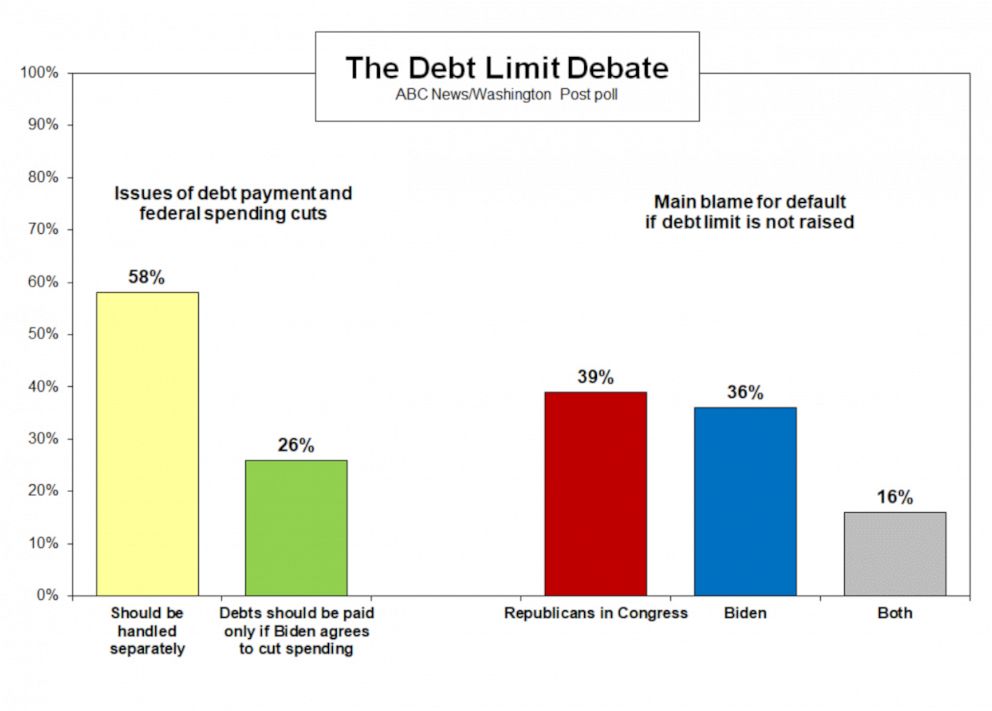
If default occurs — as Treasury Secretary Janet Yellen said Monday could happen by June 1 — 39% in this ABC News/Washington Post poll say they’d mainly blame the Republicans in Congress, while virtually as many, 36%, say they’d mainly blame Biden. Sixteen percent volunteer that they’d blame both equally.

That looks like a messaging snafu on President Joe Biden’s part, since many more people take his side than the Republican position on the issue. Fifty-eight percent say debt payment and federal spending cuts should be handled separately, as Biden has argued. Far fewer, 26%, take the GOP view that Congress should let government pay its debts only if the administration agrees to spending cuts.

Support for Biden’s position on the debt ceiling has lost 7 percentage points since February, dropping from 65% to 58% in this poll, produced for ABC by Langer Research Associates. However, the share who favor linking the debt ceiling with spending cuts has not grown; instead, more now are undecided.

Groups

While there are wide partisan differences in these views, it’s notable that 46% of Republicans part company with the party’s leadership in Washington and say the issues should be kept separate; 40% of Republicans instead favor linking them. Preference to keep debt payments and federal spending cuts as separate issues reaches 58% among independents and 74% among Democrats. (Both are down from the levels last month, when the question was preceded by one on concern about a default.)

In ideological terms, 75% of liberals and 61% of moderates prefer keeping the issues separate — as do 56% of people who describe themselves as somewhat conservative. This flips among those who are very conservative. In this group, just 36% favor separation, while 52% say the government should be allowed to pay its debt only if spending cuts are included.

Who’d actually take the blame in a default depends on the eventual circumstances. But as things stand, views are highly partisan. Among Republicans, 78% would mainly blame Biden. Among Democrats, 78% would mainly blame the Republicans in Congress. And independents divide three ways, but with a slight tilt in Biden’s favor: Thirty-seven percent say they’d mainly blame the GOP; 29%, mainly Biden; and 24%, both equally.

Methodology

This ABC News/Washington Post poll was conducted by landline and cellular telephone April 28 to May 3, 2023, in English and Spanish, among a random national sample of 1,006 adults. Partisan divisions are 26-25-41%, Democrats-Republicans-independents. Results have a margin of sampling error of 3.5 percentage points, including the design effect. Sampling error is not the only source of differences in polls.

The survey was produced for ABC News by Langer Research Associates, with sampling and data collection by Abt Associates of Rockville, Maryland. See details on the survey’s methodology here.

Copyright © 2023, ABC Audio. All rights reserved.

Is PacWest Bank on the brink of collapse? Experts weigh in after shares plummet 50%

Is PacWest Bank on the brink of collapse? Experts weigh in after shares plummet 50%
Morgan Lieberman/Bloomberg via Getty Images

(LOS ANGELES) — Shares of PacWest Bancorp plunged more than 50% in early trading on Thursday, marking the latest spasm of financial distress after three of the nation’s 30-largest banks fell within a matter of weeks.

In all, PacWest stock has fallen more than 85% this year, erasing hundreds of millions of dollars in value.

The Los Angeles-based midsized lender is exploring “all options” as it weighs offers from potential investors as well as the sale of a $2.7 billion loan portfolio, PacWest said in a statement on Wednesday.

However, the company rejected concern about a sudden run on deposits, saying it has “not experienced out-of-the-ordinary deposit flows” since the seizure and sale of First Republic on Monday.

Deposits, PacWest said last month, increased nearly 4% over an 11-day period in late March, even after the collapse of Silicon Valley Bank had set off financial uncertainty.

As the Fed aggressively hiked interest rates over the past year, the value of long-term Treasury and mortgage bonds dropped, punching a hole in the balance sheets at some regional banks.

The failure of Silicon Valley Bank in March sent shockwaves through the financial system that days later helped bring down New York City-based Signature Bank. On Monday, First Republic fell under government control before a sale to JPMorgan Chase.

While high interest rates contributed to the collapses, each of the banks also retained a sizable portion of uninsured depositors, who tend to panic without a government backstop for their funds.

PacWest appears to fit the mold, since its balance sheet carries securities vulnerable to high interest rates and a share of its deposits are uninsured, Greg Nini, a finance professor at Drexel University, told ABC News.

“The important ingredients are those fundamentals,” he said. “It sure sounds like collapse is possible.”

PacWest has not responded to ABC News’ request for comment.

The distress at First Republic earlier this week delivered some “knock-on effects” that further destabilized the bank, Nini added.

Addressing concern about deposits that lack government protection, PacWest said on Wednesday that insured deposits make up 75% of its holdings, which marks a sharp increase from the end of last year, when just 48% of its deposits were insured.

Despite rising fear about the fate of PacWest, the significant portion of guaranteed deposits should prevent the bank from sliding into failure, Julian Vogel, a finance professor at San Jose State University, told ABC News.

“I really don’t think it should be on the brink. Those people’s money is absolutely safe,” Vogel said. “Even if the company goes down, they will get their money, period.”

“While I understand that the drop in stock price can be fear-inducing, it’s not necessarily related to the overall performance of the company on a day-to-day basis.”

Stock prices at other regional banks dropped in early trading on Thursday, suggesting that the financial fallout was not limited to PacWest. Phoenix-based Western Alliance Bancorp shares plummeted about 32%; while Salt Lake City-based Zions Bancorp fell 8%.

Since the banking trouble has been largely concentrated at regional lenders located in the Southwest, depositors could be spreading concern through word of mouth, Vogel said.

“They’re all in the same region, which means that the people that have money in PacWest likely know their neighbor or friend or somebody from the gym that has money with banks affected by First Republic or Silicon Valley Bank,” he said.

The outcome at PacWest marks a “very pivotal” moment for the financial system, Vogel said.

“This is the first time that we’re seeing a bank that really shouldn’t have anything to worry about,” Vogel said. “It’s a solid company. Depositors are mostly insured.”

“If consumers keep panicking,” he added. “Then this could be the start of a new phase and there will be a lot more ahead.”

Copyright © 2023, ABC Audio. All rights reserved.

‘A steady deterioration’: US communities face a public housing crisis

‘A steady deterioration’: US communities face a public housing crisis
Jared Kofsky/ABC News

(NEW YORK) — In Platte County, Missouri, the signs of growth are on almost every corner, with new apartment buildings and shopping centers becoming a common sight. Yet signs for affordable housing remain few and far between.

“There’s still this perception that Platte County is a rich community and that there’s no poverty in Platte County, which couldn’t be further from the truth,” said Becky Poitras of the Metro Lutheran Ministry.

Over the last decade, typical rents in Platte have risen 30 percent, pricing out residents whose income hasn’t kept up, according to an ABC News analysis of U.S. Census Bureau data.

As rents have risen, so too have wait times for subsidized housing: County residents placed in public housing in 2012 had waited two years on average. Last year, residents receiving housing had waited nearly twice as long.

“There are waiting lists that are so long that people don’t bother applying, and then sometimes, the waiting lists aren’t even open,” said Maggie Thomas, a colleague of Poitras.

An ABC News and ABC Owned Television Stations investigation found that dozens of counties around the country have even longer subsidized housing wait times than those in Platte.

“Today what we’re seeing is a housing crisis unlike one that we’ve seen since the mid-20th century,” said San Diego State University Assistant Professor Valerie Stahl.

As public housing becomes increasingly difficult to access, especially in areas with growing population and rising cost of living, many of those who are struggling to afford a home question how we got here.

“It’s ridiculous that the waitlist and the waiting time is this long,” said Brenell Whitfield, who has been waiting for housing in California for over a decade.

American public housing dates back to 1937, when Congress created local housing authorities to build public housing for millions of people who were struggling after the Great Depression.

In the subsequent decades, large public housing projects were constructed nationwide. But without sufficient investment, many fell into disrepair, amassing a capital needs backlog now estimated at around $70 billion, according to the National Low Income Housing Coalition.

“We’ve seen a steady deterioration of the quality of public housing since the ’80s and ’90s,” said New York University Associate Professor Jacob Faber.

The U.S. hasn’t built any large-scale public housing since the 1970s when then-President Richard Nixon put a moratorium on its construction, Faber said, preventing expansion to keep up with population growth in counties like Platte.

In the 1980s, amid negative perceptions of neglected public housing buildings and their residents, federal and local governments turned to the private market to address its public housing problem.

Instead of investing in its existing housing portfolio, the federal government launched Section 8, which aimed to deconcentrate poverty by providing vouchers for people in need of housing to use on the private real estate rental market.

“This approach reproduced the same concentrated poverty and inequalities, as discrimination in the private market led to housing segregation,” said Assistant Professor of Sociology at the University of Toronto Prentiss Dantzler, who has spent the last decade studying affordable housing in the U.S. and Canada.

“We can’t just leave it up to private market actors to solve these issues,” Dantzler said. “The government has a place in that.”

The U.S. government also tried to address its decaying housing stock through the private market, implementing the Hope VI program to give grants to developers to demolish and revitalize public housing. Thousands of units were torn down nationwide, but only about half were replaced, and many of the replacement units were unaffordable to displaced tenants, according to Prentiss Dantzler.

“A lot of the housing stock that was targeted were predominantly Black public housing residents,” Dantzler said, adding that many of these residents “were just pushed out of public housing altogether.”

In 1999, the Faircloth Amendment solidified the federal government’s shift away from public housing, halting new public housing construction and capping units at their existing levels. This legislation is still in effect today, despite recent efforts to repeal it.

“It’s an enormous problem,” Faber said, noting that tens of millions of Americans meet income eligibility requirements for housing assistance. “We simply don’t have the units.”

While most counties nationwide are at or near limits of federally funded public housing allowed under the Faircloth Amendment – with fewer units than they had 24 years ago – due to a lack of resources and a political move away from traditional public housing.

“We’ve seen this really big shift in public housing priorities towards this voucher-based system,” Faber said. Even still, he added the government is “severely underfunding” both public housing and Section 8 vouchers program.

Alantis Perkins spent over seven years on the Quincy, Mass. Section 8 waitlist. Once he finally got his voucher, he struggled to find an affordable unit that fit program guidelines in the three-month timeframe he was given to find housing.

“It was nerve-racking,” Perkins said.

Just before the deadline, Perkins was able to move into an apartment, but he now worries his rent may increase beyond the limit allowed by his voucher.

As the rental market tightens, it becomes more difficult for voucher holders like Perkins to find a place to live.

Faber and Stahl pointed to a lack of federal action to increase support for public housing and vouchers.

Under the current system for both public housing and Section 8, the U.S. Department of Housing and Urban Development provides grants to local housing authorities, but with long or closed waitlists at existing authorities and no new housing authorities being created, the volume of people seeking housing overwhelms the capacity to house them.

HUD declined multiple interview requests from ABC News, but released a statement calling for increased rental assistance funds from Congress.

Poitras said that in places like Platte County, thousands more affordable housing units are needed as growth continues. Of Missouri’s 95 housing authorities, 84 are already at their Faircloth limits or have room for few additional units, all while homelessness remains a concern.

“If we don’t do something as a community to make change, we’re going to continue to have rising homelessness,” Poitras said.

Platte County Presiding Commissioner Scott Fricker acknowledged that the county’s growth has priced out residents, but he disagreed that more public housing is the solution.

“I don’t think government does a good job of owning housing and a lot of private owners don’t do a very good job either, but you can definitely use government subsidies in private development to create affordable housing,” Fricker said.

But relying on the private market to meet low-income Americans’ housing needs becomes tricky when the rental market is hot, some experts say.

“Public housing and Section 8 vouchers are a stable, affordable form of housing, and unfortunately, the private market is not providing that type of stability or affordability right now,” Stahl said.

Copyright © 2023, ABC Audio. All rights reserved.

Public health leaders warn dwindling COVID data risks less preparation for ‘the next outbreak’

Public health leaders warn dwindling COVID data risks less preparation for ‘the next outbreak’
TAMI CHAPPELL/AFP via Getty Images

(NEW YORK) — While COVID-19 ebbs — and many of the pandemic-era policies on surveillance data and funding wind down with it — the nation’s public health leaders warned senators on Thursday that a return to “normal” should not mean forgetting the hard lessons learned over the last three years.

When the federal government’s public health emergency expires next week, COVID-19 data collection tools will also end. Those tools have been described as vital to staying vigilant and preparing for emerging health threats.

“Infectious disease threats have been emerging at an increased pace and are increasingly complex,” Centers for Disease Control and Prevention Director Rochelle Walensky told the Senate Health, Education, Labor, and Pensions (HELP) Committee. “These diseases don’t respect national or state borders, and the increased frequency of outbreaks means that we should not be asking if we will face another serious public health threat — but when.”

Though “for many life has turned to normal after three years of COVID-19,” Walensky said it’s the mission of public health to “remain response-ready to protect Americans from any resolving or emerging health threat,” which can only be done by “actively supporting the core capabilities of public health.”

Thursday’s hearing was part of the process to reauthorize the Pandemic and All-Hazards Preparedness Act, which was first signed into law in 2006 and has been regularly reauthorized since then.

“The approaching end of the public health emergency once again reminds us that policy changes and funding are essential to the readiness of future bio-threats. The CDC will continue to closely monitor COVID-19 and provide the information to which we have access,” Walensky said.

She and other panelists emphasized that caveat: The limited access to data that comes along with a return to “normal” threatens to kneecap future surveillance efforts.

“We will adapt to limitations and utilize tried-and-true systems to monitor other respiratory diseases, to keep our eye on COVID-19,” Walensky said, “but there are data we will no longer have available because they will no longer be submitted to us. For example, certain data for a national picture of health disparities both for race and ethnicity and along urban and rural lines.”

“We will make do,” the CDC director said. “However this should worry us all, primarily because of what it says about the visibility we will have into the next outbreak. We will be back to square one — having to build and negotiate surveillance capacity while we fight a pathogen.”

Dawn O’Connell, the U.S. Department of Health and Human Services’ assistant secretary for preparedness and response, said that the U.S. actually was more prepared for COVID-19 than it would’ve been for other types of pandemics because of two prior respiratory outbreaks.

Neglecting to further that work would put the country at a big risk, O’Connell said.

“This is one of my biggest worries, is that we are losing time in preparing for the next pandemic,” she said. “I know it doesn’t feel like it, but the one place we were lucky when it came to the coronavirus is we had already done a lot of the early work on that because of SARS and MERS. We need to get the same head start.”

That’s something some senators looked to explicate in their line of questioning, with Sen. Bernie Sanders, I-Vt., interjecting: “Are you telling us that we have not done the kind of work you would like to see done in preparation for what might be coming?”

“Correct,” O’Connell said.

Another tragedy briefly cast a shadow over Thursday’s hearing, as Walensky opened her remarks by noting that one of the CDC’s employees was killed Wednesday in a mass shooting in Atlanta.

Amy St. Pierre “was a valued member of our team at the Division of Reproductive Health where she worked every day to save the lives of mothers and infants,” Walensky said.

Copyright © 2023, ABC Audio. All rights reserved.

Trump seeks to move hush-money case to federal court because he was president during alleged crime

Trump seeks to move hush-money case to federal court because he was president during alleged crime
Andy Buchanan/AFP via Getty Images

(NEW YORK) — Former President Donald Trump on Thursday sought to move his New York City criminal case to federal court since, his lawyers said, “the indictment charges [him] for conduct committed while he was President of the United States that was within the ‘color of his office.'”

Trump has pleaded not guilty to a 34-count indictment charging him with falsifying business records in connection with hush money paid to adult film actress Stormy Daniels before the 2016 presidential election.

Trump’s then-personal attorney Michael Cohen wrote the check and Trump reimbursed him with a series of monthly payments.

“This case is unprecedented in our nation’s history. Never before has a local elected prosecutor criminally prosecuted a defendant either for conduct that occurred entirely while the defendant was the sitting President of the United States or for conduct that related to federal campaign contribution laws,” Trump’s defense attorney Susan Necheles wrote in the motion.

Trump’s filing called the indictment “politically motivated” — brought because Manhattan District Attorney Alvin Bragg “disfavored President’s Trump’s acts and policies as President of the United States.”

Necheles argued federal courts have so-called “protective jurisdiction” over this case.

Trump himself has maintained prosecutors have “no case” and wrote on social media last month, “There was nothing done illegally!”

Defense attorney Todd Blanche informed Judge Juan Merchan, who is presiding over the case in New York state Supreme Court, about Trump’s intention at the conclusion of a hearing earlier Thursday related to a protective order in the case.

Prosecutors did not immediately address it. A spokeswoman for Bragg said later Thursday that “we are reviewing the notice of removal and will file an appropriate response in court.”

Merchan asked in court that both sides agree to a trial date in either February or March 2024, putting Trump’s trial in the middle of primary season as he seeks the presidency for a third time.

Once the date is set, the judge said no one associated with the case, including Trump, should schedule anything to interfere.

“He cannot agree to any speaking engagements, appearances,” Merchan said.

Merchan agreed to a request from the Manhattan district attorney’s office for an order meant to prevent Trump from attacking certain individuals associated with the case or speaking about specific evidence obtained through discovery. But he said he would not stop Trump from speaking generally about the case on the campaign trail.

“I’m straining to give him every opportunity to make his candidacy,” Merchan said. “This is not a gag order.”

Merchan also agreed with the district attorney’s office to set up a virtual hearing Trump will be required to attend at which the protective order will be read to him.

Assistant District Attorney Catherine McCaw said in court that Trump “has an extensive history” of making inflammatory remarks about witnesses, prosecutors and others associated with legal matters pending against him. However, she said, Trump will continue to have “many avenues” to discuss the case.

Blanche said he did not object to an order “limiting dissemination” of evidence by Trump on social media but he insisted Trump’s public defense “may include commentary on evidence.”

“Obviously Mr. Trump is different,” Merchan conceded. “It would be foolish of me to say he isn’t. He’s a former president and he’s running again.”

The judge added that Trump’s special status comes with a responsibility to recognize “his words do have consequences.”

Copyright © 2023, ABC Audio. All rights reserved.

FDA considers whether a birth control pill could be sold over the counter

FDA considers whether a birth control pill could be sold over the counter
Courtesy of Angela Maske

(WASHINGTON) — Angela Maske was a college freshman in Washington, D.C., when she first had trouble getting a prescription for birth control pills.

Her Catholic-affiliated university wouldn’t prescribe the medication to students as a sexual contraceptive, so Maske spent three months looking for another doctor’s appointment.

More recently, her telehealth provider stopped servicing her area, sending Maske scrambling to find another provider and a new prescription on short notice while juggling a full-time job.

Maske now works with Free the Pill, a coalition of advocates that’s spent years dedicated entirely to increasing public access to contraception — a goal they say is critical to people already struggling to access health care, find time off work or arrange for child care to make a doctor’s appointment.

“It’s just frustrating because (getting a prescription) feels like yet another barrier that people have to go through to access essential care to control their reproductive and sexual autonomy,” said Maske.

The Food and Drug Administration is on the cusp of deciding whether at least one type of hormonal birth control — a progestin-only drug called “Opill” by French drugmaker HRA Pharma — is safe enough to be sold over the counter without a prescription and without age restrictions.

First approved by the FDA in 1973, Opill is type of hormonal birth control pill known as the “minipill,” which poses fewer risks than combination pills that rely on estrogen. Still, buyers would have to screen themselves for any health risk factors, much as they would other over-the-counter medications.

FDA’s panel of scientific advisers are expected to meet next week to discuss the application, and if the agency signs off the drug in coming weeks, the product could be on shelves this summer.

“It is just super exciting that we’ve gotten here at this moment. It’s really historic,” said Kelly Blanchard, president of Ibis Reproductive Health, an advocacy organization that has long called for over-the-counter birth control pills.

Blanchard said she hopes other types of birth control pills will follow suit and that states embrace laws requiring insurance companies to cover the costs. Currently, federal law requires free contraception “as prescribed” by a health care provider, although some states have pushed their own mandates for insurance to cover over-the-counter options as well.

The question over increased access to birth control comes amid a heated national debate on women’s reproductive rights with the overruling of Roe vs. Wade, which guaranteed a constitutional right to abortion. At least 15 states have barred nearly all abortions so far.

This week, New York Democratic Gov. Kathy Hochul signed a law that authorizes pharmacists to dispense hormonal birth control. Patients there can now rely on a single long-standing order from a doctor, rather than having to return for an updated prescription; if the person does not have a health care provider, the pharmacist could dispense the drug anyway with instructions to consult a doctor.

The vast majority of Americans back widespread access to birth control. Two-thirds of adult women under 50 say they are using some form of contraception, with a third of those relying on birth control pills, according to a 2022 KFF (Kaiser Family Foundation) survey.

Most patients also believe they can screen themselves for risk factors when it comes to hormonal birth control. According to KFF, an estimated 77% of women under 50 say they want birth control pills available without a doctor’s prescription if research shows it’s safe and effective.

One concern is that patients will forgo routine examinations if doctors can be cut out of the process. Still, HRA Pharma’s federal application for Opill solicited significant support from the medical community, anti-poverty organizations and reproductive-rights advocates that say increasing access to family planning will benefit millions of people, particularly those in rural areas and people of color who struggle to access any health care.

The American Medical Association, for example, told the FDA that decades of data shows the benefits of “widespread, nonprescription availability far outweigh the limited risk associated with their use.”

In a separate filing, the American College of Obstetricians and Gynecologists said a patient doesn’t need to be examined or tested before taking the drug and that the birth control pill was overwhelmingly safe for most people to take on their own. And while routine exams are critical to a person’s overall health, the group says that shouldn’t be a reason to make birth control harder to access.

Opponents of the move cited medical risk and teen access as a reason to limit access.

“Even if they read the package insert, evidence documents that teenagers take risks disproportionate to their own safety needs. When this is compounded by the lack of parental notification or health provider supervision, the results could be catastrophic,” wrote an objection signed by several Catholic groups, including the US Conference of Catholic Bishops.

Maia Lopez, a 17-year-old high school junior living outside Dallas, Texas, who now works with Free the Pill as a youth advocate, said teens will have sex anyway.

Easier access to contraception and quality education about reproductive health would go farther to protect young people, she said.

“I think they underestimate teens,” Lopez said.

Copyright © 2023, ABC Audio. All rights reserved.